8091 resultados
Small 8vo (15 x 11 cm). "390" (= 380) ff. With Giglio's woodcut device (a bird with a scorpion in its beak above a pot with "DG" above 2 winged sea-goats, with motto "non sine quare sic facio" and "N.S.C.C.F.") on the title-page, 6 woodcut decorated initials (3 series) plus 2 repeats. Set in Aldine-style italic types (with upright capitals) with incidental roman. Contemporary limp vellum, sewn on 3 alum-tawed supports laced through the joints, with manuscript title down the spine in rotunda gothic lettering (6 mm x-height) with decorated capitals: "Filocopo d[e]l Boccaccio". Second Sansovino edition of Boccaccio's first important work, Il Filocolo (here Filocopo), a prose romance written ca. 1334-1336, about twenty years before the Decameron. Boccaccio reworked the 12th-century French love story of Floire (Florio), muslim Prince of Andalusia, and Blancheflor (Biancifiore), the orphaned daughter of his mother's Roman Christian lady-in-waiting. They grow up together in the royal household, but when they fall in love his parents try to break up the romance by selling her to merchants who will take her to Alexandria to join a harem. Florio, under the pseudonym Filocopo, rescues and marries her. He converts to Christianity and they return home where he ascends the throne and his people embrace Christianity. Boccaccio introduced many new elements into the story and told it with his usual flare for (often risqué) humour. It served as inspiration for writers around the world from Chaucer to Keats, and Boccaccio himself further developed several episodes for stories in his Decameron. - Francesco Sansovino (1521-83) had produced the first variorum edition of the Decameron in 1546 and then turned his editorial scholarship to Il Filocolo, beginning with Gaetano's text (editions in 1527 and 1538). He dedicated his first edition, published at Venice by Rapirio and Cesano in 1551, to Vitellozzo Vitelli. The main text of the present edition is nearly a page for page reprint of the 1551 edition and includes its dedication. Further editions of Sansovino's text appeared in 1564, 1575 and 1612. - With 2 early owners' inscriptions on the title-page, both struck through and part of one abraded. With a small hole in the title-page and the corners of a few leaves dog-eared, but otherwise internally in very good condition. The binding is worn, but the lovely manuscript title on the spine remains clear. Second edition of the best Renaissance redaction of Boccaccio's important, influential and entertaining first major work. Edit 16, 6334. Gay/Lemonnyer, col. 726. USTC 814845. Cf. Gamba, Italiana letteratura 198 cr. (other eds.). For the text: Kirkham et al., eds., Boccaccio: a critical guide, pp. 87-93. Marrone, Encyclopedia of Italian literary studies, pp. 252-253.
1525ref. 43463S.l.n.d. (Paris, Jean Cornillau, Hémon Le Fèvre, 1525). Petit in-folio gothique (185 x 275 mm) de CXXXIX-[1] ff. (sig. a-q8, r-s6), caractères gothiques, veau brun estampé à froid, dos à nerfs, traces de fermoir, pièce de titre papier anonyme au dos (reliure de l'époque).
1779ref. 21298Neuchâtel, Samuel Fauche, 1779-1783 ; 18 tomes in-8, veau raciné, dos lisse décoré de palette, roulette, filets, fleurons, titre et tomaison dorés, roulette sur les coupes, tranches marbrées en couleurs (reliure de l’époque) ; édition illustrée de 56 planches dépliantes et deux tableaux dépliants hors-texte. Comprend: 1. Traité d’insectologie. 2. Observations diverses sur les insectes. 3. Mémoires d’histoire naturelle. 4. Recherches sur l’usage des feuilles. 5 et 6. Considérations sur les abeilles. etc. 7-8-9. Contemplation de la nature. 10. Ecrits d’histoire naturelle : cinq mémoires sur les abeilles. 11. Ecrits et lettres d’histoire naturelle. 12. Lettres sur divers sujets d’histoire naturelle. 13 et 14. Essai analytique sur les facultés de l’âme. 15 et 16. Palingénésie philosophique. 17. Essai de psychologie. 18. Ecrits divers.
ref. 8450Paris. Imprimerie Nationale. 1900-1914. 4 tomes en 4 volumes in-folio. Reliure demi-maroquin rouge à coins, tête dorée, dos à cinq nerfs. Impression sur papier japon. E.O. tirée à 500 exemplaires. Bon exemplaire ; ne sont à mentionner que quelques frottements aux coins, bords et nerfs des reliures, sans gravité. Imposant et rare.
1587ref. 40231Paris, Abel L'Angelier , 1587. In-16 de (16)-404 ff. (A-Z8, Aa-Zz8, AA-FF8), saut de foliotation (16 à 21) sans manque, table et portrait de l'auteur au verso du titre, maroquin rouge, dos orné à nerfs, motif d'ornement doré sur les plats, dentelle intérieure, tranches dorées (reliure du XIXe siècle).
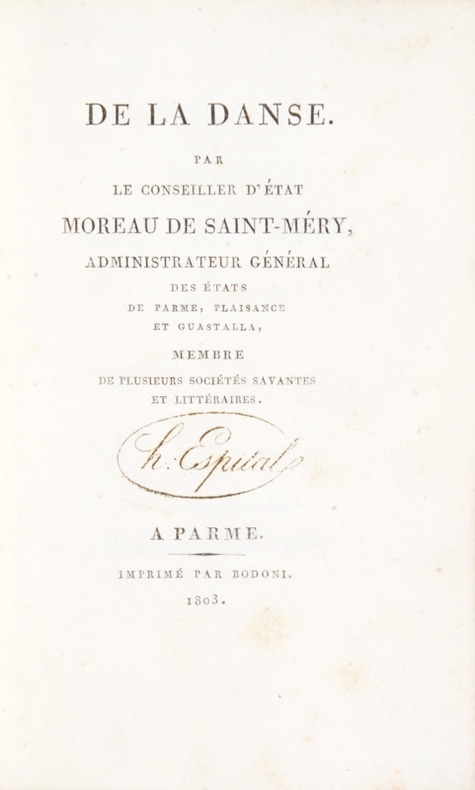
1803ref. 41822A Parme, imprimé par Bodoni, 1803. Petit in-8 de (8)-61 pp. 1 feuillet blanc, basane blonde, dos lisse orné, pièce de titre en maroquin rouge, roulette dorée sur les plats (reliure de l'époque).
1884ref. 41090Blois, Raoul Marchand, 1884. In-8 à pagination multiple (14,5 x 22,5 cm) cartonnage Bradel de soie à motifs de fleurs, dos lisse muet, non rogné (Thiolat, rel. Blois).
1790ref. 21667Constantinople, de l’Imprimerie du palais de France, mars 1790 ; in-4°, demi-veau havane, dos à faux nerfs et titre doré (reliure un peu postérieure); XXXII, 462 pp., [1]f. de Faute à corriger.
ref. ST15039bAMcMinnville Oregon: Phillip J. Pirages 2019. ONE OF 84 COPIES in floral-patterned cloth from a total edition of 165 COPIES. Text: 244 x 154 mm. 9 1/8 x 6 1/8"; Case: 502 x 372 mm. 19 3/4 x 14 5/8". ii 75 pp. Bound in floral-patterned cloth after a Morris design by Amy Borezo who also constructed the case holding the volume and leaves. The book printed letterpress on Zerkall Book Laid Vellum paper by Arthur Larson at Horton Tank Graphics. Book layout by Jill Mann. EACH COPY WITH FIVE LEAVES: ONE FROM THE KELMSCOTT CHAUCER with one or more 10-line initials multiple six- and/or three-line initials AND ONE EACH FROM THE PRESSES OF FOUR GERMAN PRINTERS FROM THE 1470s--PETER SCHOEFFER JOHANN MENTELIN GÜNTHER ZAINER AND ANTON KOBERGER. ◆The incunabular leaves consistently excellent with only minor defects and the Kelmscott leaves which were never part of a bound volume in entirely fine condition. This is a unique leaf book in the way that it combines three elements: a significant private press production involving people at the top of their craft a scholarly commentary that contributes to a further understanding of the history of printing and--most important--five leaves: one from the Kelmscott Press "Works" of Geoffrey Chaucer and four from books issued by German printers at work in the 1470s. The book has been printed and bound by hand by gifted professionals; the essay addresses a topic of significance to typophiles in a considerably more thoroughgoing way than has been done before; and the assemblage of leaves represents a powerful visual reinforcement of the text as well as an opportunity to share in the ownership of four important incunabula along with the extraordinary Kelmscott Chaucer. The story of the production is heavy on serendipity: in the winter of 2012 after purchasing a very incomplete copy of the Kelmscott Chaucer at auction we considered the possibility of producing a leaf book but because the Chaucer--universally considered to be one of the most beautiful books ever printed--had been written about by so many different people in so many different ways we didn't know what aspect was left for us to explore. The one topic we fastened on as thus far inadequately examined is the origin of the work's typeface. We soon learned that Morris who is known to have owned more than 500 incunables most admired--and was consequently most likely to have been influenced in his typographic design by--Peter Schoeffer of Mainz Johann Mentelin of Strassburg Günther Zainer of Augsburg and Anton Koberger of Nuremberg. Over the course of the years succeeding the purchase of the defective Chaucer we were fortunate beyond all expectation to acquire incomplete books from each of these four eminent printers. As a result the present leaf book will allow the reader not only to read in the accompanying essay about the influence on Morris of his typographic forebears but also to compare with his or her own eyes the resemblances between the Kelmscott leaf and the leaves from four centuries earlier. We have additional copies of this binding available at different price points. Please contact us directly for more details. Phillip J. Pirages unknown
ref. ST15039bAMcMinnville Oregon: Phillip J. Pirages 2019. ONE OF 84 COPIES in floral-patterned cloth from a total edition of 165 COPIES. Text: 244 x 154 mm. 9 1/8 x 6 1/8"; Case: 502 x 372 mm. 19 3/4 x 14 5/8". ii 75 pp. Bound in floral-patterned cloth after a Morris design by Amy Borezo who also constructed the case holding the volume and leaves. The book printed letterpress on Zerkall Book Laid Vellum paper by Arthur Larson at Horton Tank Graphics. Book layout by Jill Mann. EACH COPY WITH FIVE LEAVES: ONE FROM THE KELMSCOTT CHAUCER with one or more 10-line initials multiple six- and/or three-line initials AND ONE EACH FROM THE PRESSES OF FOUR GERMAN PRINTERS FROM THE 1470s--PETER SCHOEFFER JOHANN MENTELIN GÜNTHER ZAINER AND ANTON KOBERGER. ◆The incunabular leaves consistently excellent with only minor defects and the Kelmscott leaves which were never part of a bound volume in entirely fine condition. This is a unique leaf book in the way that it combines three elements: a significant private press production involving people at the top of their craft a scholarly commentary that contributes to a further understanding of the history of printing and--most important--five leaves: one from the Kelmscott Press "Works" of Geoffrey Chaucer and four from books issued by German printers at work in the 1470s. The book has been printed and bound by hand by gifted professionals; the essay addresses a topic of significance to typophiles in a considerably more thoroughgoing way than has been done before; and the assemblage of leaves represents a powerful visual reinforcement of the text as well as an opportunity to share in the ownership of four important incunabula along with the extraordinary Kelmscott Chaucer. The story of the production is heavy on serendipity: in the winter of 2012 after purchasing a very incomplete copy of the Kelmscott Chaucer at auction we considered the possibility of producing a leaf book but because the Chaucer--universally considered to be one of the most beautiful books ever printed--had been written about by so many different people in so many different ways we didn't know what aspect was left for us to explore. The one topic we fastened on as thus far inadequately examined is the origin of the work's typeface. We soon learned that Morris who is known to have owned more than 500 incunables most admired--and was consequently most likely to have been influenced in his typographic design by--Peter Schoeffer of Mainz Johann Mentelin of Strassburg Günther Zainer of Augsburg and Anton Koberger of Nuremberg. Over the course of the years succeeding the purchase of the defective Chaucer we were fortunate beyond all expectation to acquire incomplete books from each of these four eminent printers. As a result the present leaf book will allow the reader not only to read in the accompanying essay about the influence on Morris of his typographic forebears but also to compare with his or her own eyes the resemblances between the Kelmscott leaf and the leaves from four centuries earlier. We have additional copies of this binding available at different price points. Please contact us directly for more details. Phillip J. Pirages unknown books
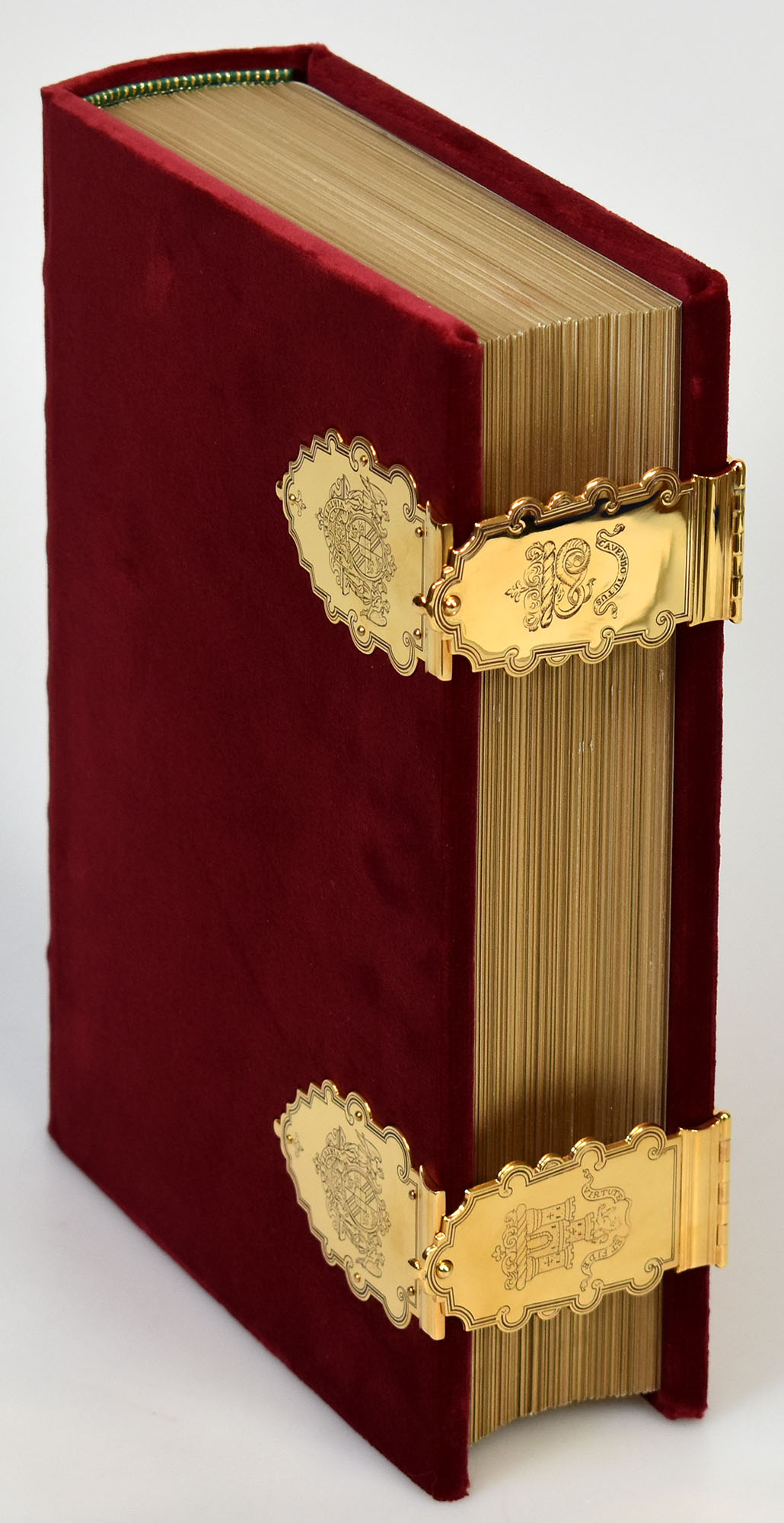
2006ref. 3854FBLuzern, Faksimile-Verlag, 2006. Bände: 28 x 20 cm. Schaukasten: 30,5 x 23 x 13 cm. [578]; 244 Seiten. Original-Samteinbände, der Faksimileband zusätzlich mit 2 vergoldeten Schließen und Rundum-Goldschnitt. Original-Schaukasten aus Plexiglas. [8 Warenabbildungen]
1791ref. 000015094Worcester Massachusetts: Isaiah Thomas 1791. First Thomas edition. Hardcover. Good or better. 4to. 2 3-1310 pp. Contemporary paneled sheep with the spine in six compartments. Illustrated with two engraved frontispieces. Completing the title page: And with the former translations diligently compared and revised by the special command of King James I of England. With marginal notes and references. To which are added an index and an alphabetical table of the names in the Old and New Testaments with their significations. American Antiquarian Society "Isaiah Thomas’s Printing Press: "Old Number One". Darlow and Moule 1353. Isaiah Thomas' printing press first operated out of Boston: producing a newspaper and materials that encouraged American colonists to rebel against the British imperial government. Thomas moved his press to Worcester at the behest of his friends who suspected that it would be impounded by the British authorities. Thomas' Bible was produced in several quarto octavo and duodecimo editions. Darlow and Moule note that Thomas enlisted the help of clergymen and others to compare nearly thirty different editions of the scripture. The Thomas Bible is one of the more attractive productions of early American printing. The clasps largely perished quite a bit of rubbing to the leather's edges. Lacks leaves K3 and K4 the final verses of Maccabees also lacks the endpapers. An armorial bookplate that states "Williams" on the front pastedown an inscription reading Thomas Williams Jr. 1792 on the verso of the Apocrypha title page. Isaiah Thomas hardcover
ref. 51-3724Paris: Paul Dupont & E. Lachaud 1870. Large folio. 57 x 40 cm. Frontispiece of Ferdinand de Lesseps color map and 25 color lithograph plates with printed tissue guards. 100pp. Original gilt cloth professionally restored. . Edition of 500 copies of which 200 were reserved for Isma'il Pasha known as Ismail the Magnificent 1830 – 1895 was the Khedive of Egypt and Sudan from 1863 to 1879 when he was removed at the behest of the United Kingdom. He was miffed at the credit Lesseps received and had this portrait removed from those 200 copies. The album is a collection of watercolors from life following and commemorating the inauguration of the Suez Canal from the ceremonies of 16th November 1869 up to the crossing between the 17th - 20thNovember. . . . Ferdinand Marie Vicomte de Lesseps GCSI 1805 – 1894 was a French diplomat and later developer of the Suez Canal which in 1869 joined the Mediterranean and Red Seas substantially reducing sailing distances and times between Europe and East Asia.Édouard Riou 1833 – 1900 was a French illustrator who illustrated six novels by Jules Verne as well as several other well-known works. OCLC Number: 3784451; Brunet VII 510; Blackmer 611 In plano : 2f. 100pp. ; illustré d'une carte en couleurs et 25 aquarelles d'après nature parRiou lithographiées en couleurs par Eugène Cicéri. Portrait-frontispice de Ferdinand deLesseps . Quelques serpentes légendées déchirées ou avec de petits manques 2planches libres frangées en bordure. Couleurs bien vives papier bien blanc.Percaline violette éditeur dos lisse et premier plat insolés titre en lettres doré sur plat supérieur et décor doré sur dernier plat.Riou exécuta cette série d'aquarelles en marge et pendant les fêtes de l'inauguration du canal de Suez novembre 1869.Fontane fut le secrétaire de Ferdinand de Lesseps et l'accompagna également pendant les travaux de l'isthme de Panama. RIOUélève de Gustave Doré illustra entre autres les ouvrages de Jules Verne et fournit des planches pour Le Tour du Monde. Brunet VII 510;Blackmer 611 L'auteur 1838-1914 est à la fois historien orientaliste journaliste et secrétaire de Ferdinand de Lesseps.En 1854 il devient cadre de la Compagnie du Canal de Suez.Eugène Cicéri a réalisé quelques paysages en Afrique du Nord qui lui valent d'être aussi classé parmi les orientalistes. Seuls 500 exemplaires ont été publiés; parmi ceux ci 200 ont été réservés pour Ismaïl Pacha Vice Roi d'd'Égypte. Il s'est senti insulté par la préface de Fontane qui a accordé tout le crédit de ce projet à de de Lesseps et il a fait retiré de ses 200 exemplaires à la fois le portrait de de Lesseps en frontispice et la préface de Fontane. Paris: Paul Dupont & E. Lachaud, [1870]. hardcover
1653ref. 43711Parisiis, , Typographia Regia, 1653. In-4 à deux colonnes de (64)-884-(58) pp., frontispice, maroquin rouge, dos orné à la grotesque, double encadrement doré à la Du Seuil sur les plats avec fleurons dorés dans les angles, coupes décorées, tranches dorées sur marbrure (reliure de l'époque).
1749ref. 42104Paris, Vaneck, 1749. Titre et 20 gravures sur cuivre (12 x 7,5 cm) frappées par 4 ou 5 sur 5 feuilles (24 x 38 cm).[CHEVILLARD (Jacques)]. Methode facile pour apprandre le blason, ou l'on joint les armes accollees, des Princes, et Princesses Ducs, et Duchesses, et celles des Maisons des plus considerables de France, avec les Explications des ornements exterieurs. Paris, Vanheck, 1749. 71 gravures sur cuivre (12 x 7,5 cm) frappées par 3 ou 4 sur 18 feuilles (24 x 38 cm).Ensemble 2 suites reliées en 1 vol. in-folio, demi-chagrin prune à coins, dos fleurdelisé à nerfs, double filet doré d'encadrement sur les plats (reliure du XIXe siècle).
1681ref. 42869La Correrie, per Laurentium Gilibert, typographum juratum apud Gratianopolim, 1681. In-4 de 348 pp. et (48) pp. d'index (sign. A-Z-Aa-Zz-Aaa-Ccc4, Ddd2), demi-veau havane, dos orné (reliure du XIXe siècle).
(10) Bll. Mit Medaillonportrait Melanchthons am Titel sowie Schlussvignette in Holzschnitt. Papierner Heftstreifenrücken. 4to. Erste Ausgabe der "Klag- und Trostschrift von dem christlichen Abschied und Begräbnis des Ehrwürdigen und Hochgelehrten Herrn Philippi Melanthonis" (wie der Titel der im selben Jahr erschienenen deutschen Ausgabe lautete). - Leichter Wasserrand; im Rand etwas lappig bzw. mit Wurmspuren. Sehr selten; seit 1950 kein Exemplar im Handel nachweisbar. VD 16, M 2167. Hartfelder S. 640, Nr. 337. Knaake II, 899.
8vo. 31, (1) pp. Later blue wrappers. A compact Latin treatise on the ancient medical art of cupping, recorded already in the works of classical medical writers Galen and Celsus. This pocket-size booklet contained everything a doctor needed to know to make use of the technique in mid-sixteenth century Europe. - As typical of humanist medical studies, the anonymous work begins with a brief reflection on the Greek origins of cupping. It then describes the uses of the technique for the extraction of blood and the manipulation of the humours. Already on page 4 the relative safety of the non-invasive procedure is emphasised: "Idque auxilium ut minus vehemens, ita magis tutum". The author then goes on to discuss the various materials used for making the cups or "cucurbitulae" (literally, "little pumpkins" or "gourds"), how to use them, for how long, where in the various areas of the body, and against which ailments they can be employed. Modern readers interested in the history of the use of cupping to reduce pain and inflammation in the lower back will be pleased to see mention of the technique to this end on pp. 27-28. - The book has moderate to severe browning to the edges of the pages thoughout, more pronounced on pp. 11-14 but not affecting the text. On the first and final pages, the cover has formerly become adhesed to the paper, the later removal of which has left marks. The paper cover shows some black staining to the spine; numerous tears in the wrapper reveal frequent use. Rare. BM-STC French 126. Adams D 169. Wellcome I, 1690. OCLC 17534872. Not in Durling.
246, (18) Bll. Mit rot kol. Holzschnitt am rot-schwarzen Titel sowie 2 Textholzschnitten. - (Beigebunden) II: [Fischart, Johann]. Die wunderlichst unerhörtest Legend und Beschreibung des abgeführten, quartirten, gevierten und viereckechten vierhörnigen Hütleins [...]. "Lausanne, Gangwolf Suchnach" [d. i.= Straßburg, Bernhard Jobin], 1580. (23) Bll. Mit Holzschnitt am Titel. - (Vorgebunden) III: Nigrinus, Georg. Fegfeuers Ungrund grüntlich erörtert und außführlich beweiset, mit der H. Schrifft, der Vätter, Concilien und ander Zeugnussen. Auß 14 Leichpredigen D. Jacobi Feuchten Weihbischoffs zu Bamburg [...]. O. O. u. Dr. 1582. (255) Bll. Titel in rot und schwarz gedruckt. Blindgepr. Schweinslederband der Zeit auf 4 Bünden (Bindebänder fehlen). 8vo. Hübscher Sammelband mit drei antikatholischen Polemiken in seltenen Elsässer Drucken. - II: Zweiter Druck dieser deutschen Bearbeitung: eine genaue, umfangreich ergänzte Übertragung des niederländischen "Byencorf" des Philipp van Marnix. "In der Gesinnung angeregt durch Calvin, in der Weltanschauung durch Erasmus, im Stil durch Rabelais" (Neufforge 112f.). Der Titelholzschnitt zeigt einen Bienenkorb in Form der Tiara mit Kirche und Windmühle (dieser Bl. 235v im Text wiederholt), ferner am letzten Textblatt ein weiterer Textholzschnitt, der die Kirche in Form einer Karikatur der "Veritas" verunglimpft. - II: Erste Ausgabe von Fischarts "Jesuitenhütleins", seiner satirischen Reimdichtung gegen die Jesuiten. - III: Einzige Ausgabe dieser Arbeit aus der Feder eines "der gröbsten Polemiker des Jahrhunderts" (Goedeke II, 505). - Titelblatt der Vorbindung mit zeitgenöss. hs. Besitzvermerk des Benediktinerstifts Altenburg bei Horn (Niederösterreich). Durchwegs etwas gebräunt bzw. leicht wasserrandig; zu Beginn mehrere zeitgenössische Marginalien. Der hübsche Prägeeinband etwas berieben; im Ganzen wohlerhalten. I: VD 16, M 1047. Ritter 855. Muller III, S. 586, Nr. 111. Goedeke II, 499, 37b. Graesse II, 587f. Weller (Druckorte) 6. Vgl. Jantz I, 81 (Ausg. 1586). - II: VD 16, F 1163. Muller III, S. 586, Nr. 109. Ritter (IV) 1721. Goedeke II, 499, 40. - III: VD 16, S 4637. Goedeke II, 507, 22.
1589ref. 42498En Angolesme, par l'Aucteur [Olivier de Minières], 1589. Petit in-8 (164 x 105 mm) de 15 pp. (A-B4), caractères italiques, veau fauve glacé, dos lisse orné de fleurons, titre doré en long, triple filet doré d'encadrement sur les plats, tranches dorées (Koehler).
8vo. 192 pp. With woodcut printer's device, headpiece and initial. Contemporary half vellum over marbled boards with faded handwritten spine-title. Second Italian, and second vernacular edition of the celebrated "Epistolae Magni Turchi", a best-selling 15th century literary invention by Laudivio Zacchia of Vezzano. Here translated by the ubiquitous Lodovico Dolce, these letters purport to represent the correspondence of Sultan Mehmet II, the conqueror of Constantinople and Byzantium (still alive at the time of writing), with governors and potentates from Persia to the Mediterranean islands, Greece, and Italy. Through this albeit fictitious collection Laudivio could highlight Turkish/Islamic territorial ambitions, as well as, by implication, political and ethical differences between East and West, not always to the credit of his Christian contemporaries. - A reissue of the 1562 first edition. The little collection proved hugely popular, calling for more than twenty incunabular editions, all now individually rare, and further reprints in the 16th and 17th centuries. - Occasional light brownstaining; lower corner of fol. C6 torn away, affecting a single letter; a tiny marginal paper flaw to fol. M2. BM STC-Italian 455. Göllner 1047. Blackmer 955. Edit 16, CNCE 26436. Tiraboschi, Storia della letteratura italiana III, 177.
8vo. (16), 279, (23) pp., final blank f. Half vellum using a leaf from an antiphonary. First Latin edition of Alessio's "De secretis", still in six books. The author is commonly identified with the alchemist Girolamo Ruscelli (1520-66). "Das Werk gehört nach Caillet zur 'haute philosophie hermetique'. Es enthält außer alchemistischen auch viele kosmetische Rezepte, ferner solche gegen Pest, Schlangengift, Ungeziefer, wie auch Konfekt, Einmachen von Früchten, Druckerschwärze, Putzmittel, Schlafmittel usw., des weiteren sehr frühe Beispiele zur Syphilis-Therapie und Arsenikverbindungen zur Haarvertilgung" (Horn/Arndt). "Une des premières éditions de ces célébres secrets que l'on considère comme merveilleux. Quelques personnes qui ont fait l'essai de plusieurs affirment que les résultats sont prodigieux" (Caillet). Sections on making wine, ink, soap, toothpaste, etc. From 1569 onwards Perna also published a German translation. - Somewhat brownstained and waterstained throughout; a few contemporary marginalia; extensive notes by a contemporary hand on reverse of title-page and at the end. Very rare; no copy in auction records of the past decades. VD 16, R 3835. Durling 110. Wellcome 178. Ferchl 455. Ferguson I, 22 (note). Duveen 15 (note). Cf. Caillet I, 177ff. Rosenthal 754. Graesse (Bib. magica) 50. Simon 33.
4to. (12) ff. (aa-cc4). With large woodcut initial. Papered spine. Rare first edition of this collection of neo-Latin verse. Contains several mentions of Brassicanus's friend Erasmus as well as of Hutten, whose "Nemo" had inspired the present verses (cf. G. Ellinger, Geschichte der nlat. Lit. Deutschlands im 16. Jh., vol. 1 [Berlin 1919], p. 441). - Trimmed rather closely at upper edge, occasionally touching headline. Slightly browned and fingerstained in margins; contemp. shelfmark to title page. Rare; the only copy in the last decades' trade was incomplete (1996: H&H 84, lot 175: DM 1,100 (modern boards, wanting final leaf). VD 16, B 7153. IA 123.888. Benzing 51f., 37. Burg 97. Panzer VI, 90, 536. Proctor/Isaac 11700. Ritter, Rép. 257. Walter 815. ADB III, 260. Not in Adams.
1859ref. 44591Paris, Librairie de France, 1859. In-12 de (4)-228 pp., portrait, maroquin rouge, dos à nerfs orné du bonnet phrygien répété quatre fois, double encadrement doré avec bonnets phrygiens dorés dans les angles, dentelle intérieure, tête dorée, non rogné, étui bordé (Thivet).
Large 4to. (16), 72, 134 pp. With woodcut printer's device on t. p. 17th century vellum with traces of a later blindstamped spine title. Important humanist edition, "the basis for all later editions" (cf. Hoffmann). Part 1 contains the Greek text with Greek marginalia and Latin critical apparatus, part 2 contains the various Latin translations by Frischlin and the learned Estienne himself. - Binding very slightly warped and with insignificant chipping to extremeties. Interior somewhat browned as usual; some brownstaining near beginning. From the collection of the English scholar and football champion Harry Chester Goodhart (1858-95), legendary goal scorer for the Old Etonians in four FA Cup finals and then, until his early death, Professor of Humanities at Edinburgh (his engraved bookplate to front pastedown). Later in the library of the Swedish collector Herbert Vilén (1908-68; his bookplate, designed by Oscar Furuhjelm in 1930, on front flyleaf). IA 129.591. Adams C 232. Renouard 145.3. Moeckli 88. Hoffmann I, 428. Schweiger I, 75.