8294 resultados
1600Broadsheet, c. 385:520 mm. Traces of folds. Mounted on red satin. Rare Vienna meat statutes dated 24 March 1600, regulating the prices of meat in Vienna, the suburbs, and Lower Austria. - Occasional paper defects, otherwise clean and well-preserved.
12mo. (2), 127 (but: 126), (4) ff. Title-page printed in red and black. With hand-coloured woodcut border and vignette to title-page, repeated hand-coloured woodcut vignette on verso of title, and a full-page woodcut coat of arms. 18th century half calf with sparsely gilt spine. Rare, pocket-sized ascetico-mystical manual in the Ars moriendi tradition: one of the several theological works by the German law professor Joachim von Beust (1522-97), who is hailed as the founder of Protestant marriage law in Saxony (1586). An early Lutheran, Beust taught at Wittenberg, but in 1580 bought an estate in Planitz (today part of Zwickau), where he retired in 1593 and also died. He is said to have been buried with a copy of his "Enchiridion de arte bene moriendi" (cf. Jöcher). - One of two variants printed in the same year (VD 16 ZV 1430 is erroneously dated "1590" on the title-page). - Somewhat browned throughout due to paper stock. A pretty copy, hand-coloured on both sides of the title. VD 16, B 2396. IA 118.407. Jöcher I, 1063.
8vo. (8), 216 ff. Stipple-engraved printer's device on title page and several prettily historiated initials. Contemporary blindstamped pigskin on 3 raised bands. Wants ties. Well-printed Paris edition of the "Liber Sextus Bonifacii", the collection of medieval canon law that formed the third part of the Corpus Iuris Canonici. One of the last productions from the press of the Parisian stationer, printer, and bookbinder Claude Chevallon (1479-1537). - Early ink ownership "Joan. Christoph Schwarz" to title page and notes to final flyleaf. Wants first flyleaf; upper pastedown shows traces of a removed bookplate. Some browning; corners wrinkled; a few thumb indexes torn out. The blind-stamped roll tools on the binding are signed "H.S.", possibly with the date "[15]14" (not recorded in Haebler). This edition not in Adams or BM-STC French.
(12) SS. Mit Titeleinfassung in Holzschnitt; Text ebenso durchgehend von Holzschnittbordüre eingefaßt. Papierner Heftstreifenrücken. 4to. Seltenes Festgedicht auf die Geburt der Dorothea von Sachsen (1591-1617, später Äbtissin von Quedlinburg), Tochter des Christian I. von Sachsen und der Sophie von Brandenburg. Am Schluß ein dreiseitiges Gedicht auf das Erdbeben vom 5. September 1590, das Ostmitteleuropa von Österreich bis Sachsen erschütterte. - Der Theologe und Humanist Johann Major (1533-1600) aus St. Joachimsthal studierte in Wittenberg und wurde 1558 in Frankfurt am Main zum Poeta Laureatus gekrönt. "Die kryptocalvinistischen Streitigkeiten führten ihn auf die Seite der Philippisten, als deren eifriger Vertreter er die Lutheraner heftig befehdete, sein Spott erging sich gegen sie besonders in satirischen Gedichten [...] Wegen seiner beständigen Befehdung der Concordienformel verwies man ihn 1586 von der Wittenberger Universität. Dank dem in demselben Jahre eingetretenen Thronwechsel durfte er zwar wieder zurückkehren, wurde aber als Kryptocalvinist 1591 von neuem eingekerkert. 1593 erscheint er wieder auf freiem Fuße und verlebte seine letzte Lebenszeit als Privatmann" (ADB XX, 111). - Wohl einem altem Sammelband entnommen; am Titel alte hs. Numerierung "12". Papierbedingt gleichmäßig gebräunt; gutes Exemplar. VD 16, M 305/306.
Small 4to (160 x 105 mm). 19 ff., plus 1 integral blank, signed A-E4. Woodcut printer’s device on title-page. Bound in late 19th century marbled boards with gilt title label on spine. Slightly foxed; a few traces of humidity to upper corners, otherwise good. Very rare first edition of this funerary oration and poetic tribute to Marie-Élisabeth, Princess of France, who died aged 5 of unknown causes on 2 April 1578. Although barred by Salic law from inheriting the throne in her own right, as the only child of Charles IX and Elisabeth of Austria, she embodied a formidable consanguinity among European noble houses. Her maternal grandparents were Maximilian II, Holy Roman Emperor and Maria of Spain, and her paternal grandparents were Henry II of France and Catherine de' Medici. Rounding off this Valois, Habsburg, and Medici parentage, her godmother was none other than the Protestant Elizabeth I of England. - When Marie-Élisabeth was just two years old, her father died; her mother returned to the Habsburg court in Vienna shortly thereafter, leaving her mainly in the care of her aunt, Marguerite de Valois, wife of the new king Henry IV. Sorbin thus dedicates the present work in four pages to Marguerite, before choosing as his Biblical starting point Lamentations II, 13. He naturally praises the princess’ illustrious ancestors and gives examples of historical parallels to her untimely death; following this is a 4 page poem ‘Tombeau de Madame Marie Isabeau de France…” which prays for the soul of the dead girl while simultaneously demanding an end to France’s civil strife. - OCLC shows just 1 US copy, at the Newberry; COPAC shows no copies in UK libraries. Pettegree, French Vernacular Books 48338 (erroneously suggesting an earlier edition of 1577 as 48333); on the preface to Marguerite de Valois, cf Vons, Jacqueline, “Dédicace de l’Oraison funèbre et Tombeau de Marie-Élisabeth de France (1572-1578)”.
1786ref. 4986DBA Vevey, Chez l'auteur, 1786. 4°. (1) Bl., VIII S., (488) S. Pappband der Zeit.
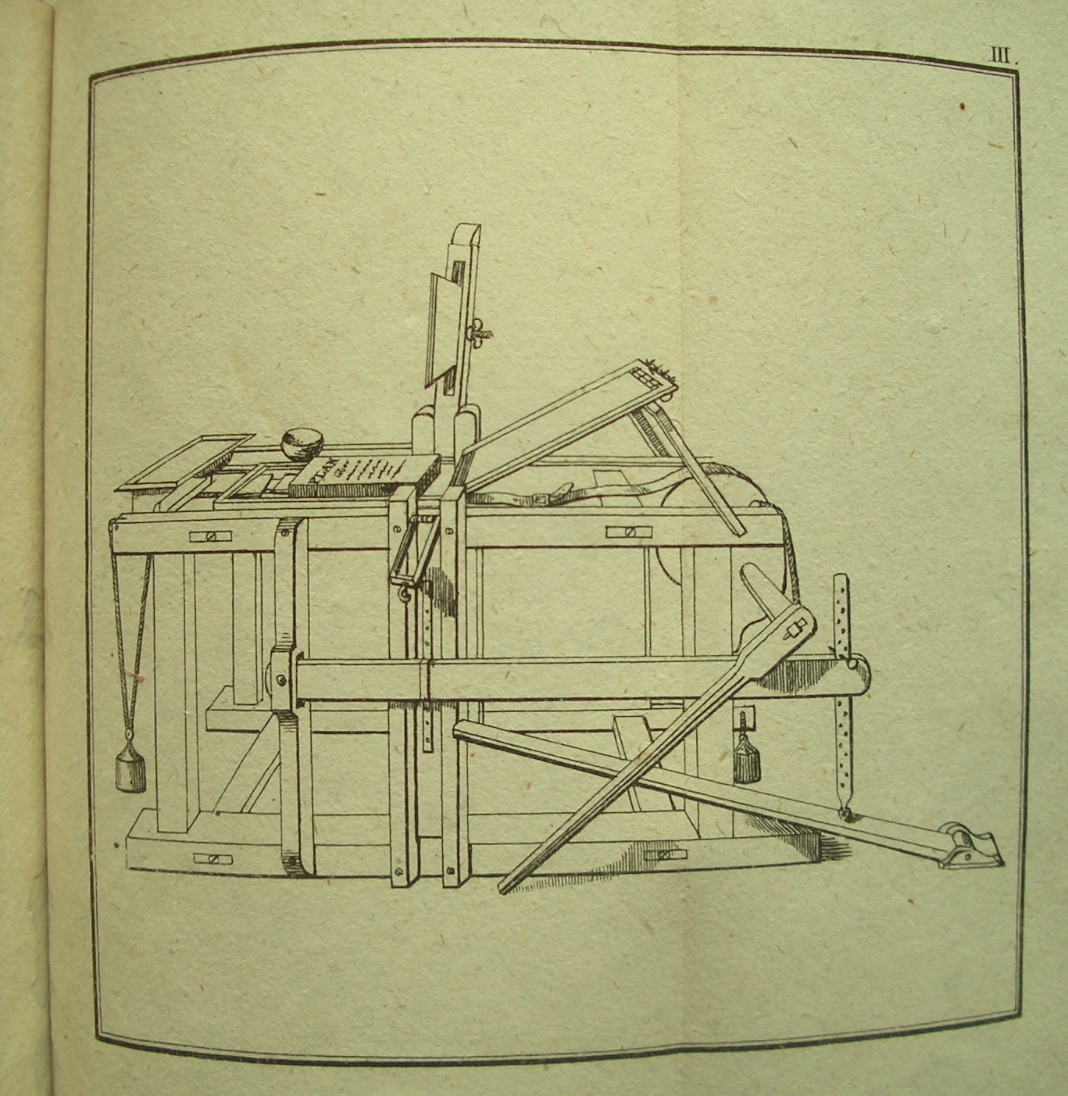
First Edition, 2 vols., 4to, [ii], vi, 152; [ii], vi, 88, 40, [148], [4]pp., engraved frontispieces, 8 engraved plates, 27 folding tables, wide-margin copy, some light worming to inner margins (not effecting text), orig. marbled paper wrappers, unopened, uncut, a very nice set. "Arranged as a dictionary, defining printing terms and containing much practical matter. A collection of diagrams and folding sheets shows presses and tools, type-founding utensils and moulds, type-specimens, case-lay, and imposition. Several poems in praise of printing precede a form of ceremony for reception of a new member of a printers' guild."?A List of Printers' Manuals to 1850. JPHS, No. 4, 1968. Without the third volume which was published four years later in 1809. Bigmore & Wyman, III, p.2.
First edition, 8vo (230 x 145 mm), vii, [2], vi-xxviii, 427, [1]pp., some light spotting, rebound in half calf, marbled boards, spine gilt, morocco title label. William Yates (15 November 1792 - 3 July 1845) was an English Baptist missionary and orientalist. After joining the Baptist Missionary Society he sailed for India and arrived in Calcutta in 1815. From there "He continued to Serampore to join William Carey (1761?1834), who had been sent out by the same society in 1792, and under his direction began to study Sanskrit and Bengali. Almost immediately he began to help with the mission's publications."?(Oxford DNB.)
1866Five volumes, complete. FIRST EDITION of the poems of Prosper Blanchemain, BEAUTIFULLY PRINTED FOR THE SOCIETE DES BIBLIOPHILES FRANCOIS (founded 1820), the first and greatest of all French bibliophile societies, of which Blanchemain was a member. Edition limited to 55 numbered copies, of which this is ONE OF 29 COPIES PRINTED ON FINE DUTCH LAID PAPER FOR THE 29 MEMBERS OF THE SOCIETE DES BIBLIOPHILES. This copy printed for noted bibliophile Count Henry de Chaponnay. Large 8vo. Beautifully bound in half havana morocco and marbled boards. Vicaire I, 815-6. The SociÈtÈ des Bibliophiles had only 29 members (including five "associÈs Ètrangers" and each member got only one copy of each of its publications. Thus members' copies, like this one, appear on the market very rarely. A stunning example of fine printing and fine binding.
1939First and only edition. THE EXTRAORDINARILY RARE FIRST PUBLICATION (of a grand total of two) OF THE SOCIETE DE BIBLIOPHILES "LES PLAQUETTES", AN OUTSTANDING EXAMPLE OF FRENCH PRE-WAR FINE AVANT-GARDE TYPOGRAPHIC PRINTING. 2 blank leaves; 27 pp. This bibliophile society was conceived by Gaston-Louis Vuitton in 1929, and by 1932 it had 57 members but hadn't yet published anything. In that year it lost all of its funds when its bank went belly up. The Society got rolling again in 1938, and finally printed this gorgeous book in 1939. The text, of course, is about booklets, and their history in France and in the world. Shortly after this book was printed World War II and the German Occupation put a final end to this Bibliophile Society: its only other publication was an equally rare edition of St Francis' "Cantique du soleil", printed in 1943. (Fleuret died in 1945.) Notable avant-garde typographical design on cover. Edition limited to 111 numbered copies (but much rarer, as few if any copies were ever actually distributed to the members of the SociÈtÈ) beautifully printed with huge margins on fine Montval laid paper. Folio. Publisher's wraps. UNCUT AND UNOPENED, FINE AND BRIGHT, LIKE NEW WITH NO DEFECTS. Original paper knife laid in. An incredible survival, even more so in such pristine condition. The only copy in WorldCat is the one in the BibliothËque Nationale.
1847FIRST EDITION OF THE ALLITERATIVE MORTE ARTHURE, one of the great monuments of Arthurian literature and of Medieval English literature. This poem, like Gawain and the Green Knight, is part of the late Medieval literary movement now called the "alliterative revival". According to Larry Benson, the most recent editor of this poem, the Alliterative Morte Arthure "lacks the delicacy and balance of Sir Gawain and the Green Knight, but the vigor of its narrative, the epic sweep of its action, and its coolly realistic presentation of fourteenth-century warfare lend the poem an interest of its own." EDITION LIMITED TO JUST 75 COPIES, each numbered and signed by the printer, of which THIS IS ONE OF ONLY 50 COPIES PRINTED ON THIN PAPER. Beautifully printed in large, attractive type on fine wove paper, with large margins. Frontispiece engraving by F. W. Fairholt after a manuscript miniature depicting the Round Table. Large 4to. Bound in original cloth, beautifully decorated in blind. Uncut. Professionally recased, with original endpapers preserved. Frontispiece discolored (as always, because of paper used) and a bit stained. Otherwise FINE AND BRIGHT. A legendary rarity, in its original binding. Extremely rare and important. sxxi
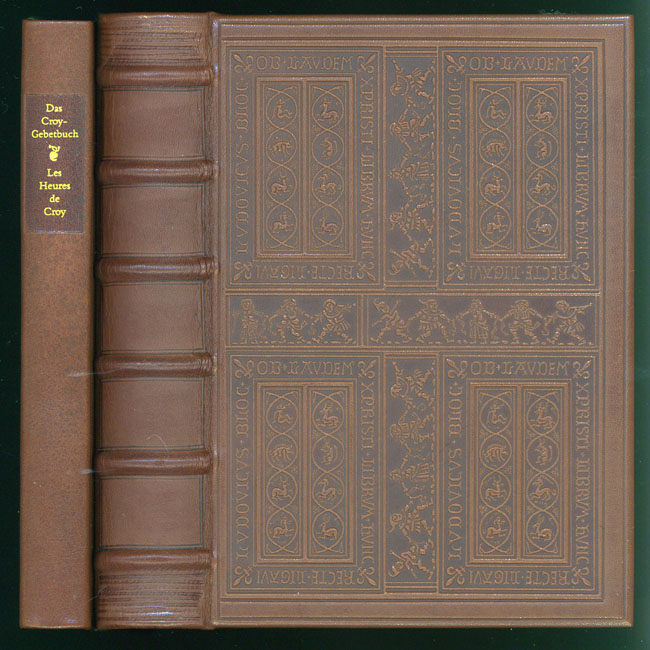
1993ref. 57567BBLuzern, Faksimile-Verlag, 1993. 8°. 21 cm. 182 Blatt, 316 (2) Seiten. Faksimile in braunem, blindgeprägtem Ganzlederband mit Rundumgoldschnitt. Begleitband in Halbleder mit goldgeprägtem Rückentitel. Zusammen in Acrylglasschuber.
1930Very rare first printing copy of Alison Uttley's second book. Reading copy only. Average wear externally with backstrip missing. Child's lead pencil scribbles and lettering upon front board else unmarked. Average wear and soiling to contents. Back hinge open. One-inch openings at head and tail of front hinge. Hairline opening in binding at page 48. With restoration this copy will be a prized possession. Book
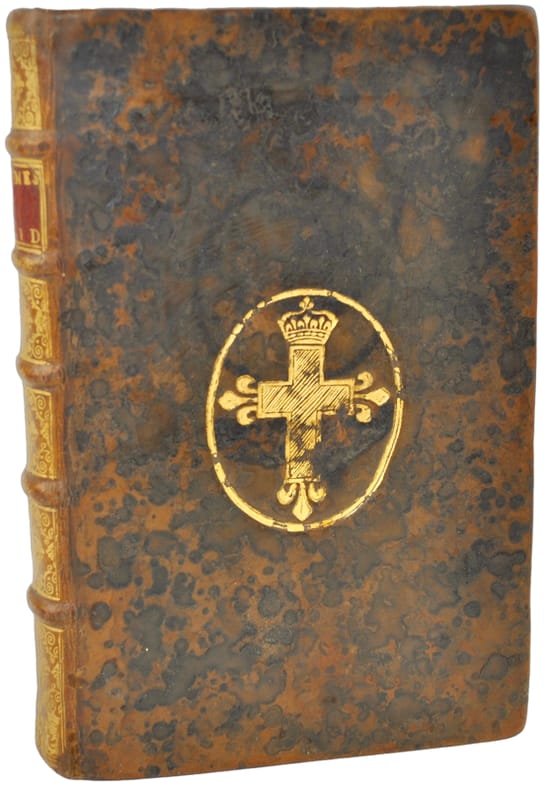
1686ref. 42484Paris, André Pralard, 1686. In-8 à trois colonnes de (24)-530-(22) pp., tables, veau brun granité, dos orné à nerfs, pièce de titre en maroquin rouge, armorié en son centre de la croix de Saint-Cyr (reliure de l'époque).
1683ref. 14992La Correrie, Laurens Gilibert, 1683. 3 parties en 1 vol. in-8 de (8)-191-(5) pp. 93 pp. 95-(1) pp., tables, veau brun, dos à nerfs, triple filet d'encadrement sur les plats, tranches rouges (reliure de l'époque).
1802ref. 15330Paris, Baudouin, Renouard, 1802. In-8 de (4)-138 pp.CAMUS (Armand-Gaston). Histoire et procédés du polytypage et de la stéréotypie. Paris, Baudouin, an X (1802). In-8 de (4)-135 mal chiffré 335 pp. et 6 hors-texte. 2 pièces reliées en 1 vol. in-8, basane racinée, dos lisse orné, pièce de titre en maroquin rouge (reliure de l'époque).
1828ref. 42654Paris, A. Mesnier (Excudebat Didot natu Minor), 1828. In-32 (80 x 50 mm) de VIII-229 pp., demi-maroquin violine à petits coins, dos lisse orné, non rogné (Relié par Lesné).
ref. 223108S.l. [Paris], s.d. (1777-78) 3 textes en deux vol. in-8, 40 pp., 31 pp. ; 75 pp., basane bordeaux, dos lisse (reliure moderne).
1587(104) Bll. Titel in rot und schwarz. Schwarz gefärbter flexibler Pergamentskriptband der Zeit auf 3 durchzogenen Bünden mit goldgepr. Deckelfileten, Eckfleurons und Ornamentstempel an den Deckeln sowie hs. Rückenschildchen. Bindebänder fehlen. 4to. Seltene Druckvariante der Erstausgabe mit rot-schwarz gedrucktem Titel. Über VD 16 nur 3 Exemplare dieser Variante nachweisbar (Göttingen, Jena, ÖNB). - Offizielle Gegendarstellung des Augsburger Rates zur im Vorjahr erschienenen Schrift "Augspurgische Händel" des ehemaligen Augsburger Pastors und Superintendenten Georg Mylius (eigtl. Müller, 1548-1607). Die Stadt wehrt sich gegen die darin erhobenen Vorwürfe und rechtfertigt die Ausweisung des protestantischen Theologen: Mylius hatte sich, als Papst Gregor XIII. 1582 den gregorianischen Kalender verordnete und Augsburg aus Kaisertreue die Reform übernahm, an die Spitze der örtlichen protestantischen Widerstandsbewegung gestellt, die den neuen Kalender zumindest für das Kirchenjahr boykottierte. "Darüber erbost, ließ der [Augsburger] Senat [Mylius] durch Bewaffnete aus der Stadt bringen, aber die Bürger befreiten ihn und führten ihn im Triumph zurück. Doch wurde er gezwungen, am 28. Mai 1584 die Stadt zu verlassen. Mylius wandte sich nach Ulm, wo er freundliche Aufnahme fand [...] Im Juni 1585 [folgte er] einem Rufe als Prediger und Professor in Wittenberg" (ADB 23, 143). Verfasser ist lt. Holzmann/B. der Augsburger Jurist Georg Tradel (1530-98; vgl. Jöcher IV, 1291). - Hinterdeckel und letzte Bll. mit kl. Wurmgang. Titel mit alter hs. Datierung "1637". Rücken mit Spuren alter Kalkung; das ursprüngliche Frakturmanuskript, dessen Tintenlettern mit der Einbandschwärzung reagierten, nunmehr negativ wieder sichtbar, wodurch der Band eine ungewöhnliche, sehr charakteristische Gestalt gewinnt. VD 16, ZV 875. BM-STC German 51 (ohne Variantenunterscheidung). Holzmann/Bohatta II, 5559. Vgl. OCLC 65517149 (nur Mikrofilm). Nicht bei Adams.
1539ref. 12105Basilae, [Robert Winter], 1539. In-8 (100 x 155 mm) de 13-(2) pp. 1 p.bl. (640) pp. (∂8, a-z8, A-R8), peau de truie sur ais de bois estampée à froid, portraits couronnés en encadrement, dos à 3 nerfs (reliure de l'époque).
1821ref. 000071Paris Desoer 1821
1829ref. 4168Nebst praktischer Anweisung bei verschiedenen Manieren in der Steindruckerei etc. für Steinbereiter, Steinzeichner, Steindrucker und Liebhaber dieser Kunst. Aus dem Französischen. Zweite vermehrte Ausgabe. Mit 19 Abb. auf 6 gefalt. lithograph. Tafeln. Ulm, J. Ebner, 1829. Klein-8vo. (14,8 x 8,9 cm). 160 S. (ab S. 156 Anzeige). Marmorierter Halblederband d. Zt. [4 Warenabbildungen]
1900ref. 11031Paris, Imprimerie Nationale, 1900-1914. 29550 g 4 volumes in-folio, en feuilles sous portefeuilles, [1] fb., [5] ff., xxiv-490 pp.; [2] ff., 572 pp.; [3] ffb., [3] ff., 550 pp., [3] ffb.; [1] fb., xxvii-528 pp.. Illustré de 36 planches hors-texte dont 35 en couleurs et une sur double-page en noir; et d'innombrables fac-similés in-texte. Exemplaire dont les trois premiers volumes sont imprimés sur vélin et le dernier sur japon; et qui contient de plus un fascicule de présentation de [6] ff. et une carte de visite d'Arthur Christian, directeur de l'Imprimerie Nationale. Le quatrième tome, est paru en 1914, après la mort d'Anatole Claudin, et a été achevé sous la direction de Léopold Delisle et de Paul Lacombe. La publication de cet ouvrage fondamental et monumental est restée inachevée. Rare ensemble. Des rousseurs, salissures et restaurations aux portefeuilles. . (Catégories : Imprimerie, Bibliographie, )
1690ref. 42054La Correrie, Claude Faure, 1690. 2 parties en 1 vol. in-8 de (12) pp. (lettre-préface et table) 343-(3) pp., veau brun orné à froid, dos à nerfs, double encadrement et fleurons sur les plats, tranches rouges (reliure de l'époque).