Münster, Sebastian.MareMagnum

8200 resultados
(366 [statt 368]) Bll. (fehlen die Bll. Z1, Z8 der letzten Lage). Mit Holzschnittdruckermarke am Titel. Neuerer blindgepr. brauner Lederband. 8vo. In maßgefertigter Leinenkassette. Zweite, ergänzte Ausgabe von Münsters erstmals 1523 herausgebrachtem hebräischen Wörterbuch. "Münster begann die Reihe seiner Heidelberger hebräischen Schriften, die übrigens fast ausnahmslos bei Johann Froben in Basel gedruckt wurden, mit dem später oft überarbeiteten und neu aufgelegten Dictionarium hebraicum (1523). Drei Handschriften von 1510, 1511 und 1521 gingen voraus; eine vierte Handschrift, die dem Druck zugrunde lag, ist verlorengegangen" (Burmeister, S. 11). "Bereits 1525 erschien eine weitere Auflage, die von Münster auf den neuesten Stand der Forschung gebracht worden war, indem er das Wörterbuch aus verschiedenen perûshim und vor allem aus der 1523 in Venedig erschienenen qônqôrdansijâ des Rabbi Isaak Nathan erweiterte. Darnach erlebte es noch zahlreiche Auflagen und Erweiterungen und ist über 40 Jahre lang das bedeutendste hebräische Wörterbuch in Deutschland geblieben. Zu seiner Beliebtheit hat beigetragen, dass das Buch kurzgefasst war, handlich und mit seinem Preis von 15 Schillingen einigermaßen erschwinglich war, sich also für den täglichen Gebrauch durch Studenten und Theologen vorzüglich eignete" (Burmeister, Biogr. Gesamtbild, S. 41). - Zahlreiche Marginalien der Zeit von verschiedenen Händen; am alten fliegenden Vorsatz theolog. Notiz des 17. Jhs. ("Theòs phthánei toùs taxeîs [...] Deus antevertit celeres [...]"). Durchgehend etwas wasserrandig bzw. wurmspurig; fachmännisch restauriert und angerändert. Es fehlen 2 Bll.: 2 SS. Text sowie das Schlussblatt mit der Druckermarke verso. Selten; nur 3 Nachweise über VD 16 (UB München, Trier, Wolfenbüttel). VD 16, M 6659. Burmeister 18. Panzer VI, 250, 583. Steinschneider (Hdb.) 1384.2. Hantzsch 228.3. Fürst II, 407. Graesse IV, 622. Adams M 1922. BM-STC German 633.
1564Folio. (416) ff. Hebrew type, 4 cols. With woodcut printer's device on title page. 17th century calf with gilt spine and cover rules; gilt Jesuit device to cover. Edges tinted yellow. Rare second Venetian edition of the first Hebrew Bible concordance (first published by Bomberg in 1523), with a new Latin dedication to Maggio Parentini. Words are arranged etymologically by roots and stems; the order of the books follows that of the Vulgate. The Arles-born Rabbi Isaac Nathan ben Kalonimus (fl. 1400-48) compiled the work commonly referred to as "Meir Nativ" ("Light of the Way") between 1437 and 1447 with the twofold aim to facilitate the study of Biblical exegesis and to keep Jews who had converted to Christianity from misquoting the Bible in religious controversies (cf. Jewish Encyclopaedia). Nathan himself moved in Christian scholarly circles and participated in theological disputations with his Christian colleagues. Notably, he based his present concordance on a work compiled by the Franciscan Arlotto de Prato. Occasionally (as here) the book is falsely attributed to Isaac's nephew Mordechai Nathan. - Text ruled in red throughout; the edges' yellow paint has seeped into the margins in places. Title page somewhat brownstained; a few corner defects early on, otherwise very clean and largely unbrowned. Ms. ownership of the Jesuit college at Chambéry (Savoy), dated 1585, on title (and repeated on last leaf but one); old stamp and long bibliographical note in French (c. 1900). Binding somewhat rubbed; spine professionally repaired. No copy in U.S. libraries. Adams B 1953. BM-STC Italian 104. Steinschneider 5399.3. Fürst III, 22. OCLC 257608293. Not in Edit 16.
1546(26) Bll. (d. l. w.), CXXXII Bll. Titel in rot und schwarz gedruckt. - (Beigebunden) II: Gerichtlicher Process, in welichem die gemainen weltlichen unnd gaistlichen Recht [...] verdolmetschet seind. Ebd., 1548. (12), XCVII Bll., l. w. Bl. - (Beigebunden) III: Der Lehenrecht kurtze und aygentliche Verteütschung [...]. Item ain gerichtliche Practica aller Malefitz oder peinlichen Sachen [...]. Ebd., 1549. (6), XLI Bll., l. w. Bl. (2. Teil mit eigenem Titelblatt:) Von Straff unnd Peen aller unnd yeder Malefitz Handlungen [...]. Ebd., 1549. (4), XXIV SS. - (Beigebunden) IV: Sum[m]a Rolandina. Ebd., 1548. (10) Bll. (d. l. w.), LIX Bll. (ohne das l. w. Bl.). Blindgepr. Schweinslederband der Zeit über Holzdeckeln mit abgeschrägten Deckelkanten. Reste von Schließen. Folio. Vierte bzw. (II und III) fünfte Ausgabe. Das erstmals 1544 posthum herausgegebene Rechtsbuch des bayerischen Juristen Perneder (um 1500-1543) wurde, mit immer neuen Anhängen vermehrt, zum führenden Lehrbuch seiner Zeit. "Perneders 'Halsgerichtsordnung' war bis in das 17. Jh. hinein die in Deutschland maßgebliche Strafrechtsordnung. Alle seine Schriften wurden seit 1544 nach teils ungenauen Abschriften und Manuskripten vom Ingolstädter Professor Wolfgang Hunger herausgegeben" (DBE). Die ADB zählt 21 Ausgaben dieser von Hunger mit Einleitungen versehenen "vielgebrauchtesten und besten Schriften popularisierender Richtung; sie sind [...] der erste Versuch eines in der Praxis wohlbewanderten Mannes, einheimisches und ausländisches Recht in einem der Legalordnung verwandten System zu verbinden" (ebd.). - Titel mit kl. Tintenstiftspuren. Gegen Ende mit Wurmspuren im w. Rand; letzte Bll. mit Wasserrändern und Papierdurchbrüchen bzw. kl. Eckfehlstellen im w. Rand. Der blindgepr. Einband mit kl. Wurmspuren und roten Anfärbungen am Vorderdeckel. Über die verwendeten Rollenstempel (Auferstehung - David - Paulus: Haebler I, 279, 7; Crucifixus - Eherne Schlange - Sündenfall - Auferstehung: Haebler II, 32, 6) möglicherweise um 1556 zu datieren und dem Dresdner Buchbindermeister Balthasar Metzger zuzuschreiben. VD 16, P 1496; P 1480; P 1513; R 2939. Stalla 218; 251; 265f.; 252. BNHCat P 328 (nur I). ADB XXV, 386. Vgl. Sauer & Auvermann (Kat. Europ. Rechtsgesch.) 1760 (nur Ausg. v. 1592). Alle nicht im OCLC. Nicht bei Adams oder BM-STC German.
(16), 269, (3) SS. Mit ganzseitigem Wappenkupfer, reich koloriert und goldgehöht vor grünem, hellgrün und golden ornamentiertem Grund. Lederband der Zeit mit reicher Deckelgoldprägung und ovalem Mittelornament; der Rücken mit sparsamer floraler Vergoldung. Dreiseitiger ziselierter Goldschnitt. Schließbänder fehlen. 4to. Einzige Ausgabe. - Auseinandersetzung der westfälischen Ritterschaft mit den bischöflichen Kanonikern um die Frage der sog. Erbmänner (Inhaber einers Erblehens). - Titel mit Randläsuren und Restaurierungsspuren; durchgehend etwas gebräunt. Untere Einbandkanten etwas lädiert. Das manchen Varianten (VD 16, ZV 26099) fehlende Kupfer mit den Wappen der Schencking, Bock, von der Wyck und Bischoping im prächtigen, außerordentlich fein ausgeführten Originalkolorit, deutlich sorgfältiger als im Vergleichsexemplar der BSB München (4° J.publ.g. 1023t). VD 16, S 2636. Schottenloher (Regensburg), 319.
Sammelband with 3 rare religious treatises, contains a series of prophecies attributed to Joachim of Fiore (12th ct.), as well as apocalyptic visions of the Franciscan friar Johann Hilten (15th ct.) in a protestant pamphlet by Andreas Engel, and finally a collection of songs and rhetorical figures by the protestant humanist Giovanni Bernardino Bonifacio (16th ct.) - Content: Present Sammelband starts with the Bertoni bilingual (Latin, Italian) edition of the »Vaticinia«, that assembles 34 elaborate full-paged engravings depicting portraits of popes in the middle of allegoric, seemingly bizarre scenes showing (pseudo-)prophecies related to them. The engraving title page shows a portrait of Fiore in the centre. The 2nd volume contains a tendentious comment of Brandenburg clergyman and historian Andreas Engel (named Angelus) of apocalyptic visions by Franciscan friar Johann Hilten, who was claimed by the protestants to have been their predecessor in the 15th ct. Engel also quotes prophecies about the fall of Papacy and of the Ottoman Empire. Finally the 3rd volume contains a collection of religious songs and rhetorical figures (epigrams, paradoxa) by the protestant Italian humanist Giovanni Bernardino Bonifacio (16th ct.), founder of the Danzig city library, edited shortly after Bonifacio's dead by Andreas Welsius. - Condition: Spine professionally restored at joints. Title page of »Vaticinia« (1) enforced at margin, one engraving with annotatios made with ink, inside in parts slightly finger and time-stained as well as minimally foxy. Bookblock cut uniformly by the binder, 3rd part with tight cut and therefore minimal loss of pagination at two leaves. - Holdings, Rarity: VD16 quotes 4 copies in Germany for »Miscellanea hymnorum« (Dresden (SLUB), Halle (ULB ), Göttingen (SUB), Wolfenbüttel (HAB), WorldCat/OCLC another additional two copies worldwide (BnF, BL); the same for »Weissagungen«: 5 copies in Germany (Dresden (SLUB), ULB (Halle), Göttingen (SUB), Weimar (HAAB), Wolfenbüttel (HAB) and one copy in Solothurn according to VD16 and WorldCat/OCLC. - References: (1) VD16 O 899; Adams J214; Hohenemser 178. (2) VD16 ZV 5013; Hohenemser 174; Volz, Hans: "Hilten, Johann". In: Neue Deutsche Biographie 9 (1972), S. 164 f. (Hilten). (3) Index Aurelianus 121.965.
8vo. (64) pp. With woodcut printer's device on verso of final leaf. Bound with numerous blank leaves. Contemporary vellum. First edition. "Decalogue with the commentary of Aben Esra [...]. Leaves d7-d8 contain the Aramaic text of the Ten Commandments [...]. Re-issued in 1559 by Sebastian Lepusculus" (cf. Burmeister, pp. 11; 111). The "synoptic word-for-word translations" of Biblical texts which Münster published during his Heidelberg years is a characteristic of his scheme of a "Propagatio linguae sanctae", to spread the knowledge of Hebrew at German universities (cf. Burmeister, p. 11). - Occasional insignificant waterstaining. Old ms. ownership of the Vienna Jesuits to title page; stamps of Vienna University Library and of Kubasta & Voigt, Vienna (c. 1900). VD 16, B 3018. Burmeister 145. Hanztsch 244.I.1. Prijs 29. Panzer VI, 260, 662. Fürst I, 252. Steinschneider (Bodl.) 681.8. Vinograd, Basle 28. Graesse I, 4. Yudlov, Ginzei Yisrael 1859. OCLC 311420175. Not in BM-STC.
1654ref. 42819Imprimés au Chasteau de Richelieu, A Paris, Pierre Le Petit, Henry Le Gras,, 1654. Petit in-8 (139 x 85 mm) de (8)-211-(5) pp. (sig. ã4, A-O8, feuillet blanc L8).[DESMARETS DE SAINT-SORLIN (Jean)]. Le Combat spirituel ou de la perfection de la vie chrétienne, traduction faite en vers par J. Desmarets. Imprimés au Chasteau de Richelieu, A Paris, Pierre Le Petit, Henry Le Gras, 1654. Petit in-8 de (8)-57 pp. (A-C8, D5).Les deux pièces reliées en 1 vol. petit in-8, maroquin rouge, dos lisse orné, encadrement de roulettes dorées sur les plats, filet doré sur les coupes, dentelle intérieure, tranches dorées (relié vers 1810).
1605ref. 40266Limoges, Jacques Barbou, 1605. In-16 de 130 pp. chiffrées 30 par erreur (sign A-H8, I1), trigramme IHS sur le titre, vélin souple (reliure de l'époque).
1558ref. 40083Toulouse, [Guyon Boudeville, pour] Antoine André, 1558. Petit in-4 (18 x 14 cm) de (12)-321-(1) pp. (sign. aa6, A-Z4, AA-QQ4, RR5), demi-chagrin rouge, dos à nerfs, non rogné (reliure du XIXe siècle).
Folio (215 x 306 mm). (24), DCXV, (1) pp. Title printed in red and black. With 46 woodcut illustrations in the text (3 double-page-sized, including 11 portraits) and a folding map of Hungary. Contemporary full vellum with handwritten spine title. First edition of this fundamental historical work. The lawyer and historian Adam Henricpetri (1543-86) covers the events accompanying the end of the reign of Holy Roman Emperer Charles V. and the beginning of his brother Ferdinand I.'s reign over a period of seven years, from 1555 to 1561. The volume is considered a prominent example of 16th century historiography and the fact that the author was a contemporary of Charles V. makes it all the more authentic. Each book treats one year and informs the reader not only about the history of the Holy Roman Empire but also about Italian, French, Spanish, Hungarian, Danish, Swedish, Polish, Russian, Indian and Turkish history. The woodcut illustrations show, among other scenes, the long procession taking place for Charles V.'s funeral service in Brussels. The highlight of this service was a grand allegorical ship representing all of Charles' merits, which is shown as a double-paged illustration. The woodcuts also include a scene from the Spanish Inquisition, the Parisian parliament, some views of European cities and portraits of important persons. - Ownership by Joh. Pet. Baikes, dated 1883. - Variously browned, slightly stained, otherwise in excellent condition. - From the library Werner Habel, with his ownership stamp to flyleaf. BM-STC German 392. Nicht bei Adams.
1787ref. 002012Paris Imprimerie de Didot l'Aîné 1787
1855ref. 66671855 "Historica Monumenta Lugduni Lugdunensis historiae monumenta, sive Diplomata, chartae, leges, epistolae, testamenta aliaque instrumenta ad res lugdunenses spectantia. - Lugdunensis historiae monumenta, inde a colonia condita usque ad saeculum quartum decimum"Lyon imprimerie d'Aimé Vingtrimier . 1855. Suivi (dans le même ouvrage du même auteur) : Musée lapidaire de la ville de Lyon Paris chez Durand Libraire1859 Tres important volume in folio Monfalcon ,Jean-Baptiste , 482 pages plus table ( 14 pp)En fin de volume un plan depliant de la ville de Lyon Interressante reliure signée Quire, dos à 5 nerfs decor doré, plats avec filets, aux armes de la ville, toutes tranches dorées. Parfait état . Photos supplémentaires sur demande .Trés rare dans cette édition originale : 1855, 100 exemplaires : l'auteur explique dans un préambule l'épopée vecue, pour decider ce projet ...
8vo. (196) pp. (a-l8, m10). With 2 different woodcut devices. Modern vellum using old material; ties. In custom-made cloth slipcase. Grammatical treatise by Elia Levita, edited with a Latin translation by Sebastian Münster. - Slightly brownstained throughout; trimmed somewhat closely. Slight worming near end in the blank margins, repaired. VD 16, E 999. Burmeister 155. Panzer VI, 259, no. 658. Fürst II, 240 & 407. Steinschneider (Bodl.) 940.37; (Handb.) 1378. Hantzsch 259.I. OCLC 15146666.
(495 [statt 496]) Bll. (fehlt letztes Bl. mit Druckermarke). Mit Holzschnittdruckermarke am Titel. Neuerer Pergamentband mit hs. Rückentitel. 8vo. In maßgefertigtem Leinenschuber. Sechste und letzte Ausgabe von Münsters erstmals 1523 herausgebrachtem hebräischen Wörterbuch. "Münster begann die Reihe seiner Heidelberger hebräischen Schriften, die übrigens fast ausnahmslos bei Johann Froben in Basel gedruckt wurden, mit dem später oft überarbeiteten und neu aufgelegten Dictionarium hebraicum" (Burmeister, S. 11). "Bereits 1525 erschien eine weitere Auflage, die von Münster auf den neuesten Stand der Forschung gebracht worden war, indem er das Wörterbuch aus verschiedenen perûshim und vor allem aus der 1523 in Venedig erschienenen qônqôrdansijâ des Rabbi Isaak Nathan erweiterte. Darnach erlebte es noch zahlreiche Auflagen und Erweiterungen und ist über 40 Jahre lang das bedeutendste hebräische Wörterbuch in Deutschland geblieben. Zu seiner Beliebtheit hat beigetragen, dass das Buch kurzgefasst war, handlich und mit seinem Preis von 15 Schillingen einigermaßen erschwinglich war, sich also für den täglichen Gebrauch durch Studenten und Theologen vorzüglich eignete" (Burmeister, Biogr. Gesamtbild, S. 41). - Zu Beginn etwas fleckig und mit Wurmspuren (fachmännisch restauriert); der Titel neu aufgezogen. Es fehlt das letzte Bl. mit der Druckermarke. VD 16, M 6663. Burmeister 22. Steinschneider (Hdb.) 1384.6. Hantzsch 228.8. Adams M 1926. BM-STC German 633.
4to. 57, (1) pp., final bl. f. With 2 large figurated initials. Marbled wrappers. First edition; rare. "One of the earliest monographs on ophthalmology in which the author attempts to explain the cause of the variety of colors of eyes. The positions of the eyes and the opinions of Aristotle and Galen on the structure of the eye are also discussed. The author lectured on medicine at Pisa from 1546 to 1552 and was also known as a scientist and philosopher" (Becker). - Elegantly printed in Roman types; slightly browned throughout. From the library of the historian of medicine Walter Pagel (1898-1983). Adams P 1959. BM-STC Italian 537. Edit 16, CNCE 34577. Becker 303. Bird 1989. Durling 3742. Graesse V, 419. Hirsch/Hübotter IV, 660 (misdated: "1551"). Osler 3725. Not in Brunet, Ebert, Hirschberg or Waller.
1536In-8°; I) cc. (172) grande marca tipografica incisa su legno all’ultima pagina non numerata; il frontespizio è in greco e latino, tutto il testo in greco. II) pp. 132, (4) con un legno all’ultima p. non num., pp. 105, (7 di cui 2 cc. bianche) un legno all’ultima p. non num.; capilettera figurati incisi su legno. la prima parte è in greco la seconda in latino. Mezza pelle verde con tassello e titolo in oro al dorso.
1654ref. 42470Imprimé au Chasteau de Richelieu, Paris, Pierre Le Petit et Henry Le Gras, 1654. In-16 (140 x 90 mm) de (8)-57 pp. vélin souple, titre manuscrit sur le dos et le premier plat (reliure de l'époque).
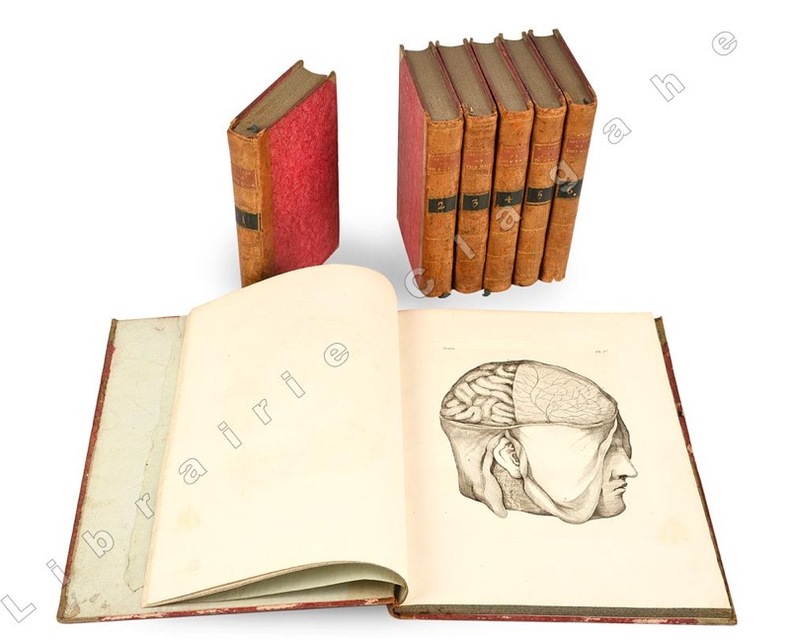
1805ref. 21362Paris, L. Duprat-Duverger, imprimerie de Baudouin, an XIII-1805 ; 6 tomes in-8 et Atlas grand in-4° (338 mm), demi-veau fauve et petits coins de vélin, pièces de titre décorées rouge-orangé et de tomaison décorées vert-empire, plat de papier rouge à l’époque, tranches mouchetées (reliure de l’époque); XI, 88, 332 pp., frontispice de Girodet, gravé par Robert De Launay, [1] f. serpente imprimée de l’explication de l’estampe ; [2] ff. (Table et Errata) ; 446 pp., [1] f. (Errata) ; 444 ; 410 ; 372 ; 372; 360 pp. ; Atlas : [1] f. Titre, IV pl. pour les Mémoires ; 35 planches sur le cerveau (XXXII et II bis, V bis et XXIIbis), dont 8 doubles.
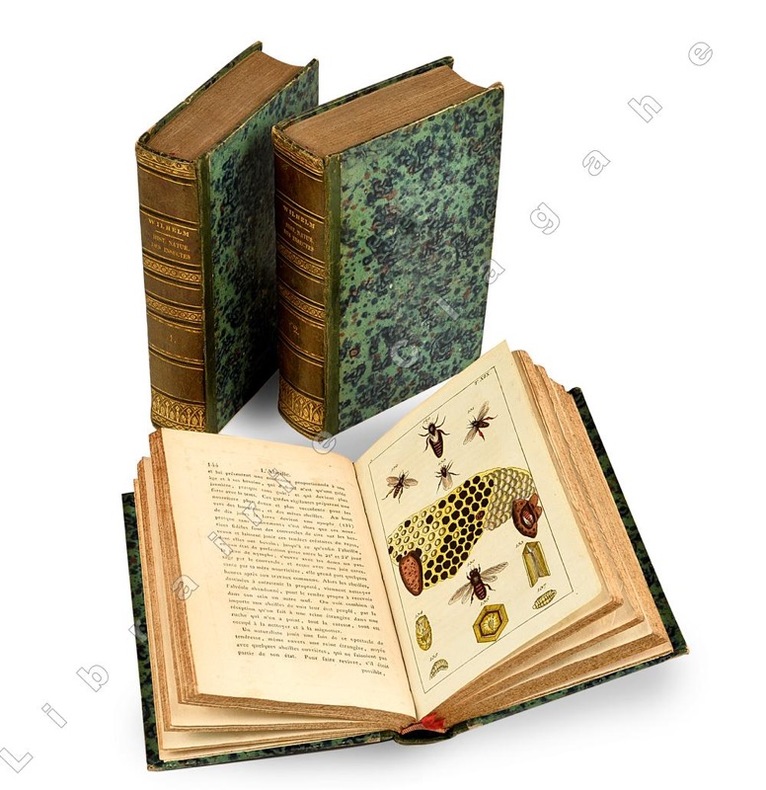
1798ref. 21300Basle, Henry Haag, 1798-1804 ; 3 tomes in-8, demi veau glacé vert foncé, dos à faux nerfs de filets à froid et dorés, roulettes décoratives, plaquette à décor de cathédule en queue, titre doré (reliure de l’époque) ; LII, 397 ; 435 ; 384 pp. et trois frontispices en noir et blanc gravés par Leizelt, une planche dépliante en noir et 150 (47, 52, 52) planches hors texte soigneusement aquarellées et gommées, soit 154 planches en tout.
1911LIMITED EDITION OF 306 COPIES. RARE large, ornate edition of Dante Alighieri's 'Divine Comedy', published on the alleged 700th anniversary of the Comedia. The text is heavily annotated, and is prefaced by the Italian poet Gabriele D'Annunzio. The edition features numerous woodcuts and text decorations reproduced from the 15th-century Venice edition of the Comedia. This exemplar is not numbered, meaning it is probably one of the first 6 copies. 415x310mm. XI+524 pages. Brown cloth Hardcover, masterfully restored from a damaged and partially missing cover. Cover corners bumped. Pages wavy with somewhat rough edges. Pages slightly yellowing. [SUMMARY]: In spite of the damage to cover it has previously sustained, this rare and impressive edition of a great literary masterpiece has been restored and is in good condition. PLEASE NOTE: This item is overweight. We may ask for extra shipping costs.
1881ref. 2080502106504268Not Available 1881. Soft Cover. Fine. Number of books: 1 Not Available paperback
1885ref. 145249Toronto 1885. Vol. I No. 1 April 4th 1885 - Vol. I No. 18 August 1st 1885. Hardcover. Good. 152 p. 46 cm. Numerous b&w engravings. 15 unnumbered inserts of tinted illustrations. Map of battleground of Batoche. Map of the North-West Territories. Respined and recornered in black leather. Black cloth with gilt impressing. Some wear including chipped edges. Hinges repaired internally. Some tears chips rough edges to text block. Label removed from title page leaving residue. Hole in rear free endpaper. Tape repairs. Lacks 4 p. supplementay Honour Roll. Weekly reporting on the violent five-month insurgency against the Canadian government fought mainly by Métis and their native allies in 1885. Articles convey the latest news from the northwest the mounted police medals for bravery bios and so on. Contains numerous scenes of Western towns battles military life and training as well as portraits and caricatures. Much advertising mainly Toronto. Peel 1460. Land 1245. hardcover
Small 8vo (150 x 100 mm). (8), 112 ff. With the title in a woodcut border with 6 putti (without wings) and 8 fantastic beasts in and growing out of stylized foliage, incorporating Sessa's device (a cat with a mouse in its mouth) in the foot; Sessa's woodcut device (cat with a mouse in its mouth, now in a crowned wreath with initials MS) on the otherwise blank final page; 1 woodcut decorated initial (as S designed with a gap in the central stroke to accommodate the profile of a man, possibly intended as Dante). Set in an Aldine-style italic (with upright capitals).19th-century (?) sheepskin parchment , sewn on 3 recessed supports, sprinkled edges. Fourth edition (the last before 1723) of Dante's important philosophical allegory in autobiographical form, expressing his love of wisdom and knowledge personified as a beautiful lady named Philosophy, and his view that they lead to virtue and worldly happiness. Dante presents the story as a metaphorical banquet where he is content to eat the crumbs that fall from the plates of the wise: "the first extended piece of original expository prose in the Italian vernacular" (Lansing). Dante began work on it around 1304, ten years after completing his verse Vita nuova, his elevation of courtly love poetry into sacred love poetry that centred around his love for the beautiful and virtuous Beatrice, an idealized picture of a real lady of the Florentine court who died in 1590. In the intervening years he had developed a great love for philosophy, literally meaning the love of wisdom (a deep understanding of human nature and the physical universe) that leads to virtue. This idea was to infuse the Convivio. He finished only four of its projected fifteen "trattati", and never widely circulated the Convivio during his life, but it represents a turning point in his writing. It appears to have given him a new inspiration so that he set it aside around 1307 to begin work on his Divine comedy, where he returned to verse but merged his first love, the more human and religious Beatrice of the Vita nuova, with his new love, Philosophy, to create the new version of Beatrice that he honours in the Divine comedy. The first treatise introduces the story, while each of the others begins with a canzone expressing a particular aspect of Dante's love for Philosophy, followed by the main text explaining its literal and symbolic meaning. The whole therefore forms an encyclopedia of secular knowledge, intended for the education of both men and women. It also passionately pleads for the use of the Tuscan vernacular Italian at a time when learned works were usually written in Latin. The fourth book was politically subversive, proclaiming that the love Dante describes ennobles the soul, and attacking the Holy Roman Emperor Frederick II's notion that nobility comes from inheritance and manners. Many elements, including the cosmology, return in the Divine comedy. - All surviving manuscripts of the Convivio are believed to derive from a single lost manuscript that was unfortunately corrupt, so the work has long been a challenge to its editors. It was first printed at Florence in 1490 under the title Convivio, the "amoroso" of the present title being added for the second edition published at Venice in 1521, emphasizing the importance of love in Dante's text. "Convivio" means banquet, but like the English convivial, its etymology (living together) gives it connotations of the pleasures of human relations. The text of the present edition follows that of 1521. - With numerous points in the text marked by a charming contemporary manuscript pointing hand in the margin. In very good condition, with only a tiny hole on the edge of the woodcut border, a small hole where the ink of one marginal pointing hand has eaten through the paper and an occasional minor spot. An unfinished work by Dante, important in its own right, as an early example of literary Italian prose and as part of the genesis of the Divine Comedy. Adams D 119. Edit 16, 1161. Gamba, Serie ... Italiana letteratura 419. Mambelli, Edizioni Dantesche 803. Sander, Dante Alghieri 2331. USTC 808776. For the text: R. Lansing, "Convivio", in: Dante encyclopedia, pp. 224-232.
1735ref. 28870Chaalons' i.e. Châlons-sur-Marne 'pour la Communauté des Libraires' 1735 1735. New edition apparently unrecorded. Not found on OCLC or the Union Catalogue of France CCFr. A fine copy. 12mo contemporary polished continental calf marbled paper endpapers blind-ruled borders red morocco spine label gilt decorations and lettering a.e. stained red. Woodcut tailpieces. By the late 17th century the French government attempted to regulate all aspects of printing and the distribution of books in and around Paris. In 1686 those regulations were codified in the Édit du Roy pour le Règlement des Imprimeurs et Libraires de Paris and the Édit du Roy pour le Règlement des Relieurs et doreurs de Livres. Further revisions were made 30 years later and after some disagreements two editions of the code were published in 1723 and 1731 in the form of a decree. The code was extended to all of France in 1744 and remained in effect until 1777. This edition is a provincially printed version of the 1723 edition printed in Châlons-sur-Marne in 1735. The code is divided into 123 articles and is remarkably comprehensive in its regulation of all aspects of the trade including the import of books old and new bound and unbound and of imported printing types; books sold by subscription; requirements for the apprenticeships to booksellers and printers; the widows of booksellers and of printers; proofreaders; type founders; traveling booksellers; fairground booksellers and printers; prohibited books; auctions and inventories of libraries and bookstores et al. From the library of 19th century Châlons librarian and local historian Amédée Lhote with his bookplate on the front paste-down and ink ownership stamp in the margin of the final page of text; a bookseller's catalogue entry for the Histoire de l'imprimerie a Châlons 1895 on the rear paste-down. Marginal notations in ink on two leaves. Chaalons' [i.e. Châlons-sur-Marne], 'pour la Communauté des Libraires', 1735 unknown
2 Vols., small folio (305 x 190 mm), xxxiii, [3], 49-458; [4], 582, [2]pp., text in English and Persian, occasional marginal pencil notes, title page and terminal leaf to both volumes browned, staining to inner upper corner of leaves to start and end of volume two, later vellum-backed marbled boards, title in manuscript to spines. One of the most extensive Persian grammars written in English. "Matthew Lumsden (1777?1835), orientalist, was fifth son of John Lumsden of Cushnie, Aberdeenshire, and a cousin of Sir Harry Burnett Lumsden (1821?1896), army general. After education at King's College, Aberdeen, he went to India as assistant professor of Persian and Arabic in the College of Fort William, and in 1808 succeeded to the professorship. In 1812 he was appointed secretary to the Calcutta Madrasa, and superintended various translations of English works into Persian then in progress. From 1814 until 1817 he had charge of the East India Company's press at Calcutta, and in 1818 he became secretary to the stationery committee."?(Oxford DNB). Provenance: John L. Platts? signature in pencil to title page.