Montanus, Giovanni Battista da.MareMagnum

8200 resultados
4to. (156) pp. Disbound. "Mainly an elucidation of part of the second book of the Prognostica of Hippocrates" (Durling). From fol. O1r onwards, this contains Emerich's treatise "an urinarum vel pulsum observatio certiores notas salutis vel mortis medico praebeat". The Verona physician Giambattista da Monte (1498-1551) was one of the most famous practical medical men of his time (cf. Hirsch IV, 271). - Insignificant edge defects to final leaf; a clean and wide-margined copy. Very rare; no copy in the trade since 1950 internationally. VD 16, M 6260 (E 1053). Durling 3256 (not: "[2], 52 ll."). Wellcome 4410 (not: "86 ll."; Emerich's "Oratio de re medica" is a separate work). Not in Waller.
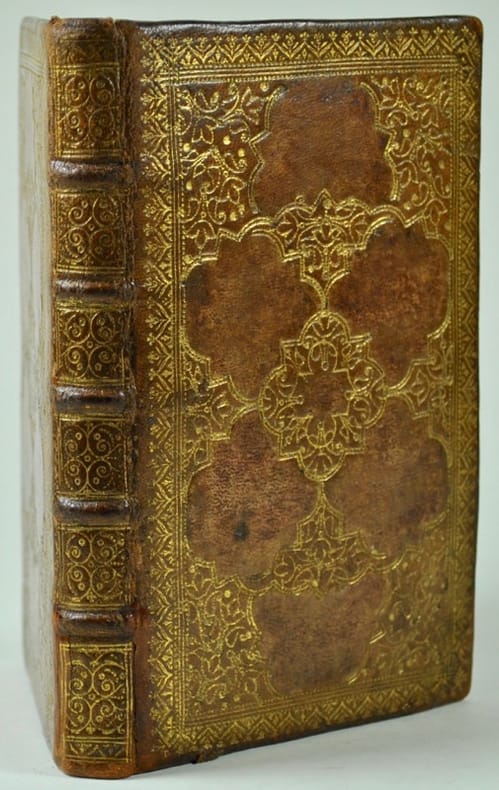
1649ref. 15312Paris, Jean Henault, 1649. In-12 (98 x 151 mm) de (106) ff. gravés recto-verso en taille-douce, maroquin fauve, plats ornés de compartiments de filets droits et courbes, fers filigranés et points dorés, dos orné de même, roulette sur les coupes, tranches dorées (reliure de l'époque).
1656ref. 42642A Paris, chez J. Hénault, 1656. In-12 (155 x 104 mm) de (106) ff. gravés recto-verso en taille-douce, maroquin rouge, dos orné à nerfs, triple filet doré et motifs d'angle sur les plats, tranches dorées, fermoirs (reliure de l'époque).
8vo. (96) pp. With arabesque woodcut border to title and 94 woodcuts by Bernard Salomon in the text. - (Bound with) II: Borluyt, Guillaume. Historiarum memorabilium ex Exodo, sequentibusq[ue], libris descriptio. Ibid., 1558. (144) pp. With arabesque woodcut border to title and 136 woodcuts by Bernard Salomon in the text. 19th century full purple morocco on five raised bands, title gilt to spine, leading edges and inner dentelle gilt. Marbled endpapers. Top edge gilt. First Latin editions, previously published in French (as "Quadris historiques de la Bible") in 1555. Each page contains four verses describing a scene from the Old Testament, accompanied by a delicately executed illustration (94 from Genesis, 77 from Exodus, and 59 from other books: a total of 230 woodcuts). Brunet gives 134 (instead of 136) woodcuts for the second book, remarking: "cette suite est fort jolie et fort recherchée". The fine series of illustrations shows the influence of Holbein and Beham, and yet is stylistically independent; "c'est l'oeuvre capitale de Bernard Salomon" (Rondot). There is no preliminary matter to the first book, but the second contains a preface and verses by Borlyut. - Occasional browning; title of first book torn and rebacked; several large tears and paper flaws throughout have been professionally repaired with minimal loss to text. Pages were washed and (in some case excessively) pressed before rebinding. All woodcuts are in good impressions. Provenance: bookplate of the Swiss minister Gaspard Ernest Stroehlin (1844-1907), professor of church history at the University of Geneva; below this slightly later bookplate of G. Velmay. Latterly in a Russian private collection. Fairfax Murray II, 429. Brun, Livre illustr. en France XVIe siècle, 203 (counting only 229 woodcuts). BM-STC French 337 & 76. Adams P 306 & B 2501. Cat. Harvard 88f. Bibles Paris, 1284. Cartier 394.
4to. (6), 92 ff. With armorial title woodcut, 12 folding engraved plates and several woodcut initials. Contemporary limp vellum with handwritten title to bottom edge. First edition. - A major study on the ancient Roman army, based on the author's reading of Polybius, Livy and Dionysius of Halicarnassus. Patrizi posits that the art of warfare is the basis of peace and human happiness. His benchmark are the Romans, whose army he views as superior to all others - in particular that of the Ottomans: if the Christian armies could only emulate the military forces of ancient Rome, he writes, they need not fear the Turks. The only modern army to come close to this ideal, he feels, was that of Duke Alfonso I d'Este gelungen, whose methods of fortification and siegecraft were exemplary. It is therefore perhaps little surprise that Patrizi dedicates his work to Alfonso II d'Este, the ruler of Ferrara and the grandson of Alfonso I. The engravings show military formations and camps, individual legionaries, attack formations, etc. - Binding repaired with modern endpapers. A good copy with very insignificant traces of worming to the title and the final two leaves, as well as a few repaired edge defects. BM-STC Italian 493. Adams P 437. Edit 16, CNCE 47279. Graesse V, 169. Not in Jähns or Cockle; not in Göllner.
4to. (4), 62, (6) pp. With woodcut printer's device on title page (repeated on final page) and 3 woodcut initials. Sewn. Early edition of a frequently reissued manual on classical coins, measurements, and weights, edited and introducted by Giovanni Battista Egnazio. Page 58 gives the diagram of an ancient measurement. - Slightly browned throughout. Apparently removed from an old sammelband; contemporary marginalia on p. 13 trimmed by binder's knife. Old ownership and notes on the preserved lower wrapper cover or interleaf. VD 16, P 4394. BM-STC German 713. Cf. Heckethorn (The Printers of Basle) 114, 6 (1530 Hieronymus Froben edition). Not in Adams.
4to. 67, (1) pp. With a figural woodcut initial. Marbled wrappers. First edition of this rare treatise on human action and the voluntariness of man's ethical dispositions: "an investigation of whether the formation of a virtuous or vicious habit is due to our freedom of choice. The treatise is divided into fourteen chapters and begins with a doxographical survey in which the Aristotelian position is opposed to the doctrines of the Stoics and the Platonists. What these latter positions have in common, according to Porzio, is that they both deny the complex nature of the human being, which he forcefully depicts as inescapably composed of both rationality and materiality. His analysis of the limits of human freedom touches upon Renaissance concepts of man and his place in the universe, as well as combines a distinctive approach to Aristotle’s teaching with an heterodox attitude towards divine grace" (L. Casini, "En renässansaristoteliker om den mänskliga frihetens gränser", in: Lychnos [2009], pp. 49-67, at p. 61). Porzio (1497-1554), a student of Pietro Pompanazzi and variously a writer on medical subjects, taught philosophy in Pisa and Naples. He held that the soul is the individual and corruptible form of the human body. - A finely printed work, showing some slight brownstaining throughout. From the library of the historian of medicine Walter Pagel (1898-1983). Edit 16, CNCE 34585. BM-STC Italian 537. Adams P 1957. Durling 3741.
1966First printing. 1348 pages. Index. "Shows the years 1895-1950 as a period of transition from the world dominated by Europe in the nineteenth century to the world of three blocs in the twentieth century." - from dust jacket. Most notable for its frank admission that there is in fact a secret plan to create a global government. Author served as mentor to Bill Clinton while the latter studied at Georgetown. Usual library markings. Average wear. Binding intact. Dust jacket now preserved in glossy new archival-grade Brodart. A sound copy of the true first printing. WEEMS p.69. Book
Folio. 140 ff. With four-part woodcut border and 10 woodcuts in the text, as well as several woodcut initials. Later half vellum with marbled covers and ms. title to spine. Pretty edition of Seneca's tragedies, edited by Girolamo Avanzi, Gellio Bernardino Marmitta, and Daniel Caietanus. "Reproduces the 1510 edition" (cf. Schweiger). "Texte encadré par le commentaire [...] Page du titre: encadrement ornemental avec fond de hachures obliques et figures de deux daupins affrontés sur les côtés. - Dans le texte: dix vignettes d'une taille rude et grossière" (Essling). The dolphins (four of them, in fact) are cleverly hidden within the ornaments of the woodcut border. Each play is prefixed by an unsophisticated, but prettily designed Renaissance woodcut. A few interspersions in an appealingly cut Greek type. - Slight edge tear to f. 16. Some wrinkling to gutter throughout. Faded 17th century ownership to title page. Some fingerstaining to margins early on, otherwise a very clean and crisp copy from the collection of the steel industrialist Giacomo Galtarossa (b. 1916), president of the Associazione industriali della provincia di Verona (his etched bookplate on front pastedown). BM-STC Italian 621. Essling II, 209, 1691. Schweiger II.2, 938. OCLC 38721121. Not in Adams.
16 pp. With an ornamental woodcut initial on the title page. Papered spine. Second edition of Sibutus's first published work, previously printed by Quentel in March 1505: a treatise on the art of memory. The humanist Sibutus (c. 1480-1528), probably from Tannroda in Thuringia, was a student of Conrad Celtis. Crowned poet laureate by Emperor Maximilian, he practised as a physician and taught rhetorics in Wittenberg, Rostock, Cologne, and Vienna. "This frequently cited and rarely discussed instruction by Sibutus contains within the space of 7½ pages so many obscure precepts, counter-productively mingled with verses by Virgil, Ovid, and others, that it must be quite incomprehensible to anyone unaccustomed with mnemonics. It is apparent that Sibutus employed a very difficult and roundabout method. So as to have no more than 36 mnemonic devices, he used the verse 'arma virumque cano' etc.; for each letter he would imagine a person whose name began with that letter etc. He does not explain how to avoid confusing these persons in case a particular letter occurs more than once" (cf. Aretin, Systematische Anleitung zur Theorie und Praxis der Mnemonik, Sulzbach 1810, p. 194ff.). More of a practitioner than a theorist, Sibutus was proficient in mnemotechnics himself: for Frederick, Elector of Saxony, he recited from memory 600 verses of his "Silvula in Albiorim", a poem praise of Wittenberg. The present volume includes two introductory poems by Johannes Murmellius and Johannes Cesarius, a dedicatory poem to the Lübeck jurist Heinrich Bucholt, as well as Sibutus's own "Carmen in vitam S. Annae". - Slight brownstaining throughout; insignificant waterstain to upper gutter. A single copy in the U.S. according to OCLC (Harvard Med. School). VD 16, S 6262. BM-STC German 812. Panzer VI, p. 358, no. 104. Verfasserlex. II.3, col. 892. OCLC 230985978. Not in Adams.
8vo. (8), "219" (but: 217) pp. - (Includes, with separate title-page): De bello turcico perpetuo administrando. Ibid., 1598. (8), 59, (13) pp. - (And:) Epistolae de bello turcico perpetuo administrando. Ibid., 1598. (20) ff. With two woodcut printer's devices to first and second title. 18th century half calf over marbled boards with traces of a giltstamped spine label. Only edition of this discussion of the 16th century's endless skirmishes and wars on the Ottoman-Habsburg border, posthumously published by Nicolaus Reusner during the early years of the Long Turkish War that had broken out in 1593. The humanist Johannes Sturm (1507-89) had been a friend of Melanchthon, Erasmus and Vesalius. "He established a celebrated school at Strasbourg in 1538, raised to the rank of academy by Maximilian II in 1566, and which was run according to Sturm's principle that a school was a state in miniature" (Blackmer). The anonymous printer was formerly thought to have been Donat Richtzenhan (BM), but VD 16 now identifies him as Tobias Steinmann. The three parts appear to have been issued separately, and the copies in Cambridge and the British Library comprise only the first two parts. - Some browning throughout. Removed from the Imperial Russian Military Academy with their bookplate to front pastedown. VD 16, S 9913. BM-STC German 840. Adams S 1986. Blackmer 1619. Göllner II, 2343-2345. Schefer 2262. Boecler 219. Hammer 1344.
1575Folio. (4), 18, 537 (but: 523) ff. Woodcut printer’s device on t. p. and last f. verso and several woodcut initials and tailpieces. 18th-c. vellum with gold-stamped label to spine. Second Giunta edition, "la più pregevole di tutte" (Paitoni). Transl. by Jacopo Nardi (b. 1476), the "Supplimento della II. deca" by Francesco Turchi, both of which are praised by Brunet. No historical work was held in higher esteem during the Renaissance; the present edition remained the most complete Italian translation for decades. - Worming to spine. Binding loosened at the beginning and end, otherwise a very nice copy. Edit 16, CNC 34172. Gamba 1480. Poggiali II, 303: "Edizione stimatissima". Haym 19/1. Paitoni II, 213: "La più pregevole di tutte". Cf. Brunet III, 1112. Cf. BM-STC Italian 390.
1931107 pages. A very rare first printing copy of this early title from Alison Uttley's beloved Little Grey Rabbit Series. Top half-inch of backstrip missing. Openings of up to one inch at each end of remaining backstrip. Moderate wear externally with bright colour illustration upon front board. Hinges intact. Contemporary Mora Road Infants' School prize-winner's bookplate upon front free endpaper else contents unmarked with light wear and soiling. Minimal foxing to endpapers. Slight lean to spine. Hairline openings to binding at first blank leaf and pages 32, 64, 80 and 97. Overall a quality copy. Book
1574ref. 44648Anvers, Christophe Plantin, 1574. In-8, 392-99-(13) pp. (sign. A-Z a b , A-G ), index, vélin doré souple à recouvrement, double filet doré, cartouche central à motifs d'entrelacs, écoinçons, dos lisse orné de doubles filets formant caissons, tranches dorées, traces de lacet (reliure de l'époque).
1613ref. 61750Parma: Ex Typographia Antaei Viothiis i.e. Anteo Viotti 1613. Folio. 8 374 8 pp including 2 blank leaves. Copper-engraved illustrated title of the Farnese coat of arms of Parma designed by Malossi i.e. Giovanni Battista Trotti 1565-1619 engraved in copper by Francesco Villamena 15660-1624 within an allegorical frame historiated initials and richly embellished throughout with decorative calligraphic woodcut engravings after drawings by Brondolo and engraved by Ferrari. Contemporary full vellum spine expertly repaired minor worming to pastedowns end leaves tidemark to gutter margin through 1st half of textblock w/o the large folding dedicatory engraving very minor worming to spine endpapers still a good copy. First edition of this fascinating work dedicated to Pope Paul V filled with 2370 theses of rational natural and moral philosophy defended at length by the brilliant 15-year old Ottavio Farnese 1598-1643 son of the Duke of Parma displaying a deep understanding of Aristotle and other ancient philosophers. Of particular interest are the wonderfully executed woodcut calligraphic figures throughout the text of sphinxes figures personified allegories musical instruments vegetables plants animals such as turtles storks roosters lions frogs and grasshoppers.No reference this cataloguer could find appears to have identified “Brondulus” possibly G.F. Brondolo. Sadly the year after this brilliant disputation in 1613 Ottavio’s paranoid father the Duke of Parma Ranuncio I Farnese imprisoned him in the notorious Parma La Rocchetta prison stripped him of all his feudal titles and there he languished for the next 30 years dying most likely of the plague in 1643. According to Worldcat listings and descriptive catalogues there appear to be surviving copies with and without the double-page allegorical plate dedicated to Pope Paul V. Worldcat locates 6 in the U.S. Getty Harvard w/o plate Newbery St. Bonaventure Library The Morgan DLC. Ex Typographia Ant[a]ei Viothi[is] (i.e. Anteo Viotti), hardcover
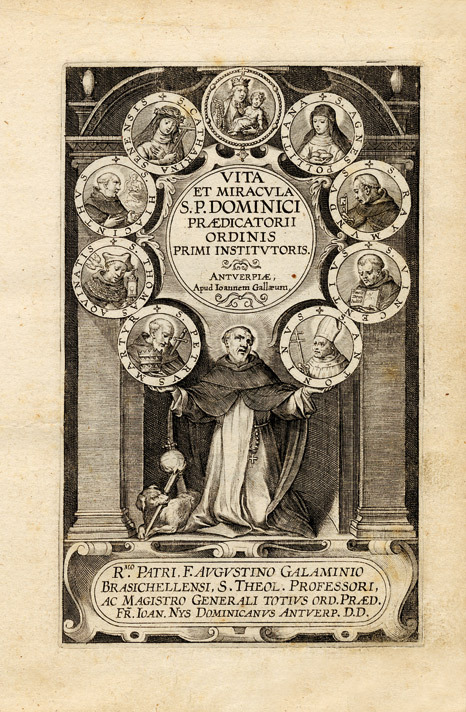
1630ref. 11321Antverpiae, Joan Galle, (circa 1630) ; F. Ioannes Nys invenit, Peter de Jode figuravit, Theodor Galle sculpsit et excudit ; titre gravé, portrait et 32 planches légendées. SUIVI de 4 planches gravées par JOAN GALLE : I- Prudentia, II- Justitia, III- Fortitudo, IV- Temperantia (les 4 vertus cardinales). SUIVI de 14 planches de sujets religieux, gravées par CORNELIUS GALLE le Vieux : Silva sacra, Fugit familia sacra, S. Barbara, S. Ianvarius Neapolis patronis, S. Lucia, S. Leontius martyr miraculis gloriossus in Muris Helvetiorum, S. Iacobus Maior, Benedicite omnes bestiae et pecora domino, S. Hieromymus, Vierge à l'Enfant, etc. Soit en tout 52 planches, reliées en 1 volume petit in-4 ; plein vélin ivoire, titre au dos, tranches rouges (reliure du XIXe).
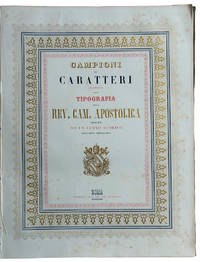
1853ref. LL 603TYPOGRAPHIC SPECIMENS OF THE VATICAN PRINTING HOUSE. Folio 342x255 mm; original cloth with title impressed in gold on upper cover; half-title leaf title-page leaf printed in blue red and gold within a triple border as well printed in blue red and gold a leaf with the advice to reader pp. VIII 62 plates and 4 plates containing many samples of fonts text printed in Italian Latin Greek Copic French also with sample of numbers music typographical borders tailpieces etc. last 4 plates: " Campioni dei tratti di penna" so calligraphic samples. Francesco Salviucci belonging to a well-known family of Roman typographers director of the Typography of the "Reverenda Camera Apostolica" describes a vast sample of the printing characters present in the typography preceded by a brief excursus on typographic art in general. In addition to the characters there are various friezes and engravings including the image of a steamship probably the first of the Papal State. Maggs cat. n. 509; Books on Printing Part II Books From Famous Presses 15th To 20th Century. Tipografia della Rev. Camera Apostolica hardcover
1886ref. 007461Paris 1886. Pebbled Cloth. Very Good. Spectacular catalogue with chromolithographic plates of ornate stoves heaters fireplaces. Elephantine Folio 49 by 34 cm. First color plate is double paged showing tile platterns followed by 23 color plates showing the company's products one stove or fireplace per plate. Double paged plate illustrates 97 samples of tiles. At end is a one page price list for January 1886. Curiously this price list doesn't correspond with the plates. Scarce -- no copies found of any catalogue issued by Debaecker or for Victor Vogt its predecessor firm on OCLC COPAC or KVK. Condition: rebacked inconspicuously. A fair amount of soiling on the boards. Occasional light soil on the leaves. Generally clean and illustrations remain bright and crisp. unknown
1886ref. 007461Paris 1886. Pebbled Cloth. Very Good. Spectacular catalogue with chromolithographic plates of ornate stoves heaters fireplaces. Elephantine Folio 49 by 34 cm. First color plate is double paged showing tile platterns followed by 23 color plates showing the company's products one stove or fireplace per plate. Double paged plate illustrates 97 samples of tiles. At end is a one page price list for January 1886. Curiously this price list doesn't correspond with the plates. Scarce -- no copies found of any catalogue issued by Debaecker or for Victor Vogt its predecessor firm on OCLC COPAC or KVK. Condition: rebacked inconspicuously. A fair amount of soiling on the boards. Occasional light soil on the leaves. Generally clean and illustrations remain bright and crisp. unknown books
1929First printing of Alison Uttley's first book - the first title in the Little Grey Rabbit Series. Hinges intact. Somewhat above-average wear externally. We presume backstrip is missing as prior owner has neatly covered spine with tape which closely matches boards in colour. Few minor pencil marks mostly erased from endpapers. Several minor perforations to front free endpaper, first blank leaf, and half-title page, as if by a kitten's tiny claws. Corresponding indentations to title page and following page. One inch chip from lower corner of page 19. Half-inch tear to top edge of page 56. Two small chips from lower corner of page 107. Two-inch tear to lower fore-edge of back free endpaper. Book
First edition, 3 vols., 4to (270 x 185 mm), [6], vi, [2], ccxxv, [1], 410, [2]; [4], 535, [3]; [4], 544, [4]pp., with half-titles, ONE OF 50 LARGE PAPER COPIES, 37 engraved plates (without the 'Presentation in the Temple' plate which was not ready at publication and occurs in only a very few copies and the 'Portrait of Los Rios' which Windle & Pippin suggest is an extra-illustration), also without the engraved portrait of Dibdin by Henry Mayer, numerous woodcuts engraved vignettes, several printed in red or blue, some mounted, some light spotting and offsetting as usual, marbled endpapers, contemporary full blue-green morocco, decorated in gilt with interlacing geometrical design on the covers, richly tooled gilt morocco doublures, flat spines lettered in gilt direct, all edges gilt, spine slightly faded, corner of lower board of vol. II bumped, some slight edge-wear to bindings otherwise a handsome set. A fine copy of the rare large paper issue of the author's most lavish publication and the high water of Dibdinian Bibliomania. Jackson 40; Windle & Pippin A28.
Folio (ca. 220 x 337 mm). (216) pp. With 106 woodcut illustrations within the text, 85 of which full-page. Woodcut printer's devices to title-page and final page verso. - (Bound with) II: Strein von Schwarzenau, Richard. Gentium et familiarum Romanarum stemmata. [Geneva], Stephanus (Estienne), 1559. (120) pp. With woodcut title-vignette. Contemporary full vellum. First edition. - The first complete edition of this "curious book" (cf. Graesse), a "state handbook of the military and civil organisation of the late Roman Empire" (cf. Hieronymus). Compiled anonymously around 410, the classical text and illustrations were passed on in several manuscripts, first appeared in print in abridged form in 1529 and were published in the present version by the classicist Gelen (ca. 1498-1554), who worked as an editor and translator at the Froben printing office. The woodcut illustrations were created by Conrad Schnitt (1495-1541), except for pp. 6f and 23 (Imperium Orientale, Imperium Occidentale, Constantinople), which probably originate from the hand of Hans Rudolf Manuel Deutsch (1525-71). They show, inter alia, allegoric depictions of parts of the Empire, the insignia of court, civil and military authorities, as well as statues, small buildings and books. Includes the petition to the emperor on warfare ("De rebus bellicis"), the corresponding illustrations, not all of which by Schnitt, showing chariots, ships and other military equipment. The treatise on civil and military organisation by Andrea Alciato, the topographic description of classical Rome by Publius Victor and the conversation between Emperor Hadrian and the philosopher Epictetus can be found towards the end. - Bound with this is a genealogical work on the origins of Roman families by the Austrian historian Strein von Schwarzenau (1538-1600), giving a short description of each family, with a family tree. - With contemporary ownership of the library of the Piarist school in Schlackenwerth (now Ostrov) to the title-page; a previous ownership crossed out. A library shelfmark to the pastedown. A page marker to the final leaf of the "Notitia". Binding somewhat brownstained. Paper evenly browned throughout with very slight brownstaining and waterstaining to a few pages. From the library of the Viennese collector Werner Habel, with his signed and stamped ownership, dated 1978, to the pastedown. VD 16, N 1884. BM-STC German 747. Adams II, 354. Hieronymus, Oberrhein. Buchill. II, 466. Lonchamp 1164. Schweiger 618. Graesse IV, 691. Ebert 14904. Brunet IV, 111. - II: Adams II, 1931. Renouard 118, 2.
15934to. (2), 13, (1) pp. With woodcut title vignette. - (Bound after) II: Valentia, Gregor de, SJ. (praes.) / Hendschele, Tobias (resp.). Disputatio theologica de theologiae necessitate et ratione [...]. Ingolstadt, David Sartorius, 1589. (6), 8 pp., l. bl. f. - (Bound after) III: Rabe, [Johann] Jakob. In formulam concordiae Iacobi Andreae Schidelini [...] quam Sturmius impugnat, [anonymos]. Ingolstadt, Weissenhorn/Wolfgang Eder, 1580. 18 unn. ff. (last bl.). With woodcut title border. - (Bound after) IV: Thyraeus, Petrus, SJ. (praes.) / Bickel, Philipp (resp.). Examen apologeticarum thesium Danielis Tossani [...]. Mainz, Caspar Behem, 1588. 50 unn. ff. With woodcut title border. - (Bound after) V: Pistorius von Nidda, Johann. Epistolae duae [...] ad Ioannem Pappum, Lutheranae theologiae doctorem [...]. Freiburg, Abraham Gemperlin, 1592. 111, (1) pp. - (Bound after) VI: Hänlin, Georg. Parallela confessionis augustinianae, et augustanae. Opposita parallelis Ioannis cuiusdam Pappi [...] Cum epistolis duabus ad eundem Pappum, scripis à Ioanne Pistorio Nidano. Freiburg, Abraham Gemperlin, 1592. (20), 122, (2) pp. - (Bound after) VII: Stevart Leodius, Pierre (praes.) / Aedilis, Georg (resp.). Brevis explicatio, octo priorum capitum epistolae D. Pauli ad Romanos [...]. Ingolstadt, David Sartorius, 1586. (4), 42, (2) pp. - (Bound after) VIII: Stevart Leodius, Pierre (praes.) / Rotbaur, Johann (resp.). Prioris epistolae D. Pauli ad Timotheum pars posterior, id est Tria posteriora capita [...]. Ingolstadt, Wolfgang Eder, 1587. (4), 35, (1) pp. With large woodcut on reverse of t.p. - (Bound after) IX: Stevart Leodius, Pierre (praes.) / Kepser, Wilhelm Sixtus (resp.). Epistolae D. Pauli ad Galatas expositio [...]. Ingolstadt, Wolfgang Eder, 1592. (4), 13 pp., 14-39, (1) ff. With woodcut printer's device on t.p. - (Bound after) X: Stevart Leodius, Pierre (praes.) / Schmidtner, Michael (resp.). Epistolae divi Pauli ad Hebraeos, septem priorum capitum brevis explicatio [...]. Ingolstadt, David Sartorius, 1588. (4), 47, (1) pp. - (Bound after) XI: Stevart Leodius, Pierre (praes.) / Winzet of Glasgow, John (resp.). In canonicam D. Jacobi epistolam brevis commentarius [...]. Ingolstadt, David Sartorius, 1591. (4), 50, (2) pp. With woodcut title border. - (Bound after) XII: Stevart Leodius, Pierre (praes.) / Melemius, Andreas (resp.). Exegesis in epistolam D. Pauli ad Ephesios ecclesiae [...]. Ingolstadt, David Sartorius, 1593. (4), 83, (1) pp. Contemporary blindstamped pigskin on 4 double bands. Wants ties. All edges loosely sprinkled in red. Fine sammelband, uniting twelve counter-reformatory pamphlets. Apart from the very rare first separate publication of the letter by Duke George of Saxony to Luther (previously printed only in collected editions), the volume contains eleven anti-Lutheran polemics, some printed as disputations or dissertations. The somewhat dusty binding shows roll-tools of the Saints Peter, Paul, and John. - Well-preserved collection of Catholic polemical writing in a contemporary blindstamped binding. I: Not in VD 16, Adams, BM-STC German. - II: VD 16, V 83. Stalla 1616. Not in de Backer/Sommervogel, Adams, BM-STC German. - III: VD 16, R 4. Stalla 840. Not in Adams or BM-STC German. - IV: VD 16, T 1244. Adams T 699. De Backer/Sommervogel VIII, 13, 9. Not in BM-STC German. - V: Adams P 1317. Not in BM-STC German or VD 16. - VI: VD 16, H 131 and P 3041. Adams H 4. Not in BM-German. - VII: VD 16, S 8953. Stalla 1564. Not in Adams or BM-STC German. - VIII: VD 16, S 8967. Stalla 1013. Not in Adams or BM-STC German. - IX: VD 16, S 8956. Stalla 1132. Not in Adams or BM-STC German. - X: VD 16, S 8957. Stalla 1607. Not in Adams or BM-STC German. - XI: VD 16, S 8961. Stalla 1693. Not in Adams or BM-STC German. - XII: VD 16, S 8959. Stalla 1739. Not in Adams or BM-STC German.
8vo. (16), 94, (2) pp. With woodcut title border. - (Bound with) II: La Grange, Claude de. De bello Melitensi a Solimano Turcarum principe gesto. [Geneva], Gabriel Cartier, 1582. 62 pp. With woodcut printer's device. Contemporary full vellum with giltstamped arms (upper cover) and ownership (lower cover) of Joachim Enzmilner, Duke of Windhaag (dated 1650). Traces of ties. I: An account of the Christians' ineffective siege of Buda, then in the hands of the Ottomans, in October 1598. Previously, the Imperial troops under the command of Adolf von Schwarzenberg had successfully retaken the fortresses of Györ and Veszprém. Rare; a single copy located via VD 16 (ULB Halle). - II: Bound after this is La Grange's concise account of the 1565 Great Siege of Malta, when the Knights Hospitaller defended the island of Malta against an attempted invasion by the Ottoman navy. - Occasional slight browning; some worming to gutter and binding. From the library of Joachim Enzmilner, Duke of Windhaag, with his arms and ownership on the covers and contemporary note "Ex Bibliotheca Windhagiana" on the title page of the first work. The 20,000 volume collection of the German jurist and statesman Enzmilner later formed the nucleus of Vienna's University library. I: VD 16, ZV 9032. Németh H 977. Not in Apponyi. - II: GLN 2974. Göllner 1746. Hammer 1070. Riant 3882.
15184to. 8 unnumbered ff, With nearly page-sized title woodcut and an armorial woodcut at the end, both by the Master of Petrarch. Marbled red boards. First and only edition of this probably rarest work by the Bregenz-born historiographer. The book was published "on the occasion of Albrecht of Brandenburg's creation as cardinal in honour of his defence of Christianity against the Turks, and the awarding of a sword and helmet-like fur cap, blessed by Pope Leo X on Christmas Day, to Emperor Maximilian through the hands of the Papal legates Cajetan and Lang" (cf. Musper). - The title woodcut shows an angel bearing the insignia of both these awards; the final woodcut shows Mennel's arms. - A clean and wide-margined copy. Rare; last at a German auction in 1964. VD 16, M 4614. BM-STC German 618. Panzer VI, 152, 133. Zapf II, 204, XV. Musper, Nachlese zum Petrarkameister, in: GJB 1951, 110 ff. Maximilian-Ausst. Wien 1959, 127.