179 results
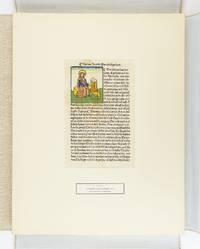
1929ref. ST17493München: Weiss & Co. Antiquariat 1929. No. 21 OF 50 SETS issued with accompanying German text; there were also 50 with accompanying English text. 480 x 375 mm. 19 x 14 3/4". With an 87-pp. volume of commentary in German. Loose as issued in a linen-covered chemise titling in black on front cover. Commentary volume in original paper wrapper. WITH 55 LEAVES FROM INCUNABULA issued by German Swiss Dutch Czech and Italian presses ALL WITH ONE OR MORE WOODCUTS 32 OF THESE HAND-COLORED. ◆Front cover of commentary volume with thin six-inch brown stain along head edge but the volume otherwise clean and fresh the leaves with occasional browning or minor staining but excellent specimens overall the hand coloring often quite attractive. Arranged according to the city in which they were printed this is a wonderful collection of 55 incunabular leaves all illustrated with woodcuts. The group includes important early images large and small with 32 of them hand painted often with brilliant memorable color. Although every leaf here is of interest there are some leaves that deserve special mention: the 1471 Zainer printing of "Heiligenleben" the earliest leaf included; a number of leaves from herbals Bibles and lives of the saints; leaves representing two different editions of Brant's "Stultifera Navis" a Basel 1500 edition of Aesop and the celebrated 1499 Aldine "Hypnerotomachia Poliphili." A full-page woodcut from Koberger's "Schatzbehalter" "Treasure Book" 1491 shows Korah Dathan and Abiram being swallowed up by the Earth for their rebellion against God while Moses and Aaron pray as God sends fire to destroy the rebels. Among the hand-painted woodcuts are several that are outstanding both for the composition of large complex images and for exuberant coloring. These include Pharoah's daughter rescuing the baby Moses as well as the adult Moses with the burning bush both from the German Bible printed by Koberger in 1483; a view of the city of Perugia in Schedel's "Weltchronik" 1493; and another Schedel leaf depicting the martyrdoms of the Apostles Andrew and Thomas. The 55 specimens included here would serve very well either as a final capstone in an advanced collection or else an outstanding nucleus for a beginning collector of illustrated incunabular leaves. Several of the books represented are difficult to obtain and most of the ones that can be procured are very expensive. Weiss & Co. Antiquariat unknown books
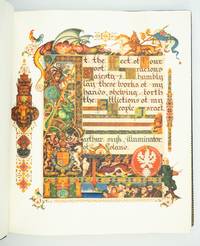
1939ref. ST20331London: Beaconsfield Press 1939. No. 72 OF 125 COPIES SIGNED BY THE ARTIST AND THE EDITOR for sale in the British Empire. 292 x 248 mm. 11 1/2 x 9 3/4". xxvi pp. 46 leaves all leaves French fold. Edited by Cecil Roth. Elegant original blue crushed morocco by Sangorski & Sutcliffe signed on front turn-in covers with gilt French fillet border and large intricate central figure designed by Szyk of a patriarch holding a goblet and book raised bands spine gilt in double ruled compartments with ornate crown centerpiece gilt titling turn-ins with double gilt-ruled and scalloped border surrounding an illustrated silk doublure featuring a Szyk portrait of Moses with the Ten Commandments done in shades of gray within a frame of elaborate design. In an excellent velvet-lined box of blue half morocco over lighter blue cloth upper cover with central lion's head in gilt on blue morocco spine like that of the book. WITH 14 FULL-PAGE AND 32 SMALLER COLOR REPRODUCTIONS OF DESIGNS BY SZYK. English translation printed in black commentary printed in red. Front flyleaf inscribed in ink: "To Mr. and Mrs. Solomon Brachman / very cordially / Arthur Szyk / New York. April 1945." Very faint naturally occurring variations in the grain of the vellum otherwise a pristine copy. With an important Holocaust-related authorial inscription this is a very fine copy of what the London Times described as "a book worthy to be placed among the most beautiful of books that the hand of man has produced." Arthur Szyk 1894-1951 a Polish Jew is considered by scholars to be the greatest 20th century illuminator. Using the style of the Medieval illuminated manuscript artists he has here created a Haggadah for Passover that is at once a beautiful book of devotion a political protest against the rise of Nazism and a plea for England's help for the Jews of Europe. By 1939 Szyk's anti-Nazi cartoons had caused Hitler to put a price on his head forcing him to flee to England. His original illustrations for his "Haggadah" featuring the villains of the Exodus with the heads of Hitler Goebbels and other leading Nazis had to be toned down before publication. All 46 pages of the Hebrew text are illustrated with scenes from the Passover story as well as vignettes of Jewish life in modern Europe—sometimes Szyk mixes the two to great effect. Perhaps the most moving illustration in the book is the elaborately illustrated dedication to King George VI of England appealing for his mercy to European Jews. The great symbols of the British Empire—the lion and unicorn St. George defeating the dragon—surround Szyk's plea to the king: "At the feet of your most gracious majesty I humbly lay these works of my hands shewing forth the affliction of my people Israel." In the lower right corner of the painting we see Jewish refugees beside one of the ships which were usually turned away from British shores while Szyk depicts himself leaning against the painting his brush and easel in hand. The text here is enriched by the historical introduction and the commentary contributed by Cecil Roth 1899-1970 the preeminent British expert on Jewish history. This crowning achievement of Szyk's life was four years in the making and has proved to be an enduring treasure. Szyk presented this copy to Texas oilfield supply magnate Solomon "Sol" Brachman 1896-1974 and his wife Etta. The son of a Latvian Jew Brachman was the founding president of the Jewish Federation of Fort Worth in 1936 and helped arrange an emergency $100000 bank loan for Israel on the eve of statehood in 1948. His wife who served as president of the National Council of Jewish Women was known as "the mother of Hadassah." Szyk's 1945 inscription was no doubt especially meaningful to this devout family whose Latvian relatives were among the 90 percent of that country's Jews who perished in the Holocaust. Beaconsfield Press unknown books
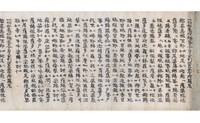
ref. 11486Scroll on paper 24 lines per dharani 17 characters per line body of the woodblock text: 240 x 494 mm. consisting of two joined sheets r: 553 mm. l: 585 mm. in length sutra text printed twice. Scroll 290 x 1138 mm. with later endpaper 68 mm. at beginning total length: 1206 mm. on a wooden roller some worming to text faint staining at foot. Most certainly Kofukuji Temple Nara: late Heian late 11th or early 12th century. An extremely early Kasuga-ban printing from the KÅfukuji temple. Our printed scroll appears to be a unique survival; we find no example in any library and it is unrecorded in all bibliographies. The earliest printed texts in Japan were dharani issued between 764 and 770; nothing more was printed until the late Heian period. "The first unequivocal record of textual printing in the Heian period 794-1185 comes from 1009 when Fujiwara no Michinaga recorded in his diary that 1000 copies of the Lotus Sutra had been printed although no copies of this seem to survive.The oldest extant example bearing a date is the Joyuishikiron which was printed in Nara by monks of the KÅfukuji temple in 1088."-Kornicki The Book in Japan pp. 118-19. In the Heian period of the "Six Temples" of Nara only KÅfukuji is known to have produced any printed books or scrolls. Our scroll was therefore most certainly printed at the KÅfukuji temple. The sutra has the general visual characteristics of late Heian printing: paler ink noticeably less jet-black than the ink usually found in Kamakura-era impressions but it should be said less pale than at least some of the surviving Heian impressions; slightly angular less brush-like letter-strokes; some noticeable variation in the firmness of the impression of the woodblock caused by uneven inking very typical of Heian-era printing; and fine-quality thin pale kÅzo paper. Kamakura-era printings tend to be characterized by jet-black sumi ink very even and well-inked impressions thick gampi paper stained a light yellow-brown with kÅryÅ clove and thick rounded letter-strokes in imitation of brush calligraphy. None of these typical Kamakura-era characteristics are present in this scroll. See Gardner Descriptive Catalogue of Japanese Books in the British Library Printed before 1700 London: 1993 p. 157. The sutra was translated from Sanskrit to Chinese by Amoghavajra ä¸ç©º C: Bukong; J: Fukū 705-74 a prolific and important translator of Esoteric scriptures and Esoteric versions of old scriptures. Born in southern India he went to China at age ten and was ordained. In 741 he went to study in Sri Lanka and India returning to China in 746 with some 500 Buddhist manuscript texts. In the following years he became one of the most politically powerful Buddhist monks in Chinese history and one of the Eight Patriarchs of the Doctrine in Shingon Buddhism. We know that this particular dharani sutra was one of the very earliest to be printed in East Asia - the oldest surviving complete printed scrolls today in both Chinese and Korean institutions are examples of the Treasure Chest Seal Dharani. A copy of the Sutra of the Whole-Body Relic Treasure Chest Seal Dharani dating from 975 is the earliest printed book in the collection of the National Library of China. The oldest surviving substantive Korean woodblock printing is a copy of the Sutra of the Whole-Body Relic Treasure Chest Seal Dharani published in 1007 year 10 of King Mokjong now kept at Chongjisa temple in Gaesong. The production of this scroll is most interesting. The two sheets of paper were first joined together and then the same woodblock was printed twice side by side. The two sheets are of slightly uneven length and part of the woodblock text on the right extends onto the left-hand sheet. The repeated recitation of the dharani was a meritorious act of faith for the followers of Buddha. Heian printing was - at least initially - characterized by repetitive printing for devotional purposes as an alternative to hand copying rather than for practical reading or study. In other words the first printed scrolls were really just longer and more elaborate versions of the suributsu multiple woodblock impressions periodically found rolled up inside Buddhist temple statues. This accords with our scroll which consists of two consecutive identical impressions of the Treasure Chest Seal Dharani. In the absence of other evidence to the contrary the repetitive printing and purely devotional nature of this scroll would tend to place its production more likely in the late 11th century or first years of the 12th rather than in the last decade or two of the Heian era - by which time scrolls clearly intended for study often with commentaries had become much more common. PROVENANCE: Ownership sumi in black seal of the "Horyuji issaikyo" 法隆寺一切経 at end of scroll and on verso where the two sheets of paper are joined. This particular seal is a variant of the seal used to mark the Horyuji's ownership of the Horyuji issaikyo manuscript sutra collection executed 1099-1131. Our variant seal was used to simply denote Horyuji ownership. As suggested in Nihon shakyo sokan our seal is of early Kamakura manufacture which means our printed scroll must predate that period. There is an early inscription on the outside of the front endpaper stating "hokyoin dharani." Our scroll was offered for sale by the Isseido Book Company in 1993 in its 90th anniversary catalogue describing it as a printing of the late Heian period. In remarkably fine condition. The outer blank margin of the left-hand sheet is somewhat dusty or smoky except for a large white circle where clearly a candle stand once was present. Preserved in two wooden boxes one fitting inside the other. ⧠We thank Prof. Peter Kornicki of Cambridge University for his essential help. unknown books
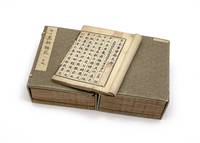
ref. 11212Collected & edited by Jiang Shaoyu 江少虞. Complete in 78 parts plus table of contents bound in 15 vols. full collation supplied in the Hyde catalogue. Large 8vo 286 x 215 mm. early paper wrappers new stitching. Japan: chokuban privately published by the Emperor Go-Mizunoo’s order 1621. First edition and a fine complete set of one of the very few surviving “imperial editions” printed with movable type kokatsujiban å¤æ´»å—版. There is considerable modern debate with no definitive conclusion whether this book was printed with metal or wooden type see below. It is of very great rarity and we find no printed copy in WorldCat. This enormous publication is by far the largest of the eight surviving chokuban imperial printings and the only surviving Gen’na chokuban 元和勅版 — imperial printing during the reign 1611-29 of Emperor Go-Mizunoo 後水尾天皇 1596-1680. The production of this large work was a very complex and difficult project employing the recently imported technology of movable type from Korea. The Song dynasty editor Jiang Shaoyu active 12th century compiled the substantial encyclopedia Huang Song shi shi lei yuan 皇宋事實類苑 of the writings of Chinese courtly scholars completed in 1145. Encouraging the preservation of Chinese traditions long valued by aristocrats Emperor Go-Mizunoo continued the project initiated by his father Emperor Go-YÅzei of printing imperially commissioned volumes of Chinese literary classics with the present work a collection of Confucian texts that were considered both an ethical and a literary legacy of the court. Some of the many topics include music medicine painting calligraphy supernatural events safeguarding the border and controlling the unruly. “The earliest surviving books printed in Korea with movable type date from the late fourteenth century…During the invasion of the Korean peninsula undertaken by Toyotomi Hideyoshi in the closing years of the sixteenth century…large numbers of printed books were looted and printing type was removed from the Printing Office and taken to Japan…It appears that Korean type was immediately put to use to print the text of the…Kobun kokyo Classic of Filial Piety in 1593 although no copies of this appear to have survived. In 1597 in the postface to another work printed in Japan with movable type a monk who was present at Hideyoshi’s headquarters acknowledged that typography in Japan had come from Korea. It was not clear whether any Korean printing artisans came to Japan as well as a result of the invasion but in any event the impact on Japan of Korean typography both technologically and intellectually was far greater than that of the Jesuit Mission Press principally because the imported Korean typography was much closer to the centres of power in Japan than the increasingly precarious Jesuit missions.”–Kornicki The Book in Japan p. 129. Emperor Go-YÅzei who nominally ruled Japan from 1586 to 1611 “displayed great enthusiasm for the new process and not content with the original type brought back from Korea ordered a new set of wooden type to be made. This was engraved between 1597 and 1602 and the books printed from this new type are generically known as choku-han or ‘imperial printings.’ Indeed ‘imperial’ is a fitting description of these works for they are among the finest unillustrated books ever produced in Japan. Not only was the typeface larger but the best-quality paper and the finest ink were used to achieve effect. Very few choku-han works were actually printed between 1597 and 1603 actually 1621 and if we exclude the 1593 edition of Kobun kokyÅ almost all the titles were copies of Chinese philosophical classics… “One other choku-han is known to have been printed by order of Emperor Go-Mino-o Emperor Go-YÅzei’s son and successor in 1621 and that is the Horuien the present work although one or two other titles were printed and have been lost. All these works are considerable examples of the printer’s art and show how quickly the Japanese were able to make full and aesthetic use of movable type.”–Chibbett The History of Japanese Printing and Book Illustration p. 69. At the time of the writing of the Hyde sale catalogue it was believed that the present work was printed with copper type; the latest research has suggested that wooden type was used. No final conclusion has been reached. See Kornicki Printing Technologies and Book Production in Seventeenth-Century Japan Cambridge: 2025 p. 26 for a discussion. Very fine and fresh set. Minor worming carefully repaired. Final volume with some dampstaining. Preserved in two chitsu. From the RokuÅ-in 鹿王院 temple in Kyoto and the library of Donald and Mary Hyde their sale Christie’s NY 7 October 1988 lot 87. With the provenance seal å¼˜æ–‡è˜ “KÅbunshÅ” the trade name of Sorimachi Shigeo å町茂雄 1901-91 the “H.P. Kraus of Japan.”. unknown books