1404 resultados
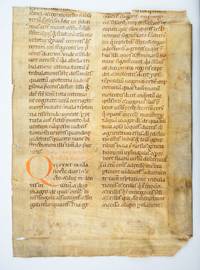
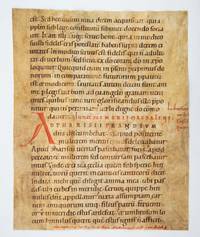
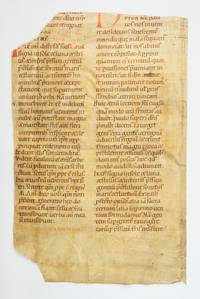
ref. ST20617eAustria Salzburg second half of 12th century. Unevenly trimmed but approximately 362 x 234 mm. 14 1/4 x 9 1/8". Double column 31 extant lines in a lovely proto-gothic hand. Rubrics in red remains of two large multi-line initials in red. Lower margin of recto with modern note in red ink in very small letters identifying the text. Recovered from a binding and thus unevenly trimmed top margin and a small part of text trimmed away at the top a handful of tiny cuts and holes of no significance vellum a little brownish but the leaf rather smooth and the majestic text entirely legible. This lectionary fragment which contains two important patristic sermons for the season of Advent demonstrates a highly regular graceful and majestic proto-gothic book hand. The oval-shaped elongation of Caroline letter forms characteristic of 12th century book hands and the mixture of rustic and uncial capitals our scribe has used for section titles appear particularly pleasing in the lovely uncramped hand at work here. The text on the recto is from St. Augustine's second Advent sermon one of a series of homilies written for the liturgical seasons. The verso contains St. Gregory's homily for the first Sunday of Advent preceded by Luke 21:25-33 a rehearsal of the signs of the end of days. The homily draws on this gospel passage to exhort the faithful to prepare themselves for the second coming. The present leaf almost certainly belonged to a Lectionary owned by a Romanesque church in Salzburg a manuscript that was later dismembered for use in bookbinding. According to the source from which we purchased this leaf it was shown in 1893 to Willibald Hauthaler 1843-1922 the Medieval historian and later the Abbot of St. Peter's Salzburg who wrote the identification along the lower edge. It was later owned by the Salzburg-based merchant artist and collector Carl von Frey 1826-96. It appeared at Christie's in 2010 where along with five sister leaves it sold for £13970. unknown
ref. ST20617fAustria Salzburg second half of 12th century. Unfolded: 350 x 296 mm. 13 3/4 x 11 3/4 mm. Double column 30 extant lines in a lovely proto-gothic hand. Rubrics in red two four-line initials in red. Recovered from a binding and thus with top margin and a small part of text trimmed away verso rather darkened with soil and glue part of the text readily legible the rest recoverable with effort negligible wormholes and small cuts but still a pleasing leaf with the recto rather clean and quite easy to read. This lectionary fragment which contains extracts from patristic writings for the season of Advent demonstrates a majestic highly regular and graceful proto-gothic book hand. The oval-shaped elongation of Caroline letter forms that are characteristic of 12th century book hands along with the mixture of rustic and uncial capitals our scribe has used for section titles appear particularly pleasing in the lovely uncramped hand at work here. The majority of the text is from St. Augustine of Hippo's "Quaestiones Evangeliorum" which provides a series of questions and answers regarding the Gospels of Luke and Matthew. The section of the work here XLIV discusses Luke 17:34-35 in which Jesus tells of the coming Kingdom of God. This text is preceded by Pope Gregory the Great's homily for the second Sunday of Advent. The final column of text on the verso is unfortunately rather rubbed and therefore difficult to identify but the headline indicates that it originates from a sermon of Pope Leo the Great. The present leaf almost certainly belonged to a Lectionary owned by a Romanesque church in Salzburg a manuscript that was later dismembered for use in bookbinding. According to the source from which we purchased this leaf it was shown in 1893 to Willibald Hauthaler 1843-1922 the Medieval historian and later the Abbot of St. Peter's Salzburg who wrote the identification along the lower edge. It was later owned by the Salzburg-based merchant artist and collector Carl von Frey 1826-96. It appeared at Christie's in 2010 where along with five sister leaves it sold for £13970. unknown
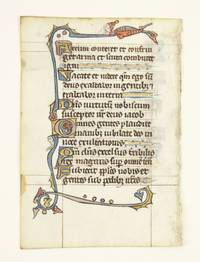
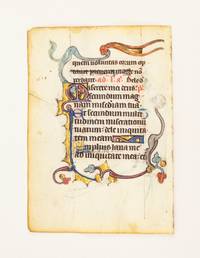
ref. ST16379-008France late 13th century. 125 x 88 mm. 4 7/8 x 3 1/2". Single column 15 lines in a gothic book hand. Attractively matted. Folio number in red several line enders in gold with blue penwork 10 one-line initials in gold on blue and pink ground one two-line initial painted pink and filled with blue and orange acanthus on gilt ground verso with a three-quarter border branching from the larger initial composed of pink and blue curling lines accentuated with gold spikes bezants and painted ivy leaves UPPER BRANCH TERMINATING IN A WONDERFUL HYBRID CREATURE WITH THE FACE OF A MAN AND THE BODY OF AN ORANGE BEAST AND THE LOWER BRANCH INCORPORATING ANOTHER FACE WITH A LONG BEARD. From the collection of Joseph Pope his MS Bergendal 116 about whom see below. ◆A little soiling and staining along edges of vellum and a couple of small marks in lower margin verso but in excellent condition overall the paint especially bright and fresh. From the distinguished collection of Canadian financier Joseph Pope 1921-2010 this charming leaf comes from a small-format Psalter intended for private use and features two amusing drolleries incorporated into the marginal design. Pope's collection was sold by Sotheby's on 5 July 2011 where this leaf appeared as part of lot 115; it was later listed in Quaritch Catalogue 1422 no. 88 which states that "according to Pope's note this leaf was found tipped in to a much later Book of Hours his MS Bergendal 64--produced in the southern Netherlands for a southern French patron during the first half of the 15th century--at f. 94 the middle of the Penitential Psalms; the manuscript was acquired by Pope at Sotheby's sale of 6 December 1983 lot 79.". unknown
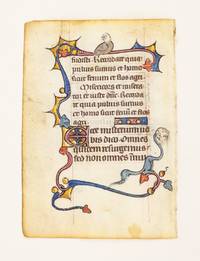
ref. ST16985LFrance first half of 14th century. 110 x 82 mm. 4 3/8 x 3 1/4". Single column 12 lines in a gothic book hand. Line enders in pink and blue with gold accents each leaf with one or more one-line initials in blue with red penwork or gold with blue penwork each leaf with one two line initial painted pink or blue filled with painted floral motifs and on a gold or blue ground one side of each leaf with A NEAR-FULL BORDER composed of pink and blue tendrils accompanied by spikey gold decoration and gold accents often terminating in ivy leaves and incorporating EXTRAORDINARILY CHARMING EXAMPLES OF MARGINALIA INCLUDING ANIMALS HUMANS AND HYBRIDS. ◆Vellum a little soiled and lightly stained and wrinkled in places some of the gold a bit rubbed one leaf with some noticeable smudging affecting some of the text and decoration including the head of one of the hybrids but the other examples of marginalia quite well preserved and still retaining much of their original charm. Though diminutive in size these leaves contain enormously appealing marginal decoration in the form of humans animals and hybrid creatures inventively incorporated into the lively borders in manners that range from adorable to bizarre. Especially popular in Flanders Northern France and England during the 13th and 14th centuries marginalia such as these comprise some of the most memorable and entertaining images to be found in any Medieval manuscripts. Despite being found largely in religious books such as Psalters and Books of Hours the images are often strange humorous or even outrageous and they provide us with consistent delight. Being by definition outside of the central text or miniature the margins seem to have been a place where illuminators felt more at ease to experiment resulting in highly imaginative and unique artistic expressions. The present specimens come from a fragmentary manuscript with many leaves either missing or rendered defective where portions of the vellum were cut away. Fortunately this group of leaves is intact and retains much marvelous imagery including a particularly annoyed-looking bird two human-beast hybrids with long necks and bushy tails and a trumpeter emerging from the border decoration blowing into a long instrument decorated with gold accents. For additional leaves from this same manuscript at different price points please check our website. unknown
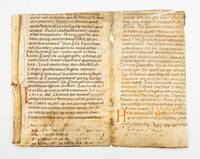
ref. ST20509c-dGermany Late 11th or early 12th century. Larger bifolium measures 221 x 275 mm. 8 7/8 x 10 3/4".; smaller bifolium measures 207 x 275 mm. 8 1/8 x 10 3/4". Single column 25-27 lines in a late Caroline hand. Rubrics in orange each bifolium with one or more one-line initial in orange and one or more large four- to five-line initials in orange. With marginal notations in a later hand. Recovered from a binding and thus with some soiling abrasions glue residue and other small problems as well as limited loss of legibility in a few places; the pages nearly complete but with a couple of letters and/or lines cut away from one side of each bifolium; even with the problems very good specimens overall the letters on the better side quite clear and readable in each case. Once part of a Lectionary a collection of scriptural readings appropriate for Masses and other ceremonial occasions through the year these attractive mostly legible binding fragments display an excellent transitional script with both Caroline minuscule and proto-gothic characteristics. The present examples include short lessons or "lectiones" taken from the Old and New Testaments including among other passages excerpts from John in which Christ casts the sellers out of the temple and Daniel relating the prayers of the three men who refused to bow to Nebuchadnezzar's golden idol. The lovely script here shares much in common with the pure Caroline miniscule of earlier centuries--particularly in the overall legibility of the text the space between individual letters and the limited use of ligatures and abbreviations; also of note is the exclusive use of the long "s" unless at the beginning of a sentence and the ampersand as a general abbreviation for the letters "et" occurring anywhere in a word e.g. "propheta" written "proph&a" here. Evidence of a progression toward proto-gothic script can be observed here in the appearance of certain letter forms such as the closed "g" a more oval "o" and the use of two forms of "d" both upright and Uncial the latter with a sloping shaft. There is added interest here in the form of marginal notations in a later hand--probably dating from the time these bifolia were in situ as binding waste. The price given here is for one bifolium. unknown
ref. 105895Dutch school: c. 1450 or later. Single leaf 138 x 98mm. Miniature without text image of Christ before Caiaphas being held by a soldier with a jester dancing behind Him disciples behind Him with a cock sitting above the three-sided border of simple flowers. In good condition. § Origin and provenance unknown; from a private California collection. c. 1450 or later. Single leaf unknown books
ref. 8719Central Italy c.1250. Matted in fine condition. § A well-painted initial of a man in flowing blue and pink robes holding a book to which he gestures probably Saint Paul. Italian miniature paintings of this period are known to be difficult to localize with any accuracy but as the face is strongly drawn with well-proportioned features it might well hail from central Italy. unknown books
1450ref. 1058951450. Dutch school: c. 1450 or later. Single leaf 138 x 98 mm. Miniature without text image of Christ before Caiaphas being held by a soldier with a jester dancing behind him disciples and a cockerel seen through a doorway in the courtyard beyond within a three-sided border of simple flowers. In good condition. § Origin and provenance unknown; from a private California collection. unknown
ref. 87191250. Central Italy c.1250. Matted in fine condition. § A well-painted initial of a man in flowing blue and pink robes holding a book to which he gestures probably Saint Paul. Italian miniature paintings of this period are known to be difficult to localize with any accuracy but as the face is strongly drawn with well-proportioned features it might well hail from central Italy. unknown
1918ref. 015759Paris Editions de la Sirène 1918 In-8 carré Reliure
1986ref. 010342Genève La Revue des Belles-Lettres n°3-4 1986 fort in-8 Broché, couverture rempliée
1768ref. 8518A Paris, l'Auteur... chez Mr. Levinville, luthier ; gravé par Mme Vendôme, imprimé par Montuhai, sans date (circa 1768) ; in-folio ; plein vélin vert, grande pièce de titre de maroquin grenat entourée d'un large décor doré sur le premier plat (reliure de l'époque) ; (2) ff. (titre-frontispice, titre, dédicace au duc de Chartres, planche représentant une mandoline), 67 pp., imprimé sur vergé fort. Ouvrage entièrement gravé.
ref. ST12083eItaly ca. 1150. 406 x 273 mm. 16 x 10 3/4". Double column 42 lines in a fine rounded early proto-gothic hand. Recto with a pleasing three-line red initial. ◆Formerly used in a binding and consequently a bit soiled and trimmed at the head with loss of the first line perhaps 100 or so small wormholes in the margin only a few causing trivial harm to the text a faint grayish stain affecting a couple of words in the top 20 lines of one column on each side but the entirety of the text completely clear and the stately leaf quite fresh and unusually well-preserved in general for a recovered specimen. This leaf comes from a very large copy of one of the major texts by one of the great popes of the early Middle Ages. Dealing in part with the central occurrence in the salvation of humanity the text here treats of John 20:19-31 which tells of the risen Christ's appearance to the Apostles. Doubting Thomas insists on touching the Lord's wounds before he will be convinced of the Resurrection. Gregory tells his audience that Thomas was healed of unbelief and so must they be although they cannot see Jesus in the flesh as did Thomas. Written ca. 593 Pope Gregory's 40 homilies on the Gospels enjoyed enduring popularity throughout Medieval times as they offered ordinary Christians practical guidance on applying the lessons of the Gospels to their own lives. Elected pope in 590 Gregory ca. 540-604 was one of the most influential pontiffs in the history of the Church. In addition to revising liturgical worship he wrote extensively on theology offering homespun wisdom rather than esoteric debates. He was declared a saint immediately upon his death. The script here is regular rounded and very pleasing--almost soothing--to the eye. Moreover the letters are so large and there is so little significant damage to the leaf that the text can be easily read from a considerable distance. unknown
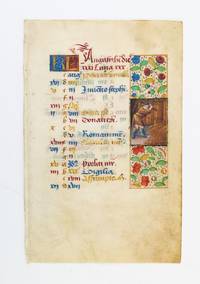
1470ref. ST17245-09Northern France probably Rouen ca. 1470. 180 x 117 mm. 7 x 4 5/8". Single column 18 lines text in a bâtarde hand. Text in red blue and gold two-line "KL" in shell gold on blue and red ground both sides with panel border composed of flowers and ink dots WITH TWO SMALL MINIATURES each centered in the middle of the panel borders featuring the labor of the month Threshing and the zodiac sign a young woman for Virgo. Vellum a bit soiled and slight wrinkling in margins small area of rubbing at bottom of the Virgo miniature but in excellent condition overall the fine details in the miniatures well preserved. Situated among the flowers of the panel borders here are two small but charming miniatures depicting the labor of the month "Threshing" and the zodiac sign for August. According to Roger Wieck far fewer than half the Books of Hours of the period contain illustrated calendars "even in manuscripts with otherwise lavish cycles of miniatures"; when they do appear they are invariably charming as is the case here. In the threshing scene a young layman brings down his grain flail two hinged pieces of wood the longer one called a helve and the other a beater joined by a thong in an effort to separate the grain while neatly gathered bushels of straw appear just behind him. On the verso we see a representation of Virgo as a young woman holding appropriately two long stalks of grain in her hands. The rich palette used in these miniatures allows the delicate gold highlighting on the harvested crop and garments to shine through adding a fine sense of detail to each image. unknown
ref. ST12668bJNortheastern France probably Arras late 15th century. 146 x 95 mm. 5 3/4 x 3 3/4". Single column 15 lines in a pleasing bâtarde hand. Rubrics in red one- and two-line initials in brushed gold on a red or blue ground EACH SIDE OF EACH LEAF WITH A BRUSHED GOLD PANEL BORDER WITH VERY PRETTY ILLUSIONISTIC FLOWERS; EACH LEAF WITH TWO SMALL MINIATURES measuring approximately 40 x 25 mm. depicting saints shown with their attributes. Headlines written in French in a later 18th century calligraphic hand. ◆Light soiling rubrics faded otherwise excellent specimens generally clean and smooth with ample margins attractive decoration and shining gold. From a charmingly decorated 15th century prayer book these lovely leaves offer the opportunity to acquire a miniature and considerable gold ornamentation at an attainable price. One leaf depicts St. Andrew holding an "X" shaped cross and St. Etienne i.e. St. Stephen here shown with three stones on his body and the other shows St. Remigius the so-called "Apostle of the Franks" and St. Quentin--a saint that was particularly venerated in France especially in the north whence we be believe these leaves originated. For other leaves from this same manuscript please check our website. unknown
1430ref. ST20979aParis ca. 1430. 191 x 140 mm. 7 1/2 x 5 1/2". Single column 16 lines in an elegant gothic book hand. Rubrics in gold line-fillers with color foliate and geometric designs on burnished gold ground two one-line initials and three two-line initials in blue or pink enclosing colored vines with foliage on gold ground one four-line initial in blue with white decoration enclosing a lattice pattern each compartment with an orange or blue leaf on gold ground BOTH SIDES WITH A DENSE RINCEAUX BORDER consisting of colorful acanthus flowers and many hairline vines terminating in gold leaves ivy and seed pods and with numerous gilt bezants. With just a couple tiny scuffs to paint and with slight rubbing to some of the small gold details but in lovely condition. This is an opulently decorated leaf from a Book of Hours offered in fine condition with glittering rinceaux borders delicate initials and luxurious gold rubrics. These sumptuous details and the high quality of the work indicate that this leaf was part of a costly manuscript commissioned by a wealthy patron. Other leaves from the same parent manuscript were sold at Bloomsbury on 6 December 2017 lots 63 and 64. One of these leaves showed St. Genèvieve leading the female saints in the Litany pointing to Paris as the place of origin. unknown
1630ref. 11321Antverpiae, Joan Galle, (circa 1630) ; F. Ioannes Nys invenit, Peter de Jode figuravit, Theodor Galle sculpsit et excudit ; titre gravé, portrait et 32 planches légendées. SUIVI de 4 planches gravées par JOAN GALLE : I- Prudentia, II- Justitia, III- Fortitudo, IV- Temperantia (les 4 vertus cardinales). SUIVI de 14 planches de sujets religieux, gravées par CORNELIUS GALLE le Vieux : Silva sacra, Fugit familia sacra, S. Barbara, S. Ianvarius Neapolis patronis, S. Lucia, S. Leontius martyr miraculis gloriossus in Muris Helvetiorum, S. Iacobus Maior, Benedicite omnes bestiae et pecora domino, S. Hieromymus, Vierge à l'Enfant, etc. Soit en tout 52 planches, reliées en 1 volume petit in-4 ; plein vélin ivoire, titre au dos, tranches rouges (reliure du XIXe).
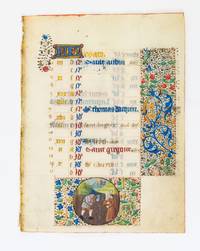
ref. ST17245-04France possibly Rouen mid-15th century. 173 x 130 mm. 6 3/4 x 5 1/8". Single column 16 ruled lines text in a gothic book hand. Text in gold blue and dark pink "KL" in blue with white tracery on a gold ground decorated with dark pink baubles and leaves and with a floral spray extension both sides with panel border composed of densely packed acanthus flowers and hairline vines with gold bezants WITH A SMALL ROUNDEL MINIATURE at the bottom depicting the labor of the month Pruning set on a panel of flowers hairline vines and gold bezants. With numbering to the left of the golden numbers and a few calendar entries in a later hand. ◆Light soiling to vellum a few small smudges in the borders a little paint transfer affecting a couple lines of text and margins of the verso but these issues all very minor and on the whole in fine condition with a particularly well-preserved miniature with rich uneroded paint. With lovely panel borders and a particularly charming roundel miniature showing the labor of the month this leaf likely comes from a high-quality manuscript made for a person of means. Though miniatures depicting the labors of the month are often illustrated with just a single person performing the task here we are treated to two laypeople--a man and a woman--working together to prune and break ground in their field. The man appears to be carrying an axe for trimming branches while the woman carries a long stick to loosen dirt for spring plantings. The names of several saints have been added to the calendar by a later hand though it would appear that they were erroneously placed in March: St. Hugh belongs on 9 April Pope Leo on 11 April and St. Tiburtius on 14 April. While almost all of these feast days are commonly found in Books of Hours of this period Hugh Bishop of Rouen is slightly unusual suggesting that the manuscript may have been made in or at least ended up in Rouen. unknown
1415ref. ST19350-056Germany and Low Countries 14th & 15th centuries. Smallest piece: 209 x 152 mm. 8 1/8 x 5 7/8"; largest piece: 372 x 235 mm. 14 3/4 x 9". Recovered from bindings and thus with uneven trimming and occasional small holes resulting in loss staining and toning to vellum some leaves with remnants of pastedowns obscuring the script but generally the leaves quite legible substantially complete and in presentable condition. This packet contains five vellum manuscript leaves all complete or nearly so all with musical notation and all serving as linings or covers of a binding when reused in their second lives. Prepared with an academic audience in mind the group presents an excellent opportunity for libraries teachers and students to develop or expand their teaching or personal collections. In addition to their obvious value as manuscripts containing the text and music of the Medieval period these leaves are also of educational importance as physical artifacts demonstrating the reuse of manuscript material in the production of later bindings. The shape of each binding is still easily discernable and a few of these specimens even include early spine labels and ink notations as well as paper remnants used in the bookbinding process. unknown
ref. 8716German: c. 1500. Single leaf 132 x 155 mm. Very good matted. § An intriguing painting showing the instruments of the Passion a crowing cock the head of Judas the thirty pieces of silver &c. A somewhat surreal piece with the head and some of the instruments floating in the air against a rich blue background Christ standing before a tomb clad in loincloth and red cloak with a blue cloak on the tomb a ladder and pillar at each side. Some surface wear and damage within the image which is also cropped slightly but an interesting and unusual painting. c. 1500. Single leaf hardcover books
1891ref. ST15049London: Seeley and Co 1891. No. 85 OF 160 COPIES ON LARGE PAPER. 382 x 275 mm. 15 x 10 3/4". 4 p.l. 111 1 pp. Publisher's gilt-stamped vellum upper cover with titling and the Tennyson coat of arms BOTH COVERS WITH LOVELY HAND-PAINTED DESIGN BY JOHN T. BEER upper cover with urn at foot and blooming rose branches emanating from a medallion bearing the date 1902 and curving around the title and escutcheon lower cover with branches of apple blossoms dividing the board into quadrants each inhabited by a bird in flight smooth spine with gilt titling edges untrimmed. With frontispiece photographic portrait of Tennyson 31 vignettes in the text and 14 copper-plate engravings after drawings by Edward Hull. Verso of title page and limitations page with ink stamp of Gloucester County Library. Weber "The Fore-Edge Paintings of John T. Beer" 195. Small scratch near head of front joint minor soiling and rubbing to edges of boards mild foxing mostly marginal and not affecting copper engravings otherwise an excellent copy clean and fresh internally with wide margins the binding especially bright the pretty decoration perfectly preserved. AN EXTREMELY ATTRACTIVE COPY. This very large format deluxe illustrated work describing the places associated with England's beloved Poet Laureate Alfred Lord Tennyson is enhanced by former owner John T. Beer's Arts & Crafts-style embellishments to the vellum binding. After retiring from a successful career as a clothier Merseyside book collector Beer ca. 1826-1903 occupied himself decorating books from his library mostly with fore-edge paintings but in a score of instances with painted bindings. Jeff Weber considers Beer "one of the most highly skilled artists of fore-edge paintings" noting that he was the first artist to put his signature to such works. Weber's catalogue raisonnée of Beer's works lists 189 fore-edge paintings 22 painted bindings including this one #195 and three bindings designed by Beer and executed by Fazakerley of Liverpool. The design here is clearly influenced by the Arts & Crafts movement and Beer owned several works by William Morris including a Kelmscott Press "Godefrey of Bologne" on the vellum covers of which he had painted a design of tulips and lilies. Among the locations discussed and pictured in the "The Laureate's Country" are Tennyson's childhood homes in Somersby and Bag Enderby Trinity College Cambridge where he matriculated and his estates Farringford on the Isle of Wight and Aldworth in West Sussex. Seeley and Co unknown
ref. ST20617bAustria Salzburg second half of 12th century. 298 x 232 mm. 11 3/4 x 9 1/4". Single column 26 lines in a lovely proto-gothic hand with two lines of uncials. Rubrics in red two two-line initials in red one four-line initial in red. Lower margin of recto with a 20th century note in very small letters in red ink see below. Recovered from a binding and thus with overall darkening though the recto much less affected by this four lines of contemporaneous annotations slightly trimmed though good margins all the way around vertical crease with small wormholes and tears touching text but not affecting legibility other minor defects but on the whole quite well preserved and entirely legible. Containing a large elegant initial and a beautiful proto-gothic script featuring two rows of uncials this leaf is an excellent example of early Austrian manuscript production. The text here includes the end of a homily by the Venerable Bede followed by the rubric for the Feast of the Birth of Mary Magdalene July 22 commencing with St. Gregory the Great's Homily 33 beginning "Ad Pharisei prandium dominus discumbebat" from his "Homilies on the Gospels." The homily played an important role in Christian understanding of Mary Magdalene as a penitent sinner identifying her for the first time as the unnamed "sinful woman" who comes to anoint Christ's feet at the house of a Pharisee Luke 7:36-50 and conflating her with Mary of Bethany sister to Martha and Lazarus. Although modern scholarship now differentiates these three women Gregory's interpretation of Mary Magdalene as a reformed prostitute has persisted for centuries. The present leaf almost certainly belonged to a Lectionary owned by a Romanesque church in Salzburg a manuscript that was later dismembered for use in bookbinding. The script is particularly pleasing being large and dignified with extremely regular letterforms executed by a steady hand. According to the source from which we purchased this leaf it was shown in 1893 to the Medieval historian and later the Abbot of St. Peter's Salzburg Willibald Hauthaler 1843-1922 who wrote the identification in red ink along the lower edge. It was later owned by the Salzburg-based merchant artist and collector Carl von Frey 1826-96. It appeared at Christie's in 2010 where along with five sister leaves it sold for £13970. unknown
ref. ST12668bHNortheastern France probably Arras late 15th century. 146 x 95 mm. 5 3/4 x 3 3/4". Single column 15 lines in a pleasing bâtarde hand. Rubrics in red one- and two-line initials in brushed gold on a red or blue ground EACH SIDE OF LEAF WITH A BRUSHED GOLD PANEL BORDER WITH VERY PRETTY ILLUSIONISTIC FLOWERS AND FRUITS and intricate strapwork design in colors; WITH TWO SMALL MINIATURES measuring approximately 40 x 25 mm. depicting John the Baptist and John the Evangelist shown with their attributes. Headlines written in French in a later 18th century calligraphic hand. ◆Light soiling a touch of paint loss to frames and background not very noticeable and not affecting the figures otherwise an excellent specimen generally clean and smooth with ample margins winning decoration and shining gold. From a charmingly decorated 15th century prayer book this leaf offers the opportunity to acquire two particularly nice miniatures each depicting an important saint. The recto shows St. John the Baptist with a lamb at his side and a book balanced on his knee; and the verso depicts St. John the Evangelist as a young man holding a chalice with what ought to be snakes emerging from it in reference to the poisoned cup he was invited to drink as a test of faith but which instead look more like tendrils of smoke. For other leaves from this same manuscript please check our website. unknown
ref. ST16985MFrance First half of 14th century. 110 x 82 mm. 4 3/8 x 3 1/4". Single column 12 lines in a gothic book hand. Line enders in pink and blue with gold accents each leaf with one or more one-line initials in blue with red penwork or gold with blue penwork each leaf with one two line initial painted pink or blue filled with painted floral motifs and on a gold ground one side of each leaf with A NEAR-FULL BORDER composed of pink and blue tendrils accompanied by spikey gold decoration and gold accents often terminating in ivy leaves and incorporating EXTRAORDINARILY CHARMING EXAMPLES OF MARGINALIA INCLUDING HUMAN-BEAST HYBRIDS. ◆Vellum a little soiled and with a few small stains one leaf with more noticeable smudging affecting some of the text and decoration another leaf with one of the heads a little rubbed but all other examples of marginalia very well preserved. Though diminutive in size these leaves contain enormously appealing marginal decoration in the form of humans animals and hybrid creatures inventively incorporated into the lively borders in manners that range from adorable to bizarre. Especially popular in Flanders Northern France and England during the 13th and 14th centuries marginalia such as these comprise some of the most memorable and entertaining images to be found in any Medieval manuscripts. Despite being found largely in religious books such as Psalters and Books of Hours the images are often strange humorous or even outrageous and they provide us with consistent delight. Being by definition outside of the central text or miniature the margins seem to have been a place where illuminators felt more at ease to experiment resulting in highly imaginative and unique artistic expressions. The present specimens come from a fragmentary manuscript with many leaves either missing or rendered defective where portions of the vellum were cut away. Fortunately this group of leaves is intact and retains much marvelous imagery including a beast with an exaggeratedly long body and horns and long-necked beasts with human heads--one who appears to be blowing smoke into the air one with a bearded face as its bottom and another with the body of a stork sporting a hat with a long pointy tendril. For additional leaves from this same manuscript at different price points please check our website. unknown
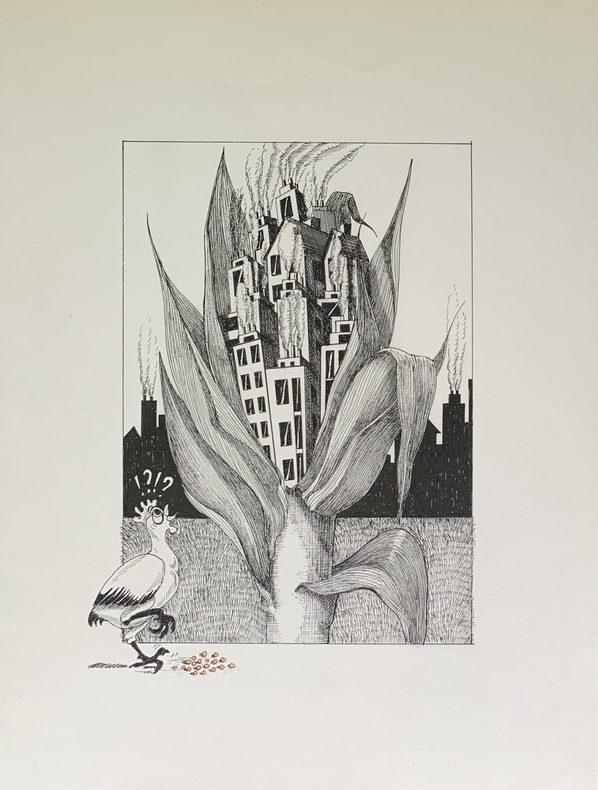
ref. awd-106458 encres originales sur vélin au format 32/24 cm (dont 40 avec ajouts localisés aux crayons de couleur et 3 signées et datées 9-86) insérées dans un book en skaï gris texturé (35,5/29,2/3,8 cm).