20.759 resultados
1951ref. 137061Los Angeles: Twentieth Century-Fox 1951. Shooting Final Draft script for the 1952 film. Brief annotations in manuscript pencil on a few pages. Included is a vintage black-and-white still photograph from the UK release circa 1952 of the 1952 US film. Features Jean Peters with distributor rubber-stamps on the verso. Based on Ferdinand Reyher's 1946 novel about a barber Wayne at the turn of the century watching his small town grow around him. He tries to shield his wife Nellie Peters from the outside world but she rebels while he is away at war and takes a fateful trip to Chicago in what turns out to be the first of a string of crises. Overall a stunning portrayal of early twentieth century midwestern Americana. Set in the fictitious town of Sevillinois Illinois and shot on location in Castleton Hutchinson and Pretty Prairie Kansas. Cream titled wrappers noted as SHOOTING FINAL on the front wrapper rubber-stamped copy No. 7 dated July 23 1951. Distribution page present with receipt intact. Title page present dated July 23 1951 noted as Shooting Final with credits for screenwriter Scott and novelist Reyher. 114 leaves with last page of text numbered 112. Mimeograph on eye-rest green stock. Pages Near Fine wrapper Very Good plus bound internally with three gold brads. Twentieth Century-Fox unknown books
1950ref. 138397Universal City CA: Universal Pictures 1950. Two post-production Continuity and Dialogue scripts for the 1950 film. Included are a script for the feature dated March 15 1950 and a script for the film's trailer dated March 20 1950. In this key film noir James Mason reprises in spirit his role from the British film noir "Odd Man Out" made three years before as a criminal who steals from the mob and is forced to go on the lam with mob boss Dan Duryea in no mood for forgiveness. The first American film to be directed by Argentinian import Hugo Fregonese. The AFI Catalog notes that Mexican Vice Consul Ernesto Romero acted as technical advisor and according to studio production notes an entire Mexican village was built on the Universal-International lot. Rodolfo Acosta Emma Roldan and Margarito Luna were all Mexican actors. Finally popular character actor James Best made his debut in "One-Way Street" appearing briefly in an uncredited role as a "Driver." Titled wrappers dated March 15 1950 and March 20 1950 both rubber-stamped 7684 with credits for actors Mason Toren Duryea Ruysdael Conrad Acosta Donovan and Espinoza as well as director Fregonese. Feature script noting nine reels 116 leaves; trailer script comprised of 7 leaves. Mimeograph on white stock. Feature script bound at the top with two silver brads; trailer script with punch holes top-stapled. Near Fine overall. Grant US. Selby Canon US. Silver Classic Noir. Spicer US. Universal Pictures unknown
1950ref. 138397Universal City CA: Universal Pictures 1950. Two post-production Continuity and Dialogue scripts for the 1950 film. Included are a script for the feature dated March 15 1950 and a script for the film's trailer dated March 20 1950. In this key film noir James Mason reprises in spirit his role from the British film noir "Odd Man Out" made three years before as a criminal who steals from the mob and is forced to go on the lam with mob boss Dan Duryea in no mood for forgiveness. The first American film to be directed by Argentinian import Hugo Fregonese. The AFI Catalog notes that Mexican Vice Consul Ernesto Romero acted as technical advisor and according to studio production notes an entire Mexican village was built on the Universal-International lot. Rodolfo Acosta Emma Roldan and Margarito Luna were all Mexican actors. Finally popular character actor James Best made his debut in "One-Way Street" appearing briefly in an uncredited role as a "Driver." Titled wrappers dated March 15 1950 and March 20 1950 both rubber-stamped 7684 with credits for actors Mason Toren Duryea Ruysdael Conrad Acosta Donovan and Espinoza as well as director Fregonese. Feature script noting nine reels 116 leaves; trailer script comprised of 7 leaves. Mimeograph on white stock. Feature script bound at the top with two silver brads; trailer script with punch holes top-stapled. Near Fine overall. Grant US. Selby Canon US. Silver Classic Noir. Spicer US. Universal Pictures unknown books
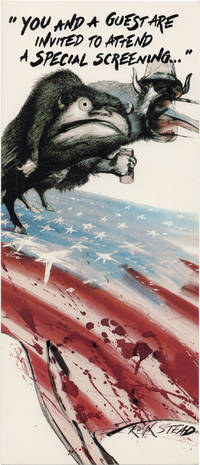
1980ref. 158084Universal City: Universal Pictures 1980. Vintage screening invitation for the 1980 film illustrated by Ralph Steadman on the recto with film credits on the verso. More than a little loosely based on Hunter S. Thompson's obituary for his closest associate Oscar Zeta Acosta a.k.a. Dr. Gonzo "The Banshee Screams for Buffalo Meat" which appeared in October 1977 issue of "Rolling Stone." A film that despite being an unholy mess represents in retrospect an intersection of ideas and talent as well as the first of many messy attempts to commit to celluloid the basically un-filmable life and work of Hunter S. Thompson. Bill Murray at this time little more than a droll comedic sensation arguably made the first step toward becoming the four-dimensional icon he is today though not necessarily by intention. Both Murray and Thompson had serious concerns about the quality of Kaye's script and at the beginning of filming both Thompson and Ralph Steadman came onto the set as "executive consultants." Though the author says he did little other than "wander around and fire machine guns" his influence on Murray was profound. The actor became obsessed with his idol and by all accounts became one with him. During production Murray and Thompson engaged in a series of dangerous one-upmanship contests including a Houdini-inspired stunt where Thompson tied Murray to a chair and threw him into a swimming pool. Murray nearly drowned before Thompson pulled him out. The pair's obsession with the film's poor script and continuity led to a hasty final addition of a voice-over narration and two explanatory scenes at the film's end. Three days prior to release a press screening was canceled because the film was still being edited. When Murray returned to the Saturday Night Live set in the fall of 1980 he was still immersed in character complete with long black cigarette holder dark glasses and nasty habits. One of the show's writers said that Murray .".was not Bill Murray he was Hunter Thompson. You couldn't talk to him without talking to Hunter Thompson." Doug Hill and Jeff Weingrad "Saturday Night Live: A Backstage History" William Morrow 1989 3.75 x 9 inches with a satin finish recto and matte verso. Fine. Universal Pictures unknown
1980ref. 158084Universal City: Universal Pictures 1980. Vintage screening invitation for the 1980 film illustrated by Ralph Steadman on the recto with film credits on the verso. More than a little loosely based on Hunter S. Thompson's obituary for his closest associate Oscar Zeta Acosta a.k.a. Dr. Gonzo "The Banshee Screams for Buffalo Meat" which appeared in October 1977 issue of "Rolling Stone." A film that despite being an unholy mess represents in retrospect an intersection of ideas and talent as well as the first of many messy attempts to commit to celluloid the basically un-filmable life and work of Hunter S. Thompson. Bill Murray at this time little more than a droll comedic sensation arguably made the first step toward becoming the four-dimensional icon he is today though not necessarily by intention. Both Murray and Thompson had serious concerns about the quality of Kaye's script and at the beginning of filming both Thompson and Ralph Steadman came onto the set as "executive consultants." Though the author says he did little other than "wander around and fire machine guns" his influence on Murray was profound. The actor became obsessed with his idol and by all accounts became one with him. During production Murray and Thompson engaged in a series of dangerous one-upmanship contests including a Houdini-inspired stunt where Thompson tied Murray to a chair and threw him into a swimming pool. Murray nearly drowned before Thompson pulled him out. The pair's obsession with the film's poor script and continuity led to a hasty final addition of a voice-over narration and two explanatory scenes at the film's end. Three days prior to release a press screening was canceled because the film was still being edited. When Murray returned to the Saturday Night Live set in the fall of 1980 he was still immersed in character complete with long black cigarette holder dark glasses and nasty habits. One of the show's writers said that Murray .".was not Bill Murray he was Hunter Thompson. You couldn't talk to him without talking to Hunter Thompson." Doug Hill and Jeff Weingrad "Saturday Night Live: A Backstage History" William Morrow 1989 3.75 x 9 inches with a satin finish recto and matte verso. Fine. Universal Pictures unknown books
1985ref. 146800Starnberg: Macropus Film 1985. Draft script for the 1989 film. Text in English. Violent conflict between Muslims and Buddhists in Sri Lanka forces a young boy to hide in a traveling circus which is run by his mother a mysteriously youthful concentration camp survivor. Set in Sri Lanka. White lacking titled wrappers. Title page present with credits for directors IMRE GYONGYOSSY and BARNA KABAY and screenwriter KATALIN PETENYI. 119 leaves with last page of text numbered 114. Xerographic duplication rectos only. Pages Very Good lightly soiled bound with three gold brads. Macropus Film unknown
1985ref. 146800Starnberg: Macropus Film 1985. Draft script for the 1989 film. Text in English. Violent conflict between Muslims and Buddhists in Sri Lanka forces a young boy to hide in a traveling circus which is run by his mother a mysteriously youthful concentration camp survivor. Set in Sri Lanka. White lacking titled wrappers. Title page present with credits for directors IMRE GYONGYOSSY and BARNA KABAY and screenwriter KATALIN PETENYI. 119 leaves with last page of text numbered 114. Xerographic duplication rectos only. Pages Very Good lightly soiled bound with three gold brads. Macropus Film unknown books
1976ref. 139893Beverly Hills CA: United Artists 1976. Eight vintage full-color lobby cards from the 1976 film. Based on characters developed by Dorothy M. Johnson. Sequel to the cult Western "A Man Called Horse" 1970 John Morgan Harris returns to save his Native tribe from being wiped out. More self-imposed rituals and torture ensue to invigorate the tribe to save their land. 11 x 14 inches. Light bumps to a few corners else Near Fine. Pitts 3369. United Artists unknown
1976ref. 139893Beverly Hills CA: United Artists 1976. Eight vintage full-color lobby cards from the 1976 film. Based on characters developed by Dorothy M. Johnson. Sequel to the cult Western "A Man Called Horse" 1970 John Morgan Harris returns to save his Native tribe from being wiped out. More self-imposed rituals and torture ensue to invigorate the tribe to save their land. 11 x 14 inches. Light bumps to a few corners else Near Fine. Pitts 3369. United Artists unknown books
1958ref. 144208Tokyo: Toho Company 1958. Vintage photograph from the 1958 Japanese film. Manuscript annotations in pencil and black ink on the verso. A drug smuggler's death stumps the police until they are convinced by a young scientist of the presence of "H-Men" slimy radioactive creatures who dissolve anything they come into contact with. The scientist refers to a ghost ship that washed up in the harbor as evidence of the H-bomb tests role in creating these monsters. Shot on location in Tokyo Japan. 8 x 10 inches. Near Fine. Toho Company unknown
1958ref. 144208Tokyo: Toho Company 1958. Vintage photograph from the 1958 Japanese film. Manuscript annotations in pencil and black ink on the verso. A drug smuggler's death stumps the police until they are convinced by a young scientist of the presence of "H-Men" slimy radioactive creatures who dissolve anything they come into contact with. The scientist refers to a ghost ship that washed up in the harbor as evidence of the H-bomb tests role in creating these monsters. Shot on location in Tokyo Japan. 8 x 10 inches. Near Fine. Toho Company unknown books
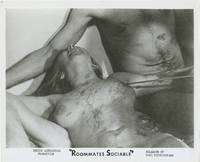
1969ref. 162181N.p.: Boss Distributors 1969. Three vintage studio still photographs from the 1969 film. Provenance stamps on the verso of each. An obscure 1969 sexploitation film from prolific exploitation director Jack Bravman. 8 x 10 inches. Near Fine. Boss Distributors unknown
1969ref. 162181N.p.: Boss Distributors 1969. Three vintage studio still photographs from the 1969 film. Provenance stamps on the verso of each. An obscure 1969 sexploitation film from prolific exploitation director Jack Bravman. 8 x 10 inches. Near Fine. Boss Distributors unknown books
1950ref. 159352Burbank CA: Warner Brothers 1950. Two vintage borderless reference photographs from the 1950 film. With mimeo snipes affixed to the versos. Based on Jack London's 1904 novel "The Sea Wolf." Two ex-fugitive employees of a corrupt gold-mine operator try to prove him to be a murderer. Shot on location in southern California. 9.5 x 7.25 inches. Near Fine. Warner Brothers unknown
1950ref. 159352Burbank CA: Warner Brothers 1950. Two vintage borderless reference photographs from the 1950 film. With mimeo snipes affixed to the versos. Based on Jack London's 1904 novel "The Sea Wolf." Two ex-fugitive employees of a corrupt gold-mine operator try to prove him to be a murderer. Shot on location in southern California. 9.5 x 7.25 inches. Near Fine. Warner Brothers unknown books
1947ref. 144680Paris: Gaumont 1947. Vintage photograph of director Jacques Becker and actor Claire Maffei on the set of the 1947 film. With manuscript annotations and a rubber stamp on the verso. A working class couple in Paris find their dreams of a life free of financial hardship about to come true when they win the lottery only to have the dream snatched away when they lose the ticket on the Metro. Shot on location in Paris. 7 x 5 inches. Near Fine. Gaumont unknown
1947ref. 144680Paris: Gaumont 1947. Vintage photograph of director Jacques Becker and actor Claire Maffei on the set of the 1947 film. With manuscript annotations and a rubber stamp on the verso. A working class couple in Paris find their dreams of a life free of financial hardship about to come true when they win the lottery only to have the dream snatched away when they lose the ticket on the Metro. Shot on location in Paris. 7 x 5 inches. Near Fine. Gaumont unknown books
1988ref. 151512N.p.: AMLF 1988. Vintage reference photograph of Jacques Demy and Yves Montand on the set of the 1988 film. Demy's fanciful portrait of the life of singer and actor Yves Montand playing himself who returns to Marseille the city of his childhood to rehearse a stage musical based on his life and falls in love the female lead Marian only to discover she is his daughter. Music by Demy's long-time collaborator Michel Legrand. Demy's final film before his unexpected death in 1990. Set in and shot on location in Marseille France. 9.5 x 7 inches. Near Fine. Rosenbaum 1000. AMLF unknown
1988ref. 151512N.p.: AMLF 1988. Vintage reference photograph of Jacques Demy and Yves Montand on the set of the 1988 film. Demy's fanciful portrait of the life of singer and actor Yves Montand playing himself who returns to Marseille the city of his childhood to rehearse a stage musical based on his life and falls in love the female lead Marian only to discover she is his daughter. Music by Demy's long-time collaborator Michel Legrand. Demy's final film before his unexpected death in 1990. Set in and shot on location in Marseille France. 9.5 x 7 inches. Near Fine. Rosenbaum 1000. AMLF unknown books
1954ref. 143324Paris: Franco London Films 1954. Vintage photograph on the set of the 1954 film showing star Daniel Gelin and director Jacques Duvivier along with crew setting up a shot on a scaffolding. With a studio stamp and mimeo snipe on the verso. Based on the 1928 novel "Der Fall Maurizius" "The Maurizius Case" by Jakob Wasserman about a young man who discovers his father may have convicted an innocent man and sets to uncover the truth. 7 x 5 inches. Near Fine. Grant France. Selby France. Franco London Films unknown
1954ref. 143324Paris: Franco London Films 1954. Vintage photograph on the set of the 1954 film showing star Daniel Gelin and director Jacques Duvivier along with crew setting up a shot on a scaffolding. With a studio stamp and mimeo snipe on the verso. Based on the 1928 novel "Der Fall Maurizius" "The Maurizius Case" by Jakob Wasserman about a young man who discovers his father may have convicted an innocent man and sets to uncover the truth. 7 x 5 inches. Near Fine. Grant France. Selby France. Franco London Films unknown books
1968ref. 139010Paris: Champs-Elysees Productions 1968. Original French grande poster for the 1968 film. Based on Catherine Paysan's 1964 novel "Je M'appelle Jericho." Jericho Simon is an old man in the midst of a split with his partner and whose kids are along for the ride as he rekindles his love with a past girlfriend. 47 x 63 inches folded as issued. A few central tears faint toning else about Near Fine. Champs-Elysees Productions unknown
1968ref. 139010Paris: Champs-Elysees Productions 1968. Original French grande poster for the 1968 film. Based on Catherine Paysan's 1964 novel "Je M'appelle Jericho." Jericho Simon is an old man in the midst of a split with his partner and whose kids are along for the ride as he rekindles his love with a past girlfriend. 47 x 63 inches folded as issued. A few central tears faint toning else about Near Fine. Champs-Elysees Productions unknown books
1954ref. 144577France: DisCina 1954. Vintage borderless photograph of director Jacques Tati during on a promotional tour for his 1953 film. Mimeo snipe on the verso. The film that introduced Jacques Tati's bumbling and hilarious Monsieur Hulot to the world. Nominated for an Academy Award. Shot on location on the coast of France. 5 x 7 inches. Near Fine. Criterion Collection 110. Ebert I. Rosenbaum 1000. DisCina unknown
1974ref. 145146France: Gray-Film 1974. Vintage oversize borderless color photograph of director and star Jacques Tati on the set of the 1974 French film. Tati's final film in which the beloved director plays a circus clown. Shown out of competition at Cannes and then released in France as a television movie. 11.75 x 9.5 inches. Near Fine. BFI. Criterion Collection 731. Rosenbaum 1000. Gray-Film unknown