[Bibles - Bishop's Version]Biblio.com

2 313 résultats
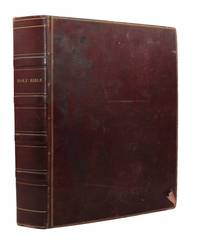
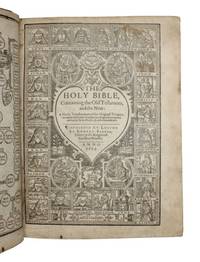
1585réf. 477London: Christopher Barker 1585. Good. 10 1/4 x 15 inches text block only. Folio. Lacks leaves before leaf 8. Bible begins at leaf 8 - 536 OT & Apocrypha 137 NT. A4 B 6 leaves par. 6 leaves 2par. 2 leaves A - Tttt 6 leaves Uuuu 8 leaves OT & Apocrypha A - Z 6 leaves NT. Small text loss to lower margin/corner of leaf 8 288 293 391 438 OT and 5 80 NT closely cropped on foremargin with slight loss to some notes more particularly at bottom. Psalter gospels and epistles rather soiled and worn with closed marginal tears and old repairs. Occasional ink to the margins. Edges soiled. Also lacks 17 18 290 OT 75 76 NT lower half of 291 OT lower one-third of 292 297 OT 33 106 121 NT. Increasing wear to margins towards the end of the New Testament with 9 leaves following Y3 title of Revelation lacking and a few leaves at the end loose. Separate title pages to Psalter and New Testament complete outer half of Apocrypha title lacking. Herbert 188; ESTCS156. Boards present though detached and with numerous repairs and losses. Spine absent. A good though imperfect reading copy of the only edition after 1572 to contain the Psalter of the 1568 folio Bishops version rather than the BCP version. Christopher Barker unknown
1864réf. 1256London: Printed by G.E. Eyre and W. Spottiswoode 1864. Leather_bound. Very Good. 3 x 4 1/2 inches. 16mo. A-O in 16s P 7 of 8 leaves. Lacks final blank and one leaf in A signature. Old neat ink inscription dated 1866 to ffep. A few closed tears and light soiling but otherwise clean and free of marking and stains. First quires slightly extended. Bound in simple full brown calf. A couple areas of lightening on spine old tape. Corners slightly rounded and covers lightly scuffed with minimal loss. Modern recasing. Not in Herbert. A very nice copy of an unrecorded and well printed Victorian New Testament in a simple possibly American binding. A nice book. Printed by G.E. Eyre and W. Spottiswoode unknown
1633réf. 156London: Robert Barker.by the Assignes of John Bill 1633. Very Early Jacobean Printing. Tooled leather. Very Good /Custom Case. 12mo original full leather 17th century tooled and inlaid binding engraved frontispiece closely cut borders all edges gilded green silk page divider decorative marbled endpapers viii blank ~ 524 vi blank pages. THE NEW TES_/ TAMENT / Of our Lord and / S A V I O V R / - Jesus Christ Newly translated out of the / Originall Grrek : and / with the former transla- / tions diligently compared / and revised by his Maie- / sties special commande- / ment. ---------------------------- Imprinted at London / By Robert Barker Printer / to the Kings most Excel- / lent Majesty and by / the Assignes of John Bill 1633. Cum privilegia. A GEM! In an original tooled leather binding in remarkably well preserved condition . Beautiful clear and crisp type. Moderate and quite uniform age-toning to paper with the occasional smudge. Pages closely cropped by the printer so some chapter headings at the top have been partially excised though not the text. Endpapers renewed. Generally minimal wear. Finely bound in contemporary tan gilt-embossed calf over wooden boards richly gilt to spine and covers. four hubs and boards. Marbled pastedowns & endpapers renewed a.e.g. and gauffered. Spine very slightly rubbed with partial loss of caps at head and foot restored and slightly visible. Edges of engraved title page reinforced with Japan paper. Previous owner's ink inscriptions on two front free endpapers naming "Edmund James Gore" & his London addresses. Housed in a protective clam-shell box custom made for this Rare and Precious 1633 edition of the Authorized King James version of the New Testament. Overall a VG copy. The continental binding on this small format Authorized version MAY be a pirated edition of the English Bible from Amsterdam. For example the Stam printing family were printing small format Bibles in 1673-- after our publication see Cambridge History of the Book in Britain IV p.467. Herbert 713-14 Wing B2511A. Robert Barker...by the Assignes of John Bill hardcover books
2006réf. 505950Passim Editions 2006. Hardcover. FINE. Large 4to. Unpaginated but 9 leaves printed on both sides. Calligraphic paper-over-boards backed in black leather housed in a clamshell box composed of calligraphic paper spine over silk boards with a sued-lined interior. Calligraphy by Susan Skarsgard. Designed printed and bound by Wesley B. Tanner of Passim Editions. Limited to 60 copies signed by the calligrapher. Fine in Fine clamshell box. Printed on Hahnemuhle cotton rag paper using a giclee. Text taken from Psalm 148 The Holy Bible King James version. Passim Editions hardcover
1980réf. 126040New York : Oxford University Press 1980. Oxford Washburn college edition. Hardback. Near fine copy in the original title-blocked cloth; spine slightly cocked. Corners sharp with an overall tight bright and clean impression. Uncommon in such positive condition. Enclosed in original pictorial slipcase. ; 1769 pages; Description: xxii 1769 p. : ill. ; 29 cm. Subjects: Bibles. New York : Oxford University Press hardcover
1980réf. 99373Oxford: Oxford Univ Pr T 1980. First Thus . Hardcover. Near Fine/No Jacket. 4to - over 9¾" - 12" tall. original full red cloth hardcoverillustrated1769 pages plus unused family record pagestop page edges giltvery light creasing to corners of last few pages otherwise a very clean near fine copy in rubbed original very good slipcase. Oxford Univ Pr (T) hardcover
1611réf. 16409London: Robert Barker 1611. A3 bound backwards. Title page the 2 leaves of the engraved map and the final 2 leaves in excellent facsimile. Additional title page from a later edition bound in behind the facsimile. Gothic and Roman types text double column with 59 lines per column and printed within woodcut rule-border calendar and almanac printed in red and black. General title-page within engraved border by Christian Boel and section title for the New Testament dated 1611 within woodcut border. Full-sheet engraved map of the Holy Land by John Speed after Dr John More 17 leaves of genealogical tables incorporating woodcut illustrations of Adam and Eve Noah’s Ark the Tower of Babel and other Biblical subjects numerous woodcut head- and tail-pieces historiated and ornamental initials. Contemporary calf boards rebacked spine labels; some staining a few leaves with small holes or edges torn away but generally a very good copy. With a notation on the paste-down that the book was “received of William Biggs for the sum of 5 shillings . by me John Lang. Ford Warminster” dated 1747 and with a small but elaborate bookplate of William Thomas Smedley 1858-1920 the noted collector of Elizabethaniana and Bacon; his library was sold in 1924 to Henry Clay Folger and the Folger library collection today includes nearly 1500 volumes formerly owned by Smedley. First edition second issue/state called the “she” Bible because of the reading of Ruth III 15: “she went into the citie”. In addition because of the small hole in C6 Matthew 26:36 it is impossible to tell whether the word Judas or Jesus is printed. The King James version of the Holy Bible is arguably the most important book ever published in English. Preparation of the Royal Version took more than 5 years and was laboriously attended to by over 50 translators and researchers. The final translations were then exchanged and reviewed reaching a final committee of six. Supervision of the printing was carried out by Miles Smith and Thomas Bilson. Although the Royal Version appropriates much from the Tyndale Coverdale Geneva and Bishops’ Bibles it is unquestionably regarded as the greatest literary translation of the Bible ever produced. Herbert 309; Pforzheimer 62; PMM 114; STC 2217. Robert Barker unknown books
1611réf. 16409London: Robert Barker 1611. A3 bound backwards. Title page the 2 leaves of the engraved map and the final 2 leaves in excellent facsimile. Additional title page from a later edition bound in behind the facsimile. Gothic and Roman types text double column with 59 lines per column and printed within woodcut rule-border calendar and almanac printed in red and black. General title-page within engraved border by Christian Boel and section title for the New Testament dated 1611 within woodcut border. Full-sheet engraved map of the Holy Land by John Speed after Dr John More 17 leaves of genealogical tables incorporating woodcut illustrations of Adam and Eve Noah’s Ark the Tower of Babel and other Biblical subjects numerous woodcut head- and tail-pieces historiated and ornamental initials. Contemporary calf boards rebacked spine labels; some staining a few leaves with small holes or edges torn away but generally a very good copy. With a notation on the paste-down that the book was “received of William Biggs for the sum of 5 shillings . by me John Lang. Ford Warminster” dated 1747 and with a small but elaborate bookplate of William Thomas Smedley 1858-1920 the noted collector of Elizabethaniana and Bacon; his library was sold in 1924 to Henry Clay Folger and the Folger library collection today includes nearly 1500 volumes formerly owned by Smedley. First edition second issue/state called the “she” Bible because of the reading of Ruth III 15: “she went into the citie”. In addition because of the small hole in C6 Matthew 26:36 it is impossible to tell whether the word Judas or Jesus is printed. The King James version of the Holy Bible is arguably the most important book ever published in English. Preparation of the Royal Version took more than 5 years and was laboriously attended to by over 50 translators and researchers. The final translations were then exchanged and reviewed reaching a final committee of six. Supervision of the printing was carried out by Miles Smith and Thomas Bilson. Although the Royal Version appropriates much from the Tyndale Coverdale Geneva and Bishops’ Bibles it is unquestionably regarded as the greatest literary translation of the Bible ever produced. Herbert 309; Pforzheimer 62; PMM 114; STC 2217. Robert Barker unknown
1687réf. AQ30934Printed for the author and Peter Story and sold by Tho: Fabian at the Bible in Pauls Churchyard. Dorman Newman at ye King's Armes in the Poultry. 1687. 6 278 3 279-358 2 359-396pp 2. With an engraved title included in the pagination displaying the figures of Moses and Aaron within an architectural design an engraved portrait frontispiece of William Addy two further engraved divisional titles also included in the pagination of the New Testament Holy Dove and the Four Evangelists and the Psalms King David playing the harp and a terminal blank. Contemporary gilt-tooled and panelled black morocco A.E.G. marbled endpapers. Some rubbing to extremities bumping to corners short split at head of spine upper hinge starting. With old bookseller's ticket tipped to verso of FFEP further bibliographical notes tipped in at end to blank fly-leaf. Early ownership initials of W.R. to verso of engraved frontispiece with a further name neatly erased. The first complete Bible to be produced entirely in shorthand engraved throughout by John Sturt and including the metrical psalms of Sternhold and Hopkins translated from the King James Authorised Version by English writing master and stenographer William Addy c.1618-c.1695. Addy's shorthand system was extensively outlined in his Stenographia or The art of short- writing compleated in a far more compendious method than any yet extant London 1684. As he himself acknowledged it owed a great debt to the system of Jeremiah Rich d. c. 1660. Darlow & Moule transcribe a note from the B.M. copy which explains the method of production: 'This Bible in Stenography my Brethren at sight and all others skill'd in ye Art of Sculpture know it's Engraven; but in a Peculiar Manner. It was written by Mr. Addy in ungum'd Ink burnished on the wax and then run through with the Engraver by John Sturt'. The old bookseller's description tipped into this copy refers to the work as the 'Pepys shorthand Bible' referencing J.W. Carlton's 1933 article "Samuel Pepys his Short-hand Books" Transactions of the Bibliographical Society. New Series Vol. XIV p.83 1933; however Pepys copy is described as featuring 'a rapturous dedication to William of Orange' which was not added until the 1689 reissue confusingly with the title continuing to display the 1687 date of this Bible. One of three slight variant editions published in 1687. All are rare; ESTC locates copies of this edition with imprint 'Printed for the author and Peter Story' on verso of the second leaf at just four locations worldwide Cambridge NYPL Oxford and Senate House. Darlow & Moule 637 ESTC R172956 Wing B2805B. First edition. 16mo. Printed for the author, and Peter Story and sold by, Tho: Fabian at the Bible in Pauls Churchyard. Dorman Newman at ye King' unknown
1825réf. AQ36181Oxford: Printed at the Clarendon Press by Samuel Collingwood and Co. 1825. Unpaginated. Contemporary gilt-tooled straight-grain burgundy morocco A.E.G. Rubbed and marked with staining and scoring to boards light wear to extremities. Contemporary ownership inscription of 'Fanny Williams Bridehead 1832' to verso of FFEP. Scattered spotting and staining throughout. A quarto Georgian Bible printed at the Clarendon Press by Samuel Collingwood Superintendent of the University Press and described by writer George Valentine Cox as 'a zealous Dissenter.as well as an excellent printer in which character from the liberal share of the profits granted to him by the University he accumulated a considerable fortune.' Recollections of Oxford 1868. This copy most likely belonged to Frances 'Fanny' Turner wife of banker and politician Robert Williams 1767-1847 who purchased the Bridehead estate of Dorset in 1797. . Quarto. Printed at the Clarendon Press by Samuel Collingwood and Co. hardcover
1613réf. AQ36763Imprinted at London By Robert Barker 1613. The text is collated and complete bound without the Map which sometimes is included. 1352pp. Signatures: A8 2A-3Z8 A-M8 square brackets as printed. NT has separate title page dated 1613; register is continuous. In this edition Genesis I 11 has: 'bring forth'; Ruth III 15 has: 'she went'. Very small burn holes to text of leaves O5 and O7 short tear to head of leaf Aa2 some loss to lower corner of leaf H8 early ownership inscription to blank verso of leaf K4: 'Edward Pointz his Book 1663'. ESTC S116976 STC 2228. Bound after: SPEED John. The genealogies Recorded In The Sacred Scriptures. London. Printed by John Beale 1613. 2 43pp. Without two terminal leaves. Initial four leaves laid down with substantial loss to title page. ESTC S102017. Bound before: PSALTER - English Sternhold & Hopkins. The booke of psalmes. London. Imprinted at the Company of Stationers 1614 8 93pp 5. Defective without 11 terminal leaves substantial portion of title page torn away final two leaves laid down. Modern blind-tooled calf. Scattered spotting. An early example textually complete and with both title pages of the definitive Anglican text of the Reformation. 'The Authorized Version of the English Bible first printed in 1611.is the most widely-published text in the English language. During many generations large portions of it were known by heart by people on both sides of the Atlantic. With Shakespeare its exact contemporary the Authorized Version has contributed countless quotations and expressions which have slipped hardly noticed into English language and idiom.The book was always printed according to a very precise formula. The lengthy wording of the title-page was unvarying. Every Bible opened with the standard preface to James I 'To the Most High and Mighty Prince James.' beginning 'Great and manifold were the blessings.' The text of the Bible was arranged in strict convention. It was generally laid out in two columns with separate numbered verses. Each chapter opened with a short summary of its content. There were no interpretative notes but there were brief references in the margins to parallel passages or variant readings. 246-249pp HAMEL Christopher De. The Book. A History of the Bible. London 2001. . Authorized Version. Quarto. unknown
1657réf. AQ33174Cambridge: Printed by John Field 1657. 1354pp. Title printed within an ornamental border containing the seal of Cambridge University signed: Rob. Vaughan sculp. The New Testament and the Psalms both have separate title pages dated 1657 the register is continuous. Handsomely bound by Gilmour of Salisbury in early nineteenth-century black panelled morocco richly tooled in gilt and blind A.E.G. gilt dentelles. Lightly rubbed some surface loss to upper board. Armorial bookplate of J. L. Jackson with later pencilled inscription 'to Mr. Calcraft. John 1.29. I Thess. v. 23 ' to FEP head of text-block trimmed with occasional loss to running- title small hole to leaf Cc1 with slight loss of text and sense very occasional chipping to margins. A choice example of a Commonwealth era Cambridge-printed King James Bible notorious for its errors from the press of John Field in a finely executed later provincial binding - to a very distinct style - by the Gilmour family Andrew then George of binders and stationers of Salisbury fl.1800 onwards. As was noted by the contemporary pamphleteer William Kilburne in his Dangerous errors in several late printed Bibles London 1659 part of a series railing against the poor-quality Bible printing work of Henry Hills and John Field this edition omits Psalms Ch.143 v.4 in its entirety 'and there are many other faults as I am well informed of very great notoriety'. Provenance: With the bookplate of James Leonard Jackson 1777-1854 rector at St. Mary's Church Swanage; presented by him to a male member of the Calcraft family of Wareham most likely John Hales Calcraft 1796-1880 Member of Parliament for Wareham. ESTC R38638 Herbert 656 Wing B2252. 8vo. Printed by John Field unknown
1823réf. AQ19315Oxford: Printed at the Clarendon Press by Samuel Collingwood and Co. 1823. Unpaginated. With additional engraved title pages for both the O.T. and N.T. and a further 27 engraved plates. Handsomely bound in contemporary blind-stamped black straight-grain morocco lettered in gilt A.E.G. Slightest of rubbing to extremities. Manuscript records of births deaths marriages etc. of the Trueman family to front blank fly-leaves very occasional light spotting. . Quarto. Printed at the Clarendon Press by Samuel Collingwood and Co. unknown
réf. 8881P., Daumont (fin XVIIIème). (Galerie de ver).
réf. 8877Sans lieu ni date, (fin du XVIIIème).
réf. 8888P., BAsset (fin XVIIIème). (Petits trous de ver).
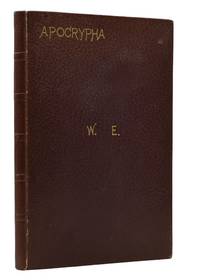
réf. AQ29535Oxford: Printed at the University Press s.d. c. 1898 186pp. Printed in double columns. Bound by Hatchards in contemporary brown morocco lettered in gilt with initials 'W. E.' likely William Eden 1849-1915 father of Anthony Eden to upper board. Lightly rubbed. Marbled endpapers internally clean and crisp. Ink inscriptions to recto of front blank fly-leaf: 'With my best wishes M. H. Xmas 1898. "Friendship maketh day light in the understanding out of darkness & confusion of thoughts" - Bacon' and: 'Given to Doodles in remembrance of many things by Sybil Eden June. 1916'. From the recently dispersed library of Anthony and Clarissa Eden. Sir Anthony Eden 1897-1977 British foreign secretary 1935-38 1940-45 and 1951-55 and Prime Minister 1955-1957. Following active service in the First World War Eden read Oriental languages at Oxford. He was elected to the House of Commons in 1923. In 1935 he was appointed foreign secretary a position he resigned in 1938 to protest Prime Minister Neville Chamberlain’s appeasement of Nazi Germany. When Churchill became Prime Minister in 1940 he was named secretary of state for war and later during the Second World War once more served as foreign secretary. Eden succeeded Churchill as Prime Minister in 1955. In 1956 his failure to respond effectively during the Suez Crisis and the subsequent loss of party and public support would ultimately lead to his resignation from office in 1957. He was knighted in 1954 and created earl of Avon in 1961. . 8vo. Printed at the University Press, [s.d., c. 1898] unknown
réf. 8871Sans lieu ni date, (fin du XVIIIème).
réf. 8869P., Basset, (fin du XVIIIème).
réf. 8870P., Daumont,1760.
réf. 8872P., Mondhard, (fin du XVIIIème).
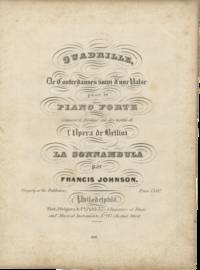
1837réf. List3613Philadelphia: Firth Meignen & Co. Publishers & Importers of Music and Musical Instruments No. 41 Chestnut Street 1837. Seven pages complete including dance figures. Folio sheet music. Very good with scattered foxing and light edge wear. A rare early American operatic dance arrangement by Francis Johnson 1792-1844 widely regarded as the first published Black composer in the United States. Issued circa 1837 this work adapts themes from Vincenzo Bellini's opera La Sonnambula 1831 into a set of quadrilles with concluding waltz arranged for piano forte and structured for social dancing. The internal headings "Pantalon" "Ladies Chain" etc. retain the formal quadrille sequence reflecting the popularity of European ballroom forms in Philadelphia during the period. Johnson a Philadelphia bandleader composer and virtuoso keyed bugle player published approximately seventy compositions over nearly three decades. Active in Philadelphia from at least the 1810s he became one of the city's most sought-after musicians leading ensembles for cotillions public balls military functions and civic celebrations. In 1818 became the first African-American composer known to have sheet music published in the United States. His band performed for elite social events and public commemorations including celebrations for the Marquis de Lafayette's visit to Philadelphia. In 1838 he toured Europe with his ensemble performing in England and reportedly receiving a silver trumpet from Queen Victoria. This piece was composed a year earlier per the Johnson page at Musicalgeography.com six years after Bellini's work. Operatic paraphrases and dance adaptations of fashionable European works were central to Johnson's output. Overall a quite scarce early title from an important composer. We find two copies in OCLC 692295106 at AAS and the William Clements Library. See "Francis Johnson's Compositions - With Sheet Music" https://musicalgeography.org/francis-johnsons-compositions/. Firth, Meignen & Co., Publishers & Importers of Music and Musical Instruments, No. 41 Chestnut Street books
1837réf. List3613Philadelphia: Firth Meignen & Co. Publishers & Importers of Music and Musical Instruments No. 41 Chestnut Street 1837. Seven pages complete including dance figures. Folio sheet music. Very good with scattered foxing and light edge wear. A rare early American operatic dance arrangement by Francis Johnson 1792-1844 widely regarded as the first published Black composer in the United States. Issued circa 1837 this work adapts themes from Vincenzo Bellini's opera La Sonnambula 1831 into a set of quadrilles with concluding waltz arranged for piano forte and structured for social dancing. The internal headings "Pantalon" "Ladies Chain" etc. retain the formal quadrille sequence reflecting the popularity of European ballroom forms in Philadelphia during the period. Johnson a Philadelphia bandleader composer and virtuoso keyed bugle player published approximately seventy compositions over nearly three decades. Active in Philadelphia from at least the 1810s he became one of the city's most sought-after musicians leading ensembles for cotillions public balls military functions and civic celebrations. In 1818 became the first African-American composer known to have sheet music published in the United States. His band performed for elite social events and public commemorations including celebrations for the Marquis de Lafayette's visit to Philadelphia. In 1838 he toured Europe with his ensemble performing in England and reportedly receiving a silver trumpet from Queen Victoria. This piece was composed a year earlier per the Johnson page at Musicalgeography.com six years after Bellini's work. Operatic paraphrases and dance adaptations of fashionable European works were central to Johnson's output. Overall a quite scarce early title from an important composer. We find two copies in OCLC 692295106 at AAS and the William Clements Library. See "Francis Johnson's Compositions - With Sheet Music" https://musicalgeography.org/francis-johnsons-compositions/. Firth, Meignen & Co., Publishers & Importers of Music and Musical Instruments, No. 41 Chestnut Street
réf. 8887P., Chez Chéreau (fin XVIIIème). (Galerie de ver).