2 896 résultats
1995RARE, COMPLETE 2-VOLUME SET for researchers of Western Semitic languages. Organized by word roots, with citations to the archaeological specimens where the each root appeared, and references to other texts where the root was explored by other researchers. 245x160mm, [lxxi+585]+[586-1266] pages. Green cloth hardcover with gilded lettering. Includes black dustjacket with white lettering. [CONDITION:] Dust-jackets lightly bumped on all edges, creased inner flap on Volume 1. Occasional pencil markings on margins. [SUMMARY:] This thorough dictionary of ancient languages is in excellent condition - almost as new. PLEASE NOTE: This item is overweight. We may ask for extra shipping costs.
1846A PRISTINE LARGE-PAPER COPY OF THE FIRST AND ONLY EDITION. XII, 168 pp. + addenda leaf (often missing, but present here). An introduction to the Chronicon Samaritanum or Liber Josuae. A LARGE-PAPER COPY, beautifully printed (in Latin, with some Hebrew types) with huge margins on extremely fine, thick laid paper (this copy about twice as thick as normal copies). Large 4to. Original unprinted wraps. Uncut and unopened. Some wear and tear to wraps, INTERNALLY FINE AND BRIGHT, COMPLETELY FRESH, LIKE NEW.
1872réf. R320127251Rödelheim. 1872. In-12. Cartonné. Etat passable, Plats abîmés, Dos satisfaisant, Papier jauni. 140 pages - ouvrage en hébreu - étiquette collée sur le dos - coins, tranches et plats très frottés - 3 photos disponibles.. . . . Classification Dewey : 492.4-Hébreu
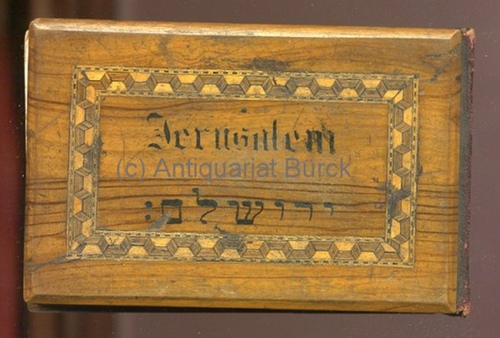
1910réf. 26282Jerusalem: Druck vermutlich bei Gebr. Monsohn. um 1910). Quer-Oktav, 10,5 x 16,5 cm. (etwas beschabt, eine kleine Ecke des hinteren Deckels fehlt, innen etwas gebräunt, Stempel auf Titel verso, insgesamt abr recht gut erhalten und farbfrisch) 12 Blatt. Original-Halbleder mit Orig.-Zedernholz-Deckeln,
1837In -4°, 70, (1), b. Manca in Iccu
1616réf. R119865Antverpiae [Antwerpen], Ex officina Plantiniana, apud viduam & filios Ioannis Moreti [Moretus] 1616 206 + [2] + [4bl.] pp., 18x12cm., text in Latin and partly in Hebrew, contemporary full vellum binding (intact, with few marginal stains), text is clean and bright except for few old handwritten annotations in the margin of the text, good condition, cfr. De Backer-Sommervogel I col.1151-1152 no.4, R119865
1926réf. 194901Ecole de l'Alliance Costantine, Ecole de l'Alliance, vers 1926. In-8 broché, 352 pages. Le dictionnaire rédigé par le rabbin Joseph Renassia (18791962), figure majeure du judaïsme algérien et directeur de la yeshiva Ets-Haïm à Constantine, est un ouvrage monumental. Plus qu'un simple dictionnaire bilingue hébreu-français, cet ouvrage intègre très souvent l'arabe dialectal / judéo-arabe pour permettre l'apprentissage du français tout en conservant les repères linguistiques des communautés juives d'Afrique du Nord. Edité à Constantine (Algérie). Rabbi Renassia y gérait sa propre activité d'édition pour diffuser la culture hébraïque auprès de la jeunesse. Il a été imprimé par Nadjar Maklouf à Sousse en Tunisie. Conçu dans un contexte d'assimilation linguistique accélérée sous la colonisation française, il visait à faciliter la transition des étudiants hébraïsants vers la langue française sans couper le lien avec la tradition hébraïque et la langue parlée locale. Maklouf Nadjar (18881963) était un imprimeur, éditeur, auteur et figure centrale de la vie culturelle juive en Tunisie. Son imprimerie basée à Sousse était l'une des plus actives du Maghreb pour l'édition de textes en hébreu, en judéo-arabe et en français. Bien que Rabbi Joseph Renassia ait vécu et enseigné à Constantine, il s'est appuyé sur la réputation et le savoir-faire technique de l'imprimerie Nadjar à Sousse pour faire tirer certains de ses ouvrages pédagogiques (dictionnaires, manuels de grammaire ou livrets d'étude). L'imprimerie Maklouf Nadjar assurait une large diffusion dans tout le Maghreb. Faire imprimer un dictionnaire à Sousse permettait de couvrir aussi bien le public algérien que tunisien. La couverture est défraichie en bords et présente des manques de papier, le corps de l'ouvrage est en bon état. De toute rareté.
19661st edition. Issue with Singers Photo on cover and lead article being the transcript of an interview with Singer on pages 2-12, which includes 6 additional photos interspersed throughout the text. The Editors note, Isaac Beshevis Singer visited the Cincinnati campus for a week of lectures and dialogue with the teachers and future rabbis of a movement which does not actually forsake Jewishness but has taken out of Jewishness its very essence. Interestingly, Lawrence Kushner, then a rabbinic student, is listed on the masthead of this issue for Photography and New York representative. The Variant ran a total of 8 volumes, 1961-1969, generally appearing 3 times per year. Issued by the student body of the Hebrew Union College, Jewish Institute of Religion. SUBJECT (S) : Jewish college students -- Periodicals. Reform Judaism -- United States. OCLC lists 11 institutions with holdings for at least some of the issues, but it is unclear which are complete. Only one Ivy League Institution (Harvard) lists any holdings at all. Somewhat rare. Very Good Condition (KH-8-64)
réf. 657Ienae Apud Ioh. Felicem Bielckium 1717 ( E. O. ) 1 fort vol. in - 8 ( 21 x 13 cm ) ( poids : 1,6 kg ) Frontisp., T. , (6) ff. n. ch. , 1348 pp. , (23) ff. n. ch. , 160 pp. . En latin . En frontispice , portrait de Ch. Stockius gravé par Fritzsche ( " Fritzsche sc. Lips. " ) . Contient nombreuses dédicaces ( Serenissimo Principi ac Domino Gvil. Ernesto Dvci Saxonniae , Jvliae , Cliviae ... , Serenissimo Principi ac Domino Joh. Gvilielmo Dvci Saxonniae , Jvliae , Cliviae ..., Serenissimo Principi ac Domino Ernesto Ludovico Dvci Saxonniae , Jvliae , Cliviae ... , Serenissimo Principi ac Domino Friderico Dvci Saxonniae , Jvliae , Cliviae ... , Serenissimis Academiae Jenensis nvtritoribvs maximis .... , Serenissimi Principes ... ) , Benevoli lectori ... , et in fine , Index Latinorum interpretamentorum , Dictionarium breve chaldaeo-rabbinicum exhibens tum voces , qvae in Daniele Esra et Targumim occurunt... . Bandeaux . Plein vélin de l' époque . Dos lisse , nom de l' auteur et titre à l' encre . Toutes tranches bleu-vert . Bon état . Vélin plus ou moins sali . Papier uniformément jauni . Petites taches d' encre pp. 371 , 719 et 1022 . Qqs lignes soulignées p. 501 . P. 433 ch. 435 . P. 547 ch. 541 , p. 548 ch. 542 et ainsi de suite jusqu' à la p. 640 ch. 636 . P. 641 ch. 635 , p. 642 ch. 636 et ainsi de suite jusqu' à la p. 985 ch. 979 . P. 986 ch. 990 , p. 987 ch. 991 et ainsi de suite jusqu' à la fin ( p. 1344 ch. 1348 ) .
1978réf. N4184Jerusalem: Makor 1978. Limited Edition . Original Half Leather. Near Fine. 4to. VOL.1- SEFARDI COLLECTION OF PIYYUTIM FOR FAST DAYS AND SPECIAL SABBATHS Ms Parma de Rossi 1192 VOL.2. SEFARDI MAHZOR FOR ROSH HASHANA AND YOM KIPPUR Ms Parma de Rossi 860 VOL. 3- SEFARDI MAHZOR FOR YOM KIPPUR Ms. Parma de Rossi 1377 FACSIMILE of the Hebrew manuscripts. A limited edition of 390 copies this copy number 288 bound by hand A FINE COPY. Makor hardcover
1840In Hebrew and Latin. xii, 1428 pages. Page edges browned. Over 6kgs extra postage for outside UK.
1656réf. 10488Rouen Jacques Cailloue et Jean Viret 1656 Un volume in-folio plein veau, dos à nerfs, caissons décorés, titre doré, [11] ff., 595 pp., titre, [2] ff., 386 pp., [bl.], illustrations in-texte, bandeaux et culs-de-lampes, lettrines ornées, texte sur deux colonnes. Coins émoussés, coiffes arasées, manque le feuillet de titre, petit travail de vers en marge, sans atteinte au texte, petits manques de papiers aux marges des premiers et derniers feuillets.
réf. 18902Undated 1920s and with place not stated. 4to 71 pp with one 12mo page at end. In poor condition damp damaged and detached from green cloth covers but with texts legible and complete. Manuscript table of contents on recto of first leaf describes nine tales in German told by Ascher Horowitz and T. Holpern on first 51 pp: 'Jewish Tales from Jerusalem 1 Dear Aschmadai 2 Reb Itzchak Alchonon der Heilige 3 Ein Brief zu Gott 4 Die Hyaene 5 Die Hungersnoth in Jerusalem 6 Der Reich Mann mit seinen Soehnen 7 Der Mann der neimals sorgte 8 Der Edelmann Ahron beim Graefen von Polen 9 Wie ein Rabbiner seine Tochter verheiratete.' These are followed by 'King Artus' in English apparently transcribed from 'Magazin ed. Berliner XII 1885 Hebrew p. I-II'. The 8vo leaf carries a manuscript page of translation into English. For the mediaeval tale 'King Artus' the only known copy of which is in the Vatican Library see Curt Leviant 'King Artus: A Hebrew Arthurian Romance of 1279' Syracuse University Press 2003. No record of any of the other nine pieces in this collection or of Ascher Horowtiz or T. Halpern on COPAC. Undated (1920s?) and with place not stated. hardcover
1819COMPLETE SET OF SIX PARTS BOUND IN TWO VOLUMES. EXTREMELY RARE complete set of 'Aruk (or Aruch), the lexicon for the language of the Talmud and the Targum compiled in the 12th century by R. Nathan of Rome. The book includes the additions of 16th century scholar Benjamin Mussafia, and original additions, introduction and German translation of the words by Moses Israel Landau (1788-1852), grandson of Judah Landau of Prague. Each volume includes two parts out of the six. The first volume features a handwritten dedication by an unknown person to R. Shalom Kutner, an orthodox rabbi active in late 19th century Vienna. [BOTH VOLUMES]: 205x130mm. [VOL.I]: [VIII+4+22+44+232] + [XX+7+293] + [290] pages / [VOL.II]: [XXXVI+262] + [510] pages. Quarter-cloth rebound Hardcover. Text block edges marbled. Cover and spine yellowing. Cover corners and edges bumped. Cover edges worn/peeling. Ex-library copy with stamps. Library sticker residues and small inscription on spine. Binding slightly visible between several pages. Pencil inscription near text on several pages. Pages yellowing, age-stained and wavy. [VOL.I]: Cover stained. 12 pages of part 1 almost detached from binding. [SUMMARY]: Despite some external wear, this rare edition of an important Talmudic dictionary is in good condition. PLEASE NOTE: This item is overweight. We may ask for extra shipping costs.
1857TWO VOLUME SET. RARE enlarged edition of a comprehensive Rabbinic lexicon, known as the Arukh, compiled by an eminent Jewish-Italian lexicographer Nathan ben Jehiel of Rome (c.1035-1106). Part of the enlargement in this edition is the inclusion of words from Zohar - the 13th-century foundational work in the literature of Jewish mystical thought known as Kabbalah. [BOTH VOLUMES]: 235x160mm. [174] + [180] double pages (altogether 708 pages, with a blank pages for notes in-bound between each page). Black board Hardcover with gilt leather spine. Cover and spine heavily rubbed. Cover corners and edges bumped and peeling. Spine edges and hinges heavily rubbed. Spine upper edges peeling. Ink writing on front whitepage and both Hebrew and German title-page. [VOL.I]: Stamp on Hebrew title-page upper corner. [VOL.II]: Front cover, front whitepage and pre-title page partly detached from binding. Stamp on front whitepage. [SUMMARY]: This extremely rare revised and enlarged edition of one of the most important lexicons of Rabbinic literature is otherwise in good condition. PLEASE NOTE: This item is overweight. We may ask for extra shipping costs.
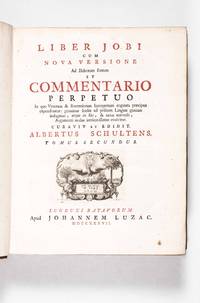
1737réf. 49261Leiden: Jean Luzac 1737. First edition. Two volumes large quarto. 52 544; 2 545-1232 63 indices 1 corrigendapp. Text in two columns with Hebrew text and facing Latin translation interspersed with commentary. Titles in red and black with engraved vignettes. Contemporary speckled calf; gilt-tooled spine with raised bands and morocco lettering pieces; gilt dentelles; edges daubed in red and green. Light scuffing to boards and fading to spines. A very good set with crisp clean text throughout. First edition of this comprehensive commentary to the biblical Book of Job by the Dutch scholar of Semitic languages Albert Schultens 1686-1750 who maintained "that the true nature of the Hebrew language and the meaning of many of its words and idioms are to be found chiefly in the Arabic" Orme. Fifty-five pages of the indices constitute a brief lexicon and provide Latin as well as Arabic equivalents for more than 1000 Hebrew words. Schultens studied theology and eastern languages at Groningen where he received his degree in theology in 1709. After a brief career as a preacher in Wassenaar he was nominated professor of Hebrew and Jewish antiquities at Franeker in 1713. In 1729 he decamped for Leiden were he was first appointed reader in eastern languages and finally full professor in 1732. At this time a chief concern of Calvinist theologians was to liberate Old Testament exegesis from the Jewish Rabbinic as well as Catholic traditions. Schultens' influential and controversial solution was revealed as early as 1706 in his first public thesis Disputatio theologico philologica de utilitate linguae Arabicae in interpretanda S. Scriptura A Theologico-Philosophical Dissertation on the Utility of the Arabic Language for the Interpretation of the Holy Scriptures "a forceful attack" Brugman & Schröder on the Protestant sola scriptura methodology of Biblical exegesis. "With the help of Jacobus Golius' Arabic dictionary he perused with zeal and fervour the Old Testament and wrote prolifically. The lexical superiority of Arabic had led him to a reconsideration of the position of Hebrew: at first he had called Arabic 'the most splendid daughter of mother Hebrew' but in his oration of 1729 he proclaimed Hebrew and Arabic cognate twin sisters. This shocked conservative theologians as an outright profanation of God's Word" Brugman & Schröder. "In 1737 he applied his theories in his bilingual edition of the book of the prophet Job whom he regarded as an Arab. The Hebrew text and the Latin translation are all but totally submerged by the extensive commentary in which Schultens draws abundantly on Arabic texts such as the Hamasa an anthology of early Arabic poetry by the ninth-century poet Abu Tammam" Vrolijk & van Leeuwen. Schultens was not without his critics and by 1824 William Orme notes a turning of the tide: "Different opinions are entertained of the correctness of his views and also of his success in applying them; but it is now generally admitted that he carries his notions of the advantage of Arabic learning to the interpretation of the Scriptures too far." Jean Luzac 1728-1777 was a member of a well-known Huguenot family of printers; he published many works for the University of Leiden including three Hebrew books of Albert Schultens. Isaac van der Mijn is noted as the printer at the colophon of the second volume. Provenance: printed label of the Bibliotheca Seminarii Warmondani at the front endleaf of the first volume. Full title: Liber Jobi cum nova versione ad Hebraeum fontem et commentario perpetuo in quo Veterum et Recentiorum Interpretum cogitata præcipua expenduntur: genuinus sensus ad priscum Linguae genium indagatur atque ex filo et nexu universo Argumenti nodus intricatissimus evolvitur. Curavit et editit. Albertus Schultens. Tomus Primus. -Tomus Secundus References: J. Brugman & F. Schröder Arabic Studies in the Netherlands Leiden: E.J. Brill 1979 p.26f. Fuks/Fuks-Mansfeld 78. Orme Bibl. Biblica p. 390. A. Vrolijk & R. van Leeuwen Arabic Studies in the Netherlands a Short History in Portraits 1580-1950 Leiden: E.J. Brill 2014 pp. 73-79. Jean Luzac unknown
1737réf. 49261Leiden: Jean Luzac 1737. First edition. Two volumes large quarto. 52 544; 2 545-1232 63 indices 1 corrigendapp. Text in two columns with Hebrew text and facing Latin translation interspersed with commentary. Titles in red and black with engraved vignettes. Contemporary speckled calf; gilt-tooled spine with raised bands and morocco lettering pieces; gilt dentelles; edges daubed in red and green. Light scuffing to boards and fading to spines. A very good set with crisp clean text throughout. First edition of this comprehensive commentary to the biblical Book of Job by the Dutch scholar of Semitic languages Albert Schultens 1686-1750 who maintained "that the true nature of the Hebrew language and the meaning of many of its words and idioms are to be found chiefly in the Arabic" Orme. Fifty-five pages of the indices constitute a brief lexicon and provide Latin as well as Arabic equivalents for more than 1000 Hebrew words. Schultens studied theology and eastern languages at Groningen where he received his degree in theology in 1709. After a brief career as a preacher in Wassenaar he was nominated professor of Hebrew and Jewish antiquities at Franeker in 1713. In 1729 he decamped for Leiden were he was first appointed reader in eastern languages and finally full professor in 1732. At this time a chief concern of Calvinist theologians was to liberate Old Testament exegesis from the Jewish Rabbinic as well as Catholic traditions. Schultens' influential and controversial solution was revealed as early as 1706 in his first public thesis Disputatio theologico philologica de utilitate linguae Arabicae in interpretanda S. Scriptura A Theologico-Philosophical Dissertation on the Utility of the Arabic Language for the Interpretation of the Holy Scriptures "a forceful attack" Brugman & Schröder on the Protestant sola scriptura methodology of Biblical exegesis. "With the help of Jacobus Golius' Arabic dictionary he perused with zeal and fervour the Old Testament and wrote prolifically. The lexical superiority of Arabic had led him to a reconsideration of the position of Hebrew: at first he had called Arabic 'the most splendid daughter of mother Hebrew' but in his oration of 1729 he proclaimed Hebrew and Arabic cognate twin sisters. This shocked conservative theologians as an outright profanation of God's Word" Brugman & Schröder. "In 1737 he applied his theories in his bilingual edition of the book of the prophet Job whom he regarded as an Arab. The Hebrew text and the Latin translation are all but totally submerged by the extensive commentary in which Schultens draws abundantly on Arabic texts such as the Hamasa an anthology of early Arabic poetry by the ninth-century poet Abu Tammam" Vrolijk & van Leeuwen. Schultens was not without his critics and by 1824 William Orme notes a turning of the tide: "Different opinions are entertained of the correctness of his views and also of his success in applying them; but it is now generally admitted that he carries his notions of the advantage of Arabic learning to the interpretation of the Scriptures too far." Jean Luzac 1728-1777 was a member of a well-known Huguenot family of printers; he published many works for the University of Leiden including three Hebrew books of Albert Schultens. Isaac van der Mijn is noted as the printer at the colophon of the second volume. Provenance: printed label of the Bibliotheca Seminarii Warmondani at the front endleaf of the first volume. Full title: Liber Jobi cum nova versione ad Hebraeum fontem et commentario perpetuo in quo Veterum et Recentiorum Interpretum cogitata præcipua expenduntur: genuinus sensus ad priscum Linguae genium indagatur atque ex filo et nexu universo Argumenti nodus intricatissimus evolvitur. Curavit et editit. Albertus Schultens. Tomus Primus. -Tomus Secundus References: J. Brugman & F. Schröder Arabic Studies in the Netherlands Leiden: E.J. Brill 1979 p.26f. Fuks/Fuks-Mansfeld 78. Orme Bibl. Biblica p. 390. A. Vrolijk & R. van Leeuwen Arabic Studies in the Netherlands a Short History in Portraits 1580-1950 Leiden: E.J. Brill 2014 pp. 73-79. Jean Luzac unknown books
1705réf. 36556Amsterdam & Utrecht: H. Boom Joh. II van Waesberge Goethals Ger. Borstius Joh. Wolters Fr. Halma W. van de Water & W. Broedelet 1705. Third Edition . Hardcover - as published. Engraved title page in red & black plus four additional engraved title pages for each of the four parts into which the text is divided: 1 Genesis - Deuter.; 2 the Prophetae antiores; 3 the Prophetae posteriores; and 4 Hagiographa. Text is in Hebrew with the preliminaries and preface by van der Hooght & others as well as the printed marginalia in Latin. This is actually the third editon edited & revised by van der Hooght of the famous Hebrew Bible originally published by Joseph Athias in 1661. Thick octavo; a.e.g. Some light worming to end leaves pastedown & rear board; lacking rear front fly leaf & front rear fly leaf. Also first engraving detached. Spine is dry and rubbed along raised bands 5 panels with some light wear to edges & joints; head of spine is torn but without loss; rubbed label in 2nd panel present & readable; some worming at head of spine; small gouge on back board. A very nice internally clean tight copy of a scarce title. H. Boom, Joh. II van Waesberge, Goethals, Ger. Borstius, Joh. Wolters, Fr. Halma, W. van de Water, & W. Broedelet hardcover
réf. 17297, 1736**, Manuscrit, relie en veau a l'impression dore et au 5 nerfs, plattes interieures decorees, gravure en frontispice, page de titre, 95 x 150mm., pages ne sont pas numerotees, 3 gravures.
1662réf. 21448Paris, Pierre le Petit, 1662 ; in-12, velin ivoire de l’époque, titre manuscrit au dos; [8], 417 pp.
réf. 16403Lodève, A. Colomer, 1645. Grand in-4, [10]-652 pp., veau moucheté brun de l'époque, deux triples filets à froid en encadrement sur les plats, des fleurons à froid aux angles, dos à nerfs orné de filets à froid, (frottements, manques, réparations du papier, taches, petits manques marginaux, trous de ver, rousseurs).
1653réf. 0026141653 Lipsiae [Leipzig], Impensis Haered. Henningi Grosfii, Literis Friderici Lanckisii Exscribebat, Chriftophorus Cellarius, 1653. Fort volume petit in-quarto (170 X 200 mm) vélin rigide, plats ornés d'un encadrement de filets avec fleurons d'angles à froid, dos lisse cloisonné de filets avec fleurons à froid dans les compartiments, titre calligraphié à l'encre noire, tranches teintées en bleu (reliure de l'époque) ; frontispice, (5) ff., 1724 pages, (11) ff. d'index et errata. Accroc avec petite fente de deux centimètres en queue du mors supérieur, tache d'encre sur le titre, feuillets brunis, infime travail de ver (trou de la taille d'une tête d'épingle) affectant les 19 premiers feuillets, cerne de mouillure dans la marge inférieure de quelques feuillets. Initiale manuscrite «F. » répétée sur les 3 premiers feuillets.
réf. 86868Jerusalem 2000 Hardback Text Volume with paperback Companion. Slipcased. Very Good Jerusalem, 2000 paperback
1666réf. 38497Amsterdam: Joseph Athias. Very Good with no dust jacket. 1666. 1st. Leather. 240 7 pages; First Leusden edition. Small 8vo late 19th century black morocco top edge gilt other edges seemingly untrimmed. Title page toned and dampstained chipped at bottom fore edge - no loss to printing gutter of title page re-enforced lightly toned throughout small chipping at bottom fore edge corners at front and back dampstaining to running heads throughout occasionally touching text lacking leaf Ss4 the terminal blank. Parallel Hebrew/Dutch text. Right hand pages Hebrew text and on the left pages Dutch translation. . Joseph Athias hardcover
Trading card, Very Small (slightly less than 2x1) . Dominion Athletic Stars Sports Card (Card Nr 14) from a series of 120 pictures of Canadian athletes which were given away in Dominion Chocolate Bars in the mid-1920s. This card features a photo on the front of the champion Toronto Y. W. H. A. Basketball Team, featuring 8 female team members in their YWHA jerseys, plus their 2 coaches. The Canadian Jewish Review of June 8, 1923, reported that at the Primrose Club last Tuesday, the Y. M. And Y. W. H. A. Of Toronto celebrated their victories in sports by tendering a banquet to the winning teams and presenting the cups and trophies to the successful players. The best feature of the evening was the presentation of the Griff Clark Trophy to the Y. W. H. A. Basket ball team, champions of the city. Text on reverse. Quite probably the only explicitly Jewish womens sports team featured on a mass-market trading card in the 1920s, and probably the first ever. Light wear, photo is clear, Good Condition. (women-4-13)