2906 risultati
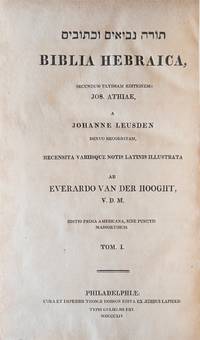
1814rif. 372931Philadelphia: Cura et Impensis Thomae Dobson edita ex aedibus Lapideis. Typis Gulielmi Fry 1814. First American edition. Text in Hebrew with notes in Latin. 6 296; 2 312 leaves. Half titles present in each volume. Uncut. 2 vols. 8vo. Original blue paper boards rebacked with plain paper. Provenance: Hugh Blair Grigsby booklabels. In a blue cloth folding box. First American edition. Text in Hebrew with notes in Latin. 6 296; 2 312 leaves. Half titles present in each volume. Uncut. 2 vols. 8vo. The first complete Hebrew Bible printed in America. Hebrew type was first used in the North American colonies in the Bay Psalm Book printed in 1640 in Cambridge. Over the next ninety-five years Hebrew type appeared in a handful of American imprints usually in brief examples of single words or short sentences. Paucity of appropriate type would continue to be a problem over the years that followed. The first Jewish Psalter was finally published in 1809 followed by this complete Bible five years later. "In 1812 Mr. Horwitz had proposed the publication of this edition of the Hebrew Bible the first proposal of the kind in the United States; early in 1813 be transferred his right and list of subscribers to Mr. Thos. Dobson who published soon afterwards the 1st volume" O'Callaghan. The title page indicates that this work is a reprinting of the second edition of the Joseph Athias Bible edited by Leusden with Latin notes by Everardo Van der Hought and that the Hebrew is printed without vowels. An important piece of American printing and of Jewish Americana. Darlow and Moule 5168a; Goldman 4; Rosenbach 171; Shaw and Shoemaker 30857; Singerman 236; M. Vaxer "The First Hebrew Bible Printed in America" Journal of Jewish Bib. 1940 vol. 2 pp. 20-26 Cura et Impensis Thomae Dobson edita ex aedibus Lapideis. Typis Gulielmi Fry unknown books
rif. 39481Philadelphia: Printed by C. Sherman 5605. 8vo 5 volumes. 8 7/8 x 5 1/2 inches. Hebrew and English text on facing pages. Each volume inscribed at the head of the English-language title "To my beloved wife from her affectionate husband" the first volume with a later family annotation. Contemporary purple morocco spine in six compartments with raised bands lettered in gilt in the second and fourth repeating gilt decoration in others marbled edges marbled endpapers. Provenance: Solomon Nunes Carvalho each cover stamped in gilt Rare large-paper association copy of the first Jewish translation of the Pentateuch into English. More than any other person of his time Isaac Leeser 1806-1868 envisioned the development of a major center of Jewish culture and religious activity in the United States. He single-handedly provided American Jews with many of the basic religious texts institutions and conceptual tools they needed to construct the cultural foundation of what would later emerge as the largest Jewish community in the history of the Jewish people. Printed in 1845 this edition of the Pentateuch in five volumes included a vocalized Hebrew text of each of the Five Books of Moses together with an English translation and notes as well as the haftarot prophetic readings. Leeser actually began working on The Law of God in 1838. Among the factors involved in his decision to begin systematically working on a translation was the recent opening of Rebecca Gratz's Sunday School which met for the first time in March 1838 in Philadelphia and was desperately in need of appropriate study material. Students were compelled to use the King James Bible for want of a Jewish alternative. Religiously objectionable passages in other texts provided by Protestant organizations were either pasted over or torn out by Gratz's staff. Leeser who supported the Sunday School and was its chief academic resource person felt compelled to find more suitable texts for the students. The impetus for Leeser throughout was always his desire to provide the Jews of America with an English text of the Bible that was produced by one of their own and was not tainted by conversionist motivations. This copy with provenance to Solomon Nunes Carvalho who was a noted American painter photographer writer and inventor best known for traveling with John C. Fremont on his fifth expedition through Kansas Colorado and Utah. He published an account of that journey titled "Incidents of Travel and Adventure in the Far West; with Colonel Fremont's Last Expedition" 1860 and was considered a pioneer in travel photography. Isaac Leeser the hazzan of Congregation K.K. Mikveh Israel married Carvalho and his wife Sarah Miriam Solis on October 15 1845 in Philadelphia where Carvalho's father had a workshop. Rosenbach 569; Singerman 884; Goldman 7; Lance J. Sussman "Another Look at Isaac Leeser and the First Jewish Translation of the Bible in the United States" Modern Judaism Vol. 5 No. 2 Gershom Scholem Memorial Issue. May 1985 pp. 159-190. Printed by C. Sherman unknown
rif. 39481Philadelphia: Printed by C. Sherman 5605. 8vo 5 volumes. 8 7/8 x 5 1/2 inches. Hebrew and English text on facing pages. Each volume inscribed at the head of the English-language title "To my beloved wife from her affectionate husband" the first volume with a later family annotation. Contemporary purple morocco spine in six compartments with raised bands lettered in gilt in the second and fourth repeating gilt decoration in others marbled edges marbled endpapers. Provenance: Solomon Nunes Carvalho each cover stamped in gilt Rare large-paper association copy of the first Jewish translation of the Pentateuch into English. More than any other person of his time Isaac Leeser 1806-1868 envisioned the development of a major center of Jewish culture and religious activity in the United States. He single-handedly provided American Jews with many of the basic religious texts institutions and conceptual tools they needed to construct the cultural foundation of what would later emerge as the largest Jewish community in the history of the Jewish people. Printed in 1845 this edition of the Pentateuch in five volumes included a vocalized Hebrew text of each of the Five Books of Moses together with an English translation and notes as well as the haftarot prophetic readings. Leeser actually began working on The Law of God in 1838. Among the factors involved in his decision to begin systematically working on a translation was the recent opening of Rebecca Gratz's Sunday School which met for the first time in March 1838 in Philadelphia and was desperately in need of appropriate study material. Students were compelled to use the King James Bible for want of a Jewish alternative. Religiously objectionable passages in other texts provided by Protestant organizations were either pasted over or torn out by Gratz's staff. Leeser who supported the Sunday School and was its chief academic resource person felt compelled to find more suitable texts for the students. The impetus for Leeser throughout was always his desire to provide the Jews of America with an English text of the Bible that was produced by one of their own and was not tainted by conversionist motivations. This copy with provenance to Solomon Nunes Carvalho who was a noted American painter photographer writer and inventor best known for traveling with John C. Fremont on his fifth expedition through Kansas Colorado and Utah. He published an account of that journey titled "Incidents of Travel and Adventure in the Far West; with Colonel Fremont's Last Expedition" 1860 and was considered a pioneer in travel photography. Isaac Leeser the hazzan of Congregation K.K. Mikveh Israel married Carvalho and his wife Sarah Miriam Solis on October 15 1845 in Philadelphia where Carvalho's father had a workshop. Rosenbach 569; Singerman 884; Goldman 7; Lance J. Sussman "Another Look at Isaac Leeser and the First Jewish Translation of the Bible in the United States" Modern Judaism Vol. 5 No. 2 Gershom Scholem Memorial Issue. May 1985 pp. 159-190. Printed by C. Sherman unknown books
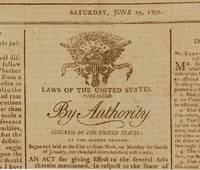
1790rif. 52510New York: John Fenno no. 41 Broad-Street near the Exchange 1790. First edtion. Softcover. Fine. Two leaves folio 16.25 by 10 in. Edges slightly trimmed; a touch of mild foxing else a fine crisp copy. Housed in linen clamshell box with gilt paper label at spine and previous owner's dediction pasted to inside cover. The first known published appearance of Jewish support for the newly elected president of the United States George Washington. One week after Washinton's inauguration Levi Sheftall on behalf of the newly reorganized Savannah Hebrew Congregation wrote him an elegant and effusive letter of congratulation. This letter along with Washington's reply was published for the first time by the United States Gazette: "Sir We have long been anxious of congratulating you on your appointment. and of testifying our unbounded confidence in your integrity and unblemished virtue. Your unexampled liberality and extensive philanthropy have dispelled that cloud of bigotry and superstition which has long as a veil shaded religion -- unrivetted the fetters of enthusiasm -- enfranchised us with all the privileges and immunities of free citizens and initiated us into the grand mass of legislative mechanism. May the great Author of worlds grant you all happiness and a continuance of guardianship to that freedom which under the auspices of heaven your magnanimity and wisdom have given these States." Washington's reply is undated but addressed "To the Hebrew Congregation of the City of Savannah." After accepting their congratulations he extends this hope: "May the same wonder-working Deity who long since delivering the Hebrews from their Egyptian Oppressors planted them in the promised land -- whose providential agency has lately been conspicuous in established these United States as an independent nation -- still continue to water them with the dews of Heaven and to make the inhabitants of every denomination participate in the temporal and spiritual blessings of that people whose God is Jehovah. George Washington." Provenance: old entry of . Hopkins at top margin first leaf trimmed. Six weeks later References: Enc. Jud. first ed. 1972 vol. 16; Evans Amer. Bibl. vol. 8; From the Ends of the Earth Judaica Treasures of the Library of Congress. John Fenno, no. 41 Broad-Street, near the Exchange unknown
1790rif. 52510New York: John Fenno no. 41 Broad-Street near the Exchange 1790. First edtion. Softcover. Fine. Two leaves folio 16.25 by 10 in. Edges slightly trimmed; a touch of mild foxing else a fine crisp copy. Housed in linen clamshell box with gilt paper label at spine and previous owner's dediction pasted to inside cover. The first known published appearance of Jewish support for the newly elected president of the United States George Washington. One week after Washinton's inauguration Levi Sheftall on behalf of the newly reorganized Savannah Hebrew Congregation wrote him an elegant and effusive letter of congratulation. This letter along with Washington's reply was published for the first time by the United States Gazette: "Sir We have long been anxious of congratulating you on your appointment. and of testifying our unbounded confidence in your integrity and unblemished virtue. Your unexampled liberality and extensive philanthropy have dispelled that cloud of bigotry and superstition which has long as a veil shaded religion -- unrivetted the fetters of enthusiasm -- enfranchised us with all the privileges and immunities of free citizens and initiated us into the grand mass of legislative mechanism. May the great Author of worlds grant you all happiness and a continuance of guardianship to that freedom which under the auspices of heaven your magnanimity and wisdom have given these States." Washington's reply is undated but addressed "To the Hebrew Congregation of the City of Savannah." After accepting their congratulations he extends this hope: "May the same wonder-working Deity who long since delivering the Hebrews from their Egyptian Oppressors planted them in the promised land -- whose providential agency has lately been conspicuous in established these United States as an independent nation -- still continue to water them with the dews of Heaven and to make the inhabitants of every denomination participate in the temporal and spiritual blessings of that people whose God is Jehovah. George Washington." Provenance: old entry of . Hopkins at top margin first leaf trimmed. Six weeks later References: Enc. Jud. first ed. 1972 vol. 16; Evans Amer. Bibl. vol. 8; From the Ends of the Earth Judaica Treasures of the Library of Congress. John Fenno, no. 41 Broad-Street, near the Exchange unknown books
564pp, recto blanc Marque typographique au tit, Lettrinesavec bois gravé pour chaque changement de lettre.