HEBREW BIBLEABAA
2.992 Ergebnisse
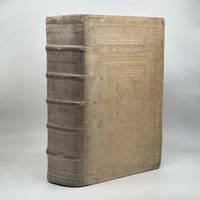
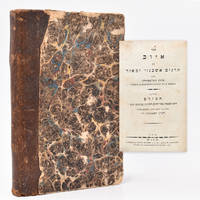
1818Best.-Nr. 1286051818. HEBREW BIBLE. OTTENSOSSER David. SCHWABACHER Heimann. Kiryah ne'emanah sefer Ezra mit uebersetzung und be'ur von Heimann Schwabacher und David Ottenzosser. Frth: Isaac ben David Zirndorfer 1818. Small octavo contemporary sheep boards rebacked. $1350.First edition of this Hebrew and German edition of the Book of Ezra prepared and printed by three eminent figures of 19th-century German Jewish scholarship.Uncommon Judeo-German edition of the Book of Ezra offering Hebrew text and a German translation transliterated in Hebrew characters on opposing pages with accompanying commentary. Heimann Schwabacher and David Ottensosser the editors were leading figures of the HaskalahÑan Enlightenment movement calling for rationality and secular educationÑin Frth a major Jewish center with a long history of Hebrew printing. This work was printed by Isaac ben David Zirndorfer sometimes given as Zrndorfer or Zrndorf proprietor of a distinguished Jewish press in Frth: ""Fuerth a center of Talmudic learning established its first Hebrew presses in 1691. In 1737 Hayyim ben Zvi Hirsch opened a print house in Fuerth issuing some 80-100 Hebrew titles in the next three and a half decades. When Hirsch died in 1772 his widow managed the shop for two years until her marriage in 1774 to Isaac ben David Zirndorfer. Zirndorfer and his family managed the press until 1868"" William Gross for the Center for Jewish Art. Vinograd Furth:726. Pages age-toned binding with expected age-wear edges expertly restored. Scarce. hardcover books
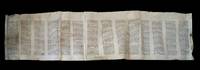
Best.-Nr. 69604Italy. HEBREW MANUSCRIPT. Italy n.d. ca 18th Century. Sefer Torah parchment manuscript fragments taken from Exodus. With a total of fourteen columns of Hebrew manuscript in 42 lines. Four sections sewn together with thin cords and the whole piece is rolled up as a scroll. The verso is reinforced with tabs along edges and seam. The whole fragments measures approximately 20 x 78 inches; 500 x 1900 mm. Some minor creasing and soiling along edges and margins. A few light stains. Repairs to a few holes most of which are marginal and just a couple that are affecting a few letters. Still overall a very good example. The scroll contain a passages from the Book of Exodus 7:1-12:36 which recounts the "Plagues of Egypt" namely the transformation of the river water into blood; the plague of frogs; the swarm of gnats; the invasion of flies; the lethal pestilence affecting livestock; the boils afflicting both livestock and people; the rain of fire and hail; the plague of locusts; the three consecutive days of darkness over the land of Egypt; and finally the death of the Egyptian firstborns. HBS 69604. $2500. [Italy] unknown books
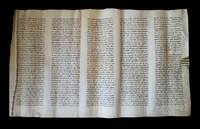
Best.-Nr. 69603Italy. HEBREW MANUSCRIPT. Italy n.d. ca 18th Century. Two Sefer Torah parchment manuscript fragment scrolls taken from Genesis. Each with five columns of Hebrew manuscript. The columns contain 42 lines. The first fragment measures 23 x 15 3/4 inches; 400 x 560 mm and the second measures 24 1/2 x 14 inches; 360 x 600 mm. Some creasing from being rolled and a bit of minor soiling along edges and margins. A few light stains. Still overall very good examples. Both scrolls contain passages from the Book of Genesis. The first scroll contains verses Gen. 9:11-14:14 which begins by describing the promise God made to mankind through Abraham that there would not be a second Great Flood and concludes with Abraham's tribulations during the wars against neighboring tribes. The second scroll contains verses Gen. 29:15- 32:10 which recounts the events involving Laban Jacob and Esau. HBS 69603. $3000. [Italy] unknown books
1912Best.-Nr. 224371912. Schwartz Isidor Publisher. Vi Azoy Tsu Veren a Sitizen. / The Citizen: A Guide to Naturalization. All Important Questions and Answers Printed in Hebrew and Yiddish Also Translations in Plain English Which You are to Know When Applying for Your Final Citizen Papers. Brooklyn: Aroysgegeben fun Isidor Schwartz / Published by Isidor Schwartz n.d. after 1912. Only edition. 31 pages. Text in English and Yiddish both transliterated and Hebrew script. 6" x 4.5". Stapled pamphlet in printed wrappers. An immigrant-era Yiddish-English naturalization guide for Jewish immigrants preparing to become U.S. citizens published by Isidor Schwartz in Brooklyn. This vernacular instructional manual contains sample questions and answers in three formats: English Yiddish in Hebrew script and transliterated English in Latin script referred to on the cover as "Jewish-English". Designed for oral preparation it walks new arrivals through both general and localized questions commonly asked at the naturalization interview particularly for applicants in New York. Questions range from general American civics-"How does a bill become a law"-to specific regional knowledge-"What is the capital of New York State" and "How many stars has the American flag" The answer is noted as "Forty-eight stars" dating the publication to after Arizona and New Mexico's 1912 admission but before Alaska and Hawaii. The phrasing used-"We vote for the candidate who is in our opinion best fitted to occupy the office he wishes to be elected to"-illustrates the pamphlet's focus on simplified phonetic civic literacy. A vital artifact of Jewish immigrant life and Americanization in the early 20th century this pamphlet exemplifies how Jewish community publishers mediated state bureaucracies for recent arrivals. Yiddish language guides like this one offered more than instruction-they were part of the infrastructure of mutual aid and cultural transition particularly within New York's dense immigrant communities. Fragile condition with moderate chipping and edgewear to front and rear wrappers covers and first page disbound; interior pages clean and legible. Overall good condition. A scarce and historically significant publication supporting Jewish American integration during a peak period of Yiddish-speaking immigration; OCLC locates only 8 institutional holdings worldwide. unknown books
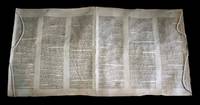
Best.-Nr. 69267NP. HEBREW MANUSCRIPT. n.p.n.d. ca 18th Century. Two Sefer Torah parchment manuscript fragments taken from Exodus. Each with three columns of Hebrew manuscript. The two leaves sewn together with thin cords and the whole piece is rolled up as a scroll. The verso is reinforced with tabs along edges and seam. The two fragments measure 22 3/4 x 23 3/4 inches and 22 3/4 x 21 3/4 inches. Some minor creasing and soiling along edges and margins. A few light stains. Still overall a very good example. "Exodus "Shemot" is the second book of the Torah Judaism's foundational text. It describes the Israelites' enslavement in Egypt their miraculous redemption through ten plagues and the splitting of the Red Sea. Under Moses' leadership they begin their travels in the desert where they experience God's revelation receive the Ten Commandments at Mount Sinai and build the mishkan tabernacle. Interspersed throughout the book are more than one hundred mitzvot commandments." Sefaria dot org. HBS 69267. $1250. NP unknown books
1596Best.-Nr. 371949Hamburg: Jacob Lucius 1596. Four parts in one each with sectional title with woodcut border. Engraved general title bound following the part one sectional title with a full page woodcut of the seal of the city of Hamburg on verso. 4 423 1 blank; 2 425-772; 773-1135 1 blank; 1139-1572pp. Folio. Contemporary pigskin stamped in blind light soiling and wear. Very minor worming first two leaves with old paper strengthening along the fore-edge. Provenance: Rev. Edwin A. Dalrymple bookplate; Maryland Diocesan Library; General Theological Seminary. Four parts in one each with sectional title with woodcut border. Engraved general title bound following the part one sectional title with a full page woodcut of the seal of the city of Hamburg on verso. 4 423 1 blank; 2 425-772; 773-1135 1 blank; 1139-1572pp. Folio. A re-issue of Elias Hutter's 1587 Hebrew Bible - the earliest production of a Hebrew press in Hamburg - published with an new engraved title as above here bound in following the first sectional title published in conjunction with the Hamburg Polyglot of 1596 "thus making the whole publication appear a tetraglot in two volumes" Darlow & Moole. Printed with the root letters in thick type and the inflectional letters in hollow type. See Darlow & Moole 1425 and 5108 Jacob Lucius unknown books
1535Best.-Nr. 372715Basel: Bebel Isengrin and Petri 1535. Text in two columns in Hebrew and Latin. 2 vols. Folio. Nineteenth century half calf and marbled boards. Old ink notation at top of front pastedowns: Duplum. Very good plus some rubbing. Text in two columns in Hebrew and Latin. 2 vols. Folio. First edition of the new Latin translation by Sebastian Münster. Copinger 243; Darlow & Moule 5087 6115; VD 16 B2881. Provenance: W. A. Copinger bookplate; General Theological Seminary [Bebel, Isengrin, and Petri] unknown books
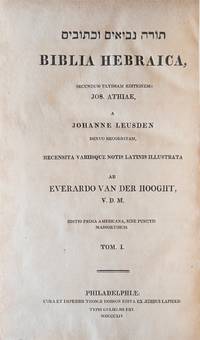
1814Best.-Nr. 372931Philadelphia: Cura et Impensis Thomae Dobson edita ex aedibus Lapideis. Typis Gulielmi Fry 1814. First American edition. Text in Hebrew with notes in Latin. 6 296; 2 312 leaves. Half titles present in each volume. Uncut. 2 vols. 8vo. Original blue paper boards rebacked with plain paper. Provenance: Hugh Blair Grigsby booklabels. In a blue cloth folding box. First American edition. Text in Hebrew with notes in Latin. 6 296; 2 312 leaves. Half titles present in each volume. Uncut. 2 vols. 8vo. The first complete Hebrew Bible printed in America. Hebrew type was first used in the North American colonies in the Bay Psalm Book printed in 1640 in Cambridge. Over the next ninety-five years Hebrew type appeared in a handful of American imprints usually in brief examples of single words or short sentences. Paucity of appropriate type would continue to be a problem over the years that followed. The first Jewish Psalter was finally published in 1809 followed by this complete Bible five years later. "In 1812 Mr. Horwitz had proposed the publication of this edition of the Hebrew Bible the first proposal of the kind in the United States; early in 1813 be transferred his right and list of subscribers to Mr. Thos. Dobson who published soon afterwards the 1st volume" O'Callaghan. The title page indicates that this work is a reprinting of the second edition of the Joseph Athias Bible edited by Leusden with Latin notes by Everardo Van der Hought and that the Hebrew is printed without vowels. An important piece of American printing and of Jewish Americana. Darlow and Moule 5168a; Goldman 4; Rosenbach 171; Shaw and Shoemaker 30857; Singerman 236; M. Vaxer "The First Hebrew Bible Printed in America" Journal of Jewish Bib. 1940 vol. 2 pp. 20-26 Cura et Impensis Thomae Dobson edita ex aedibus Lapideis. Typis Gulielmi Fry unknown books
1609Best.-Nr. 371891Geneva: Pierre de la Rouière 1609. In two columns. 28 184 283 1 84 203 1; 8 186 2 134 2pp. Folio 15 x 9-1/2 inches. Contemporary pigskin covers blocked in gilt and blind remnants of paper label on the spine gauffered edges lacks bosses and hinges and clasps worn at extremities and bottom of spine. Provenance: Johann Georg Feuchter of Jura-Weickersroda inscription on pastedown that the bible was purchased at an August 6 1728 auction for 4 florins and 30 groschen; General Theological Seminary blindstamp. In two columns. 28 184 283 1 84 203 1; 8 186 2 134 2pp. Folio 15 x 9-1/2 inches. Edited with introduction by Benito Arias Montanus 1527-1598 Spanish orientalist and editor of the Antwerp Polyglot a reprint of Plantin's similar edition. Darlow & Moole 5113 OT and 4662 NT Pierre de la Rouière unknown books
Best.-Nr. 371476Amsterdam: Joseph Jacob and Abraham the sons of Solomon Proops 5522. Titled printed in red and black. 2 178 2 179-332 10 Introduction etc. 2 160 2 161-350pp. Publisher's introduction and other preliminaries misbound preceding the later Prophets. Folio 15-7/8x10 inches. Nineteenth or early 20th century half morocco and marbled paper boards rear joint splitting worn at joints and head and tail of spine. Foxing principally to the title tear to the final text leaf. Provenance: General Theological Seminary bookplate. Titled printed in red and black. 2 178 2 179-332 10 Introduction etc. 2 160 2 161-350pp. Publisher's introduction and other preliminaries misbound preceding the later Prophets. Folio 15-7/8x10 inches. Besides being the first bi-lingual edition in Hebrew and Spanish this edition is the first Hebrew book whose publication was financed by an American - Abraham Mendes de Castro 1689-1762 of Curaçao - intended for use in the West Indies with the sale proceeds to benefit the Jewish communities of Jerusalem and Hebron. Cowley 102; Darlow & Moule 5156; Zedner 102; not in Steinschneider or Roest Joseph, Jacob and Abraham, the sons of Solomon Proops unknown books
1817Best.-Nr. 353306Vienna: Anton Schmidt 1817. Portrait frontispiece engraved additional title. 8vo. Contemporary quarter calf and marbled boards the calf tooled in blind worn rear hinge cracked lacks rear pastedown frontispiece detached. Portrait frontispiece engraved additional title. 8vo. Includes commentary by Rashi and Beur. Anton Schmidt unknown books
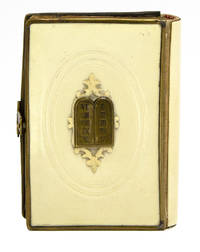
1857Best.-Nr. 311893Vienna: Jos. Schlesinger Library 1857. Text in Hebrew and English. 875 3pp. Thick 12mo. Near contemporary binding of celluloid over cloth with bone and metal decorations and metal clasp. Light surface rubbing to covers text toned. Text in Hebrew and English. 875 3pp. Thick 12mo. Jos. Schlesinger Library unknown books
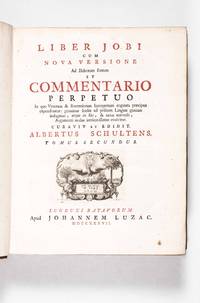
1737Best.-Nr. 49261Leiden: Jean Luzac 1737. First edition. Two volumes large quarto. 52 544; 2 545-1232 63 indices 1 corrigendapp. Text in two columns with Hebrew text and facing Latin translation interspersed with commentary. Titles in red and black with engraved vignettes. Contemporary speckled calf; gilt-tooled spine with raised bands and morocco lettering pieces; gilt dentelles; edges daubed in red and green. Light scuffing to boards and fading to spines. A very good set with crisp clean text throughout. First edition of this comprehensive commentary to the biblical Book of Job by the Dutch scholar of Semitic languages Albert Schultens 1686-1750 who maintained "that the true nature of the Hebrew language and the meaning of many of its words and idioms are to be found chiefly in the Arabic" Orme. Fifty-five pages of the indices constitute a brief lexicon and provide Latin as well as Arabic equivalents for more than 1000 Hebrew words. Schultens studied theology and eastern languages at Groningen where he received his degree in theology in 1709. After a brief career as a preacher in Wassenaar he was nominated professor of Hebrew and Jewish antiquities at Franeker in 1713. In 1729 he decamped for Leiden were he was first appointed reader in eastern languages and finally full professor in 1732. At this time a chief concern of Calvinist theologians was to liberate Old Testament exegesis from the Jewish Rabbinic as well as Catholic traditions. Schultens' influential and controversial solution was revealed as early as 1706 in his first public thesis Disputatio theologico philologica de utilitate linguae Arabicae in interpretanda S. Scriptura A Theologico-Philosophical Dissertation on the Utility of the Arabic Language for the Interpretation of the Holy Scriptures "a forceful attack" Brugman & Schröder on the Protestant sola scriptura methodology of Biblical exegesis. "With the help of Jacobus Golius' Arabic dictionary he perused with zeal and fervour the Old Testament and wrote prolifically. The lexical superiority of Arabic had led him to a reconsideration of the position of Hebrew: at first he had called Arabic 'the most splendid daughter of mother Hebrew' but in his oration of 1729 he proclaimed Hebrew and Arabic cognate twin sisters. This shocked conservative theologians as an outright profanation of God's Word" Brugman & Schröder. "In 1737 he applied his theories in his bilingual edition of the book of the prophet Job whom he regarded as an Arab. The Hebrew text and the Latin translation are all but totally submerged by the extensive commentary in which Schultens draws abundantly on Arabic texts such as the Hamasa an anthology of early Arabic poetry by the ninth-century poet Abu Tammam" Vrolijk & van Leeuwen. Schultens was not without his critics and by 1824 William Orme notes a turning of the tide: "Different opinions are entertained of the correctness of his views and also of his success in applying them; but it is now generally admitted that he carries his notions of the advantage of Arabic learning to the interpretation of the Scriptures too far." Jean Luzac 1728-1777 was a member of a well-known Huguenot family of printers; he published many works for the University of Leiden including three Hebrew books of Albert Schultens. Isaac van der Mijn is noted as the printer at the colophon of the second volume. Provenance: printed label of the Bibliotheca Seminarii Warmondani at the front endleaf of the first volume. Full title: Liber Jobi cum nova versione ad Hebraeum fontem et commentario perpetuo in quo Veterum et Recentiorum Interpretum cogitata præcipua expenduntur: genuinus sensus ad priscum Linguae genium indagatur atque ex filo et nexu universo Argumenti nodus intricatissimus evolvitur. Curavit et editit. Albertus Schultens. Tomus Primus. -Tomus Secundus References: J. Brugman & F. Schröder Arabic Studies in the Netherlands Leiden: E.J. Brill 1979 p.26f. Fuks/Fuks-Mansfeld 78. Orme Bibl. Biblica p. 390. A. Vrolijk & R. van Leeuwen Arabic Studies in the Netherlands a Short History in Portraits 1580-1950 Leiden: E.J. Brill 2014 pp. 73-79. Jean Luzac unknown books
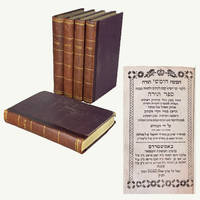
1797Best.-Nr. T22Octavo approx. 7" x 4.5". 5 vols. Eighteenth century Pentateuch vocalized. Text in Hebrew in single column format. Commentary by Rashi. Title pages within borders. Occasional headpieces and ornaments. Collation: Genesis: 1 title 1-194 1-41 13 1-72 1-32; Exodus: lacks title 1-182 1-52 13 1-72 12 24 1-62; Leviticus: 1 title 1-124 1-42 51 13 1-72 1-54 62 72 84 91; Numbers: 1 title1-154 11-3113 1-72 12 24 32; Deuteronomy: 1 title 1-143 1-32 13 1-72 1-31. Exodus lacks title otherwise complete. Binding: Rebound in quarter calf. Spines lettered in gilt. Marbled endpapers. Accompanied by slipcase. Condition: Clean and bright. The second volume chipped at head and with some staining to lower gutter impacting up to five lines of text. Provenance: "Sara van Gelder Loewenstamm" to front endpaper of first volume. Collection of Tim Lutz. Note: The Proops family were a notable dynasty of Hebrew printers publishers and booksellers in Amsterdam. Solomon ben Yosef d. 1734 likely son of a printer began as a bookseller and in 1704 founded a Hebrew press producing liturgical works as well as texts on halakhah Kabbalah ethics and history. From 1715 his books carried advertisements and in 1730 he issued the first Hebrew sales catalogue. After his death guardians and later his sons continued the press using his name until 1751. In 1785 Joseph Proops sold most stock to Kurzbeck of Vienna; his widow and sons printed on a smaller scale until 1812. Solomon ben Abraham Proops his grandson split in 1797 and worked independently until 1827. Proops family of printers hardcover books
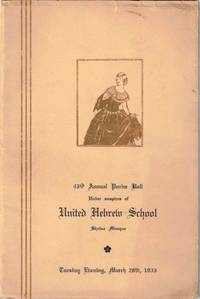
1933Best.-Nr. 73008Atlanta: Uniited Hebrew School 1933. Paperback. Good. Paperback. 40pp. Marriage invitation laid inside. Edge wear to the covers else a good complete example. Uniited Hebrew School paperback books
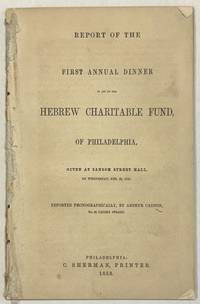
1853Best.-Nr. 40496Philadelphia: C. Sherman Printer 1853. 39 1 blank pp. Disbound tiny corner chip at head of title page. Good. Housed in a modern slipcase old bookplate on its front pastedown. Philadelphia's Jewish elite supported this organization. Abraham S. Wolf Isaac Leeser Solomon Solis H. Polack and others were the Committee of Arrangements. Funds are desperately required to meet "the many demands caused by the vast number of emigrants who annually land on our shores." The list of donors is 6-1/2 pages. Non-Jewish participation was substantial. For example former Vice President George Dallas was a conspicuous presence. Toasts patriotic addresses music and overall good cheer characterize the gathering. Singerman 1302. OCLC 78367144 3- LCP Princeton AJHS 57761577 1- Yeshiva as of October 2024. C. Sherman, Printer unknown books
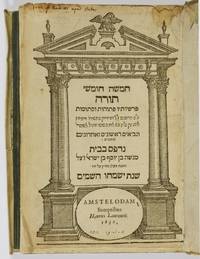
1631Best.-Nr. 55459Amsterdam: printed by Menasseh ben Israel for Henricus Laurentius 1631. First edition. Hardcover. Very good-. Octavo 16.8 by 11.4 cm. Collation: aleph-lamed-zayin8 = 296 leaves. 612 i.e. 592 pp: p. 464 erroneously numbered 484 465 as 485 and so on throughout. Two column text in unvocalized Hebrew; every fifth verse numbered in the margin. Title within architectural border; half titles with letterpress ornamentation for the Former and Latter Prophets. Contemporary vellumwith exposed thongs edges stained blue; yapp fore-edges; front joint cracked but holding strong. Intermittent light toning to text outmost leaves a bit more darkened; very occasional small stains. Title-page slighltly trimmed 4 mm at bottom edge; expert marginal repairs at bottom corners of 2 leaves; 1 leaf re-margined at fore-edge with no loss of text else a very good copy with crisp clean text. First Hebrew Bible published in Amsterdam printed by the rabbi diplomat publisher and religious thinker Menasseh ben Israel 1604-1657 one of the most distinguished members of the Portuguese Jewish community of Amsterdam and the first Jewish printer in the Northern Netherlands. The Amsterdam printer and publisher Hendrick Laurensz Lauretius provided the financing for this edition along with two other Bible editions and two editions of the Hebrew Psalms printed by Menasseh between 1631 and 1646. "These publications were not only made for the local market but mainly for international trade. Thanks to this financial help Menasseh was able to organize his printing office in a more professional way" Fuks hiring a Jewish compositor Judah Leb ben Mordecai Gimple from Posen and a gentile compositor Bartholomeus Laurensz. The printing activity of Menasseh was especially important in the steadily growing productions of the Hebrew press in the Northern Netherlands. Fulfilling the needs of the Sephardic community for Jewish ritual texts eliminated the need for expensive imports from Venice and Poland. Menasseh undersood that the relatively cheap paper and tools available in Amsterdam made it possible to compete in quality and prices with the Hebrew presses of Poland Italy and Basel. "Gentile publishers and booksellers in Amsterdam such as Jansonius and Laurentius were quick to see the opportunity of the opening Eastern European market and financed several of Menasseh's publications" Fuks. Menasseh was the first to introduce in the Netherlands waybertaytsch types for Yiddish publications along with illustrated Hebrew books. He was also the first Jewish printer to adopt the Dutch pocket-book format made famous by the Elzeviers. Notes on publication date and issue: The title is dated 1630 in Arabic numerals; the colophon notes the date of completion in Hebrew characters as 5 Adar 5391 = 7 February 1631 along with the printer's apology for being unable to provide the index of pericopes promised on the title-page due to lack of printing material. Darlow and Moule describe this issue as Variant A with a Latin imprint appearing in the cartouche beneath the Hebrew title. Provenance and annotations: early entry in brown ink at front paste-down with short Greek inscription Theos. dated 1700; old Latin inscription in black ink at top margin title in reference to Hebrew roots; date of 1812 beside Yiddish entry penned in black ink within imprint cartouche at title; old entry in German penned in black ink at verso title beneath which is an oval cartouche in imitation of the one at the title in which an owner has penned in black ink the Hebrew imprint information regarding Hendrick Laurensz as it would appear in the Varient B issue; old library shelf marks at rear paste-down; recent owner entry in blue ink in Hebrew at front paste-down. References: Darlow and Moule 5123a; Fuks/Fuks-Mansfeld no. 152; pp. 105; 111f.; Steinschneider no. 453; Vinograd Amsterdam 22. Full title and imprint: חמשה חומשי תורה פרשיותיו פתוחות וסתומות ע"פ ×”×¨×ž×‘× ז"ל ומדוייק בחסירו' ויתרות להעתק ס"ת ×¢× לוח בסופו מועיל לסופרי' ×•× ×‘×™××™× ×¨××©×•× ×™× ×•××—×¨×•× ×™× ×•×›×ª×•×‘×™×: נדפס בבית מנשה בן ישר×ל ז׳׳צל והוגה בעיון נמרץ על ידו שנת ישמחו ×”×©×ž×™× Amstelodami sumptibus Henrici Laurentii 1630. printed by Menasseh ben Israel for Henricus Laurentius hardcover books
2024Best.-Nr. 54314Leiden: Brill 2024. First English language edition. Hardcover. Fine. Octavo 9-1/2" x 6-1/2". vii 3 552pp. Index and 7 page bibliography. Text in English. Pale green spine lettered in purple over purple boards. A fine as new copy. "The series Jewish Thought and Philosophy aims to present new and original scholarship on Jewish thought and philosophy from the Middle Ages to the present day. Based on a broad concept of Jewish intellectual history it covers medieval and modern halakhic thought philosophical exegesis of the Bible medieval and modern philosophy theology mysticism political theory Jewish social thought and ethics including the interaction with non-Jewish thought. The focus is on high scholarly standards and innovative methodological approach. While monographs are preferred excellent collected volumes exploring important aspects of Jewish intellectual history as well as editions and translations of essential texts are also welcome." Publisher Supplements to The Journal of Jewish Thought and Philosophy Volume 34. Brill hardcover books
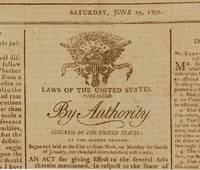
1790Best.-Nr. 52510New York: John Fenno no. 41 Broad-Street near the Exchange 1790. First edtion. Softcover. Fine. Two leaves folio 16.25 by 10 in. Edges slightly trimmed; a touch of mild foxing else a fine crisp copy. Housed in linen clamshell box with gilt paper label at spine and previous owner's dediction pasted to inside cover. The first known published appearance of Jewish support for the newly elected president of the United States George Washington. One week after Washinton's inauguration Levi Sheftall on behalf of the newly reorganized Savannah Hebrew Congregation wrote him an elegant and effusive letter of congratulation. This letter along with Washington's reply was published for the first time by the United States Gazette: "Sir We have long been anxious of congratulating you on your appointment. and of testifying our unbounded confidence in your integrity and unblemished virtue. Your unexampled liberality and extensive philanthropy have dispelled that cloud of bigotry and superstition which has long as a veil shaded religion -- unrivetted the fetters of enthusiasm -- enfranchised us with all the privileges and immunities of free citizens and initiated us into the grand mass of legislative mechanism. May the great Author of worlds grant you all happiness and a continuance of guardianship to that freedom which under the auspices of heaven your magnanimity and wisdom have given these States." Washington's reply is undated but addressed "To the Hebrew Congregation of the City of Savannah." After accepting their congratulations he extends this hope: "May the same wonder-working Deity who long since delivering the Hebrews from their Egyptian Oppressors planted them in the promised land -- whose providential agency has lately been conspicuous in established these United States as an independent nation -- still continue to water them with the dews of Heaven and to make the inhabitants of every denomination participate in the temporal and spiritual blessings of that people whose God is Jehovah. George Washington." Provenance: old entry of . Hopkins at top margin first leaf trimmed. Six weeks later References: Enc. Jud. first ed. 1972 vol. 16; Evans Amer. Bibl. vol. 8; From the Ends of the Earth Judaica Treasures of the Library of Congress. John Fenno, no. 41 Broad-Street, near the Exchange unknown books
1839Best.-Nr. 52150Philadelphia: Bagster & Marshall 1839. First American edition. Hardcover. Good . Octavo. 6 10 778pp. Pointed Hebrew text in two columns the New Testament with only vocal marks. Continuous pagination in Arabic numerals; but separate Hebrew pagination for the Old and New Testaments. Contemporary three-quarter calf over pebbled cloth boards; spine with raised bands ruled and lettered in gilt. Decorative endleaves. Covers rubbed with wear at spine caps and corners. Library pressure stamp at title bookplate and pocket at paste-downs. A good ex-library copy with very clean fresh text throughout. First American edition of this Hebrew Bible earlier published by Samuel Bagster at London in 1835; it contains the first printing of the New Testament in Hebrew translation to appear in the United States. That translation was prepared by the philologist William Greenfield 1799-1831 the editorial superintendent of the British and Foreign Bible Society and first published by Samuel Bagster at London in 1831 D&M no. 5186. In preparing his revised Hebrew version Greenfield was allowed to utilise the London Jews' Society Hebrew New Testament published at London between 1813 and 1817 D&M no. 5170. Among the earliest publications of the society founded in 1809 this version was itself based upon Elias Hutter's Hebrew translation of the New Testament published at Nuremberg in 1599 D&M no. 5111. Prepared by a group of scholars under the supervision of Thomas Fry and William Bengo Collyer this London Jews' Society edition employed only biblical words and translated Old Testament quotations from the Greek not citing them directly from the Hebrew Scriptures. The editor of the New Testament version in the present work appears to have had a notable gift for languages. William Greenfield began his Hebrew studies as a young man while apprenticed to a bookbinder taking lessons from one of his co-workers a Jew with some learning who had been described as "a reader of the law in the synagogue" ODNB. Greenfield subsequently left the business in 1824 in order to devote himself to languages and biblical criticism. His defence of the Serampore Mahratta version of the New Testament in response to an 1829 article in the Asiatic Journal brought him to the attention of the British and Foreign Bible Society who then hired him to superintend their editiorial department. "During his nineteen months in the society's service Greenfield wrote on twelve European five Asiatic one African and three American languages and acquired considerable knowledge of Peruvian African-English Chippeway and Berber" ODNB. His revision of the Hebrew New Testament earlier published by the London Jews' Society was among the last works he undertook for the British and Foreign Bible Society along with the revision of the Modern Greek Psalter as it went through the press. Provenance: Bookplate and other markings including withdrawal stamp of the Library of the Garrett Theological Seminary Evanston Illinois. Full title in Hebrew: ספר הקדש ×•×”×•× תורה × ×‘×™××™× ×•×›×ª×•×‘×™× ×’× כתבי ברית החדשה נעתק מלשון יונית ×ל לשון עברית Philadelphiae: Sumptibus Bagster et Marshall in via vulgo dicta Chestnut Street ad Repositorium Bibliorum Sacrorum etc. quae in linguis antiquis et hodiernis edita sunt. Anno erae Judaicae I rev. C; rev. C DXCIX. References: Goldman Hebrew Printing in America no. 6: "This was the first New Testament published in Hebrew in America." ODNB: "Greenfield William" Gordon Goodwin revised by H. C. G. Matthew. J. R. Marcus "Jewish Americana a Supplement to A. S. W. Rosenbach An American Jewish Bibliography" in: Monographs of the American Jewish Archives 1954 no. 1 no. 164. Cf. Darlow & Moule nos. 5111; 5170; 5186. Bagster & Marshall hardcover books
1619Best.-Nr. 52679Basel: Ludwig König 1619. First edition in part. Hardcover. Good. Eight parts in three volumes folio biblical texts and commentary in four parts continuously foliated; three supplemental sections each with separate foliation; Tiberias 1655 with separate pagination here bound after the Haftarot - Vol. 1: 6 title and prelims 1-228 1 sect. title 234-441 1 blank ff. Vol. 2: 1 sect. title 442-705 3 blank 707 sect. title-837 1 blank ff. Vol. 3: 839 half-title-881 1 blank 883-946; 8 Targum Yerushalmi; last leaf unfoliated; 67 Masorah 1 blank; 1 title 2-36 Haftarot ff.; 8 title and prelims 108pp. Despite the gap in foliation between the first and second parts and numerous errors in foliation throughout the Rabbinic Bible collates complete with all blanks noted in Prijs Die Basler hebräischen Drucke and the Haftarot bound at the end. Largely arranged in two columns of biblical texts in square font surrounded by commentaries in rabbinic Rashi font; biblical texts read from right to left. This copy with collective Hebrew title surrounded by biblical quotations in Hebrew set within elaborate woodcut architectural borders; brief preface in Hebrew by Abraham Braunschweig at the verso. Hebrew sectional titles set within the same woodcut borders for the three other biblical sections and the Haftarot with a plain letterpress half-title for the Five Megillot. Opening word of each biblical book set in large one-third to one-half page cartouche vignettes with elaborate woodcut borders and surrounding letterpress Hebrew text. Main title Jewish date chronogram = 5378 1618-1619. Near-contemporary half calf over speckled boards worn and rubbed; spines with raised bands gilt morocco lettering pieces and old paper labels heavily faded. About two-thirds of the text embrowned ranging from minimal to moderately heavy; worm tracing in a 1- by 2-inch section at leaves 541-553 affecting text. A good complete set notably containing the Ashkenazi Haftarot readings not found in all copies. Sixth Rabbinic Bible in Hebrew: Mikra'ot Gedolot edited by Johann Buxtorf I 1565-1629 professor of Hebrew at the University of Basel and the foremost Christian Hebraist of his era with the assistance of the Jewish scholars Abraham Braunschweig who served as the principal corrector and Mordechai Gumplin of Posen. This was "a truly audacious undertaking for his time" Burnett as no Christian scholar had yet attempted to edit the entire biblical corpus including the Aramaic versions Targumim and masoretic notes. Based mainly on the third Rabbinic Bible published by Daniel Bomberg at Venice in 1546-1548 the editor has carefully incorporated elements from two other Venetian editions. At the verso of the Latin title Buxtorf provides a detailed bibliographical excursus on the earlier Venetian editions and offers a tribute to Bomberg's industry by reprinting the colophon of the second Venetian Rabbinic Bible 1524-1525 at the conclusion of the masoretic appendix with text by the Hebrew grammarian and lexicographer Elijah Levita 1468 or 1469-1549 and a new introduction by Abraham Braunschweig. The design of the sectional titles and separate book title vignettes closely model those of the Venetian editions. "Buxtorf did not plan simply to reprint one of the existing Venice editions but rather to assemble the best features of them all into one work" and "to provide theologians with what he considered the most important tools for interpreting the Old Testament" Burnett. Buxtorf served in an official capacity as Basel's Hebrew censor charged with the oversight of all Jewish printing in the city and insuring that "no 'blasphemies' or slurs against Christians or Christianity appear in any book printed in Basel" Burnett. He carefully edited the Jewish commentaries in the Rabbinic Bible in accordance with this mandate "and removed many words and phrases which had escaped the attention of earlier censors" Burnett. The Rabbinic Bible contains the vocalized Masoretic text of the Hebrew Scriptures with accents and a vocalized Targum an Aramaic paraphrase of the biblical text: Onkelos for the Pentateuch; Jonathan b. Uzziel for the Prophets; and Targum Hagiographa for the Writings. The Hebrew and Aramaic versions are printed in square characters and presented in facing columns at the center of each page. The Jerusalem Targum of the Pentateuch appears as an appendix. In addition to the Aramaic paraphrases the Rabbinic Bible includes a massive scholarly apparatus of biblical commentaries by Rashi Ibn Ezra Baal ha-Turim Jacob b. Asher R. David Kimchi Radak R. Levi b. Gershon Ralbag Saadia Gaon and R. Isaiah along with the Masora a corpus of critical notes on the external form of the Biblical text compiled by Jewish scholars from late antiquity through the medieval era. As frequently occurs a copy of Buxtorf's work on the textual history of the Hebrew Bible Tiberias the 1655 revised edition is bound-in. This work was made possible by the publication in 1538 of Elijah Levita's Masoret ha-Masoret a commentary on the Masora which Buxtorf translated into Latin for his own private use in 1593. While "Buxtorf was concerned with the integrity of the consonantal text and the origin and integrity of the vowel points and accents of the Hebrew Bible from the very beginning of his scholarly career." While he had earlier published a long excursus on the age of the vowel points and accents in his 1609 Thesaurus Grammaticus "Tiberias is Buxtorf's fullest and most impressive work on the history of the biblical text" Burnett. Intended as a reference work for Christian students and scholars interested in studying the Masora Buxtorf was also keen to refute the view advanced by Levita that the Hebrew vowel points were early medieval innovations. Our folio version of Tiberias was intended to accompany the Rabbinic Bible and has the same architectural borders at the title. König also published a quarto edition in the same year but only the folio version includes a critical commentary on the Masora in which Buxtorf proposes various corrections to the Masoretic notes. As noted at the title Buxtorf's faithful study and tireless labor studio fido et labore indefesso yielded notably long-lasting results: "The Basel rabbinical Bible became a standard tool for research among Christian scholars and would remain so. until the end of the nineteenth century" Burnett. A vast array of early modern scholars including Protestants like Johannes Drusius and John Selden as well as Roman Catholics like Robert Bellarmine and Andreas Masius owned a copy or two of the Rabbinic Bible. "Johannes Buxtorf's thoroughly censored "Christian" version of the Rabbinic Bible Basel 1618-19 only made it easier for Hebraists to own copies of their own" Burnett Christian Hebraism in the Reformation Era p.163. A note on the date of publication: "The actual printing began between the mid-August and mid-September of 1618. According to the colophon production ended on the 24 of Ab 379 = August 4 1619 but since this date also appeared on the colophon of the Bomberg Biblia rabbinica edition of 1524-25 reprinted unchanged in the 1546-48 and 1568 editions it is suspect. Prijs suggested that the probable completion date was sometime during Ab of 379 between July 12 and August 10 of 1619" Burnett. References: Biblia Sacra: Burnett 7. Cowley 87. Darlow & Moule 5120 like our copy bound with the 1665 second edition of Tiberias cf. 5093. Davidson Otsar ha-shirah vol.1 p.406 no.8954. Prijs 219. Steinschneider 423 423b. VD17 23:675325G. S. Burnett Christian Hebraism in the Reformation Era Leiden: Brill 2012 p.163. Tiberias: Burnett 114. Prijs 272a. For detailed analyses of both works see: S. Burnett From Christian Hebraism to Jewish Studies Leiden: Brill 1996 pp.169-239 chaps. 6 & 7. Ludwig König hardcover books
2016Best.-Nr. 52057Leiden: Brill 2016. First edition. Hardcover. Fine. Octavo. 8 254pp. Index and 15 page bibliography. Blue spine lettered in white over color photo boards. Illustrated with a frontispiece photo and 4 text photo. A fine as new copy. In Haredi Masculinities between the Yeshiva the Army Work and Politics: The Sage the Warrior and the Entrepreneur Hakak takes us on a fascinating journey into the world of young Haredi men who dare to leave Jewish Haredi religious seminaries Yeshivas and Kollels and explore new territories. Through extensive participant observations in a Haredi army basic training course an occupational training program in Hi-Tech professions and the Haredi Headquarter of the Likud Party Hakak explores the interactions between young Haredi men and the cultural and masculine models they meet in these new sites. Hakak's observations expose the varying ways in which Haredi masculinities are being re-shaped through such interactions and how this is impacting the Haredi minority and Israeli society more broadly. Contents: 1. Masculinity youth and the haredi minority in Israel -- 2. From the army of God to the Israeli armed forces -- 3. Between the holy and the practical: young haredi men acquire a profession -- 4. Journey into the meanders of Israeli politics: haredi men in the Likud Party -- 5. Filmed on a weekday -- 6. From the world of Torah to the heart of Israeli society: concluding discussion. Volume 27 of the Brill series "Jewish Identities in a Changing World. Brill hardcover books
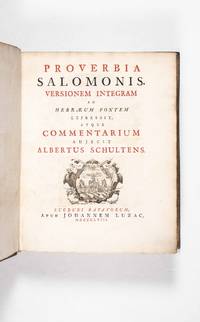
1748Best.-Nr. 49255Leiden: Jean Luzac 1748. First edition. Hardcover. Very Good. Quarto. 8 cviii 522 60 indices & corrigendapp. Text in two columns with Hebrew text and facing Latin translation interspersed with commentary. Title in red and black with engraved vignette; woodcut ornaments. Contemporary Dutch paneled vellum with blind-stamped vignettes and ruled borders; manuscript title at spine. Covers lightly soiled. Occasional touches of soiling and some leaves with mild embrowning. A very good copy generally crisp and clean. First edition of this comprehensive commentary to the biblical Book of Proverbs by the Dutch semitic language scholar Albert Schultens 1686-1750 who maintained "that the true nature of the Hebrew language and the meaning of many of its words and idioms are to be found chiefly in the Arabic" Orme. Forty-one pages of the indices constitute a brief lexicon and provide Latin as well as Arabic equivalents for more than 1000 Hebrew words. Schultens studied theology and eastern languages at Groningen where he received his degree in theology in 1709. After a brief career as a preacher in Wassenaar he was nominated professor of Hebrew and Jewish antiquities at Franeker in 1713. In 1729 he decamped for Leiden were he was first appointed reader in eastern languages and finally full professor in 1732. At this time a chief concern of Calvinist theologians was to liberate Old Testament exegesis from Jewish Rabbinic as well as Catholic traditions. Schultens' influential and controversial solution was revealed as early as 1706 in his first public thesis Disputatio theologico philologica de utilitate linguae Arabicae in interpretanda S. Scriptura A Theologico-Philosophical Dissertation on the Utility of the Arabic Language for the Interpretation of the Holy Scriptures "a forceful attack" Brugman & Schröder on the Protestant sola scriptura methodology of Biblical exegesis. "With the help of Jacobus Golius' Arabic dictionary he perused with zeal and fervour the Old Testament and wrote prolifically. The lexical superiority of Arabic had led him to a reconsideration of the position of Hebrew: at first he had called Arabic 'the most splendid daughter of mother Hebrew' but in his oration of 1729 he proclaimed Hebrew and Arabic cognate twin sisters. This shocked conservative theologians as an outright profanation of God's Word" Brugman & Schröder. Like his earlier commentary on the Biblical Book of Job one here finds that the "Hebrew text and the Latin translation are all but totally submerged by the extensive commentary in which Schultens draws abundantly on Arabic texts such as the Hamasa an anthology of early Arabic poetry by the ninth-century poet Abu Tammam" Vrolijk & van Leeuwen. Schultens was not without his critics and by 1824 William Orme notes a turning of the tide: "Different opinions are entertained of the correctness of his views and also of his success in applying them; but it is now generally admitted that he carries his notions of the advantage of Arabic learning to the interpretation of the Scriptures too far." Jean Luzac 1728-1777 was a member of a well-known Huguenot family of printers; he published many works for the University of Leiden including three Hebrew books of Albert Schultens. Isaac van der Mijn is noted as the printer at the colophon of the second volume. Provenance: bookplate of the Crozer Theological Seminary - Bucknell Library; bookseller's ticket of Librairie Ancienne et Moderne de Frederik Muller Amsterdam at the front paste-down. References: J. Brugman & F. Schröder Arabic Studies in the Netherlands Leiden: E.J. Brill 1979 p.26f. Fuks/Fuks-Mansfeld 78. Orme Bibl. Biblica p. 390. A. Vrolijk & R. van Leeuwen Arabic Studies in the Netherlands a Short History in Portraits 1580-1950 Leiden: E.J. Brill 2014 pp. 73-79. Jean Luzac hardcover books
1873Best.-Nr. 140948037Vienna: L. C. Zamarski & C. Dittmarsch 1873. The Babylonian Talmud complete in 24 books bound in 12 volumes. The title page to the first volume is undated but typically dated 1864 in institutional catalogs; the second volume is dated 1866 the last volume is dated 1872 but the last page of the Taharot Vol. XXIV is dated 1873. Tall quarto each volume measuring 14" x 10". Bound in half cloth and paper-covered boards leather spine labels with gilt lettering. Title pages printed in red black yellow and gilt. Very Good overall lots of edge wear with exposed boards chipping toning and wear to spines. Cloth of volume 7 appears to have been inexpertly repaired; binding tape repair to rear hinge. Other than that the bindings are sturdy; contents have a little foxing with age. Occasional marginal notes presumably from either Ernest or Walter Jacob; a few pages of notes in Hebrew laid in as well. This set has a very distinguished provenance: it came from the estate of Walter Jacob a significant leader in Reform Judaism in America author of 43 books and the chief rabbi at Rodef Shalom in Pittsburgh. His father Ernest Israel Jacob 1899-1974 was district rabbi of Augsburg and was deported to Dachau concentration camp for several months after Kristallnacht in 1938; he eventually emigrated to the US. Walter's grandfather Benno Jacob was considered one of the great biblical commentators of liberal Judaism. Ernest Jacob has written a note on the front pastedown of the first volume: "The textual corrections and marginal annotations in this Vienna edition of the Babylonian Talmud are by the late orientalist Samuel Landauer a great Aramaic scholar formally librarian of the University library at Strasbourg Alsace from whose estate I bought this work. Ernest I. Jacob." A lovely 19th century Hebrew edition of the central text of Rabbinic Judaism and the source of Jewish law and theology compiled in the 3rd to 6th centuries in Mesopotamia. International buyers please note: shipping this set outside the United States will require extra charges due to its weight and size. L. C. Zamarski & C. Dittmarsch unknown books
1990Best.-Nr. 199815New York: Grove Weidenfeld 1990. Softcover. Reprint. Fine in wrappers. Interpreted by Harold Bloom. Grove Weidenfeld unknown books