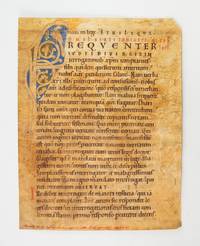
AN ILLUMINATED VELLUM MANUSCRIPT LEAF FROM A LECTIONARY IN LATIN, WITH A LARGE WHITE-VINE INITIALABAA
26 092 résultats
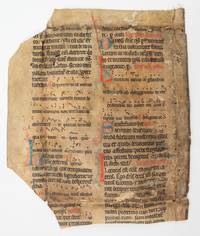
réf. ST20617cAustria Salzburg second half of 12th century. 319 x 244 mm. 12 1/2 x 9 1/2". Single column 27 lines in a lovely proto-gothic hand. Rubrics in red two one-line initials and one two-line initial in red WITH A LARGE 140 mm. WHITE-VINE INITIAL INHABITED BY A BIRD outlined in red and filled in with blue and green. Lower margin of recto with a 20th century note in red ink identifying the text. Recovered from a binding and thus with overall darkening top half of verso somewhat soiled with top line obscured though with all other letters on both sides very distinct cut a little close to the thin red extension of the initial a few minor holes inlcuding one elongated one through the top part of the initial with minimal loss. Even with these defects a powerfully attractive leaf with memorable decoration and script. Containing a beautiful proto-gothic script and an exceptional Romanesque initial this leaf is a particularly desirable example of early Austrian manuscript production. The opening initial "F" is formed with foliate designs outlined in red given shape by coloring in the negative space with an intense azure blue and moss green. Adding to the initial's charm is a large bird perched on one of the curving branches turning its head to the right as if to read the text like the initial it is also outlined in red. The white-vine style seen here would later become a model for the Italian Humanist scribes and illuminators of 15th and 16th centuries who substituted glistening gold leaf for the vibrant yellow paint favored by some artists of the Romanesque period. The text here is from St. John Chrysostom's homily on St. Matthew 22:34-40 an account of the Pharisees questioning Jesus on God's law asking "which commandment in the law is the greatest" Jesus famously replies with the key tenets of the Christian faith: "You must love the Lord your God with all your heart with all your soul and with all your mind. This is the greatest and the first commandment. The second resembles it: You must love your neighbor as yourself. On these two commandments hang the whole Law and the Prophets." This text was the Gospel reading for the 19th Sunday after Pentecost preceded by the incipit "Frequenter iudei diversis interrogationibus" "The Jews repeatedly tested him with various questions". The present leaf almost certainly belonged to a Lectionary owned by a Romanesque church in Salzburg a manuscript that was later dismembered for use in bookbinding. According to the source from which we purchased this leaf it was shown in 1893 to the Medieval historian and later the Abbot of St. Peter's Salzburg Willibald Hauthaler 1843-1922 who wrote the identification in red ink along the lower edge. It was later owned by the Salzburg-based merchant artist and collector Carl von Frey 1826-96. It appeared at Christie's in 2010 where along with five sister leaves it sold for £13970. unknown books
1986réf. 32159Kansas City: The Lowell Press 1986. First edition. Hardcover. vg. Quarto. XLVII 1 226pp. Original blue cloth with gold lettering on spine and front cover and portrait in gilt on front cover. Free front endpaper inscribed and signed by Richard L. Sutton. Remarkable edition of Girolamo Mercuriale's "De morbis cutaneis" 1572 considered the first scientific tract on skin diseases. Binding and interior in overall very good condition. The Lowell Press hardcover books
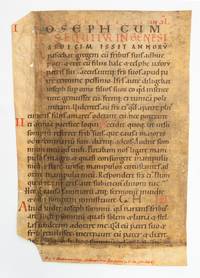
réf. ST20617dAustria Salzburg second half of 12th century. 321 x 218 mm. 12 5/8 x 8 5/8". Single column 27 lines in a lovely proto-gothic hand top two lines in red or black uncials. Rubrics and numbers in red two one-line initials in red with A LARGE 115 mm. IMAGE OF JOSEPH WEARING HIS COAT OF MANY COLORS the body outlined in brown ink and the coat outlined in red. Lower margin of recto with a 20th century note in red ink see below. Recovered from a binding and thus with overall darkening on the recto and with nothing readable on the verso bottom line of text a bit damaged because of crease through it a few small holes two corners trimmed one or two letters of final line of text lost but more than half of the Joseph figure including the face still visible and the text on the recto entirely legible. Containing a beautiful proto-gothic script and a rare figurative Romanesque initial this leaf is a particularly desirable example of early Austrian manuscript production. The text here is as neatly noted in German at the tail edge of the recto Genesis 37:2-10 the beginning of the story of Joseph the 17-year-old son of Jacob here called Israel and his second wife Rachel. In the well-known biblical account Joseph is his father's favorite of 12 sons and the patriarch gives him a beautiful coat of many colors making his brothers jealous. Joseph here intensifies their dislike of him by recounting to his brothers two of his dreams in which sheaves of grain and then various celestial bodies bowed down to him. Dream or reality the images did not sit well with the brothers who sold Joseph into slavery. Although once the leaf was reused as binding material we can nevertheless make out an historiated "I" in the form of Joseph as a young man including an outline of his multi-colored coat. It is difficult to say with certainty whether the initial would originally have been washed with color or composed solely as a line drawing but whatever the case we are lucky to have so much of it intact. With his long flowing hair semi-nude body and hand placed delicately on his hip Joseph is depicted in quite a seductive manner and the simple line-drawing further emphasizes the body's curves and lithe appearance. Romanesque initials with historiation are not nearly as common as decorative ones and the present depiction is especially unusual. While illustrations of Joseph do appear in other manuscripts of this period they tend to focus on specific events from the biblical narrative--particularly those that lend themselves to the tradition of Joseph as a prefiguration of Christ such as Joseph being thrown into the pit or revealing his identity to his brothers. The present example by contrast is all about the presentation of the figure. This leaf almost certainly belonged to a Lectionary owned by a Romanesque church in Salzburg a manuscript that was later dismembered for use in bookbinding. According to the source from which we purchased this leaf it was shown in 1893 to the Medieval historian and later the Abbot of St. Peter's Salzburg Willibald Hauthaler 1843-1922 who wrote the identification in red ink along the lower edge. It was later owned by the Salzburg-based merchant artist and collector Carl von Frey 1826-96. It appeared at Christie's in 2010 where along with five sister leaves it sold for £13970. unknown books
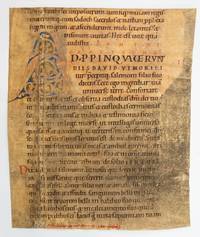
réf. ST20617aAustria Salzburg second half of 12th century. 300 x 243 mm. 11 5/8 x 9 1/2". Single column 27 lines in a lovely proto-gothic hand including lines in red and black uncials. Rubrics in red two one-line initials in red AN EIGHT-LINE 83 mm. tall WHITE-VINE INITIAL outlined in red and filled in with blue and green. Lower margin of recto with a 20th century note in red ink see below. Recovered from a binding and thus the vellum on one side noticeably darkened with a large lighter patch where a label may have been removed the other side faded with half the text illegible top edge trimmed close vertical crease going through initial much of the white in the capital now a light gray other minor issues but still an impressive leaf the once beautiful initial largely well preserved with its blue paint still rich. Containing an elegant proto-gothic script and a striking white-vine initial this leaf is an excellent example of early Austrian manuscript production. The large initial "A" is formed with foliate designs outlined in red given shape by coloring in the negative space with an intense azure blue and moss green. This style would later become a model for the Italian Humanist scribes and illuminators of 15th and 16th centuries who substituted glistening gold leaf for the vibrant yellow paint favored by some artists of the Romanesque period. The text of this leaf mainly includes readings for the seventh Sunday after Pentecost consisting of III Kings 2:1-17 beginning "Adpropinquauerunt dies David" according to the Vulgate numbering. It describes the Death of King David who instructs his son Solomon to keep the ways of God. With large and elegant letterforms executed by a steady hand this leaf almost certainly belonged to a Lectionary owned by a Romanesque church in Salzburg. According to the source from which we purchased this leaf it was shown in 1893 to the Medieval historian and later the Abbot of St. Peter's Salzburg Willibald Hauthaler 1843-1922 who wrote in very small letters the identification in red ink along the lower edge. It was later owned by the Salzburg-based merchant artist and collector Carl von Frey 1826-96. It appeared at Christie's in 2010 where along with five sister leaves it sold for £13970. Despite some condition issues related to its reuse in a later binding this leaf is still very impressive because of its beautiful calligraphy and decoration. unknown books
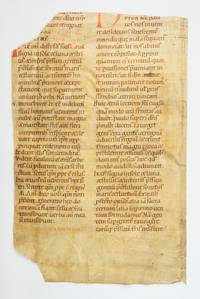
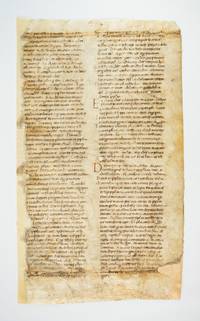
réf. ST20617eAustria Salzburg second half of 12th century. Unevenly trimmed but approximately 362 x 234 mm. 14 1/4 x 9 1/8". Double column 31 extant lines in a lovely proto-gothic hand. Rubrics in red remains of two large multi-line initials in red. Lower margin of recto with modern note in red ink in very small letters identifying the text. Recovered from a binding and thus unevenly trimmed top margin and a small part of text trimmed away at the top a handful of tiny cuts and holes of no significance vellum a little brownish but the leaf rather smooth and the majestic text entirely legible. This lectionary fragment which contains two important patristic sermons for the season of Advent demonstrates a highly regular graceful and majestic proto-gothic book hand. The oval-shaped elongation of Caroline letter forms characteristic of 12th century book hands and the mixture of rustic and uncial capitals our scribe has used for section titles appear particularly pleasing in the lovely uncramped hand at work here. The text on the recto is from St. Augustine's second Advent sermon one of a series of homilies written for the liturgical seasons. The verso contains St. Gregory's homily for the first Sunday of Advent preceded by Luke 21:25-33 a rehearsal of the signs of the end of days. The homily draws on this gospel passage to exhort the faithful to prepare themselves for the second coming. The present leaf almost certainly belonged to a Lectionary owned by a Romanesque church in Salzburg a manuscript that was later dismembered for use in bookbinding. According to the source from which we purchased this leaf it was shown in 1893 to Willibald Hauthaler 1843-1922 the Medieval historian and later the Abbot of St. Peter's Salzburg who wrote the identification along the lower edge. It was later owned by the Salzburg-based merchant artist and collector Carl von Frey 1826-96. It appeared at Christie's in 2010 where along with five sister leaves it sold for £13970. unknown books
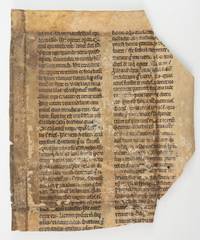
réf. ST21124c-02France or Low Countries 14th century. 270 x 461 mm. 10 5/8 x 18 1/8". Double columns 32 lines in a gothic book hand. Rubrics and staves in red three two-line initials in red or blue with contrasting penwork now quite faded. Unevenly trimmed missing at most a line of text at the bottom of each column and several words or part-words at corners of outer columns vellum with soiling browning small holes and paper residue consistent with having been used in a binding but the text entirely legible on one side and legible with effort on the other rather darkened side. From a noted Missal with large penwork initials this leaf was once used as the cover for a binding yet remains substantially complete. The text here comes from the Temporale containing the cycle of moveable feasts in the Christian year and includes Wednesday Feria IV after the fourth Sunday of Lent with a long passage from John 9. The musical notation on this leaf is highly developed consisting of a four-line staff clef marker and square neumes. unknown books
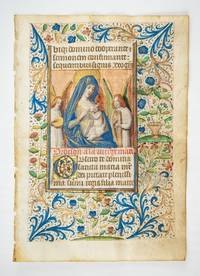
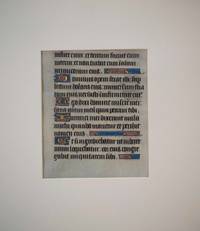
1500réf. ST20810MParis ca. 1500. 165 x 115 mm. 6 1/2 x 4 1/2". Single column verso with 18 lines in a gothic book hand. Rubrics in red one three-line initial in blue filled with foliage on burnished gold ground verso with panel border of colorful flowers a vase and acanthus recto with A MINIATURE OF THE VIRGIN AND CHILD flanked by two angels framed by gold and painted bars on three sides and A FULL BORDER of acanthus flowers a vase and gold bezants. Minor soiling to vellum but in excellent condition the miniature especially well preserved. This especially intimate and tender scene shows the so-called Virgo Lactans or Nursing Madonna the Virgin suckling the infant Christ; it accompanies the text for "Obsecro te" a popular Marian prayer appealing to the Virgin for protection and intercession. The prayer is not always accompanied by a miniature and the present illustration being rather large and skillfully done is a particularly appealing example. The Virgin's facial features are especially excellent with beautiful molding and shading that give her visage deep complexity and emotional resonance. The use of gold in this miniature adds to its richness; delicately highlighted garments tresses and angel wings catch the light and seem to shimmer as one moves the page. The high-quality illumination liberal use of gold and robust borders all suggest that the original manuscript must have been the product of an accomplished workshop. unknown books
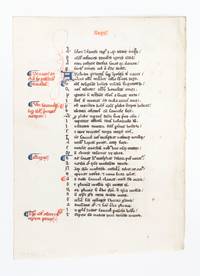
réf. ST18542England ca. 1375. 287 x 198 mm. 11 1/4 x 7 3/4. Single column 32 lines in a small rounded English gothic hand with rubrics in the margins. Rubrics in red running title in red paragraph marks in red or blue two initials measuring two lines in height and colored blue with red penwork. See: P. E. Beichner "Aurora Petri Rigae Biblia Versificata A Verse Commentary on the Bible." ◆Remnants of mounting tape in top margin of recto but a really excellent specimen the hand very clear the ink especially rich and the vellum extremely clean and quite bright. Written in a gothic hand heavily influenced by the English secretarial style this leaf comes from a copy of the "Aurora" a commentary on the Bible in verse form written in the late 12th century by French poet Petrus Riga 1140-1209 a canon of Rheims cathedral. Although little is known about the author's life Riga's text became immensely popular throughout Europe and was routinely studied in Medieval universities. According to Beichner "for those who could read Latin it supplied Scriptural lore in a popular form and it also served as a book of popular theology devotional reading moral instruction and entertainment. Its influence was propagated by teachers preachers and lexicographers by poets and other writers. It was studied imitated translated and quoted. Not only was it widely read in monasteries and convents but it was also recommended reading for the sons of nobles." It is interesting to note that although Riga's work was copied numerous times in the 13th century copies from the later Medieval period such as the present work are uncommonly rare. The parent manuscript containing our leaf was previously in the possession of the Dukes of Westminster and was sold at Sotheby's on 11 July 1966 lot 229 when it was advertised as having 267 leaves missing the first gathering plus 13 other leaves. Bookseller Francis Edwards acquired the manuscript at that sale removed three damaged leaves and sold the remainder. It was thereafter broken up and dispersed. Several sister leaves are now in the collections of Marquette University Lawrence University and the University of South Carolina. unknown books
1729réf. 123875London: Printed for Bernard Lintot. Fine in Fine dust jacket. 1729. Third Edition. Hardcover. A Third Edition that is corrected with additions in Very Good condition with the slightest of rubbing to the edges and corners and some age toning throughout the volume itself. A very nice copy of a charming book; This poem by Claudius Quilletus revolves around the raising of children choosing a wife and other concerns of marriage and family life. It is divided into four books: "The First treats of the Nature and Variety of Beauty and of the Choice of a Wife. The Second of Marriage and Enjoyment with Laws and Rules relating to both from Nature and Astrology. The Third of Conception and Imagination. The Fourth and Last of the Beauty of the Mind of Education and Virtue and of the Variety of Climes Customs and Manners." ; 12mo; xviii 96 97-102 pages . Printed for Bernard Lintot hardcover books
1652réf. 85679Amsterdam: sumptibus regiis L. Elzevier 1652. Editio nova ab auctore sucta et recognita. Hardcover. Very Good. 499p. Later old leather. 14 cm. No cover titling. Edges and joints rubbed. Backstrip crazed. Outer blanks partially pasted down. Old name Daniel Keim inked on a couple of leaves. Narrowly margined. Latin text. This defense of Charles I and of the divine right of kings was first published in the year 1649 that Charles I was executed. This "Edition nova" appears to be rather scarce. sumptibus regiis [L. Elzevier] hardcover books
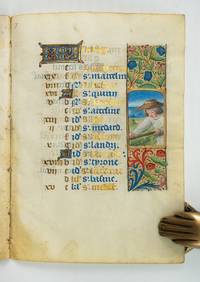
1500réf. ST20810SParis ca. 1500. 163 x 115 mm. 6 1/2 x 4 1/2". 12 leaves. Single column 18 lines in a gothic book hand. Feast days in alternating blue and burnished gold script two-line "KL" initials painted blue with white tracery and embellished with orange and blue ivy on a burnished gold ground each with a spray of gilt leaves and painted flowers one-line "A" initials in burnished gold over a pink and blue ground each page with a panel border of colorful flowers berries and acanthus over a painted gold ground with 24 SMALL MINIATURES depicting the labor of the month on rectos and zodiacal signs on versos. Some moderate smudging and soiling in bottom and fore margins January and February with tiny wormhole in head margin the miniature for January conceivably improved by a later hand but all in all a very lovely Calendar the high-quality paintings very well preserved and the whole with vibrant colors and brightly gleaming gold. Vibrantly illustrated and shimmering with gold this is an excellent example of a complete Calendar that would have appeared at the beginning of a luxuriously appointed Book of Hours. Each month is illustrated with the labor or occupation appropriate for the moment. These are in turn: warming by the fire feasting pruning picking flowers courting threshing hay harvesting wheat baking bread treading grapes sowing feeding hogs and slaughtering a hog. Our artist chose to compose these scenes more as portraits than depictions of actual tasks framing the image around each figure's face and sometimes only including small details that might indicate their occupation. In the month of June for example which depicts threshing hay we see only a sliver of the farmer's sickle and nothing at all of the hay. Instead the farmer himself is the primary focus here: and he is particularly well-executed with gentle shading on his downcast features careful brushstrokes highlighting the gleam of his hair and brushed gold suggesting the sun beating down on a bright June day. In addition to the labor or occupation of the month on the recto the 12 signs of the zodiac are depicted on the verso of each leaf these executed with equal charm and care. In cheerful bright colors our artist has depicted Leo's preening pose and glimmering mane the drama of Sagittarius' drawn bow and the cherubic plumpness of Aquarius molded in bluish shadows. In addition to the aesthetic achievements of its various parts the whole is desirable as a so-called composite Calendar with the name of a saint or special celebration occupying every day of the year. The origin of the composite Calendar is uncertain but the general opinion is that it was formalized in the early 14th century. The Parisian Hours of Jeanne d'Evreaux copied in ca. 1330 has been put forth as an early example. In any case the Calendar was subject to numerous changes in the course of time as various saints were canonized and supplanted those who while still recognized as saintly were deemed to be less favored residents for a particular calendar date. The saints' days on this Calendar are fairly typical for the Use of Paris and given the high-quality illumination liberal use of gold and robust borders it is likely that the parent manuscript was produced by an accomplished atelier in that city. Although single Calendar leaves regularly come on the market complete Calendars--particularly ones with extensive visual programs as here--are much more difficult to acquire. unknown books
réf. ST21124c-01France or Low Countries 14th century. 270 x 230 mm. 10 3/4 x 9". Double columns 32 lines in a gothic book hand. Rubrics and staves in red several initials measuring two or more lines in red or blue with contrasting penwork. Unevenly trimmed missing at most a line of text at the bottom of each column and several words or part-words at corners of outer columns vellum with soiling browning small holes and paper residue consistent with having been used in a binding one side quite darkened but the text there legible with effort nevertheless and entirely legible on the other side. From a noted Missal with numerous large penwork initials this leaf was once used as the cover for a binding yet remains substantially complete. The text here comes from the Temporale containing the cycle of moveable feasts in the Christian year and includes text for Tuesday and Wednesday Feria III and IV of Passion Week. The musical notation on this leaf is highly developed consisting of a four-line staff clef marker and square neumes. unknown books
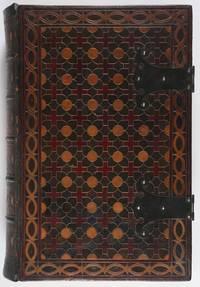
1701réf. 53475Liege: Jean-François Broncart 1701. First edition thus. Hardcover. Very good. Two tomes each in two parts bound in one volume folio: 6 lxxix 1 blank 544; 1 title 1 blank 545-957 1 blank xx Cantique des cantiques 96 La sagesse; Ecclesiastique de Jesus fils de Sirach; 1 title 1 blank 468; 1 title 1 blank 430 16 Oratio Manassae; Liber Esdrae - tertius et quartus pp. Main titles for each tome in red and black; secondary titles in black only all four titles with engraved printer's device; each dated 1701. Text in two columns Latin and French. Illustrated with 6 engraved plates: frontispiece Johann Friederich Karg von Bebenburg; folding plate with 16 vignettes 4x4 depicting well-known biblical scenes; 4 folding maps The Holy Land; The Promised Land Apportioned by Tribe; Jerusalem in the Second Temple Era - after Lamy; The World Known to the Evangelists. Quarter-page engraved vignettes at the head of each of the 30 biblical books; historiated initials; printed marginalia. Exquisitely bound in the 19th century in levant morocco extra over wooden boards with mosaic compartments in crimson ochre; and dark brown bordered in fine gilt line; spine with raised bands lightly rubbed; pair of brass mounts finished in black with steel rivets at both covers clasps and catched perished. All edges gilt and elaborately gauffered in textured floral motif; gilt inner dentelles; decorative endleaves renewed in orange and black; crimson silk ribbon marker. The work of a master binder. Expertly repaired at spine caps. Occasional faint embrowning; marginal dampstains beginning in second half mostly at outer corners; expanding to fore-edge and darkening considerably in final 20 leaves. Overall a very good copy with crisp text throughout though incomplete: lacks Antoine Arnould's "Concorde des quatre Evangélistes" along with its accompanying Latin version and the concluding index. Amply margined copy of this sumptuous edition of the Bible comprising the Latin Sixto-clementine Vulgate and the Port-Royal French translation printed in parallel columns. Isaac-Louis Lemaistre de Sacy 1613-1684 was the principal translator of the French version which was edited and completed after his death by Pierre Thomas du Fossé 1634-1698 and Henri-Charles de Beaubrun 1655-1723 who also provide annotations throughout. According to Barbier the French controversialist Thierry de Viaixnes 1659-1735 who found himself often at odds with his superiors was the principal editor of the work; at the time of its preparation he was serving as director of an academy at Hautvilliers in the diocese of Rheims McClintock & Strong. Dedicated to Johann Friederich Karg von Bebenburg 1648-1719 whose signed portrait was drawn and engraved by C. Gustav of Amling. An advocate of maximal papal power Karg served as Privy Councilor of the Prince-Bishop of Bamberg and Würzburg Peter Philipp von Dernbach then of Elector Max Emanuel of Bavaria. He served as Dean of Our Lady in Munich and was entrusted by Emperor Leopold I with a legation to Pope Innocence XI. By these efforts he secured in 1688 the election of Prince Joseph Clemens of Bavaria as Archbishop of Cologne as a result of which he was made Chancellor and Minister of State here noted on the frontispiece. Provenance and annotations: Bookplate of Herman Blum Blumhaven Library & Gallery with his ticket below; two gilt-stamped ex-libris morocco labels: Henry W. Poor oval; Adolph Lewisohn octogonal. References: Darlow & Moule 3779; Deleveau & Hillard Bibles imprimées du XVe au XVIIe siècles conservées è Paris 605; ADB 15 1882 "Karg: Johann Friedrich; Jean-François Broncart hardcover books
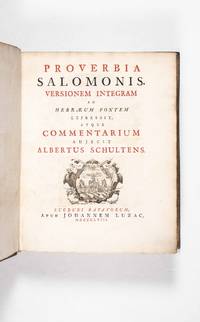
1748réf. 49255Leiden: Jean Luzac 1748. First edition. Hardcover. Very Good. Quarto. 8 cviii 522 60 indices & corrigendapp. Text in two columns with Hebrew text and facing Latin translation interspersed with commentary. Title in red and black with engraved vignette; woodcut ornaments. Contemporary Dutch paneled vellum with blind-stamped vignettes and ruled borders; manuscript title at spine. Covers lightly soiled. Occasional touches of soiling and some leaves with mild embrowning. A very good copy generally crisp and clean. First edition of this comprehensive commentary to the biblical Book of Proverbs by the Dutch semitic language scholar Albert Schultens 1686-1750 who maintained "that the true nature of the Hebrew language and the meaning of many of its words and idioms are to be found chiefly in the Arabic" Orme. Forty-one pages of the indices constitute a brief lexicon and provide Latin as well as Arabic equivalents for more than 1000 Hebrew words. Schultens studied theology and eastern languages at Groningen where he received his degree in theology in 1709. After a brief career as a preacher in Wassenaar he was nominated professor of Hebrew and Jewish antiquities at Franeker in 1713. In 1729 he decamped for Leiden were he was first appointed reader in eastern languages and finally full professor in 1732. At this time a chief concern of Calvinist theologians was to liberate Old Testament exegesis from Jewish Rabbinic as well as Catholic traditions. Schultens' influential and controversial solution was revealed as early as 1706 in his first public thesis Disputatio theologico philologica de utilitate linguae Arabicae in interpretanda S. Scriptura A Theologico-Philosophical Dissertation on the Utility of the Arabic Language for the Interpretation of the Holy Scriptures "a forceful attack" Brugman & Schröder on the Protestant sola scriptura methodology of Biblical exegesis. "With the help of Jacobus Golius' Arabic dictionary he perused with zeal and fervour the Old Testament and wrote prolifically. The lexical superiority of Arabic had led him to a reconsideration of the position of Hebrew: at first he had called Arabic 'the most splendid daughter of mother Hebrew' but in his oration of 1729 he proclaimed Hebrew and Arabic cognate twin sisters. This shocked conservative theologians as an outright profanation of God's Word" Brugman & Schröder. Like his earlier commentary on the Biblical Book of Job one here finds that the "Hebrew text and the Latin translation are all but totally submerged by the extensive commentary in which Schultens draws abundantly on Arabic texts such as the Hamasa an anthology of early Arabic poetry by the ninth-century poet Abu Tammam" Vrolijk & van Leeuwen. Schultens was not without his critics and by 1824 William Orme notes a turning of the tide: "Different opinions are entertained of the correctness of his views and also of his success in applying them; but it is now generally admitted that he carries his notions of the advantage of Arabic learning to the interpretation of the Scriptures too far." Jean Luzac 1728-1777 was a member of a well-known Huguenot family of printers; he published many works for the University of Leiden including three Hebrew books of Albert Schultens. Isaac van der Mijn is noted as the printer at the colophon of the second volume. Provenance: bookplate of the Crozer Theological Seminary - Bucknell Library; bookseller's ticket of Librairie Ancienne et Moderne de Frederik Muller Amsterdam at the front paste-down. References: J. Brugman & F. Schröder Arabic Studies in the Netherlands Leiden: E.J. Brill 1979 p.26f. Fuks/Fuks-Mansfeld 78. Orme Bibl. Biblica p. 390. A. Vrolijk & R. van Leeuwen Arabic Studies in the Netherlands a Short History in Portraits 1580-1950 Leiden: E.J. Brill 2014 pp. 73-79. Jean Luzac hardcover books
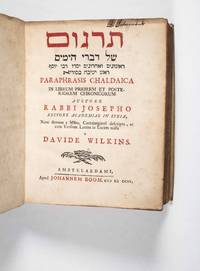
1715réf. 49239Amsterdam: Jan Boom 1715. First edition. Hardcover. Very Good. Small quarto. asterisk4 a-f4 -blank f4 A-3F4 = 235 leaves. 54 415 1 blankpp. Contemporary vellum with exposed thongs boards somewhat bowed spine darkened early manuscript title in Hebrew and Latin at spine. Old owner entry at top margin title memorial label at front paste-down. A very good copy amply-margined with fine crisp text throughout. Important edition of this Aramaic version of the biblical books of Chronicles attributed to Joseph ben Hiyya d. 333 a Babylonian amora and head of the Pumbedita academy near present-day Falluja Iraq. "Ben Hiyya was also distinguished in biblical exegesis and left an Aramaic translation of parts of the Bible which is often quoted. It is not to be assumed however that Joseph translated the whole Bible though the Aramaic translation of the Books of Chronicles is ascribed to him. Enc. Jud. The editio princeps edited from an Erfurt manuscript by Matthias Frederick Beck and accompanied by substantial annotations was published at Augsburg in 1680. "After this David Wilkins gave the public an edition from a Cambridge manuscript of which the text was more pure and more complete. The critic should unite both these editions the former for the value of its learned notes and the latter for its full and accurate text" The Biblical Repertory. The Coptic scholar David Wilkens 1685-1745 was born of Prussian parentage in Memel Lithuania. Little is known about his education in Germany probably in Berlin or how he acquired his knowledge of ancient and Semitic languages which was extensive rather than profound. He referred to the antiquarian Ezechiel Spanheim the elector of Brandenburg's ambassador in England from 1701 to 1710 as his former teacher. By 1707 Wilkins was studying at the Bodleian Library in Oxford and had encountered a group of clerical protectors in London. In 1709 engaged in preparing a history of the patriarchs of Alexandria which remained in manuscript and the editio princeps of the Coptic Bohairic New Testament the Novum Testamentum Aegyptium 1716 he left for the continent. He called on scholars examined manuscripts in Vienna Rome and Paris and stopped in Amsterdam in 1714 to see to the publication of his first works -- an edition of the Aramaic paraphrasis of the books of Chronicles and an Armenian version of the apocryphal third epistle to the Corinthians 1715 -- and of John Chamberlayne's polyglot edition of the Lord's prayer to which he contributed. Wilkins was an industrious scholar. In the three years he spent as librarian at Lambeth he made important contributions to the cataloguing of manuscripts. In 1721 he edited the Anglo-Saxon laws in 1725-6 the complete works of John Selden and in 1731 the Coptic Pentateuch. His main work was his Concilia Magnae Britanniae et Hiberniae an account of British church councils from 446 to 1717. Wilkins had many detractors -- John Gagnier the professor of Arabic at Oxford who deplored his incompetence in Arabic and Hebrew Edward Harley who described him as 'a very great scoundrel' and the cantankerous Thomas Hearne who as librarian at the Bodleian had watched him turn from a young man 'of a civil Courteous and modest behaviour' into 'a vain ambitious man of little judgement tho' great industry' ready to 'do anything in the World for a little Money' Alastair Hamilton: "Wilkens David" -- ODNB online. Provenance: From the library of G.H.A. Juynboll 1935-2010 the celebrated scholar of Islamic Hadith literature with his printed memorial label at front paste-down. Hebrew title: ×ª×¨×’×•× של דברי ×”×™×ž×™× ×¨××©×•× ×™× ×•××—×¨×•× ×™× יסדו ר×ש ישיבה ×‘×¡×•×¨×™× References: The Biblical Repertory 1834 6:248-249. Brunet 3:574 - "Livre recherché et peu commun". Enc. Jud. 10:229. Le Long Bibliotheca sacra 1723 1:92B. Le Long-Masch 2.1 p. 48: "Multo correctior est editio ac praecedens Beckiana." long note in which the relation with the never published version by Clarke is discussed. Cf. D&M 2416: The editio princeps of the Targum on Chronicles printed from an Erfurt MS. and edited with a Latin translation by M. F. Beck Augsburg 1680-3 2 vols 4to. The present edition is "a more complete form of the text from a Cambridge MS. . edited with a Latin translation by D. Wilkins. Jan Boom hardcover books
1679réf. 43160Amstelodami Amsterdam: Johannis à Someren 1679. First Latin language edition. Hardcover. g- to g. Folio 12 3/4 x 8". 16 288 20pp Index Vol. 1; 20 418 30pp Index Vol. 2. Original full vellum with handwritten title to spine. Main title in red and black lettering with title vignette. Engraved frontispiece portrait of Edward Leigh. Both volumes have separate titles. Originally published in English in London in 1639 and 1641 Edward Leigh's magnum opus is divided into two parts: - 1 "Critica Sacra : Observationes Philologicas & Theologicas In omnes Radices Veteris Testamenti" containing observations on all the radices or primitive Hebrew words of the Old Testament in alphabetical order. - 2 "Critica Sacra : Observationes Philologicas & Theologicas Observationes In omnes Graecas Voces Novi Testamenti" containing observations upon all the Greek words of the New Testament in alphabetical order. This lexicon with its dictionary and index of Biblical words became the classic work and basis for future studies of language by experts such as William Gouge who wrote the commendatory epistle in the first volume and Thomas Fuller. This 1679 edition is the first Latin translation by Henricus à Middoch. Binding partly darkened age-toned with some abrasion to head and tail of spine. Contemporary previous owners' inscription at upper margin of front free endpaper. Lower corner of fly leaf chipped. Contemporary previous owner's name on main title not affecting lettering. Ex-library stamp at lower margin of frontispiece not affecting image. Sporadic foxing and age-toning throughout. Text in two columns in Latin with some Hebrew and Greek. Binding in overall fair to good- interior in good to good condition. About the author: Edward Leigh 1602-1671 was a versatile English lay writer known particularly for his works on religious topics and a politician who sat in the House of Commons from 1645 to 1648. He fought for the Parliamentary army in the English Civil War From Wikipedia. Johannis à Someren hardcover books
1981réf. 26286Paris: Société d'Edition "Les Belles Lettres 1981. Hardcover. vg. Octavo. 154 2pp. Original orange cloth with black lettering on front cover and spine and printer's device on front and back cover. Printer's device on title-page. Fascinating work being one of the first treatises on Physiognomy: method based on the idea that the observation of a person's physical appearance and mainly the features of his face can give an insight into his character or his personality. Text in French and Latin. Binding and interior in overall very good condition. Société d'Edition "Les Belles Lettres hardcover books
1462réf. 001313Mainz: Johann Fust & Peter Schoeffer 14 August 1462 1462. Fust and Schoeffer 48-line Bible Leaf. Royal folio 413 x 286 mm. Leaf 194 from gathering 20 of book one text from 2 Esdras chapter 15 and 16. Double column 48-lines printed in Gothic type. Titles and chapters in alternating red and blue letters red and blue two-line initials rubricated capital initials. Lines 35 to 41 in both columns of recto only are reset. 2 -inch closed tear to outer margin just slightly affecting text expertly repaired two old paper-clip ghosting marks to upper margin. Leaf housed in a cloth portfolio; slipcase with gilt lettered red morocco spine label. A fine leaf from the fourth edition of the Vulgate Bible or the 48- line Bible preceded only by the 42-line Gutenberg Bible the 36-line Pfister Bible Bamberg and the 49-line Mentelin Bible Strassburg. The first also to include the date of publication the place of printing and bear the name of the printer. Mainz: Johann Fust & Peter Schoeffer, 14 August 1462, hardcover books
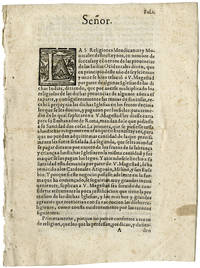
1611réf. 40080Spain 1611. Tax Exemptions for New World Religious Orders An early and evidently unrecorded 17th-century Spanish petition to the King on behalf of mendicant and monastic communities in the Spanish Americas. The authors argue that the churches attempting to tax their incomes and force them to pay tithes are hurting religious efforts in the Americas and infringing upon the historical independence of the religious orders from the churches. The document is signed in print by eleven monks each representing a different order: the Benedictines Hieronymites Franciscans Cistercians Mercedarians Dominicans Augustinians Trinitarians Jesuits Premonstratensians and Carmelites. The Jesuit signer is Pedro de Caruajal presumably Pedro de Carbajal former magistrate and judge of the Vilcas Huamán province of Peru and author of DESCRIPCION FECHA DE LA PROVINCIA DE VILCAS GUAMAN.EN EL AÑO 1586. Folio. Dbd. Early folds mild foxing. Very good. unknown books
réf. ST20968-02Italy second half of 11th or opening of 12th century. 497 x 294 mm. 19 5/8 x 11 5/8". Double column 58 lines in a late Caroline hand. Running titles in red two two-line initials in red. Portfolio's pastedown with book label of the Schøyen Collection their MS 588. Recovered from a binding and thus with some general soiling and staining to vellum a couple of small holes verso unreadable modern reinforcement and repairs to the gutter and margins affecting a couple of letters at the beginning of a number of lines but the recto quite legible in most places and easily recoverable in the few places where it's not. This impressive leaf was once part of an immense lectern Bible that would have been prominently displayed at a church or monastery ca. 1075-1100. Measuring just under 500 mm. tall its dimensions are almost big enough to be considered an "Atlantic Bible" a distinctive modern designation reserved for massive Bibles produced in the 11th and 12th centuries. Despite the loss of legibility on one side due to the leaf's reuse as binding material the other side displays a lovely rounded Caroline hand with few abbreviations. The text comes from Exodus 8:17-9:21 describing several of the Plagues of Egypt. Our leaf was most recently part of the renowned Schøyen Collection one of the largest and most distinguished private manuscript collections in the world. Started in the 1920s by Norwegian engineer M. O. Schøyen and expanded by his son Martin the collection is particularly strong in paleography and biblical texts. Among its many unique and important manuscript pieces are treasures such as the St. Cecilia Bible the only Carolingian Bible in private hands and fragments of the Dead Sea Scrolls. unknown books
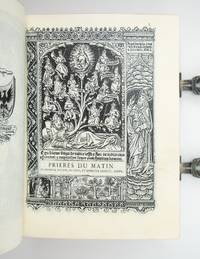
1858réf. ST21120Paris: Printed by J. Claye for Gruel & Engelman 1858. 155 x 117 mm. 6 1/8 x 4 5/8". 703 1 pp. VERY FINE GOTHIC-STYLE BLIND-STAMPED BROWN MOROCCO BY LÉON GRUEL stamp-signed at foot of spine covers with central panel showing the Tree of Jesse surrounded by the words "Egredietur virga de radice Iesse et flos deradice eius ascendet et requiescat super eum" A rod shall come forth from the root of Jesse and a flower shall grow out of his root and rest upon him" this framed by a roll of grapevines and floral vines oblique fleur-de-lys at each corner two silver square knot fore-edge clasps one catchplate replaced raised bands densely gilt turn-ins marbled endpapers and flyleaves all edges stained red. In a very fine brown morocco-backed buckram drop-back box with padded plush interior gilt lettering on spine. Title page and colophon with large device of Gruel & Engleman featuring two angels verso of title with printer's device of J. Claye each page with elaborate woodcut border featuring biblical scenes modelled on those in printed 15th century French Prayer books and seven miniatures Tree of Jesse Crucifixion Deposition Pentecost Trinity Conception of the Virgin Annunciation to the Virgin. Front flyleaf with a lengthy ink inscription to Mademoiselle Jeanne Ansart from printer Jules Claye in elegant calligraphic hand dated 1 December 1876. With three contemporary prayer cards and two commemorative cards--one for the ordination of a priest one for a nun professing her initial vows--laid in. See Judge "Léon Gruel: Master of Medieval Revival in Bookbinding" Encyclopedia of Design 2021 online: https://encyclopedia.design/2024/03/21/leon-gruel-master-of-medieval-revival-in-bookbinding/; Jeremy Norman "Master Printer Jules Claye Inscribes a Copy of a Book of Hours that He Printed on Vellum" History of Information online: https://www.historyofinformation.com/detail.phpid=5590. Faint rubbing to joints and extremities isolated trivial thumbing one small red smudge but A VERY FINE COPY--clean fresh and bright internally in a very lustrous binding with sharp impressions of the stamps. A luxurious volume in every way this is the only known copy printed on vellum of a 15th century-style prayer book created by distinguished Parisian publishers Gruel et Engelmann; it was bound by a celebrated craftsman who was an expert on the history of his craft and presented by the printer to a young woman perhaps to commemorate her taking religious vows. The firm that became Gruel et Engelmann had a complex evolution. It was founded as a bindery by Isidore Desforges in 1811 and after Desforges' daughter Catherine married Paul Gruel 1800-46 the latter took over the business in 1825. Following his death Catherine kept the bindery going for five years before marrying Parisian publisher Jean Engelmann d. 1875. The spouses merged their firms and combined their specialties to produce beautiful devotional books inspired by Medieval manuscript Books of Hours and early printed prayer books bound in appropriately historic styles. Catherine's son Léon Gruel 1840-1923 joined the firm as a binder and after his stepfather's death Gruel et Engelmann was run by Léon who headed the binding division and his stepbrother Edmond Engelmann who was in charge of the design and printing of books. In her "Bookbinders and their Craft" Prideaux says that the Gruel firm "always had the highest reputation . . . for initiative in artistic matters as well as for irreproachable execution in the detail of its many-sided achievements." The productions of Gruel et Englemann were informed by the collecting enthusiasms of the brothers--Léon's for historical bindings and Edmond's for illuminated manuscripts. Under their direction Gruel et Engelmann published and bound numerous works of devotion like the present "Paroissien" a service book that includes the texts and prayers in Latin and French used to celebrate Mass throughout the year. The author of "Manuel Historique et Bibliographique de l'Amateur de Relieure" and an expert on historical bindings Léon Gruel was adept at replicating any number of antiquarian bindings styles. As he noted in an interview with "The Bookman" in 1900 "Modern book binding has discovered nothing to equal the old designs and at best we can only copy." For this volume he chose the very appropriate Gothic style a particular favorite of his. According to the "Encyclopedia of Design" Gruel's "blend of reverence for the past with innovative application in the present allowed him to recreate historical styles with unparalleled accuracy and creativity." According to the former owner of this book distinguished bibliophile and rare book dealer Jeremy Norman Gruel et Engelmann never advertised a vellum printing of this title leading him to believe that their printer Jules Claye 1806-86--whom he considers "one of the great French trade printers of the mid-19th century"--printed this copy on vellum for himself. The sturdy vellum leaves make the text block here 63 mm. thick--a considerable bulk for a volume of this size. Claye recognized this and even concluded his lengthy and elegantly calligraphed inscription to Mlle. Jeanne Ansart with a graceful apology for the weight of the book: "As you approach the hour when God shall bless you / I offer prayers for you though we have never met / And I come to consecrate with a devout remembrance / The day you shall behold this new dawn. / This work of my handsI must admit / Is heavy for yours to bear yet it shall endure. / Forgive me remembering that our Divine Master / Climbed Golgotha beneath the burden of His cross." While it is possible that "the hour when God shall bless you" and "this new dawn" might indicate a marriage it seems more likely that this refers to Mlle. Ansart's taking the veil. The presence here of a Mass card that depicts a young woman professing her initial vows as a nun would seem to support this theory. Whatever path she chose Jeanne Ansart and successive owners cherished and carefully protected this luxurious volume over the years leaving it for us to savor visually and tactilely. [Printed by J. Claye for] Gruel & Engelman unknown books
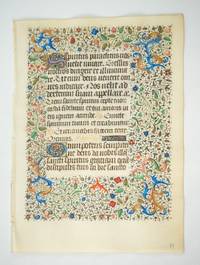
1430réf. ST20979bParis ca. 1430. 191 x 140 mm. 7 1/2 x 5 1/2". Single column 16 lines in an elegant gothic book hand. Rubrics in gold line-fillers with color foliate and geometric designs on burnished gold ground three two-line initials in blue or pink enclosing colored vines with foliage on gold ground BOTH SIDES WITH A DENSE RINCEAUX BORDER consisting of colorful acanthus flowers and many hairline vines terminating in gold leaves ivy and seed pods and with numerous gilt bezants. IN BRILLIANT CONDITION. This is an extraordinarily fine and opulently decorated leaf from a Book of Hours with glittering rinceaux borders delicate initials and luxurious gold rubrics. These sumptuous details and the high quality of the work indicate that this leaf was part of a costly manuscript commissioned by a wealthy patron. Other leaves from the same parent manuscript were sold at Bloomsbury on 6 December 2017 lots 63 and 64. One of those leaves showed St. Genèvieve leading the female saints in the Litany pointing to Paris as the place of origin. unknown books
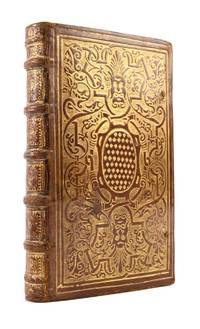
1505réf. ST21080Northern France probably Paris ca. 1505-10. 213 x 137 mm. 8 3/8 x 5 3/8". Single column 25 lines in a gothic hand. i 123 leaves. COMPLETE. Contents: blank f. i; Calendar f. 1r; Gospel Lessons f. 13r; Passion according to John f. 17r; "Obsecro te" and "O Intemerata" f. 23v; Hours of the Virgin f. 28r; Hours of the Cross f. 69r; Hours of the Holy Spirit 71v; Seven Penitential Psalms f. 75r; Litanies f. 82r; Office of the Dead f. 88r; Suffrages 114r; ruled blank f. 123. SPECTACULAR NEAR-CONTEMPORARY LYONNAISE BINDING OF POLISHED CALF VERY DENSELY GILT covers with a central oval filled with diamond-shaped tools surrounded by an intricate strapwork pattern incorporating acanthus and three heads at the top and bottom two with helmets looking sideways one more prominent staring ferociously straight on the negative space densely azured appearing from a distance as if entirely filled with gold raised bands spine compartments gilt with door-handle tools floral motifs and sawtooth borders edges gauffered and gilt later 17th century endpapers lacking ties. Rubrics in deep pink line fillers in red and blue with gilt embellishments numerous one-line initials in gold on red or blue ground many two-line initials in mauve or blue with white embellishment most enclosing a flower or two on painted gold ground EACH PAGE WITH A FULL BORDER consisting of a plain gold bar on three sides and a painted gold panel containing colorful flowers acanthus and the occasional banner WITH 21 SMALL MINIATURES each measuring between 30-50 mm. tall and 18 FULL-PAGE MINIATURES framed by a gilt and painted architectural border and accompanied by a three- or four-line initial with opening text on a banner the initial painted mauve or blue with white embellishment enclosing colorful flowers on painted gold ground the subjects of the large miniatures being: St. John on Patmos f. 13r; Agony in the Garden f. 17r; The Temptation of Adam and Eve f. 27v; Annunciation f. 28r; Visitation f. 34v; Nativity 41v; Annunciation to the Shepherds f. 44v; Adoration of the Magi f. 47v; Presentation in the Temple f. 50r; Flight into Egypt f. 52v; Coronation of the Virgin f. 57r; Christ Carrying the Cross f. 68v; Crucifixion f. 69r; Pentecost f. 71v; Bathsheba Bathing f. 74v; David and Uriah f. 75r; Job on the Dung Heap f. 88r; Trinity f. 114r. Front pastedown with book label of W. H. Corfield armorial label of "H C M" or perhaps "F C M" and a pasted-in piece of paper with early 19th century notes about the manuscript written in French. Joints with a little wear and flaking minor rubbing to edges and corners but the binding entirely sound and in a remarkable state of preservation glistening with gilt. A few small marginal holes where the vellum has thinned a couple miniatures with light flaking or rubbing to the architectural border a handful of trivial smudges to borders but the contents in fine condition being extraordinarily clean and fresh and the miniatures extremely well preserved. IN EXCEPTIONALLY FINE AND PLEASING CONDITION INSIDE AND OUT. Complete in a memorable 16th century binding and boasting a large and particularly appealing program of miniatures this splendid Parisian Book of Hours was produced by a highly skilled workshop for a patron of means and comes down to us in extraordinarily fine condition. The style of the miniatures closely resembles that of Jean Coene IV active ca. 1490-1520 an artist who hailed from a long line of manuscript illuminators originally from Bruges but active in Paris from the early 15th century. Identified by Isabelle Delaunay and Eberhard König and dubbed the "Master of the Paris Entries" Coene was a prolific artist who according to Peter Kidd "was perhaps particularly known to contemporary patrons for his ability to create new compositions." His versatility as an artist is demonstrated by the variety of volumes to which he contributed including histories voyages and Royal Entry books the latter earning him his sobriquet in addition to devotional works such as the Book of Hours seen here. Although the artist is known to have collaborated with famed Parisian illuminator Jean Pichore on several occasions see for example British Library MS Sloane 2418 Coene had his own style readily identifiable through his unique use of rich colors; sharp black outlines; modeled faces with half-closed eyes; thin eyebrows; pert mouths that turn slightly downward; and the generous application of liquid gold highlights particularly on garments and hair. Like most professional workshops of the period the Coene atelier was capable of producing work of varying quality which often depended on the wealth and needs of the patron; this work clearly a premium production shows none of the shortcuts one might expect in a more hurried execution. The consistently accomplished level of painterly skill as well as the harmony of the compositions here indicate a highly practiced hand. We can see the painter's proficiency for example in considerable delicacy and detail showing up in various places: the lace-like angel's wings in the Annunciation the carefully delineated sheep in the Annunciation to the Shepherds the various headdresses of earthly and heavenly rulers and particularly in the meticulously defined and intricately realized architectural frames. Additional pleasing features include the liquid gold application highlighting tresses and garments throughout the manuscript as well as the frequent and immensely agreeable appearance of an intensely rich red-orange. Of special note are the three openings in which miniatures face each other in logical pairs: Adam and Eve about to fall from grace facing the Annunciation where birth of mankind's savior is announced Carrying the Cross facing the Crucifixion and the bathing Bathsheba facing the lustful David who is apparently plotting the death of Bathsheba's luckless husband Uriah in battle. Pairings such as these are rarely encountered they make quite a grand statement they provide a reinforcing element to the biblical narrative and they highlight both the artist's talents and the patron's deep pockets. While many of the miniatures contain traditional subject matter we are also treated to some less frequently encountered scenes including the Garden of Gethsemane and the aforementioned Temptation of Adam and Eve. In addition the miniatures feature some noteworthy visual moments that demonstrate the artist's willingness to push beyond traditional iconography. In John on Patmos for example the Virgin and child unexpectedly appear in the sky bathed in brilliance; in the Nativity the ox and ass are front and center their heads bent nearly to the ground their mouths half open and within inches of the Christ Child a combination of curiosity and menace; and in the Flight into Egypt the Virgin whose central emotion is surely fear for her child has a sunhat almost rakishly tied around her neck. This last detail seems surely to derive from the Dürer engraving of the same subject done in 1503/04--a connection that is useful in more precisely dating the manuscript. What sets this manuscript apart even more than the nature and accomplishment of its decoration is its exceptionally fine condition with next to no signs of use internally and with an entirely unrestored period binding with its antique appeal undimmed by time. Probably dating to around 1550 the Lyonnaise binding is of very special interest brimming with gold and featuring an elaborate design incorporating unusual glowering faces. The earliest indication of ownership of this manuscript is seen in its 19th century armorial bookplate with the motto "Audentes Fortuna Juvat" "Fortune Favors the Brave" and the monogram "H C M" or "F C M". A Breviary at the Huntington mssHM 1077 with the same bookplate they say "H C M" is attributed to the Mackinnon family. A more certain provenance comes from the bookplate of W. H. Corfield 1843-1903 the first professor of hygiene and public health at University College London. Given his ownership of the present manuscript it is unsurprising that as a bibliophile he was recognized especially as a connoisseur of early bindings. Quaritch purchased our manuscript for the handsome sum of £126 at the auction of Corfield's library on 21 November 1904 lot 257 and we have been able to trace subsequent ownership to Thomas Fechnay Harvey 1879-1970 of Pennsylvania who gave the manuscript to his daughter Margaret J. Harvey 1910-84 of Philadelphia who in turn gave it as a wedding gift in 1972 to the person who sold it to us. We have found no record after 1904 or in fact before that date of the manuscript's being offered for public sale suggesting that it has been in private hands for well over a century. unknown books
1967réf. 6782Mainz: The Gutenberg Museum 1967. 1 leaf 42 lines in two columns decorated initial D with vine scroll. End of "Song of Songs" beginning of "Book of Wisdom." Mounted in black paper. Facsimile of original in the Gutenberg Museum of Mainz printed for sale at the German Pavilion at Expo '67 the world's fair held at Montreal that year. The Gutenberg Museum unknown books
1550réf. 6789ca. 1550. One vellum leaf 125 x 180 mm with text within 80 x 95 mm guidelines. Text in manuscript recto and verso including eight capitals decorated in gold leaf and colors and six spacers also decorated in blue red and gold leaf. Chapter incipit in red. hardcover books