"CONDORCET, (MARIE JEAN ANTOINE NICOLAS CARITAT MARQUIS de).Livre Rare Book
454 Ergebnisse
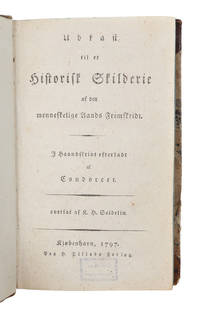
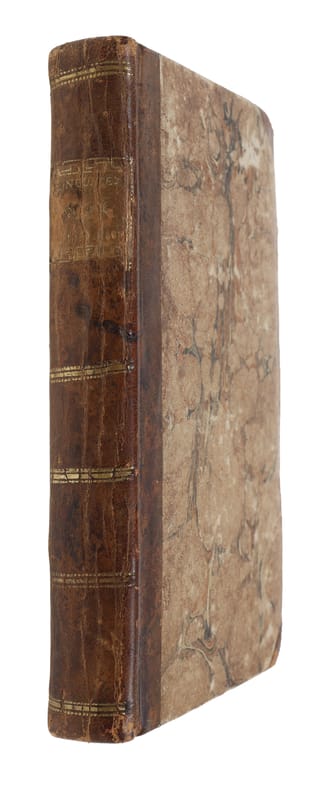
1797Best.-Nr. 61971København, Tikiøbs Forlag, 1797. 8vo. Bound in a contemporary half calf binding with gilt spine and gilt title label. Minor cracks to spine. Insignificant wear to capitals. Edges of boards worn. Corners bumped. Bibliographical notes to front free endpaper. Small ownership stamp to verso of title page. Evenly browned. XII,(2),368,(1: errata) pp.
1797Best.-Nr. 61971København Tikiøbs Forlag 1797. 8vo. Bound in a contemporary half calf binding with gilt spine and gilt title label. Minor cracks to spine. Insignificant wear to capitals. Edges of boards worn. Corners bumped. Bibliographical notes to front free endpaper. Small ownership stamp to verso of title page. Evenly browned. XII23681: errata pp. The extremely rare first Danish edition of Condorcet's main work "Esquisse d'un tableau historique des progrès de l'esprit humain.1795" "the most fully developed exposition of the progress of man" Printing and the Mind of Man p. 149 and a main work of the Enlightenment as well as of historical thought in general. The author was the creator of what came to found the basis for the modern French system. The great French philosopher political thinker and mathematician M.J.A. Condorcet 1743 - 1794 played a seminal role in 18th century France. He was friends with the likes of d'Alembert Voltaire Turgot etc. and he greatly contributed to the social and political debates of politically turbulent France. As one of the few he advocated a liberal economy equality in public education as well as in gender and race etc. He preached constitutionalism and his thoughts that are still influential today embody those of the Enlightenment and rationalism."A belief in the ultimate perfectibility of man lies at the root of all progressive thinking about the human condition. The "philosophes" and Godwin had familiarized the reading public with this notion; it was left to Condorcet to give it its finest and most durable expression. It was the gospel of nineteenth century that mankind is destined for indefinite future progress. Condorcet looking back and then forward saw proof of this in the growing equality between classes and nations the intellectual physical and moral improvement of man; and he prophesied that popular education on correct principles would strengthen and assure this progress." PMM 246.During the French Revolution Condorcet came to play a dominating role advocating a rationalist reconstruction of society and he championed many liberal causes. In 1791 he became secretary of the Legislation Assembly and the institution adopted his scheme for comprehensive state education which later became the basis of the modern French system. In the struggle between the two political parties the Girondists and the Montagnards Condorcet occupied an independent role but when he opposed the death penalty under the trial of King Louis XVI still supporting the actual trial and the radical Montagnards gained more power Condorcet was branded a traitor and in October 1793 a warrant was issued for his arrest. He now went into hiding for several months almost a year and it is during these months that he writes the work that was to become his most important the main work "Esquisse." "Sketch for a Historical Picture of the Progress of the Human Mind" which was published posthumously the year after his death. In 1794 Condorcet was arrested and two days later he was found dead in his cell -it is unknown whether he committed suicide or was murdered because of fear of fierce reactions that would definitely have occurred had the beloved man been officially sentenced to the death penalty."In the Esquisse" published after his death Condorcet traces the history of man through epochs the first three covering his progress from savagery to pastoral community and thence to the agricultural state. The next five span the growth of civilizations and knowledge down to Descartes and the ninth describes the revolution of Condorcet's own lifetime from Newton to Rousseau. The prophetic view of the tenth epoch shows Condorcet at his most original. He forecasts the destruction of inequality between nation and classes and the improvement intellectual moral and physical of human nature. it exercised considerable influence on Comte. But it is as the most fully developed exposition of the progress of man that Condorcet's work is now remembered and it is this which has given it its lasting appeal." PMM 246. hardcover
Best.-Nr. 14750P., Panckoucke, 1784-1785, 2 VOLUMES grand in 4 reliés en demi-basane, dos ornés de filets dorés, T.1 : (2), 114pp., 722pp., T.2 : (2), 787pp., 184pp.
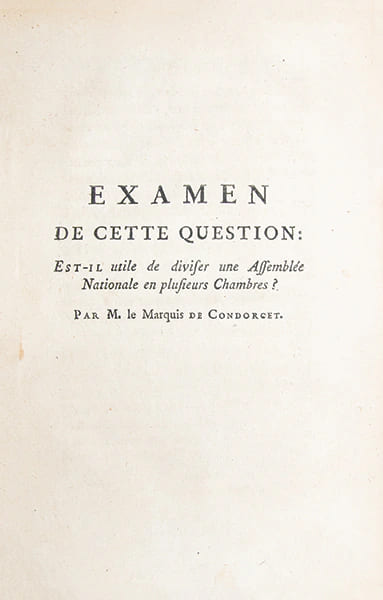
Best.-Nr. 39585In-8 (197 x 125 mm), broché, couverture de papier marbré, 40 pages. S.l.n.d. [Paris, 1789].
1840Best.-Nr. 25268Paris DALIBON 1840 -in-8 demi-veau 8 volumes, reliure demi-veau glacé havane in-octavo à coins (binding half-calfskin in-octavo with corners) (13,2 x 21,2 cm), RELIURE D'ÉPOQUE, dos 4 nerfs (spine with raised bands), décoration "or" et à froid (gilt and blind stamping decoration), Auteur, Titre et Tomaison frappés "or", pièce de titre et de tomaison sur fond noir avec un filet "or" de part et d'autre, roulette "or" en place des nerfs avec un filet "or" de part et d'autre, entre nerfs à fleuron central "or" dans un fleuron fumé à froid avec double roulettes à froid et un filet "or" de part et d'autre, filet et roulette "or" en tête et en pied, Papier peigné marron aux plats, toutes tranches lisses jaspées, orné d'un Portrait-frontispice à l'eau-forte de Montesquieu d'après Devéria gravé sur cuivre par H. C. Müller, (XLVI + 429) + (442) + (472) + (526) + (615) + (VIII +456) + (566) + (487) Pages, 1822 Paris DALIBON, LIBRAIRE (imprimerie de L.-T. CELLOT) Editeur,
1774Best.-Nr. 127684Paris: Chez Couturier père 1774 but 1775. First edition of Condorcet's defence of the free trade of grain. Turgot's liberalisation of the grain trade in 1774 coinciding with bad harvests and rocketing prices led to a fierce pamphlet war between proponents of the mercantilist and free trade schools of thought. Condorcet had written the present tract prior to Turgot's enactment of the policy perhaps to anticipate it but the work was not published until April 1775 in the midst of the troubles and the month before the outbreak of bread riots in Paris. Condorcet would elaborate his ideas further in his 1776 treatise Réflexions sur le commerce des bleds the year in which Turgot was dismissed and liberalisation of the grain trade scaled back. Octavo 181 x 118 mm. Recent marbled boards black calf label. Half-title present. Some offsetting from type a few minor creases discreet repair to tear on p. 8 else a very good copy. INED 1171 bis; Kress 7003. Williams Condorcet and Modernity p. 19. hardcover
1780Best.-Nr. 136971No place no publisher 1780. First edition of Condorcet's attack on the corps of engineers responsible for France's major canal building projects. Turgot looking to finish the large and ambitious Picardy and Burgundy canal systems placed Condorcet in charge of experimental research on canals. "Condorcet's research was instrumental in demonstrating the flaws in existing proposals for the tunnels for the new canals whose design would have made it impossible for boats to pass through. In the course of the demonstration a whole new branch of physics was invented. Apart from technical issues Condorcet also soon found himself immersed in research of a more sociological nature in Flanders and Picardy on the impact of the new canals on local communities. This resulted in an angry report to Turgot published in 1780 as the Mémoire sur le canal de Picardie in which the corps of engineers and the inadequacies of their professional training were strongly criticized" Williams p. 21. Octavo 194 x 120 mm. Disbound. Contemporary note of Condorcet's authorship to title page. Slight loss at bottom fore corner of pp. 11-14 not near text contents clean; very good. David Williams Condorcet and Modernity 2004. unknown
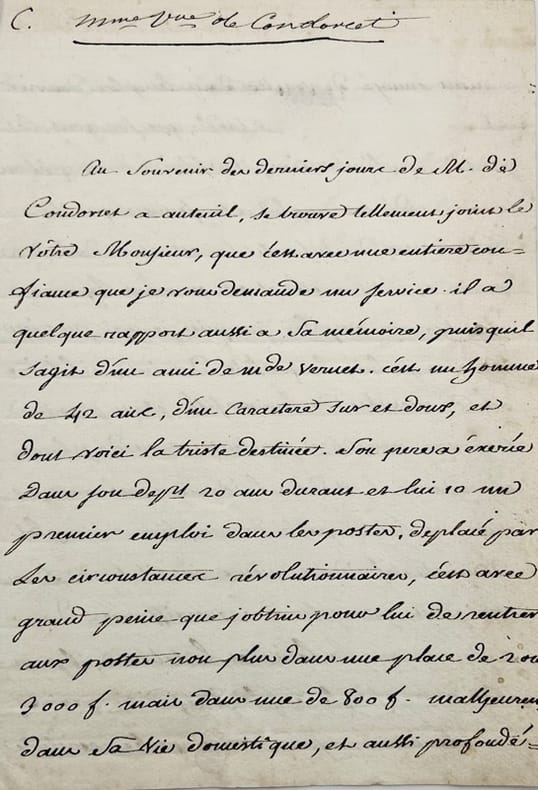
1798Best.-Nr. 44332, , 1798-1811. Ensemble 4 lettres autographes signées.
1819Best.-Nr. 71681819 .Nouvelle édition contenant l'éloge de Montesquieu par M. Villemain, les notes d'Helvetius, de Condorcet, et le commentaire de Voltaire sur l'Esprit des Lois. A Paris, Chez E. A. Lequien, 1819, 8 volumes petit in-8, maroquin brun, dos lisses ornés de frises, roulettes et filets dorés, pièces de titre et de tomaison de maroquin rouge, plats ornés d'un encadrement et motif géométrique au trait noir frappé de rosettes dorées à chaque intersection (reliure de l' époque).Jolie et intéressante édition imprimée par Didot L'ainé. Un portrait-frontispice gravé par Burdet au Tome 1.Exemplaires dans un état exceptionnel ... reliure de l'époque charmante ... du plus bel effet ....
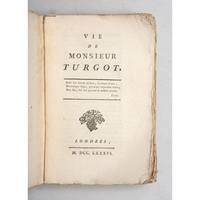
1786Best.-Nr. EONe[CON89London ie. Paris: 1786. 1786. 8vo. pp. 3 p.l. 246. old half calf rebacked. One of several issues with identical imprint this one being Gerits' issue 'B'. The present work and Dupont de Nemours' earlier memoir 1782 are the two major contemporary biographies of the great French statesman economist and financial reformer. The Life is also important for containing an early contribution to mathematical economics in a passage where Condorcet discusses the various mathematical ways "in which indirect taxation could be replaced by direct taxation and the effects of such a change". Theocharis Early Development in Maathematical Economics p. 65 A.Gerits in Harvard Library Bulletin 1992-93 Vol. III No. 4. cfCioranescu 20417. cfEinaudi 1217. cfGoldsmiths' 13128. cfKress B.1031-33. Palgrave III p. 594. London [ie. Paris]: 1786. unknown
1847Best.-Nr. 0496Paris, Firmin-Didot, 1847-49. Édition originale des œuvres complètes du philosophe par son gendre et le savant François Arago. Quasi complet, seul le volume X manque. Onze forts volumes (sur les 12) de 154 x 231 mm reliés demi-chagrin grainé tabac, dos à 5 nerfs, mention "ŒUVRES DE CONDORCET" et tomaison en caractères d'imprimerie dorés. Gardes colorées, portrait de Condorcet en frontispice sous papier de soie. Plus de 5500 pages en tout : tome I, Biographie de Condorcet par Arago et œuvres diverses, CLXXXVI et 652 pp. ; tome II, Éloges I, VIII et 672 pp. ; tome III, Éloges II, 664 pp. ; tome IV, Mélanges de littérature et de philosophie I, 644 pp. ; tome V, Mélanges de littérature et de philosophie II, 575 pp. ; tome VI, Mélanges de littérature et de philosophie III, 662 pp. ; tome VII, Économie politique et politique I, 575 pp. ; tome VIII, Économie politique et politique II, 662 pp. ; tome IX, Économie politique et politique III, 547 pp. ; tome X manquant ; tome XI, Politique I, 676 p. ; tome XII, Politique II, 690 pp. Marie-Jean-Antoine Nicolas de Caritat, marquis de Condorcet (1743-1794), fut l'une des grandes figures intellectuelles du mouvement des Lumières. "Célèbre pour ses travaux pionniers en statistique et en probabilités, pour son analyse des modes de scrutin, le vote Condorcet, « théorème du jury » et le paradoxe de Condorcet, ainsi que pour ses écrits philosophiques et son action politique, notamment contre l'esclavage et pour l'égalité des sexes, tant avant la Révolution que sous celle-ci. Siégeant parmi les girondins, il propose la refondation du système éducatif ainsi que celle du droit pénal." (Wikipédia) Grand ami de d'Alembert, puis de Voltaire, il finit par se mettre la Convention révolutionnaire à dos et mourut dans des circonstances mal connues sous la Terreur alors qu'il était au cachot. Quelques rousseurs à travers les volumes, très petits trous de ver à certains sans perte au texte, frontispice bien présent, petits manques au cuir en coiffe et queue de certains volumes, cuir du dos du vol. XII en bonne partie manquant. Bon état général. Complet hors le volume X manquant.
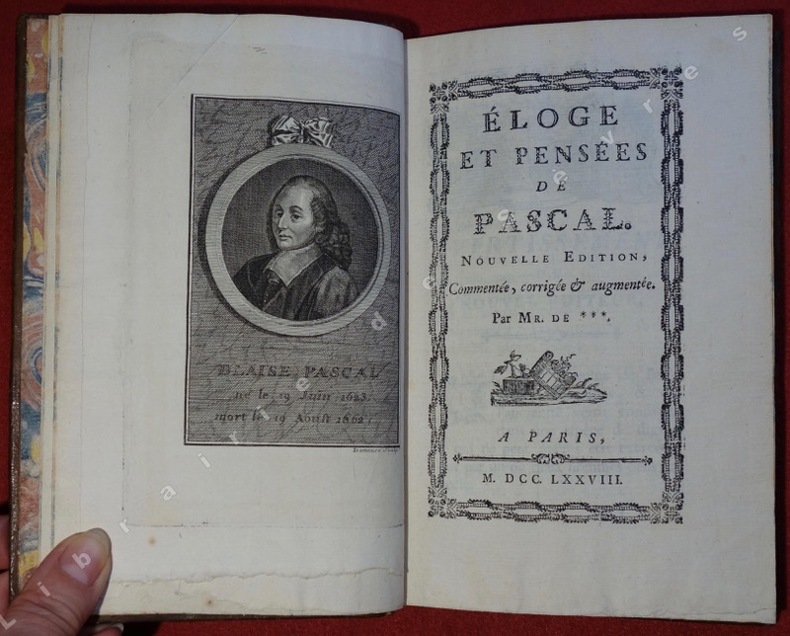
1778Best.-Nr. 148111778 Paris (Genève), 1778, sans nom d'éditeur (Grasset), in 8 de XII-316 pp., titre encadré portrait de Pascal gravé par Demeuse en frontispice et portrait de Voltaire gravé par Brichet placé face à la préface, page 163 numérotée par erreur 139, jolies vignettes gravées sur bois, culs de lampes etc., rel. d'ép. plein veau fauve marbré, dos lisse orné de fers dorés, pièce de titre de maroquin rouge, tranches jaspées de couleurs, bel ex.
1827Best.-Nr. 4336Paris, Henri Feret, 1827 ; huit tomes, in-8 ; demi-veau glacé bronze, dos lisses ornés de palettes décoratives dorées et fleurs stylisées à froid, titre doré, tranches marbrées (reliure de l'époque) ; XV, 411 ; 483 ; 495 ; 488 ; 476 ; 544 ; 460 ; 464 pp. ; et portrait par Devéria, gravé par H.C. Muller. Contient une table des matières de l'Esprit des lois très détaillée.
1786Best.-Nr. 83882London: no publisher 1786. One of four printings of 1786 Gerits's edition D with no Avis de l'éditeur and no errata and the misprints corrected: "Contrary to what is suggested by the title this book was not a biography but rather an exposé of Turgot's educational political and economic ideas" Gerits. This work together with Dupont de Nemours's biography is the chief contemporary account of the renowned financial reformer and friend of the physiocrats. It contains in a footnote Condorcet's early attempt to apply mathematics to economics. On pp. 178-184 he discusses the various mathematical ways "in which indirect taxation could be replaced by direct taxation and the effects of such a change" Theocharis Early developments in mathematical economics p. 65. Condorcet 1743-1794 was secretary to the Académie and was a prolific author. Although more celebrated for his studies in philosophy literature and politics "his mathematical treatment of probabilities and his discussion of differential equations and finite differences show an ability which might have put him in the first rank had he concentrated his attention on mathematics" W.W. Rouse Ball A Short Account of the History of Mathematics p. 388. Octavo 214 x 135 mm. Contemporary papier dominoté wrappers paper spine label hand-written in black ink. Short closed tear to pages 245-246 neatly repaired without loss occasional light spotting; a very good uncut copy in an attractive decorated paper wrapper. Kress B.1033. Gerits: "Condorcet's Vie de Monsieur Turgot" in Harvard Library Bulletin. unknown
1788Best.-Nr. 264649Paris: Chez Froullé libraire quai des Augustins 1788. First edition. 4 xvi 383 1; 4 259 1; 4 292; 4 366 pp. 4 vols. 8vo. Contemporary quarter leather pastepaper boards french tips flat spines with red leather title and volume labels. Spines rubbed some minor starting of joints to two volumes small loss to head of vol. I a very good contemporary set. First edition. 4 xvi 383 1; 4 259 1; 4 292; 4 366 pp. 4 vols. 8vo. Mazzei emigrated to America from Italy in 1773 and introduced the cultivation of grapes and olives to the United States. He became a neighbor of Jefferson in Virginia settling near Monticello at Jefferson's request and this association led to their long friendship and the author's acquaintance with Franklin and Adams. A staunch Republican Mazzei took an active role in the Independence movement. In this work he outlines the history of the American colonies the causes of the Revolution and the economy and government of the United States. Also discussed are Indians slavery emigration and the Society of the Cincinnati. The book was a contemporary success and remains an important work which Malone characterizes as "probably the most reliable of all the works of the period on the United States" Thomas Jefferson 2:109-110. Jefferson aided Mazzei in the compilation of the work while acting as American minister in Paris. Sabin 47206; Leclerc 957; Howes M456; Monaghan 1052; Muller 1612; Fay 24; Einaudi 3807; Reese Revolutionary 87 Chez Froullé, libraire, quai des Augustins unknown
1788Best.-Nr. 264649Paris: Chez Froullé libraire quai des Augustins 1788. First edition. 4 xvi 383 1; 4 259 1; 4 292; 4 366 pp. 4 vols. 8vo. Contemporary quarter leather pastepaper boards french tips flat spines with red leather title and volume labels. Spines rubbed some minor starting of joints to two volumes small loss to head of vol. I a very good contemporary set. First edition. 4 xvi 383 1; 4 259 1; 4 292; 4 366 pp. 4 vols. 8vo. Mazzei emigrated to America from Italy in 1773 and introduced the cultivation of grapes and olives to the United States. He became a neighbor of Jefferson in Virginia settling near Monticello at Jefferson's request and this association led to their long friendship and the author's acquaintance with Franklin and Adams. A staunch Republican Mazzei took an active role in the Independence movement. In this work he outlines the history of the American colonies the causes of the Revolution and the economy and government of the United States. Also discussed are Indians slavery emigration and the Society of the Cincinnati. The book was a contemporary success and remains an important work which Malone characterizes as "probably the most reliable of all the works of the period on the United States" Thomas Jefferson 2:109-110. Jefferson aided Mazzei in the compilation of the work while acting as American minister in Paris. Sabin 47206; Leclerc 957; Howes M456; Monaghan 1052; Muller 1612; Fay 24; Einaudi 3807; Reese Revolutionary 87 Chez Froullé, libraire, quai des Augustins unknown books
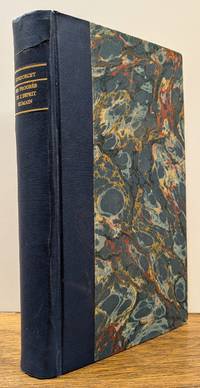
1795Best.-Nr. 168984Paris: Chez Agasse 1795. Second. hardcover. very good. 389pp. 4pp. of advertisments 8vo untrimmed rebound in cloth-backed marbled boards spine neatly repaired. Paris: Chez Agasse L'An III 1795. Second Edition. Very good . Printing and the Mind of Man 246; Robinet 382. Considered to be Condorcet's most original and most important work. Considered to be Condorcet's most original and most important work. In it he divided history into ten epochs the first nine dealing with history upto the time in which he himself lived whereas the tenth is his prophetic view of the future. It is the most original part of the book in which Condorcet forecasts among others the future moral intellectual and physical improvement of man. '. PMM Chez Agasse unknown
1795Best.-Nr. 168984Paris: Chez Agasse 1795. Second. hardcover. very good. 389pp. 4pp. of advertisments 8vo untrimmed rebound in cloth-backed marbled boards spine neatly repaired. Paris: Chez Agasse L'An III 1795. Second Edition. Very good . Printing and the Mind of Man 246; Robinet 382. Considered to be Condorcet's most original and most important work. Considered to be Condorcet's most original and most important work. In it he divided history into ten epochs the first nine dealing with history upto the time in which he himself lived whereas the tenth is his prophetic view of the future. It is the most original part of the book in which Condorcet forecasts among others the future moral intellectual and physical improvement of man. '. PMM Chez Agasse unknown books
1775Best.-Nr. CLL-817"In-8 de 12 pp. ; 63 pp. ; 70 pp., vélin vert, tranches rouges (reliure de l'époque)."
1786Best.-Nr. CLL-229Londres, 1786 In-8 de (2)ff., 322pp., veau rose, chainette dorée d'encadrement sur les plats, fleurons aux angles, dos lisse orné de lyres dorées dans des caissons dorés, pièces de maroquin vert foncé, roulette dorée sur les coupes, bordures ornées d'une dentelle à froid, tranches pailles (reliure de l'époque).
Best.-Nr. 8721"P., Panckoucke,; Liège, Plomteux; 1784-1792. Trois volumes in 4° + un atlas petit in folio veau marbré de l’ép. (petites différences dans les reliures) dos à nerfs orné de fleurons dorés, tr. rouges (quelques épidermures). 2 ff. on ch-CXIV pp. (discours préliminaire)-721 pp. et errata-787pp. 184 pp. + [IV-316 pp. et 16 planches], dictionnaire des jeux-Atlas de 43 planches. "
1827Best.-Nr. 45081827 Paris, Dalibon, 1827, 14,5x23, huit volumes. Élégante reliure en demi basane bleue. Dos orné à 5 nerfs, titre, auteur et tomaison en lettres dorées. Plats et tranches marbrées. Portrait en frontispice et une page d'écriture en fac-similé, bon exemplaire malgré quelques rousseurs. Envoi de photographies sur demande.
1786Best.-Nr. 383061786 In-8 (219 x 144 mm), demi-veau blond, dos lisse orné de doubles filets dorés en place des nerfs, titre doré, (reliure Laurenchet), (4), 299 p. et (1) p. d'errata (exemplaire imprimé sur grand papier). Londres, 1786.
Best.-Nr. 8490Véritable édition originale, sans mention d'édition. Printing and the Mind of Man, 246; En Français dans le Texte, 196. Le texte fondamental de Condorcet. À la suite se trouve relié : Dernier écrit de Condorcet précédé d'une notice sur ses derniers momens par Mme Suard. Paris, Brière, 1825. Avec un portrait lithographique en frontispice. 1/2 parchemin, pièce de titre sur dos long. Reliure début XIXè. Très bon Paris Agasse An III 1 volume in-8°
1788Best.-Nr. 89325Froullé | Paris Colle 1788 | 13.5 x 21 cm | 4 volumes Brochés