Quennell, Peter & Hodge, Alan (editors)MareMagnum

546 résultats
1977No marks or inscriptions. No creasing to covers. A very clean very tight copy with bright unmarked boards and no bumping to corners. 69pp. Periodical magazine with feature articles on At the portrait's painter -18th century, Turgot and Condorcet, Manuel Chrysoloras, the Malayan Raj, the rise of Wessex from 5th to 11th centuries, Sir Frederick Trench and London improvements, Blockade running from Nassau - 1861-5, plus book reviews and letters.
1995Sophie de Condorcet Sulla simpatia. , Sellerio Editore Palermo 1995-06-15, Libro in ottimo stato. Presenta una firma a penna all'interno. Buono (Good) . Copertina flessibile 236 88-389-1112-6
1947Book is in excellent condition with red cloth HB covers and gilt print at spine. Binding is solid and square, covers have sharp corners, exterior shows no blemishes, text/interior is clean and free of marking of any kind with age-toned paper. Previous owner's name or sticker in front section of the book. 349 pages, contents include: Moral principle in nature, Moral conceptions of primitive peoples (dual nature of moral requirements among the savage tribes, Development of moral teachings -- ancient Greece, The renaissance, Moral teachings in the modern era, Cudworth, Cumberland, Spinoza, Locke, Clarke, Voltaire, Rousseau, Turgot , Condorcet, Hume, Adam Smith, Kant, Fichte, Schelling, hegel, Schleiermacher, Bentham, Stuart, Schopenhauer, Victor Cousin, Jouffroy, etc.
grand in-8 etroit, VIII-263 pages, broché, couvert Etat proche du NEUF. [TX-5]
grand in-8 etroit, VIII-263 pages, broché, couvert Tres bel exemplaire, tres frais. [CA-12]
1997A CURA DI ARTURO MARTONE BIBLIOPOLIS 1997. DEDICA DEL CURATORE ALLA PRIMA PAGINA, PER IL RESTO PERFETTO, PARI AL NUOVO
2006MARCO EDITORE 2006. DEDICA DEL CURATORE ALL'ANTEPORTA, LIEVI SEGNI DEL TEMPO, PER IL RESTO ECCELLENTI CONDIZIONI.
1981Collana "Studi Testi Documenti", 2. Un volume di 160 pagine, brossura editoriale. Dimensioni: 14,5x22,5 cm. Minime tracce d'uso alla brossura, per il resto ottime condizioni.
réf. 0672603810-7-1Macmillan Pub Co. First Edition. Acceptable. The item might be beaten up but readable. May contain markings or highlighting as well as stains bent corners or any other major defect but the text is not obscured in any way. Macmillan Pub Co unknown
2012réf. x-2812405104Editions Classiques Garnier 2012. Paperback. New. 195 pages. French language. 8.43x5.85x0.73 inches. Editions Classiques Garnier paperback
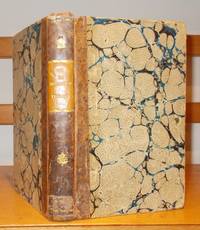
1823réf. 060320Paris: Librairie De Brissot-Thivars 1823. 3rd Edition . Hardcover. Near Fine. 466 Ii Pp. Half Green Morocco Spine Gilt Four Bands Gilt Green Marbled Boards Blue Marbled Endpapers And Edges Of Page Block. Third Edition. A Small But Very Attractively Bound Volume. Near Fine Although Small Frays At Tips. Librairie De Brissot-Thivars, hardcover
1785réf. 169550Paris: Imprimerie Royale 1785. Calculating the wisdom of crowds First edition of Condorcet's pioneering application of probability theory to collective decision-making "the first large-scale attempt to apply mathematics to knowledge of human phenomena" DSB. Condorcet investigated the probability that the majority decision of an assembly or tribunal was correct and whether rational individual choices produce coherent collective decisions. While recognizing limitations and contradictions it is ultimately a defence of democratic decisions and the wisdom of crowds and a seminal work in social choice theory. "It is mainly to the Essai a ground-breaking investigation into the relationship between voting procedures and collective outcomes that Condorcet owes his modern standing as the founder of social choice. His theory of voting and political decision-making constitutes one of the most sustained elements to be found in the whole corpus of his writings" Williams pp. 207-8. Quarto 247 x 183 mm pp. 2 cxci 1 304. Contemporary mottled calf spine lettered and decorated in gilt marbled endpapers red edges. Slight rubbing ink splash to title page contents browned. A very good copy. David Williams Condorcet and Modernity 2004. unknown
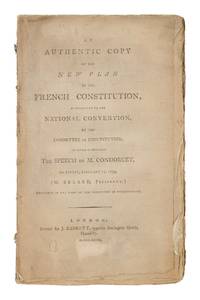
1793réf. 863891793. The Blueprint That Cost a Philosopher His Life: Condorcet's Tragic 1793 French Constitution Plan Condorcet Marquis de Jean-Antoine-Nicolas de Caritat 1743-1794. An Authentic Copy of the New Plan of the French Constitution as Presented to the National Convention by the Committee of Constitution.: To which is Prefixed the Speech of M. Condorcet on Friday February 15 1793 M. Breard President Delivered in the Name of the Committee of Constitution. London: Printed for J. Debrett Opposite Burlington House Piccadilly 1793. ii li 1 58 pp. Octavo 9" x 5-1/4"; 22.5 x 14 cm. Disbound. Uncut. Outer leaves worn and chipped at edges but text remains broad-margined and stable. Light age-toning. Internally clean and crisp. A good unsophisticated copy. $450. First English edition. This text represents the intellectual peak of the French Revolution by turning abstract Enlightenment theory into a working legal framework. Known as the "Plan Condorcet" it served as the ultimate manifesto of the moderate Girondin faction. Its rejection by the National Convention marked the precise moment the Revolution swung from rational legal reform into the radical violent Reign of Terror. Shortly after presenting this plan the Jacobins ordered Condorcet's arrest forcing him into hiding where he wrote his famous philosophical masterpiece on human progress before dying mysteriously in a prison cell days after his capture. Published by John Debrett this specific London edition highlights how closely and anxiously the British public followed the political collapse of their neighbor across the Channel. English Short-Title Catalogue T22771. unknown
1793réf. 017391Paris: De l'Imprimerie Nationale 1793. Book measures 26x20.5.cm. 25810917pp. Bound in period hardcover with marble boards. Binding rubbed worn lacking spine boards holding Institution library label on top cover. Internally very occasional stamp or mark pages clean. A nice copy in a worn binding. This first plan for a constitution presented to the Convention Nationale was largely written by Condorcet. The second part is 'Projet de déclaration des droits naturels civils et politiques des hommes'. First Edition. Hardcover. Good Plus. Quarto. De l'Imprimerie Nationale Hardcover
2005réf. 107701alzoESPASA-CALPE 2005. DURA. Bien/Sin cubierta. Sobre los progresos futuros del espíritu humano. ESPASA-CALPE hardcover
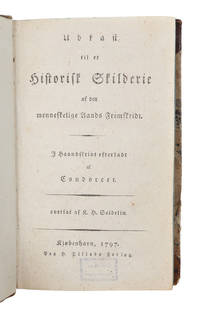
1797réf. 61971København Tikiøbs Forlag 1797. 8vo. Bound in a contemporary half calf binding with gilt spine and gilt title label. Minor cracks to spine. Insignificant wear to capitals. Edges of boards worn. Corners bumped. Bibliographical notes to front free endpaper. Small ownership stamp to verso of title page. Evenly browned. XII23681: errata pp. The extremely rare first Danish edition of Condorcet's main work "Esquisse d'un tableau historique des progrès de l'esprit humain.1795" "the most fully developed exposition of the progress of man" Printing and the Mind of Man p. 149 and a main work of the Enlightenment as well as of historical thought in general. The author was the creator of what came to found the basis for the modern French system. The great French philosopher political thinker and mathematician M.J.A. Condorcet 1743 - 1794 played a seminal role in 18th century France. He was friends with the likes of d'Alembert Voltaire Turgot etc. and he greatly contributed to the social and political debates of politically turbulent France. As one of the few he advocated a liberal economy equality in public education as well as in gender and race etc. He preached constitutionalism and his thoughts that are still influential today embody those of the Enlightenment and rationalism."A belief in the ultimate perfectibility of man lies at the root of all progressive thinking about the human condition. The "philosophes" and Godwin had familiarized the reading public with this notion; it was left to Condorcet to give it its finest and most durable expression. It was the gospel of nineteenth century that mankind is destined for indefinite future progress. Condorcet looking back and then forward saw proof of this in the growing equality between classes and nations the intellectual physical and moral improvement of man; and he prophesied that popular education on correct principles would strengthen and assure this progress." PMM 246.During the French Revolution Condorcet came to play a dominating role advocating a rationalist reconstruction of society and he championed many liberal causes. In 1791 he became secretary of the Legislation Assembly and the institution adopted his scheme for comprehensive state education which later became the basis of the modern French system. In the struggle between the two political parties the Girondists and the Montagnards Condorcet occupied an independent role but when he opposed the death penalty under the trial of King Louis XVI still supporting the actual trial and the radical Montagnards gained more power Condorcet was branded a traitor and in October 1793 a warrant was issued for his arrest. He now went into hiding for several months almost a year and it is during these months that he writes the work that was to become his most important the main work "Esquisse." "Sketch for a Historical Picture of the Progress of the Human Mind" which was published posthumously the year after his death. In 1794 Condorcet was arrested and two days later he was found dead in his cell -it is unknown whether he committed suicide or was murdered because of fear of fierce reactions that would definitely have occurred had the beloved man been officially sentenced to the death penalty."In the Esquisse" published after his death Condorcet traces the history of man through epochs the first three covering his progress from savagery to pastoral community and thence to the agricultural state. The next five span the growth of civilizations and knowledge down to Descartes and the ninth describes the revolution of Condorcet's own lifetime from Newton to Rousseau. The prophetic view of the tenth epoch shows Condorcet at his most original. He forecasts the destruction of inequality between nation and classes and the improvement intellectual moral and physical of human nature. it exercised considerable influence on Comte. But it is as the most fully developed exposition of the progress of man that Condorcet's work is now remembered and it is this which has given it its lasting appeal." PMM 246. hardcover
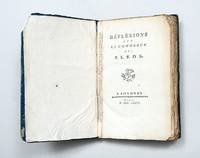
1776réf. 83886London: No Printer 1776. Uncommon first edition of Condorcet's Thoughts on the corn trade. Appointed secretary to the Académie des Sciences in 1773 for his work in mathematics Condorcet "soon won the friendship of Turgot by whom his attention was turned towards political economy. Under the inspiration of Turgot he wrote various articles or works among others Les Réflexions d'un laboureur de Picardie à M. N. auteur prohibitif à Paris 1775; and Les Réflexions sur le commerce des bleds 1776 two writings directed against M. Necker that auteur prohibitif who had brought out May 1775 his work Sur la législation et le commerce des grains." Palgrave. Octavo 212 x 134 mm pages 2 title xvi 2 errata 221. Contemporary blue marbled paper boards paper spine label lettered by hand. Front board and upper outer corner of the first 100 pages gnawed title page with closed tear to the gutter partly repaired with tape to verso; a very good copy uncut with generous margins. INED 1178. Not in Goldsmiths' Kress Mattioli or Sraffa. See Palgrave's Dictionary of Political Economy 1925 I p. 386. hardcover
1786réf. 013838London: no publisher 1786. Book measures 19.5x12.5.cm. 42991pp. Bound in period or early quarter calf marble boards gilt tooling leather title label. Binding rubbed worn chipped on head of spine. Internally library cancellation stamp on free endpaper no other library marks staining to title and about 10 pages. Some occasional minor spotting pencil underlining or minor annotations. Pages in good clean condition. ~A good copy. Quarter Calf. Good Plus. 8vo. [no publisher], Hardcover
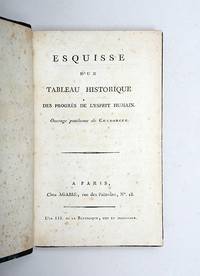
1795réf. 161166Paris: chez Agasse l'an III de la République 1795. History as progress First edition of the finest and most durable expression of the ultimate perfectibility of man perhaps the clearest and boldest statement of the enlightenment belief in progress demonstrating "man's progressive emancipation first from the arbitrary domination of his physical environment and then from the historical bondage of his own making" Encyclopedia of Philosophy II 184. Condorcet wrote the work in 1794 while in hiding from Robespierre's agents having voted against the execution of the king. Captured by the state he was found dead the next day presumed to have taken his own life to escape the guillotine. His manuscript was published the next year. "In the Esquisse. Condorcet traces the history of man through epochs the first three covering his progress from savagery to pastoral community and thence to the agricultural state. The next five span the growth of civilizations and knowledge down to Descartes and the ninth describes the revolution of Condorcet's own lifetime from Newton to Rousseau. The prophetic view of the tenth epoch shows Condorcet at his most original. He forecasts the destruction of inequality between nations and classes and the improvement intellectual moral and physical of human nature" PMM. Octavo 193 x 119 mm. Early 19th-century blue quarter roan smooth spine lettered and tooled in gilt blue mottled sides brown speckled edges. Front pastedown with early 20th-century bookseller's label of Emile Nourry of Paris and bookplate of Caroli Michel. Light rubbing to binding corners worn spotting to contents marginal loss to foot of G2 not affecting text a few peripheral nicks very good. Printing and the Mind of Man 246; En français dans le texte 196; Martin & Walter 1 8083; Quérard II p. 269. unknown
1802réf. 56417Kiøbenhavn: A. Soldin 1802. 8vo. Indbundet i et samtidigt hldrbd. med rygforgyldning. Titeletiket i skind med forgyldt titel. Kantslid. Øvre kapitæl slidt. Hjørner stødte. Et brændemærke på forpermermen har afgivet en brunplet på de første 6 blade. Enkelte brunpletter ellers ren og pæn. Trykt på godt papir. Ex libris Nicolai Bøgh. Titeloplag idet indholdet er identisk med førstetrykket fra 1798. unknown
1795réf. 42119Paris Agasse l'an III de la République une et indivisible 1795. 8vo. Bound in a very nice newer pastiche-binding in full mottled calf. Five raised bands and gilt title-label to spine. A very nice clean fresh and attractive copy. VIII 389 pp. The rare first edition of Condorcet's main work "the most fully developed exposition of the progress of man" Printing and the Mind of Man p. 149 and a main work of the Enlightenment as well as of historical thought in general. The author was the creator of what came to found the basis for the modern French system. The great French philosopher political thinker and mathematician M.J.A. Condorcet 1743 - 1794 played a seminal role in 18th century France. He was friends with the likes of d'Alembert Voltaire Turgot etc. and he greatly contributed to the social and political debates of politically turbulent France. As one of the few he advocated a liberal economy equality in public education as well as in gender and race etc. He preached constitutionalism and his thoughts that are still influential today embody those of the Enlightenment and rationalism."A belief in the ultimate perfectibility of man lies at the root of all progressive thinking about the human condition. The "philosophes" and Godwin had familiarized the reading public with this notion; it was left to Condorcet to give it its finest and most durable expression. It was the gospel of nineteenth century that mankind is destined for indefinite future progress. Condorcet looking back and then forward saw proof of this in the growing equality between classes and nations the intellectual physical and moral improvement of man; and he prophesied that popular education on correct principles would strengthen and assure this progress." PMM 246.During the French Revolution Condorcet came to play a dominating role advocating a rationalist reconstruction of society and he championed many liberal causes. In 1791 he became secretary of the Legislation Assembly and the institution adopted his scheme for comprehensive state education which later became the basis of the modern French system. In the struggle between the two political parties the Girondists and the Montagnards Condorcet occupied an independent role but when he opposed the death penalty under the trial of King Louis XVI still supporting the actual trial and the radical Montagnards gained more power Condorcet was branded a traitor and in October 1793 a warrant was issued for his arrest. He now went into hiding for several months almost a year and it is during these months that he writes the work that was to become his most important the main work "Esquisse." "Sketch for a Historical Picture of the Progress of the Human Mind" which was published posthumously the year after his death. In 1794 Condorcet was arrested and two days later he was found dead in his cell -it is unknown whether he committed suicide or was murdered because of fear of fierce reactions that would definitely have occurred had the beloved man been officially sentenced to the death penalty."In the Esquisse" published after his death Condorcet traces the history of man through epochs the first three covering his progress from savagery to pastoral community and thence to the agricultural state. The next five span the growth of civilizations and knowledge down to Descartes and the ninth describes the revolution of Condorcet's own lifetime from Newton to Rousseau. The prophetic view of the tenth epoch shows Condorcet at his most original. He forecasts the destruction of inequality between nation and classes and the improvement intellectual moral and physical of human nature. it exercised considerable influence on Comte. But it is as the most fully developed exposition of the progress of man that Condorcet's work is now remembered and it is this which has given it its lasting appeal." PMM 246. hardcover
1976réf. BN155695Suhrkamp 1976. 1976. Softcover. Entwurf einer historischen Darstellung der Fortschritte des menschlichen Geistes suhrkamp taschenbuch wissenschaft stw 175 Entwurf einer historischen Darstellung der Fortschritte des menschlichen Geistes suhrkamp taschenbuch wissenschaft stw 175 Jean Antoine Nicolas de Caritat de Condorcet Suhrkamp paperback
1955réf. C67623London: Weidenfeld & Nicolson 1955. First Edition Of This Translation. Hardback. Dust Jacket. Hardcover Hardcover. Fair. First Edition Of This Translation. Hardback. Dust Jacket. 8vo. pp 202. Original publisher's red cloth lettered gilt at the spine. The publisher's own retained copy with their stamp on the half title reading 'file copy'. Introduction by Stuart Hampshire. Very slight lean otherwise very good indeed in slight used very good minus dust jacket with abrasion from label removal. Weidenfeld & Nicolson, hardcover
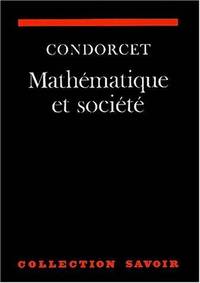
1974réf. BN510058Editions Hermann 1974. 1974. Softcover. Mathématique et société Mathématique et société Condorcet et Roshdi Rashed Editions Hermann paperback
1994réf. BN646377Promeneur 1994. 1994. Vie de Voltaire Vie de Voltaire Condorcet Promeneur unknown