Marquis de CondorcetBiblio.com

552 résultats
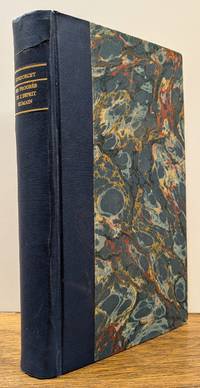
1822réf. 2206Early copy of "Esquisse d'un Tableau Historique des Progres de L'Esprit Humain" Sketch for a Historical Picture of the Progress of the Human Mind Suive de followed by "Reflexions Sur L'Esclavage des Negres" Reflections on the Slavery of Negroes by Marquis de Condorcet. 1822; Chez Masson et Fils Libraires; Paris. The book is written entirely in French. Leather covers with decorative gilt borders and gilt decorations on the spine; marbled end papers and marbling on all page edges. With a Table of Contents at the back of the book. Condorcet who denounced slavery was a French philosopher and mathematician. His ideas including support for a liberal economy free and equal public instruction constitutional government and equal rights for women and people of all races have been said to embody the ideals of the Age of Enlightenment and Enlightenment rationalism. In "Sketch for a Historical Picture of the Progress of the Human Mind" originally published in 1795 he dealt with theoretical thought on perfecting the human mind and analyzing intellectual history based on social arithmetic. In "Reflections on Negro Slavery" originally published in 1781 he argued against slavery and introduced a program to gradually abolish it. The contents are arranged into the following sections: Esquisse d'un Tableau Historique des Progres de L'Esprit Humain Sketch of a Historical Picture of the Progress of the Human Mind Reflexions Sur L'Esclavage des Negres Reflexions on the Slavery of Negroes by M. Schwartz Condorcet's pseudonym with a "Dedication to Negro Slaves" Au Corps Electoral Contre L'Esclavage des Noirs The Electoral Body Against Black Slavery Sur L'Admission des Deputes des Planteurs de Saint-Domingue dans L'Assemblee Nationale On the Admission of Deputies of Planters from Saint-Domingue to the National Assembly Adresse a L'Assemblee Nationale sur Les Conditions d'Eligibilite Address to the National Assembly on the Conditions of Eligibility Condition: Scuffing/rubbing to the leather covers; the top of the spine is worn down and has 1" tears at the left and right edges; light wear to the bottom 2 corner tips. Tight binding with no cracks and no loose pages. The pages are mostly clean with only some light occasional foxing; worm holes at the lower-inner corners of pages 266-336. Staining along the outer edges of the pastedowns. Chez Masson et Fils, Libraires hardcover
réf. 0243320590.Gpaperback. Good. Access codes and supplements are not guaranteed with used items. May be an ex-library book. paperback
réf. 0332375498.Ghardcover. Good. Access codes and supplements are not guaranteed with used items. May be an ex-library book. hardcover
1795réf. 65358Paris: Chez Agasse 1795. Can Man Become Perfect" CONDORCET Marie Jean Antoine Nicolas Caritat Marquis de. Esquisse d'un tableau historique des progrès de l'esprit humain. Ouvrage posthume de Condorcet. Paris: Chez Agasse L'an III. de la République 1795. First edition of Condorcet's philosophical masterpiece. Octavo 7 7/8 x 4 13/16 inches; 201 x 123 mm. viii 389 1 blank pp. Contemporary quarter calf over dark blue paste-paper boards spine gilt with dotted bands and ornaments gilt red morocco lettering piece. Old owner's signature on half-title. A quarter-inch marginal tear at the bottom of leaf M42 that does not affect the text. Light foxing throughout. A blue ink stain on top edge from signature Z to the end. Overall a clean and attractive copy. "It was the gospel of the nineteenth century that mankind is destined for indefinite future progress. Condorcet 1743-1794 looking back and then forward saw proof of this in the growing equality between classes and nations the intellectual physical and moral improvement of man; and he prophesied that popular education on correct principles would strengthen and assure this progress.In the Esquisse 'An Historical Outline of the Progress of the Human Mind' published after his death Condorcet traces the history of man through epochs the first three covering his progress from savagery to pastoral community and thence to the agricultural state. The next five span the growth of civilizations and knowledge down to Descartes and the ninth describes the revolution of Condorcet's own lifetime from Newton to Rousseau. The prophetic view of the tenth epoch shows Condorcet at his most original. He forecasts the destruction of inequality between nations and classes and the improvement intellectual moral and physical of human nature.it is as the most fully developed exposition of the progress of man that Condorcet's work is now remembered and it is this which has given its lasting appeal" Printing and the Mind of Man. Printing and the Mind of Man 246. HBS 65358. $2000. Chez Agasse unknown books
1933réf. R160111166BOIVIN ET CIE. 1933. In-12. Broché. Etat d'usage, Couv. convenable, Dos satisfaisant, Intérieur frais. 239 pages. Quelques phrases soulignées au crayons de papier. Coiffes abîmées.. . . . Classification Dewey : 100-PHILOSOPHIE ET DISCIPLINES CONNEXES
1795réf. 168984Paris: Chez Agasse 1795. Second. hardcover. very good. 389pp. 4pp. of advertisments 8vo untrimmed rebound in cloth-backed marbled boards spine neatly repaired. Paris: Chez Agasse L'An III 1795. Second Edition. Very good . Printing and the Mind of Man 246; Robinet 382. Considered to be Condorcet's most original and most important work. Considered to be Condorcet's most original and most important work. In it he divided history into ten epochs the first nine dealing with history upto the time in which he himself lived whereas the tenth is his prophetic view of the future. It is the most original part of the book in which Condorcet forecasts among others the future moral intellectual and physical improvement of man. '. PMM Chez Agasse unknown books
1795réf. 42119Paris, Agasse, l'an III de la République, une et indivisible (1795). 8vo. Bound in a very nice newer pastiche-binding in full mottled calf. Five raised bands and gilt title-label to spine. A very nice, clean, fresh, and attractive copy. VIII, 389 pp.
1970réf. RO30305649Librairie philosophique J. Vrin. 1970. In-8. Broché. Etat d'usage, Couv. convenable, Dos satisfaisant, Intérieur frais. 245 pages - Quelques annotations au crayon à papier n'altérant pas la lecture -. . . . Classification Dewey : 840-Littératures des langues romanes. Littérature française
réf. 95350-JB035Boivin 1933
réf. 8490Véritable édition originale, sans mention d'édition. Printing and the Mind of Man, 246; En Français dans le Texte, 196. Le texte fondamental de Condorcet. À la suite se trouve relié : Dernier écrit de Condorcet précédé d'une notice sur ses derniers momens par Mme Suard. Paris, Brière, 1825. Avec un portrait lithographique en frontispice. 1/2 parchemin, pièce de titre sur dos long. Reliure début XIXè. Très bon Paris Agasse An III 1 volume in-8°
1822réf. 1334Paris Chez Masson et fils 1822 à Paris, chez Masson et fils, libraires, 1822., (1 bl), VIII, 440p, (2 bl). In-8, demi veau glacé, pièce de titre, mord supérieur faible, tranche marbrée, dos plat orné de filets -
réf. 500342587GF-Flammarion Sans date.
réf. 42777Paris.Masson.1822.In-8,reliure d'époque.440 p. BE.Veau marbré avec filet doré et motifs fleuris.Rousseurs in-texte.
réf. 597728Paris, Brissot-Thivars, 1822. In-16, cartonnage de l'époque, pièce de titre rouge, filets et titre dorés, tranches vertes, couverture conservée, XXIII-480 pp.
1798réf. 195361798 Gènes, chez Yves Gravier libraire, 1798, An I de la République Ligurienne, in-8 de 361-(1) pp., rel. postérieure fin XIXe , demipercaline bordeaux, dos lisse avec date en pied, angle supérieur de la page de faux-titre anciennement réparé, bon ex.
1795réf. 12965A Paris, chez Agasse, 1795. In-8 de VIII-389 pp., demi-basane brune, dos frotté (reliure de l'époque).
réf. 229537À Paris, Chez Masson et fils, 1822 in-8, VIII-440 pp., broché, couv. papier marbré de l'époque
réf. 230246Milan, Imprimerie italienne et française, an VI (1798) in-8, viij pp., 384 pp., pp. 387-389, demi-chagrin fauve, dos à nerfs orné de guirlandes dorées et de filets et fleurons à froid (rel. de la fin du XIXe). Coiffes très frottées.
1795réf. 59131BBParis, Chez Agasse. L'an III. (i.e. 1795). 8°. VIII S., 389 S. Halblederband der Zeit mit rotem goldgeprägtem Rückenschild und wenig Rückenvergoldung.
1970réf. F69374Paris, Vrin 1970 xxxviii + 245pp., 19cm., dans la série "Bibliothèque des textes philosophiques", br., qqs.cachets, intérieur en bel état, F69374
1795réf. 20272A Paris, chez Agasse, l'an III de la République, [1795]. In-8 de [8]-385 pages, demi-basane brune, dos lisse orné de filets et fleurons dorés.
1988réf. 5186Flammarion 1988 352 pages poche. 1988. broché. 352 pages.
1970réf. EG456Condorcet, Esquisse d'un tableau historique des progrès de l'esprit humain, Librairie philosophique J. Vrin, "Bibliothèque des textes philosophiques", 1970, 13,7 cm X 18,5 cm, 242 pp couverture souple, broché.
1987réf. LCI-6342Romantin, Editions Martinsart 1987 1 in -4 Pleine reliure de velours de soie de coton, couleur vert émeraude. 375 [p.p] Une édition somptueuse du texte fondateur de la pensée progressiste. La reliure en velours vert émeraude, couleur de l'espérance et du savoir naissant, souligne la noblesse du projet de Condorcet. Un objet de bibliothèque d'une grande élégance, alliant la douceur du toucher à la force du texte.Édition de prestige du testament philosophique de Condorcet. L'ouvrage est magnifiquement revêtu d'un velours de coton vert émeraude, offrant une texture soyeuse et une profondeur de teinte exceptionnelle. Ce choix de matériau, à la fois noble et délicat, fait de ce volume une pièce de collection remarquable, illustrant parfaitement l'optimisme des Lumières.Reliure : Velours de coton d'une grande fraîcheur, poil intact et non écrasé. Couleur émeraude vibrante.Dos : Dos non fendu, volume bien ferme.Intérieur : Impeccable, sur papier de qualité supérieure.
1822réf. 146441822 P., Chez Masson et Fils, Libraires, 1822, 1 vol. in-8° (205 x 130 mm) relié 1/2 chagrin vert foncé, dos à 5 nerfs orné de fleurons dorés, auteur et titre doré, plats de papier marbré vert (reliure fin XIXe ou début XXe s.), de VIII (faux-titre, titre et avertissement), 440 pp.Nom au stylo sur la page de garde blanche, fines rousseurs éparses, pâle mouillure marginale sur les 30 dernières pages, bel exemplaire.