8 438 résultats
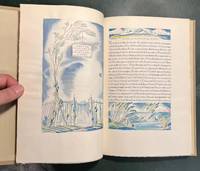
1927réf. 35609Reliure plein maroquin sable. Dos lisse avec titre doré en long. Premier plat encadré de 3 rectangles de filets inégaux dorés (bases concentriques, sommets déboités) avec titre mosaïqué doré. Fine bande de maroquin vert parcourant plats et dos au premier quart inférieur. Chasses rembordées aussi encadrées, réserve de contreplat et garde de soir moirée bleu, secondes gardes de papier marbré dans la même harmonie, triple feuillet d'habillage. Toutes tranches dorées sur témoins. Couverture et dos conservés ; dans son étui bordé. Reliure signée MAROT-RODDE. Avec des eaux-fortes et burins de Bernard NAUDIN.
réf. 17041De l'Imprimerie de la Société Littéraire Typographique en 1785 jusqu'en 1820.(dite petite édition de Kehl). 92 volumes in-12 en veau raciné de l'époque avec double pièce de titre et de tomaison. Reliure uniforme .Gravures de Deveria, Choquet,Chasselat..Rare édition complète . Etat correct en reliure d'époque. Certaines coiffes absentes.Qques rousseurs.
1753réf. 10636, , 1753-1767. 13 pièces reliées en 1 vol. in-12, veau havane marbré, dos orné à nerfs, pièces de titre en maroquin rouge, tranches rouges (reliure de l'époque).
réf. LCS-186410L’une des plus rares de Voltaire. Amsterdam, chez Changuion, [Genève, Cramer], 1765. In-8 de (1) f., viii-336pp., (1) f. d'errata. Veau moucheté glacé, dos à nerfs, pièce de titre de maroquin vieux rouge, filet or sur les coupes, tranches rouges. Reliure de l'époque. 190 x 115 mm.
1785réf. 433721785 (Kehl). De l’imprimerie de la société littéraire-typographique. 1785-1789. 70 volumes in-8, plein veau glacé olive, frise dorée en encadrement sur les plats, dos lisses ornés, pièces de titre et de tomaison rouges, tranches dorées.
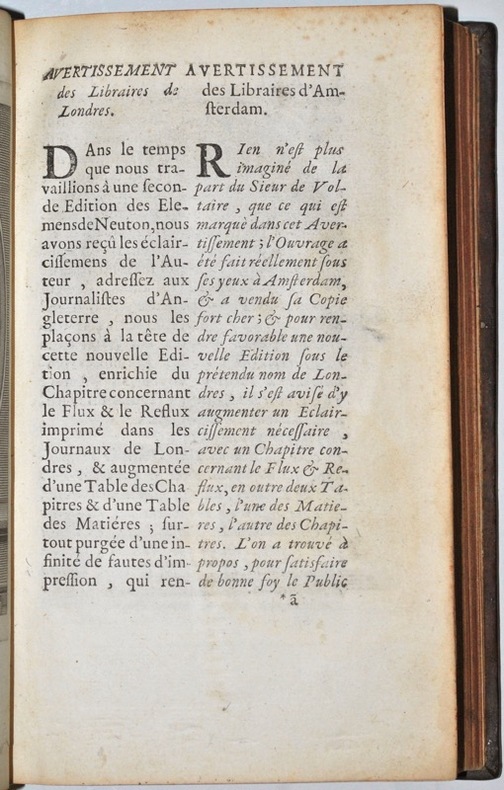
1738réf. 000010155Amsterdam: Etienne Ledet & Compagnie 1738. First edition. Hardcover. Very Good. 8vo. 5 4-399 3 pp. Full contemporary calf with the spine in six compartments spine lettered and decorated in gilt; all edges decoratively stained red. A blue silk-ribbon bookmark bound in. Title page printed in red and black with the publisher's device engraved on it. Illustrated with two frontispieces six plates a folding table a full-page chart in-text engravings and diagrams and engraved head and tailpieces quite elaborate ones. Babson 59-60. Bengesco 1570. Gray 33. PMM 97. SEP Barbara Becker "Émilie du Châtelet". The first state as the Desbordes imprint is generally recognized as the later state. With the pagination error on p. 271. Voltaire is credited with having spread Newton's revolutionary contributions to science across the European continent. He dedicated this work to his romantic and scientific partner the Marquise du Chatelet herself an accomplished scientist. The Marquise completed the first translation of Newton's Principia into French. Voltaire acknowledged her significant contributions to the production of this work an exposition of Newtonian Physics. This book was widely read and quite influential in spreading and popularizing Newton's groundbreaking ideas. Newton's work would replace Descartes' physical system and remained the standard in physics for two hundred years until the discovery of the Theory of Relativity and Quantum Mechanics in the early twentieth century. A brilliant piece of print history and a cornerstone work in the history of science. A Very Good example with the front joint expertly strengthened the bottom corners and spine tips show very minor loss; the rear decorative endpaper has a tiny chip to its corner page 231 is bound in upside down. Etienne Ledet & Compagnie hardcover
1738réf. 000010155Amsterdam: Etienne Ledet & Compagnie 1738. First edition. Hardcover. Very Good. 8vo. 5 4-399 3 pp. Full contemporary calf with the spine in six compartments spine lettered and decorated in gilt; all edges decoratively stained red. A blue silk-ribbon bookmark bound in. Title page printed in red and black with the publisher's device engraved on it. Illustrated with two frontispieces six plates a folding table a full-page chart in-text engravings and diagrams and engraved head and tailpieces quite elaborate ones. Babson 59-60. Bengesco 1570. Gray 33. PMM 97. SEP Barbara Becker "Émilie du Châtelet". The first state as the Desbordes imprint is generally recognized as the later state. With the pagination error on p. 271. Voltaire is credited with having spread Newton's revolutionary contributions to science across the European continent. He dedicated this work to his romantic and scientific partner the Marquise du Chatelet herself an accomplished scientist. The Marquise completed the first translation of Newton's Principia into French. Voltaire acknowledged her significant contributions to the production of this work an exposition of Newtonian Physics. This book was widely read and quite influential in spreading and popularizing Newton's groundbreaking ideas. Newton's work would replace Descartes' physical system and remained the standard in physics for two hundred years until the discovery of the Theory of Relativity and Quantum Mechanics in the early twentieth century. A brilliant piece of print history and a cornerstone work in the history of science. A Very Good example with the front joint expertly strengthened the bottom corners and spine tips show very minor loss; the rear decorative endpaper has a tiny chip to its corner page 231 is bound in upside down. Etienne Ledet & Compagnie hardcover books
1948réf. 31799Paris Scripta et Picta 1948 In-4, en feuilles, couverture imprime.Ce livre illustr par Van Dongen comporte 48 lithographies originales en couleurs, dont un frontispice, 47 in-texte et de nombreuses lettrines. Tirage limit 198 exemplaires numrots sur vlin de Lana. Un des 186 exemplaires.
1768réf. 9785Genève, [Cramer], 1768-1777. 29 volumes grand in-4, demi-veau blond à coins, dos à 5 nerfs ornés de filets, roulettes, titre, sous-titre et paniers de fleurs surmontés d'un joli chapeau, le tout doré. 23 volumes avec étiquettes de titre rouges et de sous-titre et tomaison caramel, 6 volumes avec étiquettes de titre caramel et de sous-titre et tomaison vertes, plats de joli papier marbré. Non rognés.
1784réf. 21024[Kehl], L'Imprimerie de la Société Littéraire-Typographique, 1784-1789. 70 volumes in-8, demi-veau moucheté brun, dos lisses ornés de filets dorés, pièces de titre et tomaison (parfois passées) rouge et verte, tranches mouchetées rouge et bleu.
1751réf. 1127E001Berlin: C.F. Henning 1751. 1st Edition . Hardback. Printed pages: 12mo. 14 488 1 Errata 2 466 2 Errata. Very Good. 3.75 x 6 inches 9.5 x 15 cm. Complete in two volumes. Full calf leather bindings red leather title labels and gilt decoration to spines. Good solid bindings. Volume one has light rippling to the pages and foxing up to page 3 hole to front free endpaper and three small holes to leading blank Volume II is very clean throughout. Engraved bookplate to front endpapers Charles Grave Hudson - 1st Baronet Hudson of Wanlip Hall Leicestershire. The first edition of one of Voltaire's most important works a landmark in the development of historiography published under the alternative pseudonym M. de Francheville. A very nice example. Overall condition is Very Good. Size: 3.75 x 6 inches 9.5 x 15 cm. C.F. Henning hardcover
réf. 750465Scripta Et Picta Paris 1948 In-4 ( 340 X 245 mm ) de 121 pages, plein maroquin tango, dos lisse janséniste, listel de maroquin rose mosaïqué aux contre-plats, contre-plats et gardes de daim prune, tranches dorées, chemise à dos de maroquin à bande et plats de papier-bois, étui bordé recouvert de papier-bois ( Reliure signée de R. DESMULES ). Superbe édition établie par le docteur A. ROUDINESCO pour le groupe de bibliophiles et d'amateurs d'art «Scripta et Picta». EDITION ORIGINALE et PREMIER TIRAGE des 71 lithographies originales en couleurs du peintre Kees VAN DONGEN ( 1877-1968 ), tirées sur les presses de Mourlot frères, dont 22 lettrines, un frontispice, une vignette de titre et 47 compositions dans le texte. 1 des 186 exemplaire numérotés sur vélin LANA. La page de titre est "ombrée" par une légère décharge de la lithographie en regard, sinon l'exemplaire est en parfait état.Très bel exemplaire de ce beau livre, magistralement relié.René DESMULES fut apprenti chez Noulhac puis chez Maylander et travaillaensuite chez Pierre Legrain, chez Gruel et chez Marot-Rodde avant de sétablir à soncompte. Il travailla alors à façon pour les plus grands décorateurs: Rose Adler,Anthoine-Legrain, Paul Bonet, Bonfils, Creuzevault, Madeleine Gras, Georges Leroux,Thérèse Moncey etc. Il était considéré comme lun des plus habiles relieurs de sontemps. » ( J. Fléty, Dictionnaire des relieurs français ayant exercé de 1800 à nos jours )
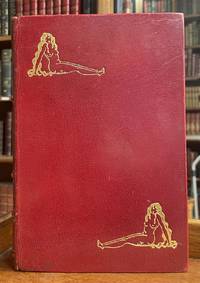
1927réf. 315984New York: Bennett Libraries 1927. hardcover. fine. Clara Tice. 8vo 10 colored etchings by Clara Tice with captioned tissue guards rubricated title page publisher's burgundy morocco by Whitman Bennett and designed by Tice with nudes to spine and front cover in gilt inner dentelles marbled endpapers top edge gilt others untrimmed. New York: The Bennett Libraries 1927. A fine copy. First Tice edition limited issue. Number 155 of 250 copies on Pannekoek paper this copy additionally signed by Tice though uncalled for in the limitation. This copy is unique as it is from the personal library of Clara Tice with her charming bookplate on the fly-leaf. Bennett Libraries unknown books
1928réf. 311598New York: Random House 1928. Limited. hardcover. fine. Kent Rockwell. Extensively illustrated throughout by Rockwell Kent with each drawing hand-colored. 112 pages. Short slim 4to handsomely rebound in 1/2 brown morocco and beige cloth boards. New York: Random House 1928. A fine copy of the special limited printing with color images printed by Elmer Adler's Pynston Printers. From a total of 1470 copies signed by Rockwell Kent this is one of only 95 hand-coloured in the studio of the artist This copy is un-numbered. A splendid production issued to celebrate the inauguration of Bennett Cerf's new company Random House. The logo for Random House used to this day comes from the final illustration in the book -- an idealized country home filled with the ideas of the Enlightenment. Random House unknown books
1738réf. 5783A Amsterdam, chez Etienne Ledet & Compagnie, 1738. In-8 de 1 frontispice gravé, 2 portraits, (6)-XII-(2)-399-(1)-(400 à) 410-(6) pp., veau brun, dos orné à nerfs, pièce de titre en maroquin rouge (reliure de l'époque).
réf. ORD-10949Paris. Lefèvre. Firmin Didot. 1829-1840. 72 tomes en 73 volumes (le tome 1 du siècle de Louis XIV a été relié en 2 volumes à cause du grand nombre de gravures ajoutées) in-8 (158 x 233mm) dos à 5 nerfs joliment ornés et coins chagrin rouge cerise, plats en papier moucheté avec filet or en bordure, gardes peignées, têtes dorées. Collection des Classiques Français sur les faux-titres. Exemplaire enrichi de près de 1500 gravures de provenances diverses du XVIIe au XIX°siècle, soit 1085 portraits et 372 scènes diverses, relatifs à l'oeuvre. Bel ensemble, à grandes marges, bien complet des 2 volumes de tables par Miger, en reliure uniforme du XIXe siècle, pratiquement sans défauts. Gravures notamment de L'Armessin, Moreau le Jeune, Desenne, Eisen, Moncornet, Desrochers, Deveria, Odieuvre, etc.
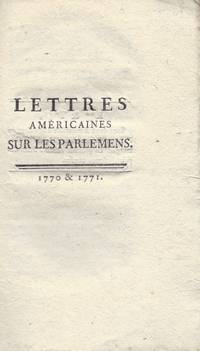
1771réf. 729S.l.: S.n. 1771. First edition. Published unbound. Stitched. First page blank but title in ink. First and last pages slightly chipped and stained. Overall in fine condition. First edition. Published unbound. Stitched. 44 4 p. A fictional correspondence between R and T “deux Américaines originaires du Port-au-Prince dans l'Isle de S. Domingue. Le premier réside a Paris depuis quelques années” two Americans from Port-au-Prince on the island of Saint-Domingue. The first lives in Paris for some years. The letters are dated between December 1770 and April 1771. The text is attributed to Voltaire and it is in favour of Maupeou’s jurisdictional reform. René Nicolas Charles Augustin de Maupeou 1714–1792 as the chief minister of the French King made a revolutionary attempt to install the enlightened despotism in France through the suppression of the power of the parliament by destroying its system and the favour of the royal authority. He also made efforts to uniform the judicial system throughout the country. Voltaire praised this revolution applauding the suppression of the old hereditary magistrature and justified the reform in several essays among them this one. Scarce and interesting publication we could trace only two copies in institutional holdings in the US. Not in Sabin. . [S.n.] unknown
1733réf. 61360London 1733. 8vo. Bound in a lovely contemporary English Cambridge-style full calf binding with a plain spine with five raised bands. Spine a bit cracked vertically and with minor loss to capitals. Corners a bit bumped and adges of boards a bit worn. Binding overall nice and tight. Small damp stain at the lower blank corner of the first few leaves otherwise a very good clean copy on thick crisp paper. 16 -including preface contents advertisements 253 1 18 -Index pp. The important actual first edition of this highly celebrated key work of the Enlightenment in which the anecdote of how Newton discovered gravity the story about Newton and the falling apple appeared for the first time together with the description of the difference between the physical world view of the English and the French the "plenum" and the "vacuum". This seminal work in which Voltaire famously depicts British philosophy science society and culture in comparison to French can be viewed as the Enlightenment equivalent to Tocqueville's "Democracy in America". This series of essays which is based on Voltaire's experiences when living in England was actually written by Voltaire mostly in English which he mastered to perfection. It has often been presumed that the first edition of the work was that published in French in 1734 but actually the present English edition constitutes the actual first appearance of the work as well as the version that is closest to Voltaire's intention as the French language version is the re-written one and the English version the original. Curiously almost all modern English versions are translations into English of the French edition instead of the original English version making this edition of the utmost importance.After the original English edition of 1733 two French editions soon followed the first in 1734. Unlike the British the French resented the book and already in 1734 the French Parliament issued an order for the author's arrest and condemned the work causing the impact of it in France to be delayed. The book was burned for being "dangerous to religion and civil order". At the same time the work became a bestseller in Britain and as much as 14 editions of the work were published in the eighteenth century. "Inspired by Voltaire's two-year stay in England 1726-8 this is one of the key works of the Enlightenment. Exactly contemporary with Gulliver's Travels and The Beggar's Opera Voltaire's controversial pronouncements on politics philosophy religion and literature have placed the Letters among the great Augustan satires. Voltaire wrote most of the book in English in which he was fluent and witty and it fast became a bestseller in Britain. He re-wrote it in French as the Lettres philosophiques and current editions in English translate his French." Nicholas Cronk Introduction to the Oxford's Classics edition from 1999.The great French philosopher Voltaire was greatly impressed by the philosophical and scientific achievements of the English especially those of Newton Locke and Bacon. As a disseminator of scientific knowledge Voltaire came to play a great rôle in the popularization of Newtonian science and its discoveries the present work being a prime example. Although the work was condemned by the French authorities it still came to play a great rôle in the spreading of Newtonian ideas in France. The present work generally came to play a dominant rôle in Enlightenment accounts of the history of science and philosophy. The work focuses on British science and thought and uses the accounts of these to emphasize what is lacking in French society and French thought. The work is generally very critical towards the French "ancient régime" and when Voltaire here discusses the emergence of empiricism it is viewed as an English tradition that stands in opposition to the French rationalist tradition with Descartes as the prime example. This view is taken over by the following Enlightenment historians of science and philosophy e.g. d'Alembert see for instance his "Preliminary Discourse" of 1751. Some of the most influential passages of the work are probably those on Bacon who Voltaire sees as the founder of modern experimental science Newton and Descartes. Letters XIV on Descartes and Newton XV on attraction and XVI on Newton's Optics from 1704 are among the most influential essays of the work. In XVI Voltaire reflects upon Newton's "Optics" and the way that he rejected Descartes' theory and set out his own account of the properties of light. In XV he presents the first account of Newton and the falling apple: "As he was walking one Day in his Garden and saw some Fruits fall from a Tree he fell into profound Meditation on that Gravity the Cause of which had so long been sought but in vain by all the Philosophers whilst the Vulgar think there is nothing mysterious in it. He said to himself that from what height soever in our Hemisphere those Bodies might descend their Fall wou'd certainly be in the Progression discover'd by Galileo; and the Spaces they run thro' would be as the Square of the Times. Why may not this Power which causes heavy Bodies to descend and is the fame without any sensible Diminution at the remotest Distance from the Center of the Earth or on the Summits of the highest Mountains; Why said Sir Isaac may not this Power extend as high as the Moon." pp. 127-28.But perhaps the most famous passage in the volume is the opening of Letter XIV: "A Frenchman who arrives in London will find Philosophy like every Thing else very much chang'd there. He had left the World a "plenum" and he now finds it a "vacuum". At Paris the Universe is seen compos'd of Vortices of subtile Matter; but nothing like it is seen in London. In France 'tis the Pressure of the Moon that causes the Tides; but in England 'tis the Sea that gravitates towards the Moon; so that when you think that the Moon should make it Flood with us those Gentlemen fancy it should be Ebb which very unluckily cannot be prov'd." pp. 109-10. hardcover
1759réf. 695351 vol. in-12 reliure fin XVIIIe, plats recouverts de papier peigné, s.n., s.l. [ Londres ?], 1759 et 1761, 299-132 pp.
1828réf. 96178Paris: Deslangle Frères 1828-34. Finely bound set of the complete works of Voltaire with historic scientific and literary notes. Octavo 97 volumes bound in three quarters morocco over marbled boards gilt titles and tooling to the spine in five compartments within raised gilt bands marbled endpapers frontispieces with tissues guards and half titles as issued. In very good condition. A complete set covering the broad scope of the versatile and prolific writer. One of the most influential thinkers of the French Enlightenment François-Marie Arouet know by the nom de plum Voltaire was a resourceful and prolific writer. His works touched nearly every literary form including plays poems novels theoretical essays and scientific treatises. A forthright and candid advocate of civil liberties he frequently criticized the institutions of religious dogma and classism prevalent in 18th century France often doing so through satire to avoid censorship and imprisonment. Deslangle Frères hardcover
1789réf. 43823Reliure d'époque plein maroquin rouge. Dos orné de doubles nerfs dorés et mosaïqués de maroquin vert, caissons d'entrenerfs dorés de caissons dorés aux filets courbes. Plats composés de trois encadrements mosaïqués de maroquin vert et havane lobé dans les angles et les milieux, ornés aux petits fers. Quintuple encadrement mosaïqué de maroquin rouge, vert et havane doré. Doublure et gardes de soie bleue ornée de roulettes dorées. Toutes tranches dorées. Grandes marges. Reliure signée BRADEL Le Jeune (avec son étiquette à l'adresse de laRue d'Ecosse, N°. 1 quartier Ste. Geneviève A Paris). Habiles restaurations sur les coiffes et les coins.
1770réf. 81957Chez La veuve Duchesne Saillant Desaint | à Paris 1770 | 11.80 x 18.50 cm | 2 volumes reliés
1789réf. 129448à Paris, chez Deterville, Libraire 1789 72 volumes. In-8 22 x 13,5 cm. Reliures de l’époque veau fauve marbré, dos lisses ornés de petits fers encadrés de roulettes dorées, pièces de titre et de tomaison maroquin grenat et vert, plats encadrés de roulette dorée, environ 450 pp. par volume, illustrations de Moreau le Jeune, comprenant 93 figures hors texte interprétées par Baquoy, Delaunay, Guttenberg, Lemire, Masquelier, Tardieu et d'autres graveurs d'après Moreau, 17 portraits hors texte, dont celui de Voltaire d'après Largillière sert de frontispice au premier volume. On a en outre ajouté au vol. I, le titre gravé des Estampes destinées à orner les éditions de M. de Voltaire réalisé pour le compte de Moreau et 1 tableau replié des œuvres de Voltaire contenues dans cette édition. Bon ensemble, bien complet des deux volumes de table, établis par Chantreau et publiés en 1801.
1784réf. 39990Kehl, De l'Imprimerie de la Société littéraire-typographique, 1784-1789. 70 volumes in-8, demi-veau vert, dos lisses très ornés de fleurons, palmes et palettes, pièces de titre et de tomaison en maroquin rouge (reliure de l'époque).
1795réf. 31846Paris Didot Jeune 1795 2 volumes in-4, maroquin rouge, encadrement de trois filets dors sur les plats, dos nerfs orns petits fers pousss or, roulette dore sur les coupes; encadrements intrieurs orns d'une roulette or, doublures et gardes de soie moire bleue, tranches dores (Canape).Edition orne d'un portrait de Jeanne d'Arc dessin par Gaucher et de 21 figures dessines par Lebarbier, Marillier, Monnet, Monsiau, le tout grav par Baquoy, Choffard, Delignon, Delvaux, Duhamel, Duprel, Lemire, Linge, Malbeste, Patas, Pauquet, Ponce et Romanet. Exemplaire enrichi de 48 eaux-fortes: les 21 des figures en deux tats (eaux-fortes pures et tat avant la lettre) de La Pucelle excutes par Moreau pour les oeuvres de Voltaire (Paris, 1819-1825), un portrait-frontispice de Voltaire dessin et grav par Walker, un portrait de Charles VII grav par Prvost d'aprs Cochin, 3 portraits en couleurs (Charles VII, Jean d'Orlans, Jeanne d'Arc) dessins et gravs par Sergent et un portrait de Jeanne d'Arc dessin et grav par Delvaux. Les eaux-fortes pures de Moreau sont toute marge, les preuves avant la lettre ont t remontes. Exemplaire portant sur la page de titre une note la plume autographe signe trs estompe: Reu en prsent de mon ami Hermann d'Uslar, docteur en mdecine, avant son dpart pour le Mexique en 1854. Hellissar. De la bibliothque Robert de Billy (ex-libris).