8 438 résultats
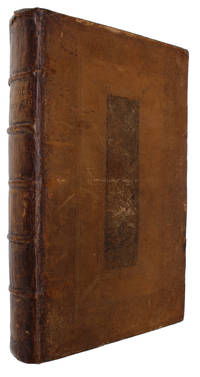
1767réf. 140947325London: Printed for J. Almon 1767. First Edition. Near Fine. First English-language edition of Cesare Bonesana di Beccaria's treatise on criminal justice reform with an added commentary by Voltaire. xii 179 lxxix pp. Bound in full contemporary mottled calf laced in boards. Morocco title label gilt tooling to spine and board edges all edges speckled red. Near Fine with light wear to covers boards slightly splayed joints worn but sound. Light toning and scattered foxing throughout more pronounced in first and last few pages. Discoloration from binder's glue to endpapers author's name penciled to front pastedown math equation penciled to back pastedown. A beautiful copy of the influential Enlightenment classic from the collection of scholar and bibliophile Arnold Meadowcroft Muirhead with his bookplate on the front pastedown. Rare. Printed for J. Almon unknown
1767réf. 140947325London: Printed for J. Almon 1767. First Edition. Near Fine. First English-language edition of Cesare Bonesana di Beccaria's treatise on criminal justice reform with an added commentary by Voltaire. xii 179 lxxix pp. Bound in full contemporary mottled calf laced in boards. Morocco title label gilt tooling to spine and board edges all edges speckled red. Near Fine with light wear to covers boards slightly splayed joints worn but sound. Light toning and scattered foxing throughout more pronounced in first and last few pages. Discoloration from binder's glue to endpapers author's name penciled to front pastedown math equation penciled to back pastedown. A beautiful copy of the influential Enlightenment classic from the collection of scholar and bibliophile Arnold Meadowcroft Muirhead with his bookplate on the front pastedown. Rare. Printed for J. Almon unknown books
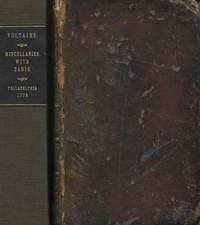
1778réf. 44246Philadelphia: Printed by Robert Bell 1778. 1778. First U. S. edition. Translated from the French with notes historical and critical by T. Smollett M. D. and T. Francklin A. M. Story contained in MISCELLANIES by Voltaire. The first book on the Haycraft-Queen Cornerstone list and excessively rare—the only copy we have ever seen and it does not seem that any copies have sold at auction for more than twenty five years. Considered to be the "Great Grandfather of the Detective Story." Foxing and staining throughout. A good copy only of this seminal work bound in a full-leather contemporary binding. Housed in a cloth clamshell case with leather label on the spine and titles stamped in gold gilt. Printed by Robert Bell, 1778. hardcover
1733réf. 60085London C. Davis and A. Lyon 1733. 8vo. Lovely contemporary full Cambridge-style binding with five raised bands to spine and blindstamped ornamental borders to boards. . Double gilt line-borders to boards. All edges of boards with gilt borders. Gilt title to spine. Hinges neatly and professionally re-inforced. Internally very nice clean and fresh. A lovely crisp and large copy with good margins printed on heavy fine paper. 16 -including preface contents advertisements 253 1 18 -Index pp. The important actual first edition of this highly celebrated key work of the Enlightenment in which the anecdote of how Newton discovered gravity the story about Newton and the falling apple appeared for the first time together with the description of the difference between the physical world view of the English and the French the "plenum" and the "vacuum". This seminal work in which Voltaire famously depicts British philosophy science society and culture in comparison to French can be viewed as the Enlightenment equivalent to Tocqueville's "Democracy in America". This series of essays which is based on Voltaire's experiences when living in England was actually written by Voltaire mostly in English which he mastered to perfection. It has often been presumed that the first edition of the work was that published in French in 1734 but actually the present English edition constitutes the actual first appearance of the work as well as the version that is closest to Voltaire's intention as the French language version is the re-written one and the English version the original. Curiously almost all modern English versions are translations into English of the French edition instead of the original English version making this edition of the utmost importance.After the original English edition of 1733 two French editions soon followed the first in 1734. Unlike the British the French resented the book and already in 1734 the French Parliament issued an order for the author's arrest and condemned the work causing the impact of it in France to be delayed. The book was burned for being "dangerous to religion and civil order". At the same time the work became a bestseller in Britain and as much as 14 editions of the work were published in the eighteenth century. "Inspired by Voltaire's two-year stay in England 1726-8 this is one of the key works of the Enlightenment. Exactly contemporary with Gulliver's Travels and The Beggar's Opera Voltaire's controversial pronouncements on politics philosophy religion and literature have placed the Letters among the great Augustan satires. Voltaire wrote most of the book in English in which he was fluent and witty and it fast became a bestseller in Britain. He re-wrote it in French as the Lettres philosophiques and current editions in English translate his French." Nicholas Cronk Introduction to the Oxford's Classics edition from 1999.The great French philosopher Voltaire was greatly impressed by the philosophical and scientific achievements of the English especially those of Newton Locke and Bacon. As a disseminator of scientific knowledge Voltaire came to play a great rôle in the popularization of Newtonian science and its discoveries the present work being a prime example. Although the work was condemned by the French authorities it still came to play a great rôle in the spreading of Newtonian ideas in France. The present work generally came to play a dominant rôle in Enlightenment accounts of the history of science and philosophy. The work focuses on British science and thought and uses the accounts of these to emphasize what is lacking in French society and French thought. The work is generally very critical towards the French "ancient régime" and when Voltaire here discusses the emergence of empiricism it is viewed as an English tradition that stands in opposition to the French rationalist tradition with Descartes as the prime example. This view is taken over by the following Enlightenment historians of science and philosophy e.g. d'Alembert see for instance his "Preliminary Discourse" of 1751. Some of the most influential passages of the work are probably those on Bacon who Voltaire sees as the founder of modern experimental science Newton and Descartes. Letters XIV on Descartes and Newton XV on attraction and XVI on Newton's Optics from 1704 are among the most influential essays of the work. In XVI Voltaire reflects upon Newton's "Optics" and the way that he rejected Descartes' theory and set out his own account of the properties of light. In XV he presents the first account of Newton and the falling apple: "As he was walking one Day in his Garden and saw some Fruits fall from a Tree he fell into profound Meditation on that Gravity the Cause of which had so long been sought but in vain by all the Philosophers whilst the Vulgar think there is nothing mysterious in it. He said to himself that from what height soever in our Hemisphere those Bodies might descend their Fall wou'd certainly be in the Progression discover'd by Galileo; and the Spaces they run thro' would be as the Square of the Times. Why may not this Power which causes heavy Bodies to descend and is the fame without any sensible Diminution at the remotest Distance from the Center of the Earth or on the Summits of the highest Mountains; Why said Sir Isaac may not this Power extend as high as the Moon." pp. 127-28.But perhaps the most famous passage in the volume is the opening of Letter XIV: "A Frenchman who arrives in London will find Philosophy like every Thing else very much chang'd there. He had left the World a "plenum" and he now finds it a "vacuum". At Paris the Universe is seen compos'd of Vortices of subtile Matter; but nothing like it is seen in London. In France 'tis the Pressure of the Moon that causes the Tides; but in England 'tis the Sea that gravitates towards the Moon; so that when you think that the Moon should make it Flood with us those Gentlemen fancy it should be Ebb which very unluckily cannot be prov'd." pp. 109-10. hardcover
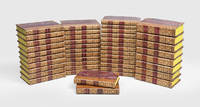
1761réf. 186427London: Printed for J. Newbery R. Baldwin W. Johnston; Printed for S. Crowder T. Longman J. Wilkie; Printed for G. Kearsley; Printed for J. and H. L. Hunt 1761-1824. His oeuvre in English for the first time First collected edition of Voltaire's works in English. This first collection did not include two works but this handsome set makes up the omission. It includes uniformly bound copies of the first English translation of The Age of Louis XV and the second English edition of Voltaire's Philosophical Dictionary. In the early 1750s editions and translations of Voltaire's works multiplied rapidly. Following his earlier surge of fame in the late 1730s driven largely by his plays and his Life of Charles XII publishers eventually produced a full English edition of his writings. This thirty six volume collection was issued between 1762 and 1765 under the direction of Tobias Smollett. Lowndes however notes that Smollett lent his name to the project but took little active part in its translation. A final volume appeared in 1770 although in this set it is represented by a later edition dated 1781. 44 vols duodecimo 170 x 109 mm. Engraved frontispieces with tissue guards to 32 vols. 2 folding plates to vol. 26 folding map to vol. 29. Late 19th-century mottled half calf twin red morocco labels compartments elaborately tooled in gilt marbled sides edges yellow. Bookplates of Sir Walter Runciman 1847-1937 occasional minor contemporary inscriptions. Bindings bright sporadic foxing pale damp-staining to a couple of volumes a few chips and short closed tears to fore edges. A very good set. Lowndes 2791. unknown
réf. LCS-18383Luxueux exemplaire, l’un des 20 imprimés sur papier de Chine contenant la suite des eaux-fortes en double état. Paris, Librairie des Bibliophiles, rue Saint-Honoré, 1878. 7 tomes en 5 volumes grand in-8 ornés d’un portrait et de 11 eaux-fortes, l’ensemble en double-état, avant et avec la lettre. Maroquin rouge, triple filet encadrant les plats, dos à nerfs, double filet sur les coupes, tranches dorés. Reliure signée Chambolle-Duru. 214 x 130 mm.
1780réf. 59752Reliure plein maroquin bleu roi de la fin du XIXe siècle. Dos à nerfs ornés. Filets et roulette dent de rat en encadrement sur les plats. Doublures de maroquin citron à large dentelle dorée, gardes de soie bleue, doubles gardes. Toutes tranches dorées. Reliure signée Chambolle-Duru. Petite tache foncée sur le premier plat du tome 2.Elle est précédée de la Préface de Dom Apuleius Risorius, bénédictin. Le frontispice par Duplessis-Bertaux montre Jeanne d'Arc dans une auberge en butte aux hardiesses des buveurs sous les regards de Jean Chandos, du moine Grisbourdon et de Saint Denis.
1751réf. 65145Chez C. F. Henning | à Berlin 1751 | 8.50 x 14.50 cm | 2 volumes reliés
1948réf. 50181Paris Scripta et Picta 1948 In-4, en feuilles, couverture imprime.Ce livre illustr par Van Dongen comporte 48 lithographies originales en couleurs, dont un frontispice, 47 in-texte, une vignette de titre et de nombreuses lettrines. Tirage limit 198 exemplaires numrots sur vlin de Lana. Un des quelques exemplaires nominatifs de collaborateur (celui-ci imprim au nom du docteur Roudinesco), enrichi dune trs rare suite en noir des lithographies tires sur papier de Chine.
1785réf. 618023 vol. in-8 reliure plein maroquin rouge, dos à 5 nerfs dorés richement ornés, plats richements orné, double filet doré en coupes, chasses ornées, gardes doublées de maroquin bleu orné d'une belle guirlande dorée d'encadrement ornementée, toutes tranches dorées, reliure signée de Chambolle-Duru, De l'Imprimerie de la Société Littéraire Typographique, [Kehl ], 1785, 2 ff., 439 pp. et 11 figures ; 2 ff., 470 pp. et 3 figures ; 2 ff. 416 pp. et 4 figures
réf. LCS-18572Précieux exemplaire à marges immenses (hauteur 175 mm) des bibliothèques Lurde et Ruble. Louvain (Francfort?), 1755. Petit in-8 de (2) ff., 161 pp. Plein maroquin citron, chiffre doré dans les angles des plats, dos à nerfs orné du même chiffre doré et répété, double filet or sur les coupes, roulette dorée intérieure, tranches dorées. Motte. 175 x 105 mm.
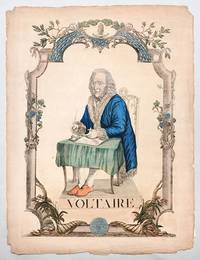
1790réf. 138601Paris: Basset c. 1790s. Voltaire as revolutionary icon A full-length portrait of the philosopher towards the end of his life in a fetching electric blue coat. The print is by the Parisian firm of Basset which was a leading source of popular prints during the Revolution. Voltaire was claimed as a foundational influence by many revolutionary leaders and in 1791 they arranged for his remains to be transferred to the Panthéon in Paris. Hand-coloured copperplate engraving. Image size: 70 x 52 cm. Framed size: 85 x 66.5 cm. Presented in a handmade gilt frame with conservation acrylic glazing. Light toning and chipping to extremities not touching impression several small tape repairs to extremities on verso not visible on recto: in very good condition. unknown
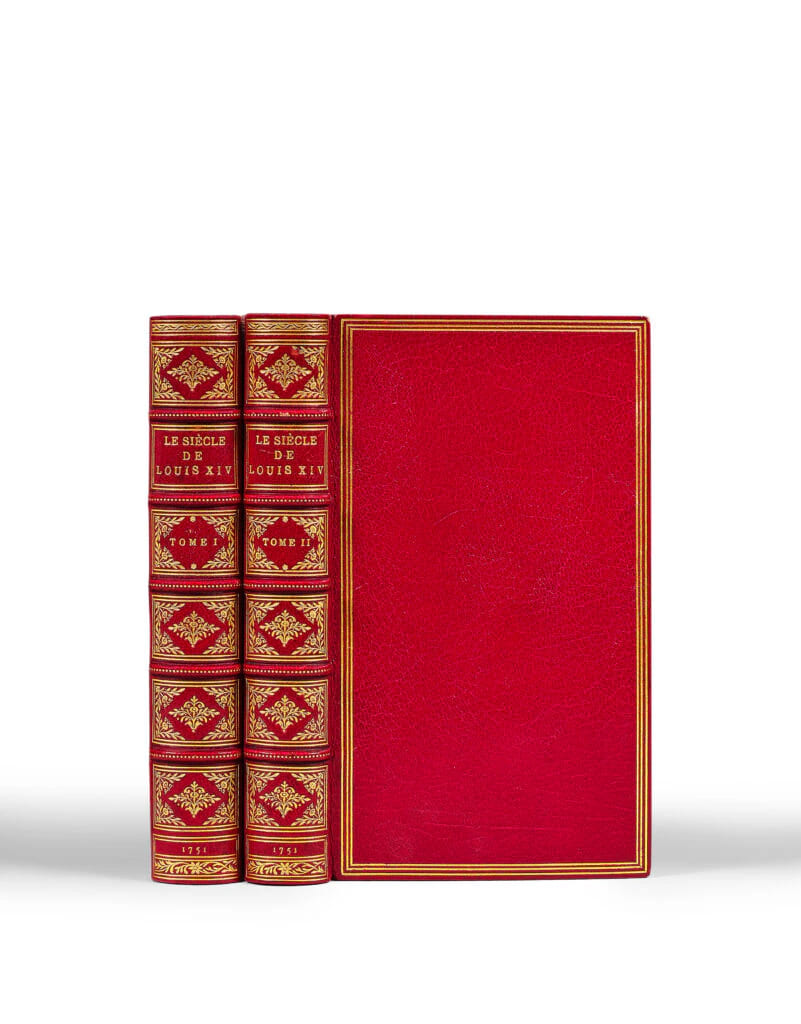
1751réf. 65145à Berlin: Chez C. F. Henning 1751. Fine. Chez C. F. Henning à Berlin 1751 8.50 x 14.50 cm 2 volumes reliés First edition displaying all the distinctive features of its publication: it presents no capital letters except at the beginning of paragraphs and it is the very first work to have been printed with Voltaire's spelling. Our copy is complete with its errata leaf which is often missing. Later bindings 19th century in full red morocco Jansenist spines with five raised bands dates and places gilt at foot boards struck at center with large gilt typographical fleurons double gilt fillets on leading edges and headcaps pastedowns lined with blue morocco presenting a wide gilt decorative border monogrammed bookplates mounted on the pastedowns of each volume following endpapers of combed paper all edges gilt bindings signed Chambolle-Duru. Superb copy perfectly established in a binding signed by a master of French bookbinding. Chez C. F. Henning hardcover
1759réf. CLL-742Londres, Jean Nourse, 1759 In-12 de 299 pp., maroquin vert, triple filet doré en encadrement, dos à nerfs orné de caissons de fleurons dorés, double filet doré sur les coupes, dentelle intérieure dorée, tranches dorées sur marbrure (Thibaron).
réf. LCS-11978Edition de luxe et première édition illustrée de La Henriade. L’un des rares exemplaires imprimés sur papier fort de Hollande, à très grandes marges. A Londres, 1728. In-4 de (3) ff., 202 pp. et 12 planches. Collation conforme à l’exemplaire conservé à la B.n.F. Relié en plein maroquin bleu, triple filet doré autour des plats, dos à nerfs richement orné, double filet sur les coupes, roulette intérieure dorée, tranches dorées sur marbrures. Reliure du XIXe siècle signée Chambolle-Duru. 300 x 235 mm.
réf. LCS-A23Précieux exemplaire relié en maroquin rouge de l’époque aux armes de François VIII de La Rochefoucauld (1663-1728), Chevalier des Ordres du roi. Paris, Pierre Ribou; au Palais, Pierre Huet, Jean Mazuel et Antoine-Urbain Coustelier, 1719. In-8 de (4) ff. et 131 pp. Plein maroquin rouge, triple filet doré autour des plats, armoiries au centre, dos à nerfs finement orné, coupes décorées, roulette intérieure, tranches dorées sur marbrures. Reliure en maroquin armorié de l’époque. 183 x 108 mm.
réf. 8753Hambourg, 1753, un volume in 8 relié en plein veau marbré, dos orné de fers dorés, tranches rouges (reliure de l'époque), (un coin légèrement émoussé), 1 feuillet non chiffré blanc, 1 feuillet non chiffré (titre : MAUPERTUISIANA - verso blanc), 2 feuillets non chiffrés (avertissement - Pièces conenues dans ce recueil, pp. 7 à 48pp., 26pp., 192pp., (1), 65pp., 56pp., 40pp., (1), 41pp., 74pp., 32pp., 16pp., 8pp., 8pp., 8pp., (4), 88pp., 16pp., 19pp.. – Soit 16 parties reliées en un volume
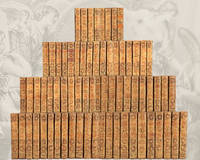
1784réf. 88246Imprimerie de la Société Littéraire-Typographique | s. l. [Kehl] 1784-1789 | 14 x 21.7 cm | 70 vol. reliés
1785réf. 88781785 [Kehl], de limprimerie de la Société Typographique, 1785 1789. 70 volumes grand in-8° (175 x 270 mm). Exemplaire dexception sur très grand papier vélin de la fameuse édition de Voltaire financée par Beaumarchais, comportant dune part lillustration destinée aux tirages de luxe de cette édition (soit 93 planches de Jean-Michel Moreau le jeune, 12 portraits, 14 planches de physique, 1 plan, 1tableau des oeuvres de Voltaire), plus un large supplément dillustrations destinées à lédition Renouard des Oeuvres de Voltaire en 66 volumes in-8° publiée entre 1819 et 1825. Louvrage contient ainsi un total de 196 planches hors texte, soit : 113 figures de Moreau le jeune (44 pour le Théâtre, volumes 1 9; 10 pour la Henriade, volume 10; 21 pour la Pucelle dOrléans, volume 11; 6 pour les Contes en vers, volume 14; 2 pour le Siècle de Louis XIV, volumes 20 et 21; 1 pour le Siècle de Louis XV, volume 22; 1 pour lHistoire de Charles XII, volume 23; 1 pour lHistoire de Russie, volume 24; 27 pour les Romans et Contes, volumes 44 et 45); 67 portraits (33 gravés par Augustin de Saint-Aubin et 34 de graveurs divers dont Renouard possédait les cuivres); 14 planches de physique (volume 31) ; 1 plan («Camp des Tartares», volume 24 ); 1 tableau dépliant des oeuvres de Voltaire, volume 70). Impressionnantes reliures en demi-basane maroquinée bordeaux à coins, plats de papier rouge, dos lisse ornés, tranches ébarbées. Datant des environs de 1825 1830, elles sont signées (au dos du volume I): «Rel[ié] p[ar] les Dl[l]es Cotty». On ignore tout de ces personnes, dont on peut seulement supposer quelles étaient apparentées à Jean-Etienne Cotty, relieur actif à Paris de 1776 à 1820, que «Lesné [...] place parmi les bons relieurs de second ordre de son temps» (Thoinan, Les Relieurs français, page 234). Bas de la charnière inférieure du volume 11 fendu sur la moitié de sa longueur, quelques coiffes frottées, coins çà et là un peu émoussés, mais dans lensemble la collection est dans un état absolument désirable. Etiquettes collées aux premiers contreplats: «Louvard, libraire, rue du Bac, no 78»; ex-libris illustré: «André Gutzwiller» (1922 2014), banquier et bibliophile bâlois.
1784réf. 88246s. l. Kehl: Imprimerie de la Société Littéraire-Typographique 1784. Fine. « Divine Voltaire ora pro nobis ! » Exceptional copy on large paper and contemporary binding Imprimerie de la Société Littéraire-Typographique s. l. Kehl 1784-1789 14 x 21.7 cm 70 vol. reliés The Kehl edition the most renowned edition of Voltaire's works illustrated and published on deluxe paper. It was printed on five different types of paper and only the deluxe editions such as ours on laid paper feature engravings. These are naturally the most sought-after and rarest copies. Binding in full painted sheep decorated with a honeycomb motif smooth spine tooled with gilt fleurons fillets and compartments light beige calf lettering and volume pieces gilt chain-roll border on covers marbled endpapers gilt roll on edges all edges marbled contemporary binding. Two volumes nos. 50 and 70 with slight variations in gilt tools on the spines and with orange morocco lettering pieces edges and covers treated somewhat differently. General condition of the 70 volumes: bindings with light rubbing to corners gilt a little dulled occasional foxing a few wormholes and old restorations not affecting the text. 28 volumes vols. 4 5 8 10 11 13 16 17 19 20 24 27 28 33 34 35 36 37 43 48 61 62 63 65 66 67 68 70 with cracked joints at the ends and 20 volumes vols. 8 11 12 14 16 18 33 34 37 42 46 49 53 56 57 60 65 66 68 70 with damaged caps. Two editions were published at the same time. Our copy belongs to the prestigious in-8 edition on large paper published in 70 volumes the other edition being in-12 format in 92 volumes. It is richly illustrated with 125 etched plates: - There are 17 portraits including 3 of Voltaire: a frontispiece portrait by N. de Largillière engraved by P. Alex. Tardieu; one drawn from Houdon's bust by Moreau le Jeune and engraved by P. Alex. Tardieu; and one allegorical portrait by Louis Croutelle after Moreau le Jeune belonging to the second series of illustrations of Voltaire's works executed by Moreau for the publisher Renouard. The 14 other portraits include an allegorical frontispiece of Frédéric-Guillaume Prince of Prussia depicted in profile in a medallion by Dambrun after Moreau le Jeune; a portrait of Henry IV by Pourbus engraved by Tardieu; one of Charles VII engraved after the original in the King's Cabinet by Mavieri; another of Agnès Sorel drawn by Moreau the Younger after the original in the King's Cabinet and engraved by Mavieri; one of Joan of Arc engraved by Beisson; followed by the Count of Dunois engraved after the original in the King's Cabinet by J. B. Fosseyeux; one of Louis XIV drawn by Moreau Le Jeune after C. Le Brun engraved by J. B. Fosseyeux; one of Charles XII engraved by P. Alex. Tardieu after the original in the King's Cabinet; one of Pierre I engraved by P. G. Langlois after a painting by L. Caravaque; one of Madame du Châtelet after Marie Anne Loir and engraved by P. G. Langlois; one of the Count of Argental after J. Defraine and engraved by J. B. Fosseyeux; one of Frédéric II of Prussia painted from life by Van Loo and engraved by P. G. Langlois; one of Catherine II of Russia engraved by J. B. Fosseyeux; and one of d'Alembert after De La Tour engraved by N. F. Maviez. - 93 engravings by Moreau le Jeune including 44 figures for le Théâtre engraved by Lingée Simonet de Launay Trière Halbou Duclos Romanet Dambrun de Longueil Delignon Le Mire Le Veau 10 for la Henriade engraved by Masquelier Delignon Dambrun Patas Gutemberg Helman Simonet Duclos Romanet 21 for la Pucelle engraved by Simonet Dambrun Halbou Baquoy Trière Delignon de Longueil Croutelle and Duclos 4 for the Contes in verse engraved by Langlois Duclos Delignon and Le Veau and 14 for the Romans engraved by Trière Duclos de Longueil Dambrun Baquoy Delignon Simonet Langlois and Halbou. - 14 scientific plates in volume 31 illustrating the experiments of Newton Descartes and Leibniz. - 1 battle Imprimerie de la Société Littéraire-Typographique unknown
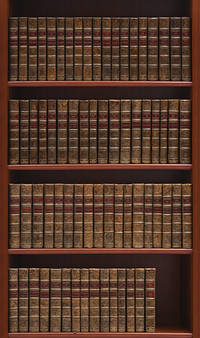
1785réf. ABC_50750Kehl: Société Littéraire Typographique 1785. Contemporary uniform marbled calf with gold-tooled ornamental borders on boards gold-tooled spines with green morocco volume numbers and two red morroco title labels. Edges gilt. 12mo. With an engraved frontispiece and a portrait of the author in volume 1. Further with 18 portraits including 4 repeats on different paper 106 plates including 17 repeats on different paper 14 folding mathematical plates in volume 31 on Newtons physics 1 engraved map and 10 woodcuts in the text. 92 volumes. Attractive set of the first issue of the famous Kehl edition of the complete works by Voltaire pseudonym of François Marie Arouet 1694-1778 and with introductions and notes by Nicolas Marquis de Condorcet 1743-1794. The name of this "Kehl edition" derives from the small German town in which it was printed to avoid French censorship. Following the death of Voltaire the Société Littéraire Typographique was founded there and dedicated themselves to the Herculean task of disseminating Voltaires work through a definitive and typographically magnificent edition. This group of Enlightenment intellectuals was led by Pierre-Augustin Caron de Beaumarchais 1732-1799 who financed the operation as well as the Marquis de Condorcet who acted as the chief editor. De Beaumarchais is perhaps best known for his very successful Figaro plays Le Barbier de Séville Le Mariage de Figaro and La Mère coupable. Two of these plays made incredibly successful transitions to opera: The Barber of Seville was adapted by Paisiello and The Marriage of Figaro was adapted by Mozart and Da Ponte. A complete list of contents available upon request.With the bookplate of George Powney Esq. pasted on the front pastedown and a later annotation in pencil on p. 130 of volume 14. Some loose volume and title labels.Corners of the bindings occassionally showing and worn. Some volumes have loose hinges.The majority of the volumes show the following: slight marginal water staining to the first and last few leaves and occasional slight staining foxing and browning. In volume 12 the head margin of pp. 201-218 is somewhat damaged pp. 251-54 in volume 31 show a tear along the fore edge a large tear in p. 223 of volume 39. Otherwise in good condition.l Bengesco G. Voltaire. Bibliographie de ses oeuvres 1882-1885; Bibliotheque Nationale Voltaire 1979; Muir P.H. The Kehl Edition of Voltaire 1948. Société Littéraire Typographique, hardcover
réf. LCS-A47Des bibliothèques Genard et Léon Rattier, avec ex-libris. Berlin, C.F. Henning, 1751. 2 tomes en 2 volumes in-12 de: I/ (7) ff., 488 pp., (1) f. d’errata,pte. déch. restaurée ss. manque p. 191; II/ (2) ff., 466 pp., (1) f. d’errata. Maroquin rouge, triple filet doré encadrant les plats, dos à nerfs ornés de filets et fleurons dorés, double filet or sur les coupes, roulette intérieure dorée, tranches dorées sur marbrures. Reliure signée de Chambolle-Duru. 143 x 85 mm.
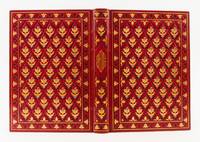
1893réf. ST17884Paris: Imprimé pour Les Amis de Livres par Chamerot et Renouard 1893. No. 55 OF 115 COPIES printed for M. Van der Vrecken de Bormans. 275 x 190 mm. 10 3/4 x 7 1/2". 4 p.l. 159 3. DAZZLING CONTEMPORARY SCARLET MOROCCO VERY ORNATELY DECORATED IN GILT SILVER AND BLACK AS WELL AS INLAID BY MARIUS MICHEL stamp-signed on front doublure covers elaborately embellished with a floral frame enclosing a large central panel filled with diapered compartments formed by gently curving black leaves each compartment containing a floral sprig tooled in silver and gold flat spine with similarly decorated ogival compartments and gilt titling OLIVE BROWN MOROCCO DOUBLURES filled with rows of inlaid red carnations with dark green pedicels leather hinges jacquard silk endleaves in pink blue and green pattern marbled flyleaves all edges gilt. Original white textured paper wrappers bound in. In a slightly worn brown morocco-trimmed marbled paper slipcase. With eight pleasing color engravings by Rops 4 Robaudi 2 and Garnier 2 depicting scenes from the story accompanied by 29 proofs in red yellow cyan and black & white as called for in the colophon. A Large Paper Copy. Front flyleaf with INK INSCRIPTION SIGNED BY MARIUS MICHEL and dated Mai 1920 noting that he had bound this copy for M. Van der Vrecken de Bormans in 1896 for a very substantial price of 600 francs. Carteret IV 407; Vicaire I 47. Three blank front flyleaves with narrow faint brown horizontal blemish across most of the page apparently a tape shadow; in all other ways A BEAUTIFUL COPY clean fresh and bright internally IN A PRISTINE BINDING. This ravishing object is a bibliophile's treasure: an illustrated luxury edition in Large Paper format of Voltaire's philosophical novel offered in a binding from a pre-eminent Parisian atelier. The impressive binding stands out not only because of its remarkable condition but also because of the variety and unerring execution of its decorative elements--from the vigorous use of black gold and silver on the cover and spine to the particularly animated inlaid morocco doublures. Considered the best binder of his generation as well as the founder of modern French bookbinding Henri Marius Michel 1846-1925 began his career in the workshop established by his father Jean in Paris in 1849 where they produced distinguished bindings in the prevailing historical styles for two decades. After the father's death in 1890 the firm came to even greater prominence when Henri began producing bindings in a completely new and original style that did nothing less than change the course of modern bookbinding in France. According to Duncan & De Bartha Henri believed passionately "that bookbinding needed a new vocabulary of ornamentation in order to express the mood and spirit of contemporary authors." The "vocabulary of ornamentation" he developed was based on nature the revolutionary "La Flore Ornamentale" style that he unveiled at the 1878 International Exposition. His favored floral forms dominate the present binding both as inlays and as silver and gold tooling. Our binding was commissioned by Paul Van der Vrecken Baron de Bormans an attaché at the Belgian Embassy in Paris and a bibliophile who belonged to "La société du livre contemporain" as well as the "Cercle Parisien du livre." The 600 francs the binding cost would have bought a very great deal in France at the end of the 19th century. Another copy of this work with the same special features and also bound in inlaid morocco by Marius Michel sold at Sotheby's in 1995 for the hammer price equivalent of $31200. Imprimé pour Les Amis de Livres par Chamerot et Renouard unknown
1893réf. ST17884Paris: Imprimé pour Les Amis de Livres par Chamerot et Renouard 1893. No. 55 OF 115 COPIES printed for M. Van der Vrecken de Bormans. 275 x 190 mm. 10 3/4 x 7 1/2". 4 p.l. 159 3. DAZZLING CONTEMPORARY SCARLET MOROCCO VERY ORNATELY DECORATED IN GILT SILVER AND BLACK AS WELL AS INLAID BY MARIUS MICHEL stamp-signed on front doublure covers elaborately embellished with a floral frame enclosing a large central panel filled with diapered compartments formed by gently curving black leaves each compartment containing a floral sprig tooled in silver and gold flat spine with similarly decorated ogival compartments and gilt titling OLIVE BROWN MOROCCO DOUBLURES filled with rows of inlaid red carnations with dark green pedicels leather hinges jacquard silk endleaves in pink blue and green pattern marbled flyleaves all edges gilt. Original white textured paper wrappers bound in. In a slightly worn brown morocco-trimmed marbled paper slipcase. With eight pleasing color engravings by Rops 4 Robaudi 2 and Garnier 2 depicting scenes from the story accompanied by 29 proofs in red yellow cyan and black & white as called for in the colophon. A Large Paper Copy. Front flyleaf with INK INSCRIPTION SIGNED BY MARIUS MICHEL and dated Mai 1920 noting that he had bound this copy for M. Van der Vrecken de Bormans in 1896 for a very substantial price of 600 francs. Carteret IV 407; Vicaire I 47. Three blank front flyleaves with narrow faint brown horizontal blemish across most of the page apparently a tape shadow; in all other ways A BEAUTIFUL COPY clean fresh and bright internally IN A PRISTINE BINDING. This ravishing object is a bibliophile's treasure: an illustrated luxury edition in Large Paper format of Voltaire's philosophical novel offered in a binding from a pre-eminent Parisian atelier. The impressive binding stands out not only because of its remarkable condition but also because of the variety and unerring execution of its decorative elements--from the vigorous use of black gold and silver on the cover and spine to the particularly animated inlaid morocco doublures. Considered the best binder of his generation as well as the founder of modern French bookbinding Henri Marius Michel 1846-1925 began his career in the workshop established by his father Jean in Paris in 1849 where they produced distinguished bindings in the prevailing historical styles for two decades. After the father's death in 1890 the firm came to even greater prominence when Henri began producing bindings in a completely new and original style that did nothing less than change the course of modern bookbinding in France. According to Duncan & De Bartha Henri believed passionately "that bookbinding needed a new vocabulary of ornamentation in order to express the mood and spirit of contemporary authors." The "vocabulary of ornamentation" he developed was based on nature the revolutionary "La Flore Ornamentale" style that he unveiled at the 1878 International Exposition. His favored floral forms dominate the present binding both as inlays and as silver and gold tooling. Our binding was commissioned by Paul Van der Vrecken Baron de Bormans an attaché at the Belgian Embassy in Paris and a bibliophile who belonged to "La société du livre contemporain" as well as the "Cercle Parisien du livre." The 600 francs the binding cost would have bought a very great deal in France at the end of the 19th century. Another copy of this work with the same special features and also bound in inlaid morocco by Marius Michel sold at Sotheby's in 1995 for the hammer price equivalent of $31200. Imprimé pour Les Amis de Livres par Chamerot et Renouard unknown books
1784réf. 191724Kehl: De L'imprimerie de la Société Littéraire-Typographique 1784-89. Canonizing Voltaire an enterprise on the eve of Revolution The first complete collection known as the "Kehl" edition for the small German town in which it was printed to avoid French censorship. After his death the Société Littéraire Typographique was founded there dedicated to the monumental effort of disseminating Voltaire's work through a definitive and typographically magnificent edition. The group of Enlightenment intellectuals ready to champion the author were led by Pierre-Augustin Caron de Beaumarchais who financed the operation and the Marquis de Condorcet who acted as chief editor. For the first time Voltaire's correspondence was published and commentary and a biography by Cordorcet was added. For the type Beaumarchais bought John Baskerville's apparatus from his widow. This coupled with the unprecedented price he paid for the rights the paper mills he purchased and the cost of setting up in Kehl bankrupted Beaumarchais. Nevertheless he concluded "Europe will be satisfied". Octavo 70 vols 213 x 134 mm. Portrait frontispiece engraved plates. Contemporary mottled calf signed by François Gaudreau at foot of spines red morocco labels double gilt fillet to compartments and boards marbled endpapers varicolour bookmarkers. Superficial splits and worming to joints still very firm occasional wear contents largely clean. A very good set. hardcover