RENAN (Ernest)Livre Rare Book

34 087 résultats
1892réf. 002820Paris, Calmann Lévy, 1892
réf. SAK1TO27Published in München. Original softcover and hardcover. This book ships from Europe shipping costs will be updated accordingly BPF. unknown
réf. M12674Very rare complete set of 2 volumes. Issue #17 is a xerox the rest is original. University Press of Liverpool Liverpool 1908-1948. First edition. In-8. Contemporary cloth a fine set. From the library of Egyptologist Charles Cornell Van Siclen III VSX. Language: English. This set ships from the USA shipping costs will be updated accordingly TXR. Relevant subjects: Egypt: Journals Egypt. unknown
1956réf. 3115397New York: Random House. Near Fine in Very Good dust jacket. 1956. Later Printing; Fourth Printing. Hardcover. Fourth printing. Warmly INSCRIBED & dated in 1959 by playwrights Frances Goodrich and Albert Hackett Hollywood's original models for Nick & Nora Charles to screenwriter Laura Kerr "The Farmer's Daughter" on front end-paper. About fine in very good dust jacket. Spine on jacket toned with couple soil spots. Brooks Atkinson foreword. Awarded the Pulitzer Prize. A notable association. ; 5 1/2" X 8 1/4"; 174 pages . Random House hardcover
réf. 4378St. John, Printed by Christopher Sower, Printer to the King’s Most Excellent Majesty, 1797. In-folio (35 x 22 cm) (528)-581 pages. Feuillets reliés d’une couture. Manque la couverture originale. Premier feuillet empoussiéré et taché à quelques endroits, minimes rousseurs au corps du texte.
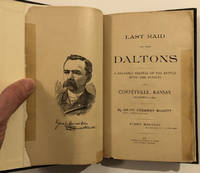
1892réf. 3832Coffeyville: Coffeyville Journal Print1892. 1892. First edition. First edition. 8vo. Rebound in grey cloth 5 p.1.13 71 1 pp. frontis. portrait illustrations portraits plan on unnumbered page 72. Adams 150 #52 says "Rare." "The author was the editor of the Coffeyville Journal and was an eye-witness to the battle of the citizens and the Dalton Gang. It is said that he was the first man to reach the wounded Emmett Dalton. He wrote this little book to give an account of what he saw and published it in a limited edition immediately after this battle took place. This is about the best account of this battle written thus far." Six Guns 671 says "Rare." "It is now very rare and a collector's item." Lacks the original wrappers a few end-pages reinforced along the edges with cellophane tape that was applied many years ago contents clean and bound into a cloth boards with titles stamped in gold gilt on the front cover. Overall a very good copy of a rare and much sought item. Coffeyville Journal Print,1892. hardcover
1891réf. 31787Paris 1891 20 Volumes petits in Folio 20 volumes de 1891 à 1912 , pp environ par volume, certain volumes comportent 2 années ou une année est " à cheval" sur 2 volumes chaque année possède environ 400 pp
1849Edizione originale. Tutto il pubblicato de «Il 9 febbraio» e di «Notizie del giorno», legati insieme, in ottime condizioni di conservazione. Diretto da Luigi Ruscone, il quotidiano bolognese apparve il 19 febbraio 1849 e cessò le pubblicazioni col n. 83 del 16 maggio dello stesso anno (il 5 giugno Radetzky entrò in Bologna). Proseguì le pubblicazioni con il titolo «Notizie del Giorno», edito sempre dalla Società Tipografica Bolognese dal n. 1 del 19 maggio 1849 al n. 41 del 30 giugno con cadenza giornaliera (seppur con qualche eccezione). Ogni numero, in folio, consta di 4 pagine. Di stampo fortemente antiaustriaco, riportava gli atti della Repubblica, commenti politici e notizie dalle altre città impegnate nella lotta contro gli austriaci. «Gli austriaci hanno violato il territorio della Repubblica; hanno occupata una delle sue città l’hanno taglieggiata e l’hanno sottoposta a condizioni obbrobriose e dure». Così apre il giornale nel suo primo numero. Unito “Il Bollettino Officiale” apparso a Bologna il 13 Maggio 1849. Il giornale nacque dalle ceneri de «La dieta italiana: giornale politico-letterario» che si pubblicò dal 1848 fino al 19 Febbraio 1849. Molto raro, solo 6 esemplari censiti nell’Opac Sbn, solo 3 completi e disponibili alla consultazione.
1932Edizione originale. Uniforme brunitura e minime mende rinforzate tramite restauro professionale alla copertina; per il resto più che buon esemplare. Primo numero della rivista diretta da Neymon per un totale di quattro fascicoli tra 1932 e 1933. I primi due fascicoli furono dedicati all’Italia: agli artisti futuristi, il primo che qui si offre; agli scrittori italiani contemporanei, il successivo. Gli artisti censiti nel presente fascicolo sono: Depero, Dottori, Marasco, Fillia, Caviglioni, Benedetta, Munari, Pozzo, Oriani, Diulgheroff, Thayaht, Andreoni, Rosso, Cocchia, Crali, Ambrosi. Notevole layout razionale per l’interno, capolavoro di Ugo Pozzo in copertina. -- «Pubblicazione complementare al contenuto dell’esposizione omonima parigina, è un documento del confronto fra proiezioni d’immaginazione “cosmica”, opzioni aeropittoriche rappresentative e sintesi plastsiche dinamiche di matrice “meccanica”. E conferma la raggiunta leadrship prampoliniana nell’ambito del futurismo plastico-visivo e architettonico» (NAF). Nuovi archivi del futurismo I, 1932/27
1933Edizione originale. Esemplare completo del rarissimo pergamino originale semitrasparente a proteggere la copertina. Brunito alla copertina e alle pagine interne, per il resto in condizioni più che buone quando non ottime. Numero 3-4-5 (giugno) del mensile diretto e curato graficamente da Depero, di cui è l’ultima uscita. Di formato e grafica diversa dai precedenti, tirato in un maggior numero di copie in occasione delle Onoranze nazionali a Umberto Boccioni organizzate dal Comune di Milano nelle giornate del 14-16 giugno 1933. Di elevatissima qualità grafica, contiene interventi originali di Marinetti (Il grido di Marinetti), Buzzi (la parolibera: Canzone di Boccioni e il testo Gloria a UB), Russolo, Notari, oltre a ripescaggi segnalati dalla stampa e scelte citazioni boccioniane. Due diagrammi disegnati da Depero, «La storia dell’arte suddivisa da Boccioni o nei seguenti periodi» e «Dall’impressionismo al futurismo», e una scelta iconografia di opere del maestro. Cammarota, Futurismo, Giornali fut., 118; Diz. Fut., pp. 385b-387b; Millefiorini, La pubblicistica futurista nei primi anni Trenta, ad indicem; Salaris, Riviste, pp. 198ss
1923Edizione originale. Esemplare un po’ vissuto ma in più che buone condizioni (una lieve gora interessa il lato interno alto di tutte le pagine, compresa la copertina; sottolineatura in lapis blu al piatto anteriore; tracce di ruggine alla pinzatura). Raro numero primo e unico di questa iniziativa di Castelli, futurista e fiumano anarchico di origine bolognese emigrato per un periodo nel Nord America all’inizio dei ’20. Contenuti di Castelli o tradotti e curati da — testi programmatici (Manifesto of Futurism; What is Futurism: Elementary Notions; ma soprattutto «The discovery of new sense» firmato Marinetti, qui in edizione originale — «The following Manifesto has been written especially for “Futuristi Aristocracy.” It has not yet appeared in print even in Italian. It is a sequel to the Manifesto on Tactilism [...]») e parolibere — accompagnati da riproduzioni di «Greek Theatre at Taormina», incisione di Horace Brodzky, il quadro «Landscape» di Rubzac, l’acquarello «New York» di John Marin e una foto che ritrae Marinetti e Pannaggi ai lati del dipinto pannaggiano «Treno in corsa». Il fascicolo fu seguito da due fogli sciolti di presentazione, non datati ma da ricondurre sempre al 1923: «Futurist Aristocracy» (col «Manifest of Futurism») e «Aristocrazia futurista» (con testo di propaganda). L’esperienza ebbe una coda nel numero bolognese «Aristocrazia futurista: voce dei futuristi di Bologna» (20 set 1925), oggi praticamente introvabile. Salaris, Riviste, pp. 324ss.; Prampolini dal futurismo all’informale, n. 3/1/7 pp. 220-221
1848Dal n 1 del 13 Luglio 1848 al n 152 del 28 Dicembre 1848 poi soppresso dalle autorità austriache, si stamparono altri 3 numeri nel marzo 1849. Fortemente antiaustriaco, la testata prende il nome dalla statua di Antonio Rioba (posta nel Campo dei Mori) che rappresenta la famiglia Mastelli, commercianti con la nomea di essere disonesti e per questo trasformati in pietra da Santa Maddalena. La statua del Rioba é una delle statue parlanti, che sulla falsa riga di quelle romane, erano usate per lasciare biglietti con poemetti sarcastici contro i potenti di turno. Dal n 19 alla testata dopo Buffo, fra parentesi viene aggiunto “a suo tempo” forse a sottolineare la serietà con cui i redattori, Francesco Berla e Augusto Giustinian, affrontarono il problema dell’occupazione austriaca. Dal n. 69 l’illustrazione al titolo muta con l’immagine della statua di Rioba. Tutto il pubblicato eccezion fatta per i tre fascicoli stampati nel 1849. La rara raccolta presenta un frontespizio figurato e porta la data del 1849. Probabilmente l’editore mise in vendita i fascicoli invenduti raccogliendoli in una unica edizione.
1949réf. 001610Angoulême Jean Emery, Editions d'art, Collection "L'Heptameron" 1949
2017réf. 014185Paris Éditions Xavier Barral 2017 In-8 Cartonnage toilé de L'éditeur
1946réf. 058060Editions Du Lombard Aucune reliure Bruxelles 1946 12 pages en format 21 - 29.5 cm - BD et illustrations
1836réf. 002756Paris, Charles Gosselin et Furne, 1836
réf. 7200P., Madre éditeur, 1871-1872. Titre illustré, catalogue des caricatures et dessins contenus dans le premier volume du Grelot (Année 1871, du numéro 1 au numéro 38) et du numéro 1 au numéro 7, du numéro 9 au numéro 38 (première année dont il manque les numéros 7 bis et 8), puis du numéro 39 au numéro 90 (deuxième année complète. Ensemble de 89 numéros (le numéro 1 est défraîchi), en un volume in folio percaline (mors en partie fendus, coins émoussés).
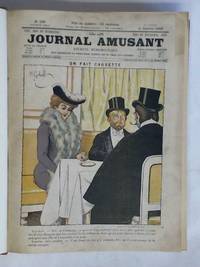
réf. 2N4241Paul Philipon et Cie. Paris 1902. Je Nummer 16 illustrierte Seiten broschierte Einbände im neuen Halbleder-Einband im historischen Stil mit geprägtem Rückentitel quart erster Einbanddeckel mit kleinem Eckausriß/teils gering fleckig/teils leichte Knickspuren. - Die Nummer 181 wurde als Sondernummer mit dem Thema "a table" gestaltet. Hervorzuheben sind die Illustrationen zur Serie "Nos Paysans" von Baric und "Nos Theatres" von Leandre und Luc / Titel und Rückseiten der einzelnen Nummern wurden gestaltet von: Guillaume 22 Gerbault 12 Leandre 12 Luc 11 Bac 10 Henriot 10 Lourdey 8 Préjelan 7 Rabier 6 Huard 4 Gottlob 3 Dorville 1 / Text französisch - unknown
193648 pages. This glamorous publication brought New York women important information including: news of the choicest fashion, entertainment, current happenings, where to go, what to see, and how much to pay. Features: Three-page photo-illustrated feature article on Gypsy Rose Lee "She Undressed Her Way to Fame!"; Full-page ad for the new Lastex Vassarette Girdle, featuring photo of designer Helen Wills; Nice one-page illustrated ad for Du Barry beauty preparations by Richard Hudnut; Letters; Fantastic one-page illustrated Macy's ad shows chef throwing knives at Thanksgiving turkey; Soundings - opinions of the New York Woman; Nice one-page illustrated fashion ad for Stern Brothers; Nice one-page illustrated fashion ad for Franklin Simon & Co. features upper half fashions; Seven fantastic photos of "Curb Commerce" in New York - radios, wart cures, picture postcards, socks, neckties, shoe shines, and photos; These Girls From Out of Town - fiction about 'those panting, galloping creatures - the lady buyers and how they wear down man; Romance Around Town - five photos of New York romance; Unfair to Organized Women - a man's complaint against the women of the world; Nice one-page color fashion photo of model in a glamorous Betty Wales ball gown; How to Collect Butlers; A Fashion Editor's Diary; What not to do to yourself - unfortunate accidents in the choice of clothes, cosmetics and behavior; Photos of the 'Best Dressed Women" from cities around the world; Attractive evening fashion centerfold features large black and white photo with color illustrations; So Much To Buy - and So Much to Spend!; Head to Toe - photos of fashionable hats and shoes; Cosmetics page; Two Quick and Easy Dinners Men Will Like; Photos of dinner table place settings; A Look at Our Medicine Chest; New About Food - a new thought on birthday cakes; "The Plough and the Stars" - Eight photos from the making of this movie which starred Barbara Stanwyck and Erin O'Brien Moore; "Valiant is the Word for Carrie" - photo-illustrated article about this movie; John Gielgud as Hamlet; Helen Hayes takes time to talk about backstage life as Queen Victoria; One page of color humorous illustrations by Dr. Suess illustrating how to attain social publicity!; One-page Schaefer beer ad - in cans!; Half-page photo ad for Best & Co. features pastel wool house coat; Manhattan Date Book; Glossy color cover photos feature woman attempting to install drapes which pipe-smoking husband reads paper; and more. Unmarked with modest wear. A quality copy of this great vintage depression-era item. Magazine
1747réf. 20484Hamburg, Conrad König, 1747. 5 n.n. Bll., 502 SS., 16 n.n. Bll., 1 Bl., 474 SS., 16 n.n. Bll., XXIV, 476 SS., 17 n.n. Bll. Mit 3 (wiederholten) gestochenen Titelvignetten und 3 (wdh.) gestochenen Textvignetten. 8°, (ca. 20,5 x 13,5 cm). Halbpergament der Zeit (etwas fleckig und berieben, Deckelbezug stärker beschabt).
18958vo., Second Edition, on laid paper, with a portrait frontispiece in photogravure, 2 plates in photogravure and 5 folding maps, neat signature on front free endpaper verso, half-title, frontispiece and title mildly spotted ; original red cloth, upper board framed in blind enclosing regimental crest of 16th Light Dragoons in gilt, gilt back, black endpapers, upper hinge tender (but binding entirely sound) else a very good, bright, clean copy. SIR CHARLES OMAN'S COPY WITH HIS NINETEENTH CENTURY ARMORIAL BOOKPLATE MOUNTED ON FRONT PASTE-DOWN. Tomkinson's Diary was first published in 1894 (a number of Press reviews is given on half-title verso). Widely regarded as a classic personal account of the campaign, it has been several times reissued but usually without the plates. This second edition contains the editor's final amendments, including the correction to the part played by Vivian's brigade at Waterloo. A RARE, POSSIBLY UNIQUE, ASSOCIATION COPY. Sandler 3277.
réf. 2576061 Wells Street Oxford Street 30 June 1815. Note: a. "He also chaired the board of the London-based South Australian Colonisation Commission created by the South Australia Act 1834 to oversee the new colony of South Australia. He also chaired the board of the London-based South Australian Colonisation Commission created by the South Australia Act 1834 to oversee the new colony of South Australia before the colony went bankrupt and he was sacked in 1841. He was chiefly known for championing the cause for emigration to the new colony and his name lives on in Adelaide's main river the Torrens the suburb of Torrensville and a few other places Wikipedia; B. "In 1831 having impressed John Stuart Mill Robert Torrens and other leading economists with the value of his ideas Wakefield became involved in various schemes to promote the colonisation of South Australia. He believed that many of the social problems in Britain were caused by overpopulation and he saw emigration to the colonies as a useful safety valve. He set out to design a colonisation scheme with a workable combination of labourers artisans and capital. The scheme was to be financed by the sale of land to the capitalists who would thereby support the other classes of emigrants. It took several attempts before the Province of South Australia was established. Although initially Wakefield was a driving force he found that as it came closer to fruition he was allowed less and less influence until he was frozen out almost completely whereupon he took offence and severed his connections with the scheme Wikipedia."; C. "Wakefield " is considered a key figure in the establishment of the colonies of South Australia and New Zealand" Wikipedia. See Image. 61 Wells Street, Oxford Street, 30 June 1815 unknown
réf. 11932Harper Brothers NY 1872 Volume 16 #801 - Volume 16 #834 May 4 1872 - Dec. 21 1872 page 346 - page 1008 excluding the following: # 809 - June 29 issue p505-520 #813 - July 27 issue p577-592# 818 Aug 31 issue p665-689 one leaf of Oct 5 issue p790-791#825 - Oct 19 issue p 801-817 supplement for Oct. 19 issue is present #831 #832 and #832 Nov. 30 Dec. 7 and Dec. 14 issues p929-993. Profusely illustrated with many engravings including many by Thomas Nast and Gustave Dore . Half bound leather and marbled boards. Marbled endpapers. Copy of O.P. Kinsey in pencil on prelim. Backstrip missing. Front and back cover loose. A little foxing toward extreme back. Very minor dampstain to upper outer edge of many leaves - generally outside border of most engravings. The ten double spreads sewn in - not tipped in. Text in very good condition. Harper Brothers, NY, 1872 hardcover
1922réf. N4540aBerlin: Rimon Publ. House 1922. First Edition . Original Half Cloth. Very Good. 4to. 1922-1924. SOME 250pp .FOR THE 6 PARTS OF THIS IMPORTANT PERIODICAL OF JEWISH ART published in Hebrew language in Berlin. With some contenc p and explantory ages in English PROFUSELY ILLUSTRATED WITH MANY PLATES IN COLOUR. EACH PART WITH THE ORIGINAL VERY DECORATIVE WRAPPERS PRESERVED. ARTICLES BY CHAGALL BIALIK AGNON AND OTHERS. Illustrated by Jewish artist many of the Jewish Russian Avantgarde PUBLISHER'S ORIGINAL HALF CLOTH BINDING. Some truly insignificant outside markings. A VERY CLEAN AND FRESH COPY .---The editors MARK and -RACHEL BERNSTEIN-WISCHNITZER had joined a group of Russian-Jewish intellectuals immigrants in Berlin with multi-lingual literary needs.RARELY FOUND IN THIS BEAUTIFUL FRESH CONDITION.------ERSTE ORIGINAL -AUSGABE 1- 6 alles erschienen. Ca. 250 S. für die 6 Teile zusammengebunden in dem Original-Halbleinen des Herausgebers. Jede einzelne der 6 Ausgaben hat ein eindrucksvolles dekoratives Umschlagsblatt alle sind erhalten. Reich illustriert teils farbig. Mit Beiträgen von Ch.N. Bialik Marc Chagall Nathan Altman u.a. viele Vertreter der JÜDISCH- RUSSISCHEN AVANTGARDE. Dieses hebräische Journal wurde in Berlin zwischen 1922 -und 1924 veröffentlicht und war der jüdischen Kunst und Literatur gewidmet. Es erschien parallel zu der jiddischen Edition genannt "Milgroim" hatte aber einen anderen literarischen Inhalt. Text in Hebräisch mit Ausnahme der zusätzlichen Inhaltsgabe der jeweiligen der 6 Ausgaben beim ersten Heft in deutsch bei Heft 2- 6 in englisch.Die Initiatoren dieser herausragenden Produktion in herausragender Druckqualität waren Dr. Mark Wischnitzer und seine Frau die berühmte Kunsthistorikerin Rachel Bernstein-Wischitzer.Beide hatten sich einer Gruppe von russisch-jüdischen Intellektuellen in Berlin angeschlossen. Ein sehr sauberes und frisches Exemplar. SELTEN! Rimon Publ. House hardcover