35 476 résultats
1985réf. 2110502151101988Kazama shobo 1985. Soft Cover. Fine. Number of books: 1 Kazama shobo paperback
réf. 23561Undated c.1905. Typewritten draft of circular letter with corrections appealing for support for Griffith’s Sinn Féin newspaper and giving details concerning its foundation. Typescript 3pp 4to good condition. Author and recipient not stated. Undated but from the context written in 1906. It begins We desire to bring under your notice the following facts respecting the "Sinn Fein" daily newspaper’ and says that Griffith and the directors stated that ‘a sum of £8000 was required for the purpose’ but that the sum of £3300 only was subscribed in answer to the appeal. The Board decided to proceed with the establishment of the paper notwithstanding that the amount was so far short of that required. The paper commenced its tenth week on 1st corrected in manuscript from ‘2nd.’ November. The entire plant – exclusive of linotypes which are always hired is the property of the Company. The plant – in addition to the Linotupes sic includes a Victory machine which fortunately was acquired for a very small sum a fine stereo plant and type. The result is that the Company have now got a nice compact plant for the purposes required. . There are in England a large number of Irishmen of means who are interested in Ireland and who are anxious to do all in their power to financial support sic the new movements. To them it will be apparent that the principal support of the new movement will be a daily paper and who if the fats sic are brought before them would readily provide the monetary help required. It proposes a ‘Meeting in support of "Sinn Fein" paper’ and requesting that the reader subscribe directly ‘owing to the size of London’. From the Papers of Robert and Sylvia Lynd. Undated [c.1905]. unknown
réf. DADAX321199906XNew unknown
réf. 26514'Home Office Whitehall S.W.1. London Wednesday 29th March 1939.' 'Transcript from the Shorthand Notes of Treasury Reporter'. Secret duplicated Home Office document no other copy of which has been discovered none on OCLC WorldCat for example and no reference to the meeting found. The document is a transcript of a highly significant meeting called by a busy Hoare he would have an important cabinet meeting on the same day to explain to press representatives the remit on the basis of 'voluntary Censorship' of the newly-formed Ministry of Information and also including discussions of 'the questions of transport labour and so on' that the press would face in the case of war as well as the planned nature of future meetings and the need for secrecy with reference to the operation of D Notices. The meeting is a frank one including an exchange during which Hoare declares 'This rather depresses me. I am beginning to wonder whether this meeting is of any use. … I did not in the least want this meeting: I imagined I was doing it for your convenience.' At the beginning Hoare explains that he has called the meeting at the request of Prime Minister Neville Chamberlain and declares that he is 'the Minister dealing with the skeleton organisation of the Ministry of Information'. This 'skeleton organisation' – with Sir Stephen George Tallents 1884-1958 as 'Director General Designate' – had come into being a few months before the meeting after the German annexation of the the Sudetenland in 1938 and around seventy staff had already been employed censoring press reports surrounding the Munich Agreement. 1 29pp foolscap 8vo on thirty leaves. Complete. In fair condition with the text paginated 1-29 on lightly-aged leaves and the covering page on a loose and worn leaf with light damage along two edges. The covering page is headed: 'Private and Confidential Meeting between the Secretary of State for Home Affairs and the Committee of Newspaper Proprietors Association etc. Home Office Whitehall S.W.1. Wednesday 29th March 1939.' At foot of covering page: 'Transcript from the Shorthand Notes of Treasury Reporter'. The rest of the page lists the twenty-one individuals present with ten in Sir Samuel Hoare's party and eleven from the press with Esmond Harmsworth of the Daily Mail as chairman. The government list begins with: 'Sir Samuel Hoare 1880-1959 later Viscount Templewood Secretary of State in the Chair Mr. Geoffrey Lloyd 1902-1984 later Lord Geoffrey-Lloyd Parliamentary Under-Secretary Home Office Sir Alexander Maxwell 1880-1963 Permanent Under-Secretary Mr. A. S. Hutchinson Arthur Sydney Hutchinson 1896-1981 later knighted Private Secretary to the Secretary of State'. The press list begins with four from the 'Newspaper Proprietors Association': 'The Hon. Esmond Harmsworth 1898-1978 of the Daily Mail later Viscount Rothermere Chairman Brigadier The Hon. E. F. Lawson Edward Frederick Lawson 1890-1963 of the Daily Telegraph later Lord Burnham Vice Chairman Mr. Stanley Bell Managing Director Associated Newspapers Mr. F. J. Cook General Manager Daily Herald and People'. The four NPA members are followed by the NPA 'Secretary to the Committee' three from the 'Newspaper Society'; a 'Scottish Daily Newspaper Society' representative; and two from the 'Periodical Trade Press and Weekly Newspaper Proprietors Association'. Hoare begins by giving the 'two or three reasons' why he has been 'anxious to have a meeting of this Committee' the first being that 'the Prime Minister Neville Chamberlain of whose appeasement policy Hoare was a leading supporter has asked me to take over the questions connected with the Ministry of Information on that side of the work of the Press and also to be the Co-Ordinating Minister for the various other questions that we discussed when you came here about A.R.P. the Air Raid Precautions Department Hoare's pet project begun in 1935 and that you have since discussed with several of the Departments – the Ministry of Transport the Ministry of Labour and so on.' Hoare reports that Chamberlain 'took the view that it would probably be more convenient to everybody if whilst you would still go on dealing with individuals of the specific Departments there should be one Minister to whom you could come if you wished to come to him and one particular individual to whom you could make suggestions if suggestions were necessary.' After declaring – 'quite without prejudice to what might happen after the emergency' – that he is 'the Minister dealing with the skeleton organisation of the Ministry of Information' Hoare turns to the purpose of the meeting: 'Next Gentlemen you will remember that this Committee came into being after a meeting that we had some months ago about A.R.P. and that at that meeting I suggested you should get into touch with the various Departments to get the various questions settled the questions of transport labour and so on: and I thought it was a good thing we should have another meeting to report progress and to see how far that machinery has actually worked in practice. I have made enquiries and my enquiries go to shew that it has worked pretty well.' Hoare discusses the Ministry of Information noting that 'Sir Stephen Tallents has now gone back to the B.B.C. It was found that he could not carry on the double duty of his work at the B.B.C. and also this organisation work at the Ministry of Information'. He suggests the the 'small body' that liaised with Tallents to 'meet myself and the staff at the Ministry in the near future and take up the position as it was left two or three months ago' with a view to seeing 'whether we needed any further machinery'. He discusses 'the kind of work the Ministry of Information would be called upon to undertake': it would be 'an organisation for supplying the Press with news: there would be under this Department a Censorship of incoming and outgoing Press telegrams and thirdly there would be advice to the Press on requests voluntarily submitted by them our general principle being to leave as much of the leaders of the Press as we could and to keep it as far as we could upon a basis of voluntary Censorship'. He announces 'the intention of the Government to stop in London as long as it could and that we have – and this I think is known to you – earmarked the Imperial Institute as the centre of the Ministry of Information in London'. A discussion follows led by Harmsworth after which Hoare leads the meeting to the question of 'materials' and a full discussion of the practicalities follows including 'the position of newspaper van drivers'. In response to a suggestion by Lawson regarding the circulation of information Hoare replies 'I am always rather nervous of circulating a lot of information about these very confidential questions myself.' To this Lawson replies: 'If we cannot discuss confidential questions without any risk of breach we are wasting out time.' Hoare's response to this is: 'That may point to not having any contacts at all. As the discussion proceeds B. Alton NPA Secretary and Secretary to the Committee complains to Hoare: 'we have had no information on the evacuation scheme until it was made public generally or of the Ministry of Transport scheme. If it is going to apply to all our commodities there is not much point in having negotiations with you: we get no advance information at all.' Hoare's response: 'This rather depresses me. I am beginning to wonder whether this meeting is of any use.' Alton backtracks: 'As I have said we have had more information to-day than I have been able to collect in six months.' At which Hoare continues to complain: 'I did not in the least want this meeting: I imagined I was doing it for your convenience.' Harmsworth jumps in with a long statement beginning with his view that the meeting 'has been extraordinarily useful because here we have all the representatives of the different Ministries whom previously we have seen one by one'. The meeting ends with a discussion of future plans for the committee Hoare undertaking to 'get a report drawn up of this meeting on the lines suggested by Sir Alexander Maxwell' and stating that 'there should be another meeting at which the various members of the Departments would be present' stressing 'that our meeting to-day' should be 'regarded as entirely confidential. Agreed.' Towards the end 'Davies' on the press side asks whether 'the report of this meeting which is to be drawn up by agreement' will be made available: 'is it to be regarded as a confidential report for the Councils of the different organisations only or will we be permitted to circulate it to members' Hoare replies: 'I should be very sorry to see a wide circulation running into many hundreds. I think as soon as you do that the whole thing becomes entirely public does it not' Lawson offers 'an absolute guarantee that there would be no publicity whatsoever'. As Hoare continues to voice concerns Davies gives 'an illustration': 'there is in existence what is called the Admiralty War Office and Air Force Press Committee whose only function for many years has been to distribute what are known as “D” notices: they go out to the whole Press even to very small weekly newspapers and I think it is the general experience that those “D” notices are respected.' Hoare defers to Maxwell who opines that it is 'quite right to let it be circualted in confidence because the man who is responsible for running a particular local newspaper wants to know it quite as much as the Gentlemen here'. The meeting ends with Hoare directing 'We will proceed on that basis then' and then thanking the press representatives 'for coming'. 'Home Office, Whitehall, S.W.1. [London] | Wednesday, 29th March, 1939.' '(Transcript from the Shorthand Notes of Treasury Repor unknown
1833réf. 059710Pontefract - Ackworth: C. Elcock & J. Lucas. 1833. First Edition . Hardcover. Very Good. 8vo. Engraved Title-page and Plates. FIRST EDITION. PONTEFRACT : 1833-1837. Edited by Luke Howard. Hardback. 5 bound volumes of the entire periodical - ceased publication in 1837. Engraved title-page opposite printed title-page to volume one. One fold-out plate facsimile of a letter in 1660 and eight other facsimiles as plates. Contemporary brown calf-leather; spine and corners. Marbled boards. Indexed. Spines with slight wear; strong and soundly bound. VERY GOOD. Very scarce as a complete set. Referenced by: Smith I 983. LUKE HOWARD FRS 1772-1864 was a British manufacturing chemist and an amateur meteorologist with broad interests in science. His lasting contribution to science is a nomenclature system for clouds which he proposed in an 1802 presentation to the Askesian Society. He was born in London the son of Robert Howard a lamp manufacturer and educated at the Quaker school in Burford Oxfordshire. He was a Quaker later converting to the Plymouth Brethren and became a pharmacist by profession. After serving an apprenticeship with a pharmacist in Stockport Cheshire he set up his own pharmacy in Fleet Street in 1793. He was elected a Fellow of the Royal Society in 1821. He spent the years 1824 to 1852 in Ackworth Yorkshire West Riding . He died in Tottenham London. He had married Mariabella Eliott 1769-1852; they had several children including John Eliot Howard FRS chemist and botanist. 8vo. Heavy set; extra postage will be requiredWill be well-packed for posting/shipping. Rosley Books for Antiquarian books CHS Cumberland Everyman GKC Inklings Keswick Literature MacDonald Rarities Theology and History. . Pontefract: Published by: C. Elcock & J. Lucas. SCARCE. C. Elcock & J. Lucas. hardcover
2004réf. 2080702109501104Demizushi 2004. Soft Cover. Fine. Number of pages: 1253 21p Size: 22cm Number of books: 4 Demizushi paperback
réf. SONG1609367030Used: Good unknown
réf. DADAX0718124944New unknown
réf. DADAX0062500562New unknown
réf. DADAX1433565730New unknown
1993réf. ZB255774London Mining Journal. 1993. Volume 320; original paper wrappers ex library textually clean. - If you are reading this this item is actually physically in our stock and ready for shipment once ordered. We are not bookjackers. Buyer is responsible for any additional duties taxes or fees required by recipient's country. Photos available upon request. London, Mining Journal. unknown
réf. DADAX0385009925New unknown
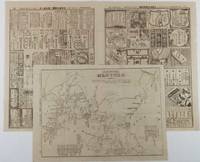
1904réf. 216797大阪. Osaka.: 大阪毎日新聞社. Ōsaka Mainichi Shinbunsha. Meiji 37 1904. Two black and white newspaper maps issued in the Ōsaka Mainichi Shinbunsha one pictorial with accompanying text and adverts printed on newsprint folded. 39.5 x 55cm Very good condition. This pictorial map of Port Arthur and Dalian was published on 4 July 1904 by the Osaka Mainichi Shinbun as a supplement. It shows Port Arthur encircled by Japanese naval vessels while Dalian is depicted as being occupied by Japanese troops. On the reverse there is an essay on the war accompanied by illustrations of Russian generals and a list of wounded soldiers who had been transported to the rear. A second map detailing developments in the Russo-Japanese War was published by the same newspaper just days later on 8 August 1904. This map provides the dates of various battles along with a chronology of the movements of the Russian Vladivostok fleet and Japanese attacks on Port Arthur. These two maps are rare examples of the kind of information made available to the general public on a day-to-day basis during the war. . 大阪毎日新聞社. [Ōsaka Mainichi Shinbunsha]. unknown
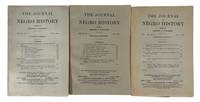
1924réf. 217871924. Woodson Carter Godwin. The Journal of Negro History. Archive of three landmark issues published between 1924 and 1928 documenting the institutional development of African American historical scholarship during the early twentieth century. The material records Black intellectual production historical recovery and scholarly publishing through the Association for the Study of Negro Life and History founded by Carter G. Woodson and Jesse E. Moorland in 1915. These issues include Black scholarship challenging white supremacist interpretations of Reconstruction slavery labor and African diasporic history through archival research and independent academic publication. The journal served as one of the central vehicles through which African American historians established scholarly networks disseminated original research and institutionalized the study of Black history within American intellectual life. The archive provides primary-source evidence for the emergence of modern African American historiography and the scholarly movement that later gave rise to Negro History Week and Black History Month. Woodson Carter Godwin ed. The Journal of Negro History. Lancaster PA and Washington D.C.: The Association for the Study of Negro Life and History 1924 1926 and 1928. Three issues in publisher's printed wrappers comprising Vol. IX No. 3 July 1924; Vol. XI No. 3 July 1926; and Vol. XIII No. 3 July 1928. Each issue measures approximately 10 x 6.5 inches and ranges between 120 and 176 pages. 1 Vol. IX No. 3 July 1924. Devoted primarily to Alrutheus Ambush Taylor's major study "The Negro in South Carolina During the Reconstruction" examining demographic change labor transition religion education and political organization in the post-emancipation South. Written while Taylor served as the first full-time Black researcher employed by Woodson's organization the study foregrounds African American agency during Reconstruction and anticipates interpretive frameworks later expanded by W.E.B. Du Bois in Black Reconstruction. 2 Vol. XI No. 3 July 1926. Continues Taylor's Reconstruction scholarship with "The Negro in the Reconstruction of Virginia" detailing Black political participation church organization disenfranchisement campaigns and the reestablishment of white political control in Virginia after Reconstruction. The article constitutes one of the earliest extended scholarly treatments of Black Reconstruction politics in the state. 3 Vol. XIII No. 3 July 1928. Broadens the journal's scope beyond the Reconstruction South through studies including N. Andrew N. Cleven's "The First Panama Mission and the Congress of the United States" W. Sherman Savage's early survey "The Negro in the History of the Pacific Northwest" and Jean Trapp's "The Liverpool Movement for the Abolition of the English Slave Trade." The issue additionally includes Ruth A. Fisher's extensive 109-page documentary compilation "Extracts from the Records of the African Companies" reproducing archival material relating to British commercial participation in the transatlantic slave trade. These issues record the emergence of African American historical scholarship as an organized intellectual discipline during a period when Black historians faced systematic exclusion from mainstream academic institutions and publishing networks. The journal's sustained attention to Reconstruction history preceded revisionist scholarship that later transformed the field with early interpretations centered on Black political participation labor and institutional development rather than Lost Cause narratives dominant in white historiography of the era. Studies on the Pacific Northwest Panama and British antislavery movements extend the journal's diasporic approach to Black history beyond the American South. Minor edgewear and faint toning to wrappers; overall very good condition. An archive of foundational African American historical scholarship and one of the central publishing achievements of twentieth-century Black intellectual life. unknown
1924réf. 217871924. Woodson Carter Godwin. The Journal of Negro History. Archive of three landmark issues published between 1924 and 1928 documenting the institutional development of African American historical scholarship during the early twentieth century. The material records Black intellectual production historical recovery and scholarly publishing through the Association for the Study of Negro Life and History founded by Carter G. Woodson and Jesse E. Moorland in 1915. These issues include Black scholarship challenging white supremacist interpretations of Reconstruction slavery labor and African diasporic history through archival research and independent academic publication. The journal served as one of the central vehicles through which African American historians established scholarly networks disseminated original research and institutionalized the study of Black history within American intellectual life. The archive provides primary-source evidence for the emergence of modern African American historiography and the scholarly movement that later gave rise to Negro History Week and Black History Month. Woodson Carter Godwin ed. The Journal of Negro History. Lancaster PA and Washington D.C.: The Association for the Study of Negro Life and History 1924 1926 and 1928. Three issues in publisher's printed wrappers comprising Vol. IX No. 3 July 1924; Vol. XI No. 3 July 1926; and Vol. XIII No. 3 July 1928. Each issue measures approximately 10 x 6.5 inches and ranges between 120 and 176 pages. 1 Vol. IX No. 3 July 1924. Devoted primarily to Alrutheus Ambush Taylor's major study "The Negro in South Carolina During the Reconstruction" examining demographic change labor transition religion education and political organization in the post-emancipation South. Written while Taylor served as the first full-time Black researcher employed by Woodson's organization the study foregrounds African American agency during Reconstruction and anticipates interpretive frameworks later expanded by W.E.B. Du Bois in Black Reconstruction. 2 Vol. XI No. 3 July 1926. Continues Taylor's Reconstruction scholarship with "The Negro in the Reconstruction of Virginia" detailing Black political participation church organization disenfranchisement campaigns and the reestablishment of white political control in Virginia after Reconstruction. The article constitutes one of the earliest extended scholarly treatments of Black Reconstruction politics in the state. 3 Vol. XIII No. 3 July 1928. Broadens the journal's scope beyond the Reconstruction South through studies including N. Andrew N. Cleven's "The First Panama Mission and the Congress of the United States" W. Sherman Savage's early survey "The Negro in the History of the Pacific Northwest" and Jean Trapp's "The Liverpool Movement for the Abolition of the English Slave Trade." The issue additionally includes Ruth A. Fisher's extensive 109-page documentary compilation "Extracts from the Records of the African Companies" reproducing archival material relating to British commercial participation in the transatlantic slave trade. These issues record the emergence of African American historical scholarship as an organized intellectual discipline during a period when Black historians faced systematic exclusion from mainstream academic institutions and publishing networks. The journal's sustained attention to Reconstruction history preceded revisionist scholarship that later transformed the field with early interpretations centered on Black political participation labor and institutional development rather than Lost Cause narratives dominant in white historiography of the era. Studies on the Pacific Northwest Panama and British antislavery movements extend the journal's diasporic approach to Black history beyond the American South. Minor edgewear and faint toning to wrappers; overall very good condition. An archive of foundational African American historical scholarship and one of the central publishing achievements of twentieth-century Black intellectual life. unknown books
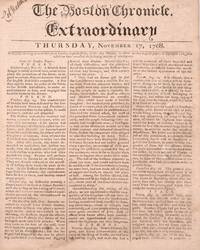
1768réf. 339729Boston 1768. 4pp. Disbound. Signature of Col. Hatch. 4pp. Includes mostly European news but notes under the date Sept. 8: "Both the tenour and purport of all the late dispatches from America is That the colonists will never give up their liberties" and lists the regiments on duty in America. The final column on the last page gives local news including a reference to non-importation: "We hear the senior class at Harvard college have unanimously agreed to take their degrees next commencement dressed in black cloth of the manufacture of this country unknown
1768réf. 339729Boston 1768. 4pp. Disbound. Signature of Col. Hatch. 4pp. Includes mostly European news but notes under the date Sept. 8: "Both the tenour and purport of all the late dispatches from America is That the colonists will never give up their liberties" and lists the regiments on duty in America. The final column on the last page gives local news including a reference to non-importation: "We hear the senior class at Harvard college have unanimously agreed to take their degrees next commencement dressed in black cloth of the manufacture of this country unknown books
1848réf. 41215Washington: George S. Gideon 1848. Broadside 8" x 12-1/2." Very Good. Gideon promises that his paper "will be emphatically a National Press designed for circulation in every section of the country. The object of the paper will be to harmonize the action and promote the efficient organization of the Whig party as well as to diffuse its principles and arouse its spirit and enthusiasm." Subscription costs are printed after which Gideon signs in type from Washington in June 1848. Beneath Gideon's name is a recommendation from seven members of the Whig Executive Committee of Congress urging support for the Paper which "will prove a vehicle of useful political information and if generally circulated will contribute powerfully to the desired change in the Administration of the Government." There follows a section for persons to sign up for subscriptions with their post office addresses. Our copy has no names listed. Not located on OCLC as of August 2025. George S. Gideon unknown
1848réf. 41215Washington: George S. Gideon 1848. Broadside 8" x 12-1/2." Very Good. Gideon promises that his paper "will be emphatically a National Press designed for circulation in every section of the country. The object of the paper will be to harmonize the action and promote the efficient organization of the Whig party as well as to diffuse its principles and arouse its spirit and enthusiasm." Subscription costs are printed after which Gideon signs in type from Washington in June 1848. Beneath Gideon's name is a recommendation from seven members of the Whig Executive Committee of Congress urging support for the Paper which "will prove a vehicle of useful political information and if generally circulated will contribute powerfully to the desired change in the Administration of the Government." There follows a section for persons to sign up for subscriptions with their post office addresses. Our copy has no names listed. Not located on OCLC as of August 2025. George S. Gideon unknown books
1863réf. 41296Richmond 1863. Folio 11-1/2" x 16." Elaborately engraved masthead. 8pp pp 33-40. Printed in four columns per page. Disbound. A couple of tears repairs and small loss. Good plus. Portraits of Major John H. Mosby and Major John Pelham are on the first page. Accompanying detailed stories celebrate Mosby's "indominable energy and reckless daring" and mourn the death of "The Gallant Pelham." Advertisements news from the Blockade poems and war news complete the issue. unknown
1863réf. 41296Richmond 1863. Folio 11-1/2" x 16." Elaborately engraved masthead. 8pp pp 33-40. Printed in four columns per page. Disbound. A couple of tears repairs and small loss. Good plus. Portraits of Major John H. Mosby and Major John Pelham are on the first page. Accompanying detailed stories celebrate Mosby's "indominable energy and reckless daring" and mourn the death of "The Gallant Pelham." Advertisements news from the Blockade poems and war news complete the issue. unknown books
réf. elala5710cToronto: 1905. First Edition. oblong 4to. pp. 199. illus. throughout. original cloth. elala5710 [cToronto: 1905] hardcover
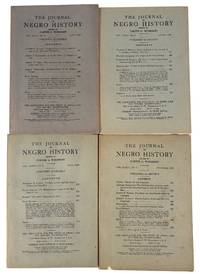
1942réf. 217921942. Woodson Carter Godwin. The Journal of Negro History. 1942-1949. Foundational issues of the journal established by Carter G. Woodson documenting the institutionalization of Black historical scholarship in the United States and advancing early academic study of African American military service political rights and diaspora culture. Issued by the Association for the Study of Negro Life and History which Woodson co-founded in 1915 these volumes situate Black experience within national and Atlantic frameworks including Revolutionary War service Reconstruction governance and twentieth-century military participation. The selection highlights how mid-century scholars constructed a documentary record of African American life in direct response to exclusion from mainstream historiography with particular emphasis on suffrage labor naval service and racial legislation. Woodson Carter Godwin ed. The Journal of Negro History. Washington D.C.: Association for the Study of Negro Life and History 1942 1947 1949. Four issues. 1 Jackson Luther P. "Virginia Negro Soldiers and Seamen in the American Revolution." The Journal of Negro History. Vol. XXVII No. 3. Washington D.C.: ASNLH 1942. Establishes early documentation of African American military participation in the Revolutionary War. Additional contents include Frank J. Klingberg's study of Jamaican legislation 1837 Ronald V. Sires's analysis of the Jamaica Slave Insurrection Loan 1832-1863 and Harold Courlander's "Profane Songs of the Haitian People" presenting vernacular cultural material from Haiti. 2 Wesley Charles H. "Negro Suffrage in the Period of Constitution-Making 1787-1865." The Journal of Negro History. Vol. XXXII No. 2. Washington D.C.: ASNLH 1947. Examines the development of Black political rights before the Civil War. Herbert Aptheker's "The Negro in the Union Navy" and Lawrence D. Reddick's "The Negro in the United States Navy during World War II" connect nineteenth-century and contemporary military service while Mercer Cook's essay surveys modern Haitian literature. 3 Lofton Williston H. "Northern Labor and the Negro during the Civil War." The Journal of Negro History. Vol. XXXIV No. 3. Washington D.C.: ASNLH 1949. Traces relationships between African American workers and Northern labor movements. Sidney Kaplan's "The Miscegenation Issue in the Election of 1864" analyzes race in wartime political discourse and Morris U. Schappes reprints Ernestine L. Rose's address on West Indian emancipation preserving a nineteenth-century abolitionist voice. 4 Bernstein Leonard. "The Participation of Negro Delegates in the Constitutional Convention of 1868 in North Carolina." The Journal of Negro History. Vol. XXXIV No. 4. Washington D.C.: ASNLH 1949. Documents Black political participation in Reconstruction governance. Additional contributions include Joseph H. Taylor on disfranchisement in Alabama Jessie P. Guzman on Monroe Nathan Work's scholarly contributions and a reprinted 1774 letter by Phillis Wheatley identified by Benjamin Quarles. These issues were published during World War II and the early Cold War when African American military service abroad and civil rights struggles at home intensified scholarly and political attention to Black history. Articles on the Union Navy and World War II naval service align with wartime debates over segregation and citizenship while studies of suffrage Reconstruction conventions and disfranchisement reflect renewed examination of constitutional rights in the context of emerging civil rights activism. Four issues in publisher's printed wrappers each approximately 108 to 118 pages. Light wear occasional foxing and minor soiling to wrappers; overall very good to near fine. A cohesive grouping illustrating how Black historians and intellectuals built an evidentiary foundation for African American history as a formal academic discipline in the mid twentieth century. unknown
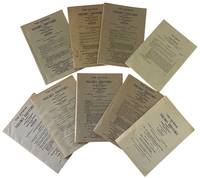
1967réf. 235281967. Woodson Carter Godwin. The Journal of Negro History traces Black historical scholarship from the civil rights movement of the late 1960s to the constitutional battles over affirmative action in the early 1980s. Kenneth B. Clark a psychologist whose work with Mamie Phipps Clark on children and racial segregation was cited in Brown v. Board of Education opens the January 1968 issue with "The Present Dilemma of the Negro" while other issues examine racial thought in colonial America Black sailors in the Navy and merchant service discipline under industrial slavery in the Old South antislavery agents working with free Black communities from 1833 to 1838 and the Bakke Weber and Fullilove affirmative-action cases. William M. Brewer and Alton Hornsby Jr. eds. The Journal of Negro History. Washington D.C.: The Association for the Study of Negro Life and History Inc. 1967-1982. Nine quarterly issues. Vol. LIII Nos. 3 and 4 July and October 1967; Vol. LIII Nos. 1 and 2 January and April 1968; Vol. LIV Nos. 1 2 3 and 4 January April July and October 1969; Vol. LV No. 1 January 1970; and Vol. LXVII No. 3 Fall 1982. Including writings "The Emergence of DuBois As An African Nationalist"; Max Welborn "Racial Massacre In Atlanta September 22 1906"; Valeria W. Weaver "The Failure Of Civil Rights 1875-1883 And Its Repercussions"; and "The Ethel Johns Report: Black Women In The Nursing Profession 1925." These issues show Woodson's program in the decades after civil rights activism brought Black historical scholarship into debates over school desegregation voting rights enforcement affirmative action and the recovery of African origins in Atlantic slavery. January 1969 number includes the annual report "The Mis-Education of The Negro" tying the Association's current work to Woodson's critique of American schooling while the 1982 number places King's memory Central African slavery Black women's nursing labor affirmative action and Civil War freedom claims in the same scholarly forum. A compact run of The Journal of Negro History that connects ASALH's Woodson-era mission to late twentieth-century scholarship on enslavement civil rights enforcement African Diaspora origins Black labor and affirmative action law. Wrappers show toning some scattered stains with some issues showing binding weakness; interiors remain readable. Overall very good condition. unknown
1942réf. 217921942. Woodson Carter Godwin. The Journal of Negro History. 1942-1949. Foundational issues of the journal established by Carter G. Woodson documenting the institutionalization of Black historical scholarship in the United States and advancing early academic study of African American military service political rights and diaspora culture. Issued by the Association for the Study of Negro Life and History which Woodson co-founded in 1915 these volumes situate Black experience within national and Atlantic frameworks including Revolutionary War service Reconstruction governance and twentieth-century military participation. The selection highlights how mid-century scholars constructed a documentary record of African American life in direct response to exclusion from mainstream historiography with particular emphasis on suffrage labor naval service and racial legislation. Woodson Carter Godwin ed. The Journal of Negro History. Washington D.C.: Association for the Study of Negro Life and History 1942 1947 1949. Four issues. 1 Jackson Luther P. "Virginia Negro Soldiers and Seamen in the American Revolution." The Journal of Negro History. Vol. XXVII No. 3. Washington D.C.: ASNLH 1942. Establishes early documentation of African American military participation in the Revolutionary War. Additional contents include Frank J. Klingberg's study of Jamaican legislation 1837 Ronald V. Sires's analysis of the Jamaica Slave Insurrection Loan 1832-1863 and Harold Courlander's "Profane Songs of the Haitian People" presenting vernacular cultural material from Haiti. 2 Wesley Charles H. "Negro Suffrage in the Period of Constitution-Making 1787-1865." The Journal of Negro History. Vol. XXXII No. 2. Washington D.C.: ASNLH 1947. Examines the development of Black political rights before the Civil War. Herbert Aptheker's "The Negro in the Union Navy" and Lawrence D. Reddick's "The Negro in the United States Navy during World War II" connect nineteenth-century and contemporary military service while Mercer Cook's essay surveys modern Haitian literature. 3 Lofton Williston H. "Northern Labor and the Negro during the Civil War." The Journal of Negro History. Vol. XXXIV No. 3. Washington D.C.: ASNLH 1949. Traces relationships between African American workers and Northern labor movements. Sidney Kaplan's "The Miscegenation Issue in the Election of 1864" analyzes race in wartime political discourse and Morris U. Schappes reprints Ernestine L. Rose's address on West Indian emancipation preserving a nineteenth-century abolitionist voice. 4 Bernstein Leonard. "The Participation of Negro Delegates in the Constitutional Convention of 1868 in North Carolina." The Journal of Negro History. Vol. XXXIV No. 4. Washington D.C.: ASNLH 1949. Documents Black political participation in Reconstruction governance. Additional contributions include Joseph H. Taylor on disfranchisement in Alabama Jessie P. Guzman on Monroe Nathan Work's scholarly contributions and a reprinted 1774 letter by Phillis Wheatley identified by Benjamin Quarles. These issues were published during World War II and the early Cold War when African American military service abroad and civil rights struggles at home intensified scholarly and political attention to Black history. Articles on the Union Navy and World War II naval service align with wartime debates over segregation and citizenship while studies of suffrage Reconstruction conventions and disfranchisement reflect renewed examination of constitutional rights in the context of emerging civil rights activism. Four issues in publisher's printed wrappers each approximately 108 to 118 pages. Light wear occasional foxing and minor soiling to wrappers; overall very good to near fine. A cohesive grouping illustrating how Black historians and intellectuals built an evidentiary foundation for African American history as a formal academic discipline in the mid twentieth century. unknown books