35 476 résultats
1967réf. 235281967. Woodson Carter Godwin. The Journal of Negro History traces Black historical scholarship from the civil rights movement of the late 1960s to the constitutional battles over affirmative action in the early 1980s. Kenneth B. Clark a psychologist whose work with Mamie Phipps Clark on children and racial segregation was cited in Brown v. Board of Education opens the January 1968 issue with "The Present Dilemma of the Negro" while other issues examine racial thought in colonial America Black sailors in the Navy and merchant service discipline under industrial slavery in the Old South antislavery agents working with free Black communities from 1833 to 1838 and the Bakke Weber and Fullilove affirmative-action cases. William M. Brewer and Alton Hornsby Jr. eds. The Journal of Negro History. Washington D.C.: The Association for the Study of Negro Life and History Inc. 1967-1982. Nine quarterly issues. Vol. LIII Nos. 3 and 4 July and October 1967; Vol. LIII Nos. 1 and 2 January and April 1968; Vol. LIV Nos. 1 2 3 and 4 January April July and October 1969; Vol. LV No. 1 January 1970; and Vol. LXVII No. 3 Fall 1982. Including writings "The Emergence of DuBois As An African Nationalist"; Max Welborn "Racial Massacre In Atlanta September 22 1906"; Valeria W. Weaver "The Failure Of Civil Rights 1875-1883 And Its Repercussions"; and "The Ethel Johns Report: Black Women In The Nursing Profession 1925." These issues show Woodson's program in the decades after civil rights activism brought Black historical scholarship into debates over school desegregation voting rights enforcement affirmative action and the recovery of African origins in Atlantic slavery. January 1969 number includes the annual report "The Mis-Education of The Negro" tying the Association's current work to Woodson's critique of American schooling while the 1982 number places King's memory Central African slavery Black women's nursing labor affirmative action and Civil War freedom claims in the same scholarly forum. A compact run of The Journal of Negro History that connects ASALH's Woodson-era mission to late twentieth-century scholarship on enslavement civil rights enforcement African Diaspora origins Black labor and affirmative action law. Wrappers show toning some scattered stains with some issues showing binding weakness; interiors remain readable. Overall very good condition. unknown books
1890réf. 82593Phownixville Pa.:: The Daily Republican Friday July 4 1890. newspaper printed in black illustrated with engraved portraits and overprinted with red and blue stripes simulating the US flag. . Lightly creased where folded; a few tiny losses at folds; quite attractive. 21-1/2 x 31 inches. The Daily Republican, unknown
1965réf. 0002987N. A Kovach 1965. First of this edition. Hardcover. Very Good/Fair. D/j has several tears and is darkened. Limited to 225 copies. N. A Kovach hardcover
1997réf. 211481997. Journal of Lesbian Studies published between 1997 and 2000 documents the institutionalization of lesbian studies and queer feminist scholarship within late twentieth-century academic publishing. Founded in 1997 the journal created an interdisciplinary forum examining lesbian history identity sexuality politics health media representation literature labor geography and cultural production while maintaining explicit connections to grassroots lesbian activism and feminist organizing. The publication reflects the expansion of LGBTQ studies within universities during the 1990s and illustrates how lesbian scholars and writers developed dedicated intellectual spaces addressing issues often marginalized within both mainstream academia and broader feminist discourse. Through peer-reviewed essays theoretical debates editorials poetry and reviews the journal provides primary-source evidence for the study of lesbian feminist thought queer theory sexuality studies and the development of LGBTQ academic institutions at the turn of the twenty-first century. Binghamton New York: The Haworth Press 1997-2000. Archive of 16 issues in 13 volumes comprising an unbroken run of the journal's first four years of publication. Published quarterly. 1 Journal of Lesbian Studies. Vol. 1 No. 1. 1997. 145 pages. First issue published following the founding of the journal. Includes Margaret Schneider's "Sappho Was Right-On Adolescent: Growing Up Lesbian." 2 Journal of Lesbian Studies. Vol. 1 No. 2. 1997. 286 pages. Special issue: "Classics in Lesbian Studies Part II" including Lillian Faderman's "Who Hid Lesbian History." 3 Journal of Lesbian Studies. Vol. 1 No. 3/4. 1997. 194 pages. Includes Sheila Jeffreys's "Transgender Activism: A Lesbian Feminist Perspective." 4 Journal of Lesbian Studies. Vol. 2 No. 1. 1998. 110 pages. Special issue: "Gateways to Improving Lesbian Health and Healthcare." 5 Journal of Lesbian Studies. Vol. 2 No. 2/3. 1998. 238 pages. Special issue: "Acts of Passion: Sexuality Gender and Performance." 6 Journal of Lesbian Studies. Vol. 2 No. 4. 1998. 132 pages. Special issue: "Living 'Difference': Lesbian Perspectives on Work and Family Life." 7 Journal of Lesbian Studies. Vol. 3 No. 1/2. 1999. 258 pages. "The Lesbian Polyamory Reader: Open Relationships Non-Monogamy and Casual Sex" edited by Marcia Munson and Judith Stelboum. 8 Journal of Lesbian Studies. Vol. 3 No. 3. 1999. 155 pages. Includes Dawn Atkins's "Lesbian Sex Scandals: Sexual Practices Identities and Politics." 9 Journal of Lesbian Studies. Vol. 3 No. 4. 1999. 161 pages. Special issue: "Lesbians Levis and Lipstick: The Meaning of Beauty in Our Lives." 10 Journal of Lesbian Studies. Vol. 4 No. 1. 2000. 174 pages. Includes Gill Valentine's "From Nowhere to Everywhere: Lesbian Geographies." 11 Journal of Lesbian Studies. Vol. 4 No. 2. 2000. 173 pages. Includes Gabriele Griffin's "'Romancing the Margins': Lesbian Writing in the 1990s." 12 Journal of Lesbian Studies. Vol. 4 No. 3. 2000. 143 pages. Includes Mary Eichbauer's "Imagining a Life: Natalie Clifford Barney." 13 Journal of Lesbian Studies. Vol. 4 No. 4. 2000. 164 pages. Special issue: "Lesbian Self-Writing: The Embodiment of Experience." Published during a formative period in the consolidation of LGBTQ and queer studies within higher education the journal reflects expanding scholarly attention to lesbian identity sexuality race health geography and feminist politics. The breadth of contributors from the United States Canada and Europe demonstrates the increasingly international scope of lesbian scholarship during the late twentieth century while the range of themes addressed across the archive documents major debates within queer theory and lesbian feminist discourse at the time. Minor handling wear throughout. Overall very good condition. Substantial early archive of one of the foundational academic journals dedicated specifically to lesbian studies and queer feminist scholarship. unknown
1997réf. 211481997. Journal of Lesbian Studies published between 1997 and 2000 documents the institutionalization of lesbian studies and queer feminist scholarship within late twentieth-century academic publishing. Founded in 1997 the journal created an interdisciplinary forum examining lesbian history identity sexuality politics health media representation literature labor geography and cultural production while maintaining explicit connections to grassroots lesbian activism and feminist organizing. The publication reflects the expansion of LGBTQ studies within universities during the 1990s and illustrates how lesbian scholars and writers developed dedicated intellectual spaces addressing issues often marginalized within both mainstream academia and broader feminist discourse. Through peer-reviewed essays theoretical debates editorials poetry and reviews the journal provides primary-source evidence for the study of lesbian feminist thought queer theory sexuality studies and the development of LGBTQ academic institutions at the turn of the twenty-first century. Binghamton New York: The Haworth Press 1997-2000. Archive of 16 issues in 13 volumes comprising an unbroken run of the journal's first four years of publication. Published quarterly. 1 Journal of Lesbian Studies. Vol. 1 No. 1. 1997. 145 pages. First issue published following the founding of the journal. Includes Margaret Schneider's "Sappho Was Right-On Adolescent: Growing Up Lesbian." 2 Journal of Lesbian Studies. Vol. 1 No. 2. 1997. 286 pages. Special issue: "Classics in Lesbian Studies Part II" including Lillian Faderman's "Who Hid Lesbian History." 3 Journal of Lesbian Studies. Vol. 1 No. 3/4. 1997. 194 pages. Includes Sheila Jeffreys's "Transgender Activism: A Lesbian Feminist Perspective." 4 Journal of Lesbian Studies. Vol. 2 No. 1. 1998. 110 pages. Special issue: "Gateways to Improving Lesbian Health and Healthcare." 5 Journal of Lesbian Studies. Vol. 2 No. 2/3. 1998. 238 pages. Special issue: "Acts of Passion: Sexuality Gender and Performance." 6 Journal of Lesbian Studies. Vol. 2 No. 4. 1998. 132 pages. Special issue: "Living 'Difference': Lesbian Perspectives on Work and Family Life." 7 Journal of Lesbian Studies. Vol. 3 No. 1/2. 1999. 258 pages. "The Lesbian Polyamory Reader: Open Relationships Non-Monogamy and Casual Sex" edited by Marcia Munson and Judith Stelboum. 8 Journal of Lesbian Studies. Vol. 3 No. 3. 1999. 155 pages. Includes Dawn Atkins's "Lesbian Sex Scandals: Sexual Practices Identities and Politics." 9 Journal of Lesbian Studies. Vol. 3 No. 4. 1999. 161 pages. Special issue: "Lesbians Levis and Lipstick: The Meaning of Beauty in Our Lives." 10 Journal of Lesbian Studies. Vol. 4 No. 1. 2000. 174 pages. Includes Gill Valentine's "From Nowhere to Everywhere: Lesbian Geographies." 11 Journal of Lesbian Studies. Vol. 4 No. 2. 2000. 173 pages. Includes Gabriele Griffin's "'Romancing the Margins': Lesbian Writing in the 1990s." 12 Journal of Lesbian Studies. Vol. 4 No. 3. 2000. 143 pages. Includes Mary Eichbauer's "Imagining a Life: Natalie Clifford Barney." 13 Journal of Lesbian Studies. Vol. 4 No. 4. 2000. 164 pages. Special issue: "Lesbian Self-Writing: The Embodiment of Experience." Published during a formative period in the consolidation of LGBTQ and queer studies within higher education the journal reflects expanding scholarly attention to lesbian identity sexuality race health geography and feminist politics. The breadth of contributors from the United States Canada and Europe demonstrates the increasingly international scope of lesbian scholarship during the late twentieth century while the range of themes addressed across the archive documents major debates within queer theory and lesbian feminist discourse at the time. Minor handling wear throughout. Overall very good condition. Substantial early archive of one of the foundational academic journals dedicated specifically to lesbian studies and queer feminist scholarship. unknown books
1827réf. 755831827. Fascinating Anthology of Legal Essays The Law Journal. A Collection of Law Tracts Published in the Years 1825 & 1826 in the Law Journal Which is a Monthly Publication Sold to Annual Subscribers Only. Vol I. London: Published by J.W. Paget 1827. iv 328 pp. Bound with Law Tracts Published in the Years 1828 & 1829 in The Law Journal Which is a Monthly Publication Sold to Annual Subscribers Only. Vol. II. London: Published by J.W. Paget 1830. viii 206 16 pp. Quarto 9" x 7". Later three-quarter calf over cloth lettering piece and gilt fillets and publication date to spine. Light rubbing to boards moderate rubbing to extremities a few cracks to text block. Moderate toning to interior light soiling and foxing in a few places faint dampstaining to a few leaves. $450. Complete as issued. Fascinating for their insight into the English bar of the early nineteenth century these volumes are anthologies of articles from The Law Journal. Contents include "On the Claim of Executors to the Residue of Their Testator's Personal Estate" "Observations on the Title to Lands Derived Through Inclosure Acts" "Analysis of 'Preston's Essay on Estates'" "A Collection of Cases on the Question Whether Trustees Take the Legal Estate Or Not" "A Practical Treatise on the Law Relative to Attornies Solicitors and Their Agents" and "Suggestions as to the Course of Study to be Adopted And the Selection of Books By Parties Designed for Attornies and Solicitors." Catalogue of the Library of the Harvard Law School 1909 I:1132. unknown
1827réf. 755831827. Fascinating Anthology of Legal Essays The Law Journal. A Collection of Law Tracts Published in the Years 1825 & 1826 in the Law Journal Which is a Monthly Publication Sold to Annual Subscribers Only. Vol I. London: Published by J.W. Paget 1827. iv 328 pp. Bound with Law Tracts Published in the Years 1828 & 1829 in The Law Journal Which is a Monthly Publication Sold to Annual Subscribers Only. Vol. II. London: Published by J.W. Paget 1830. viii 206 16 pp. Quarto 9" x 7". Later three-quarter calf over cloth lettering piece and gilt fillets and publication date to spine. Light rubbing to boards moderate rubbing to extremities a few cracks to text block. Moderate toning to interior light soiling and foxing in a few places faint dampstaining to a few leaves. $450. Complete as issued. Fascinating for their insight into the English bar of the early nineteenth century these volumes are anthologies of articles from The Law Journal. Contents include "On the Claim of Executors to the Residue of Their Testator's Personal Estate" "Observations on the Title to Lands Derived Through Inclosure Acts" "Analysis of 'Preston's Essay on Estates'" "A Collection of Cases on the Question Whether Trustees Take the Legal Estate Or Not" "A Practical Treatise on the Law Relative to Attornies Solicitors and Their Agents" and "Suggestions as to the Course of Study to be Adopted And the Selection of Books By Parties Designed for Attornies and Solicitors." Catalogue of the Library of the Harvard Law School 1909 I:1132. unknown books
1844réf. 001832Dublin: James Duffy 1844. "The Nation" newspaper was founded in 1842 by Charles Gavin Duffy Thomas Davis and John Blake Dillon - it soon became a major voice for Irish nationalism. Support for O'Connell's Young Ireland movement caused its suppression in 1848. nd soon became the major voice for Irish nationalism; it was suppressed in 1848 but was revived and continued publication until 1900. This is a Very Good copy of the "Second Edition Revised" consisting of two sections 76 pages each bound together consisting of political songs and ballads originally published in the newspaper. The Scots may go to war to the sound of the pipes; the Irish go singing ditties and ballads! VERY SCARCE. Green cloth binding stamped in the blind and filled with gilt. Irish harp on the front cover. The binding is worn but remains sound; the text is clean and still very bright and supple. Decorative endpapers. The second section is dated earlier 1844. This copy has a Presentation INSCRIPTION by the "Publisher " on the Title Page of Part I. No dustwrapper; in an archival plastic protector. Size: 12mo - over 6¾" - 7¾" tall. Inscribed By Publisher. Second Edition. Hard Cover. Very Good/No Jacket. 12mo - over 6¾" - 7¾" tall. James Duffy Hardcover
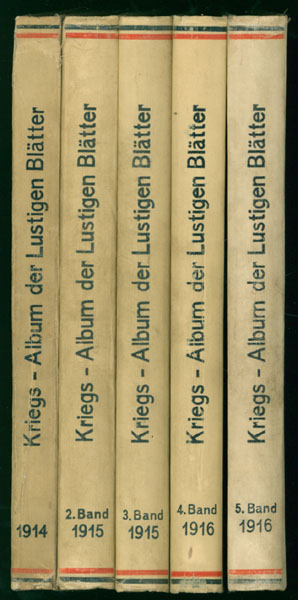
1914réf. 4921EBBerlin, Verlag der lustigen Blätter (Dr. Eysler & Co), 1914-1916. 4°. 32 cm. Nicht durchgehend paginiert. Jedes Heft mit 16 Seiten. Illustrierte Original-Halbleinenbände.
réf. 19002Paris, au bureau du Journal, 1846. In-4, 288 pp. 64 pl., demi-toile verte, plats de papier, dos lisse (frottements, des ff. débrochés, taches et rousseurs).
1932In-8 gr., 16 volumi, rilegati per semestre in mz. tela. Di questo periodico, dapprima quindicinale poi trimensile e nuovamente quindicinale, di ca. 70/90 pp. ogni numero, offriamo una raccolta così composta: - 1932 (Anno I): dal n. 1 (15 marzo) al n. 8 (30 giugno). "Manca il n. 6" - 1933 (trimensile): annata di 36 numeri. "Manca il n. 22" - 1934: I semestre, nn. 1/18, completo - 1935: II semestre, nn. 19/36, completo - 1936 (quindicinale): I semestre, nn. 1/12, completo - 1937: I semestre, nn. 1/12, completo - 1938: nn. 1/24, annata completa - 1939: II semestre, nn. 13/24, completo - 1940: II semestre, nn. 13/24, completo - 1941: nn. 1/24, annata completa - 1942: I semestre, nn. 1/12, completo - 1943: I semestre, nn. 1/12, completo. Uniamo anche: - "Le Forze Sanitarie: Atti ufficiali", 1939, in un volume. Tutto il pubblicato. Esemplare ben conservato.
1980Tutto il pubblicato, ottobre 1980 e marzo 1981. Ottimi esemplari. Presente anche la rara brossura pubblicitaria, pubblicata prima che la rivista uscisse, che contiene interviste, tra gli altri, a Giovanni Anselmo, Alighieri Boetti, Pierpaolo Calzolari, Luciano Fabro, Mimmo Paladino e Gilberto Zorio. Periodico d’arte ricco di articoli su artisti accompagnati da riproduzioni delle loro opere, attento, secondo Maffei, «alle corrispettive tendenze poetiche e letterarie». Interventi, tra gli altri, su Fausto Melotti, Sandro Chia, Mimmo Paladino, Osvaldo Licini, Alighiero Boetti, Scipione, Meret Oppenheim. In appendice traduzioni in inglese e in tedesco degli articoli salienti in ciascun numero. G. Maffei, Libri e documenti. Arte povera 1966-1980, Corraini, 2007, p. 272.Bit. Arte oggi in Italia 2 voll.
réf. 3799, Paris, L. Larose et Forcel 1902 et s., 38 années en 38 vol., reliure en demi-chagrin noir, tit. & tom. dorés sur dos à faux nerfs avec filets à froid soulignant, manque 1935 et 1936, plaçure: 1vol./an, (cuir sec et fragile, piqûres et rousseurs).
1897Edizione originale. Numeri dal 159 (novembre) al 164 (dicembre) più un numero speciale fuori serie del 1897 e tutto il pubblicato del 1900 (compreso numero speciale «Le dégout. Numéro spécial dédié aux Gouvernements européens»). Fascicoli normalmente bruniti in ottimo stato di conservazione rilegati in due volumi. 6 numeri dal 20 novembre al 25 dicembre 1897 (più un numero speciale fuori serie) e tutto il pubblicato del 1900 (compreso il numero speciale «Le dégout. Numéro spécial dédié aux Gouvernements européens») del settimanale satirico francese «Le Rire» attivo dal 1894 al 1971. Fondata a Parigi da Felix Juven - che assunse, oltre al ruolo di direttore, anche quello di editore mentre la redazione venne affidata al giornalista e critico d’arte Arsène Alexandre - , la rivista si componeva di circa 16 pagine composte da testi, strisce a fumetti, vignette e illustrazioni spesso a piena pagina in bianco e nero e a colori affidate, tra i tanti e nel tempo, a Toulouse-Lautrec, Marcel Duchamp, Charles Léandre, Leonetto Cappiello. Ovviamente feroce nei confronti della classe politica francese, «Le Rire» si rivolgeva al pubblico parigino più agiato, attento all’attualità ma anche incuriosito dai cambiamenti sociali o dalle novità artistiche e culturali.
1952Edizione originale. Ottimo esemplare (minimi segni d’usura perimetrale, tra cui un’antica punzonatura a testa e piede del taglio interno, che percorre tutte le pagine), raro a trovarsi completo in ogni sua parte. «Arte concreta» fu il bollettino mensile del M.A.C. Ogni fascicolo è una fragile creazione d’artista. Questo numero terzo presenta una notevolissima copertina composta a collage che dialoga con il sottostante disegno di Gianni Monnet. Il fascicolo è dedicato a — e contiene interventi grafici di — Garau, Monnet, Prébandier, Yersin; contiene il testo del «3° Manifesto dell’Arte spaziale». -- Del bollettino uscì una prima serie dal novembre 1951 al maggio 1952 (nrr. 1-7 con numerazione progressiva delle pagine), una seconda dall’ottobre 1952 al maggio 1953 (nrr. 8-15). Direttore responsabile Giulia Sala Mazzon. Poi cambiò testata divenendo «Bollettino del Mac e del sindacato nazionale arte non-figurativa», formato in 4°, dal numero doppio 16/17 (ott.-nov. 1953) al nr. 24 (giu. 1954), diretto nel 1954 da Franco Passoni: il materiale utilizzato per quest’ultima serie, la terza ma non dichiarata come tale, confluì poi nei «Documenti d’arte d’oggi» 1954 e 1955/56. Maffei, M.A.C., pp. 139ss
réf. 378633 tomes reliés en un volume in-12, plein veau marbré de l'époque, dos à 5 nerfs orné de compartiments fleuronnés et cloisonnés, (8), 91 p.; (2), 93 p., (1) f. bl., (2), 100 p. Londres [i.e. Paris?], 1772.
1969Primo e unico numero. Ottimo esemplare. Pecetta dei prezzi al piatto posteriore. Unico numero pubblicato della rivista diretta da Alberto Boatto, che fino ad allora aveva curato «Cartabianca» e se ne era appena staccato. Numero curato da Argan e Asor Rosa che firmano i due articoli di apertura, «Arte come contestazione» e «Vendere libertà». Oltre all’intervento del direttore Alberto Boatto, anche quelli di Achille Bonito Oliva, Germano Celant, Angelo Trimarco e Maurizio Fagiolo e Rubina Giorgi e altri. Pur continuando nel solco politico-estetica di «Cartabianca», l’impaginazione di «Senzamargine» si rivelò estremamente sperimentale. Raro. G. Maffei, Libri e documenti. Arte povera 1966-1980, Corraini, 2007, p. 285.
1974Edizione originale. Tutto il pubblicato del 1974 e del 1975 (due numeri tripli: 11/12/13 e 14/15/16). Fioritura e piccola mancanza al piatto anteriore della brossura del 1975 e normali tracce di usura a entrambi i numeri, ma nel complesso ottimi esemplari. Estremamente raro. Tutto il pubblicato degli anni 1974 e 1975 in due numeri tripli (11/12/13 e 14/15/16) nel nuovo formato 22 x 16 cm (rispetto ai precedenti 34 x 24 e 33 x 22 degli anni 1969 - 1970) della rivista «Tèchne» pubblicata a Firenze a partire dall’ottobre del 1969 e diretta da Eugenio Miccini come bollettino del Centro omonimo (voluto e creato dallo stesso artista e poeta toscano sempre nel 1969). Tra i membri fondatori del «Gruppo 70» insieme a Lamberto Pignotti e Luciano Ori, Miccini si propose con il centro culturale e con il periodico a esso collegato di proseguire il lavoro di ricerca e divulgazione militante nel campo della sperimentazione d’avanguardia e della Poesia Visiva, di cui l’artista toscano, scomparso nel 2007, fu non soltanto uno dei massimi esponenti ma anche ideatore del termine proprio all’interno dell’esperienza del già ricordato «Gruppo 70». Eccentricamente composta da fogli dattiloscritti, manifesti, riproduzioni di opere, volantini e con i suoi testi in italiano, inglese e tedesco il periodico - la cui pubblicazione proseguirà, con un’interruzione tra il 1970 e il 1974, fino al 1976 per un totale di 19 numeri divisi in 9 fascicoli - si presentava come una raccolta di materiali variamente legati sperimentazione verbo-visiva (diventando, insieme a «Lotta Poetica», l’organo ufficiale del movimento di Poesia Visiva non soltanto a livello nazionale) e come cassa di risonanza delle attività del Centro o di luoghi similmente e volontariamente lontani dai circuiti culturali tradizionali e dal potere da essi esercitato. Rispetto alle prime uscite della rivista, i volumi qui proposti si presentano con una confezione editoriale classica, apparentemente meno vicina allo stile delle riviste avanguardiste e sperimentali assemblate artigianalmente. Rimangono tuttavia le pagine dattiloscritte (con saggi e interventi più lunghi e non più proposti anche in inglese e tedesco), gli inserti e le tavole grafiche stampati su carte di tipo e formati diversi tipici del periodico. Tra i molti contributi testuali e visivi raccolti in questi numeri si segnalano, in particolare, quelli di Sylvano Bussotti, Lucia Marcucci, Emilio Isgrò, Lino Centi, Miroslav Klivar, Lamberto Pignoti, Eugenio Miccini. M. Bazzini, M. Gazzotti, «Controcorrente. Riviste e libri d’artista delle case editrici della Poesia visiva», Allemandi, Torino 2011, pp. 21 - 22; M. Bazzini, G. Maffei, «Geiger - Tèchne. Edizioni di poesia e arte», Gli Ori, Pistoia 2002; G. Maffei, P. Peterlini, «Riviste d’Arte d’Avanguardia», Edizioni Sylvestre Bonnard, 2005, p. 146.
1918Edizione originale. Fogli normalmente bruniti con occasionali fioriture, nel complesso ottimo esemplare. Estremamente raro. Terzo fascicolo (estremamente raro) della prima serie della rivista olandese «Wendingen», creata da Hendricus Theodorus Wijdeveld nel 1918. Legato all’associazione professionale «Architectura et Amicitia», il periodico nacque con l’intento di perseguire un ideale di comunione tra tutte le arti seguendo i “rivolgimenti” - “Wendigen”, appunto - propri di quegli anni di grande fermento culturale e politico. Una «totale riconciliazione delle arti», come scrisse nel primo numero il suo ideatore e capo redattore Wijdeveld, in cui l’architettura avrebbe dovuto giocare un ruolo ovviamente fondamentale ma non egemonico. Non sorprende, dunque, che dei centosedici fascicoli pubblicati tra il 1918 e il 1931 soltanto quarantasette vennero dedicati in modo esclusivo all’architettura, riservando invece estrema attenzione ai punti di contatto tra progettazione e creazione artistica (o alla progettazione messa al servizio della pura creazione artistica). Notevole fu anche la sensibilità verso la pittura simbolista e la “Nieuwe Kunst”, testimoniata ad esempio dall’ultimo numero della prima serie interamente incentrato sull’opera di Jan Toorop, tra i massimi rappresentanti in pittura dell’“Art Nouveau” olandese. Ma l’amore per l’arte in ogni sua forma espressiva è più in generale dichiarato dalle molte immagini che arricchivano ogni fascicolo - elegantissimo con il suo formato 33 x 33 cm e la rilegatura alla giapponese con rafia -, dalle illustrazioni a piena pagina e dalle meravigliose copertine affidate ogni volta ad artisti e architetti diversi. In questo terzo numero del 1918, in particolare, l’illustrazione d’apertura è affidata al designer e scultore Hildo (Hildebrand Lucien) Krop mentre quasi metà del numero è occupata da un lungo approfondimento, completo di riproduzioni fotografiche in bianco e nero, sullo scultore olandese Joseph Mendes da Costa e alla sua composizione bronzea del 1917 “Liefde” (“Amare”).
1918Edizione originale. Leggere fioriture ai fogli normalmente bruniti, nel complesso ottimo esemplare. Estremamente raro. Quarto fascicolo della prima serie della rivista olandese «Wendingen» con la bellissima copertina firmata dall’architetto Cornelis Jouke Blaauw. All’interno un lungo approfondimento sugli studi preparatori di Frits Lensvelt per le scenografie del «Faust» e un articolo su Kandinsky a cura di Jan Gratama. Creata da Hendricus Theodorus Wijdeveld nel 1918, la rivista - legata all’associazione professionale «Architectura et Amicitia» di cui Gratama era al tempo presidente - nacque con l’intento di perseguire un ideale di comunione tra tutte le arti seguendo i “rivolgimenti” - “Wendigen”, appunto - propri di quegli anni di grande fermento culturale e politico. Una «totale riconciliazione delle arti», come scrisse nel primo numero il suo ideatore e capo redattore Wijdeveld, in cui l’architettura avrebbe dovuto giocare un ruolo ovviamente fondamentale ma non egemonico. Non sorprende, dunque, che dei centosedici fascicoli pubblicati tra il 1918 e il 1931 soltanto quarantasette vennero dedicati in modo esclusivo all’architettura, riservando invece estrema attenzione ai punti di contatto tra progettazione e creazione artistica (o alla progettazione messa al servizio della pura creazione artistica). Notevole fu anche la sensibilità verso la pittura simbolista e la “Nieuwe Kunst”, testimoniata ad esempio dall’ultimo numero della prima serie interamente incentrato sull’opera di Jan Toorop, tra i massimi rappresentanti in pittura dell’“Art Nouveau” olandese. Ma l’amore per l’arte in ogni sua forma espressiva è più in generale dichiarato dalle molte immagini che arricchivano ogni fascicolo - elegantissimo con il suo formato 33 x 33 cm e la rilegatura alla giapponese con rafia -, dalle illustrazioni a piena pagina e dalle meravigliose copertine affidate ogni volta ad artisti e architetti diversi.
1963réf. Zy100Varsovie Maison d'édition de l'académie polonaise des sciences et des lettres 1963 Varsovie - Maison d'édition de l'académie polonaise des sciences et des lettres - 1963 - Phototypie a l'identique de tous les numéros et suppléments parus - Grand Infolio ( 54 x 39 cm ) - reliure toilée - bon état Tous les Numéros parus du N.1 au N.158 + Editions du soir + Suppléments + Supplément sur la condamnation du 13 Juin 1849 . La Tribune des Peuples , imprimée a Paris sortit son premier numéro le 15 Mars 1849 - Il fut condamné le 13 juin 1849 et reparu le 1er Septembre 1849 . Il y eut des suppléments . Se voulant l'organe des peuples opprimés , les articles n'étaient jamais signés - Il fut fondé par Adam Mickiewicz et le Baron Branicki . Parmi les collaborateurs on notera Charles Edmond Chojecki .
1963réf. Zy100Varsovie Maison d'édition de l'académie polonaise des sciences et des lettres 1963 Varsovie - Maison d'édition de l'académie polonaise des sciences et des lettres - 1963 - Phototypie a l'identique de tous les numéros et suppléments parus - Grand Infolio ( 54 x 39 cm ) - reliure toilée - bon état Tous les Numéros parus du N.1 au N.158 + Editions du soir + Suppléments + Supplément sur la condamnation du 13 Juin 1849 . La Tribune des Peuples , imprimée a Paris sortit son premier numéro le 15 Mars 1849 - Il fut condamné le 13 juin 1849 et reparu le 1er Septembre 1849 . Il y eut des suppléments . Se voulant l'organe des peuples opprimés , les articles n'étaient jamais signés - Il fut fondé par Adam Mickiewicz et le Baron Branicki . Parmi les collaborateurs on notera Charles Edmond Chojecki .
1979réf. jj6164Dussarthou André Reliure d'éditeur sous emboîtage 1979 In-8 (16 x 22 cm), reliure d'éditeur pleine peau sous emboîtage, filets d'encadrement dorés sur les plats estampés à froid, 218 pages, 1 de 55 exemplaires retouchés par l'artiste sur fonds aquarellés, illustrations en couleurs et hommage de l'illustrateur André Dussarthou ; dos uniformément passé, par ailleurs bel exemplaire. Livraison a domicile (La Poste) ou en Mondial Relay sur simple demande.
réf. 110161A paris, rue S. Jacques, chez Michel Guignard & Claude Robustel, près la Fontaine Saint Severin, à l'Image Saint Jean, 1713, 2 volume grand in-folio de 405x255 mm environ, impression sur 2 colonnes par page, Tome I : 15 ff. (faux-titre, titre en rouge et noir, frontispice, épistre, Avis Avertissement, Table alphabétique des Questions) 964 pages, 17ff. (Table de matières, Privilege), 1f.blanc, - Tome II : 1f.blanc, 8ff. (titre en rouge et noir, table alphabétique des Questions), 1013 pages, 14ff. (table de matières), 1f.blanc, plein veau granité cannelle, dos à 6 nerfs portant titres et tomaisons dorés, ornés de caissons à riches motifs dorés, coupes dorées, gardes marbrées, tranches mouchetées de rouge et brun. Des rousseurs et pages brunies, des cernes et mouillures par endroits, des erreurs de pagination sans manque, 1 feuillet en double (p.549-550), des frottements épidermures et auréoles sur le cuir, une coiffe accidentée (tome I), un coin rongé (tome II), un mors fendu sur 12 cm, page de faux-titre en partie détachée (dos recollé).
réf. 911498Imprimerie De La République Paris 1798-1799 30 numéros de ce rare journal, tête de collection du "BULLETIN DECADAIRE de la République Française", du numéro 1 au numéro 30 sans manques, reliés en 2 volumes in-8 ( 205 X 125 mm ), plein vélin ivoire, dos à nerfs titrés à l'encre noire, tranches mouchetées ( Reliures de l'époque ). 36 numéros furent publiés en l'an VII et 5 numéros en l'an VIII. Tourneux, I, 708, indique que "le catalogue de la B.N. a enregistré divers tirages incomplets du Bulletin Décadaire". Quelques feuillets roussis, bel exemplaire, peu fréquent.