Mc Lean, Bruce [und] Mel GoodingAntiquariat.de
1782 resultados
1985ref. 50227ABLondon., Knife Edge Press., 1985. 42 x 32 cm. 33 Blatt. OPappband mit OUmschlag (Originalsiebdruck) in illustriertem OPapp-Schuber., 50227AB Limited edition of 140 copies. Vordere untere Stoßkante etwas gestaucht, ebenfalls am Schuber an der gleichen Stelle (keine gravierende Beeinschränkung des Gesamtzustandes). Sonst sehr gutes Exemplar.
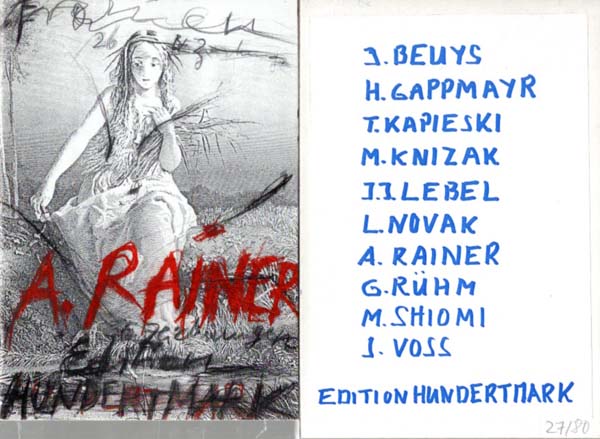
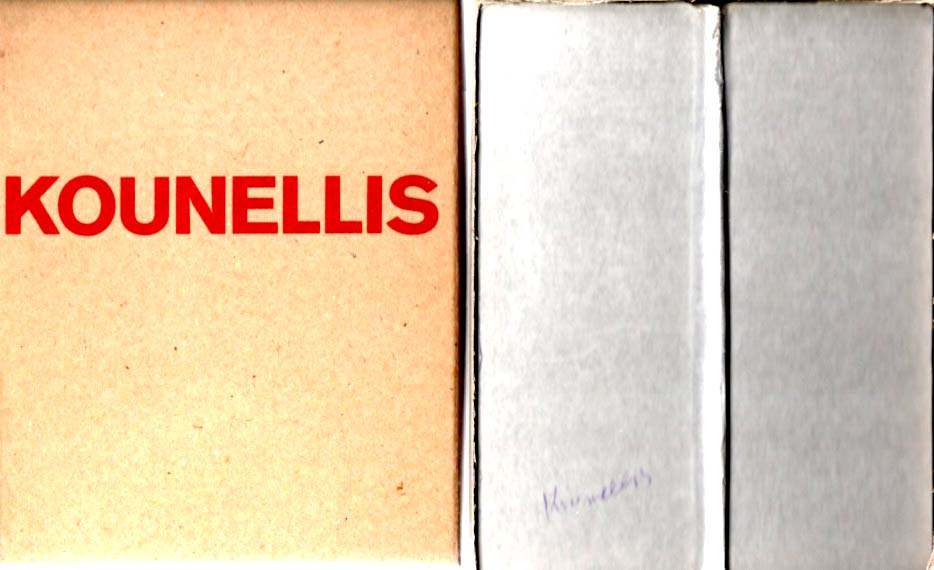
1976ref. 66736ABKöln., Editon Hundertmark., 1976-1998. 22 x 15 cm. Ca. 600 S. OKarton in OPapp-Schuber., 66736A_1 4 Bände / 40 Hefte. 1. Auflage. Schuber teils gering angestaubt, ein Schuber am Fußsteg mit kleinem Exlibris-Stempel. 1 Heft (Böhmler) am oberen Kapital bestoßen. Sonst sehr gutes Exemplar.
1966ref. 31114BBGöttingen, Galerie im Centre / Heinz Raumschüssel, 1966. Einmalige Auflage von 125 numerierten Exemplaren. Titelbedruckter Original-Kartonband im Original-Schuber. Numeriertes Exemplar (hier Nr. 20 / 125)! Vollständig!! Exemplar stammt aus Raucherhaushalt. Band ansonsten in sehr gutem Zustand. Schuber nur mit leichten Gebrauchsspuren.
1865A numbered (278) and printed document granting financial compensation to a slave owner in Suriname, by the Dutch government, signed in the original by numerous parties including the Gouverneur de Kolonie Suriname [Governor of Suriname] Van Lansberge, the Administrateur van Financienvan Het Ministerie van Kolonien te s-Gravenhague [Finance Administrator for the Ministry of the Colonies, at The Hague], and the recipient of the funds who is not only a slave owner but well-known chirurgeon A.D. Charlouis. Text is in Dutch. With steel engraved colonial coat of arms, official ink stamps, the embossed stamp of the "Klein Kolonie Suriname" government. Single leaf measuring approximately 26,5 x 13 cm. Very good condition, beautifully preserved, a scarce and historical slavery document with notable signature. The present document is interesting, as is was made almost two years after the official abolition of slave ownership in Suriname, which reveals the lengthy time period over which this process was stretched. The government's primary concern was not the freedom of the enslaved people; it was the preservation of the plantation economy, lest there be a mass exodus of workers leaving the plantations. The latter was cited as the reason and justification for the mandatory employment contract which accompanied 'free status' of a slave. Chirurgeon Andries Daniel Charlouis (Emden, Lower Saxony 1820 - Paramaribo, Suriname 1880) is the recipient of this compensation. Historical evidence reveals that he had more slaves than what is represented with this document, and that he released them gradually. He was well-known in the field of medical science, particularly for his studies on medicinal matters and the indigenous people of South America; his name appears in numerous medical journals of the period. Reinhart Frans Cornelius van Lansberge (1804-1873), whose signature authorizes this document, was the Governor-General of Suriname from 1 August 1859 to 29 June 1867. Slavery was abolished in the Dutch West Indies during his governorship. Previous to this post, he was Governor of Curacao from 1855 to 1859, and formerly Dutch Consul-General Venezuela. Doctor Charlouis, whose original signature is found to verso, received 1935 guilders with this promissory note effective 15 August 1865. This figure represents the release of approximately 6 slaves. A manuscript annotation to upper left margin, penned in a West Germanic language, refers to the abolition act: "Opheffing der slavernij... 1863" [Elimination of slavery... 1863]. Red ink annotations reveal that this document was registered on 16 September 1865, and signed by a Geregistreerde referendaris J.C. Jaunen [registered secretary]. Additional annotations to the upper margin suggest that the funds were cashed in on 16 October 1865 "Betaalbaar te Amsterdam" [paybale to Amsterdam]. Also interesting to note, two of the signed annotations to verso, those of Charlouis and a witness, make reference to German plantation owner, banker Wilhelm Eduard Ruhmann at Paramaribo. As such, this transaction was most likely transacted at Surinaamsche Bank which had been founded earlier the same year, and the funds dispatched from there to the Dutch government in The Netherlands. The Netherlands abolished the Atlantic slave-trade in 1814. However, localized slavery continued for over half a decade. Slavery was finally abolished in Suriname and the Dutch West Antilles on 1 July 1863 with the Emancipation Act. On that day, about 35,000 slaves in Suriname and 12,000 slaves on the Dutch islands in the Caribbean were given their freedom, or rather a modified version of freedom. Freed men in Suriname come under state supervision for ten years with a mandatory employment contract on the plantations. The slave owners received financial compensation from the government upon releasing their slaves to this system. The Dutch government paid 300 guilders per slave to the owner for the "lost property". (In the Dutch East Indies, payments were far lower, 50 to 350 guilders depending on the age of the slave). The abolition of slavery was referred to as 'emancipation'. Parties were organized in which King William III was presented as a key figure and benefactor of the freed slaves.
1810Manuscript accounts ledger kept by Scottish farmer Daniel Collyer, Esq., (1776-1824), and subsequently continued by his widow Elizabeth, concerning a sizeable historical farming estate upon which today stands the old Cormiston Farm Cottage, providing a very detailed record of the setup, daily undertakings, and commerce of an early nineteenth century farmstead. Folio. 317 pages in manuscript, watermarked leafs, with a rough manuscript plan of the farm drawn on the front endpaper, and a second more detailed plan drawn on a separate leaf loosely placed within. Green boards representative, simple red label to spine, original marbled endpapers. In a patented account book made by John Williams of London, stationer to the Royal family, with original bookbinder's label to front pastedown, dated 1806. Front board bowing, partial separation at front hinge, otherwise in very good condition, binding remaining firm, interior crisp and clean, a very thorough record of early Scottish farming practices and rural life. This volume is replete with detail, a treasury of information, not only about the Collyer family connection to historic Cormiston, but also about local activities including trade, market fairs, social interests, nineteenth century households and the workings of Scottish farming practices. On the lands described herein, there still stands today an old farmhouse, now operating as a family run bed and breakfast called "Cormiston Farm Cottage" [Biggar ML12 6NS, some 2 miles from the town of Biggar]. The farmhouse was built in the 1790's and is still retains many of the original Georgian and Victorian features. The house and large Georgian steading to the rear are B Listed (Grade II) by Historic Scotland, identified by the Canmore National Record of Historic Environment as "Cormiston Towers Farm" ID number 47484, site number NS93NE 29. Manuscript
1889One Original Signed Letter, written Springfield Newnham, Cambridge, Nov 24 [1879]. 2 pages, 8vo. Bi-folium on headed paper with mourning border, "Down, Beckenham, Kent, Railway Station, Orpington S.E.R." Leaf measures approximately 11,5cm x 18cm (4.5 inches x 7 inches), when folded. Very Good Condition, nicely preserved. Accompanied by a Certificate of Authenticity. The Letter reads: My dear Frances, I see in the papers that you have lost your dear mother. I remember when you kindly wrote to me by her wish, that she felt herself that her end could not be very distant. I should be very grateful for a line, and I trust you will be able to tell me that she did not suffer very much; but rather that her placid & happy nature remained with her to the last. Believe me , Very sincerely yours, Emma Darwin" Frances Julia "Snow" Wedgwood (9 July 1833 – 26 November 1913) was an English feminist novelist, biographer, historian and literary critic. She was described as "a young woman of extreme passions and fastidious principles" and "at once a powerful reasoner and an inexorable critic of reason” Manuscript
1889One Original Signed Letter, written ca.1889, 2 pages 8vo. Bi-folium on headed paper, "Down, Farnborough R.S.O, Kent". Leaf measures approximately 11,5cm x 18cm (4.5 inches x 7 inches), when folded. Very Good Condition, nicely preserved. Accompanied by a Certificate of Authenticity. The letter reads: My dear Frances, I am anxious to know how your cousin is today, & whether you have hopes of being able to move tomorrow. If you had leisure to come & see me this afternoon for a short time, I should be glad; but only send me a verbal answer at all events. yours very sincerely, E. Darwin, (Mrs. Charles Darwin)" Frances Julia "Snow" Wedgwood (9 July 1833 – 26 November 1913) was an English feminist novelist, biographer, historian and literary critic. She was described as "a young woman of extreme passions and fastidious principles" and "at once a powerful reasoner and an inexorable critic of reason. Manuscript
1833Manuscript of religious interest, concerning the Protestant Reformation in Switzerland and drawing strictly from the work of reformer and author Johann Zschokke. Manuscript entitled, "Neuere Geschichte vom Beginn der kirchlichen Trennung 1519 bis auf die heutigen Tage. Auszug aus Zschokke. 1833-34." [Recent History from the Beginning of the Ecclesiastical Separation 1519 to the Present Day. Short Excerpt from Zschokke. 1833-1834.] The writer only identifies himself as "Bernhard" on the title page. Text is in German, in a fine hand. 8vo. 129 pages, plus title page. Brown continental boards. Volume measures approximately 12 x 18 cm. Slight wear to boards at extremities, otherwise in very good condition, internally very crisp and bright, a beautifully preserved document. Zschokke is widely remembered for writings of history and fiction. As the present volume transcribes from a religious treatise, it preserves parts of a little-known and more scarce work, while also providing insight into his perspective as a religious reformer. The present volume contains highlights from Zschokke's history of Switzerland during the religious reformation era, a subject of great importance to him as a Protestant reformer himself. Manuscript
1869The light vessels being the predecessors of the two permanent lighthouses of Ceylon fame, situated some fourteen kilometers apart off the coast of Yala National Park. Two folio documents: April 1869 double leaf true copy of a memorandum on winds and currents at Little Basses; April 1870 single leaf notice to sea captains announcing the temporary lighthouse near the Great Basses, issued by Colonial Secretary Henry Turner Irving (later Governor) and penned in a secretarial hand; both on blindstamped stationery of the United States Commercial Agency of Ceylon measuring approximately 20 x 32 cm. Slight age-toning, otherwise in very good condition, rare documents connected to two offshore lighthouses which are among the most famous in Asia. This fascinating and detailed manuscript lighthouse report, was made prior to the actual lighthouses having been constructed, by a sea captain who lived on the light ship anchored off the Ceylon southern shore for at least seven years, making important observations and providing light for navigators. The first document is an annual report by John Buchanan, master of the light vessel at Little Basses, describing seasonal wind and weather conditions, sea currents, tides, monsoons and storms, over the period of one year. The captain also describes steamships having difficulties making the passage to shore. This document being a true copy of the original made in April 1869 by Thomas Steele, Assistant Government Agent at Hambantota, who took a noteworthy interest in local antiquities and Sinhalese literature. [An admiralty notice based on Buchanan's memorandum, though slightly edited, was published in the London and China Telegraph, Vol. 12, May 16, 1870, and also in The Nautical Magazine and Naval Chronicle for 1870]. Excerpts from Buchanan's lightship memorandum: ".... at Little Basses Rocks, Ceylon, during 13 months as observed from the Light Ship." "January [1869]... It would not be inaccurate to say that a strong current continues throughout January coming from the NNE from the Bay of Bengal setting S.S.W. Sea crossing very rough all the month.... both wind and tide against them...difficult for ships to get to the Northeast. It would be well not to attempt to do so." "February... towards the end of the month the wind becomes much lighter. The northerly current also slacken. Occasionally in the month the Light Vessel swings. In 1868, however, she did not swing until April, while in the current year (1869) she swings in February. During the seven years I have been here, the SW monsoon has not hitherto set in regularly until from the 4th to the 10th of May. This year it has been steady at SW since April 6th. The present year is accordingly an exception to the rule..." "I consider March one of our finest months at the Little Basses... 87º in the shade... Shipmasters going to any part of Burmah need have no cause for hesitation... " "May... the monsoon sets in strong and steady... much rain falls, and thunder and lightning... until about the 20th October..." "June, July, August and September... the S.W. monsoon blows strong and steady... Notwithstanding the extreme difficulty I have been enabled (occasionally at much risk of life and property) to keep up a monthly communication with Pottana Bay [Pothana Bay], and thence by land with Galle." "November... much thunder and lightning... Floating bodies invariably I have observed, set right out to sea, S.S.W. ..." "Summary... There are no regular tides... the N.E. monsoon... during five months without variation. Thus a steamer steering N.N.E., has not only to oppose a three-knot tide opposed to her, but the wind dead against her... some steamers barely make two miles an hour going to the north... When the sun goes to the northward of the Light Ship, there is no more N.E. monsoon... in the event of a vessel making Dondra Head when bound to Galle, which is not uncommon the Master should never attempt to beat to Galle, but recross the line." End Excerpts. "Notice to Mariners, Bay of Bengal. Temporary Lighthouse near the Great Basses" heads the second document, which was issued by Colonial Secretary Henry T. Irving at Colombo in April 1870. Irving became a colonial governor not long after. Here too, prior to construction of a permanent structure, the admiralty anchored a temporary light-vessel upon which was mounted a revolving signal. This announcement came approximately one year before placement of the first stone for the lighthouse, and four years before it would begin operation. Excerpt from Irving's notice to mariners: "... it is hereby notified... that a light-vessel, exhibiting at an elevation of 38 feet above the sea, a red revolving light at intervals of 45 seconds, has been placed... at a distance of 3/4 of a mile from the N.E. rock of the Great Basses Reef... The vessel carries two balls vertical at the Mast Head." End Excerpt. Sir Henry Turner Irving, GCMG (1833-1923) was a British Civil Servant and Colonial Administrator. He first served as acting Governor of British Ceylon. In 1873-1874, he served as Governor of the Leeward Islands. In 1874-1880, he served as Governor of Trinidad and Tobago. In 1882-1887, he served as Governor of British Guiana. He was the first Governor of Trinidad to occupy the Government House, now known as the President's House. Notes on the lighthouses that subsequently replaced the "light-ships" described above: Great Basses Reef Lighthouse is an offshore lighthouse in the south of Sri Lanka. Accessible only by boat, it is located on a reef 13 km off the coast of Yala National Park, near Little Basses Reef Lighthouse. The necessity of a lighthouse at this location was acknowledged in 1856, a design of an iron tower on a granite base was suggested and costs began to be incurred without fruition. A new design by Alexander Gordon and Sir James Nicholas Douglass was approved in 1867. The executive engineer in charge was James' brother William Douglass. Two steam vessels were used, each capable of carrying 120 tonnes of stone, and each equipped with the appropriate lifting gear. Each support block weighed 2 to 3 tons. The first stone was laid in December 1870, the last in late 1872 and the light was lit in March 1873. The cost had been £63,000, of which £40,000 had been expended to no effect before Trinity House and William Douglass were involved. Little Basses Reef Lighthouse is an active offshore lighthouse at the southern end of Sri Lanka. It is located on a reef called Kuda Ravana Kotuwa (Fort of Little Ravana), formerly called Little Basses by the British when they invaded Ceylon. It is fourteen km off the coast of Yala National Park and north east of the Great Basses Reef Lighthouse. It was completed in 1878, built by William Douglass using the same steam ships, crew and workers as the Great Basses Reef Lighthouse. Designed by Sir James Nicholas Douglass, Little Basses lighthouse was one of a limited number of lighthouses that were designed to house the large Hyperradiant Fresnel lenses that became available at the end of the 19th century. Four of these lenses were used in Sri Lankan lights, all made by Chance Brothers in England. The lighthouse is close to Daedalus Rock, site of the sinking of HMS Daedalus (1811). The two Basses lighthouses are among the most famous offshore lighthouses of Asia. Manuscript
1844A collection of manuscript and printed materials by celebrated poet, playwright, lyricist and Consul John Howard Payne consisting of an unpublished, autograph poem, an autograph letter written from Tunis as the resident American Consul dealing with the matter of an insult to the American flag as well as an account of the repatriation of his remains to American home soil from Tunis in Africa to Oak Hill Cemetery in Georgetown. A specially bound volume titled 'John Howard Payne - a Biographical Sketch' by Charles H. Brainard, Coolidge, Washington, DC 1885 providing an interesting Biography and dealing with the repatriation of Payne's remains to Washington 30 years after he died in Africa. The account is very detailed, leaves nothing to the imagination as far as the transportation of the remains are concerned and is accompanied by some photographic plates. Bound in a special full morocco presentation binding, all edges gilt, gilt inner dentelles, silk moire endpapers. A beautifully executed printed work and binding in fine condition. Manuscript
1813Manuscript letter by Sir Richard Croft, Physician to King George III and the Royal Family, accoucheur (obstetrician), and British peer, describes complications of a pregnancy four years before the "triple obstetrical tragedy" Princess Charlotte which has become his unfortunate infamy. 8vo. 2 pages in manuscript. Double leaf measuring approximately 12 x 18,5 cm, watermarked with the year 1811, with integral address, two postal ink stamps and a lovely red wax seal. Very faint age-toning only to sections of the leaf exposed for mailing, otherwise in very good condition, beautifully preserved and highly relevant to the writer's occupation as a manmidwife and the complications of pregnancy and birthing in the early nineteenth century. "Sir Richard Croft (1762-1818) physician and man-midwife gained notoriety after his involvement in the labor of Princess Charlotte, which resulted in her death. He never shook off the shame of the tragedy, and shot himself three months later." (Oxford DNB). Manuscript signed letter from the Royal Physician and Male Midwife to the late Princess Charlotte, Sir Richard Croft, who is remembered for causing the "Triple Obstetrical Tragedy" of 1817, in which is a primary source account of early nineteenth century complications and precepts surrounding pregnancy and child deliveries. The writer is Sir Richard Croft, 6th Baronet (9 January 1762 - 13 February 1818), English physician to the British Royal Family and the obstetrician to Princess Charlotte, who is famed for his role in "the triple obstetrical tragedy" of her death in 1817. He received his medical training from, among others, his father-in-law, Dr. Thomas Denman, a preeminent obstetrician in London whose textbook on childbirth had been first published in 1788. He graduated with his MD from the University of Oxford in 1789. Croft was appointed the personal physician of King George III. He was also a member of the Medical and Chirurgical Society of London, and Physician to the Lying-in Charity on Old Burlington Street. He was the primary accoucheur or midwife to Princess Charlotte, granddaughter of the reigning King George III. Manuscript
1978ref. 56597ABMönchengladbach., Städtisches Museum., 1978. 15,5 x 20,0 cm. 4 lose Karten (3 Texttableaus, 1 Titel). OKarton-Kassette., 56597A Auflage: 400 Exemplare. Sehr gutes, frisches Exemplar.
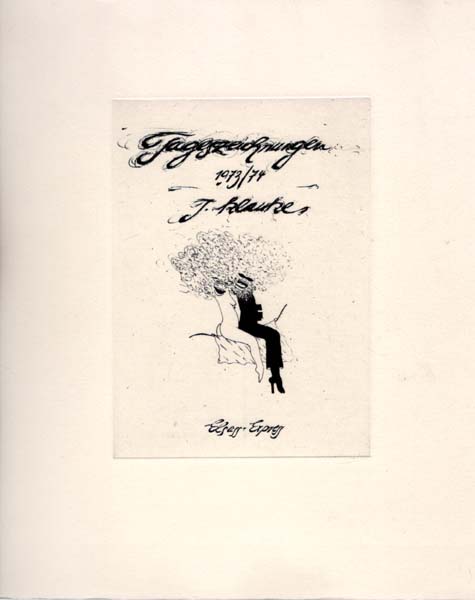
1975ref. 68712ABKöln., Elsass Express., 1975. 37,4 x 30,9 cm. [54] unpaginierte Blätter. OKarton mit schwarzweisser Originalradierung recto mit Plattenabdruck., 68712A Erste Auflage. Rücken materialbedingt wenig lesespurig, sonst sehr gutes Exemplar.
Rudolf Diesel's retained copy of his own signed manuscript letter to Samuel Breslauer, concerning the installation of a gas engine. Text is in German. 4to. Two single leafs, 2 pages of text on onion skin paper measuring approximately 30 x 24 cm. Minor age-toning, otherwise in very good condition. In this correspondence, Diesel describes alterations being made to the design of his first prototype, making comments on the compressor, transmission, and the lighting system (ignition), among other things. The second prototype, described here, would be built by October the same year. The specific plan for this engine model is noted in the upper margin: Plan F.B.930. Rudolf Christian Karl Diesel (1858-1913), needing no introduction, was a German inventor and mechanical engineer who is world-famous for having invented the Diesel engine. At the time of this letter, Diesel was diligently working on altering and perfecting his 1893 engine design. This design would later be known as the diesel engine. The first prototype Motor 150/400, had been completed 12 July 1893. Initial tests proved it to be a successful concept. By October 1895, after the first prototype had been converted into the second prototype Motor 220/400. After testing, and always seeking to improve, again it was decided that a completely new engine had to be designed from scratch. On 20 February 1896, Krupp, Maschinenfabrik Augsburg, and Diesel, decided to start the development of the new engine. The new engine was supposed to be a 250 mm bore engine with a 400 mm stroke. On 5 March 1896, Diesel filed a patent application for supercharging; on 26 March, it was decided to build the new engine with a supercharger. In order to improve the efficiency of the development process, a new design bureau was built directly into Diesel's Augsburg testing laboratory. Several young engineers worked there, including Imanuel Lauster. On 30 April 1896, after Lauster had completed the drawings, the workshop at Augsburg began making parts for the engine. The first successful Diesel engine Motor 250/400, designed by Rudolf Diesel, was officially tested in 1897 by German industrial engineer Moritz Schröter. Schröter concluded, "we are beholding a quite marketable machine that has been thoroughly designed with great attention to every single detail." At this time, several firms bought licences for building legal copies of the Motor 250/400. It is now on display at the German Technical Museum in Munich. The recipient of the correspondent is Samuel Breslauer (1870-1942), a lawyer, journalist and editor, who rose to be head of the Politics department for the Berlin newspaper "Berliner Lokal Anzeiger", a daily newspaper with one of the highest national circulations of its time. Breslauer is remembered as one of the numerous Jews who were captured and deported camp during the holocaust. Surely his public role would have made him an immediate target by the German extremist leader. In August 1942, Breslauer and his wife Bertha were taken to the Theresienstadt concentration camp where they both died, she within four days.
1867Manuscript diary with several drawings, kept by an Englishman who travelled with his family to Germany, Belgium, Switzerland from 29 May 1867 - 15 June 1867, then to France from 1 June 1873 - 12 December 1874, relocating them for these 15 months to Normandy. Contains approximately 36 drawings, one which is a double-leaf scene pasted within, and a few botanical specimens mounted within. Accompanied by a travel itinerary with colour map detailing part of the first journey to the continent in 1867. 8vo. 2, 136, 156 pages. Brown leather boards, tooled front and back. Volume measures approximately 10 x 15 x 2 cm. Map/itinerary leaf measures 18 x 12,5 cm. Wear to boards especially at spine, front hinge delicate, otherwise in very good condition, an interesting Victorian diary. The writer is John Davis Britton, born on 28 December 1832 as revealed within the diary when he celebrates his 41st birthday at home in Vire. He is travelling with his wife Kitty, and children, at least five of whom are named - Lizzie, Aline, Ethel, Diddy, Dick. The delightful two-week travel to the continent features accounts of Lucerne at the dawn of tourism before most of today's historic hotels were even built, and highly favourable descriptions of Freiburg im Breisgau which has nothing short of enamoured the visitors. Manuscript
1927ref. 78147New York: The MacMillan Company. 1927. XIV, (2), 213 S., 1 Falttafel,. Sehr sauber - sehr gut erhalten. - Very fine condition. 8° (Oktav, 18,5 bis 22,5 cm), Goldgeprägtes Orig.- Leinen (Hardcover).
ref. AMA-1762 volumes in 12, demi-maroquin violine à coins, dos à 4 nerfs, date dorée en pied, filets dorés sur les plats, tête dorées, couvertures conservées, envois (Reliures de Aussourd). 251 pp.-(1)f., 246 pp.-(1)f
1801Four manuscript court documents pertaining to an American merchant ship captured in 1801 by a Spanish Privateer while on a voyage to Barcelona and Malaga with valuable cargo, the subsequent recapture by the American crew, and claim for compensation from the salvage of her cargo. Three folio, one octavo, all single-leafs. Two documents are split at folds, one of which has very minor loss to text, otherwise the lot in very good condition, clean and legible, a most interesting record of the event and proceedings in the Admiralty Court. The American Brig Eliza, formerly Schooner Maria, whose homeport was Charleston and master was Captain Joseph Michael, was destined for Barcelona and Malaga in June 1801, with a cargo belonging to an American merchant named John Seamy. Near Tarifa, in Cádiz Province, on 10 July she was seized by Spanish privateers and ordered to the Port of Algeciras. While at anchor there, Captain Michael, with the help of his crew, in particular a Benjamin Hubble, managed to re-take the ship from the Spanish. They immediately proceeded across the Bay to Gibraltar with the intention of selling the ship and cargo for personal gain. Refusal to acquiesce to the Spanish privateers would have resulted in extreme retribution for the American captain and crew if they had not succeeded in their escape, as mentioned in the documents as a reason to disallow the captain of any monetary gains for the recovered vessel. There was also intense fighting around Gibraltar, involving the French, Spanish, and British, therefore the Spanish were well-positioned and well-armed. It was the Battle of Algeciras Bay taking place, having begun only 4 days earlier on 6 July 1801. (It would end on the 12th). Adding to the eminent danger for the Americans, when the United States had declared independence, British diplomats were quick to inform the Barbary States that U.S. ships were open to attack. In May 1801, some 6 weeks before the incident described in the present documents, the First Barbary War had begun, a war between the alliance of the United States and several European countries, against the Northwest African Muslim states known collectively as the Barbary States. Prior to independence, American colonists had enjoyed the protection of the British Navy. The British no longer offered protection. The Mediterranean Sea was now a precarious place for Americans to sail. On 4 December 1801, four members of the crew, Benjamin Huddle, Robert Sherington, Thomas William, William Sesten, engaged a proctor to recover the ship and her cargo. His compensation would be half of the value of the salvage. Following the recovery voyage, accusations flowed freely and, a few months later, in December 1801, a trial in the Admiralty Court ensued. The proctor presented his case for the claimants. The result of the trial is not identified herein, but can be assumed in favour of the claimants, based on the final document, which is a "release of all claims" by the ship's new captain, Nathan Ells, who was a mate under Captain Michael, employed on the ship during the event in question.
1836Primary source account of the Belenzada Affair, by a British marine serving on HMS Cornwallis (1813) and participating in the event at Lisbon, describing daily and hourly actions taking place during the counter-revolution begun by Queen Maria II. Annotated by a contemporary transcriber who seems to be a friend of the diarist and presumably the recipient of the original letter, to front upper margin: "Extract Private letter" and to the end leaf: "Novr. 3d 1836 Revolution at Lisbon Copy of Wms Report of it". 8vo. 7 pages in manuscript. Two double leafs measuring approximately 21 x 26,5 cm. Occasional creasing, very minor loss to first leaf, not affecting legibility of context, otherwise in very good condition. The Belenzada, also known as the Belém Affair, was an attempted coup in November 1836 by Queen Maria II of Portugal and her husband Prince Ferdinand II, to remove the liberal government which had been established by the September Revolution, and to reinstate the Constitutional Charter of 1826. Despite enjoying diplomatic support from the United Kingdom and Belgium, the attempt was frustrated by the determination of the National Guard, the regular army and the general population of Lisbon. This primary source document provides a superbly detailed chronical of events of one counter-revolution in Imperial Portugal, initiated by Queen Maria II herself, as a response to the uprising of the Setembrismo and Cartismo movement to end the political "devorismo" ('devourism') as it was termed at the time. The event is all-but-forgotten by Western historians, albeit said to be one of the three most important of conspiracies or plots executed during this period of unrelenting political conflict. Manuscript
1934Twenty-four (24) letters, 29 December 1934 - 11 April 1940, written by French priest Jacques Grignon while in South China working to establish a seminary for the Catholic Church, feature firsthand accounts of Communist movements and attacks, of the Japanese threat, and the general state of affairs during the first part of the Chinese Civil War. All text is in French. Twenty letters are typescript, signed "Jacques" in manuscript and feature occasional manuscript annotations by the author; four letters are in manuscript and signed in the same manner as the latter. Together with one envelope addressed in typescript to the writer's brother Jean Grignon in Paris, to whom all of the letters are addressed. 8vo. 23 pages altogether, on single leaf delicate tissue writing paper, ranging in size slightly, the smallest leafs measuring approximately 13,5 x 21 cm, the largest measuring approximately 19 x 25 cm. Envelope measures approximately 13 x 8 cm. Tear to upper margin of one letter, unobtrusive to text, otherwise the lot in very good condition, excellent primary source content. Letters written by a Parisian civilian sent to China in a time of global economic turmoil contemplates Communism, economy, and morality, showing notable concern towards the plight of France during the ongoing Great Depression, while describing the equally unsettling state of affairs in China during the Chinese Civil War. The writer, Jacques Grignon was a French priest, who arrived in China in 1934, evidently not long before the first letter, to join three others in establishing a seminary in Yunnanfu (present-day Kunming) in southern China. Little else is known about him, although he had family in Paris. His letter of 6 February 1936 also reveals that he had just celebrated his 42nd birthday, as such being born circa 1894. A learned and intellectual man, with a rather liberal perspective at times, considering his chosen vocation as he mentions political events and severe social problems, he also considers certain injustices that had brought about the crisis to substantiate his unique approach. Specific events discussed while in China include the movements of Communist insurgents, the revolt of Zhang Xueliang [The Xi'an Incident of 1936] and the subsequent release of Generalissimo Chiang Kai-shek who had been captured, and Japanese troops positioned in Peking for what would become the Battle of Beiping-Tianjin [25-31 July 1937]. Interesting anecdotes describe the lackadaisical manner of progress made by the Chinese in construction, the beginnings of official systemization for street names and house numbering in Yunnan [Kunming,] as well as general challenges with ammenities and travel in China. Manuscript
1837Manuscript signed discourse written at the onset of the Panic of 1837, concerning the ethics and obligations of the Mechanics' and Manufacturers' Bank in Trenton which had been established less than three years earlier, by respected Trenton attorney and Whig politician William Halsted (1794-1878) who had recently been elected a Member of the United States Representatives to represent New Jersey, signed and dated in the original by the author. 8vo. 8 pages in manuscript, penned recto and verso, each leaf affixed to the next with two spots of glue to upper margin, measuring approximately 20 x 25 cm, and featuring an embossed cameo of a three-masted barque. Some creasing, otherwise in very good condition. At the request of the Directors of the Mechanics' and Manufacturers' Bank of Trenton, from a legal standpoint, Halsted answers three specific questions regarding the bank's refusal (inability) to redeem paper currency into specie (silver or gold coins). His erudite assessment surely resulted in careful deliberation by the members of the board, while it provides for us now a scarce period perspective of the historic financial crisis. Halsted's discourse is dated 8 June 1837. A financial assessment of the Mechanics' and Manufacturers' Bank in Trenton was reviewed at the Legislature's General Assembly of 24 October 1837. Following the publication of a detailed banking statement, as seen in the volumes of the Legislature, the State Gazette of 22 December 1837 published this remark, "The condition of The Mechanics Bank is now before the Community and it is proved to be worthy of great confidence." William Halstead (1794-1878) was an American Whig Party politician who represented New Jersey at large in the United States House of Representatives from 1837-1839. Halstead was elected as a Whig to the Twenty-Fifth United States Congress (4 March 1837 to 3 March 1839). Manuscript
1900Beirut, Damascus, Hama, Bhamdoun: 28 February 1900 - June 1901. Lot of 5 manuscript letters written and signed by Harvard anthropologist Henry Minor Huxley, concerning anthropological work performed for the Howard Crosby Butler Archaeological Expedition to the Middle East, as well as a noteworthy archaeological discovery of an ancient and curious stone inscription, its location guarded with secrecy by the few expedition members having this knowledge. 8vo. double-leafs varying in size. 24 pages combined, each letter signed in the original. Two letters are on hotel stationery. Occasional light creasing, otherwise in very good condition, clean and bright, a fascinating and candid primary source account. Writing to a trusted source, his mother, Huxley's reveals the discovery of an ancient inscription carved into an overturned stone, in a language possibly not yet identified, stating that he took the first photograph of it, and that only a select few expedition members are privy to knowing its location. His commentary on experiences with the local civilians and officials are straightforward and occasionally blunt. Henry Minor Huxley, A.M. accepted the offer to join the American Archaeological Expedition led by American archaeologist Howard Crosby Butler. The first part of the archaeological work took place from mid-October to mid-December 1899, and a second trip was made for continued work from March to June, 1900. In the summer of 1900, he was devoted to acquiring a working knowledge of the vernacular Arabic. Huxley's work, however, involved a broader scope. During this second trip, he was also tasked with the study of physical anthropology, as is apparent in the present correspondence. This work proved so valuable that Huxley, owing to the patronage of New York businessman and archeological enthusiast B.T. Babbitt Hyde, remained for another year to further these anthropological observations, independently. What does not appear to be officially documented in publications, but is highly fascinating, is what Huxley writes in his last letter of the present lot. That is, in June 1901, just prior to returning to America, he alone returned to the site of a stone inscription discovered during the earlier part of the expedition (presumably in 1899), to copy it, photograph it, and turn it back face down so that no others would see it. This would increase the likelihood that he and one other would have a better chance of being the first to decipher it.
1973ref. 66417ABReykjavik., Dieter Roth., 1973. 47 x 33 cm. Ca. 1200 S. OKarton mit Gazeverleimten Rücken., 66417AB Auflage 150 Exemplare. Sehr gutes Exemplar. [Tränen 2].
1970ref. 62503ABStuttgart. London. Reykjavik., Edition Hansjörg Mayer., 1970. 23 x 17 cm. [256] S. OKarton mit verleimter Papp-Manschette mit Montagen., 62503AB Auflage 1000 Exemplare. Buch am Rücken berieben, am oberen Kapital 1 cm Abrieb des Bezugspapier. Sonst sehr gutes Exemmplar. Gesammelte Werke Band 11.
1861Nikolayevsk-on-Amur, Chita, Sretensk, Blagoveshchensk, TransBaikal villages, 17 May 1861 - 23 September 1880. Two manuscript journals of an English Engineer in Russian Far East, contracted to test and repair some of the pioneering steamships on the Rivers Amur and Shilka, and other important works in the Trans-Baikal region, beginning his work some 24 years before the founding of the Eastern Siberian Inland Navigation Company, and interacting several notables who were involved in the development projects. 8vo. The earliest volume comprises 113 pages of manuscript entries dating from 17 May 1861 to 22 July 1861 and then a few pages from and then from 1 January 1868 to 22 May 1870, with a tipped-in folding map of the Amur River. The subsequent volume contains 135 pages in manuscript and dates from 14 August 1876 to 23 September 1880. Cloth over marbled boards. Volumes measure approximately 19 x 24 cm and 17 x 20 cm, respectively. Map measures approximately 46 x 20 cm. Wear to boards, hinges loose, otherwise internally clean, an exceedingly scarce and early primary source account of early developments of steam navigation in the Far East of Russia. This account is very early for the region, particularly the inner reaches of the Amur river and its tributaries, where there were scarce inhabitants or even visitors, and thus are even fewer surviving manuscript accounts. It pre-dates the founding of the important "Eastern Siberian Inland Navigation Company" which would be founded in 1885, twenty-four years after the writer began his pioneering work. It also pre-dates the Trans-Siberian Railway which would be built between 1891 and 1916 under the supervision of Russian government ministers personally appointed by Tsar Alexander III and his son, the Tsarevich Nicholas (later Tsar Nicholas II). The writer's arrival occurs only three years after the Aigun Treaty in 1858, through which the area north of the Amur belonging to the Manchu Qing dynasty since the 1689 Treaty of Nerchinsk was suddenly ceded to Russia. The Amur River has formed Russia's border with China since the 1858 Aigun Treaty and the 1860 Treaty of Peking. A folding map compiled in 1858 according to contemporary Russian sources, delineates the winding route of the Amur River throughout the Russian-Chinese borderlands, from Lake Baikal, to the mountainous Transbaikal region, to the Sea of Okhotsk snd the Strait of Tartary. Manuscript