1782 resultados
1512Spain, 1512. Manuscript will and testament, in Latin, of Anthonio Colonier from the Catalan village of Arenys de Munt, dated Calella, 8 May 1512. Folio, 27 x 34 cm, written in a neat scribal hand on vellum. Some age-toning, otherwise in very good condition, a rare manuscript document surviving over 500 years. Latin Manuscript Will and Testament of Catalan Farmer from Arenys de Munt, 1512. The will and testament of Anthonio Colonier, a farmer from the Catalan village of Arenys de Munt in the outskirts of Calella (where the will was signed) and north of Barcelona. In it, Colonier names his daughter, Eulalie, as his legitimate heir. Arenys de Munt is a municipality in the comarca of the Maresme in Catalonia, Spain. It is situated inland from the coast, in the el Corredor range. It retains a textile industry and is also known for the production of strawberries, cherries and liqueurs. (Arenys is Catalan for "sands (of a seasonal creek)" and de Munt for "up hill"). Manuscript
[Berlin], 22 February [1895]. Rudolf Diesel's retained copy of his own signed manuscript letter to Samuel Breslauer, following up on previous correspondence concerning the installation of his prototype diesel engine, during the design stage. Text is in German. 4to. Single leaf, 4 lines of text on onion skin paper measuring approximately 30 x 24 cm. Minor age-toning, otherwise in very good condition. Rudolf Christian Karl Diesel (1858-1913), needing no introduction, was a German inventor and mechanical engineer who is world-famous for having invented the Diesel engine. At the time of this letter, Diesel was diligently working on altering and perfecting his 1893 engine design. This design would later be known as the diesel engine. The first prototype Motor 150/400, had been completed 12 July 1893. Initial tests proved it to be a successful concept. By October 1895, after the first prototype had been converted into the second prototype Motor 220/400, it had become clear that, a completely new engine had to be designed from scratch. On 20 February 1896, Krupp, Maschinenfabrik Augsburg, and Diesel, decided to start the development of the new engine. The new engine was supposed to be a 250 mm bore engine with a 400 mm stroke. On 5 March 1896, Diesel filed a patent application for supercharging; on 26 March, it was decided to build the new engine with a supercharger. In order to improve the efficiency of the development process, a new design bureau was built directly into Diesel's Augsburg testing laboratory. Several young engineers worked there, including Imanuel Lauster. On 30 April 1896, after Lauster had completed the drawings, the workshop at Augsburg began making parts for the engine. The first successful Diesel engine Motor 250/400, designed by Rudolf Diesel, was officially tested in 1897 by German industrial engineer Moritz Schröter. Schröter concluded, "we are beholding a quite marketable machine that has been thoroughly designed with great attention to every single detail." At this time, several firms bought licences for building legal copies of the Motor 250/400. It is now on display at the German Technical Museum in Munich. The recipient of the correspondent is Samuel Breslauer (1870-1942), a lawyer, journalist and editor, who rose to be head of the Politics department for the Berlin newspaper "Berliner Lokal Anzeiger", a daily newspaper with one of the highest national circulations of its time. Breslauer is remembered as one of the numerous Jews who were captured and deported camp during the holocaust. Surely his public role would have made him an immediate target by the German extremist leader. In August 1942, Breslauer and his wife Bertha were taken to the Theresienstadt concentration camp where they both died, she within four days.
8vo. 19 pages, plus introduction, penned on 6 string-tied double leafs bearing the watermark 'Cansell 1834.' Item measures approximately 10,5 x 17,5 cm. Slight age-toning, otherwise in very good condition. Unrecorded English manuscript translation of Ahmet Resmî Efendi's lesser known narrative "Viyana Sefaretnamesi" in which he described his diplomatic embassy to Vienna during the Seven Years' War. This is an abridged work, providing a summary of the journey from Istanbul to Vienna in 1757, and most importantly, his official meeting with Francis I, Holy Roman Emperor, King of Germany. The English writer includes footnotes on some Ottoman custom and terminology, drawing these from the work of Austrian diplomat and orientalist Joseph von Hammer-Purgstall (1774-1856) who, at around this same time, had translated the earlier Sefâretnâme of Evliya Efendi ito English. Ahmet Resmî Efendi's report "Viyana Sefaretnamesi" was written immediately upon his return to Istanbul from Vienna in 1758. Manuscript
18818vo, 154 pages, 80 pages of ads, bound in original publisher's cloth, heavily annotated and inscribed by author on title page, a rare Presentation Copy in very good condition. A linguistic and and folkloric study, issued in the publisher's Oriental Series. Scarce in the first edition. Tsuni-Goam is a figure in the Khoikhoi mythology. He is sometimes called a trickster figure, similar to Cagn of the related Bushmen people. In other contexts, he appears as a patron of hunters and in some stories he even had a part in creating the world. The multiple roles of have been called a reflection of the fluidity of the Khoisan's religious resources and rituals, which are usually ambiguous and lack in standardization. He was also a life-death-rebirth figure, dying and resurrecting himself on numerous occasions. Resulting from this, his funeral cairns can be found in many locations in southern Africa, and it is customary to throw a stone onto them for good luck Manuscript
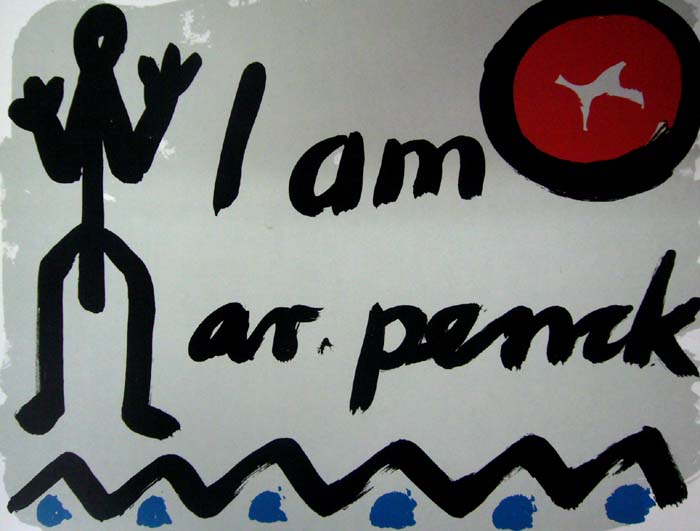
1989ref. 69180ABStuttgart., Edition Cantz., 1989. 29,5 x 24,7 x 4,7 cm (Schuber); 28,5 x 24,5 cm (Buch und Kassette). 107 S. Blindgeprägter OPappband mit illustriertem, glanzkaschiertem OUmschlag; blindgeprägte bronzegoldfarbene OKassette; OPappschuber., 69180A Erste Auflage. Schuber etwas berieben und wenig angestaubt. Sonst sehr gutes Exemplar.
2013ref. 235FBOhne Ort., Sadie Coles HQ., 2013. 34 x 25 cm. 644 S. Gelbes OLeinen mit rot geprägtem Titel und Rücken., 235F First edition 1200 copies. . Tadelloses Exemplar.
1989ref. 56442ABAmsterdam., Aschenbach Galerie., 1989. 38 x 30 cm. 12 kartonierte Blatt. Illustriertes OHalbleinen., 56442AB Nahezu tadelloses Exemplar.
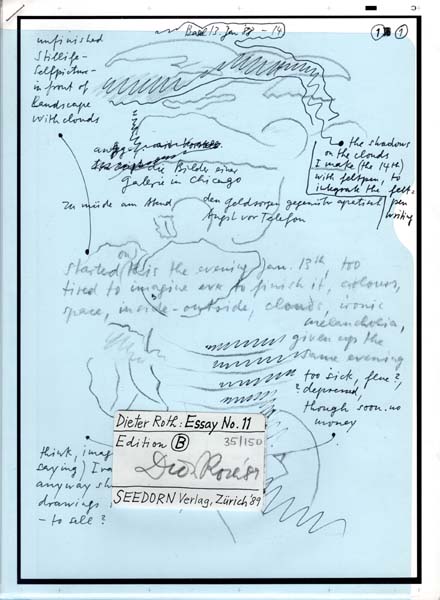
1989ref. 66600ABZürich., Seedorn Verlag., 1989. 37,5 x 29,5 cm OKarton-Kuvert. 26 Blatt, Klammerheftung., 66600AB Auflage 150 + 75 Exemplare. Sehr gutes Exemplar.
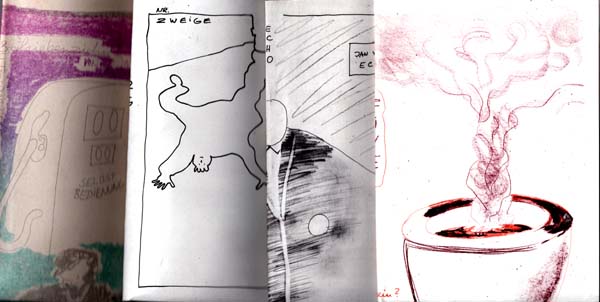
1977ref. 67265ABReykjavik. Zürich. Amsterdam., Selbstverlag Jan Voss., 1977 - 1982. 22 x 16 cm., 67265AB Falzenverklebung teils etwas gelöst, sonst sehr gutes Exemplar.
1979ref. 69093ABCambridge (MA)., Edition Noel., 1979. 44,3 x 31,8 cm (Mappe); 28,5 x 38,3 cm. [5] Blätter. Graue Esselte-Sammelmappe mit handschriftlicher Titelei des Künstlers recto., 69093A Sehr gutes Exemplar.
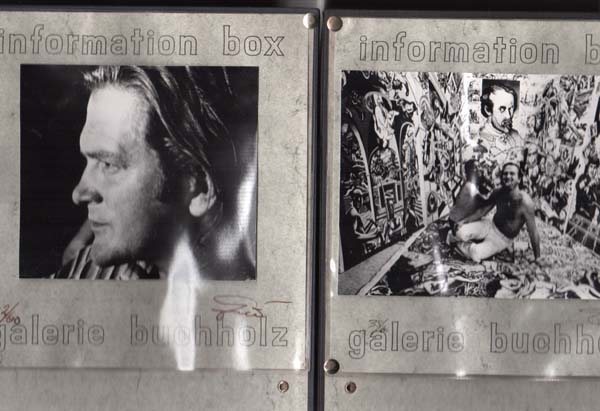
1973ref. 62925ABMünchen., Galerie Buchholz., 1973/1974. 32,8 x 25,5 x 7,2 cm. OPapp-Boxen mit montierten Schwarz-Weiß-Fotos., 62925AB 2 Boxen. Auflage 60 Exemplare. Sehr gutes, frisches Exemplar.
1947London, 20 September 1947. Manuscript Signed Letter by the Right Honourable Montgomery of Alamein, to well known fiction writer Lady Anderson, mentioning an unpublished book by Anderson which precedes her formal writing career. 8vo. Single-leaf measuring approximately 14 x 18cm (5.5 x 7 inches). Very good condition, and accompanied by the original postally used envelope. Graciously confirming receipt of what appears to be an unpublished book by a well known female author, and perhaps the first she had written, this letter is penned and signed by Bernard Law Montgomery (1887-1976), 1st Viscount Montgomery of Alamein, and British Army Field Marshal nicknamed "Monty" and the "Spartan General" whose illustrious military career spanned both World Wars, during which time he earned numerous honours and awards. The recipient is Barbara Anderson, Lady Anderson (1926-2013) née Barbara Lillian Romaine, an internationally recognized fiction writer from New Zealand, and later, the wife of Sir Neil Dudley Anderson, Chief of New Zealand Defence Staff. Only a few months to this letter being written, Barbara had graduated with a BSc from Otago University. She subsequently worked as a medical technologist and teacher, though her passion had always been in writing. She finally pursued her formal writing career in her sixties, publishing a volume of short stories, for the first time, in 1989. The book mentioned in this letter does not appear on common lists of her published works, and pre-dates her writing career by approximately thirty years. The letter reads as follows: "Dear Lady Anderson, I have just got back from Germany and found your book 'Lend Me Your Ears'. Thank you so very much. Yrs. ever Montgomery of Alamein" [signed] Manuscript
1972ref. 68880ABParis., Editions Art-C.C. [Christophe Czwiklitzer]., 1972. 34,7 x 25,9 x 9,8 cm (Buchobjekt); 36,7 x 27 x 13,7 (Plexiglaskasten). 235 S. Schwerer OPappband mit OWildleder kaschiert. In OPlexiglasschuber mit OPlexiglasschutz., 68880A Erste Auflage. Plexiglas mit Kratzspuren und etwas angestaubt. Band minimalst angestaubt, sonst noch sehr gutes Exemplar.
1988ref. 68398ABViersen., Tiedmann-Siebdruck., 1988. 35,5 x 31,6 cm. [8] unpaginierte lose Blätter mit leichten Vorsatzblättern. Illustrierte OPappmappe mit schwarzem OPappumschlag., 68398A Erste Auflage. Mappe mit minimalsten Randläsuren und kleiner Knickspur recto oben. Vorsatzblätter papierbedingt etwas nachgedunkelt, sonst sehr gutes Exemplar. Grafiken in frischem Zustand.
1982ref. 68713AB[Karlsruhe]., Selbstverlag., [1982]. 42,3 x 30,3 cm. [35] unpaginierte Blätter. In OPergaminpapier eingeschlagener OPappfolder mit offenem OPappschuber in zweitem, grauem OPappschuber., 68713A Erste Auflage. Schuber wenig lichtrandig und angestaubt, Rüclen etwas nachgedunkelt, sonst sehr gutes Exemplar.
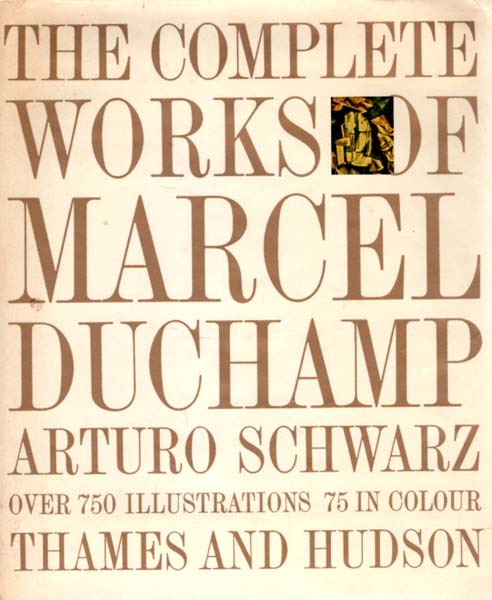
1969ref. 46087ABLondon., Thames and Hudson., 1969. 32 x 27 cm / 43 x 26 cm. 630 S. 1 Blatt; 217 S. OLeinen mit OUmschlag, OLeinen mit transparentem, illustriertem OKunststoff-Umschlag., 46087AB 2 Bände / Two Volumes. First printing / Erste Ausgabe. Hauptband am Umschlag am oberen Steg und am Rücken etwas berieben, teils leicht läsiert, sonst gutes Exemplar. Der Umschlag des zweiten Bandes an zwei Stellen mit kleinem Einriss, sonst sehr gutes Exemplar.
2004ref. 67220ABKöln., Snoeck Verlagsgesellschaft., 2004. 42,5 x 30 cm. XI S., 3 Blatt, 400 Xerographien. OLeinen mit OUmschlag in OPapp-Schuber., Umschlag Schuber marginal angestaubt. Sehr gutes Exemplar.
1972ref. 953FBKöln., DuMont Verlag., 1972. 25 x 20 cm. 281 S. OKarton., 953F 1. Auflage. Gutes bis sehr gutes Exemplar. DuMont Kunst-Praxis.
1972ref. 537FBKöln., DuMont Verlag., 1972. 25 x 20 cm. 281 S. OKarton., 537F 1. Auflage. Sehr gutes Exemplar. DuMont Kunst-Praxis.
ref. 61077ABo.J. 61077AB Einige wenige Bücher etwas gebräunt bzw. mit Gebrauchspuren, sonst insgesamt gute Erhaltung.
1704Manuscript leaf introducing an early work of translation by a Franciscan Friar of the Third Order, hand painted in full colour and featuring fascinating symbolism. Text is in Latin. Leaf measures approximately 34 x 49 cm. One soft fold, minor age-toning, otherwise in very good condition, a beautifully preserved hand painted document made at the turn of the 18th century. The present document suggests that as membership of the Franciscan Third Order grew rapidly, and no formal papal education was being received by those preaching in the streets, there was a need for some form of instruction or guidance. As such, some of the key and simple canonical documents began being written for the laymen/women to understand the principles. The symbolism features intimation of anti-slavery. Purposed with works of teaching the gospel, providing charity, and social well-being for the public, early members of the Franciscan Third Order were a community focused on truth and humility, striving to emulate Christ and model a pure life. The symbolism in the manuscript illustration of the present document is fascinating and enlightening, in particular the focal image top and center. This is an armorial motif depicting slavery, rather the Catholic church's purported desire to slavery. Unlike the standard Moor's head seen in the papal coat of arms seen since early days, the imagery here features an African tribal warrior chief, all seen but his legs, with a confident stance and holding a spear up high in declaration; this is drawn inside of a gold shield topped with the pope's mitre simplex headdress. As a whole, this could be interpreted as the Franciscan Third Order's support to abolish slavery. Some of the more common instances of symbolism are the red ribbons to signify the Blood which Christ, and the laurel leafs in a circular placement as in the ancient Greek custom of symbolising victory, honor, and peace, in this case being victory over sin, honor to the Holy one, and peace on earth. There are also two large gilt fleur-de-lis, which is often said to from 1244 in the arms of the Kings of France, although clearly used earlier as this document precedes the latter event by 40 years. In early Catholic-based examples such as the present leaf, the fleur-de-lis is believed to represent either the Trinity, or the lancehead of a spear such as which would have pierced the side of Jesus on the Cross. Manuscript
1901Reading (Berkshire, England), 1901-1923. Manuscript minute book for the Reading Rifle Club, established in 1900, containing all particulars of its growing membership, annual shooting programs and competitions, rules and regulations, financial statements, and the like, recorded in various hands over the years and containing several original signatures. A few of the club's printed documents, some manuscript letters from members, and newspaper clippings are tipped in. Together with a printed pocketsize 9 page handbook of the club's rules. 8vo. 218 pages on watermarked lined paper. Half calf over dark teal cloth boards titled in gilt to spine, original marbled endpapers, bookbinder's label to front pastedown. Endpapers reinforced at seam, otherwise in very good condition, a most interesting volume dealing with shooting as a sanctioned pastime. A fine example of a pre-war shooting club, nineteenth century firearms etiquette, and freedom to enjoy skilled gunnery competition. Gaining popularity and new members every year from its opening season, the Reading Rifle Club appears to have been most diligently managed, every one of its meetings being recorded in this manuscript minute book. Entries are wide-ranging in subject matter, some topics up for discussion being entrance fees and prizes, monthly competitions, an annual challenge cup, subscriptions, nominations and elections for leadership and administrative posts, expenses and receipts, ammunition purchases, firearms kept onsite, new members, annual shooting programs and competitions, rules and protocol, scoring, handicapping, dividing competitors into classes, the daily pay rate for the range warden, special use of the firing range, and so forth. Meetings were very regular from the turn of the century until 1914, then reduced rather abruptly owing to the Great War, during which time most of the members would have been in service, putting their shooting skills to practical use. Many captains are named as members, being of the British Army or the Royal Navy, many surely being attached to the pre-First World War Berkshire Yeomanry. Further research may find some notable persons. Being a legitimate and accredited pastime promoting honest and skilful competition, the member roll also included reverends. [In 2009 the National Rifle Association of the United Kingdom celebrated its 150th Anniversary. Today the association is primarily concerned with civilian full-bore target rifle shooting, although retaining its military heritage and close links with the British Armed Forces. Similarly, the Reading Rifle Club would have attracted Captains and Colonels of the Royal Armed Forces.] Incidences of special interest include experimentation with a patent target machine, a disconcerting matter of irregular entries on a score card, possible embezzlement of subscription money, a shooter having an epileptic seizure, and a proposal for establishing a summer camp at Clacton-on-Sea together with the Colchester Rifle Club. We also find occasional mention of Churn Camp, which was at the time in Berkshire, and another popular place for men of the Berkshire Yeomanry. Indeed a pastime requiring fastidious safety monitoring and honorable sportsmanship, frequent mention is made of the governing body of full bore rifle and pistol shooting sports, the National Rifle Association (NRA), which had been founded only forty years earlier in 1859. The Reading Rifle Club was affiliated to it. [The National Rifle Association was based at Putney Heath & Wimbledon Common, in south-west London, 12 years before its better known American cousin.] Manuscript
1792Exceedingly rare and historically significant manuscript complete with manuscript drawings, made circa 1792, transcribing the banned controversial work by Hayashi Shihei which attributed coveted geographical regions to non-Japanese sovereigns, and which led the author to house arrest and his works destroyed by the Shogun. This work centers largely around the indigenous Ainu people and the people living in the Joseon Dynasty (Korea), thus being a very early account of Korea. All text is in Japanese. Author-published. 89 pages in manuscript including title page and end leaf. Indication of once being string-stitched at spine, opening from left to right. Leafs measure approximately 19 x 26 cm. SIGNIFICANT AMOUNT OF WORM BURROWING, some leaves lightly fused together as a result, MAPS NOT PRESENT, nonetheless a valuable historic addition for any library, being an exceedingly scarce surviving manuscript of the famous "Sangoku Tsuran Zusetsu" by Hayashi Shihei. One of the earliest attempts to define Japan's outer boundaries, and distinguish it from the neighboring nations, the book deals with Joseon Dynasty (Korea) and the Kingdom of Ryukyu (Okinawa), and Ezo (Hokkaido) and the Ogasawara Islands (Bonin Islands). The content of this work is as controversial today as it was when it was released by the author 235 years ago. A statue of Hayashi Shihei stands in his honour, however, in Kotodai Park, Sendai. This work was emphatically criticized, immediately banned, and destroyed by the shogunate, all but a very scant few copies, that is, which were kept in hiding by scholars who took it upon themselves to secretly transcribe the important writings, with the original in hand. This is one of those surviving secret manuscripts, which were so very few in number and are exceedingly scarce. Hayashi Shihei (1738-1793) was a Japanese military scholar, political theorist, military strategist, writer, and a retainer of the Sendai Domain. He was a samurai of the Sendai clan issued in 1785 (Tenmei 5). His name is sometimes transliterated, according to the Sino-Japanese reading, as Rin Shihei’'. Hayashi is known as one of the "Three Excelling Men of the Kansei Period" (Kansei no san-kijin). Circa 1785 he wrote the highly controversial "Sangoku Tsuran Zusetsu" [Illustrated General Survey of the Three Countries] which consisted of five maps and one text volume which detailed the customs of Korea, Ryukyu Kingdom, and Ezo country (Hokkaido), recounting an exploratory geographical survey of the regions that were then the frontiers of Japan, including Korea, Hokkaido, and the Ryukyu Islands, also providing descriptions of the inhabitants, including the Ainu. It contained, among other repugnant content in the eyes of the shogun, the attribution of Korean sovereignty over the Dokdo / Takeshima / Liancourt archipelago, and secondly, Chinese sovereignty over the Senkaku Islands [Diaoyu Islands] instead of recognizing it as part of the Ryukyu Kingdom (which had been a vassal state of the Satsuma Domain of Japan with 'de jure' status since 1609). Not a single publisher dared to put their name on the work, for fear of retribution, and thus, Hayashi released it independently in the years of 1787-1791, at his own expense. In 1792 [Kansei 4], the Tokugawa shogunate evaluated the content of this book, declared it a delusion, and banned it. The printings of Sangoku Tsuran Zusetsu also became collateral victim of this banning. Almost all the original woodblock-printed versions of Sangoku Tsuran Zusetsu were collected and destroyed. In 1787, he had published a second work of enlightened perspective and concern, titled ???? "Kaikoku Heidan" [Military Defense of a Maritime Nation]. This was a 16-volume work which brought to light the potential inadequacy in the military defense of Japan during the Edo period, specifically highlighting the island's vulnerability from the sea, as well as the need for Japan to adopt Western military science for improved defenses along Japanese frontiers, and the re-education of the samurai. Hayashi believed the nation's crisis was due to the repeated arrivals of foreign ships. He complained of a lack of organized drill exercises, and stressed the importance of choren, or teamwork drill, rather than mere individual martial training. He gave technical descriptions about shipbuilding, cannons and other military designs. He was especially critical of the Shogunate's sakoku national isolation policy. The work generated great interest, but it too, was banned in May 1792, on the grounds that national security matters were being discussed without official consent. This work having been published a few years prior, it was impossible to locate and destroy all printed copies, but the woodblocks were seized and destroyed with those of Sangoku Tsuran Zusetsu. Simultaneously, as his two works were banned and destroyed, Hayashi was placed under house arrest. He died the following year, 28 July 1783, at the young age of 54. There were rumours of suicide and speculations of decapitation by authorities, but no evidence for either has surfaced. Ironically, shortly after Hayashi was punished, a Russian ship arrived in Nemuro, and the shogunate was forced to take measures to protect the coast, as had been suggested in Hayashi's "Kaikoku Heidan". In spite of the shogunate's best efforts, a scant few of 'Sangoku Tsuran Zusetsu' survived, thanks to a handful of audacious erudite men, and manuscript transcripts of his maps began to circulate covertly in learned Japanese circles. This book also went from Nagasaki to Holland and Germany through Katsuragawa Hoshu (1751-1809), who was a physician to the Shogun from 1777 and an Edan scholar in Edo; it was subsequently translated into European languages in Russia. In 1872, it was translated into French by the German Oriental scholar Heinrich Klaproth. Shugun Tokugawa Ienari, who suppressed and destroyed these works, and who exiled the author to his home, reigned from 1787-1837. In the first year of his reign there were rice riots in Edo and Osaka. Later tragedy, the Great Fire of Kyoto and the Tenpo famine took place. And in his strict fashion, in 1817 he ordered the expulsion of Titia Bergsma, the first European woman to visit Japan. The Dutch and Chinese were allowed to visit the country, but only for trade, and no women were permitted. Bergsma never saw her husband again. Credit to Pierre Joppen of Paulus Swaen Gallery, whose research on the subject is exhaustive and from whom some of the above content has been copied.
1827Folio, signed and inscribed document on laid, watermarked paper. Printed to one side, completed in manuscript by William IV of the United Kingdom when he was Lord High Admiral. The official warrant, by the Royal Navy, commissioning Charles Sharp to serve on His Majesty's ship 'Herald.' Single leaf measuring approximately 32cm x 20cm. Small tears to lower margin, unobtrusive to the text, otherwise in very good and original condition. Scarce signed royal personalia item. Manuscript
1870Manuscript commonplace book created at the York House - where Charles Dickens reputedly wrote some of his novels - by a woman called Laura Simpson, daughter of Malton solicitor Alfred Simpson, Esq., who was also appointed Bailiff of the Borough of Malton in 1856 by 6th Earl Fitzwilliam, owner of the York House, the most important historic house in Malton. Miss Laura signs and dates the front endpaper on 30 August 1872, and again to its verso on 2 February 1873, though dated entries range from 1870 to 1875. 8vo. 68 pages featuring manuscript entries and newspaper clippings of various subject matters. Quarter calf over brown and yellow marbled boards. Volume measures approximately 16,5 x 19,5 cm. Very good condition. The volume was created by a young woman who evidently lived at York House in Malton which has an interesting connection to Charles Dickens from only twenty-five years earlier. Her father having close ties with the owner of the Fitzwilliam Malton Estate, it is quite conceivable that he met or knew the great author personally. Laura Simpson is the daughter of Alfred Simpson, Esq., a solicitor, Chairman of the Malton Burial Board, and Bailiff of the Borough of Malton, whose residence was at Yorkersgate, presumably being a tenant of the York House owing to the Simpson-Fitzwilliam family connection through an earlier marriage. York House is an impressive 17th century home in Malton where Charles Dickens reputedly wrote many of his novels, where he certainly found inspiration for some of his characters. The reason for Charles Dickens' association with Malton, and York House in particular, was his long friendship with Charles Simpson, solicitor. The Smithson family had their offices on Chancery Lane in Malton and they also shared a practice in London. The death of Charles Simpson's father in 1829, had necessitated his brother Henry to return to Malton and take over the family business, whereas Charles remained in London. It is whilst residing in London that Smithson & Dickens met. Thomas Mitton, a friend of Dickens had persuaded him to act as surety on a loan to purchase a one-third stake of Smithson & Dunn. In 1840, Henry followed his father and brother John to his grave. Charles was compelled to leave London and take over both the Chancery Lane practice and the duties of the town Bailiff previously carried out by his father and brother. Dickens visited Malton often in the 1840s. He delighted audiences with his readings wherever he went. He read in Malton, in what was said to be a theatre, on one of his visits. Manuscript