890 résultats
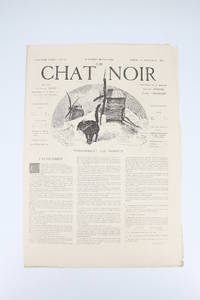
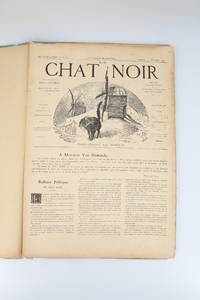
1883réf. 81900Paris: Au cabaret Le Chat noir 1883. Fine. Au cabaret Le Chat noir Paris 1883 31 x 45 cm broché First edition of this complete 1883 year containing 50 issues in original wrappers under blue temporary covers. Spine split with angular lacks to the covers. Each issue consists of four pages. Texts by Emile Goudeau Alphonse Allais Jean Richepin and Paul Verlaine ""Le Chat noir"" ""Langueur"" ""La Princesse Bérénice"" ""Pantoum négligé"" ""Paysage"" ""Conseil falot"" ""L'Aube à l'envers"" ""Un pouacre"" ""Madrigal"" notably. Drawings by Willette Rodolphe Salis Henri de Sta Tiret-Bognet Henri Pille Caran d'Ache etc. Le Chat noir is a weekly magazine created by Rodolphe Salis and Emile Goudeau published from 1882 to 1897 with the aim of promoting the famous cabaret of the same name serving as its record. It published the texts recited during performances. It is moreover an important literary and artistic testimony of the end of the 19th century centered around bohemian life and the Parisian effervescence characteristic of it. Au cabaret Le Chat noir unknown
1886réf. 81973Paris: Au cabaret Le Chat noir 1886. Fine. Au cabaret Le Chat noir Paris 1886 31 x 45 cm en feuillets First edition one of the rare copies printed on laid paper. The issue consists of 4 pages and is illustrated with a comic strip by Théophile Alexandre Steinlen: ""Les mésaventures d'Auguste"". Literary contributions by Alphonse Allais ""L'avancement"" Maurice Mac Nab ""La vue de Naples"" Eugène Godin ""Ronds de cuir"". Fine copy. Le Chat noir is a weekly magazine created by Rodolphe Salis and Emile Goudeau published from 1882 to 1897 with the aim of promoting the famous cabaret of the same name of which it intended to be the record. It published texts declaimed during the performances. It is moreover an important literary and artistic testimony of the late nineteenth century around the bohemia and the Parisian effervescence that was its own. Au cabaret Le Chat noir unknown
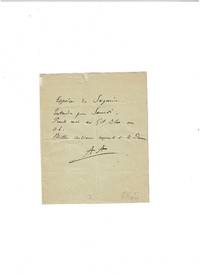
1880réf. 756851880. Fine. s. d. circa 1880 11.60 x 14.20 cm un billet Autograph letter signed by Alphonse Allais mounted on fine cardboard. Traces of transverse folds small lacks and marginal tears. ""Espèce de sagouin. / Entendu pour samedi. / Prends moi au Gil Blas vers 6h / Mille cordiaux respects à ta dame. A.A."" ""You rascal. / Agreed for Saturday. / Pick me up at Gil Blas around 6pm / A thousand cordial respects to your lady. A.A."" unknown
1956réf. 72216Paris: Grasset 1956. Fine. Grasset Paris 1956 12 x 19 cm broché First edition one of 479 numbered copies on châtaignier paper the only deluxe copies after 1 Madagascar and 20 pur fil. Preface by Anatole de Jakovsky photographic portrait of Alphonse Allais as frontispiece. Handsome copy retaining its publisher's wraparound band the spine soiled and discolored. Grasset unknown
1955réf. 69961Paris: Les quatre jeudis 1955. Fine. Les quatre jeudis Paris 1955 14 x 20.50 cm broché First edition one of 20 numbered copies on pur fil paper the only deluxe copies along with 10 on Holland paper. Presentation by Anatole Jakovsky followed by 7 unpublished letters by the author. Handsome copy. Les quatre jeudis unknown
1956réf. 58844Paris: Les quatre jeudis 1956. Fine. Les quatre jeudis Paris 1956 14.50 x 19 cm broché First edition one of 950 numbered copies on royal Bellegarde laid paper. Handsome copy. Les quatre jeudis unknown
1866réf. 596571866. Fine. 1866 27.50 x 43.50 cm autre Charcoal black stone and white chalk drawing with wash highlights. Signed lower left in white chalk ""de St Allais 1866"". Thick rigid cardboard of 4 mm. Very fine condition despite a slight lack of 7mm at the upper left corner. Dry stamp lower right corner: Papier Pellée. Slight toning. Finely worked lake and grove landscape. NB: This work is available at the bookstore on request within 48 hours. unknown
1893réf. 42997Paris: Paul Ollendorff 1893. Fine. Paul Ollendorff Paris 1893 12 x 19 cm relié First edition for which there is no mention of large paper copies. Contemporary Bradel binding in half khaki cloth over marbled paper boards the spine with gilt floral motif a double gilt fillet at foot of spine red shagreen title label small marginal scratches one lower corner rubbed. A rare and precious autograph inscription from Alphonse Allais to his publisher Paul Ollendorff : "". le seul éditeur vraiment digne de ce nom hommage d'un auteur qui n'est pas non plus dans une potiche the only publisher really worthy of that name homage from an author who is also not on a sinecure"". Provenance : library of Paul Ollendorff. Paul Ollendorff hardcover
1809réf. 26525Paris: Imprimerie Impériale 1809. Fine. Imprimerie Impériale Paris 1809-1829 54 x 71 cm une feuille Original unshaved full-page etching from the Imperial edition of the Description de l'Égypte or Recueil des observations et recherches faites en Égypte pendant l'expédition française publié par les ordres de Sa Majesté l'Empereur Napoléon le Grand A Collection of the observations and research carried out in Egypt during the French expedition published on the orders of his Majesty the Emperor Napoleon the Great'.Produced between February 1802 and 1830 on the orders of Naopleon Bonaparte and published between 1809 and 1828 1000 copies were printed and distributed to institutions on vergé paper with an 'Égypte ancienne et moderne' watermark visible when held up to the light. Light marginal spotting not touching image otherwise in very fresh fine condition. An engraving from the Description de l'Egypte one of the masterpieces of French printing and the birth of a new field: Egyptology. A gigantic survey of Egypt at the time of Bonaparte's conquests in 1798 and 1799 the work is divided into 13 volumes of engravings making up 892 plates of which 72 colored as well as presenting the splendors of the Egypt of the Pharaohs in 9 volumes. The other volumes discuss natural history and present a fascinating portrait of Coptic and Islamic Egypt as it was seen by Bonaparte's Eastern Armies. The Egyptian campaign' militarily a disaster demonstrates through the engravings of the Description d'Egypte the scientific success it nonetheless became thanks to the 167 expert members of the Commission of the Sciences and Arts of the Institut d'Egypte Egyptian Institute who followed Napoleon's army. The Institut gathered together in Egypt the mathematician Monge the chemist Berthollet the naturalist Geoffroy Saint-Hilaire as well as numerous artists engineers architects and doctors. They were tasked with re-discovering modern and ancient Egypt and displaying its natural treasures as well as the know-how of its inhabitants.This edition the so-called Imperial edition of the plates for the Description de l'Egypte was printed in four large formats two of which were specially created for it and christened Moyen-Egypte and Grand-Egypte. A special press was built to print it the process extending over 20 years from 1809 to 1829. The Imperial edition proved so popular that a second edition this time in black and white and without the Egypte ancienne et moderne watermark known as the Royal Edition was published during the Restoration by the printing house of C.-L.-F. Panckoucke Paris.The engravings of the Description d'Egypte owe a great deal to Baron Dominique-Vivant Denon illustrator diplomat collector and later Director of the Musée Napoléon the Louvre. His exploration of the South of Egypt gave Bonaparte the idea of sending the experts of the Institut there thus creating a faithful and complete portrait of the area. This was the research gathered together from 1802 in the mammoth Description de L'Egypte.Denon embarked on this story of archeological exploration at the age of 51 reaching first Alexandria and then Cairo before exploring Upper Egypt. Along with the members of the Institut d'Egypte the Natural History Museum's painter H.J. Redouté brother of Pierre-Joseph Redouté author of Roses the mineralogist Dolomiue and the draughtsman Joly Denon then explored the Nile Delta and Lower Egypt. When however he joined the 21st Light Infantry Regiment as it marched across Upper Egypt in pursuit of the retreating Mameluks in November 1798 he found himself the only civilian. In the very midst of the battle itself he reeled off sketches of the works of art that peppered his path right up to the threshold of the Sudan. He said that he had crossed a country that is apart from its name entirely unknown to Europeans and therefore everything was worth describing Voyages dans la Basse et la Haute Egypte pendant les campagnes de Imprimerie Impériale unknown
1809réf. 35406Paris: Imprimerie Impériale 1809. Fine. Imprimerie Impériale Paris 1809-1829 71 x 54 cm une feuille Original unshaved full-page etching from the Imperial edition of the Description de l'Égypte or Recueil des observations et recherches faites en Égypte pendant l'expédition française publié par les ordres de Sa Majesté l'Empereur Napoléon le Grand A Collection of the observations and research carried out in Egypt during the French expedition published on the orders of his Majesty the Emperor Napoleon the Great'.Produced between February 1802 and 1830 on the orders of Naopleon Bonaparte and published between 1809 and 1828 1000 copies were printed and distributed to institutions on vergé paper with an 'Égypte ancienne et moderne' watermark visible when held up to the light. Light marginal spotting not touching image otherwise in very fresh fine condition. An engraving from the Description de l'Egypte one of the masterpieces of French printing and the birth of a new field: Egyptology. A gigantic survey of Egypt at the time of Bonaparte's conquests in 1798 and 1799 the work is divided into 13 volumes of engravings making up 892 plates of which 72 colored as well as presenting the splendors of the Egypt of the Pharaohs in 9 volumes. The other volumes discuss natural history and present a fascinating portrait of Coptic and Islamic Egypt as it was seen by Bonaparte's Eastern Armies. The Egyptian campaign' militarily a disaster demonstrates through the engravings of the Description d'Egypte the scientific success it nonetheless became thanks to the 167 expert members of the Commission of the Sciences and Arts of the Institut d'Egypte Egyptian Institute who followed Napoleon's army. The Institut gathered together in Egypt the mathematician Monge the chemist Berthollet the naturalist Geoffroy Saint-Hilaire as well as numerous artists engineers architects and doctors. They were tasked with re-discovering modern and ancient Egypt and displaying its natural treasures as well as the know-how of its inhabitants.This edition the so-called Imperial edition of the plates for the Description de l'Egypte was printed in four large formats two of which were specially created for it and christened Moyen-Egypte and Grand-Egypte. A special press was built to print it the process extending over 20 years from 1809 to 1829. The Imperial edition proved so popular that a second edition this time in black and white and without the Egypte ancienne et moderne watermark known as the Royal Edition was published during the Restoration by the printing house of C.-L.-F. Panckoucke Paris.The engravings of the Description d'Egypte owe a great deal to Baron Dominique-Vivant Denon illustrator diplomat collector and later Director of the Musée Napoléon the Louvre. His exploration of the South of Egypt gave Bonaparte the idea of sending the experts of the Institut there thus creating a faithful and complete portrait of the area. This was the research gathered together from 1802 in the mammoth Description de L'Egypte.Denon embarked on this story of archeological exploration at the age of 51 reaching first Alexandria and then Cairo before exploring Upper Egypt. Along with the members of the Institut d'Egypte the Natural History Museum's painter H.J. Redouté brother of Pierre-Joseph Redouté author of Roses the mineralogist Dolomiue and the draughtsman Joly Denon then explored the Nile Delta and Lower Egypt. When however he joined the 21st Light Infantry Regiment as it marched across Upper Egypt in pursuit of the retreating Mameluks in November 1798 he found himself the only civilian. In the very midst of the battle itself he reeled off sketches of the works of art that peppered his path right up to the threshold of the Sudan. He said that he had crossed a country that is apart from its name entirely unknown to Europeans and therefore everything was worth describing Voyages dans la Basse et la Haute Egypte pendant les campagnes de Imprimerie Impériale unknown
1809réf. 26226Paris: Imprimerie Impériale 1809. Fine. Imprimerie Impériale Paris 1809-1829 53.50 x 71 cm une feuille Original unshaved full-page etching from the Imperial edition of the Description de l'Égypte or Recueil des observations et recherches faites en Égypte pendant l'expédition française publié par les ordres de Sa Majesté l'Empereur Napoléon le Grand A Collection of the observations and research carried out in Egypt during the French expedition published on the orders of his Majesty the Emperor Napoleon the Great'.Produced between February 1802 and 1830 on the orders of Naopleon Bonaparte and published between 1809 and 1828 1000 copies were printed and distributed to institutions on vergé paper with an 'Égypte ancienne et moderne' watermark visible when held up to the light. Light marginal spotting not touching image otherwise in very fresh fine condition. An engraving from the Description de l'Egypte one of the masterpieces of French printing and the birth of a new field: Egyptology. A gigantic survey of Egypt at the time of Bonaparte's conquests in 1798 and 1799 the work is divided into 13 volumes of engravings making up 892 plates of which 72 colored as well as presenting the splendors of the Egypt of the Pharaohs in 9 volumes. The other volumes discuss natural history and present a fascinating portrait of Coptic and Islamic Egypt as it was seen by Bonaparte's Eastern Armies. The Egyptian campaign' militarily a disaster demonstrates through the engravings of the Description d'Egypte the scientific success it nonetheless became thanks to the 167 expert members of the Commission of the Sciences and Arts of the Institut d'Egypte Egyptian Institute who followed Napoleon's army. The Institut gathered together in Egypt the mathematician Monge the chemist Berthollet the naturalist Geoffroy Saint-Hilaire as well as numerous artists engineers architects and doctors. They were tasked with re-discovering modern and ancient Egypt and displaying its natural treasures as well as the know-how of its inhabitants.This edition the so-called Imperial edition of the plates for the Description de l'Egypte was printed in four large formats two of which were specially created for it and christened Moyen-Egypte and Grand-Egypte. A special press was built to print it the process extending over 20 years from 1809 to 1829. The Imperial edition proved so popular that a second edition this time in black and white and without the Egypte ancienne et moderne watermark known as the Royal Edition was published during the Restoration by the printing house of C.-L.-F. Panckoucke Paris.The engravings of the Description d'Egypte owe a great deal to Baron Dominique-Vivant Denon illustrator diplomat collector and later Director of the Musée Napoléon the Louvre. His exploration of the South of Egypt gave Bonaparte the idea of sending the experts of the Institut there thus creating a faithful and complete portrait of the area. This was the research gathered together from 1802 in the mammoth Description de L'Egypte.Denon embarked on this story of archeological exploration at the age of 51 reaching first Alexandria and then Cairo before exploring Upper Egypt. Along with the members of the Institut d'Egypte the Natural History Museum's painter H.J. Redouté brother of Pierre-Joseph Redouté author of Roses the mineralogist Dolomiue and the draughtsman Joly Denon then explored the Nile Delta and Lower Egypt. When however he joined the 21st Light Infantry Regiment as it marched across Upper Egypt in pursuit of the retreating Mameluks in November 1798 he found himself the only civilian. In the very midst of the battle itself he reeled off sketches of the works of art that peppered his path right up to the threshold of the Sudan. He said that he had crossed a country that is apart from its name entirely unknown to Europeans and therefore everything was worth describing Voyages dans la Basse et la Haute Egypte pendant les campagnes Imprimerie Impériale unknown
1809réf. 23435Paris: Imprimerie Impériale 1809. Fine. Imprimerie Impériale Paris 1809-1829 70 x 51.50 cm une feuille Original unshaved full-page etching from the Imperial edition of the Description de l'Égypte or Recueil des observations et recherches faites en Égypte pendant l'expédition française publié par les ordres de Sa Majesté l'Empereur Napoléon le Grand A Collection of the observations and research carried out in Egypt during the French expedition published on the orders of his Majesty the Emperor Napoleon the Great'.Produced between February 1802 and 1830 on the orders of Naopleon Bonaparte and published between 1809 and 1828 1000 copies were printed and distributed to institutions on vergé paper with an 'Égypte ancienne et moderne' watermark visible when held up to the light. Light marginal spotting not touching image otherwise in very fresh fine condition. An engraving from the Description de l'Egypte one of the masterpieces of French printing and the birth of a new field: Egyptology. A gigantic survey of Egypt at the time of Bonaparte's conquests in 1798 and 1799 the work is divided into 13 volumes of engravings making up 892 plates of which 72 colored as well as presenting the splendors of the Egypt of the Pharaohs in 9 volumes. The other volumes discuss natural history and present a fascinating portrait of Coptic and Islamic Egypt as it was seen by Bonaparte's Eastern Armies. The Egyptian campaign' militarily a disaster demonstrates through the engravings of the Description d'Egypte the scientific success it nonetheless became thanks to the 167 expert members of the Commission of the Sciences and Arts of the Institut d'Egypte Egyptian Institute who followed Napoleon's army. The Institut gathered together in Egypt the mathematician Monge the chemist Berthollet the naturalist Geoffroy Saint-Hilaire as well as numerous artists engineers architects and doctors. They were tasked with re-discovering modern and ancient Egypt and displaying its natural treasures as well as the know-how of its inhabitants.This edition the so-called Imperial edition of the plates for the Description de l'Egypte was printed in four large formats two of which were specially created for it and christened Moyen-Egypte and Grand-Egypte. A special press was built to print it the process extending over 20 years from 1809 to 1829. The Imperial edition proved so popular that a second edition this time in black and white and without the Egypte ancienne et moderne watermark known as the Royal Edition was published during the Restoration by the printing house of C.-L.-F. Panckoucke Paris.The engravings of the Description d'Egypte owe a great deal to Baron Dominique-Vivant Denon illustrator diplomat collector and later Director of the Musée Napoléon the Louvre. His exploration of the South of Egypt gave Bonaparte the idea of sending the experts of the Institut there thus creating a faithful and complete portrait of the area. This was the research gathered together from 1802 in the mammoth Description de L'Egypte.Denon embarked on this story of archeological exploration at the age of 51 reaching first Alexandria and then Cairo before exploring Upper Egypt. Along with the members of the Institut d'Egypte the Natural History Museum's painter H.J. Redouté brother of Pierre-Joseph Redouté author of Roses the mineralogist Dolomiue and the draughtsman Joly Denon then explored the Nile Delta and Lower Egypt. When however he joined the 21st Light Infantry Regiment as it marched across Upper Egypt in pursuit of the retreating Mameluks in November 1798 he found himself the only civilian. In the very midst of the battle itself he reeled off sketches of the works of art that peppered his path right up to the threshold of the Sudan. He said that he had crossed a country that is apart from its name entirely unknown to Europeans and therefore everything was worth describing Voyages dans la Basse et la Haute Egypte pendant les campagnes Imprimerie Impériale unknown
1809réf. 25826Paris: Imprimerie Impériale 1809. Fine. Imprimerie Impériale Paris 1809-1829 54 x 71 cm une feuille Original unshaved full-page etching from the Imperial edition of the Description de l'Égypte or Recueil des observations et recherches faites en Égypte pendant l'expédition française publié par les ordres de Sa Majesté l'Empereur Napoléon le Grand A Collection of the observations and research carried out in Egypt during the French expedition published on the orders of his Majesty the Emperor Napoleon the Great'.Produced between February 1802 and 1830 on the orders of Naopleon Bonaparte and published between 1809 and 1828 1000 copies were printed and distributed to institutions on vergé paper with an 'Égypte ancienne et moderne' watermark visible when held up to the light. Light marginal spotting not touching image otherwise in very fresh fine condition. An engraving from the Description de l'Egypte one of the masterpieces of French printing and the birth of a new field: Egyptology. A gigantic survey of Egypt at the time of Bonaparte's conquests in 1798 and 1799 the work is divided into 13 volumes of engravings making up 892 plates of which 72 colored as well as presenting the splendors of the Egypt of the Pharaohs in 9 volumes. The other volumes discuss natural history and present a fascinating portrait of Coptic and Islamic Egypt as it was seen by Bonaparte's Eastern Armies. The Egyptian campaign' militarily a disaster demonstrates through the engravings of the Description d'Egypte the scientific success it nonetheless became thanks to the 167 expert members of the Commission of the Sciences and Arts of the Institut d'Egypte Egyptian Institute who followed Napoleon's army. The Institut gathered together in Egypt the mathematician Monge the chemist Berthollet the naturalist Geoffroy Saint-Hilaire as well as numerous artists engineers architects and doctors. They were tasked with re-discovering modern and ancient Egypt and displaying its natural treasures as well as the know-how of its inhabitants.This edition the so-called Imperial edition of the plates for the Description de l'Egypte was printed in four large formats two of which were specially created for it and christened Moyen-Egypte and Grand-Egypte. A special press was built to print it the process extending over 20 years from 1809 to 1829. The Imperial edition proved so popular that a second edition this time in black and white and without the Egypte ancienne et moderne watermark known as the Royal Edition was published during the Restoration by the printing house of C.-L.-F. Panckoucke Paris.The engravings of the Description d'Egypte owe a great deal to Baron Dominique-Vivant Denon illustrator diplomat collector and later Director of the Musée Napoléon the Louvre. His exploration of the South of Egypt gave Bonaparte the idea of sending the experts of the Institut there thus creating a faithful and complete portrait of the area. This was the research gathered together from 1802 in the mammoth Description de L'Egypte.Denon embarked on this story of archeological exploration at the age of 51 reaching first Alexandria and then Cairo before exploring Upper Egypt. Along with the members of the Institut d'Egypte the Natural History Museum's painter H.J. Redouté brother of Pierre-Joseph Redouté author of Roses the mineralogist Dolomiue and the draughtsman Joly Denon then explored the Nile Delta and Lower Egypt. When however he joined the 21st Light Infantry Regiment as it marched across Upper Egypt in pursuit of the retreating Mameluks in November 1798 he found himself the only civilian. In the very midst of the battle itself he reeled off sketches of the works of art that peppered his path right up to the threshold of the Sudan. He said that he had crossed a country that is apart from its name entirely unknown to Europeans and therefore everything was worth describing Voyages dans la Basse et la Haute Egypte pendant les campagnes de Imprimerie Impériale unknown
1894réf. 7284Paris: Paul Ollendorff 1894. Fine. Paul Ollendorff Paris 1894 11.50 x 18.50 cm relié First edition of which there were no deluxe copies. Bradel binding in sand half cloth smooth spine corners slightly bumped contemporary binding. Paul Ollendorff hardcover
1934réf. 307411934. Rouen Henri Defontaine 1934. Un vol. au format gd in-8 215 x 173 mm de xxvi - 190 pp. Reliure de l'poque de demi-maroquin glac tabac filet vertical en noir port sur chacun des plats dos nerfs orns de filets gras froid titre dor tÂte mouchete couvertures et dos conservs. Exemplaire revÂtu d'une agrable reliure du temps. Un des 800 exemplaires du tirage numrot sur ''beau papier vlin''. Jolie typographie en deux tons ; agrmente de compositions de Pierre Le Trividic. ''Peintre de l'cole de Rouen Le Trividic suit les cours de l'cole des Beaux-Arts dans la section d'architecture o il remporte tous les premiers prix. C'est donc comme architecte qu'il s'installe en 1926. Mais parallÂlement il s'adonne sa passion pour le dessin et la peinture et dessine notamment pour la presse locale. Ouvert toutes les expressions artistiques il est aussi illustrateur d'ouvrages affichiste graveurÉ'' ''Les critures bizarres d'Alphonse Allais; par leurs tics clichs et allusions par le tour indfinissable de leur rhtorique et de leur maboulisme impliquent toute l'anarchie littraire de ces quinze derniÂres annes''. Dos trÂs lgÂrement pass. Du reste trÂs belle condition. b42961 unknown
réf. 22963Rouen E. Aug 1890. Un vol. au format gd in-4 328 x 257 mm de 2 ff. n.fol. viii - 252 pp. et 2 ff. n.fol. Reliure de l'poque de demi-percaline satine azur coins dos lisse orn de doubles filets dors fleuron central dor piÂce de titre de maroquin vieux-rouge titre dor tÂte mouchete couvertures conserves. Edition originale. L'ouvrage recÂle 120 charmantes compositions par Fraipont. Georges Fraipont ''fut lÂve de Grome et Merson. Socitaire des Artistes franÂais depuis 1905 on lui doit d'intressantes pointes-sÂches. Il a illustr un grand nombre d'oeuvres littraires''. In Bnzit. ''Il exposa au Salon des Artistes franÂais des vues de Paris et de la Bretagne''. in Osterwalder citant la prsente contribution de l'artiste. ''Le sujet de ce livre porte en soi-mÂme tant de grces et tant de charmes que la prose la plus modeste pourra peut-Âtre garder encore quelques traces de son dlicieux parfum''. Table : De Croisset JumiÂges - Flaubert Croisset - Caudebec - Saint-Wandrille - De Villequier Tancarville - Yvetot et ses environs - Doudeville - Pissy-Poville - Chteau d'Esneval Pavilly - Chteau de ClÂres - Saint-Georges de Boscherville - Plateau de Roumare - Corneille au Petit-Couronne. Bnzit IV Dictionnaire des peintres p. 475 - Osterwalder I Dictionnaire des illustrateurs p. 387. Angles lims. Coiffes lgÂrement embouties. PremiÂre garde fendille. Claires rousseurs dans le texte davantage marques aux premiers et derniers feuillets. Du reste bonne condition. b42961 unknown
2024réf. 117175Chicago: University of Chicago Press 2024. Cloth/dust jacket Octavo. Hardcover. Very good/very good. white cloth black lettering to spine dust jacket 820 pp. University of Chicago Press hardcover
2012réf. DADAX3849140091TREDITION CLASSICS 2012-11-22. paperback. New. 5.43x0.63x8.23. Buy with confidence. Excellent Customer Service & Return policy. TREDITION CLASSICS paperback
2012réf. DADAX3849144054TREDITION CLASSICS 2012-11-21. paperback. New. 5.43x0.94x8.23. Buy with confidence. Excellent Customer Service & Return policy. TREDITION CLASSICS paperback
2012réf. DADAX3849139174TREDITION CLASSICS 2012-11-21. paperback. New. 5.43x0.59x8.23. Buy with confidence. Excellent Customer Service & Return policy. TREDITION CLASSICS paperback
1971réf. 321663New York: Albondocani Press 1971. Unbound. Fine. Printed yellow cardstock. 5" x 6". Fine. Gorey illustration with promotional and ordering information on the verso. Albondocani Press unknown
2010réf. DADAX1170653049Gale Ecco Print Editions 2010-05-29. paperback. New. 7.44x0.92x9.69. Buy with confidence. Excellent Customer Service & Return policy. Gale Ecco, Print Editions paperback
2012réf. DADAX3849140423TREDITION CLASSICS 2012-11-21. paperback. New. 5.43x0.67x8.23. Buy with confidence. Excellent Customer Service & Return policy. TREDITION CLASSICS paperback
réf. 0198747136.Ghardcover. Good. Access codes and supplements are not guaranteed with used items. May be an ex-library book. hardcover
réf. 40021:1Paris Librairie des Publications officielles Imprimerie Nationale 1947. 422; 423-800 S. 2 Bde. zahlr. Fig. gr.okt. kt. . -- New Palgrave 1987 I 79. - Erste Ausgabe. Paris, Librairie des Publications officielles + (Imprimerie Nationale), 1947. unknown