964 résultats
1926réf. 2110502150415030Central Swords Association Headquarters 1926. Soft Cover. Fine. Number of books: 3 Central Swords Association Headquarters paperback
2007réf. 2090202122801474Not Available 2007. Soft Cover. Fine. Number of books: 318 Not Available paperback
réf. 5196237Short description: In Russian. Sword, Ivan Nikolaevich. Yid Islander or Stolen Treasure. You are welcome to reach out to us for a detailed description of the copies currently available. Delivery of this book may take longer than usual including extended processing and pre-shipping time, no expedited shipping is available. Please advise us if you have a set date or a deadline to receive your order.SKU5196237
réf. 5196237Short description: In Russian. Sword Ivan Nikolaevich. Yid Islander or Stolen Treasure. The image is provided for reference only. It may reflect condition of one of the available copies or only help in identifying the edition. Please feel free to contact us for a detailed description of the copies available. SKU5196237 unknown
1880réf. 8798Paris, Librairie des Bibliophiles (Jouaust), 1880-1888. 12 titres reliés en 13 volumes in-12, 11 volumes tirés à 300 exemplaires numérotés sur papier vergé de Hollande (après 20 Chine et 20 Whatman), et 2 volumes (X et XI) à 500 ex. sur papier vergé de Hollande (après 20 et 15 Chine et Whatman), ex-libris Henri Vieillard sur le contre plat. Reliures uniformes d'époque demi maroquin vert, dos ornés de fleurettes dorées et mosaïquées, tranches supérieures dorées, couvertures conservées, reliures signées Levasseur, dos insolés, rares rousseurs, principalement sur les tranches. Collection complète, ensemble rare.I - DU BEC. Discours de l'antagonie du chien et du lièvre. 1880 ; II - CLAMORGAN. La chasse du loup nécessaire à la Maison Rustique. 1881 ; III - Le bon Varlet de chiens. 1881 ; IV* et IV** - TARDIF, Guillaune. Le Livre de l'Art de Faulconnerie et des chiens de chasse. 1882, 2 volumes ; V - CRETIN, Guillaume. Débat entre deux dames sur le passetemps des chiens et des oiseaux, suivi de la Chasse royale, poème de H. Sahel. 1882 ; VI - Le Livre du Roi Dancus, texte français du XIIIe siècle, suivi d'un Traité de faulconnerie également inédit. 1883 ; VII - H. ARCUSSIA, Charles. La Conférence des Fauconniers. 1883 ; VIII - DU SABLÉ, Guillaume. La Muse chasseresse. 1884 ; IX - BULLANDRE, Simon de. Le Lièvre, poème. 1885 ; X - LA FERRIÈRE, Comte H. de. Les Grandes chasses au XVIe siècle. 1884 ; XI - GOURDON DE GENOUILHAC. L'Église et la Chasse. 1886 ; XII - GRUAU, Louys. Nouvelle invention de chasse pour prendre et oster les loups de France. 1888.
1788réf. 003379A Paris, chez Mérigot père, Gattey, Guyot et à Ermenonville, chez Murray in-8 (233 x 150 mm), 68 pp + 2 pages de musique gravées. demi-veau gris foncé, dos à cinq nerfs finement orné (relié vers 1840). vingt-quatre fines gravures en premier tirage, à la manière noire (la gravure n° 14 manque). Charmant ouvrage, décrivant cet endroit qu'appréciait particulièrement Jean-Jacques Rousseau et oû il a été enterré en 1778. La chanson (paroles et musique) qui figure à la fin du volume a pour titre "Chanson du Berger de la Grotte verte" est du marquis de Girardin. (quelques frottements et piqûres)
19523 vols., 8vo., First Edition; handsomely bound in full navy crushed morocco, sides with gilt frame border, backs with raised bands, second and fourth compartments with red morocco labels lettered and ruled in gilt, all other compartments ruled and tooled in gilt, gilt tops, hand-made endpapers, a most attractive set ideal as a gift or for presentation. The trilogy comprises Men at Arms (1952), Officers and Gentlemen (1955) and Unconditional Surrender (1961).
1954réf. 2111902160600304Japan Art Sword Preservation Association 1954. Soft Cover. Fine. Size: 26x37 cm Japan Art Sword Preservation Association paperback
réf. 2110502151105915Not Available N.A. Soft Cover. Fine. Volume: 306 Not Available paperback
2012réf. SBBIH-D3EKJTYXD65PCreateSpace Independent Publishi 2012. paperback. Very Good. Most of our very good books have only minor imperfections such as shelf wear consistent with a new book that's sat on a bookshop shelf for a year or two. Occasionally we may miss other minor imperfections as we have to grade books at speed. Our books are dispatched from a Yorkshire former cotton mill. We list via barcode/ISBN so please note that the images are stock images and may not be the exact copy you receive furthermore the details about edition and year might not be accurate as many publishers reuse the same ISBN for multiple editions and as we simply scan a barcode or enter an ISBN we do not check the validity of the edition data when listing. If you're looking for an exact edition please don't order at least not without checking with us first although we don't always have time to check. We aim to dispatch prompty the service used will depend on order value and book size. We can ship to most countries see our shipping policies. Payment is via Abe only. CreateSpace Independent Publishi paperback
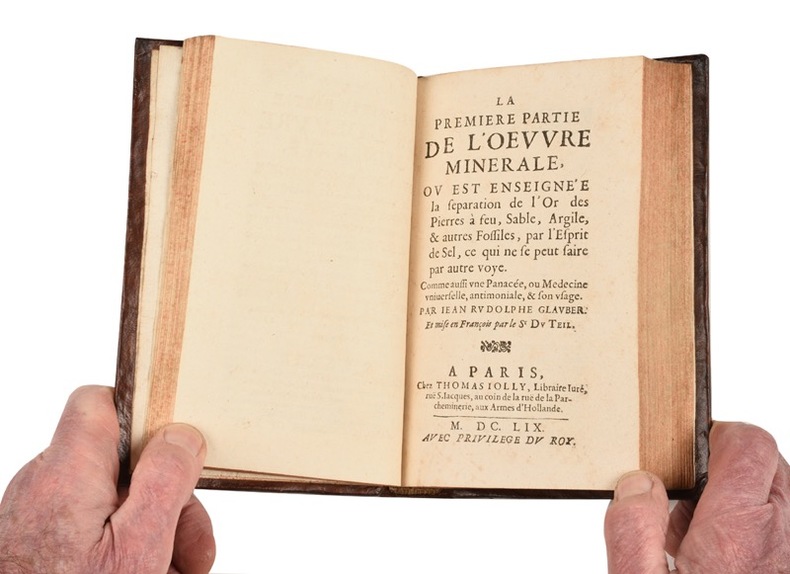
réf. 21548- Annotations sur l’appendix de la cinquiesme partie des “Fourneaux philosophiques”, où il est traitté de plusieurs secrets inconnus, et utiles. Mises en lumière, en faveur des incrédules et ignorans par Jean Rudolphe Glauber. Et traduites en françois par le Sr Du Teil. 62 pp., [1] f.bl. (Stanislas de Guaïta 1421-352)- L’Oeuvre minérale : La Première partie... ou est enseignée la séparation de l’or des pierres à feu, sable, argile, et autres fossiles, par l’esprit de sel, ce qui ne se peut faire par autre voye. Comme aussi une panacée, ou medecine universelle, antimoniale, et son usage. 64 pp.- L’Oeuvre minérale : La seconde partie... De la naissance et origine de tous les métaux et minéraux ; de quelle façon ils sont produits par les astres, sont composez d’eau et de terre, et reçoivent diverses formes. En faveur des curieux. 48 pp.- L’Oeuvre minérale : La troisième partie... ou commentaire sur le livre de Paracelse, appelé “le Ciel des Philosophes”, ou le livre des vexations, dans lequel sont enseignées les transmutations des métaux ; avec un appendix touchant la fonte, la séparation, et les autres opérations nécessaires. 111 pp., [1] bl.- La teinture de l’or ou le véritable or potable ; sa nature, et sa différence d’avec l’or potable, faux et sophistique. Sa préparation spargique et son usage dans la médecine. 22 pp., [1]f.bl. (Caillet 4588 - Stanislas de Guaïta 625)- Traité de la médecine universelle, ou le vray or potable. C’est à dire, une exacte description de la vraye médecine universelle, et de l’admirable vertu qu’elle exerce sur les végétaux, animaux et minéraux. Pour servir de clair flambeau au monde aveugle, luy enseignant le moyen de discerner le mensonge d’avec la vérité ; et de secourir les pauvres malades abandonnez. 61, [1] pp., [1] f.bl. (Stanislas de Guaïta 352 - Lenglet Du Fresnoy p.177)- La Consolation des navigants. Dans laquelle est enseigné à ceux qui voyagent sur mer un moyen de se garantir de la faim et de la soif, voire mesme des maladies qui leur pourraient survenir durant un long voyage. 64 pp. (E.O. trad. Caillet 4569 - Stanislas de Guaïta 352).
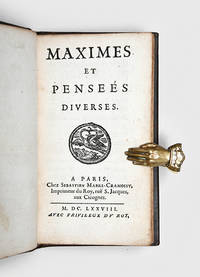
1678réf. 194492Paris: Chez Sebastien Mabre-Cramoisy 1678. Wise words from a literary hostess First edition by the "hostess of the salon that perfected the genre of the maxime. A genre she virtually invented" Conley pp. 20 & 33. Probably originating as a literary parlor game the maxime was concerned with social dynamics psychology and intellectual virtues. Many of Sablé's maximes were critiques of aristocratic society. Raised in a diplomatic family Sablé 1599-1678 was known for her manners and moral character and for her incisive discernment of these qualities in others. The writer Madeleine de Scudéry praised her: "No one has ever known so perfectly all the differences about love. I know of no activity as agreeable as listening to her make distinctions between pure love and worldly love" our translation p. 67. Sablé established her celebrated salon around 1640 in the Place Royale. After she moved to the precincts of the Port-Royal convent in the 1650s the salon became associated with the Jansenist movement. The salon predominantly discussed philosophy in particular ethics. "This preoccupation with moral issues explored through epigrammatic analysis provided the conditions for the emergence of the salon's distinctive literary genre: the maxime" Conley p. 30. The most famous attendee was François de La Rochefoucauld whose works Sablé critiqued and edited. This posthumous compilation was edited by the priest Nicolas d'Ailly c.1630-1700. Duodecimo 143 x 78 mm pp. xviii 90 12. Title page vignette head- and tailpieces. Recent calf 5 raised bands spine lettered tooled and ruled in gilt edges speckled red. Contemporary inscriptions to front and rear blanks. Extremities rubbed gutters sporadically reinforced with archival tape light browning to page extremities occasional faint damp stains: in very good condition. John J. Conley The Suspicion of Virtue: Women Philosophers in Neoclassical France 2002; Madeleine de Scudéry Artamène ou le Grand Cyrus VI 1654. hardcover
1703réf. 3645Bourg du Cul-de-Sac Saint-Domingue 1703. Four-page manuscript notarial act bifolio approx. 35 × 23 cm written in brown ink on laid paper signed by the notary Perigny and the royal counselor Vernoy. With contemporary marginal notes including a concise summary of the transaction. Light toning at edges; upper and outer margins with tears and a few small losses affecting portions of text on pp. 1 and 3 though still fully legible. Old horizontal fold from storage. Text entirely legible signatures clear and intact. Overall very good condition. Four-page manuscript notarial act bifolio approx. 35 × 23 cm written in brown ink on laid paper signed by the notary Perigny and the royal counselor Vernoy. With contemporary marginal notes including a concise summary of the transaction. A rare 1703 notarial act from the earliest years of Saint-Domingue when the colony was just beginning its rise to become France’s most powerful Caribbean possession. This rare document was created at a time when Saint-Domingue was still in its earliest stage of development. Only six years earlier the Treaty of Ryswick 1697 had formally recognized France’s claim to the western third of Hispaniola ending decades of informal settlement by buccaneers displaced islanders and early planters. In 1703 French royal authority was just beginning to replace these loose and often lawless communities. The Superior Council of Léogane had recently been established to impose order and to lay the legal and administrative foundations of what would soon become France’s richest and most important colony. The act records the transfer of a debt totaling 800 livres. François De Sable a planter and landholder in the Petite Plaine district ceded to Louis Dalineau a merchant based in Petit Gonave his legal right to collect this sum from Paul Lefebvre d’Albon a naval commissioner stationed at Rochefort. The debt had originated in a 1702 contract recorded by Maitre Chaumet royal notary at Leogane. The document was witnessed by Nicolas Berthelot a merchant and storekeeper and Michel Richard a ship captain. It was drawn up and signed by Perigny royal notary at the Bourg du Cul-de-Sac and certified by Vernoy likely an abbreviated form of Duvernoy or Duvernay a royal counselor at the Superior Council of Léogane whose signature conferred full legal authority on the act throughout the colony. The three principal figures in the act represent the different forces shaping the colony at this time. François De Sable belonged to the first generation of settlers who established the Cul-de-Sac plain as a center of plantation agriculture. His wife Marie Jollin was born on Saint Christopher St. Kitts and came from the French community expelled by the English in 1690. Many of these displaced families were resettled by France in Saint-Domingue to strengthen its claim to the territory. A 1671 census of St. Kitts lists Marie’s parents among the island’s French inhabitants. Later parish records show Marie’s burial at Notre Dame du Cul-de-Sac on November 3 1728 recorded as the widow of François De Sable GHC 2006. While François’s own origins are not documented the evidence strongly suggests that he was part of this same wave of resettlement. By 1703 he was established enough to engage in formal legal and financial matters reflecting the transition from scattered informal settlements to a society regulated by royal law. Louis Dalineau was active as a merchant in Petit Gonâve when this document was created linking nearby settlements such as Cul-de-Sac and Léogane to wider trade networks. This act captures him at an early stage of his career before he rose to become one of the leading merchants of La Rochelle a major Atlantic port. By the 1730s his warehouses were filled with goods arriving from the Caribbean forming part of the city’s rapidly expanding colonial commerce Martinetti 2019. His activities extended beyond private trade to royal provisioning contracts including large-scale shipments for French troops in the Americas FranceArchives n.d. He was also involved in financial transactions with the Banque Royale such as petitions for certificates of deposit linked to colonial trade and Canadian companies Nouvelle-France.org n.d. Dalineau thus represents the merchant class that tied Saint-Domingue to global trade and turned local production into wealth on a worldwide scale. The debtor Paul Lefebvre d’Albon 1666–1746 was then a naval commissioner at Rochefort one of France’s principal naval and colonial centers. Only three years later in 1706 he was sent to Cayenne French Guiana where he spent forty years as the colony’s chief administrator. Over time he rose from commissaire de la Marine to commissaire ordonnateur and finally to commissaire général de la Marine ordonnateur overseeing royal revenues naval supplies and civil administration and at times serving as acting governor. His long tenure marked the consolidation of royal power in South America during the first half of the eighteenth century. His final years and inheritance are documented in the 1746 testament of his widow Marie Anne Mathé recently discovered and transcribed GHC 2025. This 1703 act brings together three key forces at a pivotal moment in the colony’s history: the first generation of settlers who established the foundations of plantation society in Saint-Domingue the merchants who linked these remote communities to the wider Atlantic world and the agents of royal and naval administration who extended the reach of the French crown overseas. It also preserves the names of other participants reflecting the network of officials and witnesses whose roles were central to the colony’s early legal system. As one of the earliest surviving legal documents from the colony it is a tangible testament to how these forces and individuals came together to shape what would soon become France’s most valuable colony. References: FranceArchives. n.d. Fonds du notaire Jacques Bréard Rochefort 3 E 33/22 fol. 122–123v.;GHC Généalogie et Histoire de la Caraïbe. 2006. Bulletin 206 p. 5288.; GHC Généalogie et Histoire de la Caraïbe. 2025. Document 515.; Martinetti C. 2019. Négoce atlantique et évolution des constructions urbaines à La Rochelle au XVIIIe siècle. In G. Saupin Ed. Les villes atlantiques européennes pp. 291–309. Presses universitaires de Rennes.; Nouvelle-France.org. n.d. Sommation par Louis Dalineau… Minutes des notaires René Rivière Pierre Soullard et François Soullard liasse 1711–1731 1721 3 E art. 1803 . unknown