1312 risultati
1859rif. 048359London: John Murray 1859. Green cloth on boards gilt titles and embossed decoratives. Faint dusting of a little age soiling. Rubbing to extremeties. Spines: mildly faded; head & foot with thin wear. Edges: mild soiling and old foxings. Eps: feps with owners bookplate: The William Charles Comber Collection with Comber Coat-of- Arms. Vol. I: light splitting to front hinge. Frontis: fldg etching of Maori 'The War dance' some white tape repair on the blank side. Coloured fldg map of New Zealand with light old foxings; an 8cm tear to verso edge at guttering. Moderate foxing to many pagesalbeit mostly to the margins. 331p plus 32p of Mr. Murray's General List of Works. Small booksellers sticker to rep foot. Binding is VG. Vol. II: ffep with old English round hand signature January 1865. Frontis with tissue guard: etching of 'Stage for Hakari or Feast to Governor Grey in 1849 at the Bay of Islands to celebrate the Peace between the two races.' Fldg illustration "Sketch of Kororaeka"; with a 14cm tear on the fold line and onto top section. Light foxing to a few pages albeit mostly to the margins. Binding is VG. 368p. First Edition. Hb. VG/None. John Murray Hardcover
rif. 3337116124.Gpaperback. Good. Access codes and supplements are not guaranteed with used items. May be an ex-library book. paperback
rif. 1843429225.Gpaperback. Good. Access codes and supplements are not guaranteed with used items. May be an ex-library book. paperback
1985rif. 055554Fort Benning GA: Dept.of Army-Headquarters 75th Infantry Ranger Regiment 1985. Paper Back. Very Good/No Jacket. 8vo - over 7¾" - 9¾" tall. chapt.pag.; SC staple-bound; blue w/blk.-pic.cover; rubbed w/PON&inkcover; 1"tear @ top staple; corner-fold; cleantight pgs. "Purpose: a. To standardize the conduct of airborne operations within the 75th Infantry Ranger Regiment. b. To facilitate the planning and preparation for administrative tactical and combat airborne operations. Dept.of Army-Headquarters, 75th Infantry (Ranger) Regiment unknown
1944rif. 054986Corpus Christi TX: Aviation Cadet Regiment U.S. Naval Air Training Center 1944. Hardcover. Very Good -/No Jacket. Folio - over 12" - 15" tall. 319pp.photo section&adverts; HB quarter-bound; white burlap&blue w/blue&gilt; rubbed w/lg.stainft.cover-PON&info.ft.cover; wear on edges&corners w/some soil; hinges cracked w/2"teartitle; cleantight pages except for info on pertinent pages by previous owner -Ray Jackson Rogers of Corona NM. Rogers' separation paper tipped in bk.endpaper w/more infobk.pastedwn. signed by Rogers. historical. Aviation Cadet Regiment, U.S. Naval Air Training Center hardcover
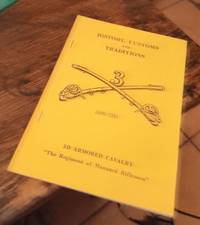
1981rif. 054918USA: 3D Armored Cavalry 1981. Paper Back. Fine/No Jacket. 8vo - over 7¾" - 9¾" tall. 27pp.; SC staple-bound; yellow w/blk.-pic.cover; fine condition w/cleantight pgs. Military history 3D Armored Cavalry unknown
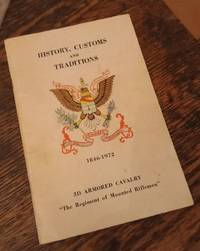
1972rif. 054917USA: 3D Armored Cavalry 1972. Paper Back. Very Good/No Jacket. 8vo - over 7¾" - 9¾" tall. 31pp.; SC staple-bound; white w/blk.-pic.cover; rubbed w/ink PONsbk.cover&inside covers; cleantight pgs. Military history 3D Armored Cavalry unknown
1981rif. 054919USA: 3D Armored Cavalry 1981. Paper Back. Fine/No Jacket. 8vo - over 7¾" - 9¾" tall. 27pp.; SC staple-bound; green w/blk.-pic.cover; fine condition w/cleantight pgs. Military history 3D Armored Cavalry unknown
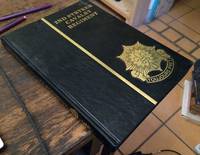
2008rif. 007667US Army/Minneapolis Minnesota: 2nd Stryker Cavalry Regiment/Jostens Commercial Printing 2008. Hardcover. Fine/No Jacket. Folio - over 12" - 15" tall. 303pp.; HB blk.w/gilt-emboss cover; fine condition w/cleantight pgs. History & yearbook. color photos throughout. 2nd Stryker Cavalry Regiment/Jostens Commercial Printing hardcover
rif. 2597716 August 1803; War Office Whitehall. See his entries in the Oxford DNB and History of Parliament. 1p foolscap 8vo. In fair condition aged and worn with small piece of paper torn away at foot of page resulting in some loss of text of slug also wear and a few nicks at head and a stain to one edge. Good firm signature ‘C Yorke’ and its surroundings unaffected. A printed form letter signed by Yorke as ‘Right Honble. the Pay-Master General / &c. &c. &c.’ and completed in a secretarial hand and addressed to ‘Gentlemen’. States that from 31 March 1803 Captain Henry Shelley of the 20th Regiment of Foot should be placed on the half pay of the 85th Regiment of Foot at the rate of five shillings a day in the room of ‘Captain Bent who exchanges’. 16 August 1803; War Office [Whitehall]. unknown
rif. 20204Hamilton Lanarkshire Scotland. Declaration dated 13 July 1813. On both sides of a piece of vellum roughly 21 x 15.5 cm. An unusual survival aged and discoloured in the fashion customary with vellum. On the front is a design of an armorial shield encircled in draperies in ink and colours blue red yellow beneath which are the words 'Burgess Ticket for Captain Kennedy 1 Regt Royal Lanarkshire Local Militia 1813'. On the reverse all in the hand of the signatory: 'At Hamilton the thirteenth day of July one thousand eight hundred and thirteen The which day in presence of William Hamilton and John Torrance Esqrs Baillies of the Burgh of Hamilton with Consent of the remaining Members of the Town Councill thereof Captain James Kennedy 1st Regt Royal Lanarkshire Local Militia was duly admitted Burgess of said Burgh with Liberty to him to Enjoy the whole Priviledges and Immunities thereto belonging as amply in all respoects as any Burgess does or can Enjoy who accepted thereof and Gave his Oath de fideli Extracted by A Hamilton Clk'. See Image. Hamilton, Lanarkshire, Scotland. Declaration dated 13 July 1813. hardcover
rif. 18807North African Campaign British Army 1940-1943. . 4pp. 4to. On four leaves. In fair condition on aged and worn paper with minor rust marks from paperclip. Ownership signature at top right of first page: 'Lt M P M Ollard'. The pages are numbered in type 5 corrected in manuscript to '1' 2 3 and 4. The first page is headed 'Some golden rules for the desert' with subheadings 'Desert March Discipline' 'Protection' 'Navigation' 'Messing Rations etc.' 'Maintenance' and 'General'. The next section is headed 'Tips for the desert' with subheadings 'Clothing' 'Stores and Equipment' 'M. T.' 'Comforts' including a list of 13 'boon' commodities from 'N.C.I. powder for fleas' to 'Salt water soap' 'Hygiene' and 'General'. A section headed 'Hints on desert driving for "B" vehicles' follows with three short sections ending the document: 'Navigation' 'Maps' and 'Wind'. Dozens of pieces of advice including: 'When in vicinity of the enemy or on roads or tracks known to have been attacked from the air air sentries on the move and at the halt are essential. When attacked by enemy aircraft evacuate obliquely from vehicle.' 'Packing of rations and utensils when operating over rough country demands great care. Tea and sugar should be carried in tins and not in paper bags Eggs should be packed in sand. Boxes or packages must be wedged tightly together in vehicles with the heavier stuff underneath. Bread should be wrapped in damp cloth.' 'The navigator is not infallible. The commander or second navigator should always check up on him. If necessary or in doubt a halt should be called for a moment to check up. It is better to do this than go miles out of your course.' 'If you break down or get lost STAY by your VEHICLE. RATION your FOOD and WATER AT ONCE and help those who are looking for you by flashing a mirror waving a flag etc.' No other copy traced with no entries on OCLC WorldCat or on COPAC. [ North African Campaign, British Army, 1940-1943. ] hardcover
1919rif. 73315Cologne Germany: United States Army Second Regiment of Engineers 1919. Presumed First Edition First printing thus. Hardcover. Fair. 113 pages. Illustrations. Maps. Fold-out. This was printed by M. DuMont Schauberg Cologne. Some page markings ink scribbles presumed by a child. Cover has wear and soiling. Dornbusch 746. Introduction by General John A. Lejeune. The 2nd Engineer Battalion is an engineering battalion in the United States Army which can trace its lineage back to 1861. 2d Battalion of Engineers expanded reorganized and redesignated 1 July-1 August 1916 as the 2d Regiment of Engineers. 2d Regiment of Engineers expanded 21 May-20 June 1917 to form the 2d 4th and 5th Regiments of Engineers 4th and 5th Regiments of Engineers-hereafter separate lineages. 2d Regiment of Engineers redesignated 29 August 1917 as the 2d Engineers. Assigned in September 1917 to the 2d Division later redesignated as the 2nd Infantry Division United States. The Regiment participated in Mexican Expedition: Mexico 1916-1917 and World War I: Aisne; Aisne-Marne; St. Mihiel; Meuse-Argonne; Lorraine 1918; Ile de France 1918. General Lejeune wrote in the Introduction that "In the last battle of the war it the Regiment threw two foot-bridges across the Meuse in the face of withering machine guns and heavy artillery fire thereby enabling the advanced battalions of the Division to cross the river and seize the highest on the east bank. Battery Rathbone 1905-1948 was part of the harbor defenses of San Francisco. Battery Rathbone was a reinforced concrete Endicott Period 6 inch coastal gun battery on Fort Barry Marin County California. The battery was named in G.O. 194 27 Dec 1904 after Lt. Samuel B. Rathbone U.S. Artillery who died of wounds received in action at Queenstown Heights Canada in 1812. Battery construction started in 1904 and transferred to the Coast Artillery for use 8 Jun 1905. The east half of the Battery was renamed in G.O. 13 22 Mar 1922 for Brig. Gen. James F. McIndoe who died 6 Feb 1919. Battery deactivated in 1948. The following appeared on 28 October 1920 in The Columbus Ledger: A Columbus Boy's Distinguished Military Service. Hundreds of Columbus people recall him pleasantly-- plain Will Mitchell then now Colonel William A. Mitchell of the United States army. It was only natural that the young man's thoughts should turn toward a military career as his older brother Colonel Americus Mitchell was then an officer in the United States army. A local sponsor became greatly interested in him and was of substantial assistance in obtaining his appointment to the West Point Military Academy from the Fourth Georgia district. His army record subsequently was one of steady advancement. During the world War Colonel Mitchell organized the 20th Engineers a forestry regiment containing about 27000 men and shipped it to Europe going over himself with the last detachment of the regiment. This was perhaps the largest regiment ever organized. Shortly after he reached France Colonel Mitchell was placed in command of the 2nd Engineers this regiment constituting the Engineer regiment of the 2nd Division. He served with this regiment from Chateau Thierry to the armistice and later on became corps engineer of the 8th corps. Those familiar with world-war history of course know of the famous Second Division and his regiment constituted one of the most efficient parts of this great division. For his services he was awarded several medals by the French one of them the second highest honor given by the French government and the distinguished service medal by the United States. Colonel Mitchell then became an instructor at Fort Leavenworth. United States Army, Second Regiment of Engineers hardcover
1938rif. 37933New York: Seventh Regiment N.G.N.Y. 1938. First Edition. First Printing. fair to good. 641 illus. index compliments card laid in some weakness to front board boards somewhat worn and soiled some endpaper soiling. Seventh Regiment, N.G.N.Y. hardcover
rif. 1104586177.Ghardcover. Good. Access codes and supplements are not guaranteed with used items. May be an ex-library book. hardcover
rif. 0548276463.Ghardcover. Good. Access codes and supplements are not guaranteed with used items. May be an ex-library book. hardcover
rif. 0548597561.Gpaperback. Good. Access codes and supplements are not guaranteed with used items. May be an ex-library book. paperback
rif. 0548500622.Gpaperback. Good. Access codes and supplements are not guaranteed with used items. May be an ex-library book. paperback
rif. 1112134425.Gpaperback. Good. Access codes and supplements are not guaranteed with used items. May be an ex-library book. paperback
rif. 17022The account of 'Events in 1855 and 1856' dated by Wrench from Park Lodge Baslow Derbyshire 1902. The duplicated letter dated 12 December 1880. The printed advertisement for talk at the School Baslow and dated 14 January 1881. Wrench was the son of a clergyman and well connected being presented to the Prince of Wales and staying at Chatsworth in his old age. His obituary in the British Medical Journal 27 April 1812 describes how he went out to the Crimea in 1854. 'He had been gazetted Assistant Surgeon to the 34th Regiment in November and joined it on its arrival in the Crimea. He served during the terrible winter of that year and was present at the capture of the quarries the successful assault on the Redan of June 18th and the final capture of Sebastopol on September 8th 1855. He was mentioned in despatches and received the Crimean medal and clasp for Sebastopol and the Turkish medal.' Wrench's own account of his experiences in the Crimea Item One below – entirely unpublished – is a personal one vividly-written and full of detail. It does not appear to be present in the collection of his family papers at Nottingham University Library. ONE: Manuscript consisting of 'Events in 1855' 4pp and '1856 12pp making a total of 16pp. 8vo on twelve leaves attached with a stud. In good condition on aged and dogeared paper. The first page of the 1855 manuscript is headed '12 sic Pages in this Year' but comprises four numbered pages. The beginning of account sets the scene and gives an indication of the level of detail: 'The 1st Janry found me doing duty with the 28th Foot or Slashers in the 3rd. Divt of the army before Sebastopol having landed at Balaclava from the Ship "Queen of the South" on the 20th. Nov. 1854. On the 6th July I was ordered to do duty with the 50th. Foot but as I did not wish to move the weather being very bad and my tent being as comfortable or rather as little uncomfortable as it could be made except to join my own Regt. the 34th. to which I had been gazetted on the 1st. of December 1854. I applied to be sent to it and was ordered to join which I did on 9th of Janry.' The account is made up from diary entries and is none the less vivid and interesting for that: 'On the following morning a wounded Russian named Alexo was brought into our Hospital and we amputated his leg he did really well and was eventually exchanged at Odessa. Poor Jordan's death threw a great damp on the Regiment as he was the first Officer we had had killed. On the 9th. of April being Easter Monday the 2nd. Bombardment took place. It was a fearfully wet windy day so that no one was able to go out to see what damage was done. On the 10th. I was on trenches and the noise was terrific but nothing to what I have since heard. I had a very narrow escape from a round shot which hopped over the parapet close to where I was.' In June 'after 68 hours bombardment an assault was made on the Quarries by ourselves . I did not go down till about 8 with Robinson Scott & Peel and 100 men. We were marching about the Trenches half the night and were finally sent to the middle ravine just below Mamelon. The scene there was most horrible the ground being strewn with dead & wounded. English French & Russians. One poor Russian boy was dragged up by two Zouaves but fainted just opposite to where we were lying. I got a light and found he was shot through the belly and that nothing could be done for him. I gave him some water and he lie sic by me some time but died before morning. I got an amulet off his neck & his cap pouch which I sent home'. The 1856 account begins in dramatic style: 'The first entry in this Diary relates to the explosion which took place within the British Lines during the Siege of Sebastopol. Feb 3rd. I was not many hundred yards from this explosion when it took place & will here relate now Janry 1900 my recollection of it. It took place in Novr. or Decr. 1855. I had just come in from a ride & had given my horse to my Batman when I noticed a vast cloud of smoke shoot up from the Right Siege train an open air arsenal about 500 yds from my house - a tremendous noise of explosion followed & knowing that there would be a rain of missiles from above to fall immediately I jumped under my doorway - hoping the strong lintel would protect me . a shower of fragments fell around me rattling on my iron roof - and wounding many men in the Regiment - 70 men were killed by the explosion some over half a mile off. The artillery horses were passing in front of my door to water & stampeded hurting several men in their rush. Both my horse and my dog bolted. I got the horse back in a few hours - but my dog taken sic a few weeks before out of Sebastopol returned to her old home and was found there weeks afterwards I brought her to England My house that I had just finished building myself did not sustain much damage. .' The account continues packed with incident. At one point he writes: 'I had written the above in 1859 and continue it forty one years after November 4 1900. The events & fights of May 1856 being written so legibly in my brain that I can read much of what we did & said. Alas all the actors except myself are passed away. My notice has been called to the excursion by reading an Illustrated article in a magazine named "Travel" in which Dr. Hy. Lansell has been describing a tour taken last year over the same ground - so little altered from what I saw in 1856 that his description would do for mine'. The diary concludes in fine style. On 2 May 1856 he goes to Yalta where he finds 'the daughters of the English Clerk of the Works of Prince W's Palace were keeping the Hotel a very rough primitive structure low stone built rooms with a long rough wooden verandah overlooking the lovely Bay - We enjoyed an excellent dinner of Turbot & Oyster Sauce & a bottle of excellent local wine like Hock - as we returned we went over the Emperor's Villa Orianda . One day when I remember seeing for the first time a Persian horizontal Water Wheel in a very pretty village embosomed in Walnut Trees where also I bought an embroidered linen neck scarf which I still possess - On another occasion I accompanied Best & Chapman to the Alma & where I picked up the Russian Cannon Ball now on top of the Study Clock - I tried hard to get someone to accompany me to Bagshi Serai & Chuphut Kale but I had to go alone - I wonder now how I dare. For it was in the heart of the Enemies Country. I remember the Priest spit when I went near them in the Church in the Rock and I rode home at night through the Russian Camp on the river Balbec. I certainly felt no fear but that was the Ignorance of youth'. A final note more than half a page long records a meeting at Chatsworth in 1902 with Grand Duke Michael and his wife the Countess Torby. TWO: Duplicated letter by Wrench a hectograph in purple ink intended for circulation among his 'dear children'. 4pp. 12mo. Bifolium. In fair condition on aged and lightly-creased paper. Signed 'E. M. Wrench'. At the beginning is a half-page drawing by Wrench captioned 'Russian Soldier - In the Valley of the Shadow of Death. near Sebastopol - 1855 on Black Sea in the distance'. He describes a lecture he gave at Bakewell the previous Monday on the Siege of Sebastopol beginning 'I began by describing the terrible state of the hospital at Balaclava in November 1854. I had a ward full of wounded from Inkerman with bad cases of fever & cholera - All the windows had been blown out by the great storm of November the 14th. The sick had no beds and often nothing to eat until 3 or 4 oclock in the afternoon. The harbour of Balaclava was crowded with steamers while the coast near was strewn with the wrecks of the 21 ships that had gone down in the storm. .' The letter continues with much valuable detail and a drawing of a 'Section of "sunk" tent with fire place' on the third page. In the final paragraph he reports that 'Lord Edward Cavendish M.P. took the chair at my lecture. The room was quite full and some of the audience had come 8 or 10 miles to hear me.' THREE: Printed handbill advertisement with duplicated illustration another purple hectograph by Wrench on reverse joke featuring two soldiers and a horse and cart. 1p. 12mo. In good condition on lightly-aged paper. The printed advertisement is crisply printed and the date '14th' is added in red ink. It reads: 'A Lecture will be delivered in the School Baslow On Friday January 14th. 1881 At 7.30 p.m. By E. M. Wrench F.R.G.S. entitled Personal recollections of the Siege of Sebastopol. Illustrated by Drawings &c. Admission One Penny. No Change given at the Door.' The account of 'Events in 1855 [and 1856]' dated by Wrench from Park Lodge, Baslow [Derbyshire], 1902. The duplicated letter dat unknown
rif. 17021Two duplicate letters one dated from Park Lodge Baslow Derbyshire on 23 December 1907 and 'Christmas 1907'; and the other from the same place 'Aug 1909' and 13 September 1909. Third duplicate and typescript without place or date. Wrench was the son of a clergyman and well educated and well connected being presented to the Prince of Wales and staying at Chatsworth in his old age. His obituary in the British Medical Journal 27 April 1912 describes how after service in the Crimea 'he was transferred to the 4th Lancers went to Madras with that regiment in the following month and served with it during the whole of the Indian Mutiny. For his services in India he received the Indian medal and clasp for Central India. He returned to England in 1860 and married in 1861 his cousin the daughter of Mr. William Kirke of Markham Hall Nottinghamshire'. The four items in the present collection are all in good condition on lightly-aged paper. The three duplicates - all closely and neatly written in a vivid and informative style - are among ones produced by Wrench for circulation within his family there being copies in the collection of Wrench papers in Nottingham University Library. They comprise two letters and a narrative account. The typescript by an unnamed individual is not present at Nottingham. None of the four items is in the Imperial War Museum catalogue. ONE: Duplicate of Autograph Letter by Wrench 'Edwd M Wrench M.V.O - F.R.C.S. late asst Sugeon 12 R Lancers'. Dated at beginning 23 December 1907 and at end 'Christmas 1907 - Park Lodge Baslow Derbyshire'. The letter describes the 'Jubilee commemoration' at the Royal Albert Hall and is headed 'My last Parade'. It begins: 'It was indeed well done The dinner to the surviving Veterans who fought in the Indian Mutiny campaign in 1857 given by the proprietors of the London Daily Telegraph a procession of heart stirring episodes from the Inspection by F.M. Lord Roberts on the steps of the Albert Memorial where I found private Meredith of the 24th who was with me in the trenches at the assault on the Redan Sebastopol June 18 1855 to the surging chorus by the thousands in the Albert Hall of Auld Lang Syne near the end of what Lord Curzon in his thrilling speech said was a "ceremony" rather than a festival a speech that made the tears tremble on my eyelids. They overflowed at the solemn sounding of the "last post" recalling to my memory in the words of the poet O Hara a charge of the 12th Lancers I rode with at the battle of Banda .'. He names others present including 'Col Robertson . he was still the bravest of the brave for though 86 he was in velvet Levee dress silk stockings & pumps without a great coat. He told me he was a teetotaller his picturesque appearance attracted Lord Roberts eye and drew a heavy fire on us not of rifles but of snap shot cameras the result of which has been my portrait in such good company scattered by the hundreds of thousands in The Daily Mirror of Decr 24 . I have looked down the barrel of a loaded musket near enough to see a Sepoys yellow eyes taking aim at the butt end and ridden with cannon balls hopping over my head like balls in a cricket ground I cannot compare my perils during the Sepoy Mutiny to many others of the Kirke family'. 2pp. 8vo. TWO: Duplicate of Autograph Letter by Wrench 'Ed M Wrench'. Dated at beginning 'Park Lodge Baslow Aug 1909' and at end 13 September 1909. 3pp. 8vo. The letter begins: 'Having recently discovered that General W A Franks Major-General William Astell Franks 1838-1929 now living at Northland Road Southampton was present when Uncle Henry Kirke died when fleeing from the Mutineers of his Regt. 12 BNI in 1857 I took the liberty of writing to him he very kindly responded to my enquiries & I feel sure the information he has afforded will be interesting adding much to our scanty knowledge of that terrible time.' There follow extended transcriptions from Franks's letters: '. I saw him the day he died . he was on his horse but rolling about on it . he looked at me with a vacant stare & was deadly pale. I could see he was dying. Shortly after he fell off his horse he was the only one of our party that was buried all the rest being left where they fell .'. Of his own activities Wrench notes: 'I had gone to India almost direct from the Crimea in the year previous 1856. I was assistant Surgeon in the 12th Lancers so was never in the same danger as the Officers of the Native Regiments though I had my share of dangers . and had men blown to pieces by shell not a dozen yards from me . We went not as is said to revenge the Mutiny but to protect the loyal natives of which there were many & restore order yet in one battle we killed 500 rebels and looted two Palaces from one at Kabula we took 40 cart loads of gold & silver; my share of which was £750 . 0 . 0 so I have no personal grievance'. He continues with reference to the Battle of Banda and 'hunting rebels in the jungles'. THREE: Narrative account titled 'Cousin Henry Kirkes story of his escape from Mutineers June 1857'. The account begins: 'In 1857 Uncle Henry was commanding the Head Quarters of the 12th Bengal N.I. at Nowgong now spelt Naogaon Aunt Kirke Henry & St George were with him - He greatly distrusted the Sepoys and when he heard of the mutiny at Barrackpoor in April he immediately sent Aunt & St George off to the Hills just in time for they left Meerut only two days before the fatal 10 May'. A gripping account follows filled with incident: '. At the beginning of June Uncle heard that the left wing of his regiment stationed at Jhansi about sixty miles distant had killed the officers and all the Christian women and children there; Uncle forthwith ordered a parade and addressed the men. He told them of the mutiny of their comrades at Jhansi and added "Now I will let any man that wishes go and join the mutineers but let those who are true come and swear by the Colours". The whole 500 cheered and swore they would be true to him and the Colours. Two days afterwards they broke out into open mutiny shot the Regtl. Sergeant Major and made the officers fly for their lives. . The Europeans ten officers two ladies riding on Uncle's charger and a baby that Henry carried in front with a man riding behind him started for Banda. They asked a Brahmin the way he refused unless they gave him a rupee this Henry did when he ran off demanding another and swore by his gods that if given this he would be faithful but having got it he called to some villagers to come and kill the Faringhees for they had lots of money and so they would be rich for life. Some of the officers wished to shoot the man but Henry dissuaded them but presently the ruffian threw his lathi or club at the ladies horse which reared and they fell off. The man ran forward to kill them when Henry shot him through the back of the head he fell on his face. The villagers turned the dead man over and the two rupees fell out of his mouth when Henry heard them say "It is true they are rich for see they have loaded their guns with rupees". .'. 3pp. 8vo. FOUR: Mimeographed typescript titled '"Not to Revenge but to Protect."' 18pp. 8vo. Containing a transcriptions of Item One pp.16-18 and Item Three pp.4-9 and of passages from Item Two pp.13-15 with a commentary by a knowledgeable but unrelated party. Two duplicate letters, one dated from Park Lodge, Baslow, Derbyshire, on 23 December 1907 (and 'Christmas 1907'); and the other unknown
rif. 12126The nine items all from Kandy Ceylon Sri Lanka and dating from October 1817 to January 1819. The nine items in this collection provide valuable information regarding the management of the estate of a Georgian colonial British army office. Coane's battalion had served in New South Wales and Van Diemen's Land between 1812 and 1814 and had been in Ceylon under Lieutenant-Colonel Andrew Giels since 1814 by the time Coane died on 5 January 1819 his demise much regretted by his superiors. The nine items are on aged and worn paper with chipping to extremities. ONE: Autograph Letter Signed from 'George. Minter' to unnamed recipient. Kandy; 29 December 1818. 4pp. 12mo. Bifolium. The letter begins in dramatic style: 'Dear Sir Ere this reaches you I much fear Major Coane will be no more. Mr Marshall as well as Dr. Armstrong who have been in constant attendance on him for the last three days having just told me that they have little or no hopes of his surviving till to morrow.' He writes that Coane 'still remains sensible' and wishes the recipient to turn over 'His Will and other papers' to 'the Committee of Paymastership'. Like the recipient Minter has been appointed by Coane one of his executors. TWO: Account by Minter of 'The property of the late Major Coane in my possession'. Signed by Minter and dated Kandy 8 January 1819. 1p. landscape 8vo. Marked 'No 1'. THREE: 'List of the Effects of the late Major Coane 73d Regt Sold by public Auction With the purchasers Names and Amounts - Kandy 7th. January 1819.' Dated 16 January 1819. 2pp. 8vo. Giving the purchasers' names and amounts paid for items ranging from 'One Brass Jumboo sic' to 'one Regtl forage Cap'. Marked 'No 2'. FOUR: 'The late Major coane in account with Lieutenant Minter'. Signed by Minter and dated Kandy 8 January 1819. 1p. 8vo. Marked 'No 3'. FIVE: Manuscript list of clothes. 1p. 8vo. Docketed: 'Hay's Memorandum. to Maj. A. Coane Sun 13th Jany. 1819'. SIX: 'An Account of monies paid by Lieut & Adjutant Hay on Account of the Grenadier Company'. 1p. 12mo. SEVEN: 'Account of monies with the Adjutant and Captain A Coane 73rd Regiment of Foot to 24th Octr. 1817'. 1p. landscape 12mo. EIGHT: 'Account of monies with the Adjutant and the Grenadier Company 73rd Regiment'. 1p. 4to. First entry: 'Paid Companys books from 2nd. Novr. to 24th November 1817 Inclusive'. NINE: 'Account of monies with the Adjutant and the Grenadier Co. 73rd. Regiment of Foot.' 1p. 4to. First entry: 'Balance to 24th Novr. 1817 as Per Ledger'. The nine items all from Kandy, Ceylon [Sri Lanka], and dating from October 1817 to January 1819. hardcover
rif. 12274No place. 25 September 1917. 2pp. 12mo. Good on lightly-aged paper. The letter is written in pencil and begins: 'Sir I am awfully sorry to say that I have just been ordered to report tomorrow to G. H. Q. where I shall very probably receive the order to go to the Yankee Army. I am really very sorry to leave you without having even been able to present to you my respects and my thanks for the kindness you have always shown to me during the time I have been attached to this brigade which is now exactly a year ago. I shall no more have now any lecture to do as I do not feel inclined to lecture the Yankees!!!' He concludes by expressing the hope that 'little you-you and her young brother Potter's children will sometimes think of the french sic interpreter who liked to hear of their doings'. Docketed at head by Potter: 'Please destroy. signed H.C.P.' and at the end: 'Such a nice chap. The one who sent sweets & the flowers to June. signed H.C.P.' After a distinguished military career in India Potter's saw active service in the Great War Battle of the Somme; Battle of Arras; 3rd Battle of Ypres and others; wounded four times with the King's Liverpool Regiment on the Western Front throughout the entire First World War No place. 25 September 1917. unknown
rif. 12188Castletown Isle of Man. 1 January 1847. 1p. 4to. Thirteen lines of text daintily printed in small type. On lightly-aged and creased paper with a number of short closed tears. Dated in print at the foot 'Castletown Isle of Man 1847.' Beneath this De Renzy has written in manuscript '1st January signed George Webb De Renzy Major and Barrack-Master'. The text begins: 'The Work advertised in the "Times" and other Newspapers is a Poetical Illustration of the Career of Field Marshal the Duke of Wellington and his Illustrious Companions in Arms embracing Effusions on the most striking and prominent Events connected with his martial Achievements. - It is likely to come under the notice of Her Majesty the Queen Dowager Prince Albert His Grace of Wellington and the Nobility Gentry and the Public generally. It will be copiously and beautifully illustrated and as slect in the Matter and Manner of its style as may be inferred from the Character of the Presentation will admit. - One Hundred Copies will be presented to the Public Press and one to each Contributor.' The final paragraph reads: 'The Compiler thus offers a fair field to the Aspirations of Genius whether known or unknown to the world. The theatre is a spacious one and presents a noble opportunity to those gifted Spirits who may be desirous of bringing their Names before the Empire and giving to their fellows the brightest Scintillations of their Genius.' The book with the slightly amended title 'Poetical Illustrations of the Achievements of the Duke of Wellington and his Companions in Arms' was finally published in 1852 by Simpkin Marshall & Co. of London and Sutherland & Knox of Edinburgh. De Renzy is an interesting figure. When in 1822 he published 'Enchiridion; or a Hand for the One-Handed' the 'New Monthly Magazine' explained that 'having lost his right arm at the battle of Vittoria' he 'was induced to turn his attention to the forming a set of instruments which should enable him to be at all times independent of any other assistance than such as he might derive from them'. The United Service Magazine found within the 'Poetical Illustrations' 'gems' which 'give the book - what it ought to possess - high literary pretensions'. Castletown, Isle of Man. 1 January 1847. unknown
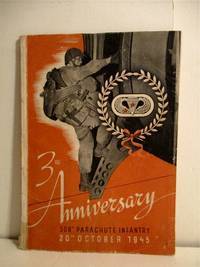
1945rif. 78-1065BFrankfurt: Otto Lembeck 1945. 1945. 60p. Combat history. Roll of Honor KIA. Rosters at printing by Company. Group Photos. Large Wraps. Tear at foot of spine. Very Good copy. Paperback. Very Good. Book. Frankfurt: Otto Lembeck, 1945. Paperback