1315 risultati
rif. 12274No place. 25 September 1917. 2pp. 12mo. Good on lightly-aged paper. The letter is written in pencil and begins: 'Sir I am awfully sorry to say that I have just been ordered to report tomorrow to G. H. Q. where I shall very probably receive the order to go to the Yankee Army. I am really very sorry to leave you without having even been able to present to you my respects and my thanks for the kindness you have always shown to me during the time I have been attached to this brigade which is now exactly a year ago. I shall no more have now any lecture to do as I do not feel inclined to lecture the Yankees!!!' He concludes by expressing the hope that 'little you-you and her young brother Potter's children will sometimes think of the french sic interpreter who liked to hear of their doings'. Docketed at head by Potter: 'Please destroy. signed H.C.P.' and at the end: 'Such a nice chap. The one who sent sweets & the flowers to June. signed H.C.P.' After a distinguished military career in India Potter's saw active service in the Great War Battle of the Somme; Battle of Arras; 3rd Battle of Ypres and others; wounded four times with the King's Liverpool Regiment on the Western Front throughout the entire First World War No place. 25 September 1917. unknown
rif. 12188Castletown Isle of Man. 1 January 1847. 1p. 4to. Thirteen lines of text daintily printed in small type. On lightly-aged and creased paper with a number of short closed tears. Dated in print at the foot 'Castletown Isle of Man 1847.' Beneath this De Renzy has written in manuscript '1st January signed George Webb De Renzy Major and Barrack-Master'. The text begins: 'The Work advertised in the "Times" and other Newspapers is a Poetical Illustration of the Career of Field Marshal the Duke of Wellington and his Illustrious Companions in Arms embracing Effusions on the most striking and prominent Events connected with his martial Achievements. - It is likely to come under the notice of Her Majesty the Queen Dowager Prince Albert His Grace of Wellington and the Nobility Gentry and the Public generally. It will be copiously and beautifully illustrated and as slect in the Matter and Manner of its style as may be inferred from the Character of the Presentation will admit. - One Hundred Copies will be presented to the Public Press and one to each Contributor.' The final paragraph reads: 'The Compiler thus offers a fair field to the Aspirations of Genius whether known or unknown to the world. The theatre is a spacious one and presents a noble opportunity to those gifted Spirits who may be desirous of bringing their Names before the Empire and giving to their fellows the brightest Scintillations of their Genius.' The book with the slightly amended title 'Poetical Illustrations of the Achievements of the Duke of Wellington and his Companions in Arms' was finally published in 1852 by Simpkin Marshall & Co. of London and Sutherland & Knox of Edinburgh. De Renzy is an interesting figure. When in 1822 he published 'Enchiridion; or a Hand for the One-Handed' the 'New Monthly Magazine' explained that 'having lost his right arm at the battle of Vittoria' he 'was induced to turn his attention to the forming a set of instruments which should enable him to be at all times independent of any other assistance than such as he might derive from them'. The United Service Magazine found within the 'Poetical Illustrations' 'gems' which 'give the book - what it ought to possess - high literary pretensions'. Castletown, Isle of Man. 1 January 1847. unknown
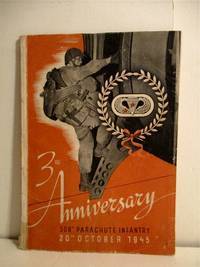
1945rif. 78-1065BFrankfurt: Otto Lembeck 1945. 1945. 60p. Combat history. Roll of Honor KIA. Rosters at printing by Company. Group Photos. Large Wraps. Tear at foot of spine. Very Good copy. Paperback. Very Good. Book. Frankfurt: Otto Lembeck, 1945. Paperback
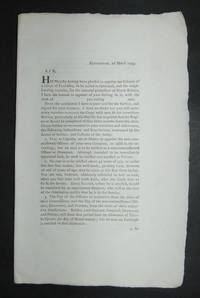
rif. 40454Edinburgh: n.p. 1793. Folio 340 x 215 mm 4pp. dated on p. 1: Edinburgh 2d March 1793 3 folded as issued uncut a fine copy. With reference to the "Grant Fencible Regiment" that is the Strathspey Regiment of Fencible Men instituted on 1 March 1793 and commanded by Sir James Grant The form of commission for a Captain in the Regiment with instructions on raising a Company which include "the Regiment should be completed within three months from this date. You as Captain are at liberty to appoint the non-commissioned Officers of your own Company. No man is to be inlisted above 45 years of age or under five feet four inches; but well made growing Lads between 16 and 18 years of age may be taken at five feet three inches. The Pay of the Officers to commence from the dates of their Commissions. each Serjeant Corporal Drummer and Private have an allowance of Three halfpence per day of Bread-money;. each Recruit must have the following articles viz Two Shirts; Two pair of Shoes Two pair fine Hose; A Bonnet and Feathers; A black Stock; A Haversack; all of which to be purchased out of his Bounty;. The Regiment is to serve in any part of Scotland but not to march out of it except in case of Invasion of the more Southern parts of the Kingdom." The British Library and National Library of Scotland copies only in the ESTC. [Edinburgh: n.p., 1793.] unknown
rif. 39343Warwick: Printed 1903. First edition 8vo 72pp. coloured frontis. and 2 further coloured plates orig. publishers pebble cloth upper cover lettered in gilt and detached spine split in need of recasing. Rare not listed by JISC. Provenance: Ink signature of Lieut.-Colonel Hubert Arthur Oldfield Hanley; bookplate of Ernest J. Martin. Warwick: Printed 1903 hardcover
rif. 39326London: Printed by William Clowes and Sons Ltd. 1883. First edition 8vo xxi 1 127 1pp. lacks front endpaper orig. red cloth lettered in gilt a little faded and stained 'B.G.H.' in ink on upper cover. Rare no copy listed on JISC. London: Printed by William Clowes and Sons, Ltd., 1883 hardcover
rif. 36904publishedby Ackermann & Co. London. 1833. restrike c.1870. print size: 22.5x30 1/4"; image size: 17 1/8"x 26 3/8"; from the original plate 1830 butissued pulled later 1870/80 beautifully coloured in brilliantcondition. Spendlove pp46-51; plate 69. publishedby Ackermann & Co., London. [1833]. restrike c.1870? unknown
1836rif. 113830London: John Macrone 1836. Hardcover. Good. viii 273 xxx p. 20 cm. Cloth hardcover with blank impressing. Gilt print on spine. Corners bumped small dents in fore-edges spine faded. Darkened endpapers. Presentation copy signed by author in year of publication on front free endpaper. Also signed by author at top of title page in 1839. Stains to inner margins pp. 142-143 195-198 and mark on lower corner of p. 193. A few other small spots. In general paper clean and bright. Page torn out after xxx. General George De Lacy Evans raised a force of British half-pay officers and mainly Irish volunteers to fight on behalf of Queen Christina against the usurper Don Carlos in what has become known as the Carlist Wars. Author Charles William Thompson often wrote home to his parents while serving as an ensign in the 9th Regiment British Legion. As stated in the preface he wrote of "anything new and striking that fell under his observation in the course of his wanderings." These included Andalusian horses soaking rain billets with Spanish families Cathedral bas-reliefs prisoners executed by garrote fever dysentery and digging boots out of the mud while wearing white gloves. The author was wounded in the hip at San Sebastian on May 5 1836 an event graphically described on pages 238-241. Appendix lists officers who died of typhus or in action as well as general orders and copies of letters. John Macrone hardcover
rif. 1341788083.Ghardcover. Good. Access codes and supplements are not guaranteed with used items. May be an ex-library book. hardcover
1945rif. 62-929BN.P. N.d. C. 1945. 1945. 34p. Photos. Folding map. Element of the 26th Yankee Division. Northern France Rhineland Ardennes Central Europe. Small Wraps. Fine Copy. Paperback. Fine. N.P., N.d. C. 1945. Paperback
rif. 1163265055.Gpaperback. Good. Access codes and supplements are not guaranteed with used items. May be an ex-library book. paperback
rif. 1166656616.Ghardcover. Good. Access codes and supplements are not guaranteed with used items. May be an ex-library book. hardcover
rif. 1166173127.Gpaperback. Good. Access codes and supplements are not guaranteed with used items. May be an ex-library book. paperback
rif. 1165497697.Ghardcover. Good. Access codes and supplements are not guaranteed with used items. May be an ex-library book. hardcover
rif. 1166604330.Gpaperback. Good. Access codes and supplements are not guaranteed with used items. May be an ex-library book. paperback
rif. 1165814617.Gpaperback. Good. Access codes and supplements are not guaranteed with used items. May be an ex-library book. paperback
rif. 14757Three plates engraved by Robert Havell and son printed by Edward Egerton-Williams in colours and finished by hand each with printer's blindstamp. From an edition limited to 110 copies printed from the original printing plates in 1988 employing the same techniques as used in 1823. This fine edition was published as a collaborative effort between the State Library of New South Wales and the renowned fine art publishers Alecto Editions. "By 1820 Sydney was a town of 12000 inhabitants about a third of whom were convicts. It had grown dramatically during the administration of Lachlan Macquarie who was appointed governor of New South Wales in 1810. Unlike previous governors Macquarie was not content merely to oversee a penal colony. His vigorous building programme changed forever the appearance of Sydney while his policy of accepting emancipated convicts as respected citizens demonstrated a social attitude strangely out of step with the times. Both these policies earned him criticism. In 1819 alarmed by Macquarie's extravagant public works the British Government commissioned a lawyer and civil servant J.T.Bigge to investigate. The attacks by his critics were met head on by Macquarrie's supporters in New South Wales. Books pamphlets and paintings luded the governor's undoubted achievements. Almost certainly Major Taylor's drawings were used in if not commissioned for this cause. The engraved views of the Panorama present a flattering image of the Australian seat of government and by extension of Macquarie's term there.Taylor arranged the engraving and printing of the of the three sheet Panorama. upon his return to England in July 1822.Havell appears to have worked from Taylor's. large watercolours but amended them with additional details. and decorative elements.It is most fortuitous that the copper plates.have survived. There is no other example of such a case for 19th century Australian engravings. unknown
rif. 1017172358.Ghardcover. Good. Access codes and supplements are not guaranteed with used items. May be an ex-library book. hardcover
1863rif. BOOKS1618New York NY: Frank McElroy Printer. G: spine faded cover stains; p.117-120 chewed p.165 torn fox/No Dustjacket. 1863. 16mo. 281 pp. . Frank McElroy, Printer unknown
rif. 12219Without place and date 1960s. The account describes events in April and May 1945. 13pp. foolscap 8vo. Paginated 1 to 13 and signed at the end 'Ernie Wilmott'. On seven leaves stapled into grey covers with the title 'The Last Month' typed on the front cover. In good condition in worn wraps. The account commences: 'There had been gun fire from the west and the south for the last three days. Friday the 13th April 1945 the usual officials did not come to fetch the men but a little later than usual the Gaschwyz sic column was called so we assembled and left for work about 20 of us. There was a lot of activity in the station yard German military vehicles were coming and going and a contingent of unarmed Russian fatigue men were on parade.' A typically vivid passage reads: 'In the morning of the 24th April I heard chaps reporting prisoners passing through and our guards not interfering a lot of Indians were going through without any guards. Chaps with kit got up early because of being cold. I got up after seven and went outside and saw the Indians going through. A column of Russian prisoners appeared with guards and were halted just outside. The German guards were standing about in groups talking to each other and taking no notice of the prisoners some of whom were already making off. A man got up on a cart and addressed us he said he couldn't advise us to go he couldn't advise us to stay the German commandant had said that if we stayed he would do his best to obtain food for us there was a horse dying in the next village and he had the first refusal of it if it expired and we should have it.' The account ends on Wilmott's return: 'At London I bid my comrades of the last 2 years goodbye and got on a train at Paddington. It was a noisy journey ex P.O.W.'s one side of the compartment civilians the other we all talked at once. At Bristol I had to catch a bus home and suddenly realised I had to pay the fare it was more than 3 years since I had paid a fare anywhere.' The covering Autograph Letter Signed by Batt is signed 'Jack' on letterhead of 1 Churstonville Court 1 Overbury Avenue Beckenham Kent. 1p. 4to. Undated and with recipient's name not given. 'The writer Ernie Willmott sic spoke 4 Languages and was learning Russian whilst POW in Germany. As he spoke German he was chosen as Camp Leader of our working Camp at Gaschwitz-Leipzig. Our Common path of experience starts at Campo 53 Page 69 - from there we were together unitl the war ended or shared similar experiences.' In a postscript he adds that Wilmott 'was not in Campo 66 at Capua but in hospital at Caserta'. Also present is a Typed Letter Signed to Batt from 'Charles'. On letterhead of 99 South Eden Park Road Beckenham Kent. 21 June 1974. 1p. 8vo. The 'article on Sidi Nsir' brings back 'many memories' and he is enclosing 'The Story of 46 Division'. Without place and date (1960s?). The account describes events in April and May 1945. paperback
rif. 18337Arras. 6 December 1840. Headed with the first line in gold: 'Corps Royal du Genie. 2e. Regiment. Academie d'Escrime. Brévet de Maitre d'Armes.' The commission reads: 'Nous soussigné Maîtres d'Armes Composant la garrison d'Arras après avoir reconnu les capacités du Sieur Chaix Marius Maître Ouvrier à la Ce. Compagnie du 2e. Bataillon du dit Regiment. On one side of a 28 x 36 cm piece of cream paper. In fair condition aged creased and worn with central vertical fold. An attractive production within a black border with an illustration of a helmet breastplate axe sword and laurel leaf at head painted in red grey green and gold. Elève du Sieur Poncet Maître d'Armes reconnaissons l'avoir reçu en qualité de Maître en foi de quoi nous lui avons délivré le présent Brevet pour lui servir et valoir ce que de raison. En consequence nous invitons nos Freres d'Armes à lui préter aide et assistance en cas de besoins partout ou il aura merité leur Amitié et leur Estimé.' The signatures include: 'Faindienier 1er. Mtre.'; Reniéville; Bouvier; Grégoire; Champ; Bernard; Maray; Altier and Baldwin. See photo. Arras. 6 December 1840. unknown
rif. A9781166656614New. unknown
rif. 8933Letter One: 'Camp Sebastopol. January 24th. 1856.' Letter Two: 'Camp 49 Regt Sebastopol. March 31st.'. Letter One: 12mo 4 pp. Bifolium. 75 lines of text. Clear and complete. Good on lightly-aged paper. Expresses regret at 'Morten Edens melancholy death so young & so clever as he was'. 'There is great talk of Peace. We hardly know if to believe it - few will be sorry should the news prove to be true as I think most of us have had enough fighting. Apparently refers to his sweetheart under a cypher. She has not written to him but 'London gaieties have little time for correspondence'. 'The weather here is something awful - cold & wet fogs & sleet. The place is a sea of mud up to your knees without exaggeration.' His father has sent him food and clothing. The officers are 'getting up a school for the men as the weather is too bad for drill' but 'there is no scarcity of work' with the roads requiring constant repair and 'the Minie Rifle Instruction' going on daily. 'There was a good deal of firing on Sunday night down by the Tchernaya - and we rather expected an attack however it all ended in Smoke.' The docks which he considers 'the most splendidly finished' he has ever seen 'built up of that beautiful red & blue granite' have 'all been blown up'. Letter Two: 12mo 4 pp. Bifolium. 67 lines of text. Clear and complete. Fair on aged paper with 6 cm vertical closed tear through both leaves. Containing an interesting description of 'Spring horse races' which took place 'in the Valley of the Tchernaya' as a result of an armistice. The allied armies crowded the banks on one side of the river and on the other 'the Russians let loose for the occasion'. There was much bartering - 'Knifes sic Pipes Tobacco Money and various other articles . thrown across the river attached to a stone or enveloped in mud. The river is not more than 2 or 3 yards wide at some places so that we could have plenty of conversation with our Enemies without breaking the "General order". The French were allowed by their Chiefs to cross and they appeared to get on capitally with the Russian Officers'. The French fired 101 guns in a general salute to the heir to their emperor and the British returned the salute with the same number. Regarding the outcome of 'the conferences' hears that 'you people in England are very pugilistic and are determined to have war if you can'. Considers that the British Army 'was never in better condition for a campaign' and thinks it 'a pitty to stop just now'. Gibson was still alive in 1864 when he married Georgina Eliza daughter of William Clarke. Note: "The 49th was at the battles of Alma Inkerman and Sevastopol during which three Victoria Crosses were awarded to members of the Regiment." Letter One: 'Camp Sebastopol. January 24th. 1856.' Letter Two: 'Camp 49 Regt Sebastopol. March 31st.' hardcover