125,701 results
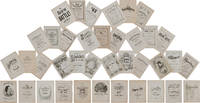
1859ref. 66557Chicago: Root & Cady; Lyon & Healy; H.M. Higgins; H.T. Merrill; Brainard & Sons; and others 1859-1883. Ante-Fire Imprints from Chicago's Golden Age of Music Publishing A vast collection of printed sheet music the considerable majority of it consisting of Chicago ante-fire imprints and with many songs about the Civil War. The items gathered here represent the height of popular music in America in the mid-19th century and especially during the war at which time Chicago was the center of music publishing on the continent. In addition to a handful of bound volumes of sheet music and musical instruction the core of this collection consists of 393 individually published folio sheet music booklets from all of Chicago's most prominent publishers representing approximately 250 separate titles with many of the most popular present in multiple copies or editions. Most well-represented within are works by the star composers of the day such as George F. Root and Henry C. Work including such enduring songs as "The Battle Cry of Freedom" "The First Gun is Fired" "Tramp Tramp Tramp" "Marching Through Georgia" and "Lorena." Root's "Battle Cry of Freedom" was so popular that tradition holds his brother Ebenezer's publishing company had to run fourteen printing presses simultaneously to keep up with the demand for copies although the claim is impossible to verify since the company's records were wiped out along with most of their stock in the Great Chicago Fire. Aside from Civil War songs religious works and popular ballads there are a handful of other songs which touch on the spirit of the times including such titles as Root & Cady's "Tin-ni-min-ni-win-kum-kua or the Chinaman's Farewell" 1869 "Out West" 1866 and "Oil-do-ra-do" 1865. The aforementioned Root & Cady are by far the most prominent publisher in this collection and are responsible for 230 of the song booklets and six of the nine bound volumes. While the first music store in Chicago opened as early as 1847 the city's heyday as the center of music publishing in the United States really began with the advent of Root & Cady. Chicago historian and musicologist Dena Epstein writes of the company: "The formation of the firm of Root & Cady first announced in the Press and Tribune for December 9 1858 was a momentous event in Chicago music history. The partners Ebenezer Towner Root and Chauncey Marvin Cady were experienced practical musicians.The national reputation of George Frederick Root as a teacher and composer gave added prestige to his brother's new business venture. From the first this firm took a leading position in the music trade in Chicago.Before long the firm was pioneering in the local manufacture of all the music it published.From this time until the firm was ruined in the fire of 1871 it led the music trade of Chicago." The Great Fire of 1871 devastating to so many industries was particularly catastrophic for the city's music publishers: nearly all of them were headquartered in the burned area and their enormous stocks of loose sheets and unbound sheet music folios literally went up in flames overnight. Root & Cady wrote about the event in their periodical The Song Messenger of the North=West one issue of which is present in this collection a few weeks after it occurred: "There is no need for us to recount the history and extent of the terrible conflagration which makes the 9th of October 1871 a memorable day in the annals of Chicago.All the large firms of music dealers were burned out.All these lost heavily as no goods were saved from any of the stocks. The most serious loss befell Root & Cady as was inevitable from the nature of their business. They had in stock about 30000 different titles of sheet music.Every piece of music in stock was destroyed; nor is this the worst of it. About seven thousand of these pieces were Root & Cady's own publications and they must be reprinted before they can be obtained. Then too in books the loss was very great. Large editions of their books most in demand had been printed for the fall trade and these are all destroyed.In short the loss to Root & Cady alone amounts to upwards of two hundred and sixty thousand dollars. And so in a few hours departed the accumulations of years of toil." Root & Cady attempted to rebuild but were forced in short order to sell their remaining catalogue to S. Brainard's Sons a Cleveland-based music publisher who also had offices in Chicago. Of the publishers represented in this collection including such temporary juggernauts as H.T. Merill and H.M. Higgins who moved to Sweet Valley to become a successful citrus grower only Lyon & Healy survived the physical and economic devastation of the fire and Chicago never again regained its prominent position in the music industry. A substantial and wide-ranging collection of primarily ante-fire imprints from the height of Chicago's music era "when its patriotic songs 'did more to arouse the popular heart and fix the determination of the people during the darkest days of the War than all the acts of Congress or proclamations of those in authority'" Epstein p. 11. More detailed information about the contents of the collection can be furnished upon request. Condition varies by item but largely very good. A number of pieces disbound or split neatly at gutter varying degrees of tanning and staining. A small number of items in lesser condition with one lacking titlepage and one lacking last leaf of text otherwise all items complete. Dena J. Epstein "Music Publishing in Chicago Before 1871: An Introduction" in Notes 2nd Series Vol. 1 no. 3 June 1944 pp.3-11. unknown books
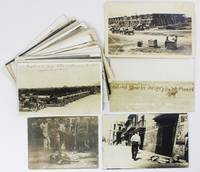
1921ref. 6158Various places in Mexico Texas and Arizona 1921. Overall about very good. 106 real photo postcards including six duplicates. Varying sizes but most approximately 3.5 x 5.5 inches. Scattered contemporary and later manuscript annotations. Light wear at edges occasionally a bit heavier. Some scattered damp and dust soiling. A substantial collection of over 100 real photo postcards that depict scenes from the Mexican Revolution and the related border war interventions of the United States Army. The images included here some quite violent in nature are dated from 1913 to 1922; most are captioned in the negative. They show ruined buildings military encampments injured soldiers and corpses on both sides of the U.S.-Mexican border and in Veracruz. Also included are identified portraits of individuals such as Francisco Madero Pancho Villa on his deathbed and American General John Pershing. Many of the images are by El Paso photographer W.H. Horne who was one of the most prominent photographers of Border War incidents captured the Columbus Raid in New Mexico and photographed skirmishes near his home in El Paso. Also present are a short series of images by Cal Osborn who documented border incidents near Douglass Arizona and a group by William Hadsell William Hadsell an American resident of Veracruz who ran a Kodak store and was a prolific recorder of events there. Several Mexican photographers are represented as well. Many of the photos are quite gruesome in nature and show corpses in various states of decomposition as well as the aftermath of battles and executions but in all provide an arresting visual document of the interventions by the United States in Mexico during the 1910s. Powerful images of the Mexican Revolution and the resulting upheaval there and along the border with the United States. unknown
1921ref. 6158Various places in Mexico Texas and Arizona 1921. Overall about very good. 106 real photo postcards including six duplicates. Varying sizes but most approximately 3.5 x 5.5 inches. Scattered contemporary and later manuscript annotations. Light wear at edges occasionally a bit heavier. Some scattered damp and dust soiling. A substantial collection of over 100 real photo postcards that depict scenes from the Mexican Revolution and the related border war interventions of the United States Army. The images included here some quite violent in nature are dated from 1913 to 1922; most are captioned in the negative. They show ruined buildings military encampments injured soldiers and corpses on both sides of the U.S.-Mexican border and in Veracruz. Also included are identified portraits of individuals such as Francisco Madero Pancho Villa on his deathbed and American General John Pershing. Many of the images are by El Paso photographer W.H. Horne who was one of the most prominent photographers of Border War incidents captured the Columbus Raid in New Mexico and photographed skirmishes near his home in El Paso. Also present are a short series of images by Cal Osborn who documented border incidents near Douglass Arizona and a group by William Hadsell William Hadsell an American resident of Veracruz who ran a Kodak store and was a prolific recorder of events there. Several Mexican photographers are represented as well. Many of the photos are quite gruesome in nature and show corpses in various states of decomposition as well as the aftermath of battles and executions but in all provide an arresting visual document of the interventions by the United States in Mexico during the 1910s. Powerful images of the Mexican Revolution and the resulting upheaval there and along the border with the United States. unknown books
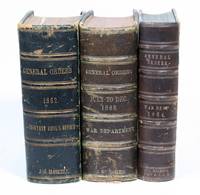
1862ref. 2923Washington D.C.: War Department 1862. Calf marbled boards. Very Good. FIRST OBTAINABLE PRINTING OF THE PRELIMINARY EMANCIPATION PROCLAMATION setting a date for the freedom of more than three million enslaved in the United States and reframing the Civil War as a fight against slavery. Issued by the War Department to regimental commanders in the field during the Civil War in the week after the completion of President Lincoln’s official manuscript version. Contained is a set of three volumes of General Orders covering the full year 1862 July-Dec 1863 and the full year 1864. History of the Emancipation Proclamation: “The proclamation has been called by responsible persons one of the three great documents of world history ranking with Magna Carta and the Declaration of Independence” – Eberstadt “From the first days of the Civil War slaves had acted to secure their own liberty. The Emancipation Proclamation confirmed their insistence that the war for the Union must become a war for freedom. It added moral force to the Union cause and strengthened the Union both militarily and politically. As a milestone along the road to slavery’s final destruction the Emancipation Proclamation has assumed a place among the great documents of human freedom” – National Archives Following the Seven Days Battle and General McClellan’s retreat from the Peninsula at the end of June 1862 President Lincoln realized that there would be no early end to the war and found himself “as inconsolable as it was possible for a human to be and yet live.” Anxious for news from the army and needing to escape the constant interruptions at the White House he frequently visited the telegraph office in the War Department building to await dispatches. It was during one such visit early in July that he asked the chief of the telegraph staff Major Thomas Thompson Eckert for some paper to “write something special” and began the first draft of the Emancipation Proclamation completing it in a few weeks. Lincoln had long hoped to resolve the slavery issue through a congressional act of emancipation compensating slave owners for their loss of “property” but that approach was roundly rejected by representatives from the border states leaving the President who had decided upon the necessity of emancipation with a presidential proclamation as the only option. The extraordinary document he conceived would announce the liberation on January 1 1863 of all slaves in those states still in rebellion against the Union and promised compensation to slave owners in those states that returned to the fold before that time if they adopted “immediate or gradual abolishment of slavery.” This proclamation would be followed by a final proclamation issued on the 1st of January identifying those states still in rebellion and confirming the liberation of all slaves therein. On Tuesday July 22 Lincoln presented his draft to the Cabinet telling them that he had resolved firmly upon the course of action it specified and asking them not for advice but suggestions. The only observation he had not anticipated came from Secretary of State Seward who proposed that it might be best to wait for a military victory before issuing the Proclamation as it could otherwise seem like “the last measure of an exhausted government.” Immediately recognizing the wisdom of the suggestion Lincoln held back. On September 17 after an anxious wait of nearly two months he received the victory he needed at the bloody Battle of Antietam. Completing his final draft Lincoln presented it to his cabinet for refinement on September 22. Following the meeting Seward took the amended draft with him to the State Department where a formal manuscript copy was made then signed by Lincoln and Seward. The formal official “Emancipation Proclamation” was of course issued on January 1 1863 the day it became the law of the land. Printing History: This printing in the War Department’s official “General Orders” is the fourth printing overall but realistically the first obtainable printing. It is preceded by: -The first printing Eberstadt #1 a small three-page circular intended for distribution within the government and to the local press likely printed on September 22. At the time that Charles Eberstadt published his study of the Proclamation 1950 he was able to locate only one copy which he himself owned and as nearly as we have been able to determine no other copies have come to light since then. -The second printing Eberstadt #2 may be a phantom printing. Charles Eberstadt was not able to locate a copy but he inferred its existence from the standard State Department practice of printing a folio edition consisting solely of the text of the proclamation followed by another printing consisting of the text of a letter of transmittal from the Secretary of State as well as the text of the proclamation. While there may be a copy of Eberstadt #2 in the National Archives as he speculated it is not recorded in their online catalogue nor have we been able to find a copy in any other online catalogue including OCLC the Library of Congress and the Abraham Lincoln Library. -Eberstadt’s third printing is of legendary rarity. It consists of Secretary of State Seward’s one-page letter of transmittal addressed “To the Diplomatic and Consular Officers of the United States in foreign countries” and the text of the proclamation. Eberstadt located a total of only five copies in institutions at the Library of Congress the National Archives Yale the Clements Library and Brown. OCLC does not record any additional copies nor is it recorded in Monaghan. There has been one copy at auction $400000 in 2021 and that was described as the only copy in private hands. -The present copy General Orders No. 139 is Eberstadt’s fourth printing of the Preliminary Emancipation Proclamation dated in print on September 24. Eberstadt surmises that this field order printing could have been accomplished as late as September 29 or 30. Although it may have been printed in as many as 15000 copies it is very rare in commerce likely due to the ephemeral nature of the printing and distribution. Additional General Orders and Provenance: The three volumes once belonged to John G. Haskell A.Q.M. Chief Quartermaster and contain the General Orders for the year 1862 July-December only for the year 1863 and for the full year 1864. John Gideon Haskell 1832-1907 was a resident of Kansas and joined the Union Army when the war broke out. He enlisted with the 14th Kansas Volunteer Cavalry Regiment and later served as Assistant Quartermaster General of Kansas as quartermaster of the Third Kansas and the Tenth Kansas Volunteers as Captain and Assistant Quartermaster on the staff of General James G. Blunt and as Chief Quartermaster of the Army of the Frontier. After the war Haskell was named official state architect and worked on the state house the capitol the State University and more. In addition to the preliminary Emancipation Proclamation the three volumes also contain the Acts of Congress on many other subjects including pay discharge recruitment handling of troops etc. Washington D.C.: War Department Adjutant General’s Office 1862-64. Three volumes. Small octavo contemporary three-quarter brown morocco two volumes with cloth boards one with marbled boards. Some rubbing and wear to bindings pencil notations on endpapers with collation and highlighting certain orders and some internal pages. Dampstaining to general title of 1862 volume; internal text and Emancipation Proclamation generally fine. RARE AND IMPORTANT. References: Charles Eberstadt. “Lincoln’s Emancipation Proclamation.” New York: 1950. War Department unknown
1862ref. 2923Washington D.C.: War Department 1862. Calf marbled boards. Very Good. FIRST OBTAINABLE PRINTING OF THE PRELIMINARY EMANCIPATION PROCLAMATION setting a date for the freedom of more than three million enslaved in the United States and reframing the Civil War as a fight against slavery. Issued by the War Department to regimental commanders in the field during the Civil War in the week after the completion of President Lincoln’s official manuscript version. Contained is a set of three volumes of General Orders covering the full year 1862 July-Dec 1863 and the full year 1864. History of the Emancipation Proclamation: “The proclamation has been called by responsible persons one of the three great documents of world history ranking with Magna Carta and the Declaration of Independence” – Eberstadt “From the first days of the Civil War slaves had acted to secure their own liberty. The Emancipation Proclamation confirmed their insistence that the war for the Union must become a war for freedom. It added moral force to the Union cause and strengthened the Union both militarily and politically. As a milestone along the road to slavery’s final destruction the Emancipation Proclamation has assumed a place among the great documents of human freedom” – National Archives Following the Seven Days Battle and General McClellan’s retreat from the Peninsula at the end of June 1862 President Lincoln realized that there would be no early end to the war and found himself “as inconsolable as it was possible for a human to be and yet live.” Anxious for news from the army and needing to escape the constant interruptions at the White House he frequently visited the telegraph office in the War Department building to await dispatches. It was during one such visit early in July that he asked the chief of the telegraph staff Major Thomas Thompson Eckert for some paper to “write something special” and began the first draft of the Emancipation Proclamation completing it in a few weeks. Lincoln had long hoped to resolve the slavery issue through a congressional act of emancipation compensating slave owners for their loss of “property” but that approach was roundly rejected by representatives from the border states leaving the President who had decided upon the necessity of emancipation with a presidential proclamation as the only option. The extraordinary document he conceived would announce the liberation on January 1 1863 of all slaves in those states still in rebellion against the Union and promised compensation to slave owners in those states that returned to the fold before that time if they adopted “immediate or gradual abolishment of slavery.” This proclamation would be followed by a final proclamation issued on the 1st of January identifying those states still in rebellion and confirming the liberation of all slaves therein. On Tuesday July 22 Lincoln presented his draft to the Cabinet telling them that he had resolved firmly upon the course of action it specified and asking them not for advice but suggestions. The only observation he had not anticipated came from Secretary of State Seward who proposed that it might be best to wait for a military victory before issuing the Proclamation as it could otherwise seem like “the last measure of an exhausted government.” Immediately recognizing the wisdom of the suggestion Lincoln held back. On September 17 after an anxious wait of nearly two months he received the victory he needed at the bloody Battle of Antietam. Completing his final draft Lincoln presented it to his cabinet for refinement on September 22. Following the meeting Seward took the amended draft with him to the State Department where a formal manuscript copy was made then signed by Lincoln and Seward. The formal official “Emancipation Proclamation” was of course issued on January 1 1863 the day it became the law of the land. Printing History: This printing in the War Department’s official “General Orders” is the fourth printing overall but realistically the first obtainable printing. It is preceded by: -The first printing Eberstadt #1 a small three-page circular intended for distribution within the government and to the local press likely printed on September 22. At the time that Charles Eberstadt published his study of the Proclamation 1950 he was able to locate only one copy which he himself owned and as nearly as we have been able to determine no other copies have come to light since then. -The second printing Eberstadt #2 may be a phantom printing. Charles Eberstadt was not able to locate a copy but he inferred its existence from the standard State Department practice of printing a folio edition consisting solely of the text of the proclamation followed by another printing consisting of the text of a letter of transmittal from the Secretary of State as well as the text of the proclamation. While there may be a copy of Eberstadt #2 in the National Archives as he speculated it is not recorded in their online catalogue nor have we been able to find a copy in any other online catalogue including OCLC the Library of Congress and the Abraham Lincoln Library. -Eberstadt’s third printing is of legendary rarity. It consists of Secretary of State Seward’s one-page letter of transmittal addressed “To the Diplomatic and Consular Officers of the United States in foreign countries” and the text of the proclamation. Eberstadt located a total of only five copies in institutions at the Library of Congress the National Archives Yale the Clements Library and Brown. OCLC does not record any additional copies nor is it recorded in Monaghan. There has been one copy at auction $400000 in 2021 and that was described as the only copy in private hands. -The present copy General Orders No. 139 is Eberstadt’s fourth printing of the Preliminary Emancipation Proclamation dated in print on September 24. Eberstadt surmises that this field order printing could have been accomplished as late as September 29 or 30. Although it may have been printed in as many as 15000 copies it is very rare in commerce likely due to the ephemeral nature of the printing and distribution. Additional General Orders and Provenance: The three volumes once belonged to John G. Haskell A.Q.M. Chief Quartermaster and contain the General Orders for the year 1862 July-December only for the year 1863 and for the full year 1864. John Gideon Haskell 1832-1907 was a resident of Kansas and joined the Union Army when the war broke out. He enlisted with the 14th Kansas Volunteer Cavalry Regiment and later served as Assistant Quartermaster General of Kansas as quartermaster of the Third Kansas and the Tenth Kansas Volunteers as Captain and Assistant Quartermaster on the staff of General James G. Blunt and as Chief Quartermaster of the Army of the Frontier. After the war Haskell was named official state architect and worked on the state house the capitol the State University and more. In addition to the preliminary Emancipation Proclamation the three volumes also contain the Acts of Congress on many other subjects including pay discharge recruitment handling of troops etc. Washington D.C.: War Department Adjutant General’s Office 1862-64. Three volumes. Small octavo contemporary three-quarter brown morocco two volumes with cloth boards one with marbled boards. Some rubbing and wear to bindings pencil notations on endpapers with collation and highlighting certain orders and some internal pages. Dampstaining to general title of 1862 volume; internal text and Emancipation Proclamation generally fine. RARE AND IMPORTANT. References: Charles Eberstadt. “Lincoln’s Emancipation Proclamation.” New York: 1950. War Department unknown books
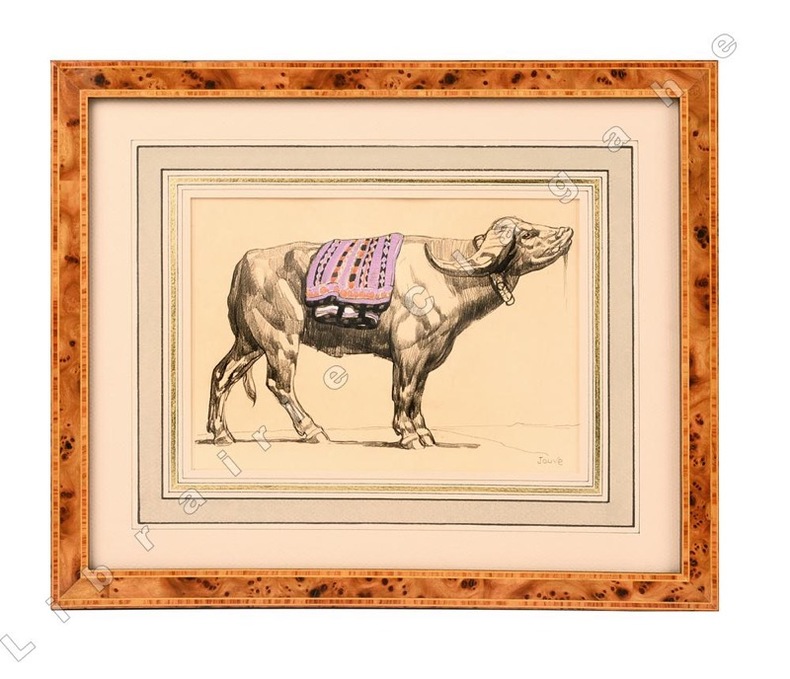
1852ref. 21442Dessin original au crayon gras, gouache et aquarelle sur papier japon impérial (185 x 217 mm ; recadré 151 x 212), signé au crayon dans le coin inférieur droit ; passe-partout à large encadrement bicolore beige et vert et large filet doré, encadrement de loupe. Format total 295 x 355 mm. Au dos, partie de dessin au crayon et fusin, découpée.
1879ref. 10407Londres, Imp. Delatre, Howland st. 23, 1879. 1 vol. in-folio de 1 titre, 19 planches et 1 table gravés, maroquin rouge, dos lisse orné, large roulette dorée d'encadrement sur les plats, titre frappé au centre (reliure anglaise de l'époque).
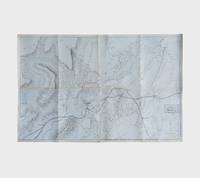
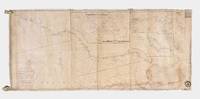
1863ref. 377677Chattanooga 1863. Printed field map on four joined sheets of blue paper with manuscript annotations in red by Captain Preston C. F. West. Signed by West below the cartouche. 25x38-3/4 inches. Archival repairs on verso to folds. Printed field map on four joined sheets of blue paper with manuscript annotations in red by Captain Preston C. F. West. Signed by West below the cartouche. 25x38-3/4 inches. The urgent need for Union military purposes of detailed maps of the interior of the southern states in rebellion quickly became evident after the events at Fort Sumter. While the Army Corps of Engineers had skilled mapmakers who had honed their proficiency in the antebellum explorations in the west their numbers were too few and their services needed in other military engineering roles. Thus many of the best mapmakers of the Civil War would be members of the U.S. Coast Survey tasked with mapping the inland regions of the war in addition to their services along the coasts. Among them was Captain Preston C. F. West 1835-1901 detached to service on the staff of General William F. "Baldy" Smith for the first three years of the war rising to the rank of Major and taking part in numerous battles including Antietam Fredericksburg Gettysburg and Cold Harbor. West's most significant accomplishments would be his role in the Chattanooga campaign in October and November 1863 as a scout intelligence officer and cartographer. He would be among those thanked by Major General George H. Thomas in a November 22 1863 letter to USCS superintendent A. D. Bache: "Permit me to thank you most cordially for your kindness in placing under the direction of Brigadier General W. F. Smith chief engineer department of the Cumberland Messrs. P. C. E. West Clarence Fendall F. W. Dorr and J. W. Donn officers of the Coast Survey service. In the short time they have been on duty at these headquarters they have rendered most valuable service in reconnoitring surveying and mapping the country" quoted in the Report of the Superintendent of the Coast Survey . 1863. In Brigadier General Smith's January 19 1864 report on the Battle of Chattanooga submitted to Brigadier General John A. Rawlins he forwarded maps of the region by West writing: "These maps are mainly due to the exertions of Captain West U. S. Coast Survey of my staff and to the labors of Captains Dorr and Donn . and who all deserve the thanks of the general for theor labors. By them the distances were determined before the battle of the use of the artillery and also the heights of the artillery positions occupied by us and the enemy" quoted in the Official Records. The Chattanooga campaign taking place between September and November 1863 resulted in a decisive Union victory that effectively ended Confederate control of Tennessee and paved the way for the invasion of the Deep South. The present map on a scale of two inches to the mile and dated just days before the decisive battle depicts the region from the Tennessee River bend on the western side of Raccoon Mountain in the west to three miles to the east of Tyner's Station on the Chattanooga Knoxville Railroad line imn the east to Walden's Ridge in the north and the Georgia boundary in the south - i.e. approx. 228 square mile region centered on the Tennessee River just northeast of Chattanooga. This point comprised the strategic Union position on the heights overlooking the city and the river crossings used by the Union to attack the Confederate position on Missionary Ridge. West has added manuscript annotations in red showing the Union positions and movements. Interestingly the map's cartouche states that it was compiled from surveys under the direction of Captain W. E. Merrill although West has crossed out his name and added his own in manuscript suggesting the true source of the survey. This unrecorded field printed map was likely produced via photozincography aka "zinco" a process that allowed a manuscript map to be quickly duplicated via a photographic method that transferred a collodion glass plate negative via contact transfer to produce a negative on zinc that could be inked and printed like a lithograph though without the need for heavy lithographic stones. It was an ideal method for the printing of maps for military use in the field and was a process first used a decade earlier in Great Britain to reproduce maps for the Ordnance Survey. Not in Stephenson unknown
1863ref. 377677Chattanooga 1863. Printed field map on four joined sheets of blue paper with manuscript annotations in red by Captain Preston C. F. West. Signed by West below the cartouche. 25x38-3/4 inches. Archival repairs on verso to folds. Printed field map on four joined sheets of blue paper with manuscript annotations in red by Captain Preston C. F. West. Signed by West below the cartouche. 25x38-3/4 inches. The urgent need for Union military purposes of detailed maps of the interior of the southern states in rebellion quickly became evident after the events at Fort Sumter. While the Army Corps of Engineers had skilled mapmakers who had honed their proficiency in the antebellum explorations in the west their numbers were too few and their services needed in other military engineering roles. Thus many of the best mapmakers of the Civil War would be members of the U.S. Coast Survey tasked with mapping the inland regions of the war in addition to their services along the coasts. Among them was Captain Preston C. F. West 1835-1901 detached to service on the staff of General William F. "Baldy" Smith for the first three years of the war rising to the rank of Major and taking part in numerous battles including Antietam Fredericksburg Gettysburg and Cold Harbor. West's most significant accomplishments would be his role in the Chattanooga campaign in October and November 1863 as a scout intelligence officer and cartographer. He would be among those thanked by Major General George H. Thomas in a November 22 1863 letter to USCS superintendent A. D. Bache: "Permit me to thank you most cordially for your kindness in placing under the direction of Brigadier General W. F. Smith chief engineer department of the Cumberland Messrs. P. C. E. West Clarence Fendall F. W. Dorr and J. W. Donn officers of the Coast Survey service. In the short time they have been on duty at these headquarters they have rendered most valuable service in reconnoitring surveying and mapping the country" quoted in the Report of the Superintendent of the Coast Survey . 1863. In Brigadier General Smith's January 19 1864 report on the Battle of Chattanooga submitted to Brigadier General John A. Rawlins he forwarded maps of the region by West writing: "These maps are mainly due to the exertions of Captain West U. S. Coast Survey of my staff and to the labors of Captains Dorr and Donn . and who all deserve the thanks of the general for theor labors. By them the distances were determined before the battle of the use of the artillery and also the heights of the artillery positions occupied by us and the enemy" quoted in the Official Records. The Chattanooga campaign taking place between September and November 1863 resulted in a decisive Union victory that effectively ended Confederate control of Tennessee and paved the way for the invasion of the Deep South. The present map on a scale of two inches to the mile and dated just days before the decisive battle depicts the region from the Tennessee River bend on the western side of Raccoon Mountain in the west to three miles to the east of Tyner's Station on the Chattanooga Knoxville Railroad line imn the east to Walden's Ridge in the north and the Georgia boundary in the south - i.e. approx. 228 square mile region centered on the Tennessee River just northeast of Chattanooga. This point comprised the strategic Union position on the heights overlooking the city and the river crossings used by the Union to attack the Confederate position on Missionary Ridge. West has added manuscript annotations in red showing the Union positions and movements. Interestingly the map's cartouche states that it was compiled from surveys under the direction of Captain W. E. Merrill although West has crossed out his name and added his own in manuscript suggesting the true source of the survey. This unrecorded field printed map was likely produced via photozincography aka "zinco" a process that allowed a manuscript map to be quickly duplicated via a photographic method that transferred a collodion glass plate negative via contact transfer to produce a negative on zinc that could be inked and printed like a lithograph though without the need for heavy lithographic stones. It was an ideal method for the printing of maps for military use in the field and was a process first used a decade earlier in Great Britain to reproduce maps for the Ordnance Survey. Not in Stephenson unknown books
1808ref. 367005London: P. Mason at Steel's Navigation Warehouse 1808. Blue-backed sea chart. Insets of the harbor of Rio the Bay of All Saints and the Island of Fernand Noronha. Manuscript annotations by Conner plotting the course of the USS Hornet in the War of 1812. Approx. 31 x 70 inches. Tape repairs on verso some staining. Manuscript note on verso by Philip Syng Physick Conner. Blue-backed sea chart. Insets of the harbor of Rio the Bay of All Saints and the Island of Fernand Noronha. Manuscript annotations by Conner plotting the course of the USS Hornet in the War of 1812. Approx. 31 x 70 inches. Pennsylvania native David Conner joined the navy as a midshipman in 1809 and during the War of 1812 served with distinction aboard the USS Hornet where he rose to the rank of first lieutenant during the war. He participated in action aboard the Hornet against the HMS Peacock in February 1813 and in the March 1815 capture of HMS Penguin and was awarded two medals of valor. In 1817 he was commissioned first lieutenant under Captain Biddle aboard the USS Ontario for its voyage to the Pacific. He would eventually rise to the rank of Commodore commanding the blockade of the Gulf Coast during the Mexican War and responsible for landing Scott's army at Vera Cruz. On October 26 1812 the frigate USS Constitution and sloop USS Hornet left Boston to raid British shipping along the coast of South America. The Hornet sailed under the command of famed American naval captain James Lawrence best remembered for his order "Don't give up the ship" in the June 1813 battle between the Shannon and the Chesapeake. After a couple months cruising the waters off the coast of Brazil on February 24 1813 the USS Hornet engaged the HMS Peacock off the mouth of the Demerary River. Exchanging broadsides the Hornet's cannons shot true damaging the British ship. Outmaneuvering the Peacock downwind the Hornet approached from the stern firing and forced the Peacock which had lost her captain and taken heavy casualties to strike. The American ship sent on a boarding party but the Peacock quickly sank. This large sea chart oriented with north to the east depicts the coast of Brazil from Sao Luis Maranhao to the Lagoon Merim and is profusely annotated by Conner charting the cruise of the Hornet off the coast between December 1812 and February 1813 i.e. the movements of the ship prior to the engagement with the Peacock. Included in the manuscript additions is evidence of the brief blockade of the English frigate Bonne Citoyenne at Salvador where Lawrence challenged the ship to single ship combat with the Hornet but had to abandon the blockade upon the arrival of a British line of battle ship. "Running up the coast she took on January 6 1813 the schooner Ellen loaded with dry goods . On the fourth of February off Pernambuco she seized the brig Resolution ten guns carrying coffee fustic etc. from Rio to Marnaham and a nice little purse containing 23000 in specie. This the Hornet put intop her opwn pocket and then burnt the brig" Conner. After several more weeks of cruising the Hornet engaged the Peacock. On June 18 1914 auctioneer Stan V. Henkels sold the books papers journals and log books from the younger Conner's library which included Lt. David Conner's original logs of the voyage of the USS Ontario now at the Library of Congress MSS84251. The present map was not included in that sale; however it appeared within lot 71 at Parke Bernet on May 25 1971. Conner Philip Syng Physick. "The Hornet's Sting and Wing" in The New England Magazine Vol. XXIII No. 3 Nov. 1900 pp. 268-274 P. Mason at Steel's Navigation Warehouse unknown
1808ref. 367005London: P. Mason at Steel's Navigation Warehouse 1808. Blue-backed sea chart. Insets of the harbor of Rio the Bay of All Saints and the Island of Fernand Noronha. Manuscript annotations by Conner plotting the course of the USS Hornet in the War of 1812. Approx. 31 x 70 inches. Tape repairs on verso some staining. Manuscript note on verso by Philip Syng Physick Conner. Blue-backed sea chart. Insets of the harbor of Rio the Bay of All Saints and the Island of Fernand Noronha. Manuscript annotations by Conner plotting the course of the USS Hornet in the War of 1812. Approx. 31 x 70 inches. Pennsylvania native David Conner joined the navy as a midshipman in 1809 and during the War of 1812 served with distinction aboard the USS Hornet where he rose to the rank of first lieutenant during the war. He participated in action aboard the Hornet against the HMS Peacock in February 1813 and in the March 1815 capture of HMS Penguin and was awarded two medals of valor. In 1817 he was commissioned first lieutenant under Captain Biddle aboard the USS Ontario for its voyage to the Pacific. He would eventually rise to the rank of Commodore commanding the blockade of the Gulf Coast during the Mexican War and responsible for landing Scott's army at Vera Cruz. On October 26 1812 the frigate USS Constitution and sloop USS Hornet left Boston to raid British shipping along the coast of South America. The Hornet sailed under the command of famed American naval captain James Lawrence best remembered for his order "Don't give up the ship" in the June 1813 battle between the Shannon and the Chesapeake. After a couple months cruising the waters off the coast of Brazil on February 24 1813 the USS Hornet engaged the HMS Peacock off the mouth of the Demerary River. Exchanging broadsides the Hornet's cannons shot true damaging the British ship. Outmaneuvering the Peacock downwind the Hornet approached from the stern firing and forced the Peacock which had lost her captain and taken heavy casualties to strike. The American ship sent on a boarding party but the Peacock quickly sank. This large sea chart oriented with north to the east depicts the coast of Brazil from Sao Luis Maranhao to the Lagoon Merim and is profusely annotated by Conner charting the cruise of the Hornet off the coast between December 1812 and February 1813 i.e. the movements of the ship prior to the engagement with the Peacock. Included in the manuscript additions is evidence of the brief blockade of the English frigate Bonne Citoyenne at Salvador where Lawrence challenged the ship to single ship combat with the Hornet but had to abandon the blockade upon the arrival of a British line of battle ship. "Running up the coast she took on January 6 1813 the schooner Ellen loaded with dry goods . On the fourth of February off Pernambuco she seized the brig Resolution ten guns carrying coffee fustic etc. from Rio to Marnaham and a nice little purse containing 23000 in specie. This the Hornet put intop her opwn pocket and then burnt the brig" Conner. After several more weeks of cruising the Hornet engaged the Peacock. On June 18 1914 auctioneer Stan V. Henkels sold the books papers journals and log books from the younger Conner's library which included Lt. David Conner's original logs of the voyage of the USS Ontario now at the Library of Congress MSS84251. The present map was not included in that sale; however it appeared within lot 71 at Parke Bernet on May 25 1971. Conner Philip Syng Physick. "The Hornet's Sting and Wing" in The New England Magazine Vol. XXIII No. 3 Nov. 1900 pp. 268-274 P. Mason at Steel's Navigation Warehouse unknown books
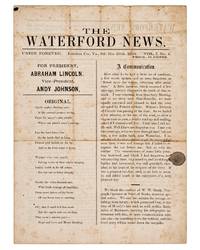
1864ref. 3090Loudon VA: Published by "Sarah Lizzie & Lida 1864. First edition. custom folder. Good. THE UNION UNDERGROUND WOMEN'S NEWSPAPER OF CONFEDERATE VIRGINIA: A remarkable Union newspaper written and edited by three young Quaker women inside Confederate Virginia - this issue prominently endorsing Abraham Lincoln for reelection. An extraordinary survival from one of the most remarkable journalistic enterprises of the Civil War: an underground Union newspaper conceived written edited and distributed by three young Quaker women living within Confederate Virginia. Sarah A. Steer 1837-1921 and sisters Elizabeth "Lizzie" Dutton 1839-1915 and Emma Eliza "Lida" Dutton 1844-1913 lived in Waterford Loudoun County a strongly Unionist Quaker community repeatedly exposed to Confederate incursions. Determined that their Union sympathies "should not be suppressed" the three women reported edited published and distributed the newspaper arranging for its printing across Union lines. Their copy was carried across the Potomac into Maryland where the paper was printed by the Baltimore American whose editor was an old friend of the Dutton family. The women themselves described the enterprise as a "hazardous undertaking." Their stated purpose was "to cheer the weary soldier and render material aid to the sick and wounded" with proceeds from the ten-cent cover price benefiting the United States Sanitary Commission. Only eight issues appeared during the final year of the Civil War. This August 1864 issue underneath the bold masthead proclaiming "UNION FOREVER" opens with a prominent political endorsement: FOR PRESIDENT ABRAHAM LINCOLN. Vice-President ANDY JOHNSON. Appearing less than three months before the presidential election the announcement was an explicit declaration of Union political allegiance by three young women publishing within a Confederate state. MOSBY'S RAIDERS AND GUERRILLA WARFARE: Several articles in this issue document the reality of guerrilla warfare surrounding Waterford. Mosby's Raiders-also called Mosby's Rangers-were Confederate cavalrymen commanded by John Singleton Mosby the officer known as the "Gray Ghost." Officially the 43rd Battalion Virginia Cavalry they specialized in quick raids behind Union lines principally in northern Virginia. They attacked supply and communication routes captured soldiers and horses and dispersed to evade pursuit. They were an organized Confederate military unit using guerrilla tactics. Under the heading "ROBBERY" the editors report that Mosby's men raided Point of Rocks and intercepted a letter containing $14 in subscriptions sent by soldiers of the 1st Eastern Shore Maryland Infantry. Their response is pointedly sarcastic: "Now this chivalric son of the South who wages no war against women appropriated the money to his own use." They nevertheless assure the soldiers that each subscriber remains entitled to "the thanks of the Editors." Elsewhere a summary of recent events recounts Mosby's July raid on Point of Rocks and describes Waterford as having been "surrounded by rebels with their bragging" and cut off from communication until Union troops returned. The paper also praises telegraph operator W. W. Shock for carrying his telegraphic equipment toward Baltimore in an effort to maintain Union communications while Confederate forces controlled the surrounding routes. WAR AS EXPERIENCED BY WOMEN: Perhaps most compelling is the opening editorial in which the editors describe the arrival of Union soldiers after Waterford had been surrounded by Confederate forces. The townspeople opened their homes and supplied the troops with food and clothing. The women recall: "Flags and handkerchiefs waved as the soldiers passed by and the citizens felt joy unspeakable." The editorial offers an unusually immediate female-authored account of civilian life in a contested Southern community: soldiers moving through the streets Confederate forces nearby shortages divided loyalties and local women participating directly in the Union war effort through journalism. NATIONAL RECEPTION - AND PRESIDENT LINCOLN: The little newspaper quickly attracted attention well beyond Loudoun County. The present issue itself notes complimentary notices in the Virginia State Journal and the Bucks County Intelligencer. More strikingly under the heading "REBEL LITERATURE" the editors reprint a notice from the Baltimore American which praises The Waterford News and identifies its editors-"Sarah Lizzie and Lida"-as "three brave warm-hearted Union girls." Its reputation spread still further. According to the Waterford history Horace Greeley's New York Tribune praised the paper while a Maryland regiment forwarded early issues directly to President Lincoln. The accompanying letter reported that by late June the "fair Editresses" had already raised nearly $1000 for the Sanitary Commission-an amount suggesting substantial circulation for such a locally produced wartime newspaper. Thus this was not merely a village newspaper operating in isolation: within weeks of its founding the work of three young women in Waterford had reached both the national press and the White House. FROM CIVIL WAR JOURNALISM TO RECONSTRUCTION: Sarah Steer's activism continued immediately after the war. She sought funds from the Freedmen's Bureau Philadelphia Quakers and local supporters to establish a school for freed children. Before the schoolhouse itself was completed she began teaching in her side yard in 1865 and is identified as the "first teacher of black children" in Loudoun County by The Waterford Foundation. The trajectory is remarkable: from editing an underground Union newspaper during the Civil War to educating formerly enslaved children at the beginning of Reconstruction. RARITY: Only eight issues of The Waterford News were published and individual original issues are exceptionally uncommon in commerce. The present issue is particularly compelling for its combination of the dramatic "UNION FOREVER" masthead explicit Lincoln-Johnson endorsement eyewitness reports of Mosby's operations substantial editorial writing by the three women themselves contemporary notices documenting the paper's national reception and the remarkable fact that earlier issues had already reached President Lincoln. The Waterford News. Vol. I No. 4. Waterford Loudoun Co. Virginia: Published by "Sarah Lizzie & Lida" August 20 1864. One single folding sheet approximately 15.5x10.75 inches creating four pages 7.75x10.75 in when folded. Some foxing and light overall toning; two minor ink blots; short separations at fold intersections without significant text loss; minor marginal handling wear. A remarkable survival. Published by "Sarah, Lizzie & Lida unknown
1864ref. 3090Loudon VA: Published by "Sarah Lizzie & Lida 1864. First edition. custom folder. Good. THE UNION UNDERGROUND WOMEN'S NEWSPAPER OF CONFEDERATE VIRGINIA: A remarkable Union newspaper written and edited by three young Quaker women inside Confederate Virginia - this issue prominently endorsing Abraham Lincoln for reelection. An extraordinary survival from one of the most remarkable journalistic enterprises of the Civil War: an underground Union newspaper conceived written edited and distributed by three young Quaker women living within Confederate Virginia. Sarah A. Steer 1837-1921 and sisters Elizabeth "Lizzie" Dutton 1839-1915 and Emma Eliza "Lida" Dutton 1844-1913 lived in Waterford Loudoun County a strongly Unionist Quaker community repeatedly exposed to Confederate incursions. Determined that their Union sympathies "should not be suppressed" the three women reported edited published and distributed the newspaper arranging for its printing across Union lines. Their copy was carried across the Potomac into Maryland where the paper was printed by the Baltimore American whose editor was an old friend of the Dutton family. The women themselves described the enterprise as a "hazardous undertaking." Their stated purpose was "to cheer the weary soldier and render material aid to the sick and wounded" with proceeds from the ten-cent cover price benefiting the United States Sanitary Commission. Only eight issues appeared during the final year of the Civil War. This August 1864 issue underneath the bold masthead proclaiming "UNION FOREVER" opens with a prominent political endorsement: FOR PRESIDENT ABRAHAM LINCOLN. Vice-President ANDY JOHNSON. Appearing less than three months before the presidential election the announcement was an explicit declaration of Union political allegiance by three young women publishing within a Confederate state. MOSBY'S RAIDERS AND GUERRILLA WARFARE: Several articles in this issue document the reality of guerrilla warfare surrounding Waterford. Mosby's Raiders-also called Mosby's Rangers-were Confederate cavalrymen commanded by John Singleton Mosby the officer known as the "Gray Ghost." Officially the 43rd Battalion Virginia Cavalry they specialized in quick raids behind Union lines principally in northern Virginia. They attacked supply and communication routes captured soldiers and horses and dispersed to evade pursuit. They were an organized Confederate military unit using guerrilla tactics. Under the heading "ROBBERY" the editors report that Mosby's men raided Point of Rocks and intercepted a letter containing $14 in subscriptions sent by soldiers of the 1st Eastern Shore Maryland Infantry. Their response is pointedly sarcastic: "Now this chivalric son of the South who wages no war against women appropriated the money to his own use." They nevertheless assure the soldiers that each subscriber remains entitled to "the thanks of the Editors." Elsewhere a summary of recent events recounts Mosby's July raid on Point of Rocks and describes Waterford as having been "surrounded by rebels with their bragging" and cut off from communication until Union troops returned. The paper also praises telegraph operator W. W. Shock for carrying his telegraphic equipment toward Baltimore in an effort to maintain Union communications while Confederate forces controlled the surrounding routes. WAR AS EXPERIENCED BY WOMEN: Perhaps most compelling is the opening editorial in which the editors describe the arrival of Union soldiers after Waterford had been surrounded by Confederate forces. The townspeople opened their homes and supplied the troops with food and clothing. The women recall: "Flags and handkerchiefs waved as the soldiers passed by and the citizens felt joy unspeakable." The editorial offers an unusually immediate female-authored account of civilian life in a contested Southern community: soldiers moving through the streets Confederate forces nearby shortages divided loyalties and local women participating directly in the Union war effort through journalism. NATIONAL RECEPTION - AND PRESIDENT LINCOLN: The little newspaper quickly attracted attention well beyond Loudoun County. The present issue itself notes complimentary notices in the Virginia State Journal and the Bucks County Intelligencer. More strikingly under the heading "REBEL LITERATURE" the editors reprint a notice from the Baltimore American which praises The Waterford News and identifies its editors-"Sarah Lizzie and Lida"-as "three brave warm-hearted Union girls." Its reputation spread still further. According to the Waterford history Horace Greeley's New York Tribune praised the paper while a Maryland regiment forwarded early issues directly to President Lincoln. The accompanying letter reported that by late June the "fair Editresses" had already raised nearly $1000 for the Sanitary Commission-an amount suggesting substantial circulation for such a locally produced wartime newspaper. Thus this was not merely a village newspaper operating in isolation: within weeks of its founding the work of three young women in Waterford had reached both the national press and the White House. FROM CIVIL WAR JOURNALISM TO RECONSTRUCTION: Sarah Steer's activism continued immediately after the war. She sought funds from the Freedmen's Bureau Philadelphia Quakers and local supporters to establish a school for freed children. Before the schoolhouse itself was completed she began teaching in her side yard in 1865 and is identified as the "first teacher of black children" in Loudoun County by The Waterford Foundation. The trajectory is remarkable: from editing an underground Union newspaper during the Civil War to educating formerly enslaved children at the beginning of Reconstruction. RARITY: Only eight issues of The Waterford News were published and individual original issues are exceptionally uncommon in commerce. The present issue is particularly compelling for its combination of the dramatic "UNION FOREVER" masthead explicit Lincoln-Johnson endorsement eyewitness reports of Mosby's operations substantial editorial writing by the three women themselves contemporary notices documenting the paper's national reception and the remarkable fact that earlier issues had already reached President Lincoln. The Waterford News. Vol. I No. 4. Waterford Loudoun Co. Virginia: Published by "Sarah Lizzie & Lida" August 20 1864. One single folding sheet approximately 15.5x10.75 inches creating four pages 7.75x10.75 in when folded. Some foxing and light overall toning; two minor ink blots; short separations at fold intersections without significant text loss; minor marginal handling wear. A remarkable survival. Published by "Sarah, Lizzie & Lida unknown books
1525ref. 5385Hagenau: Johann Setzer 1525. SOLE EDITION. Hardcover. Fine. Bound in late 19th or early 20th c. marbled boards spine mended. A nice copy with the impressions of bearer type on the first and final leaf. Small light dampstain to corner of two leaves and some light spots on final printed leaf. A rare polemic by Philip Melanchthon against the radical reformer Thomas Müntzer the "murderous and bloodthirsty prophet" and the most significant figure in the second crucial phase of the Peasants' War. In the face of crushing taxation and crop failures the German peasants had declared open rebellion against the oppression of their feudal lords. Müntzer encouraged them with fiery oratory and led them into battle. The peasants' were defeated at the Battle of Frankenhausen. Captured in battle Müntzer was executed by beheading his body was impaled and his head stuck on a stake outside the gates of Mühlhausen where it remained for years. This book was printed a month after Müntzer's decisive defeat. Melanchthon's purpose in publishing this book was to show that Müntzer was a tool of the devil and to warn others not to follow his teachings. The book contains a speech purportedly given by Müntzer to rally his troops as they prepared to meet the armies of the Saxon and Hessian princes on 17 May 1525 at Frankenhausen. Contemporary reports indicate Müntzer did in fact give a speech but the text as given in this book was almost certainly composed by Melanchthon and his allies. Thomas Müntzer In 1523 Müntzer formerly the leader of the radical "Zwickau Prophets" began to radicalize the area of Allstedt where he was then pastor preaching that the ungodly were to be eliminated and the elect would establish a kingdom of Christ on earth and threatening the political rulers of the area with rebellion. In early 1524 as Müntzer grew bolder in his denunciation of the authorities and called for an elimination of the enemies of God he divided the citizenry into military units in order to resist any outside interference in his activities. Müntzer openly challenged and attacked Luther who was openly opposed to Müntzer's ministry of the elect as one of "our mad debauching pigs which are horrified by the windstorm the raging billows and by all the waters of wisdom." Following the Battle of Frankenhausen Müntzer was captured and executed by beheading. His body was impaled and his head stuck on a stake outside the gates of Mühlhausen where it remained for years. Following Müntzer's execution on May 27 Luther would write "I killed Müntzer; his death is on my shoulders. But I did it because he wanted to kill my Christ'". Brecht Vol II p. 185 The Peasants' War The Peasants' War was one of the bloodiest chapters in the turbulent early history of the German Reformation. The uprising began in upper Swabia in early 1524 and quickly spread to southern and western Germany as well as to parts of Switzerland and Austria. The peasants were motivated by a number of factors: crushing taxation lack of a voice in government no recourse to the courts crop failure and helplessness in the face of their feudal masters' demands. But whereas these conditions had resulted in smaller uprisings in the past the massive rebellion of 1524-5 was also a result of the turbulent upheaval caused by the nascent Reformation. By the time the rebellion was crushed in late 1525 some 100000 combatants and civilians had been killed. Reprisals were carried out for the next two years and the peasants' demands as outlined in their Twelve Articles came to nothing. "There is absolutely no evidence to suggest that the words are Müntzer's; he certainly made some kind of speech and an idea of what he said was reported by men such as Hans Hut who had been at Müntzer's side. But Melanchthon was on that day in Wittenberg 150 kms distant and certainly would not have been able to record the words spoken. At best the text is reported third-hand and faulty; at worst it is a complete fabrication."Drummond In Melanchthon's version of the speech Müntzer claimed a divine prophecy led him to call for the uprising: "I only began all this at God's command and not for selfish reason or out of boldness for I have never been a soldier in all my days; but because God spoke to me and told me to march forth". Melanchthon presents Müntzer's case in language that closely resembles Müntzer's writings and the speech includes a battle cry against the nobility: "They are nothing but tyrants who fleece the people and exhaust our blood and sweat with their splendour with useless pomp with their whoring and villainy. . . . But what do our princes do They do not give justice they do not keep the roads clear do not prevent murder and robbery or punish offences and evil do not defend widows and orphans do not help the poor to justice - which is the very reason that God created the rulers . . . You should not imagine that God will let this go on for much longer for just as he destroyed the Canaanites so he will destroy our princes. Melanchthon adds his commentary to the speech. Despite not being present he argues that many of Müntzer's followers seemed reluctant to join the battle: "And when Thomas had finished speaking the majority of the army were desperate and wanted to get away from there for they saw that the water was about to overflow the bucket. But there was no order or discipline which allowed anyone to take good advice on what to do." Translated by Andy Drummond. Johann Setzer hardcover
1525ref. 5385Hagenau: Johann Setzer 1525. SOLE EDITION. Hardcover. Fine. Bound in late 19th or early 20th c. marbled boards spine mended. A nice copy with the impressions of bearer type on the first and final leaf. Small light dampstain to corner of two leaves and some light spots on final printed leaf. A rare polemic by Philip Melanchthon against the radical reformer Thomas Müntzer the "murderous and bloodthirsty prophet" and the most significant figure in the second crucial phase of the Peasants' War. In the face of crushing taxation and crop failures the German peasants had declared open rebellion against the oppression of their feudal lords. Müntzer encouraged them with fiery oratory and led them into battle. The peasants' were defeated at the Battle of Frankenhausen. Captured in battle Müntzer was executed by beheading his body was impaled and his head stuck on a stake outside the gates of Mühlhausen where it remained for years. This book was printed a month after Müntzer's decisive defeat. Melanchthon's purpose in publishing this book was to show that Müntzer was a tool of the devil and to warn others not to follow his teachings. The book contains a speech purportedly given by Müntzer to rally his troops as they prepared to meet the armies of the Saxon and Hessian princes on 17 May 1525 at Frankenhausen. Contemporary reports indicate Müntzer did in fact give a speech but the text as given in this book was almost certainly composed by Melanchthon and his allies. Thomas Müntzer In 1523 Müntzer formerly the leader of the radical "Zwickau Prophets" began to radicalize the area of Allstedt where he was then pastor preaching that the ungodly were to be eliminated and the elect would establish a kingdom of Christ on earth and threatening the political rulers of the area with rebellion. In early 1524 as Müntzer grew bolder in his denunciation of the authorities and called for an elimination of the enemies of God he divided the citizenry into military units in order to resist any outside interference in his activities. Müntzer openly challenged and attacked Luther who was openly opposed to Müntzer's ministry of the elect as one of "our mad debauching pigs which are horrified by the windstorm the raging billows and by all the waters of wisdom." Following the Battle of Frankenhausen Müntzer was captured and executed by beheading. His body was impaled and his head stuck on a stake outside the gates of Mühlhausen where it remained for years. Following Müntzer's execution on May 27 Luther would write "I killed Müntzer; his death is on my shoulders. But I did it because he wanted to kill my Christ'". Brecht Vol II p. 185 The Peasants' War The Peasants' War was one of the bloodiest chapters in the turbulent early history of the German Reformation. The uprising began in upper Swabia in early 1524 and quickly spread to southern and western Germany as well as to parts of Switzerland and Austria. The peasants were motivated by a number of factors: crushing taxation lack of a voice in government no recourse to the courts crop failure and helplessness in the face of their feudal masters' demands. But whereas these conditions had resulted in smaller uprisings in the past the massive rebellion of 1524-5 was also a result of the turbulent upheaval caused by the nascent Reformation. By the time the rebellion was crushed in late 1525 some 100000 combatants and civilians had been killed. Reprisals were carried out for the next two years and the peasants' demands as outlined in their Twelve Articles came to nothing. "There is absolutely no evidence to suggest that the words are Müntzer's; he certainly made some kind of speech and an idea of what he said was reported by men such as Hans Hut who had been at Müntzer's side. But Melanchthon was on that day in Wittenberg 150 kms distant and certainly would not have been able to record the words spoken. At best the text is reported third-hand and faulty; at worst it is a complete fabrication."Drummond In Melanchthon's version of the speech Müntzer claimed a divine prophecy led him to call for the uprising: "I only began all this at God's command and not for selfish reason or out of boldness for I have never been a soldier in all my days; but because God spoke to me and told me to march forth". Melanchthon presents Müntzer's case in language that closely resembles Müntzer's writings and the speech includes a battle cry against the nobility: "They are nothing but tyrants who fleece the people and exhaust our blood and sweat with their splendour with useless pomp with their whoring and villainy. . . . But what do our princes do They do not give justice they do not keep the roads clear do not prevent murder and robbery or punish offences and evil do not defend widows and orphans do not help the poor to justice - which is the very reason that God created the rulers . . . You should not imagine that God will let this go on for much longer for just as he destroyed the Canaanites so he will destroy our princes. Melanchthon adds his commentary to the speech. Despite not being present he argues that many of Müntzer's followers seemed reluctant to join the battle: "And when Thomas had finished speaking the majority of the army were desperate and wanted to get away from there for they saw that the water was about to overflow the bucket. But there was no order or discipline which allowed anyone to take good advice on what to do." Translated by Andy Drummond. Johann Setzer hardcover books
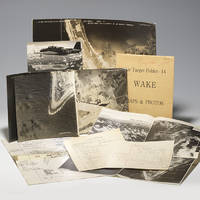
1943ref. 1050611943. WORLD WAR II. Archive: Wake Island Raid maps photographs and documents. Near Wake Island: Intelligence Center Pacific Ocean Areas October 5-6 1943. Sixteen maps photographs and documents; maps range in size from 8 by 8 inches to 18 by 21-3/4 inches; photographs range from 6-1/4 by 8 inches to 18 by 9-1/4 inches. $9500.Superb archive of rarely seen map and photographs used in planning and documenting the October 5 1943 raid on Wake Island which was taken by the Japanese only weeks after the Pearl Harbor attack.Wake Island a U.S. airbase located approximately 2200 miles west of Pearl Harbor was captured by the Japanese in late December 1941. The island remained under Japanese control until the garrison there surrendered on September 7 1945. In October 1943 a U.S. task force conducted a two-day air raid on the island. The Japanese commander Shigematsu Sakaibara convinced the raid was the beginning of an attempt to retake the island marched 98 American civilian prisoners of war to a remote corner of the island and executed them. Following the war Sakaibara was tried and executed for war crimes. Of particular interest is a large map on thick stock folded into quarters and reinforced with tape on the verso bearing copious pencil annotations documenting the second day of air raids on the island recording various points in the action from the initial takeoff from the carrier at ""0515"" through the squadron's departure around ""0745."" The pilot carefully draws the route of two bombing runs the first against the runways on the main island of Wake and the second targeting the barracks and ammunition storage on nearby Peale Island. The pilot noted the direction of anti-aircraft fire positions of guns as well as the wind and the general weather conditions: ""Cumulus @ 2500 strong vertical developmentÉ Squalls to and from island."" The pilot recorded damage sighted including ""Red flame black smoke 0710"" coming from an underground storage area adjacent to Runway A. On his second run he observed ""Black smoke 0706-0715Ñstill going strong at 0725"" near the barracks on adjacent Peale Island. The archive also features four large highly detailed reconnaissance photographs of Wake island together with a large body of smaller maps all used in the planning of the October raid. Also of interest is a mimeographed document titled ""U.S.S. Yorktown Air Department Plan of the Day Tuesday 5 October 1943"" which details the schedule of the first day of operations beginning at ""0245"" and ending prior to sunset at ""1645"" noting the planned launchings and landings of seven major sorties against Wake. Several of the items are stamped ""VT-5 Air Intelligence""; VT-5 was a torpedo bomber squadron stationed on the Yorktown during the war. All items apparently from the collection of Lt. H.T. Reynolds of torpedo bomber Squadron VT-5 stationed aboard the U.S.S. Yorktown. One of the photographs of an Avenger in flight over Wake Island is captioned ""Lt. Reynolds U.S.S. Yorktown 1943.""Typical folds and other wear consistent with use though generally very well preserved in excellent condition overall. A superb collection of original materials used in the planning and subsequent reports on this historic attack. unknown
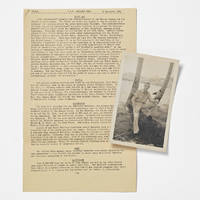
1945ref. 1175421945. WORLD WAR II. Mimeographed typescript of the USS Salamaua News. No place September 3 1945. Two sheets of beige paper staple-bound as issued each measuring 8 by 13 inches; pp. 2. $9500.Original mimeographed USS Salamaua News newsletter containing detailed news of Japanese surrender preliminary reports on POWs in Japan and their treatment by the Japanese Japanese reactions to the surrender brief news from around the world and baseball standings accompanied by a black-and-white photograph of the newsletter's owner Lt. Commander Fred R. Salisbury II of the Salamaua.This newsletter was issued for crewmen on the USS Salamaua best known for being attacked on January 13 1945. This ship newsletter from nine months after the attack kept the crew of approximately 570 officers and enlisted men informed of world eventsÑparticularly those relevant to their service. This issue of the newsletter provides details of the Japanese surrender; initial reports on prisoners in Japanese prison camps; and other world news including standings for the National League and American League baseball teams.Notable quotations from the newsletter include: ""TOKYO BAY Japan surrendered formally and unconditionally to the United States and its allied partners todayÉ MacArthur told the Japs that 'As supreme commander for the allied powers I announce it is my firm purpose in the tradition of the countries I represent to proceed in the discharge of my responsibilities with justice and tolerance while making all necessary dispositions to insure that terms of surrender are fully promptly and faithfully complied withÉ President Truman speaking over a radio hookupÉ proclaimed Sunday September 2nd as 'V-J Day' The day of formal surrender by JapanÉ Liberated allied prisoners of war Sunday recited more instances of beating hunger and humiliationÉ There was no indication of deliberate German scale mass exterminationÉ Approximately 4200 Americans British and Dutch remain in camps in the Tokyo-Yokohama areaÉ TOKYO The Japanese said Saturday that for two days after Emperor Hirohito told his people the war was over several planes evidently flown by fanatical suicide pilots dropped pamphlets on major Japanese cities asking the people to disregard the Emperor's word and fight onÉ""The USS Salamaua had participated in the invasion of Lingayen Gulf in the Philippines. A kamikaze attack carried out by a Ki-84 airplane left a 16-foot by 32-foot hole in the Salamaua's flight deck. It also sparked a number of fires. The plane had carried two 551-pound bombs allowing it to penetrate deeply into the lower decks. One bomb detonated near the tank tops just above the bilge and narrowly missing the bomb stowage compartment. The blast sent debris and fuselage across the flight deck collapsing a number of bulkheads. The second bomb failed to explode and was ejected through the starboard side of the ship at the waterline. The 20-inch hole it left allowed seawater to rush into the ship. As a result the ship lost power communications and steering becoming a sitting duck.While the Salamaua sat immobile two more planes tried to strike it. One crashed into the sea while another detonated in mid-air as it approached. The failure of those pilots meant that the attack killed only 15 of the Salamaua's crew. Another 88 crewmen were injured some seriously.When Rear Admiral Calvin T. Durgin in command of a task force asked for the origin of the smoke he saw coming from the Salamaua he received the reply ""Something just went through our flight deck."" The starboard engine was submerged and the ship listed 8 degrees to starboard. Yet the crew managed to get the ship functional using only the portside engine. Ten long hours after the attack the Salamaua was able to break away to Leyte for repairs. An entire day of pumping failed to alleviate the flooding so the ship merely underwent stabilization repairs before being sent to San Francisco for two rounds of repair. The Salamaua returned to the Philippines in May and eventually was retired from service in 1946 earning the dubious distinction of being the last ship to be successfully attacked by a kamikaze. From the collection of Lt. Commander Fred R. Salisbury II of Minnesota. Salisbury worked in his father's business a furniture manufacturer until the outbreak of World War II Salisbury enlisted in the U.S. Navy in February of 1942 and was assigned to be lieutenant commander of the USS Salamaua a Casablanca-class escort aircraft carrier. Salisbury was released on inactive duty in March 1946 and became vice president of the family business. Laid-in photograph of Salisbury in Guam in 1945.A fascinating World War II artifact. unknown
1943ref. 1050611943. WORLD WAR II. Archive: Wake Island Raid maps photographs and documents. Near Wake Island: Intelligence Center Pacific Ocean Areas October 5-6 1943. Sixteen maps photographs and documents; maps range in size from 8 by 8 inches to 18 by 21-3/4 inches; photographs range from 6-1/4 by 8 inches to 18 by 9-1/4 inches. $9500.Superb archive of rarely seen map and photographs used in planning and documenting the October 5 1943 raid on Wake Island which was taken by the Japanese only weeks after the Pearl Harbor attack.Wake Island a U.S. airbase located approximately 2200 miles west of Pearl Harbor was captured by the Japanese in late December 1941. The island remained under Japanese control until the garrison there surrendered on September 7 1945. In October 1943 a U.S. task force conducted a two-day air raid on the island. The Japanese commander Shigematsu Sakaibara convinced the raid was the beginning of an attempt to retake the island marched 98 American civilian prisoners of war to a remote corner of the island and executed them. Following the war Sakaibara was tried and executed for war crimes. Of particular interest is a large map on thick stock folded into quarters and reinforced with tape on the verso bearing copious pencil annotations documenting the second day of air raids on the island recording various points in the action from the initial takeoff from the carrier at ""0515"" through the squadron's departure around ""0745."" The pilot carefully draws the route of two bombing runs the first against the runways on the main island of Wake and the second targeting the barracks and ammunition storage on nearby Peale Island. The pilot noted the direction of anti-aircraft fire positions of guns as well as the wind and the general weather conditions: ""Cumulus @ 2500 strong vertical developmentÉ Squalls to and from island."" The pilot recorded damage sighted including ""Red flame black smoke 0710"" coming from an underground storage area adjacent to Runway A. On his second run he observed ""Black smoke 0706-0715Ñstill going strong at 0725"" near the barracks on adjacent Peale Island. The archive also features four large highly detailed reconnaissance photographs of Wake island together with a large body of smaller maps all used in the planning of the October raid. Also of interest is a mimeographed document titled ""U.S.S. Yorktown Air Department Plan of the Day Tuesday 5 October 1943"" which details the schedule of the first day of operations beginning at ""0245"" and ending prior to sunset at ""1645"" noting the planned launchings and landings of seven major sorties against Wake. Several of the items are stamped ""VT-5 Air Intelligence""; VT-5 was a torpedo bomber squadron stationed on the Yorktown during the war. All items apparently from the collection of Lt. H.T. Reynolds of torpedo bomber Squadron VT-5 stationed aboard the U.S.S. Yorktown. One of the photographs of an Avenger in flight over Wake Island is captioned ""Lt. Reynolds U.S.S. Yorktown 1943.""Typical folds and other wear consistent with use though generally very well preserved in excellent condition overall. A superb collection of original materials used in the planning and subsequent reports on this historic attack. unknown books
1945ref. 1175421945. WORLD WAR II. Mimeographed typescript of the USS Salamaua News. No place September 3 1945. Two sheets of beige paper staple-bound as issued each measuring 8 by 13 inches; pp. 2. $9500.Original mimeographed USS Salamaua News newsletter containing detailed news of Japanese surrender preliminary reports on POWs in Japan and their treatment by the Japanese Japanese reactions to the surrender brief news from around the world and baseball standings accompanied by a black-and-white photograph of the newsletter's owner Lt. Commander Fred R. Salisbury II of the Salamaua.This newsletter was issued for crewmen on the USS Salamaua best known for being attacked on January 13 1945. This ship newsletter from nine months after the attack kept the crew of approximately 570 officers and enlisted men informed of world eventsÑparticularly those relevant to their service. This issue of the newsletter provides details of the Japanese surrender; initial reports on prisoners in Japanese prison camps; and other world news including standings for the National League and American League baseball teams.Notable quotations from the newsletter include: ""TOKYO BAY Japan surrendered formally and unconditionally to the United States and its allied partners todayÉ MacArthur told the Japs that 'As supreme commander for the allied powers I announce it is my firm purpose in the tradition of the countries I represent to proceed in the discharge of my responsibilities with justice and tolerance while making all necessary dispositions to insure that terms of surrender are fully promptly and faithfully complied withÉ President Truman speaking over a radio hookupÉ proclaimed Sunday September 2nd as 'V-J Day' The day of formal surrender by JapanÉ Liberated allied prisoners of war Sunday recited more instances of beating hunger and humiliationÉ There was no indication of deliberate German scale mass exterminationÉ Approximately 4200 Americans British and Dutch remain in camps in the Tokyo-Yokohama areaÉ TOKYO The Japanese said Saturday that for two days after Emperor Hirohito told his people the war was over several planes evidently flown by fanatical suicide pilots dropped pamphlets on major Japanese cities asking the people to disregard the Emperor's word and fight onÉ""The USS Salamaua had participated in the invasion of Lingayen Gulf in the Philippines. A kamikaze attack carried out by a Ki-84 airplane left a 16-foot by 32-foot hole in the Salamaua's flight deck. It also sparked a number of fires. The plane had carried two 551-pound bombs allowing it to penetrate deeply into the lower decks. One bomb detonated near the tank tops just above the bilge and narrowly missing the bomb stowage compartment. The blast sent debris and fuselage across the flight deck collapsing a number of bulkheads. The second bomb failed to explode and was ejected through the starboard side of the ship at the waterline. The 20-inch hole it left allowed seawater to rush into the ship. As a result the ship lost power communications and steering becoming a sitting duck.While the Salamaua sat immobile two more planes tried to strike it. One crashed into the sea while another detonated in mid-air as it approached. The failure of those pilots meant that the attack killed only 15 of the Salamaua's crew. Another 88 crewmen were injured some seriously.When Rear Admiral Calvin T. Durgin in command of a task force asked for the origin of the smoke he saw coming from the Salamaua he received the reply ""Something just went through our flight deck."" The starboard engine was submerged and the ship listed 8 degrees to starboard. Yet the crew managed to get the ship functional using only the portside engine. Ten long hours after the attack the Salamaua was able to break away to Leyte for repairs. An entire day of pumping failed to alleviate the flooding so the ship merely underwent stabilization repairs before being sent to San Francisco for two rounds of repair. The Salamaua returned to the Philippines in May and eventually was retired from service in 1946 earning the dubious distinction of being the last ship to be successfully attacked by a kamikaze. From the collection of Lt. Commander Fred R. Salisbury II of Minnesota. Salisbury worked in his father's business a furniture manufacturer until the outbreak of World War II Salisbury enlisted in the U.S. Navy in February of 1942 and was assigned to be lieutenant commander of the USS Salamaua a Casablanca-class escort aircraft carrier. Salisbury was released on inactive duty in March 1946 and became vice president of the family business. Laid-in photograph of Salisbury in Guam in 1945.A fascinating World War II artifact. unknown books
1945ref. 16008London : War Office August 1945. 780 by 1050mm. 30.75 by 41.25 inches. Chromolithograph map with manuscript annotations in pencil and pen with three insets and diagrams to right margin minor browning a few nicks and tears to margins. A unique map of Hong Kong and the New Territories with contemporary manuscript annotations showing the liberation of Hong Kong from Japanese occupation. This map which shows Hong Kong Kowloon and the New Territories was first published by the British War Office in 1936. The present example a second edition was published shortly after the end of the Second World War when Britain reoccupied the islands following four years of Japanese occupation. Thick red lines across the map indicate the "all weather roads" that could be relied upon for travel and communications across the region. Extending from Lantau Island to the west to Mirs Bay in the east from the Chinese city of Shenzhen in the north to the southern Soko Islands it is generally considered one of the most detailed maps of Hong Kong made in the early twentieth century. The present example is made more interesting by the copious manuscript annotations that appear across the centre of the map. A grid has been drawn over Hong Kong in pencil marking the lines of longitude and latitude more precisely. Discolouration indicates that it this lower central portion that was the primary focus of the map during its use. Annotations in pen identify features such as "Dockyard Stores" "Canal" and "Coal Dump" and military information including "Officers Mess" and "2 AA Guns". There are also numerous annotations listing the number of Japanese soldiers in Victoria these include "3000 Japs" together with a further 200 with horses and the Japanese Officer's Mess. Japanese troop numbers are noted on Kowloon totalling just under 2000 men. More annotations can be seen further north near modern day Shenzhen marking the location of the Head Quarters for both the Hong Kong Artillery Force and the Defence Force as well as military companies and infantry divisions. A note in the upper right margin identifies it as the hand of "Capt Owens" an officer in the British Task Force that landed in Hong Kong on 30th August 1945 to take back control of the territory from the Japanese. Established in 1857 the British War Office was the governmental department responsible for the administration of the British Army until 1964 when its functions were transferred to the Ministry of Defense. During this time it produced many maps with the number of publications increasing rapidly during years of conflict. War Office, unknown
1918ref. 156559India Mesopotamia and Persia: December 1914 - July 1918. I have come to the conclusion that the war out here is much more pukka campaigning than in France An unpublished and otherwise untraced First World War album recording the experiences of an officer serving in India Mesopotamia and with Dunsterforce in Persia. It preserves his lively letters home and over 150 photographs taken on duty the final letter written only days before he was killed in action at Resht. Most letters are addressed to his mother Ada Eliza Wilkinson née Machin and the album opens with his formal portrait signed by her on the verso. Beginning with his voyage to India in December 1914 he records life in Port Said the Suez transit and his posting to Quetta where he lived comfortably but grew frustrated at being far from the fighting. Throughout 1915 he describes training frontier camps and the slow grind of the war his early enthusiasm giving way to weariness and disillusion. In late 1916 he finally volunteered for active service in the Middle East reaching Basra in October and soon taking part in mobile desert operations railway protection and frequent skirmishes with Turkish forces. His letters convey both the hardships and the relative freedom of campaigning compared with the Western Front. Wounded by a sniper in early 1917 he recuperated briefly in India before returning to the field. In December 1917 he joined Dunsterforce in Persia reporting on the weakening Ottoman position. He was killed in action at Resht on 20 July 1918 and buried with military honours at the Russian consulate. The album concludes with numerous letters of condolence from senior officers and comrades. The photographs document Bombay Quetta Delhi and daily military life in India as well as Basra Amara Beit Nama and operations in Mesopotamia and Persia including irrigation works armoured cars and troop movements. Loosely inserted are three autograph letters a postcard and a 1949 British Legion Service of Remembrance. No other manuscript or typescript copies of the letters are known. The family also compiled a memorial volume for Wilkinson's brother Geoffrey Miles Wilkinson killed later in the war. Quarto 255 x 205 mm. Occasional contemporary manuscript annotations. Together 258 typescript sheets each with text one side only 153 mounted photographs with typescript captions mostly gelatin silver snapshots photographic portrait mounted on card. Bound in contemporary black leatherette front cover monogrammed "J.G.W." Binding with some wear typescript sheets toned some photos oxidized as expected foxing and adhesive marks to opening portrait: a very good example. hardcover
1922ref. 14937Hong Kong 1922. 665 by 860mm. 26.25 by 33.75 inches . Colour lithographed map dissected and mounted on linen folding map. An early attractive and detailed map of Hong Kong and the New Territories first published in 1905 and re-issued with additions in 1922. From another example of this chart we have handled it appears that the coastline from Sai Kung to Mirs Point onwards was taken from Admiralty charts; that of Deep Bay from the mouth of the Sham Chun River to South-West Point from a survey by the P.W.D.; thence northward and westward from Admiralty charts; that of Lan Tao and adjacent islands from a 1-inch map compiled by Tate; and the New Territories from a map compiled by W. J. Newland in 1903-04 with additions and revisions by P.W.D. in 1913 and 1922. As listed in the Reference table the map shows Important Villages & Market Places; Villages; Churches & Mission Stations; Pagodas & Temples; Pass; Heights in Feet above Sea Level; Bridges; Limit of Navigation for Large Junks; Cart Roads; Pack Roads & Paths; Telegraphs; Tramways; Boundary of British Territory; and Railways. "The local spelling of place-names has been followed". This map has been compiled from Existing Intelligence Division maps of Hong Kong; Admiralty Charts; Map of New Territory Kowloon compiled by Mr. Tate for Colonial Government Survey 1899 1900; Survey of Kowloon and part of New Territory 8 In. 1 Mile carried out in 1902-1903. The boundary along the Shores of Mirs Bay and Deep Bay is the High Water Mark. It has not yet been surveyed and is only shown provisionally. Geographical Section General Staff No. 1393. Additions Mar. 1922 War Office Aug. 1905. Scale 1:84480 or ¾ Inch to 1 Mile. unknown
1944ref. 188792Washington DC: Joint Intelligence Study Publishing Board 1944-46. The lead compiler's copies Classified material from the first significant US joint-intelligence programme each with the lead researcher's ownership signature "Capt. H. Kuhlenbeck" at the head of the front wrapper and all but the first identified as a "contributor's advance copy" in his hand. Established in 1943 the JANIS programme produced comprehensive reports on different strategic theatres and involved personnel from military naval and air intelligence as well as the Office of Strategic Services and the Office Chief of Engineers. For each area either a country or a subregion JANIS operatives compiled briefings on geography climate demographics communications military facilities and health and sanitation. By the end of the war the reports had become the model for all strategic intelligence work and long-term planning. In 1947 the programme was absorbed into the CIA. A naturalized American citizen Hartwig Kuhlenbeck 1897-1984 was recruited into the US Army Medical Corps in 1944 at the rank of captain. Having travelled in Asia and been a visiting professor in Tokyo in the 1920s he was assigned to the Office of the Surgeon General as an expert in health and sanitation in East Asia. His reports here on Manchuria China and parts of Japan provide assessments and recommendations concerning environmental conditions public health facilities and the spread of major diseases. For the China East Coast volume he was assisted by Dr E. A. Struthers a British medical officer in Malaya. Kuhlenbeck remained with JANIS until 1946 returning to his successful academic career shortly after a promotion to major. Loosely inserted in three of the works are memoranda from the Joint Intelligence Study Publishing Board that list the programme's participating personnel. Kuhlenbeck is identified as the lead for the health reports and reachable on a War Department landline. 7 works folio. With folding maps in 2 works illustrations and tables in text; 3 works with loosely inserted memorandum. Original buff card front covers printed in black hole-punched as issued. Housed in custom green cloth portfolio spine lettered in gilt. General signs of handling some wrappers toned: a well-preserved collection. hardcover
1814ref. 2677Hunthill House Scotland 1814. Written in English in a small and narrow but legible italic hand with occasional corrections or additions in a different hand on wove paper watermarked Budgen & Wilmott / 1812. Four unnumbered pages of French text at front and four at back the latter dated 27 May 1814 in a different hand apparently the author’s on different paper with no visible watermark. Very good; some occasional spotting. Contemporary red straight-grained morocco gilt edges scuffed and scraped joints strained head of spine chipped. An unpublished first-hand memoir filled with searing descriptions of the horrors of war by a French army officer veteran of the terrible Peninsular War. The narrator was one of few survivors of the surrender of French forces after the Battle of Bailén in July 1808. The background to this event was Napoleon's attempt to complete the isolation of England from the continent by sending a French army into the Iberian Peninsula to occupy Portugal and Spain thereby preventing British trade with the Continent. Napoleon later referred to the Peninsular War characterized by appalling cruelty on both sides as the ‘Spanish ulcer’; it was to be one of the primary factors in his downfall. General Pierre Dupont de l'Étang was charged with securing French control of the major cities in Spain. Dupont's 20000 men had initial success but as they penetrated deeper into Spain they faced increasing resistance. This memoir by H. de Montvaillant an 18-year-old Protestant officer from Montpellier who was serving in the second Corps d’Observation of the Gironde recounts the route and experiences of Dupont's army to its furthest point of penetration into Spain: Córdoba. There after a particularly bloody and cruel occupation the army was forced to withdraw and was soon overwhelmed. Dupont surrendered his army at Bailén. Originally promised safe passage most of the French were slaughtered immediately after their surrender. Montvaillant’s account commences with the French arrival in Bayonne in November 1807. By December 22 the French troops had arrived in the town of Vittoria 50 miles west of Pamplona and by January 9 1808 they had advanced to south of Burgos. Detailed descriptions of the monuments churches libraries art and inhabitants of various localities passed through in their zigzagging progress south through French-occupied Spain enliven this first part of Montvaillant’s narrative: he describes with evident pleasure Burgos Valladolid Guadarrama and the Escorial Madrid and Toledo where the troops spent most of May. He makes the acquaintance of many Spaniards. In Toledo a young woman explains to him the contradictions of Spanish women rendered emotionally susceptible by their extreme religious devotion but whose sometimes shocking to the French frankness contrasts with a strict sexual morality. Later he deplores the time wasted in Toledo while the Spanish insurgents were building up their strength. As the French troops proceed southward the local populations exhibit increasing hostility often hidden under excessive politeness. They encounter a Frenchwoman who has fled Bailén saying that she was not safe there because of her nationality but the soldiers assume that she exaggerates. By the end of May the French pass the Sierra Morena and enter Andalusia and the truth becomes evident. It is at this point that the narrative takes on an ominous tone. Montvaillant notes that the population had abandoned the villages taking all foodstuffs. He records that the senior officers had assumed that the army would only be harassed by small bands of “brigands” a far cry from the massive resistance that it encountered: “We learned that the insurgents each day gathered strength and that the Junta of Seville was determined to stop us in our March. The following day we got to the little town Baylen in whose plains two months afterwards our destiny was decided” p. 86. The first battle was engaged at Alcoléa just upstream from Córdoba an event Montvaillant describes in a poem in French transcribed. The next day the French arrived at Córdoba where the Spanish enemy had taken refuge. A musketry attack upon their arrival so enraged General Dupont that “he gave up the town to pillage" p. 88. Allowed to run wild the French soldiers sacked the city committing hideous crimes: “Neither tears promises or humble supplications could arrest the thirst for pillage.” p. 89. Discipline was nonexistent drunkenness and looting continued for eight days. The soldiers raped the women and ransacked homes. Montvaillant presents himself as a savior of women and the elderly on several occasions but notes that some of the Spanish whom he and fellow officers placed under protection in Córdoba were later “the first to persecute the unprotected French prisoners and even those who had been their Benefactors” p. 92. While he does not detail the contents of the soldiers’ plunder it is known that the rich churches of Córdoba were heavily looted. Notwithstanding the circumstances he manages to visit and describes in amazement the great mosque-cathedral scarcely changed in a thousand years. Nine days after the French entrance into Córdoba Montvaillant and his troops were ordered back to Alcolea to guard a bridge crossing. En route there from Cordóba he discovered and graphically describes the many mutilated corpses of the French sick and wounded who had been left along the line of march while the main body of General Dupont's troops had taken Córdoba. “It is almost incredible how people calling themselves Christians could push inhumanity to such an excess” p. 96. The army moved back to Andújar near Bailén and encamped. Montvaillant records that the general staff had by now realized that the French were outnumbered and that the opposition had organized itself. Dupont's army was isolated without hope of reinforcement or re-supply defending a garrison situated on a flat plain in the scorching sun. The narrative becomes one of revenge heat troop dispositions losses tactical mistakes errors of the general staff and increasing difficulties. Dupont's surrender came on July 20 1808 and thus begins the second part of the memoir devoted to the narrator’s experiences as a prisoner of war. The officers were segregated from the defeated army before being escorted supposedly to return to France. Most of the army was slaughtered within days. Montvaillant records details of the survivors’ months-long “death march” southwards to the coast. Having finally arrived at Jerez de la Frontera near Cádiz to await embarkation to France they waited in vain. Their captors kept them in Jerez having discovered that the ruling Junta of Seville had abrogated the surrender treaty and that the inhabitants were planning to massacre them on their approach to Cádiz. Montvaillant’s account is henceforth devoted to anecdotes of captivity and of the prisoner’s horrendous treatment at the hands of their escorts and guards. He is unclear as to exact dates but it seems that the French captives were held at Jerez until mid-December and then hastily driven aboard ships to sail for the Balearic Islands. A severe storm intervened and they were blown off course to Africa finally coming to port at Gibraltar; several days later they were blown back to Andalusia at Málaga. After more storms and much sailing having been at sea 25 days for a voyage which normally took a week they finally made the Balearics. And here the worst surprise of many bad surprises awaited them: the desert island of Cabrera. Montvaillant counts some 4000 soldiers and 400 officers who were forced to survive as best they could on this scorching hot nearly waterless uninhabited island p. 148. Details of his account square with Denis Smith’s monograph on the subject. During the next four years close to 9400 French prisoners of war were exiled to this island; possibly 40% died of disease or malnutrition. The officers as usual fared much better than their soldiers. Montvaillant was one of 216 officers who were collected from this exile after a month and taken to the capital Palma p. 150; another group was sent to Mahon in Minorca. There imprisoned in better circumstances the group waited although the news from outside was threatening as the Spanish "mobs" were calling for their "sacrifice." The officers between attempting escapes were able to conjure up some distractions. The narrator passed the time translating Spanish poems and plays and spending up to eight hours at a stretch playing chess. They also freely imbibed the good Mallorcan wine danced and partied; making do without women Bacchus presided as he delicately puts it. But nearly half these officers were massacred during a riot and assault on the prison by the inhabitants of Palma described by Montvaillant in gory detail pp. 158-162. The survivors were returned to Cabrera in March 1810 as were the officers from Mahon. They found there a diminished population of half-naked walking skeletons. During the next five months spent on Cabrera Montvaillant was nonetheless able to observe a thriving “political economy” on the island where enough food was still provided that the prisoners had the energy for theater productions and dances. Describing the gender-bending that took place as the men playing female roles in the performances instinctively took on conventionally feminine attitudes even to the point of inspiring crushes bickering and jealousy among the audience members Montvaillant comments that the theatrical chronicle of Cabrera would make quite a book ”un bel in folio”- p. 170. In early August Montvaillant and the officers were removed from the island on an English ship — all unhesitatingly leaving their men to rot on the island where they remained for four more years. A diplomatic impasse kept the officers off the coast at Gibraltar for several weeks until they were finally put on ships for Portsmouth and Plymouth. Montvaillaint went on to Salisbury for a short time and then embarked again for Leith en route to his final destination in Scotland where he remained in comfortable exile until the accession of Louis XVIII in 1814. The text is written in an occasionally stilted English a translation from the author’s own French account by a family whom he had befriended at Hunthill House near Jedburgh Scotland where he stationed. Eight pages of notes in French by the author are inserted four pages at the beginning the bifolium is inserted using wax seals and four pages at the end. The French preface contains a romanticized account of the author’s Scottish sojourn including a temptress fairy and concludes with the author’s promise to never forget his friends in Scotland. The English text is preceded by the title-leaf and a one-page dedicatory poem introduced by a statement that these “`Recollections’ in an English Garb are presented by the sincerest of Friends to the Author” and dated Hunt Hill 1 January 1814. Following the narrative in a letter to his family dated from Jedburgh 27 May 1814 Montvaillant explains the history of the manuscript the remaining pages contain literary notes including translations into French of poems by Robert Burns and Sir Walter Scott. During his years of exile in Jedburgh Montvaillant had become deeply attached to the owners of Hunthill House and to their three daughters. Without them he claims he would not have survived the loneliness of his exile. In homage and gratitude he dedicated his memoir to them. His friends retained the original French version as a keepsake of their friend and an engrossing biographical narrative and presented him with this translation which he brought back to France planning to render it anew into French to share with his family and close friends. He emphasizes that he plans to keep the manuscript unpublished; perhaps the memories were too painful. Cf. Denis Smith The Prisoners of Cabrera: Napoleon's Forgotten Soldiers 1809-1814 New York 2001. unknown
1814ref. 2677Hunthill House Scotland 1814. Written in English in a small and narrow but legible italic hand with occasional corrections or additions in a different hand on wove paper watermarked Budgen & Wilmott / 1812. Four unnumbered pages of French text at front and four at back the latter dated 27 May 1814 in a different hand apparently the author’s on different paper with no visible watermark. Very good; some occasional spotting. Contemporary red straight-grained morocco gilt edges scuffed and scraped joints strained head of spine chipped. An unpublished first-hand memoir filled with searing descriptions of the horrors of war by a French army officer veteran of the terrible Peninsular War. The narrator was one of few survivors of the surrender of French forces after the Battle of Bailén in July 1808. The background to this event was Napoleon's attempt to complete the isolation of England from the continent by sending a French army into the Iberian Peninsula to occupy Portugal and Spain thereby preventing British trade with the Continent. Napoleon later referred to the Peninsular War characterized by appalling cruelty on both sides as the ‘Spanish ulcer’; it was to be one of the primary factors in his downfall. General Pierre Dupont de l'Étang was charged with securing French control of the major cities in Spain. Dupont's 20000 men had initial success but as they penetrated deeper into Spain they faced increasing resistance. This memoir by H. de Montvaillant an 18-year-old Protestant officer from Montpellier who was serving in the second Corps d’Observation of the Gironde recounts the route and experiences of Dupont's army to its furthest point of penetration into Spain: Córdoba. There after a particularly bloody and cruel occupation the army was forced to withdraw and was soon overwhelmed. Dupont surrendered his army at Bailén. Originally promised safe passage most of the French were slaughtered immediately after their surrender. Montvaillant’s account commences with the French arrival in Bayonne in November 1807. By December 22 the French troops had arrived in the town of Vittoria 50 miles west of Pamplona and by January 9 1808 they had advanced to south of Burgos. Detailed descriptions of the monuments churches libraries art and inhabitants of various localities passed through in their zigzagging progress south through French-occupied Spain enliven this first part of Montvaillant’s narrative: he describes with evident pleasure Burgos Valladolid Guadarrama and the Escorial Madrid and Toledo where the troops spent most of May. He makes the acquaintance of many Spaniards. In Toledo a young woman explains to him the contradictions of Spanish women rendered emotionally susceptible by their extreme religious devotion but whose sometimes shocking to the French frankness contrasts with a strict sexual morality. Later he deplores the time wasted in Toledo while the Spanish insurgents were building up their strength. As the French troops proceed southward the local populations exhibit increasing hostility often hidden under excessive politeness. They encounter a Frenchwoman who has fled Bailén saying that she was not safe there because of her nationality but the soldiers assume that she exaggerates. By the end of May the French pass the Sierra Morena and enter Andalusia and the truth becomes evident. It is at this point that the narrative takes on an ominous tone. Montvaillant notes that the population had abandoned the villages taking all foodstuffs. He records that the senior officers had assumed that the army would only be harassed by small bands of “brigands” a far cry from the massive resistance that it encountered: “We learned that the insurgents each day gathered strength and that the Junta of Seville was determined to stop us in our March. The following day we got to the little town Baylen in whose plains two months afterwards our destiny was decided” p. 86. The first battle was engaged at Alcoléa just upstream from Córdoba an event Montvaillant describes in a poem in French transcribed. The next day the French arrived at Córdoba where the Spanish enemy had taken refuge. A musketry attack upon their arrival so enraged General Dupont that “he gave up the town to pillage" p. 88. Allowed to run wild the French soldiers sacked the city committing hideous crimes: “Neither tears promises or humble supplications could arrest the thirst for pillage.” p. 89. Discipline was nonexistent drunkenness and looting continued for eight days. The soldiers raped the women and ransacked homes. Montvaillant presents himself as a savior of women and the elderly on several occasions but notes that some of the Spanish whom he and fellow officers placed under protection in Córdoba were later “the first to persecute the unprotected French prisoners and even those who had been their Benefactors” p. 92. While he does not detail the contents of the soldiers’ plunder it is known that the rich churches of Córdoba were heavily looted. Notwithstanding the circumstances he manages to visit and describes in amazement the great mosque-cathedral scarcely changed in a thousand years. Nine days after the French entrance into Córdoba Montvaillant and his troops were ordered back to Alcolea to guard a bridge crossing. En route there from Cordóba he discovered and graphically describes the many mutilated corpses of the French sick and wounded who had been left along the line of march while the main body of General Dupont's troops had taken Córdoba. “It is almost incredible how people calling themselves Christians could push inhumanity to such an excess” p. 96. The army moved back to Andújar near Bailén and encamped. Montvaillant records that the general staff had by now realized that the French were outnumbered and that the opposition had organized itself. Dupont's army was isolated without hope of reinforcement or re-supply defending a garrison situated on a flat plain in the scorching sun. The narrative becomes one of revenge heat troop dispositions losses tactical mistakes errors of the general staff and increasing difficulties. Dupont's surrender came on July 20 1808 and thus begins the second part of the memoir devoted to the narrator’s experiences as a prisoner of war. The officers were segregated from the defeated army before being escorted supposedly to return to France. Most of the army was slaughtered within days. Montvaillant records details of the survivors’ months-long “death march” southwards to the coast. Having finally arrived at Jerez de la Frontera near Cádiz to await embarkation to France they waited in vain. Their captors kept them in Jerez having discovered that the ruling Junta of Seville had abrogated the surrender treaty and that the inhabitants were planning to massacre them on their approach to Cádiz. Montvaillant’s account is henceforth devoted to anecdotes of captivity and of the prisoner’s horrendous treatment at the hands of their escorts and guards. He is unclear as to exact dates but it seems that the French captives were held at Jerez until mid-December and then hastily driven aboard ships to sail for the Balearic Islands. A severe storm intervened and they were blown off course to Africa finally coming to port at Gibraltar; several days later they were blown back to Andalusia at Málaga. After more storms and much sailing having been at sea 25 days for a voyage which normally took a week they finally made the Balearics. And here the worst surprise of many bad surprises awaited them: the desert island of Cabrera. Montvaillant counts some 4000 soldiers and 400 officers who were forced to survive as best they could on this scorching hot nearly waterless uninhabited island p. 148. Details of his account square with Denis Smith’s monograph on the subject. During the next four years close to 9400 French prisoners of war were exiled to this island; possibly 40% died of disease or malnutrition. The officers as usual fared much better than their soldiers. Montvaillant was one of 216 officers who were collected from this exile after a month and taken to the capital Palma p. 150; another group was sent to Mahon in Minorca. There imprisoned in better circumstances the group waited although the news from outside was threatening as the Spanish "mobs" were calling for their "sacrifice." The officers between attempting escapes were able to conjure up some distractions. The narrator passed the time translating Spanish poems and plays and spending up to eight hours at a stretch playing chess. They also freely imbibed the good Mallorcan wine danced and partied; making do without women Bacchus presided as he delicately puts it. But nearly half these officers were massacred during a riot and assault on the prison by the inhabitants of Palma described by Montvaillant in gory detail pp. 158-162. The survivors were returned to Cabrera in March 1810 as were the officers from Mahon. They found there a diminished population of half-naked walking skeletons. During the next five months spent on Cabrera Montvaillant was nonetheless able to observe a thriving “political economy” on the island where enough food was still provided that the prisoners had the energy for theater productions and dances. Describing the gender-bending that took place as the men playing female roles in the performances instinctively took on conventionally feminine attitudes even to the point of inspiring crushes bickering and jealousy among the audience members Montvaillant comments that the theatrical chronicle of Cabrera would make quite a book ”un bel in folio”- p. 170. In early August Montvaillant and the officers were removed from the island on an English ship — all unhesitatingly leaving their men to rot on the island where they remained for four more years. A diplomatic impasse kept the officers off the coast at Gibraltar for several weeks until they were finally put on ships for Portsmouth and Plymouth. Montvaillaint went on to Salisbury for a short time and then embarked again for Leith en route to his final destination in Scotland where he remained in comfortable exile until the accession of Louis XVIII in 1814. The text is written in an occasionally stilted English a translation from the author’s own French account by a family whom he had befriended at Hunthill House near Jedburgh Scotland where he stationed. Eight pages of notes in French by the author are inserted four pages at the beginning the bifolium is inserted using wax seals and four pages at the end. The French preface contains a romanticized account of the author’s Scottish sojourn including a temptress fairy and concludes with the author’s promise to never forget his friends in Scotland. The English text is preceded by the title-leaf and a one-page dedicatory poem introduced by a statement that these “`Recollections’ in an English Garb are presented by the sincerest of Friends to the Author” and dated Hunt Hill 1 January 1814. Following the narrative in a letter to his family dated from Jedburgh 27 May 1814 Montvaillant explains the history of the manuscript the remaining pages contain literary notes including translations into French of poems by Robert Burns and Sir Walter Scott. During his years of exile in Jedburgh Montvaillant had become deeply attached to the owners of Hunthill House and to their three daughters. Without them he claims he would not have survived the loneliness of his exile. In homage and gratitude he dedicated his memoir to them. His friends retained the original French version as a keepsake of their friend and an engrossing biographical narrative and presented him with this translation which he brought back to France planning to render it anew into French to share with his family and close friends. He emphasizes that he plans to keep the manuscript unpublished; perhaps the memories were too painful. Cf. Denis Smith The Prisoners of Cabrera: Napoleon's Forgotten Soldiers 1809-1814 New York 2001. unknown books