1.257 Ergebnisse
1974Best.-Nr. 2091502135500776Not Available 1974. Soft Cover. Fine. Number of pages: 463 pages 291 pages Size: 21 x 29 cm Not Available paperback
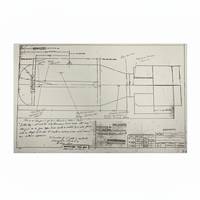
Best.-Nr. 12518Little Boy was the code name of the atomic bomb which was dropped on Hiroshima on August 6 1945 by the 12-man crew of the B-29 Superfortress Enola Gay. Here we have a black and white copy of a Blue print showing the first atomic bomb with handwritten explanations of the components and how it works in the hand of a crew member who dropped this bomb on Hiroshima Enola Gay's Weapons Test Officer Jeppson. Jeppson was one of only 2 men who was both at Los Alamos during the development and testing of the bomb and also on board the Enola Gay when it dropped the bomb. Jeppson has made handwritten notations showing where a bullet of U235 shoots into a mass of U235 to create a the atomic explosion. He writes on the blueprint pointing out where the "uranium bullet" is that shoots in "the uranium target ring" and explanations on how it worked. The design was a very conservative one that was as certain to work as any untested device can be. The design was complete by February 1945 and the actual bomb was ready for combat use by early May 1945 - except for the U-235 pit. The Little Boy design used the gun method to explosively force a sub-critical mass of uranium-235 and three U-235 target rings together into a supercritical mass initiating a nuclear chain reaction. This was accomplished by simply shooting one piece of the uranium the "projectile U235" into the other namely the "target U235" by means of a chemical explosives. Here Morris Jeppson the Weapons Test Officer of the Enola Gay has made handwritten notations explaining the main different parts of this Atomic Bomb he writes: "Little Boy Bomb Weight about 5 tons". He draws arrows labeling the "target U235" where the projectile 235 should hit. He points out the "hook to hang bomb in B29" that held the Bomb to the Enola Gay the write "projectile U235" pointing to the bullet of U235 that will shout into the target . On the margin he explains in his hand: "The design of Little Boy used the gun assembly method. The bullet of U235 impacting the target of U235 produces a critical mass in a very short period of time - and the heavy nose casing contains critical conditions long enough for the nuclear reaction to proceed. During the flight I removed 3 green electrical plugs and replaced them with red coded plugs. This allowed the detonation voltage to go from fusing to the explosive that fired the projectile of U235 into the target of U235 when the bomb reached about 1500 feet above Hiroshima. Underneath his explanation he signs "Morris Jeppson/ Weapons Test Officer/ Enola Gay Mission/ HIROSHIMA - 6 Aug. 1945" . The bomb was armed in flight then Jeppson removed the safety plugs as describes on the document and as such was the last to touch Little Boy before it was dropped at approximately 8:15 a.m. JST. Approximately 70000 people were killed as a direct result of the blast and a similar number were injured. Measure approx. 18" x 24". In excellent condition. unknown books
1975Best.-Nr. 2090202120407907Hiroshima Prefecture 1975. Soft Cover. Fine. Number of books: 1 Hiroshima Prefecture paperback
Best.-Nr. 2090202118203293Not Available N.A. Soft Cover. Fine. The book is in fine condition. Not Available paperback
2002Best.-Nr. 2090202120101074Not Available 2002. Soft Cover. Fine. Number of books: 15 Not Available paperback
2002Best.-Nr. 2090202120301073Not Available 2002. Soft Cover. Fine. Number of books: 15 Not Available paperback
1945Best.-Nr. 125961945. World War IIAtomic Bomb Van Kirk Theodore J. "Dutch". Single blueprint copy inscribed and signed dated "6 Aug 1945." Single blueprint sheet. Annotated blueprint of "Little Boy" the uranium-235 atomic bomb detonated over Hiroshima on August 6 1945 inscribed and explained by Theodore Van Kirk navigator of the B-29 Enola Gay during the first wartime use of a nuclear weapon. Developed under the direction of the Manhattan Project the bomb marked a decisive technological and geopolitical rupture at the close of World War II inaugurating the nuclear age and reshaping global military doctrine. Approximately 70000 people were killed as a direct result of the blast with comparable numbers injured rendering the event one of the most consequential military actions of the twentieth century. Black-and-white blueprint copy approximately 18 x 24 inches illustrating the internal configuration of "Little Boy" employing the gun-type assembly method in which a sub-critical uranium-235 projectile was fired into a hollow uranium-235 target to achieve supercritical mass and initiate a nuclear chain reaction. Van Kirk has added detailed manuscript notations in pencil and ink identifying principal components including the "Neutron Source" "Steel Tamper" "Gunpowder" "Explosion Device" "Highly Sensitive Radio Antennae" "Uranium 235 'Bullet' Fired into Target to Create a Critical Mass" and "Uranium 235 Hollowed out Target." Along the margin in black ink he writes: "This is a blue print of our Hiroshima Atomic bomb 'Little Boy.' It was the only uranium bomb made. The bomb was designed as a gun type bomb with a bullet of U-235 fired into a U-235 target to create a critical mass." Signed below in blue ink: "Theodore J 'Dutch' Van Kirk Navigator - Enola Gay 6 Aug 1945." The design of "Little Boy" was finalized by early 1945 and reflected a conservative engineering approach intended to ensure detonation reliability despite the unprecedented nature of atomic warfare. As a navigational officer on the mission Van Kirk occupied a critical operational role in delivering the weapon to its target and his explanatory annotations reveal how participants later articulated the bomb's mechanics and singular status as the only uranium-based device used in combat. Minor edge wear and light handling marks; blueprint lines sharp and legible; manuscript annotations and signature clear and strong. Overall very good to near fine condition. unknown