Herman, Edward S.; Ahmad, Aijaz; Abunimah, Ali; Perlman, Fredy; Heinberg, Richard; Ray, GeneMareMagnum

1.061 Ergebnisse
200374 pages. Features: Parallel and Linked Genocides - Iraq and Palestine; The Nazification of Israel; The Growing Clamor for Ethnic Cleansing; Anti-Semitism and the Beirut Pogrom; George Bush and the American Empire; Ground Zero - Hiroshima haunts 9/11; and much more. Average wear. Unmarked. A sound copy. Book
198060 pages. Features: Volvo ad touts the 18.7 year life-expectancy of their cars; Another Chance for Joe Clark?; Sexy ad for Miami Beach; Profile Article on Rupert Murdoch; Dogsled racing in the Yukon - Paul Sheridan and Dick Eastmure; Yuri Luryi - 35 years on the trail of Raoul Wallenberg; There Could be Economic Civil War if Alberta Stops Sending Oil East; Discovery of 4,000-year-old civilization at the northern tip of Labrador; Celebrity photos of Nelson Skalbania, Stephen Yan (of Wok with Yan), the Frantic Follies, and composer-singer Carol Connors; Pope John Paul II visits the Philippines - article with photos; Indictment of the mullahs' rule in Iran; Rev. Ian Paisley in Ireland; Death threats to Teddy Kennedy aide Richard E. Burke; Canada may have been impacted by US nuclear bomb testing prior to Hiroshima; Government Loan Guarantee to Chrysler Canada; Bert and Irving Gerstein's Peoples Jewelers Ltd. purchases Zale Corp. of the U.S. - article with photo; Tony Tanti of the Oshawa Generals breaks Wayne Gretzky's OMJHL goal scoring record - article with photo; Feature article on actor Donald Sutherland; Gold medal for speed skater Gaetan Boucher; Archeological dig in Calgary's Nose Hill - excavations of the entrepreneurial kind; The Problems of Enforcing Seat Belt Legislation; Dance article on Lawrence Gradus and the Theatre Ballet of Canada; and more. Average wear. A sound vintage copy. Magazine
1955238p. Hardcover Good condition in fair d.j. fair
Folio 160p., illus. SOFTCOVER. Paperback Very good condition
1984412p., illus. Hardcover Very good condition good
1961TRADUZIONE DI A. Guadagnin EDIZIONI DI COMUNITà 1961 228 PP. TIMBRO DI APPARTENENZA ALLA PAGINA DI RIEPILOGO EDITORIALE, VOLUME INTONSO, MAI SFOGLIATO.
1966SUGAR 1966 294 PP. FONDO DI MAGAZZINO: SEGNI DEL TEMPO ALLA COPERTINA, VOLUME INTONSO, MAI SFOGLIATO. SEBBENE NON INTEGRA, ANCORA PRESENTE LA FASCETTA PUBBLICITARIA EDITORIALE CHIUSA, COME DA FOTO Il bombardamento di Londra visto da Virginia Woolf, le prime bombe atomiche su Nagasaki e Hiroshima, le ultime parole di Stefan Zweig prima del suicidio, una lettera di Simone Weil a Maurice Schumann, l'8 settembre descritto da Giaime Pmtor, i rischiosissimi e avventurosi voli dl Samt-Exupéry in Africa, la "scoPerta" dei campi di sterminio da parte dei generali americani in Germania i diari di Kaj Munk e Julius Fucik assassinati dai nazisti, gli ultimi appunti musicali di Anton Webern ucciso "per sbaglio" nel 1945. Oltre a queste celebri testimonianze, altre raccolte in questo volume portano firme poco conosciute o sono addirittura anonime testimonianze individuali di combattenti e di borghesi, di intellettuali e di proletari ben diverse le une dalle altre, anche perché provengono da differenti paesi. Si fondono tuttavia insieme per ricostruire davanti ai nostri occhi, in una cronaca appassionata e intima, disperata e generosa, gli avvenimenti che vanno dal 1939 al 1945. Questi documenti fanno parte della storia e ci aiutano a capirla e a ricordarla, ad analizzarla e a esorcizzarla. Proprio su questa memoria della tragedia e su questo rifiuto dell atrocità è basata l'unica possibilità di pace.
1966in 8 (21,5x16) Brossura con sovracoperta illustrata; pp.310, segni del tempo e scolorimento e piccoli strappi in sovracoperta , libro buono. Ed. 1966
2014Best.-Nr. x-4036356305Kaiseisha. 2014. Tankobon Softcover. New. Japanese language. 7.32x5.12x0.63 inches. Kaiseisha. paperback
Best.-Nr. 2i8734Mazda Motor Corporation Hiroshima/Japan 1986/1987. Je Band ca. 400 S. in getrennter Zählung mit zahlreichen Illustrationen kartonierte Einbände quart durchgängig gelocht/etwas werkstattfleckig/1 Einband mit kleinem Eckausriß/handschriftliche Initialen auf unterem Schnitt. unknown
Best.-Nr. 2i8735Mazda Motor Corporation Hiroshima/Japan 1985/1986. Ca. 400 S./ca. 300 S. in getrennter Zählung mit zahlreichen Illustrationen kartonierte Einbände quart durchgängig gelocht/berieben/werkstattfleckig/1 Einband mit Knickspuren und kleinem Eckausriß/handschriftliche Initialen auf unterem Schnitt. unknown
Best.-Nr. 2i8412Mazda Motor Corporation Hiroshima/Japan 1990/1993. Ca. 780 S./ca. 160 S. in getrennter Zählung mit zahlreichen Illustrationen kartonierte Einbände quart werkstattfleckig und mit leichten Gebrauchsspuren/ein Band mit handschriftlicher Zahl auf unterem Schnitt. - Mazda Europa - unknown
2019Best.-Nr. x-9813293047Springer Verlag 2019. Paperback. New. 152 pages. 9.25x6.10x0.39 inches. Springer Verlag paperback
2026Best.-Nr. x-1032670371Taylor & Francis Ltd 2026. Paperback. New. 188 pages. 6.14x0.44x9.21 inches. Taylor & Francis Ltd paperback
2026Best.-Nr. x-1032893141Taylor & Francis Ltd 2026. Paperback. New. 154 pages. 6.14x0.35x9.21 inches. Taylor & Francis Ltd paperback
2026Best.-Nr. x-1032762314Taylor & Francis Ltd 2026. Paperback. New. 262 pages. 6.14x0.59x9.21 inches. Taylor & Francis Ltd paperback
2026Best.-Nr. x-1032574488Taylor & Francis Ltd 2026. Paperback. New. 330 pages. 6.14x0.75x9.21 inches. Taylor & Francis Ltd paperback
2020Best.-Nr. x-4569789463PHP Kenkyujo 2020. Hardcover. New. Japanese language. 5.12x0.55x7.40 inches. PHP Kenkyujo hardcover
Best.-Nr. 33622150like new. unknown
1945Best.-Nr. 221391945. Editor unknown. Atlanta Journal August 6 1945 records the first American newspaper cycle responding to the atomic bombing of Hiroshima a military and political event that introduced nuclear weapons into warfare and reshaped the final phase of World War II. The issue supports research into wartime journalism anti-Japanese racial language in the American press home-front reception of nuclear warfare and the public announcement of the atomic age; Hiroshima was bombed on August 6 1945 and President Truman's statement described the bomb as having "more power than 20000 tons of T.N.T." Atlanta Journal. Atlanta Georgia. August 6 1945. Final Home Edition. Number of pages and size not stated. Front-page headlines include "Atomic Power Bomb Loosed on Jap Cities" "Death Charge Equals 20000 Tons of TNT" and "Japs Fail to Scratch New Hornet in Terrific 14-month War Cruise." The headlines preserve the immediacy of American reporting on Hiroshima as well as the racialized wartime language used in mainstream newspapers during the Pacific War. General handling wear good overall. A same-day Southern newspaper issue documenting how the first use of atomic warfare entered American public consciousness through mass-circulation news. unknown
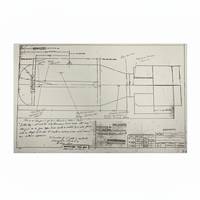
1945Best.-Nr. 125961945. World War IIAtomic Bomb Van Kirk Theodore J. "Dutch". Single blueprint copy inscribed and signed dated "6 Aug 1945." Single blueprint sheet. Annotated blueprint of "Little Boy" the uranium-235 atomic bomb detonated over Hiroshima on August 6 1945 inscribed and explained by Theodore Van Kirk navigator of the B-29 Enola Gay during the first wartime use of a nuclear weapon. Developed under the direction of the Manhattan Project the bomb marked a decisive technological and geopolitical rupture at the close of World War II inaugurating the nuclear age and reshaping global military doctrine. Approximately 70000 people were killed as a direct result of the blast with comparable numbers injured rendering the event one of the most consequential military actions of the twentieth century. Black-and-white blueprint copy approximately 18 x 24 inches illustrating the internal configuration of "Little Boy" employing the gun-type assembly method in which a sub-critical uranium-235 projectile was fired into a hollow uranium-235 target to achieve supercritical mass and initiate a nuclear chain reaction. Van Kirk has added detailed manuscript notations in pencil and ink identifying principal components including the "Neutron Source" "Steel Tamper" "Gunpowder" "Explosion Device" "Highly Sensitive Radio Antennae" "Uranium 235 'Bullet' Fired into Target to Create a Critical Mass" and "Uranium 235 Hollowed out Target." Along the margin in black ink he writes: "This is a blue print of our Hiroshima Atomic bomb 'Little Boy.' It was the only uranium bomb made. The bomb was designed as a gun type bomb with a bullet of U-235 fired into a U-235 target to create a critical mass." Signed below in blue ink: "Theodore J 'Dutch' Van Kirk Navigator - Enola Gay 6 Aug 1945." The design of "Little Boy" was finalized by early 1945 and reflected a conservative engineering approach intended to ensure detonation reliability despite the unprecedented nature of atomic warfare. As a navigational officer on the mission Van Kirk occupied a critical operational role in delivering the weapon to its target and his explanatory annotations reveal how participants later articulated the bomb's mechanics and singular status as the only uranium-based device used in combat. Minor edge wear and light handling marks; blueprint lines sharp and legible; manuscript annotations and signature clear and strong. Overall very good to near fine condition. unknown
1945Best.-Nr. 125481945. Van Kirk Theodore J. handwritten autograph letter signed 6 August 1945 provides a first-person account by the navigator of the B-29 Enola Gay addressing fears of blast damage and radiation exposure during the Hiroshima atomic bombing mission. As navigator on the aircraft that delivered the first deployed atomic weapon in warfare Van Kirk 1921-2014 occupied a critical operational role requiring precise calculations of speed altitude and distance to ensure both mission success and crew survival. This manuscript directly supports research into World War II strategic bombing the operational realities of the Manhattan Project and contemporary military understanding of radiation hazards at the moment nuclear weapons entered combat. His reflections reveal not only technical planning but also the limited scientific certainty conveyed to flight crews regarding the bomb's destructive and radiological effects. Van Kirk Theodore J. 6 August 1945. Two pages. Approximately 8.5 x 11 inches. In this holograph letter written in question-and-answer format Van Kirk addresses the risks anticipated by the crew: "Did you have any fears about the effects the atomic bomb would have on the Enola Gay and the crew Yes. The fact that the bombs shock waves might destroy or damage the airplane was a major concern." He recalls being advised by a scientist that "we think the airplane will be OK if you're 9 miles away when the bomb explodes" and explains that "it was to get speed and altitude - and therefore distance - that we stripped down our airplanes. We were 12 miles away when the bomb exploded." Regarding radiation he writes: "We were not greatly concerned. We were told that the mushroom shaped cloud was deadly radiation and to stay clear of it. Otherwise no equipment to protect from radiation. No crew members were affected." He signs "Sincerely / Theodore J 'Dutch' Van Kirk / Navigator - Enola Gay / 6 Aug. 1945." The manuscript preserves his phrasing underscoring the mixture of scientific briefing operational adaptation and residual uncertainty that characterized the mission. Composed retrospectively and dated to the day of the bombing the letter reflects how participants later articulated their understanding of radiation at a time when its long-term biological effects were not yet fully grasped by the broader public or as Van Kirk's statement suggests by operational crews. His emphasis on distance calculations and aircraft modification illustrates the intersection of scientific theory and practical military execution in August 1945 when strategic air power entered the nuclear age. The acknowledgment that no protective equipment was provided and that crews relied primarily on avoidance of the mushroom cloud contributes to the evidentiary record of early nuclear risk assessment within the U.S. Army Air Forces. Minor edge wear and light handling creases; ink strong and fully legible; paper clean. Overall very good to near fine condition. A substantive self-authored reflection on blast mechanics and radiation awareness at the inception of atomic warfare. unknown
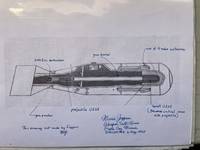
1945Best.-Nr. 125771945. Jeppson Morris. Hand-annotated diagram of the "Little Boy" atomic bomb 1945 provides a direct technical interpretation of the weapon used in the bombing of Hiroshima by a participant who bridged both its development and deployment. As weapons officer aboard the Enola Gay and a scientist present at Los Alamos Laboratory Jeppson occupied a rare dual role linking the Manhattan Project's design phase with the operational execution of nuclear warfare. His annotations explain the internal structure and function of the uranium gun-type bomb offering a contemporaneous explanation of how critical mass was achieved and how the weapon was triggered. The document situates technical knowledge of nuclear fission within the lived experience of those responsible for its first use in warfare during World War II. Jeppson Morris. "Little Boy" atomic bomb diagram. United States 1945. One-page black-and-white printed diagram with extensive handwritten annotations and arrows in ink signed at lower margin "Morris Jeppson / Weapon Test Officer / Enola Gay Mission / HIROSHIMA 6 Aug. 1945." The annotations identify and explain key components including "target U235" "projectile 235" and the process by which the bomb "Becomes critical mass with projectile" along with labeled elements such as the "electric detonator" "gun barrel" and "one of 4 radar antennas." The markings function as a technical overlay to the printed schematic clarifying both structure and mechanism from the perspective of the officer responsible for in-flight arming and monitoring of the device. The atomic bombing of Hiroshima marked the first combat use of nuclear weapons and introduced a new phase of warfare defined by unprecedented destructive capacity and strategic implications. Jeppson's role in both the scientific and operational dimensions of the mission positions this document within the immediate transmission of specialized knowledge from laboratory to battlefield. His annotations provide insight into how participants understood and communicated the bomb's function contributing to the historical record of nuclear science military technology and the transformation of warfare at the end of World War II. Light handling wear; diagram remains clear with strong legible annotations and signature. Overall very good. unknown
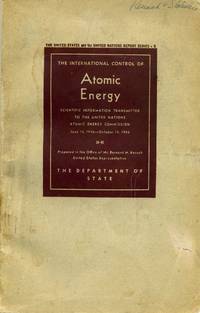
1946Best.-Nr. 99751946. United States Department of State. The International Control of Atomic Energy: Scientific Information Transmitted to the United Nations Atomic Energy Commission June 14 1946 - October 14 1946 1946 constitutes one of the earliest formal U.S. government submissions to the United Nations Atomic Energy Commission outlining proposed mechanisms to regulate nuclear weapons following the atomic bombings of Japan. Issued in the immediate aftermath of World War II and within one year of the atomic bombing of Hiroshima the report presents a technical and policy framework focused on controlling fissile materials as the primary safeguard against proliferation. This copy bears a direct inscription by Theodore Van Kirk navigator of the Enola Gay on August 6 1945 linking the theoretical policy proposals of international governance with firsthand participation in the first operational use of atomic weapons. Van Kirk underscores a central conclusion of the report by writing: "As stated on p. 164 The best control measure for the prevention of atomic bomb manufacture are those intended to prevent the accumulation of the essential fissionable materials" followed by his identification: "Theodore Van Kirk - Navigator - Enola Gay 6 Aug. 1945." United States Department of State. The International Control of Atomic Energy: Scientific Information Transmitted to the United Nations Atomic Energy Commission June 14 1946 - October 14 1946. Washington D.C.: Department of State 1946. Softcover volume measuring approximately 6 x 9 inches 195 pages. The work compiles scientific data policy recommendations and diplomatic proposals submitted to the United Nations concerning the international management of atomic energy and the prevention of nuclear weapons development. The inscription appears on the title page in Van Kirk's hand directly referencing a specific passage within the text and reinforcing its central argument regarding material control. Produced during the earliest phase of postwar nuclear diplomacy the report aligns with U.S. efforts to establish international oversight of atomic energy before the escalation of Cold War arms competition. The presence of Van Kirk's annotation situates the document within both policy formation and military execution bridging governmental attempts at regulation with the lived experience of atomic warfare. Light wear to covers with minor handling; internally clean; inscription clear and legible. Overall very good condition. unknown
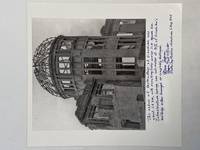
1945Best.-Nr. 127651945. Jeppson Morris. Inscribed photograph of the Hiroshima Atomic Dome following the atomic bombing provides a quantified assessment of destruction written by the weapons officer responsible for arming the bomb aboard the Enola Gay on August 6 1945. As the individual who physically armed the device prior to release Morris Jeppson links technical execution of the mission with retrospective evaluation of its effects. His inscription records measured estimates of blast radius fire spread and infrastructure damage contributing to the historical record of how participants in the bombing articulated its scale and consequences in numerical terms. Jeppson Morris. Hiroshima Atomic Dome photograph. United States post-1945. Black-and-white photograph measuring approximately 9 x 8.5 inches inscribed in ink by Morris Jeppson. The inscription reads: "The radius of destruction of Hiroshima was about 1.6 km with resulting fires across 11.4 square km. Infrastructure damage was estimated at 90% of Hiroshima's buildings either damaged or completely destroyed. Morris Jeppson - Weapon Test Officer - Enola Gay Mission - Hiroshima 6 Aug. 1945." The image depicts the Atomic Dome one of the few surviving structures near the hypocenter paired with Jeppson's statistical summary of destruction integrating visual evidence with numerical interpretation. The Hiroshima bombing introduced a new scale of urban destruction defined by nuclear technology with immediate and long-term consequences for civilian populations and infrastructure. Jeppson's inscription reflects how participants in the mission communicated its impact through measurable data aligning with postwar efforts to document and understand the physical effects of atomic weapons. The combination of a landmark image of the Atomic Dome with a participant-authored damage assessment offers a primary source for the study of nuclear warfare urban devastation and the translation of technological force into quantifiable outcomes. Light handling wear; photograph remains clean with strong legible inscription. Overall very good. unknown