1.271 Ergebnisse
2026Best.-Nr. x-1032893141Taylor & Francis Ltd 2026. Paperback. New. 154 pages. 6.14x0.35x9.21 inches. Taylor & Francis Ltd paperback
1995Best.-Nr. 2090202120406280Hiroshima City 1995. Soft Cover. Fine. Number of books: 1 Hiroshima City paperback
1992Best.-Nr. 2092902137405482Gijutsu to ningen 1992. Soft Cover. Fine. Number of books: 1 book Gijutsu to ningen paperback
1959Best.-Nr. 28869Frankfurt a. M., Berlin, Bonn, Verlag Moritz Diesterweg, 1959. 70 Seiten , 23 cm, kartoniert
1954Best.-Nr. 2090502113702680Not Available 1954. Soft Cover. Fine. The book is in fine condition. Not Available paperback
1965Best.-Nr. 2083002116201061Asahi Shoin Tsutomu Harada Hiroshima 1965. Soft Cover. Fine. The book is in fine condition. Asahi Shoin Tsutomu Harada (Hiroshima) paperback
1981Best.-Nr. 2090202120415662Hiroshima Atomic Bomb Victims Association 1981. Soft Cover. Fine. Number of books: 1 Hiroshima Atomic Bomb Victims Association paperback
2009Best.-Nr. 2090202120401168Hiroshima Keizai University Library 2009. Soft Cover. Fine. Number of books: 1 Hiroshima Keizai University Library paperback
Best.-Nr. 2111902158405897Domesu shuppan N.A. Soft Cover. Fine. Size: 19cm B6 Domesu shuppan paperback
1989Best.-Nr. 2090202120413761Domesu shuppan 1989. Soft Cover. Fine. Number of books: 1 Domesu shuppan paperback
1945Best.-Nr. 221391945. Editor unknown. Atlanta Journal August 6 1945 records the first American newspaper cycle responding to the atomic bombing of Hiroshima a military and political event that introduced nuclear weapons into warfare and reshaped the final phase of World War II. The issue supports research into wartime journalism anti-Japanese racial language in the American press home-front reception of nuclear warfare and the public announcement of the atomic age; Hiroshima was bombed on August 6 1945 and President Truman's statement described the bomb as having "more power than 20000 tons of T.N.T." Atlanta Journal. Atlanta Georgia. August 6 1945. Final Home Edition. Number of pages and size not stated. Front-page headlines include "Atomic Power Bomb Loosed on Jap Cities" "Death Charge Equals 20000 Tons of TNT" and "Japs Fail to Scratch New Hornet in Terrific 14-month War Cruise." The headlines preserve the immediacy of American reporting on Hiroshima as well as the racialized wartime language used in mainstream newspapers during the Pacific War. General handling wear good overall. A same-day Southern newspaper issue documenting how the first use of atomic warfare entered American public consciousness through mass-circulation news. unknown
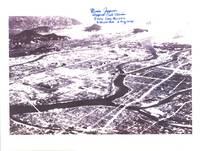
1976Best.-Nr. 125641976. Jeppson Morris signed photograph of Hiroshima after the August 6 1945 atomic bombing linking the physical destruction of the city to a member of the Enola Gay mission crew. Jeppson served as assistant weaponeer aboard the B 29 and had responsibility for weapons testing and arming procedures associated with the "Little Boy" atomic bomb; shortly before the aircraft reached Hiroshima he removed its safety devices and inserted the arming plugs. The photograph therefore combines a post bombing view of Hiroshima with the autograph and mission identification of a participant directly involved in preparing the weapon for use. Black and white photograph 11 x 8 1/2 inches showing the devastated Hiroshima landscape after the atomic bombing. Few structures remain visible beyond foundations and other remnants while burned tree trunks stand amid the cleared terrain. Jeppson has signed and inscribed the image "Morris Jeppson - Weapons Test Officer - Enola Gay Mission- Hiroshima-6 Aug 1945" explicitly identifying his role aircraft target and mission date. The Enola Gay dropped the first atomic weapon used in combat over Hiroshima on August 6 1945. Jeppson's inscription gives the image direct association with the mission and preserves his own description of his position as "Weapons Test Officer" while contemporary institutional histories also identify him as assistant weaponeer to Captain William S. Parsons. The visible destruction provides a stark record of the consequences of the bombing while Jeppson's signed identification connects that aftermath to the personnel responsible for carrying and arming the weapon. Condition not stated. unknown
1945Best.-Nr. 193451945. Van Kirk Theodore "Dutch." Signed poster reproducing the navigator's log of the August 6 1945 Enola Gay mission documents the flight that delivered the first atomic bomb used in warfare. Van Kirk served as navigator aboard the B-29 plotting the aircraft's course from North Field on Tinian to Hiroshima and back during a mission that initiated the wartime use of nuclear weapons and transformed military strategy international relations and public understanding of technological destruction. The National Museum of the United States Air Force records that the Enola Gay departed at 2:45 a.m. and released the uranium bomb known as "Little Boy" over Hiroshima later that morning. The poster provides a signed visual chronology for the study of World War II aviation operational navigation the Manhattan Project and the beginning of the nuclear age. Hiroshima Mission Navigator's Log of the Enola Gay. Issuer place and date of printing not identified. Poster reproducing three manuscript pages entirely in Van Kirk's hand; dimensions not supplied. The successive entries trace the mission from takeoff through navigation toward Japan the bombing run and the aircraft's return to base. The log records the 0245 departure the turn onto a 345-degree heading and the climb to 30800 feet with "BOMB AWAY" entered at 0915. These operational notations reduce the mission to headings altitudes times and navigational actions preserving the procedural language by which the crew recorded an event of extraordinary human consequence. Signed at the bottom "Theodore J. 'Dutch' Van Kirk Navigator-Enola Gay Hiroshima Aug. 6 1945." Because the three manuscript pages are photographically or mechanically reproduced the poster should not be described as Van Kirk's original wartime log; only the concluding inscription and signature are represented as original autograph material. The Enola Gay's release of "Little Boy" over Hiroshima marked the first use of a nuclear weapon in war; the bomb detonated approximately 1800 feet above the city. The reproduced entries offer an operational perspective distinct from later narrative accounts showing how the navigator organized the mission through timed observations and course calculations while leaving the destruction below largely outside the log's technical vocabulary. No creasing staining fading tears or edge losses are identified; reproduced manuscript images and Van Kirk's signed inscription remain clear near fine. Signed commemorative record joining the navigator's minute-by-minute flight chronology with direct identification by the last surviving member of the Enola Gay crew. unknown
1945Best.-Nr. 125481945. Van Kirk Theodore J. handwritten autograph letter signed 6 August 1945 provides a first-person account by the navigator of the B-29 Enola Gay addressing fears of blast damage and radiation exposure during the Hiroshima atomic bombing mission. As navigator on the aircraft that delivered the first deployed atomic weapon in warfare Van Kirk 1921-2014 occupied a critical operational role requiring precise calculations of speed altitude and distance to ensure both mission success and crew survival. This manuscript directly supports research into World War II strategic bombing the operational realities of the Manhattan Project and contemporary military understanding of radiation hazards at the moment nuclear weapons entered combat. His reflections reveal not only technical planning but also the limited scientific certainty conveyed to flight crews regarding the bomb's destructive and radiological effects. Van Kirk Theodore J. 6 August 1945. Two pages. Approximately 8.5 x 11 inches. In this holograph letter written in question-and-answer format Van Kirk addresses the risks anticipated by the crew: "Did you have any fears about the effects the atomic bomb would have on the Enola Gay and the crew Yes. The fact that the bombs shock waves might destroy or damage the airplane was a major concern." He recalls being advised by a scientist that "we think the airplane will be OK if you're 9 miles away when the bomb explodes" and explains that "it was to get speed and altitude - and therefore distance - that we stripped down our airplanes. We were 12 miles away when the bomb exploded." Regarding radiation he writes: "We were not greatly concerned. We were told that the mushroom shaped cloud was deadly radiation and to stay clear of it. Otherwise no equipment to protect from radiation. No crew members were affected." He signs "Sincerely / Theodore J 'Dutch' Van Kirk / Navigator - Enola Gay / 6 Aug. 1945." The manuscript preserves his phrasing underscoring the mixture of scientific briefing operational adaptation and residual uncertainty that characterized the mission. Composed retrospectively and dated to the day of the bombing the letter reflects how participants later articulated their understanding of radiation at a time when its long-term biological effects were not yet fully grasped by the broader public or as Van Kirk's statement suggests by operational crews. His emphasis on distance calculations and aircraft modification illustrates the intersection of scientific theory and practical military execution in August 1945 when strategic air power entered the nuclear age. The acknowledgment that no protective equipment was provided and that crews relied primarily on avoidance of the mushroom cloud contributes to the evidentiary record of early nuclear risk assessment within the U.S. Army Air Forces. Minor edge wear and light handling creases; ink strong and fully legible; paper clean. Overall very good to near fine condition. A substantive self-authored reflection on blast mechanics and radiation awareness at the inception of atomic warfare. unknown
1945Best.-Nr. 107541945. Van Kirk Theodore J. "Dutch." Signed photograph of the Enola Gay documenting the B 29 Superfortress used in the first atomic bombing in warfare and bearing an inscription by its navigator. Van Kirk served as navigator aboard the B 29 Enola Gay during the August 6 1945 bombing of Hiroshima guiding the aircraft during its flight from Tinian to Japan and its return. The image supports research into World War II aviation the Manhattan Project atomic warfare and the commemorative culture through which mission participants later identified and interpreted the aircraft. The National WWII Museum confirms Van Kirk's position as navigator aboard the Enola Gay. Color photographic image of the Enola Gay undated. 6 by 12 inches. The aircraft is the primary subject although its viewpoint setting markings and whether it is shown in flight or on the ground are not specified in the supplied description. Van Kirk has inscribed the photograph in blue ink: "To recipient - best wishes and thanks - Dutch Van Kirk Navigator - Enola Gay Gang 6 Aug. 1945." The personalized salutation and informal phrase "Enola Gay Gang" identify the photograph as a later commemorative presentation rather than a contemporaneously inscribed wartime image. On August 6 1945 the Enola Gay departed Tinian carrying the uranium bomb known as "Little Boy" and released it over Hiroshima initiating the use of nuclear weapons in war. The aircraft and its crew subsequently became central to competing historical interpretations of military necessity civilian destruction technological change and the beginning of the atomic age. Van Kirk's full mission inscription connects the pictured aircraft directly to the navigator responsible for plotting its course and records the date through the language of a surviving participant. Blue-ink inscription remains bold and legible; no defects are reported. Near fine. A personally inscribed aircraft portrait joining the material history of the Enola Gay with the later commemoration of the Hiroshima mission. unknown
1945Best.-Nr. 125531945. Van Kirk Theodore J. handwritten autograph letter signed 6 August 1945 provides a first-person account by the navigator of the B-29 Enola Gay addressing the operational risks of deploying the first atomic bomb and the crew's reaction to the magnitude of its detonation over Hiroshima. As navigator on the aircraft that carried out the 6 August 1945 mission Van Kirk 1921-2014 bore responsibility for the precise calculations necessary to deliver an unprecedented weapon under combat conditions. This manuscript supports research into World War II strategic air warfare the operational uncertainties surrounding the Manhattan Project's first use in combat and the technological anxieties inherent in deploying a weapon whose destructive capacity exceeded prior experience. His reflections illuminate both mechanical vulnerability and the psychological shock experienced by participants at the dawn of nuclear warfare. Van Kirk Theodore J. 6 August 1945. Two pages. Approximately 8.5 x 11 inches. In this holograph letter written in question-and-answer format Van Kirk considers the potential for catastrophic malfunction: "Could something have gone wrong during the flight or when the bomb was launched Of course - all kinds of things. We all know what can go wrong with airplanes even during pastime flying. The bomb could 'hang up' in the bomb bay and not launch cleanly. Therefore it would not fall as predicted and if not could cause damage or destroy the plane." Reflecting on the detonation itself he acknowledges: "Were the crew members surprised at the extent of the explosion Yes. The explosion was much greater than the test in New Mexico and much bigger than any of us could realize." He signs "Theodore J Van Kirk / Navigator - Enola Gay / 6 Aug. 1945." The manuscript preserves his language emphasizing both the technical fragility of the mission and the unforeseen scale of the weapon's destructive force compared to the Trinity test. Although composed retrospectively and dated to the day of the mission the letter contributes to the documentary record of how participants later described the uncertainties surrounding the first atomic combat deployment. Van Kirk's acknowledgment that the explosion exceeded expectations underscores the limited empirical frame of reference available even to trained officers briefed on the weapon's development. His discussion of bomb bay malfunction and aircraft vulnerability highlights the intersection of conventional aviation risk and revolutionary weapons technology in August 1945. Minor edge wear and light handling creases; ink strong and fully legible; paper clean. Overall very good to near fine condition. A substantive self-authored reflection on mechanical peril and the unprecedented scale of the first atomic explosion in warfare. unknown
1945Best.-Nr. 125471945. Van Kirk Theodore J. handwritten autograph letter signed 6 August 1945 offers a first-person reflection by the navigator of the B-29 Enola Gay on the most perilous moments of the Hiroshima atomic bombing mission and the psychological atmosphere aboard the aircraft. Theodore "Dutch" Van Kirk 1921-2014 a central member of the three-man flight deck crew provides direct testimony concerning the uncertainty surrounding the bomb's force and the crew's fear that the detonation might destroy their own plane. The letter supports research in World War II military aviation the operational history of the Manhattan Project and the lived experience of nuclear warfare from the American aircrew perspective. By fore grounding danger doubt and immediate reaction Van Kirk's account contributes to the documentary record of how participants later interpreted the unprecedented destructive power they helped unleash. Van Kirk Theodore J. 6 August 1945. Two pages. Approximately 8.5 x 11 inches. In this holograph letter written in question-and-answer format Van Kirk records: "What do you think was the most dangerous moment during the mission Undoubtedly the seconds when and right after the bomb exploded. The question was 'will the bomb blow up or severely damage the airplane.' Thankfully we got far enough away so this did not happen." Addressing crew morale he continues: "Were your fellow crew members anxious about carrying out the mission There was some doubt in everyone's mind about the force of the bomb. Would it damage or even destroy the plane. I was all assuaged the moment the bomb exploded." He signs "Theodore J 'Dutch' Van Kirk / Navigator - Enola Gay / 6 Aug 1945." The manuscript preserves his phrasing and emphasis underscoring both technical calculation and personal apprehension at the moment nuclear warfare entered combat history. Although composed retrospectively and dated to the mission itself the letter reflects the sustained historical reckoning with the atomic bombings and the strategic doctrine that followed. Van Kirk's language centers not on political justification but on immediate survival revealing the acute awareness among crew members that the weapon's effects were not fully predictable even to those tasked with delivering it. Such testimony is especially significant given that only a small number of crew members had direct visual access to the detonation and experienced the shock wave firsthand. Light handling wear and minor edge creasing; ink bold and fully legible; paper clean. Overall very good to near fine condition. A substantive and self-authored statement documenting the perceived mortal risk faced by the Enola Gay crew at the threshold of the nuclear age. unknown
1945Best.-Nr. 121191945. Van Kirk Theodore "Dutch." Signed poster reproducing the navigator's log of the Enola Gay mission to Hiroshima documenting the flight chronology of the first atomic bombing used in warfare on August 6 1945. Van Kirk served as navigator aboard the B-29 commanded by Paul Tibbets and recorded the aircraft's route from Tinian Island to Japan and its return to base. By presenting successive navigational entries-including the notation "BOMB AWAY"-the poster provides a reproduced documentary account of the mission that initiated the nuclear age and supports research into World War II aviation the Manhattan Project atomic warfare and the continuing historical and ethical study of Hiroshima. The National WWII Museum identifies Van Kirk as the Enola Gay's navigator and preserves his oral testimony concerning the mission. Flight Log of the Enola Gay Atomic Bomb Mission to Hiroshima. Signed by Theodore "Dutch" Van Kirk. Publisher place date and dimensions not specified. The poster reproduces three pages of navigational-log entries progressing from takeoff through the aircraft's return to Tinian. Recorded events include the B-29's departure at 0245 Tinian time navigation toward Iwo Jima and the Japanese home islands and "BOMB AWAY" at 0915 corresponding to 0815 in Hiroshima. The Nuclear Museum records the surviving log as beginning shortly after the 0245 takeoff and concluding with the aircraft's landing at 1458 with all entries given in Tinian time. Van Kirk signed the poster in full in blue ink. The supplied description states that the reproduced pages were handwritten by Van Kirk but the poster itself should be distinguished clearly from the original August 6 1945 navigational log. The original log was offered by Heritage Auction Galleries in October 2007 with an estimate of $350000 to $400000 and realized $358500. Heritage described it as the log retained by Van Kirk after the mission and consigned directly by him while the present object is a later commemorative reproduction carrying his autograph. Its sequence of times and positions makes the poster a concise visual record of the operational stages through which the mission proceeded while Van Kirk's signature connects the reproduction directly to the airman responsible for navigation. Blue-ink signature and reproduced log images remain clear; no defects are reported. Near fine. A signed commemorative document presenting the flight chronology of the Enola Gay through the recorded observations of its navigator. unknown
1976Best.-Nr. 125641976. Jeppson Morris signed photograph of Hiroshima after the August 6 1945 atomic bombing linking the physical destruction of the city to a member of the Enola Gay mission crew. Jeppson served as assistant weaponeer aboard the B 29 and had responsibility for weapons testing and arming procedures associated with the "Little Boy" atomic bomb; shortly before the aircraft reached Hiroshima he removed its safety devices and inserted the arming plugs. The photograph therefore combines a post bombing view of Hiroshima with the autograph and mission identification of a participant directly involved in preparing the weapon for use. Black and white photograph 11 x 8 1/2 inches showing the devastated Hiroshima landscape after the atomic bombing. Few structures remain visible beyond foundations and other remnants while burned tree trunks stand amid the cleared terrain. Jeppson has signed and inscribed the image "Morris Jeppson - Weapons Test Officer - Enola Gay Mission- Hiroshima-6 Aug 1945" explicitly identifying his role aircraft target and mission date. The Enola Gay dropped the first atomic weapon used in combat over Hiroshima on August 6 1945. Jeppson's inscription gives the image direct association with the mission and preserves his own description of his position as "Weapons Test Officer" while contemporary institutional histories also identify him as assistant weaponeer to Captain William S. Parsons. The visible destruction provides a stark record of the consequences of the bombing while Jeppson's signed identification connects that aftermath to the personnel responsible for carrying and arming the weapon. Condition not stated. unknown books
1945Best.-Nr. 193451945. Van Kirk Theodore "Dutch." Signed poster reproducing the navigator's log of the August 6 1945 Enola Gay mission documents the flight that delivered the first atomic bomb used in warfare. Van Kirk served as navigator aboard the B-29 plotting the aircraft's course from North Field on Tinian to Hiroshima and back during a mission that initiated the wartime use of nuclear weapons and transformed military strategy international relations and public understanding of technological destruction. The National Museum of the United States Air Force records that the Enola Gay departed at 2:45 a.m. and released the uranium bomb known as "Little Boy" over Hiroshima later that morning. The poster provides a signed visual chronology for the study of World War II aviation operational navigation the Manhattan Project and the beginning of the nuclear age. Hiroshima Mission Navigator's Log of the Enola Gay. Issuer place and date of printing not identified. Poster reproducing three manuscript pages entirely in Van Kirk's hand; dimensions not supplied. The successive entries trace the mission from takeoff through navigation toward Japan the bombing run and the aircraft's return to base. The log records the 0245 departure the turn onto a 345-degree heading and the climb to 30800 feet with "BOMB AWAY" entered at 0915. These operational notations reduce the mission to headings altitudes times and navigational actions preserving the procedural language by which the crew recorded an event of extraordinary human consequence. Signed at the bottom "Theodore J. 'Dutch' Van Kirk Navigator-Enola Gay Hiroshima Aug. 6 1945." Because the three manuscript pages are photographically or mechanically reproduced the poster should not be described as Van Kirk's original wartime log; only the concluding inscription and signature are represented as original autograph material. The Enola Gay's release of "Little Boy" over Hiroshima marked the first use of a nuclear weapon in war; the bomb detonated approximately 1800 feet above the city. The reproduced entries offer an operational perspective distinct from later narrative accounts showing how the navigator organized the mission through timed observations and course calculations while leaving the destruction below largely outside the log's technical vocabulary. No creasing staining fading tears or edge losses are identified; reproduced manuscript images and Van Kirk's signed inscription remain clear near fine. Signed commemorative record joining the navigator's minute-by-minute flight chronology with direct identification by the last surviving member of the Enola Gay crew. unknown books
1945Best.-Nr. 221391945. Editor unknown. Atlanta Journal August 6 1945 records the first American newspaper cycle responding to the atomic bombing of Hiroshima a military and political event that introduced nuclear weapons into warfare and reshaped the final phase of World War II. The issue supports research into wartime journalism anti-Japanese racial language in the American press home-front reception of nuclear warfare and the public announcement of the atomic age; Hiroshima was bombed on August 6 1945 and President Truman's statement described the bomb as having "more power than 20000 tons of T.N.T." Atlanta Journal. Atlanta Georgia. August 6 1945. Final Home Edition. Number of pages and size not stated. Front-page headlines include "Atomic Power Bomb Loosed on Jap Cities" "Death Charge Equals 20000 Tons of TNT" and "Japs Fail to Scratch New Hornet in Terrific 14-month War Cruise." The headlines preserve the immediacy of American reporting on Hiroshima as well as the racialized wartime language used in mainstream newspapers during the Pacific War. General handling wear good overall. A same-day Southern newspaper issue documenting how the first use of atomic warfare entered American public consciousness through mass-circulation news. unknown books
1945Best.-Nr. 121191945. Van Kirk Theodore "Dutch." Signed poster reproducing the navigator's log of the Enola Gay mission to Hiroshima documenting the flight chronology of the first atomic bombing used in warfare on August 6 1945. Van Kirk served as navigator aboard the B-29 commanded by Paul Tibbets and recorded the aircraft's route from Tinian Island to Japan and its return to base. By presenting successive navigational entries-including the notation "BOMB AWAY"-the poster provides a reproduced documentary account of the mission that initiated the nuclear age and supports research into World War II aviation the Manhattan Project atomic warfare and the continuing historical and ethical study of Hiroshima. The National WWII Museum identifies Van Kirk as the Enola Gay's navigator and preserves his oral testimony concerning the mission. Flight Log of the Enola Gay Atomic Bomb Mission to Hiroshima. Signed by Theodore "Dutch" Van Kirk. Publisher place date and dimensions not specified. The poster reproduces three pages of navigational-log entries progressing from takeoff through the aircraft's return to Tinian. Recorded events include the B-29's departure at 0245 Tinian time navigation toward Iwo Jima and the Japanese home islands and "BOMB AWAY" at 0915 corresponding to 0815 in Hiroshima. The Nuclear Museum records the surviving log as beginning shortly after the 0245 takeoff and concluding with the aircraft's landing at 1458 with all entries given in Tinian time. Van Kirk signed the poster in full in blue ink. The supplied description states that the reproduced pages were handwritten by Van Kirk but the poster itself should be distinguished clearly from the original August 6 1945 navigational log. The original log was offered by Heritage Auction Galleries in October 2007 with an estimate of $350000 to $400000 and realized $358500. Heritage described it as the log retained by Van Kirk after the mission and consigned directly by him while the present object is a later commemorative reproduction carrying his autograph. Its sequence of times and positions makes the poster a concise visual record of the operational stages through which the mission proceeded while Van Kirk's signature connects the reproduction directly to the airman responsible for navigation. Blue-ink signature and reproduced log images remain clear; no defects are reported. Near fine. A signed commemorative document presenting the flight chronology of the Enola Gay through the recorded observations of its navigator. unknown books
1945Best.-Nr. 107541945. Van Kirk Theodore J. "Dutch." Signed photograph of the Enola Gay documenting the B 29 Superfortress used in the first atomic bombing in warfare and bearing an inscription by its navigator. Van Kirk served as navigator aboard the B 29 Enola Gay during the August 6 1945 bombing of Hiroshima guiding the aircraft during its flight from Tinian to Japan and its return. The image supports research into World War II aviation the Manhattan Project atomic warfare and the commemorative culture through which mission participants later identified and interpreted the aircraft. The National WWII Museum confirms Van Kirk's position as navigator aboard the Enola Gay. Color photographic image of the Enola Gay undated. 6 by 12 inches. The aircraft is the primary subject although its viewpoint setting markings and whether it is shown in flight or on the ground are not specified in the supplied description. Van Kirk has inscribed the photograph in blue ink: "To recipient - best wishes and thanks - Dutch Van Kirk Navigator - Enola Gay Gang 6 Aug. 1945." The personalized salutation and informal phrase "Enola Gay Gang" identify the photograph as a later commemorative presentation rather than a contemporaneously inscribed wartime image. On August 6 1945 the Enola Gay departed Tinian carrying the uranium bomb known as "Little Boy" and released it over Hiroshima initiating the use of nuclear weapons in war. The aircraft and its crew subsequently became central to competing historical interpretations of military necessity civilian destruction technological change and the beginning of the atomic age. Van Kirk's full mission inscription connects the pictured aircraft directly to the navigator responsible for plotting its course and records the date through the language of a surviving participant. Blue-ink inscription remains bold and legible; no defects are reported. Near fine. A personally inscribed aircraft portrait joining the material history of the Enola Gay with the later commemoration of the Hiroshima mission. unknown books
1945Best.-Nr. 125481945. Van Kirk Theodore J. handwritten autograph letter signed 6 August 1945 provides a first-person account by the navigator of the B-29 Enola Gay addressing fears of blast damage and radiation exposure during the Hiroshima atomic bombing mission. As navigator on the aircraft that delivered the first deployed atomic weapon in warfare Van Kirk 1921-2014 occupied a critical operational role requiring precise calculations of speed altitude and distance to ensure both mission success and crew survival. This manuscript directly supports research into World War II strategic bombing the operational realities of the Manhattan Project and contemporary military understanding of radiation hazards at the moment nuclear weapons entered combat. His reflections reveal not only technical planning but also the limited scientific certainty conveyed to flight crews regarding the bomb's destructive and radiological effects. Van Kirk Theodore J. 6 August 1945. Two pages. Approximately 8.5 x 11 inches. In this holograph letter written in question-and-answer format Van Kirk addresses the risks anticipated by the crew: "Did you have any fears about the effects the atomic bomb would have on the Enola Gay and the crew Yes. The fact that the bombs shock waves might destroy or damage the airplane was a major concern." He recalls being advised by a scientist that "we think the airplane will be OK if you're 9 miles away when the bomb explodes" and explains that "it was to get speed and altitude - and therefore distance - that we stripped down our airplanes. We were 12 miles away when the bomb exploded." Regarding radiation he writes: "We were not greatly concerned. We were told that the mushroom shaped cloud was deadly radiation and to stay clear of it. Otherwise no equipment to protect from radiation. No crew members were affected." He signs "Sincerely / Theodore J 'Dutch' Van Kirk / Navigator - Enola Gay / 6 Aug. 1945." The manuscript preserves his phrasing underscoring the mixture of scientific briefing operational adaptation and residual uncertainty that characterized the mission. Composed retrospectively and dated to the day of the bombing the letter reflects how participants later articulated their understanding of radiation at a time when its long-term biological effects were not yet fully grasped by the broader public or as Van Kirk's statement suggests by operational crews. His emphasis on distance calculations and aircraft modification illustrates the intersection of scientific theory and practical military execution in August 1945 when strategic air power entered the nuclear age. The acknowledgment that no protective equipment was provided and that crews relied primarily on avoidance of the mushroom cloud contributes to the evidentiary record of early nuclear risk assessment within the U.S. Army Air Forces. Minor edge wear and light handling creases; ink strong and fully legible; paper clean. Overall very good to near fine condition. A substantive self-authored reflection on blast mechanics and radiation awareness at the inception of atomic warfare. unknown books
1945Best.-Nr. 125471945. Van Kirk Theodore J. handwritten autograph letter signed 6 August 1945 offers a first-person reflection by the navigator of the B-29 Enola Gay on the most perilous moments of the Hiroshima atomic bombing mission and the psychological atmosphere aboard the aircraft. Theodore "Dutch" Van Kirk 1921-2014 a central member of the three-man flight deck crew provides direct testimony concerning the uncertainty surrounding the bomb's force and the crew's fear that the detonation might destroy their own plane. The letter supports research in World War II military aviation the operational history of the Manhattan Project and the lived experience of nuclear warfare from the American aircrew perspective. By fore grounding danger doubt and immediate reaction Van Kirk's account contributes to the documentary record of how participants later interpreted the unprecedented destructive power they helped unleash. Van Kirk Theodore J. 6 August 1945. Two pages. Approximately 8.5 x 11 inches. In this holograph letter written in question-and-answer format Van Kirk records: "What do you think was the most dangerous moment during the mission Undoubtedly the seconds when and right after the bomb exploded. The question was 'will the bomb blow up or severely damage the airplane.' Thankfully we got far enough away so this did not happen." Addressing crew morale he continues: "Were your fellow crew members anxious about carrying out the mission There was some doubt in everyone's mind about the force of the bomb. Would it damage or even destroy the plane. I was all assuaged the moment the bomb exploded." He signs "Theodore J 'Dutch' Van Kirk / Navigator - Enola Gay / 6 Aug 1945." The manuscript preserves his phrasing and emphasis underscoring both technical calculation and personal apprehension at the moment nuclear warfare entered combat history. Although composed retrospectively and dated to the mission itself the letter reflects the sustained historical reckoning with the atomic bombings and the strategic doctrine that followed. Van Kirk's language centers not on political justification but on immediate survival revealing the acute awareness among crew members that the weapon's effects were not fully predictable even to those tasked with delivering it. Such testimony is especially significant given that only a small number of crew members had direct visual access to the detonation and experienced the shock wave firsthand. Light handling wear and minor edge creasing; ink bold and fully legible; paper clean. Overall very good to near fine condition. A substantive and self-authored statement documenting the perceived mortal risk faced by the Enola Gay crew at the threshold of the nuclear age. unknown books