3518 risultati
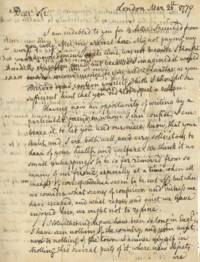
1779rif. List3711London 1779. Autograph letter signed Joseph Green to Boston merchant Samuel Eliot. Folded letter datelined "London Mar. 26th 1779" with "Rec'd 22nd Decr. 1779" docket on top flap. 7 x 9 ¼ inches 3pp. Some repairs with archival tape folded small tears at some folds. Excellent. A thoughtful Revolutionary-era letter written by Joseph Green the Boston clergyman poet satirist and wit whose verses made him one of the best-known literary figures in colonial New England. A graduate of Harvard College and member of Boston's mercantile elite Green maintained friendships with figures including Mather Byles and Benjamin Church. He is known for his satirical poetry and as a signer of the 1773 attestation supporting Phillis Wheatley's authorship of Poems on Various Subjects Religious and Moral. A Loyalist during the American Revolution and named in the 1778 Massachusetts Banishment Act Green departed Boston in 1775 and spent the remainder of his life in England. The present letter was written only a year before his death in London in 1780. Written during the period of British blockade and privateering that turned the Atlantic into a contested military space the letter survives as a rare example of communication successfully passing between a Loyalist exiled in London and a Boston merchant. Green repeatedly returns to the difficulty of maintaining contact noting that "all means of correspondence seem to be cut off" and explaining that he is able to write only because he has found "a particular friend in whom I can confide." The letter itself written in March and not received until December 1779 provides tangible evidence of the obstacles confronting transatlantic correspondence during the Revolution. Green writes: "Having now an opportunity of writing by a particular friend in whom I can confide I embrace it to let you and our niece know that your Aunt and I are both well and very solicitous to hear of your health and welfare. We think it no small unhappiness to be so far removed from so many of our friends especially at a time when all means of correspondence seem to be cut off; but when we consider what scenes of confusion and distress we have escaped and what repose and quiet we have enjoyed here we ought not to repine. "Notwithstanding we have been so long in Engl'd I have seen nothing of the country and your Aunt next to nothing of the town. I amuse myself in trolling thro' several parts of it where new objects are perpetually presenting themselves; and I am the fonder of this exercise as it contributes to health as well as amusement. "The climate here agrees well with my constitution. I enjoy better health than I did at home & my friends tell me I am younger. But I know better than to believe them in this because I think if I was to go about it I could prove I am near four years older than when I left Boston." Green's remarks describe the reality of transatlantic communication during the Revolutionary War when Loyalists abroad and their friends in America frequently depended upon trusted private carriers rather than regular postal channels. The letter's journey from London to Boston-requiring months to arrive and bearing Eliot's receipt docket of December 22 1779-illustrates precisely the obstacles Green describes. Green continues with observations on one of the great public controversies of wartime Britain the celebrated court martial of Admiral Augustus Keppel following his engagement with the French fleet off Brest. Green describes the intense public reaction and the partisan passions surrounding the affair: "We have had a forced and ostentatious display of joy on acct. of Admiral Keppel's acquittal. He has been try'd by a court martial on a charge brought against him by Admiral Palliser for misconduct in the engagement he had the last summer with the French fleet off Brest. This has been made a party affair and has been carry'd to a most extravagant height. The whole city has been illuminated three or four nights and there have been great rejoicings thro' the Kingdom. But the matter is now pretty well over and Palliser has ruin'd himself by it." Most affecting however is Green's reflection on the increasingly remote prospect of ever returning to Boston. He seems to realize that his exile may be permanent writing that "At the time I left Boston it was uncertain when I should return or whether I should return at all. But the improbability was not so great then as it is now. The door was then shut now it is bolted." Green's letter offers a moving account of Loyalist exile-separation from friends and family with hope for return fading. We find no other records of letters written by Green during this period in commerce or at auction.
1989rif. 278792Bern , Francke, 1989. Originalpappbände. Zwei Bände Originalbroschur. 25 cm
1939rif. 42437ABLeipzig, Hirschfeld, 1932; Paris, Alcan, 1933-39; New York, Institute of Social Reseach, 1939-41. Orig.-Broschuren.
1826rif. 1247121826 30 Volumes - A Paris, Ladvocat Libraires - 1826-1828 - Demi basane rouge du temps, 4 nerfs sautés, ornementation à froid mais bandeaux dorés sur les coiffes, titre et auteur sur fond rouge uni. 350 à 400 pages par volume - Très bel ex-libris sur chacun des volumes
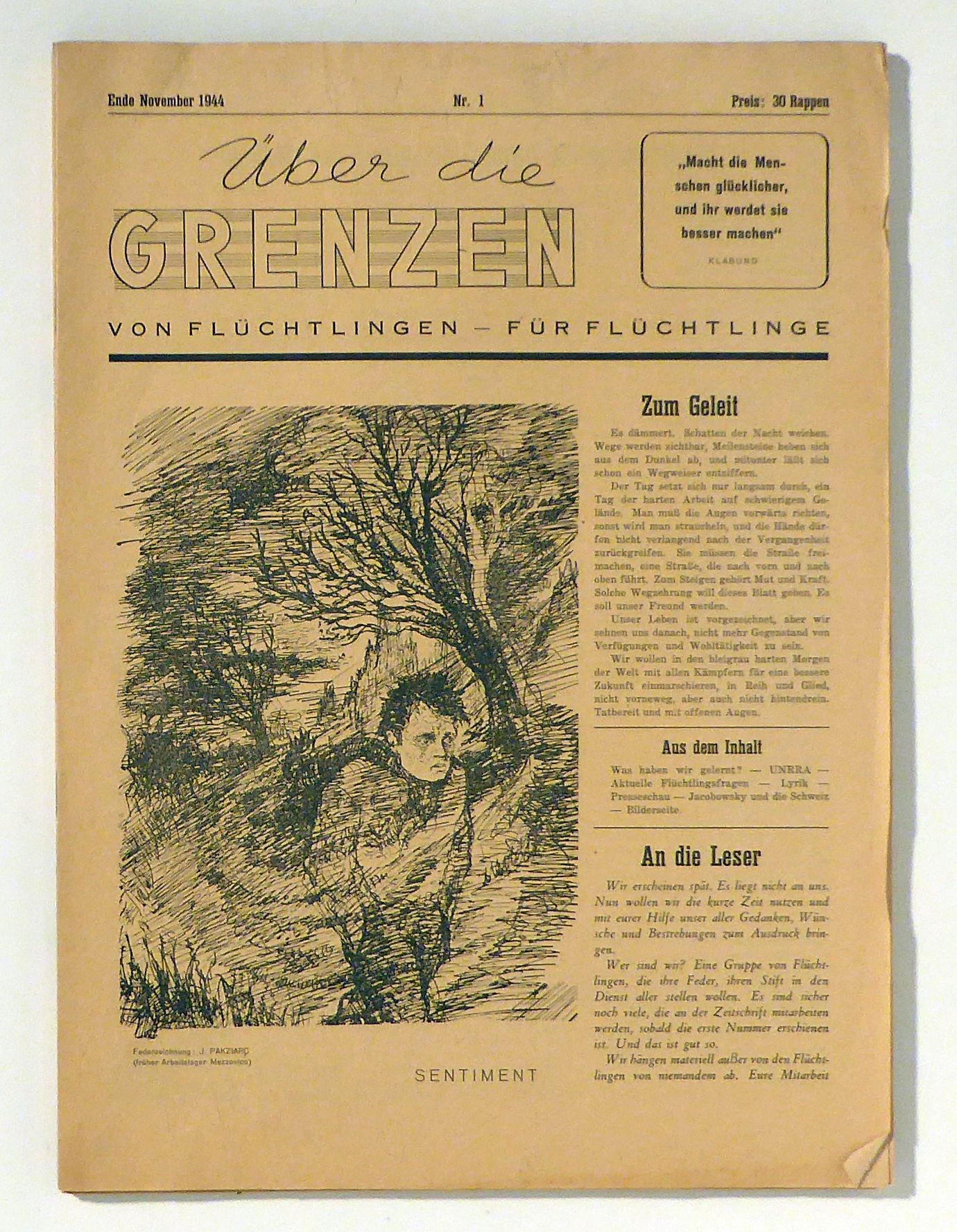
1944rif. 125810(Wallisellen-Zch.); Affoltern, Schul- und Werkstätten-Lager; Aehren-Verlag, 1944-1945. 14 Nummern, je 12 S.; 5 Hefte, mit zahlreichen Abbildungen nach Zeichnungen und Fotografien. Original-Broschur, 4°. Alles was erschienen. Deutsches Exilarchiv I, S. 578. Die in der Schweiz erscheinende Exilzeitschrift "Über die Grenzen" wurde von einer Redaktionskommission von in schweizerischen Lagern lebenden Flüchtlingen und Emigranten unter Aufsicht der "Zentralleitung der Arbeitslager" und genehmigt von der schweizerischen Regierung (Bundesrat) herausgegeben. Neben "Internierten", arbeiteten daran auch zahlreiche Schweizer und nicht in Lagern lebende Flüchtlinge mit.Anschliessend an die in unregelmässigen Abständen erscheinenden Nummern der Zeitschrift erschienen ab 1945 auch noch 5 Hefte einer Schriftenreihe "Über die Grenzen". Heft 1: Gesang auf dem Wege, Gedichte (Anthologie); Heft 2: Wilhelm Frank, Studenten und Universitäten nach dem Kriege; Heft 3: Bruno Kaiser, Der Maler Disteli und die Flüchtlinge; Heft 4: Theater, Meinungen und Erfahrungen; Heft 5: Hans Mayer, Von der Dritten zur Vierten Republik. Geistige Strömungen in Frankreich 1939-1945. - Zu den Mitarbeitern gehörten Jo Mihaly, Hans Mayer, Karl Ackermann, Hermann Adler, Else Lasker-Schüler, Jakob Haringer, Stephan Hermlin, Felix Kohn, Therese Giehse, Lisa Tetzner, Ernst Ginsberg, Wolfgang Heinz, Kurt Horwitz, Kurt Hirschfeld, Leopold Lindtberg, Teo Otto, Karl Paryla, Leonard Steckel, Oskar Wälterlin, Bruno Kaiser, Wilhelm Frank, Hans Erni, Jakob Pakziarc, Rudolf Engel, Otto Bachmann, Max Hunziker, Fritz Wotruba und zahlreiche andere. Gestaltet wurden die Hefte von Werner Saul, der auch zahlreiche, oft ganzseitige Karikaturen und Bildgeschichten zeichnete. Vgl. Mittenzwei, Exil in der Schweiz, S. 325-335. Vollständig äusserst selten. Beigelegt: Lesezeichen, auf der einen Seite mit Werbung für die im Aehren Verlag Affoltern erschienenen Schriftenreihe, auf der anderen mit Pressestimmen für die Monatsschrift. Für die Schriftenreihe waren offenbar weitere Hefte geplant. Auf dem Lesezeichen werden unter "In Vorbereitung" neben dem erschienenen Heft von Hans Mayer über Frankreich und dem Sammelheft "Theater Meinungen und Erfahrungen", hier noch mit dem Titel "Das Theater von Morgen", auch aufgeführt "Werner Saul und Michel Tschesno, 1001 Tag, Zeichnungen" und "Malerei und Plastik. Beiträge von Fritz Wotruba, Ferdinands Springer, Teo Otto, Marino Marini". Softcover Etwas gebräunt und fingerfleckig, vereinzelt eselsohrig und unwesentliche Markierungen. Über die Grenzen. Von Flüchtlingen - für Flüchtlinge
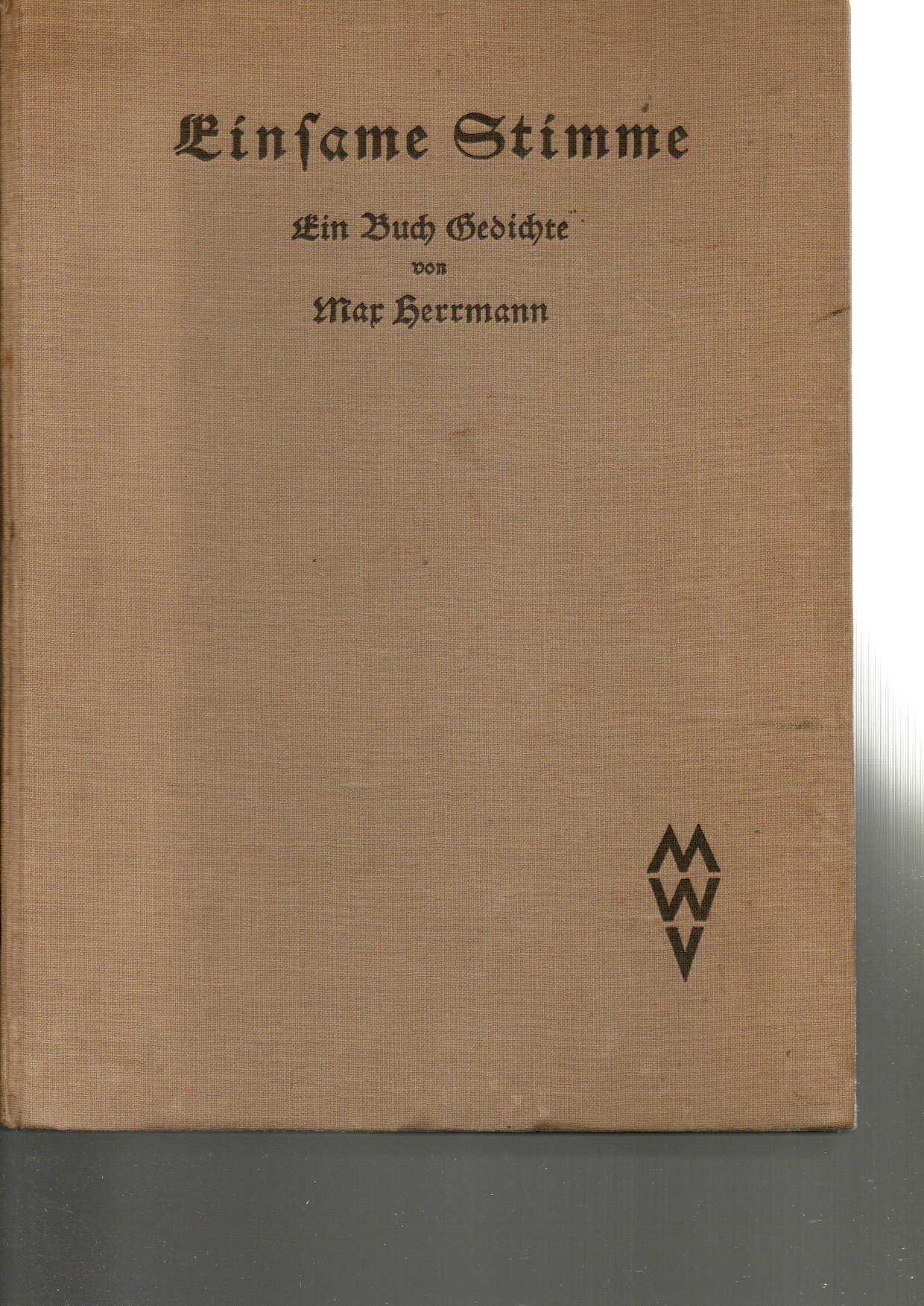
1927rif. 15023Martin Wasservogel Verlag, Berlin, 1927. [4]173(5) Seiten, OLeinen m. Farbkopfschnitt. Widmung auf dem Vorsatzblatt: "Für Alfred Döblin mit freundlichen Grüßen Max Herrmann Berlin, Dezember 27". Limitierte Auflage von 900 nummerierten Exemplaren. Das vorliegende Exemplar ohne Nummer. Der Leineneinband ist leicht verschmutzt. Das Leinen mit kleinen Aufreibungen am Rücken. Gutes Exemplar. In dieser Form ein Unikat. With a dedication by Herrmann to the writer Alfred Döblin. Unicat. Wikipediaauszug über Döblin (1878-1957): "Sein weitaus am stärksten rezipierter Roman ist Berlin Alexanderplatz.... 1933 floh der Jude und Sozialist Döblin aus Deutschland und kehrte nach Ende des Zweiten Weltkrieges zurück, um Deutschland 1953 erneut zu verlassen. Große Teile seines literarischen Schaffens, darunter die Amazonas-Trilogie, die Novembertetralogie und der letzte Roman Hamlet oder Die lange Nacht nimmt ein Ende werden der Exil-Literatur zugeordnet. 1941 konvertierte er zum katholischen Glauben, bereits 1936 hatte Döblin die französische Staatsbürgerschaft angenommen." [2 Warenabbildungen]
1942rif. 005575Buenos Aires Editions de l'Aigle 1942 In-4 Broché, couverture rempliée Edition originale
1793rif. R43126s.l., s.d. [1793] [vi +] 212pp.+ [iii] pp. de tables, reliure cart.d'époque, dos en cuir (titre et fleuron doré), 19cm., bel état, [l'avant-propos par A.J., Ev. Comte de Chaalons, finit par: "Donné à Gémert en Hollande, où la persécution contre l'Eglise de France & son Clergé nous a forcés de nous retirer. Ce 6 Juillet 1793"]
[vi +] 212pp.+ [iii] pp. de tables, reliure cart.d'époque, dos en cuir (titre et fleuron doré), 19cm., bel état, [l'avant-propos par A.J., Ev. Comte de Chaalons, finit par: "Donné à Gémert en Hollande, où la persécution contre l'Eglise de France & son Clergé nous a forcés de nous retirer. Ce 6 Juillet 1793"]
1898rif. 002932Librairie du Victor Hugo illustré, 1898
1995rif. BN496037De Gruyter Saur 1995. 1995. Gesellschaft für Exilforschung / Society for Exile Studies. Nachrichtenbrief / Newsletter: 1984 bis 1993 mit Gesamtregister Gesellschaft für Exilforschung / Society for Exile Studies. Nachrichtenbrief / Newsletter: 1984 bis 1993 mit Gesamtregister Loewy Ernst Studies Gesellschaft für Exilforschung / Society for Exile Barbara Seib u. a. De Gruyter Saur unknown
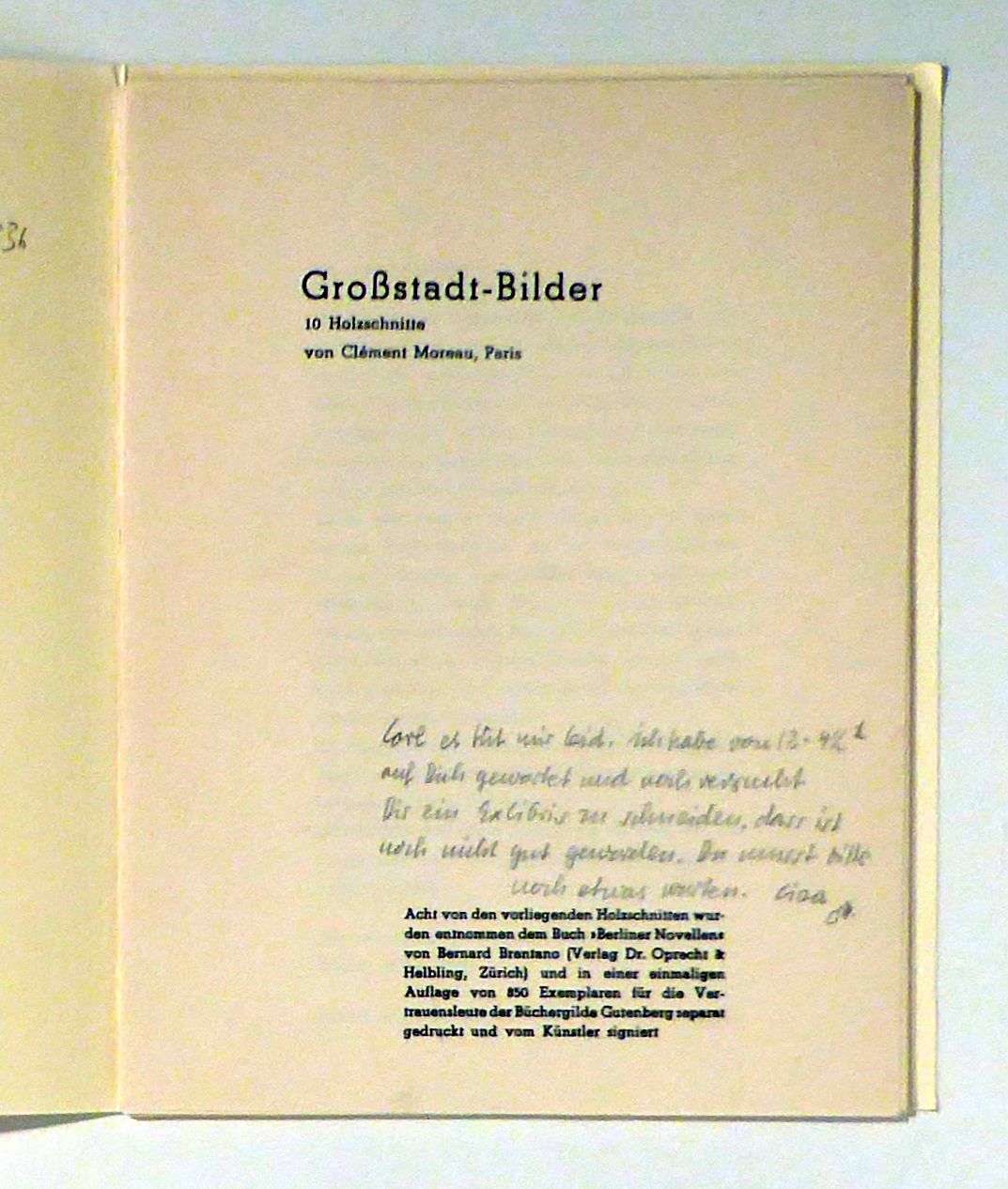
1933rif. 157836Zürich, Wien, Prag, Büchergilde Gutenberg, 1933. 12 Bll., mit 10 Original-Holzschnitten. 12 Blatt, lose in Kartonmappe, 8°. Die Mappe wurde 1933 zum Jahresende in einer limitierten Auflage von 850 Exemplaren gedruckt und an die Vertrauensmänner der Büchergilde abgegeben, zur Honorierung der ausserordentlichen Anstrengungen, die nötig waren um die Büchergilde in die Emigration zu retten. Anders als bei der regulären Ausgabe, wo jeweils nur ein Blatt vollsigniert ist und die übrigen Blätter nur monogrammiert sind, hat Meffert beim vorliegenden Exemplar alle 10 Blätter mit vollem Namen signiert. Auf dem Titelblatt eine mehrzeilige Notiz von Clément Moreau an Carl (Theodor Hubacher). Er habe mehrere Stunden vergeblich auf ihn gewartet und die Zeit benützt, um ein Exlibris zu schneiden. Das sei aber noch nicht gut geworden und er müsse deshalb noch etwas warten. Hubacher ist ein schweizerischer Architekt, der im Tessin lebte und mit Clément Moreau befreundet war. [2 Warenabbildungen] Softcover Schönes Exemplar.
1960rif. 58268NP 1960. 9 x 7 1/8 inches. Black and white photograph a publicity still bears no attribution on the verso. Stravinsky is generally acknowledged as one of the most important and influential composers of the 20th century. Among his works are the ballets The Firebird 1910 and The Rite of Spring 1915 and the opera The Rake's Progress 1951 with libretto by W.H. Auden and Chester Kallman. Very good. #5145. unknown
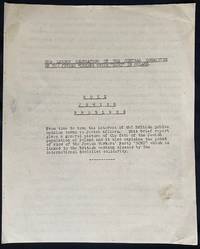
1945rif. 43528No Place London: No Publisher London Delegation of the Bund 1945. No Date 1945 1st Edition. Original Stapled Paper Wrappers Small 4to 17 pages. Mimeograph production. Early 1945 Bundist report aimed at the British public on the impact of six years of Nazi extermination policy on Polish Jewry. "From time to time the interest of the British public opinion turns to Jewish affairs. This brief report gives a general picture of the fate of the Jewish population of Poland and it also explains the point of view of the Jewish Workers' Party 'BUND' which is linked to the British working classes' by the international Socialist solidarity" From the front cover. This early 1945 report to the British public on the destruction of and resistance by Polish Jewry lays out the brutal numbers and facts of ghettoization and then extermination as well as a detailed history of Bund-led Jewish resistance to the Nazis and to deportations to the camps. The mimeograph production and many typographical errors lend a kind of open authenticity to the document that of exiled Jewish trade unionists addressing their British comrades in England. It begins: "The Jewish nation has borne tremendous sacrifices in this war. Several million Jews have been first tortured in a sic inhuman manner and then murdered - several millions that is many times more than the losses suffered by the much more numerous communities of the British Empire and the United States put together. Polish jews sic suffered the greatest losses. There were nearly three and half millions of them living in six hundred Polish cities and towns not counting villages. First they were deported by the Germans to the few ghettos established by them in Poland. Soon afterwards the ghettos were emptied in turn and their 'deported' population was murdered in extermination camps and death chambers." The publication lists the figures for "the ten biggest ghettos of Poland" noting that "In these towns alone the Germans murdered more than one million Jews. Incidentally in all of them with the exception of Cracow Lwow and Czestowchowa 'Bund' was the dominant Jewish party. Out of the nearly three and half millions of Polish Jews there is only a small fraction left today. A small number of survivors have been saved from death by the victorious advance of the Soviet Army. The remainder of the Jews who are still alive under the German Occupation are either in concentration and forced labour comps or in hiding among the Polish population with whom they are fighting in the ranks of the underground movement. Those survivors address to us constant appeals for help and rescue." The solution at this point in the war is that "We must - and our brothers in Poland demand it - we must put such fear into the Germans that they stop the murders of Jews and all the other people whom they still hold in their weakening clutches." The authors are careful at this point to be clear that they do not see Zionism and the immigration of surviving Jews to Palestine as the goal for survivors and post-War Jewish life. They demand immediate assistance and reparations for survivors the criminalization of all antisemitic activity which "should be considered as an attack against the fundamental principles of democracy" and the reconstruction of Jewish life under Socialism in the countries where Jewish refugees now find themselves or in their countries or origin. "Immigration should be free and should not be regulated according to the nationality or religion of the emigrant. Any attempts at presenting the emigration of Jews as a separate problem and considering it as a means of solving the Jewish question always lead to anti-Jewish discrimination." .PALESTINE. does not offer a solution of the Jewish question. Even if one takes into consideration that millions of Jews have been murdered the present Jewish population of Palestine comprises at the most 5% of the number of Jews all over the world. Palestine does not solve the question of anti-semitism either. The majority of Jews will remain dispersed in many countries and in those countries the Jewish question will have to be solved on the spot and anti-semitism extirpated. Palestine is a country of the Jews living there and of the non-Jews who are her inhabitants. We believe that in the same way as we wish to see it in other countries in Palestine also the Jewish minority should build its future on a collaboration with the non-Jewish majority having at the same time a guarantee of a full equality of rights and a complete freedom of its own national and cultural development. We are not a homeless people. The home of the Jews is in the countries in which they live and with which they are linked by many ties. In the same way as for British Jews Britain is their homeland to which they are attached and which they do not want to give up and for American Jews the U.S. A. and French Jews France so for Polish Jews their homeland is Poland. The attitude towards Jews in various countries should be based on the principle that a country is a common homeland for the whole of its population irrespective of origin and religion. The fate of the Jewish population is irrevocably linked to that of the countries it inhabits. It means for the Jews in every country the necessity of fighting for the country's freedom prosperity progress and development as these are a condition of the Jews' own freedom prosperity progress and development. For us as a Labour Party of the Jewish population of Poland it means a fight for the freedom and independence of our country that if sic is of Poland and the building of her future and at the same time the future of Polish Jews on democratic and Socialist principles." The authors then outline the long history of the Bund's underground resistance work against the Nazis" including much on the Warsaw Ghetto Uprising. "In its activities which started on the first day of the occupation the 'Bund' collaborated with the Polish Workers' Underground Movement in the same way as before the war it collaborated with the Polish Socialist Party" including work within the trade union movement and among Jewish youth including 'regularly publishing our clandestine papers eight of them appearing every month.' To achieve this aim fighting detachments of the party were being developed and the whole organisation which from the very first has been proclaiming the idea of an armed struggle against the occupier began to prepare to oppose the 'deportations' to the extermination camps by an armed action. In October 1942 began the last phase of these preparations. The 'Bund' underground movement and the so-called Jewish National Committee an organisation comprising various Zionist groups got together and while preserving their political differences established a Co-ordination Committee and the joint 'Jewish Armed Resistance Organisation' Z.O.B. From that time onwards the armed struggle of the Jewish population in Poland has been led by this resistance organisation. In January 1943 the streets of the Warsaw Ghetto were the scene of the first armed engagement which lasted for several days.Space does not allow us to tell the full story of this rising which in any case had better be written in Poland and not abroad. According to our latest reports from Poland those few remaining survivors of the rising in the Warsaw Ghetto have been writing the story of the events in which they have taken part. After this rising fürther acts of Jewish armed resistance were reported from Poland;" these further acts are then listed and include: "BIALYSTOK In this city the Jews who before the war had been strongly under the influence of the 'Bund' put up a fierce resistance when the Nazis began to liquidate the ghetto in mid- August 1943. The armed rising lasted a month and was conducted with remarkable heroism. TREMBLIN sic This death camp where the Nazis had murdered hundreds of thousands of Jews was completely destroyed at the beginning of August 1943 by the Jews who were there at the time. They attacked the German guards and killed the entire Nazi unit thirty men strong. They seized the ammunition set fire to all the camp buildings and damaged electric cables. Afterwards two hundred Jews escaped to the neighbouring forest. u>SOBIBOR Heroism characterising the Tremblinka revolt marked also the rebellion of Jews at another extermination camp at Sobibor. The Jews revolted there in October 1943 and a large number of them escaped from the camp. General strike in the Lódz ghetto. In February 1943 a general strike broke out in the Lodz ghetto because of German executions. The strike was successful and the executions ceased. MAY DAY 1944 The few survivors of the 500000 Jews of the Warsaw Ghetto who had found refuge among the Polish population the 'Aryan' quarters of Warsaw have not ceased the struggle. Members of the Jewish Workers Movement in Warsaw and in other parts of Poland have even succeeded in organising this year special May Day celebrations. In Warsaw alone five armed Jewish May Day meetings took place." Additional battles between the Jewish-Polish underground and Nazi forces are described as well as underground Jewish resistance newspapers-including one still publishing several thousand copies per issue "distributed in Warsaw and in the provinces" in early 1945. "According to other reports the Jewish survivors of Warsaw organised themselves in fighting detachments. One detachment was named 'Michal Klepfisz' after the hero of the 'Bund' one of the leaders of the rising in the Warsaw ghetto.This detachment distinguished itself particularly during the severe fighting with the Germans for the Old City quarter of Warsaw. General Bor the Commander of the Warsaw uprising gave the detachment special recognition and stated that it alone had killed three hundred Germans and captured a large amount of German arms and ammunition. The other Jewish detachment was fighting under the name of 'Berek Joselewicz' well known historical figure of the Kosciuszko insurrection in Poland in 1794. This detachment took part in the siege and occupation of the main Warsaw post office building. General Bor reported that this Jewish detachment captured more than hundred Germans. 'Even now' it would be difficult to find words which would testify better to the continuity of action and of the struggle waged by the Jewish Workers' Movement irrespective of circumstences sic. After three battles in Warsaw after the slaughter of millions of Jews and the loss of the most valued comrades this movement is still fulfilling its difficult task of fighting th oppression and bringing help to the victims of the Germans." The publication gives a brief introductory history of the Bund appropriate for a British reader which events from the recent past such as: 1936. 'Bund' organised a political strike to protest against anti-Jewish riots which took place in the little town of Przytyk. Hundreds of thousands joined the strike which was supported by many Polish Socialists and by workers organised in Polish Trade Unions. 1938-39. During the municipal elections the majority of the Jewish population in the big cities and in many towns of Poland voted for 'Bund'. In Warsaw out of twenty Jewish municipal councillors 17 belonged to the 'Bund' and only three represented other parties. Finally the authors offer other details about the Bund its strength its publications and its various cultural and political activities concluding with great impact with a description of the "well known Medem Sanatorium for children at Miedzesyn near Warsaw.The sanatorium remained open until 1942 when the Germans 'deported' all the children to extermination camps. The sanatorium's staff were allowed to choose between staying at their posts or accompanying the children. They all chose the latter and together with the children left by a death-train for the notorious Treblinka Camp." OCLC: 504396338. OCLC locates only 1 copy worldwide British Library none in North America or Israel. Light wear and toning very well preserved Very Good Condition. Rare and important. PBERL-1-12-XX. No Place [London]: No Publisher [London Delegation of the Bund] unknown
1937rif. 16408Edition Cosmopolites, Paris, 1937. 111(1) S., illustrierte OBroschur. Mit 7 Originallithographien von Max Beckmann auf Tafeln. Der Einband etwas verschmutzt und lichtrandig. Das Bild zeigt das Titelblatt. Sehr selten. Very rare. With 7 original graphics by Beckmann.
1960rif. 58268NP 1960. 9 x 7 1/8 inches. Black and white photograph a publicity still bears no attribution on the verso. Stravinsky is generally acknowledged as one of the most important and influential composers of the 20th century. Among his works are the ballets The Firebird 1910 and The Rite of Spring 1915 and the opera The Rake's Progress 1951 with libretto by W.H. Auden and Chester Kallman. Very good. #5145. unknown books
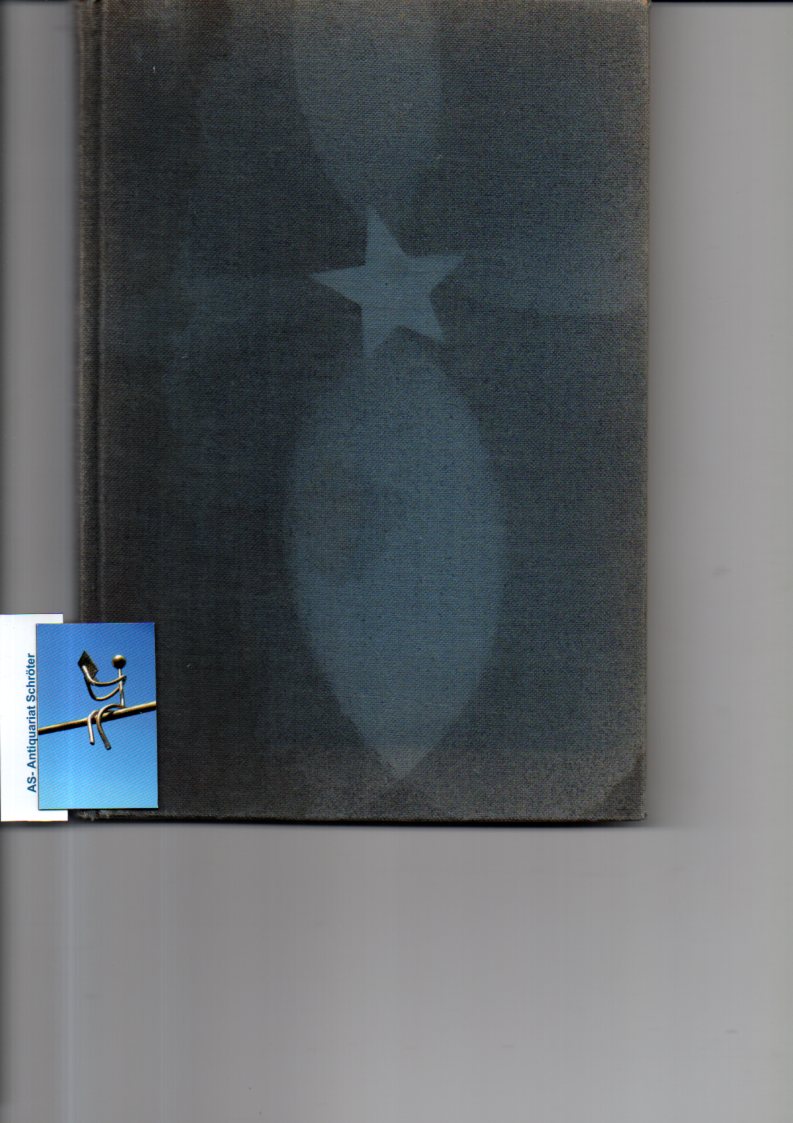
1934rif. 12837Equinox Cooperative Press, New York, 1934. 61(1) Seiten, ca 22x15cm, Obedruckter Leineneinband, im Kolophon nummeriert (454/999) und von Thomas Mann mit Bleistift signiert. Das Rückenschild fehlt, insgesamt etwas angestaubt und leicht lichtrandig. Enthält erstmals in englischer Sprache die Kurzgeschichten: "A Gleam", "Railway Accident" und "A Weary Hour". Neunte Veröffentlichung der Equinox Cooperative Press. Minimaler Einriss am Leinen des Rückens. Ordentliches Exemplar dieser seltenen Exilk-Ausgabe. Good copy. Numbered and limited, Signed by Thomas Mann.
Very Good Turkish, Ottoman (1500-1928) Original autograph letter signed (ALS) by Ottoman princess 'Sükriye Serafeddin'. 17,5x14,5 cm. In Ottoman script (Turkish with Arabic letters). 1 p. [in four]. Bifolium. The letter starts with 'Huve' and it has 12 lines. She mentions a letter that was sent by this unnamed recipient to 'Serafeddin' who is probably from the Ottoman dynasty. Sükriye Sultan was an Ottoman princess, the daughter of the heir to the throne Sehzade Yusuf Izzeddin, son of Sultan Abdulaziz, and Leman Hanim. Sükriye Sultan was born on 24 February 1906 in Çamlica Palace. Her mother was Leman Hanim. She was the second child, and eldest daughter born to her father and the eldest child of her mother. She had two younger siblings, a brother, Sehzade Mehmed Nizameddin, two years younger than her, and a sister, Mihrisah Sultan, ten years younger than her. She was the granddaughter of Abdulaziz and Dürrünev Kadin.
rif. 10945In 12 plein cuir fauve raciné à nerfs, pièces de titre en partie manquante, coiffes restaurées. Page de titre à la date de 1760 sans mentions de lieu ni d’éditeur. VIII, 520 pages. Deuxième édition publiée la même année que l’édition originale in 4. Il y développa le principe de la nouvelle école avec un franc parler, qui lui attira de nombreux suffrages et le fera emprisonné 5 jours au château de Vincennes, puis sera contraint à l’exil deux mois au château de Bignon. Il s’éleva notamment contre les fermiers généraux, il fit une critique sévère du régime fiscal alors en vigueur. Bon exemplaire
1983rif. 16656Munich: Edition Text Kritik 1983-2010. Together 28 octavo volumes. Original printed card wrappers. Condition uniformly fine - free of markings or significant wear. Texts entirely in German. A complete run through 2010 of this important annual publication devoted to German Exile Literature primarily of the Thirties and Forties. Each yearbook is an edited volume of essays on a particular theme as follows: 1- Stalin und die Intellektuellen :: 2- Erinnerungen ans Exil kritische Lektüre der Autobiographien nach 1933 :: 3- Gedanken an Deutschland im Exil :: 4- Das jüdische Exil :: 5- Fluchtpunkte des Exils :: 6- Vertreibung der Wissenschaften :: 7- Publizistik im Exil :: 8- Politische Aspekte des Exils :: 9- Exil und Remigration :: 10- Künste im Exil :: 11- Frauen und Exil. Zwischen Anpassung und Selbstbehauptung :: 12- Aspekte der künstlerischen inneren Emigration :: 13- Kulturtransfer im Exil :: 14- Rückblick und Perspektiven :: 15- Exil und Widerstand :: 16- Exil und Avantgarden :: 17- Sprache - Identität - Kultur :: 18- Exile im 20. Jahrhundert :: 19- Jüdische Emigration zwischen Assimilation und Verfolgung Akkulturation und jüdischer Identität :: 20- Metropolen des Exils :: 21- Film und Fotografie :: 22- Bucher Verlage Medien :: 23- Autobiografie und Wissenschaftliche Biografik :: 24- Kindheit und Jugend im Exil - Ein Generationenthema :: 25- Ubersetzung als transkultureller Prozess :: 26- Kulturelle Räume und asthetische Universalität :: 27- Exil Entwürzelung Hybridität :: 28- Gedachtnis des Exils Formen der Erinnerung. Edition Text + Kritik unknown books
Original boards. 8vo, 1300 pages. SUBJECTS: Very Good Condition. (Neusner-4-3)
1807rif. PHO-2075Paris, L. A. Pitou, Octobre 1807. 2 vol. in-8° (204x127mm), de 312 pp. ; 404 pp. 2 gr. dépliantes en front. Basane fauve à motifs curieusement noircis laissant apparaitre le fauve par endroits, dos lisse orné, pièce de titre et de tomaison en maroquin havane, filet doré sur les coupes, tranches citron (Reliure du temps). Coins usés, légères épidermures, frottements aux charnières. De la bibliothèque de Michel Marie de POMEREU, Château du Héron, avec son ex-libris gravé. L'auteur dénonce, entre autres, les atroces conditions de détention des déportés. Usure aux coins, bon exemplaire.
1805rif. PHO-2400Paris, Chez l’auteur et chez tous les Marchands de Nouveautés, an XIII (1805). 2 vol. in-8 (19,6 × 11,8 cm) demi-basane brune à coins de parchemin vert, dos lisses ornés de motifs dorés (reliure de l’époque). Reliures légèrement frottées, légères rousseurs, petit travail de ver sans atteinte (tome 2)
xvi, 319 pages. Black and white photographic plates. Maps. First reprint of the 1949 first edition. "In the great WWII Italian campaign against the German Army, the Poles played a part which gained them the admiration of their comrades and the respect of their enemies. They fought many a victorious battle alongside their Allies, but their greatest was at Monte Cassino. When the Polish standard floated proudly from the ruins of the monastery, it signalled the march to Rome." - Foreword. Hinges starting. Former military library copy with relatively few related markings to endpapers only. Somewhat above-average wear to publisher's red cloth-covered boards. A worthy copy of this proud history. ENSER p.341. Book