3518 risultati
1984rif. 16650New Haven: Yale University Press 1984. First Edition. Octavo. Cloth boards; dustjacket; 351pp. Spine and margins of jacket sunned else a tight VG to NF copy. Yale University Press unknown books
2002rif. 16643Wiesbaden: Harrassowitz 2002. First Edition. Octavo. Printed card wrappers; 344pp; illus. Mild external wear; text clean tight and unmarked; VG or better. Harrassowitz unknown books
1975rif. 16657Worms: Georg Heintz 1975. First Edition. Octavo. Printed card wrappers; 145pp. Slight tanning to text paper else Very Good - a clean tight copy. Georg Heintz unknown books
1986rif. 16646Los Angeles: University of Southern California Library 1986. First Edition. Small quarto. Pictorial card wrappers; 107pp; illus. Errata slip laid in. Clean and unmarked; Near Fine. Catalog for an exhibition at the USC Libraries in 1986. University of Southern California Library unknown books
1982rif. 16649Chapel Hill: University of North Carolina Press 1982. First Edition. Octavo. Cloth boards; dustjacket; 448pp. Includes bibliography. Very Good copy in slightly rubbed and worn dustwrapper. Text clean tight and unmarked. University of North Carolina Press unknown books
2005rif. 16654Munich: Allitera verlag 2005. Octavo. Pictorial card wrappers; 283pp; illus. Fine. Allitera verlag unknown books
1978rif. 16661Berlin: Henschelverlag 1978. First Edition. Octavo. Printed card wrappers; 334pp; 8 inserted leaves of plates halftones. Mild external dusting and wear; internally clean tight and unmarked; VG or better. Henschelverlag unknown books
1983rif. 16656Munich: Edition Text Kritik 1983-2010. Together 28 octavo volumes. Original printed card wrappers. Condition uniformly fine - free of markings or significant wear. Texts entirely in German. A complete run through 2010 of this important annual publication devoted to German Exile Literature primarily of the Thirties and Forties. Each yearbook is an edited volume of essays on a particular theme as follows: 1- Stalin und die Intellektuellen :: 2- Erinnerungen ans Exil kritische Lektüre der Autobiographien nach 1933 :: 3- Gedanken an Deutschland im Exil :: 4- Das jüdische Exil :: 5- Fluchtpunkte des Exils :: 6- Vertreibung der Wissenschaften :: 7- Publizistik im Exil :: 8- Politische Aspekte des Exils :: 9- Exil und Remigration :: 10- Künste im Exil :: 11- Frauen und Exil. Zwischen Anpassung und Selbstbehauptung :: 12- Aspekte der künstlerischen inneren Emigration :: 13- Kulturtransfer im Exil :: 14- Rückblick und Perspektiven :: 15- Exil und Widerstand :: 16- Exil und Avantgarden :: 17- Sprache - Identität - Kultur :: 18- Exile im 20. Jahrhundert :: 19- Jüdische Emigration zwischen Assimilation und Verfolgung Akkulturation und jüdischer Identität :: 20- Metropolen des Exils :: 21- Film und Fotografie :: 22- Bucher Verlage Medien :: 23- Autobiografie und Wissenschaftliche Biografik :: 24- Kindheit und Jugend im Exil - Ein Generationenthema :: 25- Ubersetzung als transkultureller Prozess :: 26- Kulturelle Räume und asthetische Universalität :: 27- Exil Entwürzelung Hybridität :: 28- Gedachtnis des Exils Formen der Erinnerung. Edition Text + Kritik unknown books
1973rif. 16556Stuttgart: Philipp Reclam 1973. Octavo. Printed card wrappers; 624pp. Biographical appendix. Bump to rear corner; mild creasing to covers; Very Good. Philipp Reclam unknown books
1989rif. 16569Detroit: Wayne State University Press 1989. First Edition. Octavo. Cloth boards; dustjacket; 347pp; illus; includes bibliography. Fine unmarked copy in lightly rubbed and dusted jacket; Near Fine. Wayne State University Press unknown books
1969rif. 16561Frankfurt am Main: Europaische Verlagsanstalt 1969. First Edition. Octavo. Cloth boards; dustjacket; 408pp. Neat ownership signature else a tight Near Fine copy in lightly chipped and soiled dustwrapper. Text entirely in German. Europaische Verlagsanstalt unknown books
1972rif. 16565New York: Overlook Press 1972. First Edition. Octavo. Cloth boards; dustjacket; 416pp. Mild wear and aging still Very Good or better free of markings in lightly rubbed dustwrapper. Overlook Press unknown books
1971rif. 16564Dusseldorf: Bertelsmann 1971. First Edition. Octavo. Printed card wrappers; 378pp; includes bibliography. Moderate external soil and wear; internally clean tight and free of markings. Text entirely in German. Bertelsmann unknown books
1893rif. 113577New York: Cassell Publishing Company 1893. Tall octavo pp. 1-4 1 2-134 134-140: blank note: last three leaves are blanks; second and third used as rear free endpaper and rear paste-down original decorated tan cloth front and spine panels stamped in brown all edges untrimmed. First U.S. edition. Romantic adventure novel set during the Napoleonic wars in Spain; involves press gangs and smugglers among other things. The author also wrote children's and historical fiction as well as stories with Indian settings. Number 21 in the "Unknown Library." No copy of a UK edition is recorded by COPAC. OCLC records two copies of this Cassell edition. Copies of these "Unknown" and "Pseudonym" Library titles are getting harder to find. Not in Wolff. Cloth just a bit dusty a near fine copy. Very scarce. #113577 Cassell Publishing Company unknown books
1960rif. 58268NP 1960. 9 x 7 1/8 inches. Black and white photograph a publicity still bears no attribution on the verso. Stravinsky is generally acknowledged as one of the most important and influential composers of the 20th century. Among his works are the ballets The Firebird 1910 and The Rite of Spring 1915 and the opera The Rake's Progress 1951 with libretto by W.H. Auden and Chester Kallman. Very good. #5145. unknown books
1979rif. 114207Miami: Ediciones Universal 1979. Paperback. 100p. text in Spanish inscribed in Spanish and signed by contributor Elio Alba Buffill very good first edition trade paperback in green wraps with small closed tear at head of front gutter. Colección Sociedad Cubana de Filosofía Exilio. Tribute to the Catholic priest from Havana Cuba who spoke for abolition of slavery was sentenced to death by King Ferdinand VI and fled to New York City where he spent the remainder of his life. Ediciones Universal paperback books
rif. 48418London: The CNT 196-. 1p. flyer printed one side only 8x11.5 inches lightly worn creased from being folded in half else very good condition. The Appeal asked for support the families of workers arrested during the upsurge within Spain that centered around the creation of free trade unions. The CNT unknown books
1844rif. 36132Baltimore: Printed by John D. Toy 1844. 1st printing American Imprints 44-6139. INSCRIBED by the author to one 'Robert F. Dunlap' at the top of the front wrapper. Original printed buff paper wrappers sewn. Some wear & soiling to wrappers. A VG copy. 48 pp. 8vo. 8-3/4" x 5-1/4" Printed by John D. Toy unknown books
1983rif. 16656Munich: Edition Text Kritik 1983-2010. Together 28 octavo volumes. Original printed card wrappers. Condition uniformly fine - free of markings or significant wear. Texts entirely in German. A complete run through 2010 of this important annual publication devoted to German Exile Literature primarily of the Thirties and Forties. Each yearbook is an edited volume of essays on a particular theme as follows: 1- Stalin und die Intellektuellen :: 2- Erinnerungen ans Exil kritische Lektüre der Autobiographien nach 1933 :: 3- Gedanken an Deutschland im Exil :: 4- Das jüdische Exil :: 5- Fluchtpunkte des Exils :: 6- Vertreibung der Wissenschaften :: 7- Publizistik im Exil :: 8- Politische Aspekte des Exils :: 9- Exil und Remigration :: 10- Künste im Exil :: 11- Frauen und Exil. Zwischen Anpassung und Selbstbehauptung :: 12- Aspekte der künstlerischen inneren Emigration :: 13- Kulturtransfer im Exil :: 14- Rückblick und Perspektiven :: 15- Exil und Widerstand :: 16- Exil und Avantgarden :: 17- Sprache - Identität - Kultur :: 18- Exile im 20. Jahrhundert :: 19- Jüdische Emigration zwischen Assimilation und Verfolgung Akkulturation und jüdischer Identität :: 20- Metropolen des Exils :: 21- Film und Fotografie :: 22- Bucher Verlage Medien :: 23- Autobiografie und Wissenschaftliche Biografik :: 24- Kindheit und Jugend im Exil - Ein Generationenthema :: 25- Ubersetzung als transkultureller Prozess :: 26- Kulturelle Räume und asthetische Universalität :: 27- Exil Entwürzelung Hybridität :: 28- Gedachtnis des Exils Formen der Erinnerung. Edition Text + Kritik unknown
1978rif. 18731París: Edit 71 1978.- 337 p.; 4º menor.- Impreso directamente de la redacción mecanográfica máquina de escribir. SOCIOLOGÃA Y POLÃTICA ESPAÑOLA EN GENERAL GIBRALTAR Libro en español Edit 71 paperback
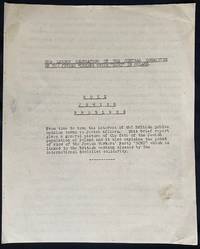
1945rif. 43528No Place London: No Publisher London Delegation of the Bund 1945. No Date 1945 1st Edition. Original Stapled Paper Wrappers Small 4to 17 pages. Mimeograph production. Early 1945 Bundist report aimed at the British public on the impact of six years of Nazi extermination policy on Polish Jewry. "From time to time the interest of the British public opinion turns to Jewish affairs. This brief report gives a general picture of the fate of the Jewish population of Poland and it also explains the point of view of the Jewish Workers' Party 'BUND' which is linked to the British working classes' by the international Socialist solidarity" From the front cover. This early 1945 report to the British public on the destruction of and resistance by Polish Jewry lays out the brutal numbers and facts of ghettoization and then extermination as well as a detailed history of Bund-led Jewish resistance to the Nazis and to deportations to the camps. The mimeograph production and many typographical errors lend a kind of open authenticity to the document that of exiled Jewish trade unionists addressing their British comrades in England. It begins: "The Jewish nation has borne tremendous sacrifices in this war. Several million Jews have been first tortured in a sic inhuman manner and then murdered - several millions that is many times more than the losses suffered by the much more numerous communities of the British Empire and the United States put together. Polish jews sic suffered the greatest losses. There were nearly three and half millions of them living in six hundred Polish cities and towns not counting villages. First they were deported by the Germans to the few ghettos established by them in Poland. Soon afterwards the ghettos were emptied in turn and their 'deported' population was murdered in extermination camps and death chambers." The publication lists the figures for "the ten biggest ghettos of Poland" noting that "In these towns alone the Germans murdered more than one million Jews. Incidentally in all of them with the exception of Cracow Lwow and Czestowchowa 'Bund' was the dominant Jewish party. Out of the nearly three and half millions of Polish Jews there is only a small fraction left today. A small number of survivors have been saved from death by the victorious advance of the Soviet Army. The remainder of the Jews who are still alive under the German Occupation are either in concentration and forced labour comps or in hiding among the Polish population with whom they are fighting in the ranks of the underground movement. Those survivors address to us constant appeals for help and rescue." The solution at this point in the war is that "We must - and our brothers in Poland demand it - we must put such fear into the Germans that they stop the murders of Jews and all the other people whom they still hold in their weakening clutches." The authors are careful at this point to be clear that they do not see Zionism and the immigration of surviving Jews to Palestine as the goal for survivors and post-War Jewish life. They demand immediate assistance and reparations for survivors the criminalization of all antisemitic activity which "should be considered as an attack against the fundamental principles of democracy" and the reconstruction of Jewish life under Socialism in the countries where Jewish refugees now find themselves or in their countries or origin. "Immigration should be free and should not be regulated according to the nationality or religion of the emigrant. Any attempts at presenting the emigration of Jews as a separate problem and considering it as a means of solving the Jewish question always lead to anti-Jewish discrimination." .PALESTINE. does not offer a solution of the Jewish question. Even if one takes into consideration that millions of Jews have been murdered the present Jewish population of Palestine comprises at the most 5% of the number of Jews all over the world. Palestine does not solve the question of anti-semitism either. The majority of Jews will remain dispersed in many countries and in those countries the Jewish question will have to be solved on the spot and anti-semitism extirpated. Palestine is a country of the Jews living there and of the non-Jews who are her inhabitants. We believe that in the same way as we wish to see it in other countries in Palestine also the Jewish minority should build its future on a collaboration with the non-Jewish majority having at the same time a guarantee of a full equality of rights and a complete freedom of its own national and cultural development. We are not a homeless people. The home of the Jews is in the countries in which they live and with which they are linked by many ties. In the same way as for British Jews Britain is their homeland to which they are attached and which they do not want to give up and for American Jews the U.S. A. and French Jews France so for Polish Jews their homeland is Poland. The attitude towards Jews in various countries should be based on the principle that a country is a common homeland for the whole of its population irrespective of origin and religion. The fate of the Jewish population is irrevocably linked to that of the countries it inhabits. It means for the Jews in every country the necessity of fighting for the country's freedom prosperity progress and development as these are a condition of the Jews' own freedom prosperity progress and development. For us as a Labour Party of the Jewish population of Poland it means a fight for the freedom and independence of our country that if sic is of Poland and the building of her future and at the same time the future of Polish Jews on democratic and Socialist principles." The authors then outline the long history of the Bund's underground resistance work against the Nazis" including much on the Warsaw Ghetto Uprising. "In its activities which started on the first day of the occupation the 'Bund' collaborated with the Polish Workers' Underground Movement in the same way as before the war it collaborated with the Polish Socialist Party" including work within the trade union movement and among Jewish youth including 'regularly publishing our clandestine papers eight of them appearing every month.' To achieve this aim fighting detachments of the party were being developed and the whole organisation which from the very first has been proclaiming the idea of an armed struggle against the occupier began to prepare to oppose the 'deportations' to the extermination camps by an armed action. In October 1942 began the last phase of these preparations. The 'Bund' underground movement and the so-called Jewish National Committee an organisation comprising various Zionist groups got together and while preserving their political differences established a Co-ordination Committee and the joint 'Jewish Armed Resistance Organisation' Z.O.B. From that time onwards the armed struggle of the Jewish population in Poland has been led by this resistance organisation. In January 1943 the streets of the Warsaw Ghetto were the scene of the first armed engagement which lasted for several days.Space does not allow us to tell the full story of this rising which in any case had better be written in Poland and not abroad. According to our latest reports from Poland those few remaining survivors of the rising in the Warsaw Ghetto have been writing the story of the events in which they have taken part. After this rising fürther acts of Jewish armed resistance were reported from Poland;" these further acts are then listed and include: "BIALYSTOK In this city the Jews who before the war had been strongly under the influence of the 'Bund' put up a fierce resistance when the Nazis began to liquidate the ghetto in mid- August 1943. The armed rising lasted a month and was conducted with remarkable heroism. TREMBLIN sic This death camp where the Nazis had murdered hundreds of thousands of Jews was completely destroyed at the beginning of August 1943 by the Jews who were there at the time. They attacked the German guards and killed the entire Nazi unit thirty men strong. They seized the ammunition set fire to all the camp buildings and damaged electric cables. Afterwards two hundred Jews escaped to the neighbouring forest. u>SOBIBOR Heroism characterising the Tremblinka revolt marked also the rebellion of Jews at another extermination camp at Sobibor. The Jews revolted there in October 1943 and a large number of them escaped from the camp. General strike in the Lódz ghetto. In February 1943 a general strike broke out in the Lodz ghetto because of German executions. The strike was successful and the executions ceased. MAY DAY 1944 The few survivors of the 500000 Jews of the Warsaw Ghetto who had found refuge among the Polish population the 'Aryan' quarters of Warsaw have not ceased the struggle. Members of the Jewish Workers Movement in Warsaw and in other parts of Poland have even succeeded in organising this year special May Day celebrations. In Warsaw alone five armed Jewish May Day meetings took place." Additional battles between the Jewish-Polish underground and Nazi forces are described as well as underground Jewish resistance newspapers-including one still publishing several thousand copies per issue "distributed in Warsaw and in the provinces" in early 1945. "According to other reports the Jewish survivors of Warsaw organised themselves in fighting detachments. One detachment was named 'Michal Klepfisz' after the hero of the 'Bund' one of the leaders of the rising in the Warsaw ghetto.This detachment distinguished itself particularly during the severe fighting with the Germans for the Old City quarter of Warsaw. General Bor the Commander of the Warsaw uprising gave the detachment special recognition and stated that it alone had killed three hundred Germans and captured a large amount of German arms and ammunition. The other Jewish detachment was fighting under the name of 'Berek Joselewicz' well known historical figure of the Kosciuszko insurrection in Poland in 1794. This detachment took part in the siege and occupation of the main Warsaw post office building. General Bor reported that this Jewish detachment captured more than hundred Germans. 'Even now' it would be difficult to find words which would testify better to the continuity of action and of the struggle waged by the Jewish Workers' Movement irrespective of circumstences sic. After three battles in Warsaw after the slaughter of millions of Jews and the loss of the most valued comrades this movement is still fulfilling its difficult task of fighting th oppression and bringing help to the victims of the Germans." The publication gives a brief introductory history of the Bund appropriate for a British reader which events from the recent past such as: 1936. 'Bund' organised a political strike to protest against anti-Jewish riots which took place in the little town of Przytyk. Hundreds of thousands joined the strike which was supported by many Polish Socialists and by workers organised in Polish Trade Unions. 1938-39. During the municipal elections the majority of the Jewish population in the big cities and in many towns of Poland voted for 'Bund'. In Warsaw out of twenty Jewish municipal councillors 17 belonged to the 'Bund' and only three represented other parties. Finally the authors offer other details about the Bund its strength its publications and its various cultural and political activities concluding with great impact with a description of the "well known Medem Sanatorium for children at Miedzesyn near Warsaw.The sanatorium remained open until 1942 when the Germans 'deported' all the children to extermination camps. The sanatorium's staff were allowed to choose between staying at their posts or accompanying the children. They all chose the latter and together with the children left by a death-train for the notorious Treblinka Camp." OCLC: 504396338. OCLC locates only 1 copy worldwide British Library none in North America or Israel. Light wear and toning very well preserved Very Good Condition. Rare and important. PBERL-1-12-XX. No Place [London]: No Publisher [London Delegation of the Bund] unknown
1917rif. 64488Melbourne: Critchley Parker 1917. 1st edition. Very Good. small octavo. chipped wrappers 141pp. Ôpublished in aid of the work of the Overseas Committee of the British Institute of Journalists in seeking help throughout the world for the exiled Journalists of Belgium their wives and children.Õ Some chipping to wrappers & toning to paper o/w a very good complete & tight copy of a very scarce item Critchley Parker unknown
1991rif. BN253453Kiel : Neuer Malik-Verl. 1991. 1991. Hitlerflüchtlinge im Norden : Asyl und politisches Exil 1933 - 1945. hrsg. v. Hans Uwe Petersen Gesellschaft für Politik und Bildung Schleswig-Holstein Beirat für Geschichte der Arbeiterbewegung und Demokratie in Schleswig-Holstein: Veröffentlichungen des Beirats für Geschichte der Arbeiterbewegung und Demokratie in Schleswig-Holstein ; Bd. 7 Hitlerflüchtlinge im Norden : Asyl und politisches Exil 1933 - 1945. hrsg. v. Hans Uwe Petersen Gesellschaft für Politik und Bildung Schleswig-Holstein Beirat für Geschichte der Arbeiterbewegung und Demokratie in Schleswig-Holstein: Veröffentlichungen des Beirats für Geschichte der Arbeiterbewegung und Demokratie in Schleswig-Holstein ; Bd. 7 Schleswig-Holstein Asyl 3. Reich Exil - Petersen Hans Uwe Hrsg. Kiel : Neuer Malik-Verl. unknown
rif. BN374511Bundesamt für Flüchtlinge Medien und Kommunikation; BBL Verkauf Bundespubl. Prominente Flüchtlinge im Schweizer Exil Board book Prominente Flüchtlinge im Schweizer Exil Board book Prominente Flüchtlinge im Schweizer Exil Board book Bundesamt für Flüchtlinge, Medien und Kommunikation; BBL, Verkauf Bundespubl. unknown
1995rif. BN496037De Gruyter Saur 1995. 1995. Gesellschaft für Exilforschung / Society for Exile Studies. Nachrichtenbrief / Newsletter: 1984 bis 1993 mit Gesamtregister Gesellschaft für Exilforschung / Society for Exile Studies. Nachrichtenbrief / Newsletter: 1984 bis 1993 mit Gesamtregister Loewy Ernst Studies Gesellschaft für Exilforschung / Society for Exile Barbara Seib u. a. De Gruyter Saur unknown