JAHNN, Hans HennyAntiquariat.de
3.536 resultados
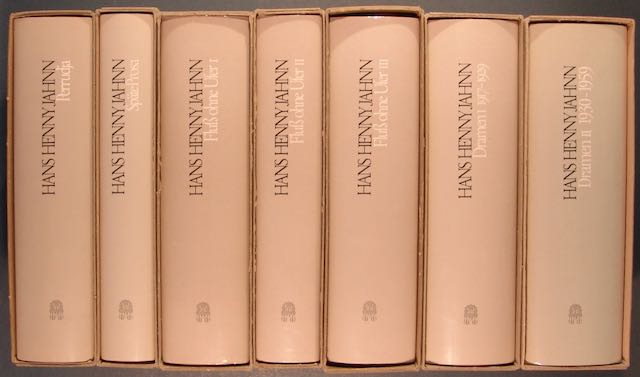
1994ref. 82748Hbg.: Hoffmann u. Campe 1985-1994. Zus. 13.736 Ss., 38 Bll. 8°. Graues Ln. mit schwarzem Rückentitel u. Umschl. in Schuber. [4 Warenabbildungen]
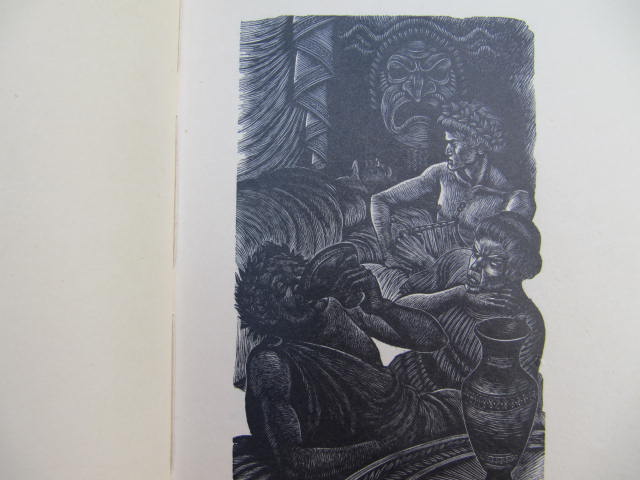
1987ref. 8490The Bear Press, Bayreuth, 1987. 64(3) S., O-Halb-Leder mit blindgeprägtem Vorderdeckel im OPapp-Schuber. Farb-Kopfschnitt, Fadenheftung. Druck in der Weiß-Kursiv auf Gekko Hodomura-Japan durch die Offizin Poeschel. Handschriftlich nummeriertes Exemplar: 90 / 150. Übertragung und Nachwort von Wolfram Benda. Spindler 73,9. Neuwertiges Exemplar. 9. Druck der Bear Press Wolfram Benda. Das Foto zeigt eine Graphik. Limited edition with three unknown graphics by Eichenberg (1901-1990).
1949ref. 1500Amsterdam, Bermann-Fischer 1949. OPp. 82 S. 8°. Mit mehrzeiliger Widmung der Verfasserin auf dem Vorsatz für ?Herrn M. Dormann mit allen guten Wünschen Nelly Sachs Stockholm d. 20.3.50. Bergsundstrand 23?. Rücken etwas gebräunt und an den Kanten berieben. Gut erhaltenes Exemplar.
1942ref. 6067ALondon, Penguin, 1942. 4°. 6 Textbl. u. 42 teils farbige Tafeln auf Albumblätter montiert. Mit 1 Originalzeichnung Szobels. Leinenband der Zeit.
1922Very Good Armenian Original fine red cloth bdg. with decorative gilt on board. Spine is repaired masterfully. Large roy. 8vo. (25 x 18 cm). In Armenian. [24], 429 p., 1 folded Armenian map of Turkey (map size: 24x33 cm), 29 unnumbered full-page b/w plates (one is folded). Armenian Golgotha is a memoir written by Grigoris Balakian about his eyewitness account of the Armenian Events. The memoir was released in two volumes. Volume 1, about his life prior to and during the Armenian Deportation, was released in 1922. Volume 2, about his life as a fugitive after the Deportation, was released in 1959. Originally published in Armenian, the memoir was later published in various languages including an English translation by Peter Balakian, Balakian's great-nephew, with Aris Sevag. Grigoris Balakian [or, Palakean, Palakian, Balakean], was a bishop of the Armenian Apostolic Church, in addition to being a survivor and memoirist of the Armenian Events in the Ottoman Empire. Grigoris Balakian was born in Tokat in the Ottoman Empire and graduated from the Sanasarian College in Erzurum. He had been studying architecture in Germany for two years and got a degree in civil engineering. He became a celibate priest ordained under the monastic name Grigoris Balakian. On 24 April 1915, he was among the group of 250 leading Armenian figures of Constantinople who were arrested and deported. One group was deported to Ayas. Balakian was deported to Çankiri, north-east of Ankara with the rest of the 190 other deportees from the capital. Only 16 of them would survive. He marched with 48 deportees from Çankiri in the direction of Deir Al-Zor in the Syrian desert. On the way, Balakian won the confidence of captain of constabulary Shukri Bey and learned about the Ottoman government's plan to exterminate the whole Armenian population. Balakian was able to flee toward Islahie. He joined a group of workers on the Bagdad-railway where Turkish deserters did forced labor alongside Armenian refugees. While Armenian workers between Marash and Bartche were being slain, Balakian fled to another construction site on the Bagdad railway. He was helped by German engineers and finally succeeded - disguised as Herr Bernstein - in escaping from Constantinople to Paris. At the 1921 trial in Berlin against Soghomon Tehlirian, the murderer of Talât Pasha, Balakian appeared as a witness for the defendant together with Johannes Lepsius. Soghomon Tehlirian was ultimately acquitted. Balakian became prelate of Manchester, London, and finally bishop of Marseille. Two churches were built under his guidance in Marseille and Nice (St. Mary, 1928) as well as a number of chapels and schools. He died in Marseille. Balakian is the granduncle of Anna Balakian, an expert on symbolism and surrealism who chaired New York University's Department of Comparative Literature, and the great-granduncle of Peter Balakian, an Armenian-American writer and winner of the 2016 Pulitzer Prize for Poetry. Balakian's memoirs in Armenian Golgotha are an important eyewitness account of the Armenian Events. He describes his experiences during the deportation. Balakian was one of the few surviving leaders of the Armenian community who gave an account of the deportation. Komitas (Gomitas) Vartapet belonged to the same group of detainees as Balakian. His information about the traumatization of the famous composer and founder of modern Armenian classical music is of eminent importance. OCLC: 1137218025. First Armenian Edition. Rare.
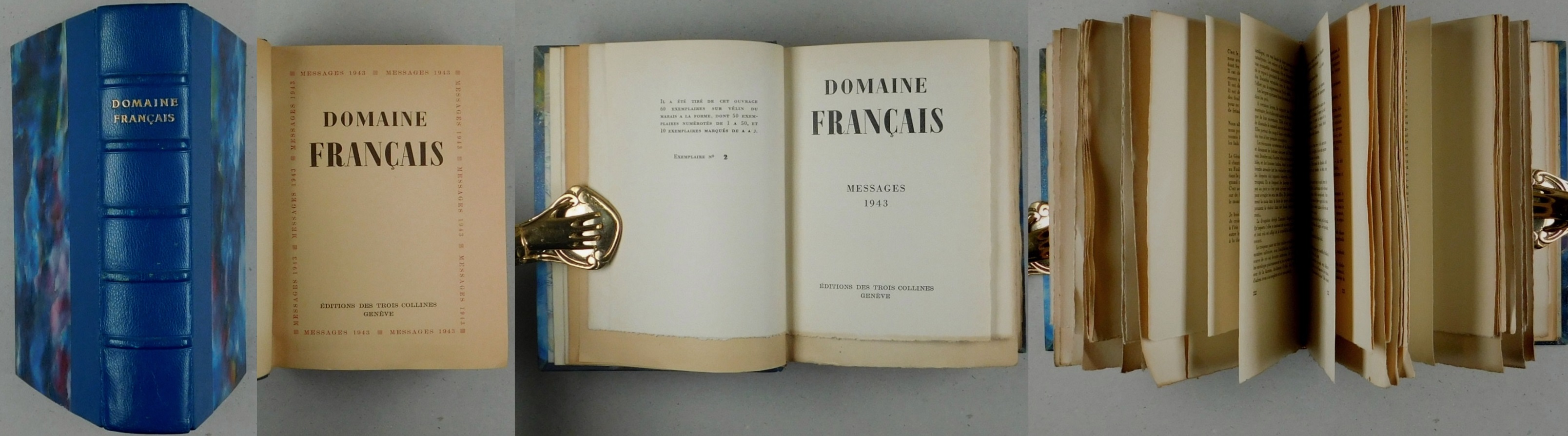
1943ref. 55113BBGenève, Éditions des Trois Collines, 1943. 8°. 445 p., 2 p. n.ch. Reliure demi maroquin bleu à 5 nerfs, titre doré, couverture conservée.
1943ref. 55113BBGenève, Éditions des Trois Collines, 1943. 8°. 445 p., 2 p. n.ch. Reliure demi maroquin bleu à 5 nerfs, titre doré, couverture conservée.
1937ref. 206596CBPrag/Zürich/Paris, 1937. 8°. 1.688 S. Hellrote Original-Broschur. Hefte 1 - 53 (cplt.). (Jedes Heft mit einer Papierspur vorn, insgesamt sehr guter Zustand).
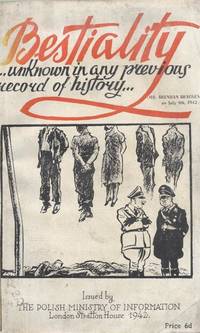
1942ref. 39727London: Stratton House 1942. with no dust jacket. First edition. Original illustrated wraps. 12mo. 56 pages. 19 cm. 'A Record of the German Barbarities in Poland in the First Six Months of 1942.' With two page map of concentration camps in Germany. Extremely detailed early report concerning Nazi atrocities executions concentration camps the extermination of the Lublin ghetto etc. Contents include: Introduction; Documents from Poland; General Sikorski's protest speech; Resolution of the Polish National Council; Press conference at the Ministry of Information; and Justice will be done: official statements and declarations. Included in in the "Documents from Poland" section is a piece on the "Destruction of the Jewish Population." "As early as 1940 the Government Delegate alerted London about the persecution of Jews in Poland. Thereupon the Polish government-in-exile sent a note on this subject to allied governments May 3 1941. Also in 1941 the Polish Ministry of Information in London published a booklet on the persecution of Jews in Poland entitled 'Bestiality Unknown in Any Previous Record of History' and based on information received from occupied Poland. In January 1942 the Ministry issued another publication 'The New German Order in Poland. ' Both publications created a stir throughout the allied world which after 1941 could no longer plead ignorance of the persecution of Jews in Poland. " "The Polish Underground State: A Guide to the Underground 1939-1945" Stefan Korbonski. The US Holocaust Museum keeps their copy in their Rare Book Room. Subjects: World War 1939-1945 - Poland. World War 1939-1945 - Atrocities. OCLC: 8022841. Staples show rust as generally found light rubbing to covers attractive and dramatic about Very Good Condition.B HOLO2-104-27C-MMACCBBE-I-'. London: Stratton House unknown
1949xvi, 319 pages. Black and white photographic plates. Maps. First reprint of the 1949 first edition. "In the great WWII Italian campaign against the German Army, the Poles played a part which gained them the admiration of their comrades and the respect of their enemies. They fought many a victorious battle alongside their Allies, but their greatest was at Monte Cassino. When the Polish standard floated proudly from the ruins of the monastery, it signalled the march to Rome." - Foreword. Hinges starting. Former military library copy with relatively few related markings to endpapers only. Somewhat above-average wear to publisher's red cloth-covered boards. A worthy copy of this proud history. ENSER p.341. Book
1965Original boards. 8vo, 1300 pages. SUBJECTS: Very Good Condition. (Neusner-4-3)
1807ref. PHO-2075Paris, L. A. Pitou, Octobre 1807. 2 vol. in-8° (204x127mm), de 312 pp. ; 404 pp. 2 gr. dépliantes en front. Basane fauve à motifs curieusement noircis laissant apparaitre le fauve par endroits, dos lisse orné, pièce de titre et de tomaison en maroquin havane, filet doré sur les coupes, tranches citron (Reliure du temps). Coins usés, légères épidermures, frottements aux charnières. De la bibliothèque de Michel Marie de POMEREU, Château du Héron, avec son ex-libris gravé. L'auteur dénonce, entre autres, les atroces conditions de détention des déportés. Usure aux coins, bon exemplaire.
1805ref. PHO-2400Paris, Chez l’auteur et chez tous les Marchands de Nouveautés, an XIII (1805). 2 vol. in-8 (19,6 × 11,8 cm) demi-basane brune à coins de parchemin vert, dos lisses ornés de motifs dorés (reliure de l’époque). Reliures légèrement frottées, légères rousseurs, petit travail de ver sans atteinte (tome 2)
1983ref. 16656Munich: Edition Text Kritik 1983-2010. Together 28 octavo volumes. Original printed card wrappers. Condition uniformly fine - free of markings or significant wear. Texts entirely in German. A complete run through 2010 of this important annual publication devoted to German Exile Literature primarily of the Thirties and Forties. Each yearbook is an edited volume of essays on a particular theme as follows: 1- Stalin und die Intellektuellen :: 2- Erinnerungen ans Exil kritische Lektüre der Autobiographien nach 1933 :: 3- Gedanken an Deutschland im Exil :: 4- Das jüdische Exil :: 5- Fluchtpunkte des Exils :: 6- Vertreibung der Wissenschaften :: 7- Publizistik im Exil :: 8- Politische Aspekte des Exils :: 9- Exil und Remigration :: 10- Künste im Exil :: 11- Frauen und Exil. Zwischen Anpassung und Selbstbehauptung :: 12- Aspekte der künstlerischen inneren Emigration :: 13- Kulturtransfer im Exil :: 14- Rückblick und Perspektiven :: 15- Exil und Widerstand :: 16- Exil und Avantgarden :: 17- Sprache - Identität - Kultur :: 18- Exile im 20. Jahrhundert :: 19- Jüdische Emigration zwischen Assimilation und Verfolgung Akkulturation und jüdischer Identität :: 20- Metropolen des Exils :: 21- Film und Fotografie :: 22- Bucher Verlage Medien :: 23- Autobiografie und Wissenschaftliche Biografik :: 24- Kindheit und Jugend im Exil - Ein Generationenthema :: 25- Ubersetzung als transkultureller Prozess :: 26- Kulturelle Räume und asthetische Universalität :: 27- Exil Entwürzelung Hybridität :: 28- Gedachtnis des Exils Formen der Erinnerung. Edition Text + Kritik unknown books
1938ref. 4478Madrid, Imprenta Colectiva Torrent, 1938. 384 S., mit zahlreichen s/w-Abbildungen nach Fotografien auf Tafeln, Kartenskizzen und einem Faksimile. Original-Halbleinwand, mit Schutzumschlag, gr.8°. Deutsches Exilarchiv 5984. - Sternfeld/Tiedemann 254. Alfred Kantorowicz [1899-1979] war Mitarbeiter am Braunbuch (1933), nach dem Spanischen Bürgerkrieg floh er 1941 in die USA, nach der Rückkehr 1946 wuurde er Professor für deutsche Literatur in der DDR und Herausgeber der Werke Heinrich Manns, In Ungnade geraten, übersiedelte er 1957 min die Bundesrepublik. Der mehrfarbige Schutzumschlag in den Farben der Republik zeigt eine Karte der iberischen Halbinsel. Kommandant des Bataillons war der Schweizer Otto Brunner (1896-1973). Hardcover Schutzumschlag im Rücken eingerissen, minim fleckig. Falz gebrochen, Besitzvermerk auf fliegendem Vorsatz.
ref. 10945In 12 plein cuir fauve raciné à nerfs, pièces de titre en partie manquante, coiffes restaurées. Page de titre à la date de 1760 sans mentions de lieu ni d’éditeur. VIII, 520 pages. Deuxième édition publiée la même année que l’édition originale in 4. Il y développa le principe de la nouvelle école avec un franc parler, qui lui attira de nombreux suffrages et le fera emprisonné 5 jours au château de Vincennes, puis sera contraint à l’exil deux mois au château de Bignon. Il s’éleva notamment contre les fermiers généraux, il fit une critique sévère du régime fiscal alors en vigueur. Bon exemplaire
1924Very Good Turkish, Ottoman (1500-1928) Original autograph letter signed (ALS) by Ottoman princess 'Sükriye Serafeddin'. 17,5x14,5 cm. In Ottoman script (Turkish with Arabic letters). 1 p. [in four]. Bifolium. The letter starts with 'Huve' and it has 12 lines. She mentions a letter that was sent by this unnamed recipient to 'Serafeddin' who is probably from the Ottoman dynasty. Sükriye Sultan was an Ottoman princess, the daughter of the heir to the throne Sehzade Yusuf Izzeddin, son of Sultan Abdulaziz, and Leman Hanim. Sükriye Sultan was born on 24 February 1906 in Çamlica Palace. Her mother was Leman Hanim. She was the second child, and eldest daughter born to her father and the eldest child of her mother. She had two younger siblings, a brother, Sehzade Mehmed Nizameddin, two years younger than her, and a sister, Mihrisah Sultan, ten years younger than her. She was the granddaughter of Abdulaziz and Dürrünev Kadin.
1934ref. 12837Equinox Cooperative Press, New York, 1934. 61(1) Seiten, ca 22x15cm, Obedruckter Leineneinband, im Kolophon nummeriert (454/999) und von Thomas Mann mit Bleistift signiert. Das Rückenschild fehlt, insgesamt etwas angestaubt und leicht lichtrandig. Enthält erstmals in englischer Sprache die Kurzgeschichten: "A Gleam", "Railway Accident" und "A Weary Hour". Neunte Veröffentlichung der Equinox Cooperative Press. Minimaler Einriss am Leinen des Rückens. Ordentliches Exemplar dieser seltenen Exilk-Ausgabe. Good copy. Numbered and limited, Signed by Thomas Mann.
1960ref. 58268NP 1960. 9 x 7 1/8 inches. Black and white photograph a publicity still bears no attribution on the verso. Stravinsky is generally acknowledged as one of the most important and influential composers of the 20th century. Among his works are the ballets The Firebird 1910 and The Rite of Spring 1915 and the opera The Rake's Progress 1951 with libretto by W.H. Auden and Chester Kallman. Very good. #5145. unknown books
1937ref. 16408Edition Cosmopolites, Paris, 1937. 111(1) S., illustrierte OBroschur. Mit 7 Originallithographien von Max Beckmann auf Tafeln. Der Einband etwas verschmutzt und lichtrandig. Das Bild zeigt das Titelblatt. Sehr selten. Very rare. With 7 original graphics by Beckmann.
1960ref. 58268NP 1960. 9 x 7 1/8 inches. Black and white photograph a publicity still bears no attribution on the verso. Stravinsky is generally acknowledged as one of the most important and influential composers of the 20th century. Among his works are the ballets The Firebird 1910 and The Rite of Spring 1915 and the opera The Rake's Progress 1951 with libretto by W.H. Auden and Chester Kallman. Very good. #5145. unknown
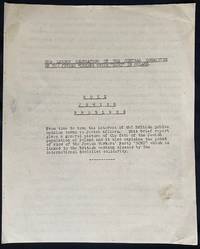
1945ref. 43528No Place London: No Publisher London Delegation of the Bund 1945. No Date 1945 1st Edition. Original Stapled Paper Wrappers Small 4to 17 pages. Mimeograph production. Early 1945 Bundist report aimed at the British public on the impact of six years of Nazi extermination policy on Polish Jewry. "From time to time the interest of the British public opinion turns to Jewish affairs. This brief report gives a general picture of the fate of the Jewish population of Poland and it also explains the point of view of the Jewish Workers' Party 'BUND' which is linked to the British working classes' by the international Socialist solidarity" From the front cover. This early 1945 report to the British public on the destruction of and resistance by Polish Jewry lays out the brutal numbers and facts of ghettoization and then extermination as well as a detailed history of Bund-led Jewish resistance to the Nazis and to deportations to the camps. The mimeograph production and many typographical errors lend a kind of open authenticity to the document that of exiled Jewish trade unionists addressing their British comrades in England. It begins: "The Jewish nation has borne tremendous sacrifices in this war. Several million Jews have been first tortured in a sic inhuman manner and then murdered - several millions that is many times more than the losses suffered by the much more numerous communities of the British Empire and the United States put together. Polish jews sic suffered the greatest losses. There were nearly three and half millions of them living in six hundred Polish cities and towns not counting villages. First they were deported by the Germans to the few ghettos established by them in Poland. Soon afterwards the ghettos were emptied in turn and their 'deported' population was murdered in extermination camps and death chambers." The publication lists the figures for "the ten biggest ghettos of Poland" noting that "In these towns alone the Germans murdered more than one million Jews. Incidentally in all of them with the exception of Cracow Lwow and Czestowchowa 'Bund' was the dominant Jewish party. Out of the nearly three and half millions of Polish Jews there is only a small fraction left today. A small number of survivors have been saved from death by the victorious advance of the Soviet Army. The remainder of the Jews who are still alive under the German Occupation are either in concentration and forced labour comps or in hiding among the Polish population with whom they are fighting in the ranks of the underground movement. Those survivors address to us constant appeals for help and rescue." The solution at this point in the war is that "We must - and our brothers in Poland demand it - we must put such fear into the Germans that they stop the murders of Jews and all the other people whom they still hold in their weakening clutches." The authors are careful at this point to be clear that they do not see Zionism and the immigration of surviving Jews to Palestine as the goal for survivors and post-War Jewish life. They demand immediate assistance and reparations for survivors the criminalization of all antisemitic activity which "should be considered as an attack against the fundamental principles of democracy" and the reconstruction of Jewish life under Socialism in the countries where Jewish refugees now find themselves or in their countries or origin. "Immigration should be free and should not be regulated according to the nationality or religion of the emigrant. Any attempts at presenting the emigration of Jews as a separate problem and considering it as a means of solving the Jewish question always lead to anti-Jewish discrimination." .PALESTINE. does not offer a solution of the Jewish question. Even if one takes into consideration that millions of Jews have been murdered the present Jewish population of Palestine comprises at the most 5% of the number of Jews all over the world. Palestine does not solve the question of anti-semitism either. The majority of Jews will remain dispersed in many countries and in those countries the Jewish question will have to be solved on the spot and anti-semitism extirpated. Palestine is a country of the Jews living there and of the non-Jews who are her inhabitants. We believe that in the same way as we wish to see it in other countries in Palestine also the Jewish minority should build its future on a collaboration with the non-Jewish majority having at the same time a guarantee of a full equality of rights and a complete freedom of its own national and cultural development. We are not a homeless people. The home of the Jews is in the countries in which they live and with which they are linked by many ties. In the same way as for British Jews Britain is their homeland to which they are attached and which they do not want to give up and for American Jews the U.S. A. and French Jews France so for Polish Jews their homeland is Poland. The attitude towards Jews in various countries should be based on the principle that a country is a common homeland for the whole of its population irrespective of origin and religion. The fate of the Jewish population is irrevocably linked to that of the countries it inhabits. It means for the Jews in every country the necessity of fighting for the country's freedom prosperity progress and development as these are a condition of the Jews' own freedom prosperity progress and development. For us as a Labour Party of the Jewish population of Poland it means a fight for the freedom and independence of our country that if sic is of Poland and the building of her future and at the same time the future of Polish Jews on democratic and Socialist principles." The authors then outline the long history of the Bund's underground resistance work against the Nazis" including much on the Warsaw Ghetto Uprising. "In its activities which started on the first day of the occupation the 'Bund' collaborated with the Polish Workers' Underground Movement in the same way as before the war it collaborated with the Polish Socialist Party" including work within the trade union movement and among Jewish youth including 'regularly publishing our clandestine papers eight of them appearing every month.' To achieve this aim fighting detachments of the party were being developed and the whole organisation which from the very first has been proclaiming the idea of an armed struggle against the occupier began to prepare to oppose the 'deportations' to the extermination camps by an armed action. In October 1942 began the last phase of these preparations. The 'Bund' underground movement and the so-called Jewish National Committee an organisation comprising various Zionist groups got together and while preserving their political differences established a Co-ordination Committee and the joint 'Jewish Armed Resistance Organisation' Z.O.B. From that time onwards the armed struggle of the Jewish population in Poland has been led by this resistance organisation. In January 1943 the streets of the Warsaw Ghetto were the scene of the first armed engagement which lasted for several days.Space does not allow us to tell the full story of this rising which in any case had better be written in Poland and not abroad. According to our latest reports from Poland those few remaining survivors of the rising in the Warsaw Ghetto have been writing the story of the events in which they have taken part. After this rising fürther acts of Jewish armed resistance were reported from Poland;" these further acts are then listed and include: "BIALYSTOK In this city the Jews who before the war had been strongly under the influence of the 'Bund' put up a fierce resistance when the Nazis began to liquidate the ghetto in mid- August 1943. The armed rising lasted a month and was conducted with remarkable heroism. TREMBLIN sic This death camp where the Nazis had murdered hundreds of thousands of Jews was completely destroyed at the beginning of August 1943 by the Jews who were there at the time. They attacked the German guards and killed the entire Nazi unit thirty men strong. They seized the ammunition set fire to all the camp buildings and damaged electric cables. Afterwards two hundred Jews escaped to the neighbouring forest. u>SOBIBOR Heroism characterising the Tremblinka revolt marked also the rebellion of Jews at another extermination camp at Sobibor. The Jews revolted there in October 1943 and a large number of them escaped from the camp. General strike in the Lódz ghetto. In February 1943 a general strike broke out in the Lodz ghetto because of German executions. The strike was successful and the executions ceased. MAY DAY 1944 The few survivors of the 500000 Jews of the Warsaw Ghetto who had found refuge among the Polish population the 'Aryan' quarters of Warsaw have not ceased the struggle. Members of the Jewish Workers Movement in Warsaw and in other parts of Poland have even succeeded in organising this year special May Day celebrations. In Warsaw alone five armed Jewish May Day meetings took place." Additional battles between the Jewish-Polish underground and Nazi forces are described as well as underground Jewish resistance newspapers-including one still publishing several thousand copies per issue "distributed in Warsaw and in the provinces" in early 1945. "According to other reports the Jewish survivors of Warsaw organised themselves in fighting detachments. One detachment was named 'Michal Klepfisz' after the hero of the 'Bund' one of the leaders of the rising in the Warsaw ghetto.This detachment distinguished itself particularly during the severe fighting with the Germans for the Old City quarter of Warsaw. General Bor the Commander of the Warsaw uprising gave the detachment special recognition and stated that it alone had killed three hundred Germans and captured a large amount of German arms and ammunition. The other Jewish detachment was fighting under the name of 'Berek Joselewicz' well known historical figure of the Kosciuszko insurrection in Poland in 1794. This detachment took part in the siege and occupation of the main Warsaw post office building. General Bor reported that this Jewish detachment captured more than hundred Germans. 'Even now' it would be difficult to find words which would testify better to the continuity of action and of the struggle waged by the Jewish Workers' Movement irrespective of circumstences sic. After three battles in Warsaw after the slaughter of millions of Jews and the loss of the most valued comrades this movement is still fulfilling its difficult task of fighting th oppression and bringing help to the victims of the Germans." The publication gives a brief introductory history of the Bund appropriate for a British reader which events from the recent past such as: 1936. 'Bund' organised a political strike to protest against anti-Jewish riots which took place in the little town of Przytyk. Hundreds of thousands joined the strike which was supported by many Polish Socialists and by workers organised in Polish Trade Unions. 1938-39. During the municipal elections the majority of the Jewish population in the big cities and in many towns of Poland voted for 'Bund'. In Warsaw out of twenty Jewish municipal councillors 17 belonged to the 'Bund' and only three represented other parties. Finally the authors offer other details about the Bund its strength its publications and its various cultural and political activities concluding with great impact with a description of the "well known Medem Sanatorium for children at Miedzesyn near Warsaw.The sanatorium remained open until 1942 when the Germans 'deported' all the children to extermination camps. The sanatorium's staff were allowed to choose between staying at their posts or accompanying the children. They all chose the latter and together with the children left by a death-train for the notorious Treblinka Camp." OCLC: 504396338. OCLC locates only 1 copy worldwide British Library none in North America or Israel. Light wear and toning very well preserved Very Good Condition. Rare and important. PBERL-1-12-XX. No Place [London]: No Publisher [London Delegation of the Bund] unknown
1995ref. BN496037De Gruyter Saur 1995. 1995. Gesellschaft für Exilforschung / Society for Exile Studies. Nachrichtenbrief / Newsletter: 1984 bis 1993 mit Gesamtregister Gesellschaft für Exilforschung / Society for Exile Studies. Nachrichtenbrief / Newsletter: 1984 bis 1993 mit Gesamtregister Loewy Ernst Studies Gesellschaft für Exilforschung / Society for Exile Barbara Seib u. a. De Gruyter Saur unknown
1898ref. 002932Librairie du Victor Hugo illustré, 1898
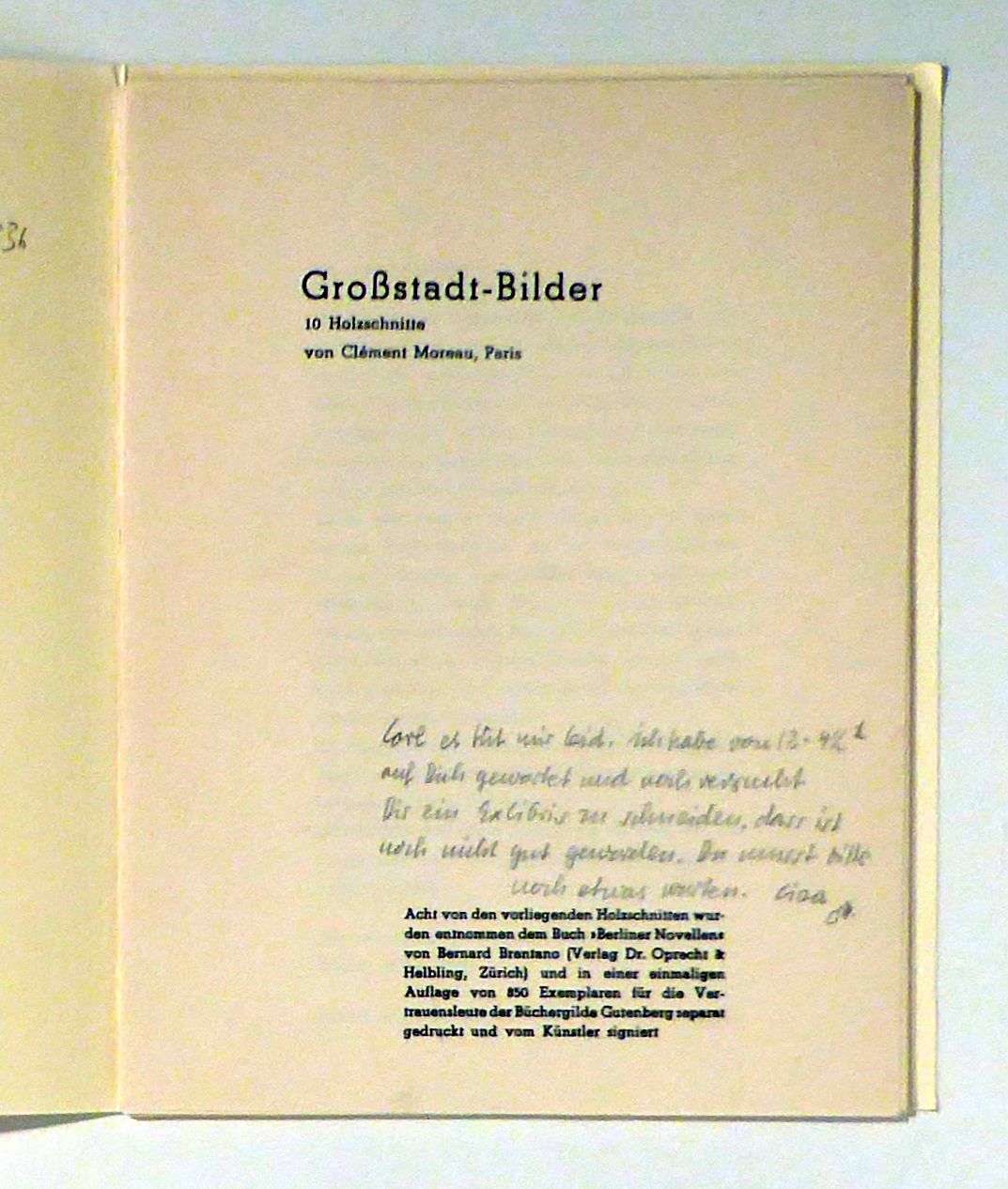
1933ref. 157836Zürich, Wien, Prag, Büchergilde Gutenberg, 1933. 12 Bll., mit 10 Original-Holzschnitten. 12 Blatt, lose in Kartonmappe, 8°. Die Mappe wurde 1933 zum Jahresende in einer limitierten Auflage von 850 Exemplaren gedruckt und an die Vertrauensmänner der Büchergilde abgegeben, zur Honorierung der ausserordentlichen Anstrengungen, die nötig waren um die Büchergilde in die Emigration zu retten. Anders als bei der regulären Ausgabe, wo jeweils nur ein Blatt vollsigniert ist und die übrigen Blätter nur monogrammiert sind, hat Meffert beim vorliegenden Exemplar alle 10 Blätter mit vollem Namen signiert. Auf dem Titelblatt eine mehrzeilige Notiz von Clément Moreau an Carl (Theodor Hubacher). Er habe mehrere Stunden vergeblich auf ihn gewartet und die Zeit benützt, um ein Exlibris zu schneiden. Das sei aber noch nicht gut geworden und er müsse deshalb noch etwas warten. Hubacher ist ein schweizerischer Architekt, der im Tessin lebte und mit Clément Moreau befreundet war. [2 Warenabbildungen] Softcover Schönes Exemplar.