53 867 résultats
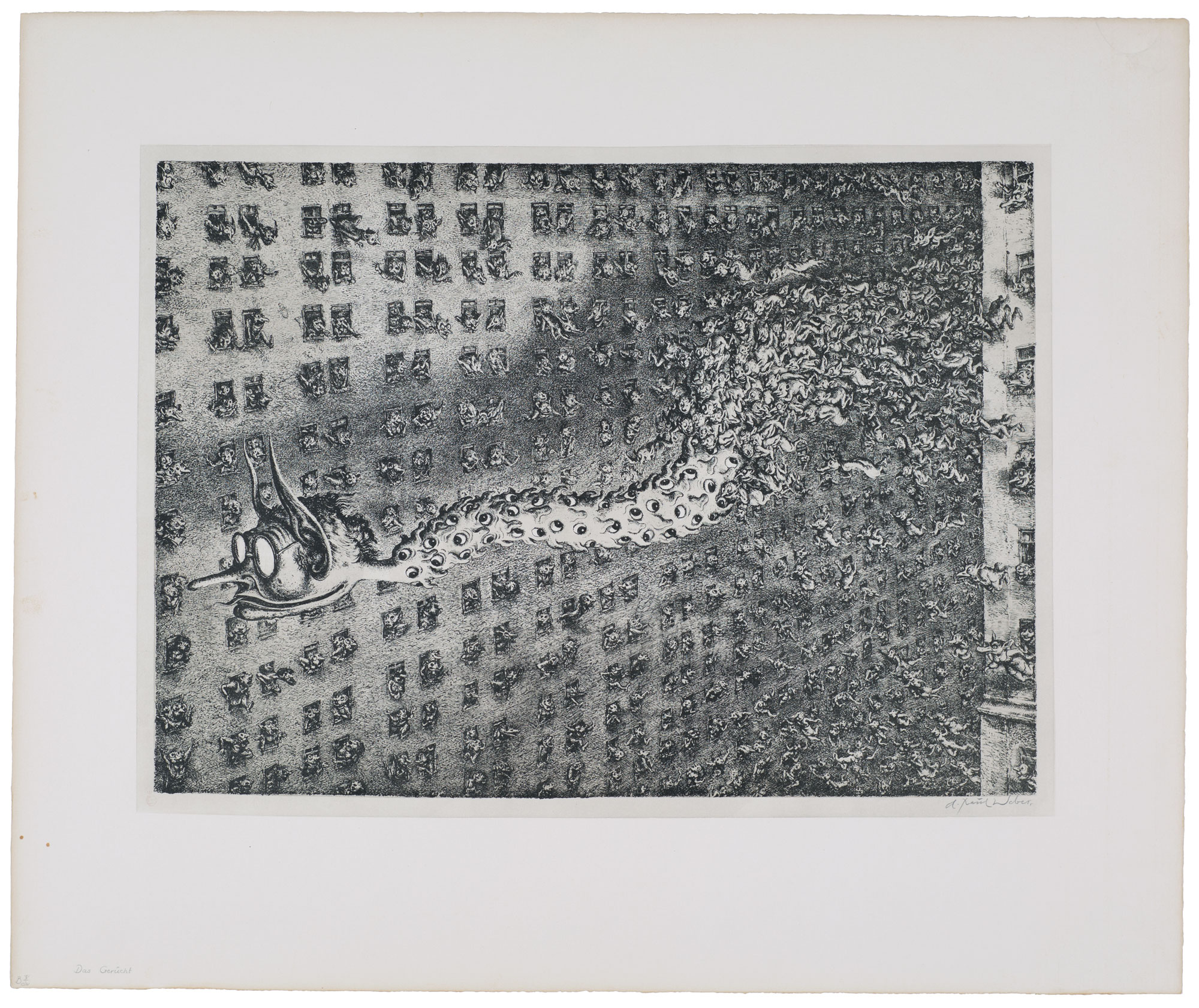
réf. 0977-Co.J. Lithographie, 1969, auf Velin, rechts unterhalb der Darstellung mit Bleistift signiert, links unterhalb der Darstellung mit dem Clan-Presse Signet gestempelt, im Unterrand mit Bleistift betitelt. Darstellungsgröße 41,2:57,5 cm, Blattgröße 63,7:76,5 cm. Literatur: Dorsch 837.- Überarbeitete Fassung der Lithographie von 1953 (Dorsch 836); diese entstand, als der alte Stein keine Abzüge mehr erlaubte; die Unterschiede zeigen sich hauptsächlich in den dargestellten Figuren wie beispielsweise bei dem Mann, der direkt unter dem Kinn der Schlange aus dem Fenster schaut, bärtig ist. Bei der seltenen hand-schriftlichen Bezeichnung " B " mit römischer Ziffer und dem Zusatz W. oder CW handelt es sich um eine angefangene Zählung der Abzüge ( B = Blatt ), die aber nicht konsequent bis zum Ende durchgeführt wurde; W. oder CW bezeichnet den Drucker, A. Paul Weber oder seinen Sohn Christian Weber.
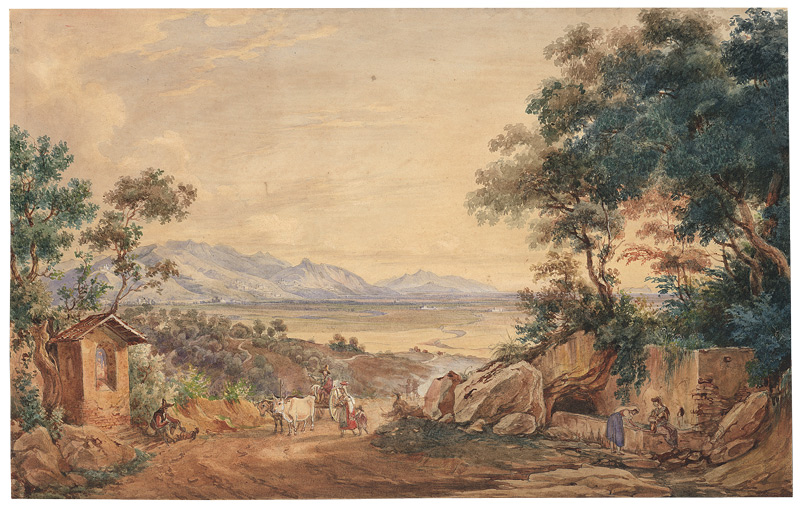
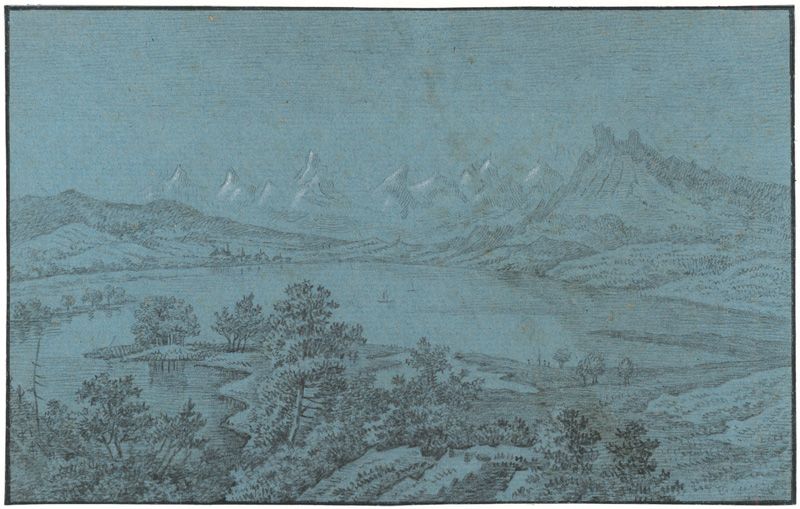
réf. 015-Io.J. Aquarell über Bleistift, mit einigen Deckweißlichtern, mit schwarzer Tuschlinie umrandet, verso vom Künstler bezeichnet ?Aussicht von Velletri aus über die Pontinischen Sümpfe nach Terracina zu?, auf Velin. 25:40 cm.
1844réf. 41372Milsom Street Bath and 26 Haymarket London: Edmund Francis English Jr. and Thomas McLean. Lithographed and printed at 79 St. Martin's Lane and by Moyes and Barclay Castle Street Leicester Square London 1844. Folio. 24 1/4 x 16 1/2 inches. First Edition. 8 1-10. 18 pp. 12 leaves of plates. Title with hand-colored vignette mounted on card lithographed dedication to Princess Emilia of Baden and the Marchionesses Douglas and Clydesdale List of Subjects and List of Vignettes on Letterpress List of Subscribers "To the Reader" by English Lithograph letter from Beckford to English that is not mentioned in Abbey 6 tinted lithograph "Illustrations of Lansdown Tower Bath" with text on each room of the tower and Beckford's obituary and woodcut epitaph errata note 13 tinted and hand-colored lithograph plates mounted on 12 card leaves with pencilled titles underneath plates. Dark red straight-grained half morocco over publisher's brown moiré cloth title stamped and lettered in gilt on front and on spine with bookplate on pastedown Grand first edition folio volume of a fantastical folly with 13 hand-colored lithographs of Beckford's unimpeachable decor. Shortly after the eccentric novelist collector bibliophile and plantation-owner William Beckford died in May of 1844 the book Views of Lansdown Tower was published revealing Beckford's extraordinary retreat its luxurious interiors and the exquisite art collection he had assembled inside this fantastical architectural folly just outside Bath in Somerset England. Views was initiated by Willes Maddox under the patronage of Beckford who is found in the book's subscribers list. Beckford had moved to Bath from his estate Fonthill Abbey in Wiltshire in 1822 and remained there until his death. In 1826 Beckford employed a young architect named Henry Goodridge 1797-1864 to build the tower and its adjoining library about a mile away from Beckford's residence in Crescent. Beckford's Tower known initially as Lansdown Tower was built in Italianate neo-classical style on Lansdown Hill. The Tower and its attached railings are now designated as a Grade I listed historic building by the UK. It is the only standing example of Beckford's architecture. Though he did not live there Beckford used the tower as a showcase for his collection of art and fine books and its crowning cupola as a belvedere for taking in picturesque vistas of the surrounding landscape. The book reproduces drawings by Maddox in lithographs by C. J. Richardson. Maddox later gained a reputation for painting the portraits of eminent Turks and took up an invitation from the Sultan to work in Istanbul. Four of the book's 13 plates illustrate some of Beckford's objets d'art including ceramics ivories and metalware alongside his immaculate parlor furniture. The colored plates in order: I. Ornamental Title with View of Tower. II. Exterior of LansdownTower. III. The Vestibule. IV. The Scarlet Drawing Room. V. The Staircase. VI. View of the Belvedere. VII. Objects of Vertu No.1 in Mr. Beckford's Collection. VIII. The Sanctuary. IX. The Crimson Drawing Room. X. Black Cabinet in Crimson Drawing Room. XI. Objects of Vertu No.2 in Mr. Beckford's Collection. XII. The Library. XIII. Objects of Vertu No.3 in Mr. Beckford's Collection. XIV. Ornamental Furniture in Mr. Beckford's Collection. And the Vignettes in Letterpress: XV. Embattled Gateway in Garden. XVI. Italian Cottage. XVII. The Grotto. XVIII. View in Garden where the Sarcophagus stood before removed. XIX. The Tomb of Mr. Beckford. XX. The Tomb of Mr. Beckford's favourite Dog. Abbey Scenery 420. Bobins II 682. SP Lohia 626. Edmund Francis English Jr. and Thomas McLean. Lithographed and printed at 79 St. Martin's Lane, and by Moyes and Barclay, Castle unknown
1844réf. 41372Milsom Street Bath and 26 Haymarket London: Edmund Francis English Jr. and Thomas McLean. Lithographed and printed at 79 St. Martin's Lane and by Moyes and Barclay Castle Street Leicester Square London 1844. Folio. 24 1/4 x 16 1/2 inches. First Edition. 8 1-10. 18 pp. 12 leaves of plates. Title with hand-colored vignette mounted on card lithographed dedication to Princess Emilia of Baden and the Marchionesses Douglas and Clydesdale List of Subjects and List of Vignettes on Letterpress List of Subscribers "To the Reader" by English Lithograph letter from Beckford to English that is not mentioned in Abbey 6 tinted lithograph "Illustrations of Lansdown Tower Bath" with text on each room of the tower and Beckford's obituary and woodcut epitaph errata note 13 tinted and hand-colored lithograph plates mounted on 12 card leaves with pencilled titles underneath plates. Dark red straight-grained half morocco over publisher's brown moiré cloth title stamped and lettered in gilt on front and on spine with bookplate on pastedown Grand first edition folio volume of a fantastical folly with 13 hand-colored lithographs of Beckford's unimpeachable decor. Shortly after the eccentric novelist collector bibliophile and plantation-owner William Beckford died in May of 1844 the book Views of Lansdown Tower was published revealing Beckford's extraordinary retreat its luxurious interiors and the exquisite art collection he had assembled inside this fantastical architectural folly just outside Bath in Somerset England. Views was initiated by Willes Maddox under the patronage of Beckford who is found in the book's subscribers list. Beckford had moved to Bath from his estate Fonthill Abbey in Wiltshire in 1822 and remained there until his death. In 1826 Beckford employed a young architect named Henry Goodridge 1797-1864 to build the tower and its adjoining library about a mile away from Beckford's residence in Crescent. Beckford's Tower known initially as Lansdown Tower was built in Italianate neo-classical style on Lansdown Hill. The Tower and its attached railings are now designated as a Grade I listed historic building by the UK. It is the only standing example of Beckford's architecture. Though he did not live there Beckford used the tower as a showcase for his collection of art and fine books and its crowning cupola as a belvedere for taking in picturesque vistas of the surrounding landscape. The book reproduces drawings by Maddox in lithographs by C. J. Richardson. Maddox later gained a reputation for painting the portraits of eminent Turks and took up an invitation from the Sultan to work in Istanbul. Four of the book's 13 plates illustrate some of Beckford's objets d'art including ceramics ivories and metalware alongside his immaculate parlor furniture. The colored plates in order: I. Ornamental Title with View of Tower. II. Exterior of LansdownTower. III. The Vestibule. IV. The Scarlet Drawing Room. V. The Staircase. VI. View of the Belvedere. VII. Objects of Vertu No.1 in Mr. Beckford's Collection. VIII. The Sanctuary. IX. The Crimson Drawing Room. X. Black Cabinet in Crimson Drawing Room. XI. Objects of Vertu No.2 in Mr. Beckford's Collection. XII. The Library. XIII. Objects of Vertu No.3 in Mr. Beckford's Collection. XIV. Ornamental Furniture in Mr. Beckford's Collection. And the Vignettes in Letterpress: XV. Embattled Gateway in Garden. XVI. Italian Cottage. XVII. The Grotto. XVIII. View in Garden where the Sarcophagus stood before removed. XIX. The Tomb of Mr. Beckford. XX. The Tomb of Mr. Beckford's favourite Dog. Abbey Scenery 420. Bobins II 682. SP Lohia 626. Edmund Francis English Jr. and Thomas McLean. Lithographed and printed at 79 St. Martin's Lane, and by Moyes and Barclay, Castle unknown books
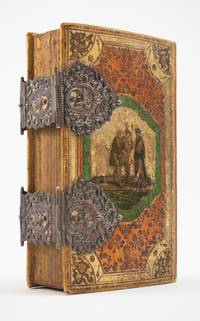
1781réf. ST21118Altona: Gedruckt mit Eckhardtischen Schriften; Hamburg: Georg Paul Zimmer 1781. 167 x 102 mm. 6 5/8 x 4". 8 p.l. 1008 28 pp.; 100 pp. CONTEMPORARY PAINTED AND ELABORATELY BLIND-TOOLED VELLUM ACCENTED WITH PASTED-ON ENGRAVED IMAGES COLORED BY HAND covers with outer white frame enclosing a salmon-pink central panel blind-stamped with floral sprays this panel in turn surrounding a lobed centerpiece bordered in green the centerpiece on the front cover with onlaid colored engraving of an angel hovering over a fiery landscape the landscape a modern inserted replication that on the rear cover showing three figures in a landscape a nobleman on the right and two peasants on the left; flat spine blind-tooled in compartments with central floral sprig more floral sprigs at corners TWO VERY LARGE ELABORATELY FILIGREED CLASPS Dutch gilt endpapers all edges gauffered with a floral design. Woodcut devices on title pages woodcut opening headpieces. Binding a little soiled but entirely solid and quite attractive text faintly yellowed due to paper quality occasional small stains other trivial imperfections but an excellent copy--clean and fresh internally in a well-preserved binding. Containing Lutheran hymns as well as Scripture readings for Sundays and Feast days this is a so-called "Peasant Binding" and one that is more inventive and elaborate than most other examples of the style. The use of the word "peasant" in this context is a reference to the obvious influence of folk art on the decoration rather than to a clientele for which it was solely intended. Especially in central and northern Europe in the 18th century Bibles prayer books and hymnals in brightly painted vellum bindings as here were popular presents among an audience literate and sufficiently affluent to afford such gifts. They are now increasingly uncommon. In the present case the detailed depictions of the angelic and human figures and especially the very large and elaborately configured clasps stand out as especially conspicuous and atypical design features. Gedruckt mit Eckhardtischen Schriften; Hamburg: Georg Paul Zimmer unknown
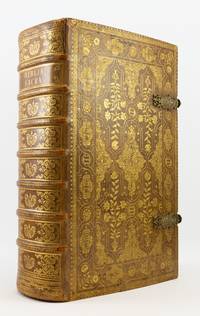
1768réf. ST19422Nuremberg: Johann Andrea Endterischen 1768. 460 x 295 mm. 18 1/4 x 11 1/2". 17 p.l. 11 48 2 2 3-8 3 9-190 2 191-740 pp.; 512 pp.; 2 2 3-190 2 191-480 18 pp. Three parts bound in one volume. STRIKING CONTEMPORARY SMOOTH CALF LAVISHLY GILT in the entrelac style covers with frame and compartments formed by gilt-ruled strapwork and filled with floral designs and lace-like ornaments of massed volutes and small tools raised bands spine compartments with central bouquet of pomegranate and flowers with massed floral tools on either side gilt lettering brass clasps featuring images of King David and St. Paul gilt-tooled turn-ins marbled endpapers all edges gilt and gauffered with pomegranates and flowers older repair to front joint alongside top compartment. Extra engraved title page woodcut headpieces and historiated initials 47 engraved plates comprised of: copperplate portraits of Luther and 11 Electors; 11 section titles each with 11 vignettes; nine full-page engraved depictions of Moses the Prophets and the Evangelists; seven full-page plates engraved with 12 vignettes six double-page maps and two double-page engravings. Front pastedown with ornate heart-shaped bookplate of Adam Melchior Dæumer dated 1784. ◆Two-inch crack to head of rear joint a bit of rubbing to joints and extremities a handful of quite minor dark spots to boards isolated trivial smudges or stains internally other insignificant imperfections but still a fine specimen--THE CONTENTS EXCEPTIONALLY CLEAN BRIGHT AND FRESH and the remarkable binding entirely solid and bright with gilt. This is an especially pleasing copy of the last and most extensive edition of the very popular and sumptuously illustrated Weimar Electors' Bible offered here in an impressive contemporary binding. Known as the "Kurfürstenbibel" because of its portraits of the Electoral Princes called "Kurfürsten" in German it was originally prepared for Ernst I Duke of Saxe-Gotha and Altenburg as a celebration of Martin Luther's Bible translation. Editions were issued by the Endters one of the prominent German printing families beginning in 1641. In addition to portraits of Luther and the Protestant princes of Germany the present edition contains the maps views and illustrated half-titles by Jacob van Sandrart and others first used in the edition of 1686. Our copy contains four maps and views not found in other copies of this edition showing the eastern Mediterranean and Palestine as well as both a map and a view of Jerusalem. The size of our volume puts a great strain on the binding which has nevertheless stood the test of time remarkably well. The overall decoration is exuberant the delicate gauffering lovely and the original straps remarkably well preserved. Johann Andrea Endterischen unknown
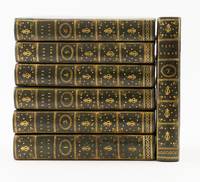
1775réf. ST17825Paris: Joseph-Gérard Barbou rue Mathurins 1775. 163 x 96 mm. 6 3/8 x 3 3/4". Seven volumes. Edited by J. N. Lallemand; preface by Jean Baptiste Louis Crévier. EXTREMELY ATTRACTIVE CONTEMPORARY GREEN ARMORIAL MOROCCO perhaps by Derome covers with triple gilt rule border central gilt coat of arms of the Blanche family featuring a seated fox with one paw raised above it a row of three five-pointed stars smooth spine divided into compartments containing a gilt lyre surrounded by stars and dots floral sprigs at corners volume number within a laurel wreath gilt lettering marbled endpapers all edges gilt. With printer's two-swans device on title pages volume I with frontispiece portrait engraved by L. J. Cathelin after J. C. Philips. With pencilled note on front flyleaf attributing the binding to Derome. Brunet III 1108 "Edition estimée"; Dibdin II 171. For the binding: Olivier Pl. 2279. ◆Spines slightly and uniformly sunned very light shelf wear to bindings occasional faint foxing in volume IV but A SUPERB SET almost entirely absent of any signs of use. This is a fine-paper copy in a binding both charming and handsome of what Dibdin deems "a truly beautiful and accurate edition" of Livy's Roman history. Brunet called it an "esteemed edition" and notes that fine paper copies like the present set sold for twice what regular copies cost. First printed by Sweynheym and Pannartz in 1469 the "Histories" of Titius Livius Patavani 59 B.C. - 17 A.D. follow the rise of Rome from the founding of the city through its triumphs in the Punic Wars and up through the reign of the author's contemporary emperor Augustus. His account is notable for its emphasis on the glorious triumphs and accounts of heroism of the Romans stemming in his eyes from their virtue; his history is intended not just to inform but also to elevate the reader. The present edition according to Dibdin builds on the fine editions edited by Crevier and Drakenborch incorporating their useful notes and additions. It was beautifully printed by Joseph-Gérard Barbou 1723-90 scion of a family that had begun printing in Lyon in 1529 moving to Paris in 1540. Joseph apparently specialized in Latin classics producing editions of Cicero Lucretius Pliny Caesar and Martial among others. The fine binding here does not have Derome's ticket but is well executed enough to make the attribution written in at front plausible. There were no fewer than 18 members of the Derome family not to mention workshop associates who made their livings as binders in Paris from the middle of the 17th century until the first quarter of the 19th. Our binding is tasteful--perfect for a scholarly edition of a classic--and conceivably the work of one of the Deromes or of an extremely competent associate. Olivier attributes our armorial stamp to the 18th century Blanche family of Burgundy and he finds it on a copy of Barbou's 1771 Sallust in the library of Madame la Comtesse de Cossé. The "country house" condition of the present set suggests an aristocratic owner more concerned with owning fine books than with reading them. [Joseph-Gérard] Barbou, rue Mathurins unknown
1781réf. ST21118Altona: Gedruckt mit Eckhardtischen Schriften; Hamburg: Georg Paul Zimmer 1781. 167 x 102 mm. 6 5/8 x 4". 8 p.l. 1008 28 pp.; 100 pp. CONTEMPORARY PAINTED AND ELABORATELY BLIND-TOOLED VELLUM ACCENTED WITH PASTED-ON ENGRAVED IMAGES COLORED BY HAND covers with outer white frame enclosing a salmon-pink central panel blind-stamped with floral sprays this panel in turn surrounding a lobed centerpiece bordered in green the centerpiece on the front cover with onlaid colored engraving of an angel hovering over a fiery landscape the landscape a modern inserted replication that on the rear cover showing three figures in a landscape a nobleman on the right and two peasants on the left; flat spine blind-tooled in compartments with central floral sprig more floral sprigs at corners TWO VERY LARGE ELABORATELY FILIGREED CLASPS Dutch gilt endpapers all edges gauffered with a floral design. Woodcut devices on title pages woodcut opening headpieces. Binding a little soiled but entirely solid and quite attractive text faintly yellowed due to paper quality occasional small stains other trivial imperfections but an excellent copy--clean and fresh internally in a well-preserved binding. Containing Lutheran hymns as well as Scripture readings for Sundays and Feast days this is a so-called "Peasant Binding" and one that is more inventive and elaborate than most other examples of the style. The use of the word "peasant" in this context is a reference to the obvious influence of folk art on the decoration rather than to a clientele for which it was solely intended. Especially in central and northern Europe in the 18th century Bibles prayer books and hymnals in brightly painted vellum bindings as here were popular presents among an audience literate and sufficiently affluent to afford such gifts. They are now increasingly uncommon. In the present case the detailed depictions of the angelic and human figures and especially the very large and elaborately configured clasps stand out as especially conspicuous and atypical design features. Gedruckt mit Eckhardtischen Schriften; Hamburg: Georg Paul Zimmer unknown books
1775réf. ST17825Paris: Joseph-Gérard Barbou rue Mathurins 1775. 163 x 96 mm. 6 3/8 x 3 3/4". Seven volumes. Edited by J. N. Lallemand; preface by Jean Baptiste Louis Crévier. EXTREMELY ATTRACTIVE CONTEMPORARY GREEN ARMORIAL MOROCCO perhaps by Derome covers with triple gilt rule border central gilt coat of arms of the Blanche family featuring a seated fox with one paw raised above it a row of three five-pointed stars smooth spine divided into compartments containing a gilt lyre surrounded by stars and dots floral sprigs at corners volume number within a laurel wreath gilt lettering marbled endpapers all edges gilt. With printer's two-swans device on title pages volume I with frontispiece portrait engraved by L. J. Cathelin after J. C. Philips. With pencilled note on front flyleaf attributing the binding to Derome. Brunet III 1108 "Edition estimée"; Dibdin II 171. For the binding: Olivier Pl. 2279. ◆Spines slightly and uniformly sunned very light shelf wear to bindings occasional faint foxing in volume IV but A SUPERB SET almost entirely absent of any signs of use. This is a fine-paper copy in a binding both charming and handsome of what Dibdin deems "a truly beautiful and accurate edition" of Livy's Roman history. Brunet called it an "esteemed edition" and notes that fine paper copies like the present set sold for twice what regular copies cost. First printed by Sweynheym and Pannartz in 1469 the "Histories" of Titius Livius Patavani 59 B.C. - 17 A.D. follow the rise of Rome from the founding of the city through its triumphs in the Punic Wars and up through the reign of the author's contemporary emperor Augustus. His account is notable for its emphasis on the glorious triumphs and accounts of heroism of the Romans stemming in his eyes from their virtue; his history is intended not just to inform but also to elevate the reader. The present edition according to Dibdin builds on the fine editions edited by Crevier and Drakenborch incorporating their useful notes and additions. It was beautifully printed by Joseph-Gérard Barbou 1723-90 scion of a family that had begun printing in Lyon in 1529 moving to Paris in 1540. Joseph apparently specialized in Latin classics producing editions of Cicero Lucretius Pliny Caesar and Martial among others. The fine binding here does not have Derome's ticket but is well executed enough to make the attribution written in at front plausible. There were no fewer than 18 members of the Derome family not to mention workshop associates who made their livings as binders in Paris from the middle of the 17th century until the first quarter of the 19th. Our binding is tasteful--perfect for a scholarly edition of a classic--and conceivably the work of one of the Deromes or of an extremely competent associate. Olivier attributes our armorial stamp to the 18th century Blanche family of Burgundy and he finds it on a copy of Barbou's 1771 Sallust in the library of Madame la Comtesse de Cossé. The "country house" condition of the present set suggests an aristocratic owner more concerned with owning fine books than with reading them. [Joseph-Gérard] Barbou, rue Mathurins unknown books
1768réf. ST19422Nuremberg: Johann Andrea Endterischen 1768. 460 x 295 mm. 18 1/4 x 11 1/2". 17 p.l. 11 48 2 2 3-8 3 9-190 2 191-740 pp.; 512 pp.; 2 2 3-190 2 191-480 18 pp. Three parts bound in one volume. STRIKING CONTEMPORARY SMOOTH CALF LAVISHLY GILT in the entrelac style covers with frame and compartments formed by gilt-ruled strapwork and filled with floral designs and lace-like ornaments of massed volutes and small tools raised bands spine compartments with central bouquet of pomegranate and flowers with massed floral tools on either side gilt lettering brass clasps featuring images of King David and St. Paul gilt-tooled turn-ins marbled endpapers all edges gilt and gauffered with pomegranates and flowers older repair to front joint alongside top compartment. Extra engraved title page woodcut headpieces and historiated initials 47 engraved plates comprised of: copperplate portraits of Luther and 11 Electors; 11 section titles each with 11 vignettes; nine full-page engraved depictions of Moses the Prophets and the Evangelists; seven full-page plates engraved with 12 vignettes six double-page maps and two double-page engravings. Front pastedown with ornate heart-shaped bookplate of Adam Melchior Dæumer dated 1784. ◆Two-inch crack to head of rear joint a bit of rubbing to joints and extremities a handful of quite minor dark spots to boards isolated trivial smudges or stains internally other insignificant imperfections but still a fine specimen--THE CONTENTS EXCEPTIONALLY CLEAN BRIGHT AND FRESH and the remarkable binding entirely solid and bright with gilt. This is an especially pleasing copy of the last and most extensive edition of the very popular and sumptuously illustrated Weimar Electors' Bible offered here in an impressive contemporary binding. Known as the "Kurfürstenbibel" because of its portraits of the Electoral Princes called "Kurfürsten" in German it was originally prepared for Ernst I Duke of Saxe-Gotha and Altenburg as a celebration of Martin Luther's Bible translation. Editions were issued by the Endters one of the prominent German printing families beginning in 1641. In addition to portraits of Luther and the Protestant princes of Germany the present edition contains the maps views and illustrated half-titles by Jacob van Sandrart and others first used in the edition of 1686. Our copy contains four maps and views not found in other copies of this edition showing the eastern Mediterranean and Palestine as well as both a map and a view of Jerusalem. The size of our volume puts a great strain on the binding which has nevertheless stood the test of time remarkably well. The overall decoration is exuberant the delicate gauffering lovely and the original straps remarkably well preserved. Johann Andrea Endterischen unknown books
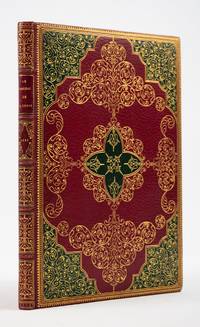
1651réf. ST20278Paris: Chez F. Mazot 1651. 172 x 118 mm. 6 3/4 x 4 3/4". 3 34 leaves 35-39 1 pp. 2 leaves. LOVELY CRIMSON CRUSHED MOROCCO GILT AND ONLAID BY CAPÉ stamp-signed on front turn-in covers with onlaid green morocco cornerpieces and central quatrefoil all filled and surrounded by delicate pointillé tooling in floral and paisley designs raised bands spine compartments tooled in pointillé gilt lettering richly gilt turn-ins marbled endpapers all edges gilt. In a felt-lined morocco-lipped marbled paper slipcase. ENGRAVED THROUGHOUT WITH 38 FULL-PAGE ILLUSTRATIONS consisting of one portrait two allegorical religious scenes including title and 35 illustrations of the Holy Eucharist 40 pages of engraved text 37 of these with text flanked by full-length figures of saints accompanied by other religious symbols at head and foot of page two framed with vignettes of angels or the Madonna one page with text only. Front pastedown with "A W F" book label of bookseller Adrian Fluhmann. Duportal "Étude sur les livres à figures" pp. 244-45; Brunet V 624; Graesse VI 4; Leaves perhaps very lightly washed and pressed but an extremely fresh clean copy IN A SPARKLING BINDING. Covered by a luxurious binding by Capé this is a particularly attractive copy of a sumptuously illustrated prayer book composed entirely of engraved plates. According to Duportal it is "One of three important publications whose engravings reveal the trend characteristic of religious illustrations in France between 1601 and 1660." The work opens with a dedication to Charles d'Aubespine Marquis de Châteauneuf 1580-1653 with a full-page portrait by Guillame de Gheyn b. 1610. The bulk of the book is made up of two groups of plates. Those in the first group appearing primarily on the rectos contain prayers in Latin and French flanked by pairs of saints; gaps in the prayers are filled by naturalistic flowers insects and birds. Many of these plates also include a scene or two in miniature depicting the life of one or both of the saints or a vignette of angels. While just two of these engravings are signed "J. Collin" they all appear to be in the same hand which demonstrates an impressive level of finesse and delicacy depicting graceful figures with sure light lines. Duportal notes that this artist had a "talent charmant" and that well-executed dry-points of this type are quite rare in French books of the period. The second group of engravings appear strictly on the versos and depict the performance of a part of the Mass beneath a cloud in which appears a relevant scene from the life of Christ. They are all unsigned and clearly by a different hand with more rustic features--possibly "copies of originals published abroad" according to Duportal. The book concludes with two leaves of text framed by gamboling putti and the Virgin. Copies of this work can be found with varying numbers of leaves and engravings apparently the result of multiple reprintings with added material produced between 1651-53 but the present item can be distinguished as an early if not the very first edition as it does not contain "Privilege du Roy" dated 1652 or 1653. Furthermore our copy also contains the earliest state of the plates without the "I N R I" initials on the cross found on the title page and with the earlier state of the verso engravings before they were substantially reworked. Our edition seems to be quite rare with OCLC finding just one other copy with the same sequence of contents at the Bibliothèque Sainte-Genevieve. The stunning binding by Capé looks just as fresh and lustrous as the day it left its workshop. One of the most distinguished binders in France in the middle years of the 19th century Capé d. 1867 was especially well known for the delicacy of his work--which can be appreciated to full effect in the present example. He was the binder to the Empress Eugénie and Béraldi calls him "the Bozérian of the second Empire." This is precisely the kind of book our former owner the discriminating connoisseur-bookseller Fluhmann would have owned. Chez F. Mazot unknown
1651réf. ST20278Paris: Chez F. Mazot 1651. 172 x 118 mm. 6 3/4 x 4 3/4". 3 34 leaves 35-39 1 pp. 2 leaves. LOVELY CRIMSON CRUSHED MOROCCO GILT AND ONLAID BY CAPÉ stamp-signed on front turn-in covers with onlaid green morocco cornerpieces and central quatrefoil all filled and surrounded by delicate pointillé tooling in floral and paisley designs raised bands spine compartments tooled in pointillé gilt lettering richly gilt turn-ins marbled endpapers all edges gilt. In a felt-lined morocco-lipped marbled paper slipcase. ENGRAVED THROUGHOUT WITH 38 FULL-PAGE ILLUSTRATIONS consisting of one portrait two allegorical religious scenes including title and 35 illustrations of the Holy Eucharist 40 pages of engraved text 37 of these with text flanked by full-length figures of saints accompanied by other religious symbols at head and foot of page two framed with vignettes of angels or the Madonna one page with text only. Front pastedown with "A W F" book label of bookseller Adrian Fluhmann. Duportal "Étude sur les livres à figures" pp. 244-45; Brunet V 624; Graesse VI 4; Leaves perhaps very lightly washed and pressed but an extremely fresh clean copy IN A SPARKLING BINDING. Covered by a luxurious binding by Capé this is a particularly attractive copy of a sumptuously illustrated prayer book composed entirely of engraved plates. According to Duportal it is "One of three important publications whose engravings reveal the trend characteristic of religious illustrations in France between 1601 and 1660." The work opens with a dedication to Charles d'Aubespine Marquis de Châteauneuf 1580-1653 with a full-page portrait by Guillame de Gheyn b. 1610. The bulk of the book is made up of two groups of plates. Those in the first group appearing primarily on the rectos contain prayers in Latin and French flanked by pairs of saints; gaps in the prayers are filled by naturalistic flowers insects and birds. Many of these plates also include a scene or two in miniature depicting the life of one or both of the saints or a vignette of angels. While just two of these engravings are signed "J. Collin" they all appear to be in the same hand which demonstrates an impressive level of finesse and delicacy depicting graceful figures with sure light lines. Duportal notes that this artist had a "talent charmant" and that well-executed dry-points of this type are quite rare in French books of the period. The second group of engravings appear strictly on the versos and depict the performance of a part of the Mass beneath a cloud in which appears a relevant scene from the life of Christ. They are all unsigned and clearly by a different hand with more rustic features--possibly "copies of originals published abroad" according to Duportal. The book concludes with two leaves of text framed by gamboling putti and the Virgin. Copies of this work can be found with varying numbers of leaves and engravings apparently the result of multiple reprintings with added material produced between 1651-53 but the present item can be distinguished as an early if not the very first edition as it does not contain "Privilege du Roy" dated 1652 or 1653. Furthermore our copy also contains the earliest state of the plates without the "I N R I" initials on the cross found on the title page and with the earlier state of the verso engravings before they were substantially reworked. Our edition seems to be quite rare with OCLC finding just one other copy with the same sequence of contents at the Bibliothèque Sainte-Genevieve. The stunning binding by Capé looks just as fresh and lustrous as the day it left its workshop. One of the most distinguished binders in France in the middle years of the 19th century Capé d. 1867 was especially well known for the delicacy of his work--which can be appreciated to full effect in the present example. He was the binder to the Empress Eugénie and Béraldi calls him "the Bozérian of the second Empire." This is precisely the kind of book our former owner the discriminating connoisseur-bookseller Fluhmann would have owned. Chez F. Mazot unknown books
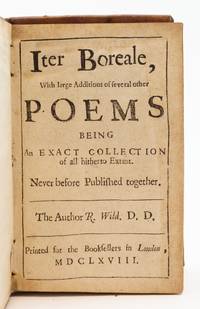
1668réf. ST19030London: Printed for the Booksellers in London 1668. First Complete Edition Fourth Edition overall. 145 x 90 mm. 5 3/4 x 3 1/2". 1 p.l. blank 3-122 pp. 3 leaves table and final blank. Contemporary sheep covers ruled in blind smooth spine early paper label with gilt titling. Front blank with the ink ownership inscription of John Drinkwater; inside lower board with the book label of Michael Curtis Phillips. Hayward "English Poetry" 121 this copy; Grolier Club "Wither to Prior" 976; Wing W2136; ESTC R7135. ◆Covers with light scuffing bottom leather thong of two broken but the text block quite secure at the top pastedowns lifted but the insubstantial binding still in remarkably good original condition; internally A VERY FINE COPY especially clean fresh and bright. From the library of Richard Jennings noted for the outstanding condition of his books this is an especially fresh and extraordinarily well-preserved copy of poems by a Puritan divine known for his surprisingly biting wit. Dryden dubbed Robert Wild 1609-79 "the Wither of the City" after hearing the Financial District's workers' enthusiastic reception of the title poem here which celebrates General Monck's successful campaign to restore Charles II to the throne: "I have seen them reading it in the midst of 'Change so vehemently that they lost their bargains by their candles' ends." Our collection contains several of Wild's most notable works including "The Recantation of a Penitent Proteus" satirizing Puritan clergy who had conformed to the Anglican Church; "The Loyal Nonconformist" professing his loyalty to the monarchy but maintaining his Puritan religious views; and "The Fair Quarrel" an attack on the 1665 Five Mile Act designed to drive nonconformist ministers out of their parishes. Wild was something of a paradox: he could preach a hellfire Puritan sermon but also write verse sufficiently scandalous to be mistakenly attributed to the notorious libertine John Wilmot Earl of Rochester. Our volume was loaned by Richard Jennings for the celebrated 1947 London Exhibition of First and Early Editions of English Poetry catalogued by John Hayward. It would not be reasonable to expect to find a finer unrestored contemporaneous copy of this imprint. Printed for the Booksellers in London unknown
1668réf. ST19030London: Printed for the Booksellers in London 1668. First Complete Edition Fourth Edition overall. 145 x 90 mm. 5 3/4 x 3 1/2". 1 p.l. blank 3-122 pp. 3 leaves table and final blank. Contemporary sheep covers ruled in blind smooth spine early paper label with gilt titling. Front blank with the ink ownership inscription of John Drinkwater; inside lower board with the book label of Michael Curtis Phillips. Hayward "English Poetry" 121 this copy; Grolier Club "Wither to Prior" 976; Wing W2136; ESTC R7135. ◆Covers with light scuffing bottom leather thong of two broken but the text block quite secure at the top pastedowns lifted but the insubstantial binding still in remarkably good original condition; internally A VERY FINE COPY especially clean fresh and bright. From the library of Richard Jennings noted for the outstanding condition of his books this is an especially fresh and extraordinarily well-preserved copy of poems by a Puritan divine known for his surprisingly biting wit. Dryden dubbed Robert Wild 1609-79 "the Wither of the City" after hearing the Financial District's workers' enthusiastic reception of the title poem here which celebrates General Monck's successful campaign to restore Charles II to the throne: "I have seen them reading it in the midst of 'Change so vehemently that they lost their bargains by their candles' ends." Our collection contains several of Wild's most notable works including "The Recantation of a Penitent Proteus" satirizing Puritan clergy who had conformed to the Anglican Church; "The Loyal Nonconformist" professing his loyalty to the monarchy but maintaining his Puritan religious views; and "The Fair Quarrel" an attack on the 1665 Five Mile Act designed to drive nonconformist ministers out of their parishes. Wild was something of a paradox: he could preach a hellfire Puritan sermon but also write verse sufficiently scandalous to be mistakenly attributed to the notorious libertine John Wilmot Earl of Rochester. Our volume was loaned by Richard Jennings for the celebrated 1947 London Exhibition of First and Early Editions of English Poetry catalogued by John Hayward. It would not be reasonable to expect to find a finer unrestored contemporaneous copy of this imprint. Printed for the Booksellers in London unknown books
1975réf. 1038FBBruxelles., POUR ECRIRE LA LIBERTE., 1975. 37 x 30 x 8 cm. OPapp-Kassette., 1038F 900 boites contenant des oeuvres numerotees de 101 Kassette am Deckelrand zum Rücken berieben und etwas angeplatzt. 3 Namensetiketten haben sich gelöst und liegen lose bei. Die inliegenden Objekte sehr gut erhalten.
1930réf. 166218Berlin, Kiepenheuer, 1930. S. 123-151. OBr. Umschl. M. Randläsuren. Rücken m. kl. Fehlst. U. geklebt.
1974réf. 1013FBMönchengladbach., Städtisches Museum Mönchengladbach., 1974. 21 x 17 cm. 12 S. Leporello, 4 S. OPapp-Kassette., 1013F Tadellos frisches Exemplar.
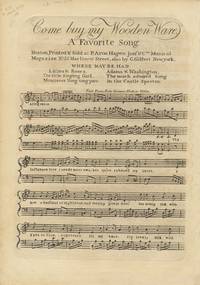
réf. 41678The collection is arranged in two parts as follows: Part I 18th century imprints Many listed in Sonneck: Bibliography of Early Secular American Music Revised and Enlarged by William Treat Upton 39 pieces published in Baltimore Carr; Boston von Hagen; New York Carr Gilfert Mollers Paffs; and Philadelphia Carr Willig. Part II 1801-1825 imprints Many listed in Wolfe: Secular Music in America 1801-1825 Approximately 211 pieces published in Albany Goldberg; Baltimore Carr Cole; Boston Graupner Hewitt Jackson Parker; Brooklyn Jhousbery; New York Christman Dubois & Stodart Geib Gilfert Goodrich Hewitt Riley Paff Sage and Wilson; and Philadelphia Aitken Bacon Blake Carr & Schetky Chalk Jackson Shaw and Willig. All pieces folio disbound with signs of wear consistent with age and use including browning soiling foxing dampstaining and small tears; inner margins slightly ragged and with small sewing holes; occasional repairs and other minor defects. The present collection is of particular interest to early American music history in its reflection of prevailing local musical activities and developing taste. The influence of contemporary musical activities on the London and Paris stages and in private salons is also evident. A full inventory is available upon request. unknown
réf. 41678The collection is arranged in two parts as follows: Part I 18th century imprints Many listed in Sonneck: Bibliography of Early Secular American Music Revised and Enlarged by William Treat Upton 39 pieces published in Baltimore Carr; Boston von Hagen; New York Carr Gilfert Mollers Paffs; and Philadelphia Carr Willig. Part II 1801-1825 imprints Many listed in Wolfe: Secular Music in America 1801-1825 Approximately 211 pieces published in Albany Goldberg; Baltimore Carr Cole; Boston Graupner Hewitt Jackson Parker; Brooklyn Jhousbery; New York Christman Dubois & Stodart Geib Gilfert Goodrich Hewitt Riley Paff Sage and Wilson; and Philadelphia Aitken Bacon Blake Carr & Schetky Chalk Jackson Shaw and Willig. All pieces folio disbound with signs of wear consistent with age and use including browning soiling foxing dampstaining and small tears; inner margins slightly ragged and with small sewing holes; occasional repairs and other minor defects. The present collection is of particular interest to early American music history in its reflection of prevailing local musical activities and developing taste. The influence of contemporary musical activities on the London and Paris stages and in private salons is also evident. A full inventory is available upon request. unknown books
1784réf. 055973Konstantiniyye Constantinople: Müteferrika's Basmahâne Dâru't-Tibâati'l-Ma'mûre Râsid ve Vâsif Efendiler Matbaasi. AH 1198 = 1784 CE. 1784. 1st Edition . Leather. Very Good. Folio - over 12 - 15" tall. Bound in original full brown calf with flap miklep by Muteferrika Printing House. Folio. 32 x 22 cm. In Ottoman Turkish Old Turkish with Arabic letters. 2 6 238 leaves. The text is framed with a text block measuring 25.5 x 14.5 cm. Each page contains 33 lines. Printed on a special European watermarked paper acquired during the Ibrahim Müteferrika era. As traditionally done in Islamic bookmaking the title of the book is handwritten along the lower edge. Two leaves containing pp. 90-94 likely completed from another copy with trimmed margins loosely inserted. Occasional foxing on some pages otherwise a fine and well-preserved copy. Exceedingly rare first and only edition of the 19th incunabulum published by the pioneer of book printing in the Islamic world and founder of the first Turkish press Ibrahim Müteferrika 1672-1745 under the direction of his first heirs after his death. In this rare work -the first book published by Rasid and Vâsif Efendis the initial successors of Müteferrika- the events between 1730 and 1744 are chronicled a period during which Ottoman-Habsburg relations were defined by major military conflicts and shifting diplomatic alliances culminating in the Austro-Turkish War 1737-1739 and the Treaty of Belgrade. Following the Treaty of Passarowitz in 1718 the Habsburg Monarchy had expanded its territories into the Balkans acquiring regions such as the Banat of Temesvár northern Serbia including Belgrade and parts of northern Bosnia. However the Ottoman Empire sought to reclaim these territories. The opportunity arose during the Russo-Turkish War 1735-1739 when Austria allied with Russia against the Ottomans leading to the Austro-Turkish War of 1737-1739. The wars concluded with the Treaty of Belgrade 18 September 1739 the Battle of Grocka 21-22 July 1739 the Siege and Capture of Belgrade July -18 September 1739. The first war was a decisive Ottoman victory over the Habsburg forces near Belgrade. The defeat had a substantial psychological impact on the Habsburg court and led to a re-evaluation of their military strategy. Following the victory at Grocka Ottoman forces besieged and recaptured Belgrade a strategic city previously under Habsburg control. These events between 1730 and 1744 significantly impacted the balance of power in Eastern Europe and shaped the subsequent interactions between the Ottoman Empire and the Habsburg Monarchy. "Ibrahim Müteferrika 1674-1745 was an Ottoman müteferrika court official printer publisher author and translator of Hungarian origin. He was the first person in the Ottoman Empire to establish a printing press and publish books in Turkish. In 1720 when Nevsehirli Damat Ibrahim Pasha sent Yirmisekiz Mehmed Çelebi as ambassador to Paris Mehmed Çelebi took his son Mehmed Said Efendi along with him. While Yirmisekiz Mehmed Çelebi's embassy report sefâretnâme provided important information about France his son did not remain idle and contributed to the transfer of many innovations to the Ottoman Empire. During his stay in Paris Mehmed Said Efendi visited a printing press and decided to pursue similar efforts upon returning to Istanbul. After his return he met Ibrahim Müteferrika and together they began working to establish a printing press. Their idea was supported by Grand Vizier Nevsehirli Damat Ibrahim Pasha. Permission to open the press was granted on the condition that only non-religious works would be printed. They obtained a fatwa legal opinion from the Seyhülislam Abdullah Efendi allowing the printing of secular books and an imperial edict ferman of approval from Sultan Ahmed III. On December 16 1727 the foundation was laid for the first printing house named Dârü't-Tibâati'l-Âmire. Machines and Latin-alphabet type were imported from abroad. The source of the Arabic script types is unclear though there is evidence that Müteferrika produced them himself. Müteferrika's Basmahâne, Dâru't-Tibâati'l-Ma'mûre (Râsid ve Vâsif Efendiler Matbaasi., AH 1198 = [1784 CE]. hardcover
1951réf. 665Los Angeles: Twentieth Century Fox Film Corp 1951. 38 x 24 1/2 inches. Very good condition. Movie poster of the Ben Hogan Story called Follow the Sun. Very rare. See pics. Twentieth Century Fox Film Corp unknown
réf. 064-Do.J. Schwarze Kreide, braun laviert, auf Bütten, rechts unten mit dem braunen Pinsel gemalte Signatur ?Schüz?, auf Sammlungsuntersatz des 18. Jahrhunderts montiert. 25,3:34,5 cm. Literatur: Ph. F. Gwinner, Kunst und Künstler in Frankfurt am Main... Frankfurt am Main, J. Baer, 1862, p. 313ff.
réf. EN-073o.J. Radierung, 1918, auf cremefarbenem Japan, mit Bleistift betitelt, datiert und signiert. 29,8:19,8 cm.- Blatt 13 aus der Mappe ?Gesichter?. München, Verlag der Marées Gesellschaft R. Piper, 1919.- Vorzüglicher Abdruck mit vollem Rand und dem Blindstempel der Marées Gesellschaft. Eins von 40 Exx. auf Japan, vor Verstählung der Platte.- Literatur: Hofmaier 133 B a mit dem Blindstempel der Marées Gesellslchaft. 1 von 40 Exx. auf Japan, vor der Verstählung der Platte; Beckmann Liste 177; Glaser 114; Gallwitz 104.- Vorzüglicher Abdruck mit vollem Rand.
réf. EN-072o.J. Radierung, 1916, auf cremefarbenem Japan, mit Bleistift betitelt, datiert und signiert. 23:29,2 cm.- Blatt 8 aus der Mappe ?Gesichter?. München, Verlag der Marées Gesellschaft R. Piper, 1919.- Vorzüglicher Abdruck mit dem Blindstempel der Marées Gesellschaft. Eins von 40 Exx. auf Japan, vor der Verstählung der Platte, oben und unten mit vollem Rand, die Seitenränder gering beschnitten.- Literatur: Hofmaier 88 B a; Beckmann Liste 79; Glaser 81; Gallwitz 65.
réf. 273-Eo.J. Feder in Grau und Braun, braun laviert, über Bleistift, auf cremefarbenem Velin. 29,7:41,7 cm. Wahrscheinlich gehört diese Zeichnung zur ?Voyage pittoresque de Basle à Bienne par les Vallons de Mottiers-Grandval? im Rahmen der Birstal-Reisebeschreibungen, ab 1802 im Eigenverlag erschienen, die im Katalog zur Baseler Ausstellung 1998 in mehrere Kategorien eingeteilt wird. Unsere Zeichnung gehört zur Kategorie 5: Darstellung kleiner und kleinster Landschaftsausschnitte mit kleinen Wasserfällen, Felsblöcken, Einzelbäumen, Baumgruppen, Kräutern, Astwerk, Wurzeln. ?Der Maler wirft seinen Blick nicht von oben auf die darzustellenden Gegenstände, er betrachtet sie von der Seite oder von unten her. Sehr häufig setzt er sich direkt ans Flussbett. Diese Tafeln sind eine der Besonderheiten der Birmann?schen Voyage Pittoresque. Ihre Motive sind fast ausnahmslos nur von Birmann, vor oder nach ihm von keinem andern Maler, dargestellt worden. Dadurch erhält das Werk einen unverwechselbaren Charakter? (zitiert aus: Ausst. Katalog: Peter und Samuel Birmann. Künstler, Sammler, Händler, Stifter, Basel 1998, S. 49).