53 651 résultats
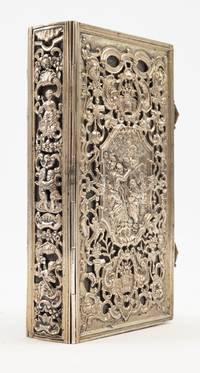
1885réf. ST20549cOxford: Printed at the University Press for Peacock Mansfield and Britton London ca. 1885. 146 x 80 mm. 5 3/4 x 3 1/8". 536 pp. IN A LOVELY 18TH CENTURY SILVER BINDING over contemporary brown morocco DONE IN THE FRENCH RÉGENCE STYLE combining piercing with repoussé ornamentation the covers with central cartouche depicting a scene from the life of Christ in repoussé that on the front cover showing the Baptism of Christ with two hallmarks at the upper left an "A" and a rooster that on the lower cover showing the Ascension this surrounded by a pierced frame of rocaille drawer handles vases of flowers swans a leafy fronds spine pierced with rocaille and flowers separating three allegorical putti ornaments representing Faith Hope and Charity two openwork rocaille clasps. Endpapers rather worn at fore edge isolated very faint foxing otherwise A FINE COPY the text clean and fresh and THE SILVER BINDING SPARKLING AND UNMARRED. This glittering binding is a lovely example of 18th century silverwork in nearly flawless condition. While we have been unable to identify the maker the binding is probably French. A silver binding on a 1686 copy of a Rotterdam "Speculum Poenitentiae" catalogued by Antiquariat Roo is identical to ours in size and design except for the content in the large central frames and is identified by them as French. They find a master's mark of "T. G" beneath the front scene not present on our binding. In any case the delicate symmetrical ornamentation featured on our binding is typical of French Régence decorative arts with scrolls studded with naturalistic embellishments that reward close inspection. Many charming details are hidden within the sea of volutes such as the swans stealing treats from overflowing baskets of fruit. The central scenes from the life of Christ come to life through meticulous execution as our silversmith has taken great care with the details: water trickles from John the Baptist's outstretched arm and voluminous curls of cloud frame Christ's Ascension. The later Book of Common Prayer the binding now contains is a testament to the binding's enduring appeal as a precious devotional object. Printed at the University Press for Peacock, Mansfield, and Britton, London unknown books
réf. FH-342o.J. Folge von 19 (von 20 Blatt) Farbholzschnitten, auf Japan, sämtlich mit Bleistift signiert und bezeichnet. Darstellungsgrößen 6,6:8,8 cm bis 24:31,3 cm. Werknummern: 224, 250, 252, 253, 254, 255, 256, 257, 258, 259, 260, 261, 262, 264, 265, 266, 267, 269 und 270. Literatur: Ausst. Katalog: Fürstenfeldbruck, 1999.
réf. 022-Io.J. Sepia-Pinsel über schwarzer Kreide, auf Bütten mit Fragment des Wasserzeichens: bekrönter Wappenschild mit Lilie, links unten bezeichnet ?Viterbo près Corchiano?. 22,3:29,8 cm. Auf altem Etikett bezeichnet ?Philipp Hackert 1737-1807?. Verso dünne Stelle im Papier. Literatur: Vgl. Ausst. Katalog: D. Coutagne, Francois-Marius Granet 1775-1849. Une vie pour la peinture. Aix-en-Provence 2008, Abb. Nr. 46, S. 89, ?Vue du Tibre près du Ponte Molle à Rome, (1803?)?.
réf. EN-151o.J. Lithographie, um 1923, auf Kupferdruckpapier, mit Bleistift nummeriert und signiert ?Hubbuch?, verso betitelt. Darstellungsgröße 25:35,5 cm, Blattgröße 48:37,5 cm. Mit wenigen Fleckchen. - Nr. 7 von 10 Exx., sehr schöner Druck. - Literatur: nicht bei Riester; Ausstellungskatalog: Karl Hubbuch Druckgraphik, Galerie Michael Hasenclever, München, Okt./Nov. 1983, Nr. 131 mit Abb.; Ausstellungskatalog: Karl Hubbuch. Retrospektive. Karlsruhe, Städtische Galerie im Prinz-Max-Palais, 1993/94, Kat.-Nr. 149, o. Abb. - Karl Hubbuch porträtiert hier die politische Realität zur Zeit der frühen Weimarer Republik und entlarvt die Übereinkunft zwischen reichem, traditionell gesinntem Bürgertum bzw. Adel und dem republikfeindlichen, vom Ausgang des 1. Weltkriegs enttäuschten Militär. [2 Warenabbildungen]
réf. 003-Io.J. Bleistift, in lichten Farben aquarelliert (grau, gelb und wenig rosa), mit Deckweißhöhungen, auf festem Zeichenpapier. 22:29,8 cm. Mit leichtem Lichtrand rundum, sonst tadellos. Vorzeichnung zur Lithographie (mit Tonplatte) von 1851 aus der Folge ?Skizzen und Bilder aus Rom und der Umgegend.? Literatur: P.K.W. Freude: Karl Lindemann-Frommel. Ein Malerleben in Rom. Murnau 1997, D/XXI/5, Abb. 68.
réf. 0904-Co.J. Farbradierung, Roulette und Aquatinta, 1901, auf cremefarbenem Japan, mit Bleistift signiert. 19,5:13,3 cm. ? Mit ca. 1,5/2 cm breitem Rand um die Plattenkante, dieser etwas unregelmäßig geschnitten. Literatur: Kat. Galerie Glöckner. Köln 2007/2008, Nr. 82.- Vorzüglicher Abdruck, mit leichtem Wischton! ? Die in mehreren Farben gedruckten Exemplare dieser Radierung sind selten!
réf. FH-318o.J. Farbholzschnitt, 1909, auf dichtem Japan-Bütten, am linken Rand mit Bleistift signiert, bezeichnet und datiert ?C. A. Reichel. Salzburg. 1909.? Darstellungsgröße 37,4:27 cm, Blattgröße 39,5:29,2 cm. ? Mit ungleichmäßig breiten Rändern, drei Ecken mit Knickspuren, rechte obere Ecke fehlt teils, insgesamt leicht stockfleckig. Literatur: Dickinger 1985, WVZ Nr. 19; Ausst. Katalog: Art for All. Der Farbholzschnitt in Wien um 1900. Schirn Kunsthalle Frankfurt/Albertina Wien, 2016/2017, Farbabb. S. 209, Werkliste S. 390. ? Außer diesem hier beschriebenen Exemplar, sind zwei weitere in der Sammlung der Albertina Wien nachweisbar (DG1910/364 und DG 1941/54). Ersteres wurde in der genannten Ausstellung gezeigt. Den drei Farbholzschnitten ist gemeinsam, dass sich jeder in kleinen Details von den zwei anderen unterscheidet. Die Unterschiede kommen dadurch zustande, dass der Künstler die einzelnen Farbholzschnitte nach dem Druck mit Farbe im Bereich des roten Fußbodens mit Farbe übergangen hat und die schwarzen Linien teils mit schwarzer Tusche individuell gezogen hat. Damit sind im Grunde Abdrucke mit unikatartigem Charakter entstanden. Farbholzschnitte des eigenwilligen Künstlers Carl Anton Reichel sind selten im Handel anzutreffen!
réf. 614-Eo.J. Feder in Braun, grau und braun laviert, auf Bütten mit undeutlichem Wasserzeichen, verso mit brauner Feder nummeriert ?5.? sowie Bleistiftskizzen. 25,7:32,8 cm. - Im oberen Bereich leichte Quetschfalte sowie im oberen Rand sorgfältig restauriertes Löchlein. Vergleichsliteratur: Ausst. Katalog: Johann Christian Reinhart. Ein deutscher Landschaftsmaler in Rom. Hamburg/München 2012/2013, Kat.-Nr. 15, Abb. S. 120 (die hier genannte Zeichnung ist in der Größe: 25,1:32,2 cm, mit unserer nahezu identisch). Die Authentizität der Zeichnung wurde mündlich bestätigt von Dr. Carlo Schmid, Düsseldorf (Feb. 2017), dem wir für die freundliche Unterstützung danken.
réf. 679-Eo.J. Pinsel in Grau und Deckweiß, über Bleistift, 1783/85, mit schwarzer Tuschlinie umrandet, auf blauem Bütten. 28,2:20,4 cm. ? Kleiner Abriss an der linken oberen Ecke ist sorgfältig ergänzt, Papierfehler in Form eines länglichen Löchleins im oberen Drittel der Darstellung kaum sichtbar. Literatur: Manfred Pix, Johann Christian Reinhart (1761-1847). Eine Dokumentation in Bild und Wort. Bd. I, 2018, W 218, Abb. S. 268. Pix verweist unter den Nummern B 99 und B 100 auf die Ähnlichkeit der Wahl der Landschaftsmotive bei Adrian Zingg (1734-1816), der wie Reinhart in Zeichnungen, die wenige Tage nach der Begegnung mit Reinhart und Conrad Gessner, am 13. Oktober 1785 entstanden, nämlich Wasserfälle darstellt.
réf. 303-Wo.J. Rote Kreide, auf cremefarbenem Velin, links unten signiert ?I. Teichmann?. 38:52,5 cm.- Winziges Löchlein im Papier rechts oben, verso umlaufend an den Rändern Reste alter Montage. Deutlich wird hier Teichmanns Nähe zur Mitte des 19. Jahrhunderts einsetzenden Lebensreform-Bewegung und der in diesem Zusammenhang propagierten Freikörperkultur.
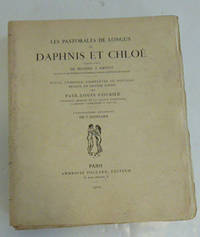
réf. 51-6792Paris: Ambroise Vollard 31 octobre 1902. 4to. 24.5 x 30cm. 10. 294 4pp.Original wraps in a contemporary half calf chemise with marbled boards in a matching slipcase repaired. One of 250 numbered copies.Francis Bouvet The Complete Graphic Work no. 75; Luc Monod Manuel. no. 7262; François Chapon Le Peintre et le livre pp. 67-68 -- The Artist & the Book 28 -- Rauch 22; OCLC Number / Unique Identifier:54167315.One of the most famous modern illustrated books – copy on hollande paper. Seduced by his first collaboration with Pierre Bonnard on Parallel by Verlaine 1900 Ambroise Vollard commissioned a second one from him these Pastorales. Where Parallel with its daring layout and the choice of printing the lithographs in pink had been disconcerting the layout of this second book is more classical the illustration being clearly separated from the text. However at the time of its publication it remained "shunned by bibliophiles who for a long time refused to see it as an appropriate illustration technique for luxury books because it was considered too commercial even vulgar" Limited edition. Vollard Petiet et l'estampe de maîtres pp. 44-45. .This judgment has largely been revised by their successors and the work is today considered one of the greatest successes of the illustrated book. Carteret Illustrés IV p. 242: a beautiful work highly sought after and highly rated. One of the greatest stars of modern books. ; « Like Bonnard’s earlier lithographs for Parallèlement and Manet’s for Le Corbeau these subtle plates had little appeal in 1902 for a public that preferred the sharply defined realism of the professional engraver.The book is today considered one of the finest of its period”. The Artist and the Book n°28 ; Mahé II col. 695 ; Mornand Vingt-deux artistes du livre pp. 45-46 “Daphnis et Chloé fut pour Bonnard l’occasion de montrer toute la souplesse de son talent non seulement par la pureté du style bien antique des personnages mais par le caractère des paysages essentiellement grecs”. Paris: Ambroise Vollard, 31 octobre 1902. paperback
réf. 05-06351968. Gouache painting on board. 1.5 x 17 inches. BellevueAnnotated titled and dated on the mount by the artist in pencil. Literature: Millard Sheets. One-Man Renaissance by Janice Lovoos and Edmund Penney p. 148. Authenticated by the artist's son Tony Sheets on the verso. "Hilton’s Rainbow Murals Perhaps second only to Diamond Head as a Waikiki landmark the rainbow murals adorning the mauka mountain and makai ocean ends of the Village’s Rainbow Tower are the world’s tallest ceramic murals. Designed by renowned artist Millard Sheets the colorful ceramic tiles climb the entire height of the 31-story tower. By design the murals welcome all visitors to Oahu regardless of their hotel choice; the focal point for the murals is 2.5 miles away which on the ocean side coincides with the air corridor in and out of Honolulu International Airport. An inscription in Hawaiian on the mural reads: “Ho’ola’a ia I na kanaka me o ka uhane o Hawaii” “dedicated to the people and spirit of Hawaii”. During 2004 the murals will receive a facelift of sorts – more than 100 tiles that have cracked broken or become badly weathered by the elements over the past 35 years will be replaced with exact recreations that will be impossible to discern from Sheets’ original masterpieces." 1968. unknown
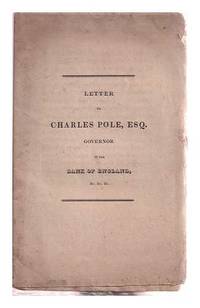
1820réf. 342776Publisher; Unknown 1820. First edition. Softcover. Specimen color/red plates 1 5 & 10 pound notes printed on single and double sides loosely inserted. Good copy; edges slightly nicked and dust-dulled as with age. An unread example with unopened pages. Remains particularly well-preserved overall; bright and clean. Additional scans and bibliographic detail on request. Date of publication is suggested. Physical description; 14 pp. Dis-bound as issued. Subjects; Bank of England.1800-1850. Bank notes - original currency samples -Great Britain. Banks and banking Central Great Britain. Currency - counterfeit and fraudulent - currency - forgery - nineteenth century. Currency printing - authentic registers. Pole served as Bank governor from 1820-1822 only. Publisher; Unknown paperback
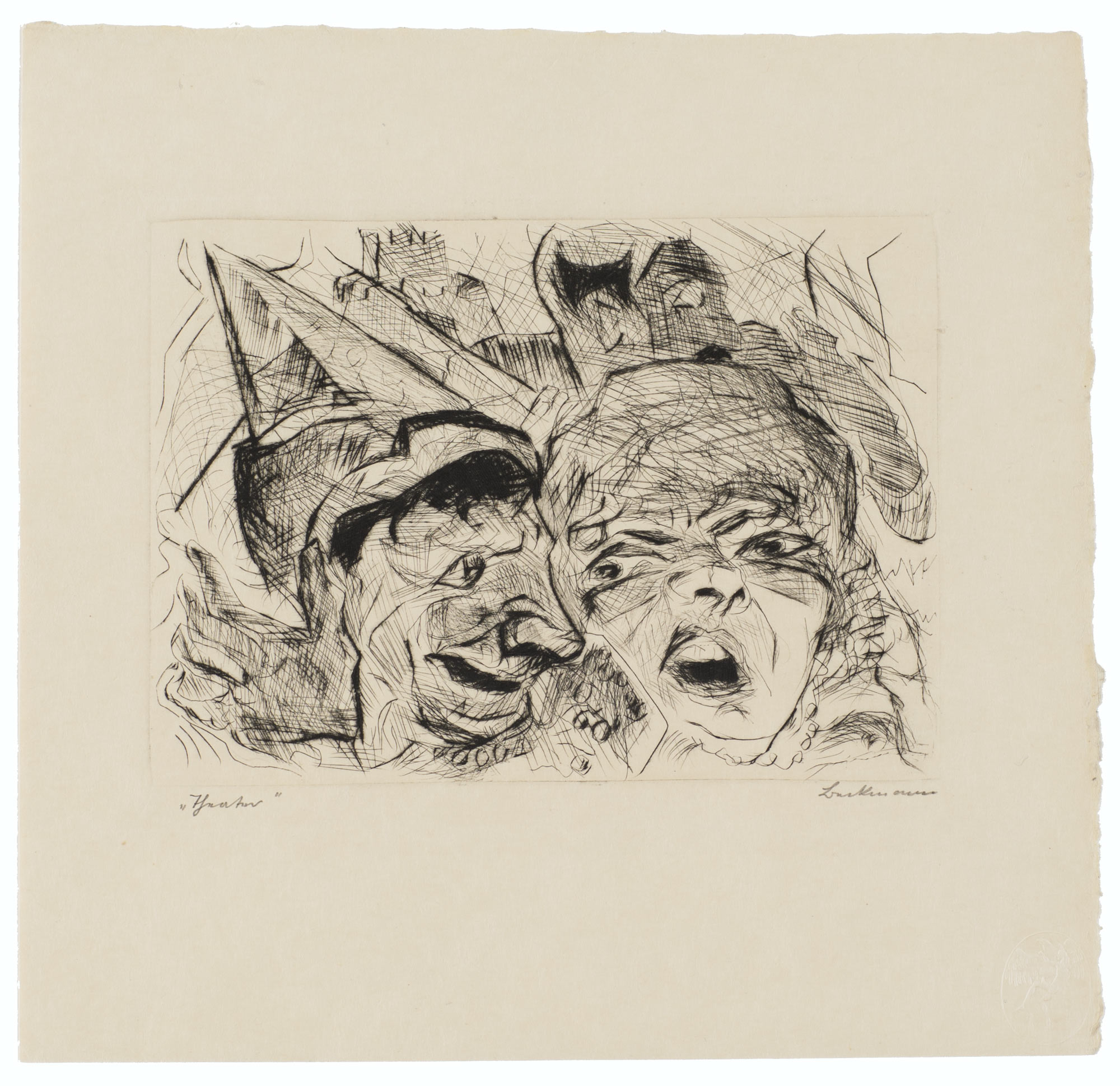
réf. EN-071o.J. Radierung, 1916, auf cremefarbenem, mit Bleistift betitelt, datiert und signiert. 12,5:17,3 cm.- Blatt 9 aus der Mappe ?Gesichter?. München, Verlag der Marées Gesellschaft R. Piper, 1919.- Vorzüglicher Abdruck mit vollem Rand und dem Blindstempel der Marées Gesellschaft. Eins von 40 Exx. auf Japan, vor Verstählung der Platte. Literatur: Hofmaier 89 B a; Beckmann Liste 85; Glaser 83; Gallwitz 66.
réf. EN-141o.J. Feder in Schwarz und Aquarell in Rot, auf chamoisfarbenem Velin, monogrammiert, bezeichnet und datiert ?peag / Berlin (19)30?, auf Karton montiert, dort betitelt, bezeichnet und datiert ?Café Lunte? / Orig. Zchg. / Berlin 1930? sowie signiert ?Peter-Anton Gekle.? - Dargestellt ist der Blick in das legendäre Café Lunte, dem Treffpunkt der Berliner Bohème der 1920er bis 1930er Jahre in der Eislebener Straße 11, an der Wand der dadaistische Spruch ?Anti chianti Chianti-Christ!?. - Die Eislebener Straße in Charlottenburg wurde ab 1893 angelegt und nach der Stadt Eisleben benannt, dem Geburts- und Sterbeort Martin Luthers. Sie ist nur 270 Meter lang und stellt eine der Verbindungsstraßen zwischen der Rankestraße und der Nürnberger Straße dar. Schon Anfang des 20. Jahrhunderts war die ?Eislebener? eine gutbürgerliche Adresse. Wie viele andere der umliegenden Straßen war auch die Eislebener Straße in den 1920er und frühen 1930er Jahren geprägt von der künstlerischen Bohème. In einem ehemaligen Zigarrenladen in der Eislebener Straße 11 residierte das kleine Café ?Die Lunte?. Man nannte sie ?wohl die verruchteste, billigste der Künstlerkneipen?, der renommierte Fotograf Umbo (d.i. Otto Umbehr, 1902-1980) fotografierte hier.
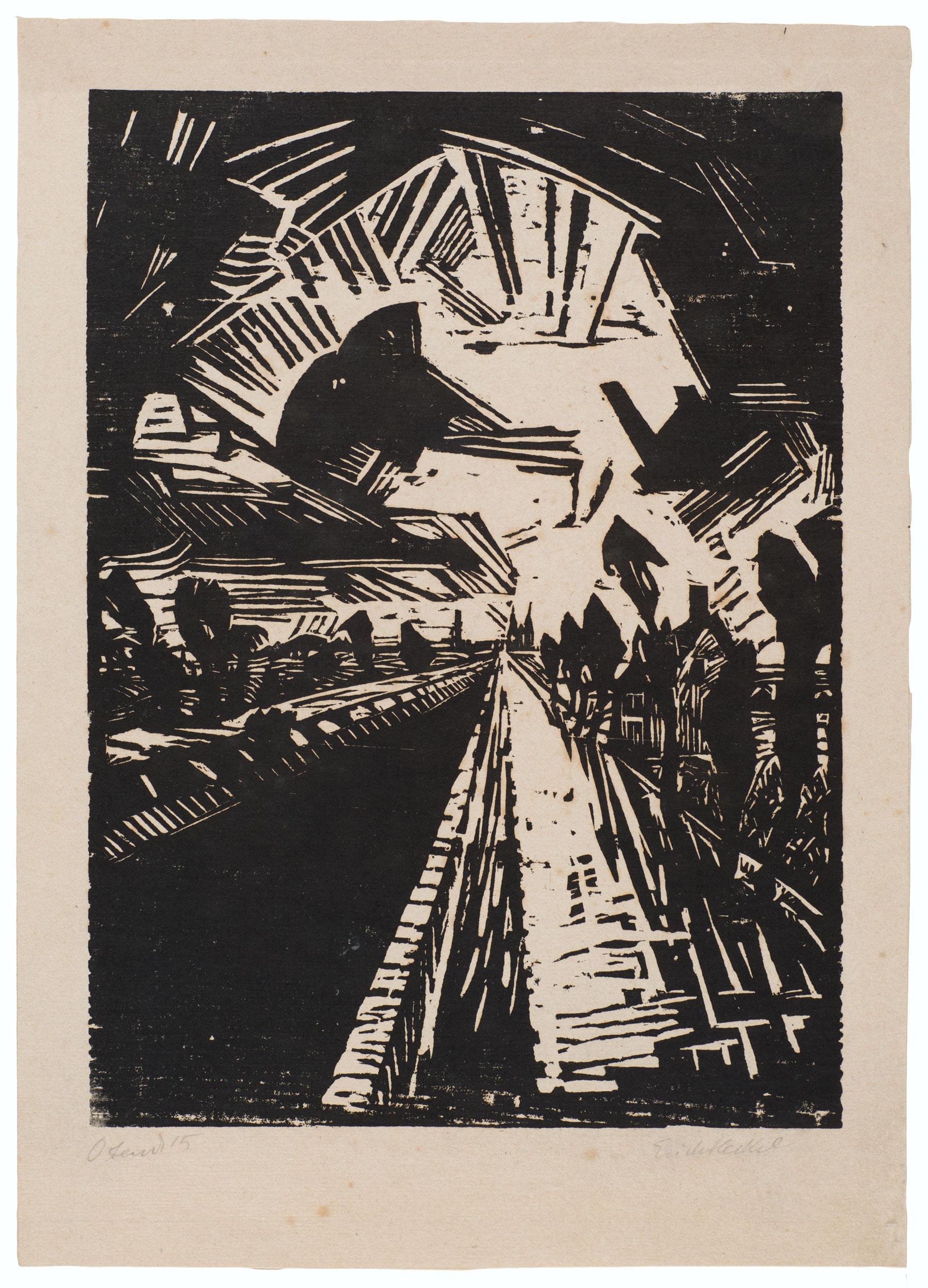
réf. EN-022o.J. Holzschnitt, 1915, auf Büttenkarton, mit Bleistift signiert, datiert und bezeichnet ?Ostende?. Darstellungsgröße 37:27 cm, Blattgröße 44,9:32 cm. - Die rechte obere Ecke leicht knitterig, im Rand mit vereinzelten Braunflecken. Literatur: Dube H 287, I (von III).
réf. 67457ABo.J. 67457AB Die gesamte Sammlung befindet sich in einem nahezu makellos frischen Zustand.
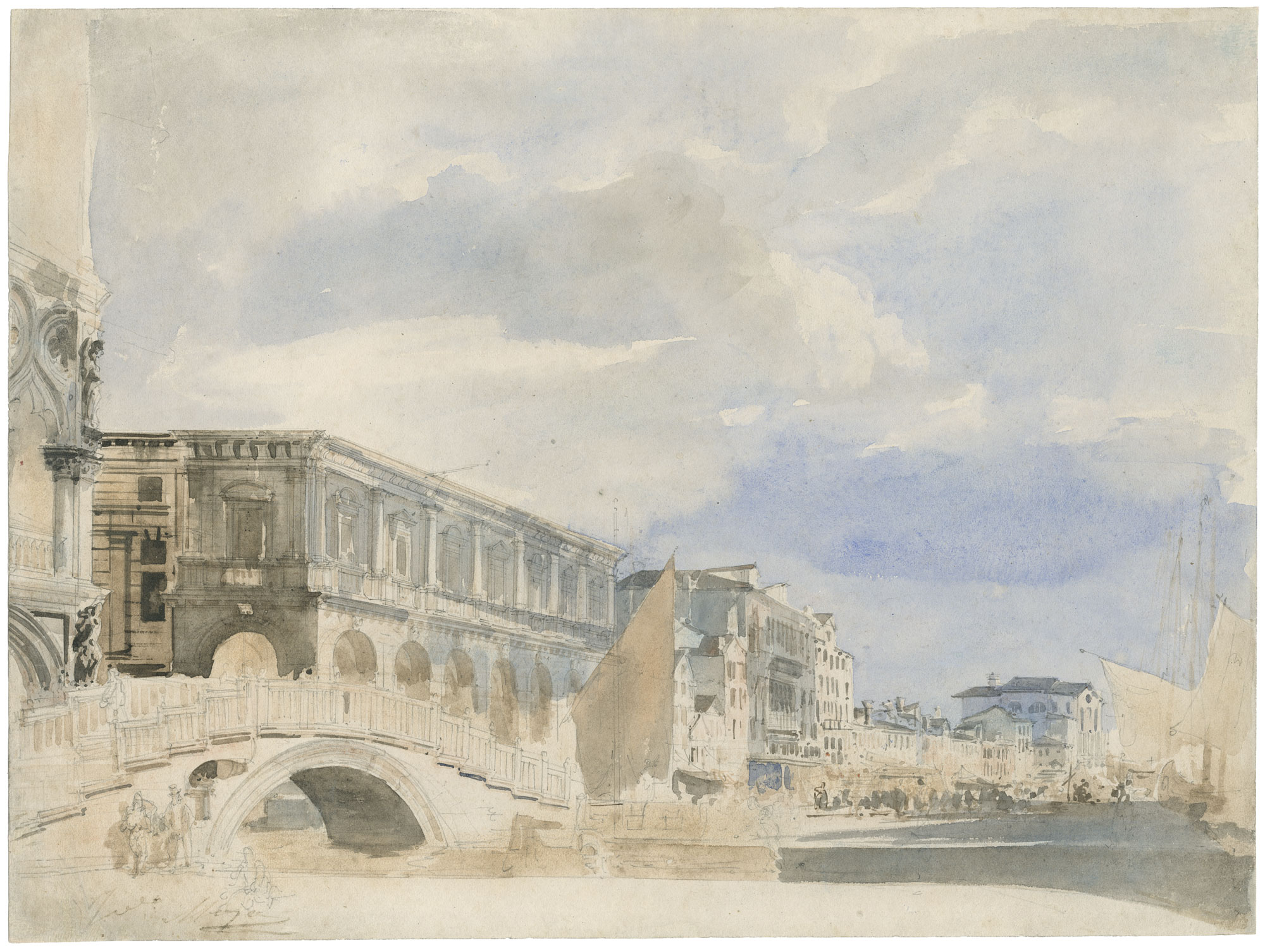
réf. 125-Io.J. Aquarell, über Bleistift, auf cremefarbenem Velin, links unten datiert und signiert ?Juli (1824) Meyer?. 23,1:31 cm. ? Verso am Oberrand leichter Papierabrieb durch alte Montierung. Die Ponte della Paglia ist eine Brücke in Venedig im Sestiere San Marco. Sie überspannt den Rio de Palazzo o de la Canonica und verbindet den Molo San Marco mit der Riva degli Schiavoni. Ihren Namen verdankt sie den mit Stroh beladenen Booten, die hier festmachten und von deren Existenz man aus verschiedenen Gesetzen und Erlässen der Republik weiß. Beispiele von Zeichnungen, die am Beginn des Italienaufenthaltes entstanden, der von Juli 1824 bis Anfang 1849 dauerte, kommen im Handel äußerst selten vor.
1635Acquaforte e bulino, 1635, firmata e datata in lastra in alto, a puntasecca: Rembrandt ft 1635; sotto l’ovale l’iscrizione Quem pia miarari plebes, quem castra solebant, / damnare et mores aula coacta suos. Jactatus multum, nec tantum fructus ab anni / WTENBOGARDUS sic tuus, Haga redit. HGrotius. (La corte secolare fu costretta a condannare sia l’uomo tanto ammirato, sia le sue convinzioni. L’Aja, il tuo Uytenbogaert ritorna a te dopo lungo errare, provato solo dagli anni. Ugo Grozio). Esemplare nel V stato di VI, con i margini della lastra ripuliti. Magnifica prova, impressa su carta vergata coeva priva di filigrana, rifilata al rame, leggere ossidazioni in basso, per il resto in ottimo stato di conservazione. Il ritratto raffigurato è quello del predicatore Johannes Uytenbogaert (1577-1644), all’età di settantotto anni. Personaggio illustre ed assai influente del tempo, divenne il leader della Rimostranza, una corrente liberale della chiesa calvinista che formalizzava la dottrina di Arminio. Al Concilio di Dort (1618- 1619) la Rimostranza fu condannata e i seguaci perseguitati: Uytenbogaert fu costretto all’esilio, per porter far ritorno all’Aja solo nel 1629. La didascalia di Grozio - a sua volta appartenente alla fazione dei rimostranti e esiliato nel 1635 – non si limita a rievocare questi eventi, ma intende sottolineare il ritorno di Uytenbogaert a L'Aja. È probabile che il ritratto sia ordinato per diffonderne le stampe fra gli amici e gli estimatori dell'anziano pastore. Potrebbe essere lo stesso Uy- tenbogaert a commissionarlo, ma non è detto. Due anni prima Rembrandt lo ritrae in un dipinto, su richiesta di Abraham Antonisz. Recht, un mercante favorevole ai rimostranti. In quella occasione Uytenbogaert posa per Rembrandt, mentre per l'acquaforte non è sicuro che ciò sia avvenuto: infatti, nelle due opere il viso dell'uomo è rappresentato in modo quasi identico, perfino nelle ciocche di capelli che sfuggono dallo zucchetto. Per la testa, Rembrandt deve essere partito da un disegno oggi perduto. Esemplare in cornice dorata settecentesca. Bibliografia Hind 128; Bartsch 279; White & Boon 279, V/VI; E. Hinterding, Rembrandt, Dipinti, incisioni e riflessi sul ‘600 e ‘700 italiano, p.120, 26. Etching and engraving, 1635, signed and dated at upper edge Rembrandt ft 1635. Inscribed in Latin beneath the image: Quem pia miarari plebes, quem castra solebant, / damnare et mores aula coacta suos. Jactatus multum, nec tantum fructus ab anni / WTENBOGARDUS sic tuus, Haga redit. HGrotius. Example of the fifth state of six. Magnificent work, printed on contemporary laid paper without watermark, closely trimmed to the platemark, light oxidations at lower part, otherwise in good condition. Johannes Uytenbogaert (1557-1644), an important political and theological figure of the period , was a leader of the Dutch Remonstrants and a former chaplain to Maurice, Prince of Orange. Following the views of Jacobus Arminius, the Remonstrants presented to the States-General in 1610 a 'Remonstrance', setting forth their points of divergence from stricter Calvinism. Attacked on all sides, they were expelled from the Netherlands by the Protestant Synod of Dort (1618-19), which declared Remonstrant theology contrary to Scripture. Allowed back in the Netherlands by 1630, they were officially recognised in 1798. The inscription, in Latin, is far more extensive than in Rembrandt's other prints, and was composed by the leading Remonstrant Hugo de Groot - a Remonstrant still in exile in 1635. It alludes to Wtenbogaert's piety and court service, as well as his 'comeback' to the Hague in 1629. Rembrandt had previously depicted Uytenbogaert in a painting of 1633, in which the minister stands before a table and a large opened book (the portrait survives in the Rijksmuseum). Bibliografia Hind 128; Bartsch 279; White & Boon 279, V/VI; E. Hinterding, Rembrandt, Dipinti, incisioni e riflessi sul ‘600 e ‘700 italiano, p.120, 26.
1980réf. 1014FBRoma., Galleria Pieroni., 1980. 23,6 x 17,1 cm. 12 unpaginierte S. OKarton, der vordere Deckel mit grauem Lack handgesprüht., 1014F Einband verso etwas stockig, sonst sehr gutes Exemplar.
1845réf. ST21010Paris: Imprimerie de Wittersheim 1845. 182 x 120 mm. 7 1/8 x 4 3/4". 24 pp. Original tan printed wrappers with several small expert repairs to back stitched as issued. Housed in a tan paper-covered chemise with black morocco label and gilt lettering and matching slipcase. With eight wood-engraved plates by Porret after George Catlin. Sabin 47467; Howes 500. Some harmless fraying along bottom edge of wrapper covers just a little soiled text a bit toned and lightly foxed two small open tears to last two leaves but the important illustrations printed on a better quality of paper bright and pleasing. With some inevitable defects given what it is but still an excellent copy of a fragile pamphlet. This is a well-preserved copy of the fragile and uncommonly seen brochure recording the famous mid-19th century Paris performances of Ioway Indians and George Catlin's celebrated Native American portraits a visit that caused a sensation among Parisians. Catlin 1796-1872 walked away from a Pennsylvania law practice at age 25 in order to pursue his dream of becoming an artist. He achieved some success as a portrait painter but found the work dull. After seeing a delegation of Native American leaders from the Western states in Philadelphia and perhaps being influenced by the fact that his mother had been captured for a time by the Indians in 1778 he decided to dedicate himself to memorializing those tribes whose traditional way of life was being destroyed. He travelled throughout the American interior where he met and painted people from many indigenous groups making an effort to depict realistically their traditional ways of life. ANB says that his paintings "show people not romantic stereotypes and the ethnographic value of his work has only appreciated with the passage of time." He staged exhibitions of his work in the United States then worked with promoter George H. C. Melody to take his exhibition across the Atlantic to tour Europe. They were accompanied by Chief Francis White Cloud d. 1859 and 11 other members of the Iowa or Ioway tribe along with translator Jeffrey Deroine also Doraway 1806-59 a formerly enslaved African American who had been raised near the Iowa and leveraged his language skills into a successful career as a diplomat and interpreter. Arriving in Paris in 1845 the exotic entourage which featured Catlin's paintings alongside performances by the Iowa contingent was an enormous success impressing a great many visitors including among the famous Charles Baudelaire Benjamin Disraeli Victor Hugo and George Sand. The present pamphlet produced as a record of the visit includes eight reproductions of Catlin's paintings along with a description of the Native American visitors an account of their meeting with King Louis-Phillipe and ethnographic excerpts from the Office of Indian Affairs. This work infrequently appears on the market: we could trace only two copies at auction since 1966. Our copy with the delicate wrappers largely intact and retaining its original stitching is especially desirable. Imprimerie de Wittersheim unknown
1845réf. ST21010Paris: Imprimerie de Wittersheim 1845. 182 x 120 mm. 7 1/8 x 4 3/4". 24 pp. Original tan printed wrappers with several small expert repairs to back stitched as issued. Housed in a tan paper-covered chemise with black morocco label and gilt lettering and matching slipcase. With eight wood-engraved plates by Porret after George Catlin. Sabin 47467; Howes 500. Some harmless fraying along bottom edge of wrapper covers just a little soiled text a bit toned and lightly foxed two small open tears to last two leaves but the important illustrations printed on a better quality of paper bright and pleasing. With some inevitable defects given what it is but still an excellent copy of a fragile pamphlet. This is a well-preserved copy of the fragile and uncommonly seen brochure recording the famous mid-19th century Paris performances of Ioway Indians and George Catlin's celebrated Native American portraits a visit that caused a sensation among Parisians. Catlin 1796-1872 walked away from a Pennsylvania law practice at age 25 in order to pursue his dream of becoming an artist. He achieved some success as a portrait painter but found the work dull. After seeing a delegation of Native American leaders from the Western states in Philadelphia and perhaps being influenced by the fact that his mother had been captured for a time by the Indians in 1778 he decided to dedicate himself to memorializing those tribes whose traditional way of life was being destroyed. He travelled throughout the American interior where he met and painted people from many indigenous groups making an effort to depict realistically their traditional ways of life. ANB says that his paintings "show people not romantic stereotypes and the ethnographic value of his work has only appreciated with the passage of time." He staged exhibitions of his work in the United States then worked with promoter George H. C. Melody to take his exhibition across the Atlantic to tour Europe. They were accompanied by Chief Francis White Cloud d. 1859 and 11 other members of the Iowa or Ioway tribe along with translator Jeffrey Deroine also Doraway 1806-59 a formerly enslaved African American who had been raised near the Iowa and leveraged his language skills into a successful career as a diplomat and interpreter. Arriving in Paris in 1845 the exotic entourage which featured Catlin's paintings alongside performances by the Iowa contingent was an enormous success impressing a great many visitors including among the famous Charles Baudelaire Benjamin Disraeli Victor Hugo and George Sand. The present pamphlet produced as a record of the visit includes eight reproductions of Catlin's paintings along with a description of the Native American visitors an account of their meeting with King Louis-Phillipe and ethnographic excerpts from the Office of Indian Affairs. This work infrequently appears on the market: we could trace only two copies at auction since 1966. Our copy with the delicate wrappers largely intact and retaining its original stitching is especially desirable. Imprimerie de Wittersheim unknown books
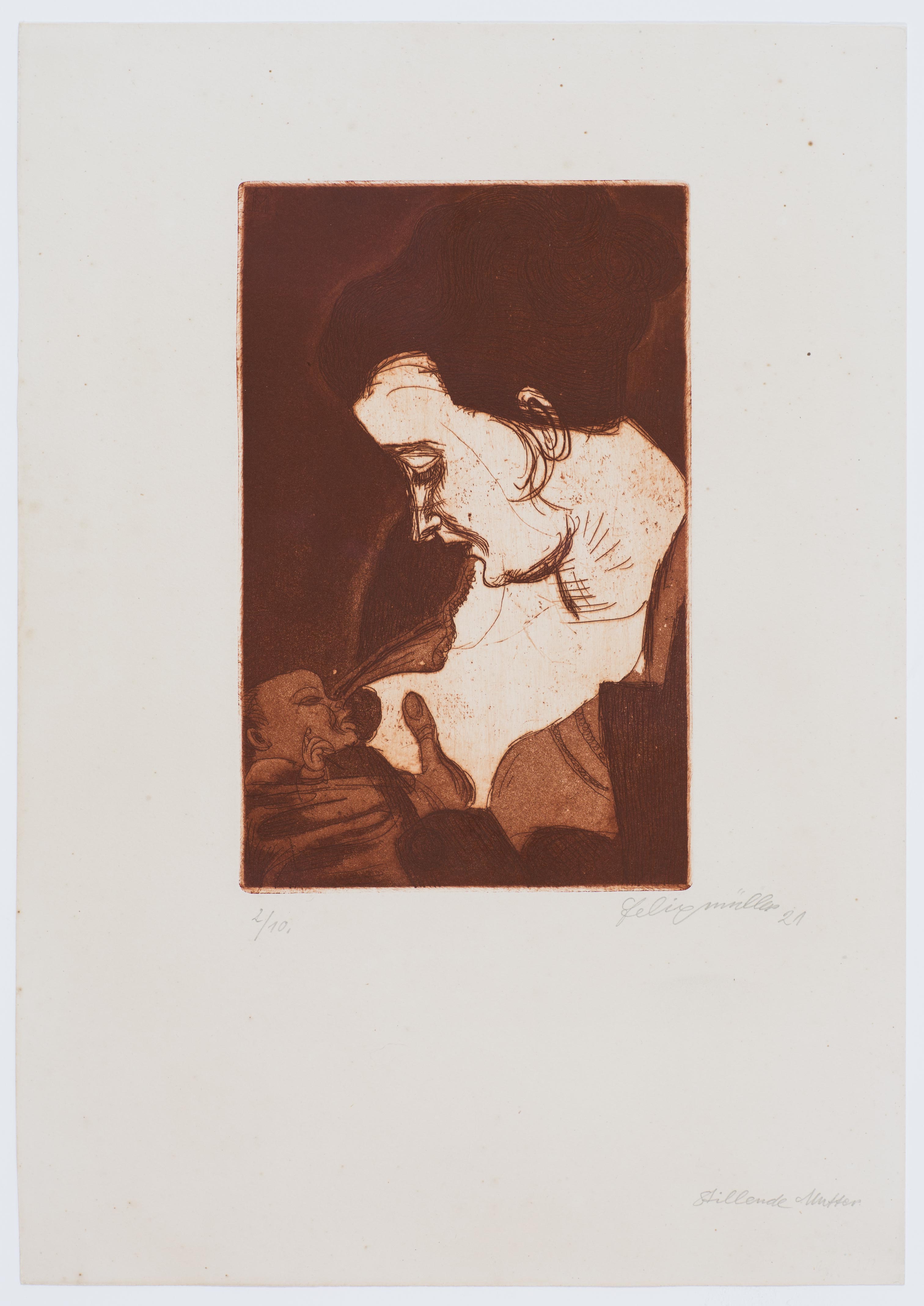
réf. EN-103o.J. Aquatinta und Radierung, 1921, gedruckt in Rotbraun, auf cremefarbenem Kupferdruckkarton, mit Bleistift nummeriert, signiert und datiert ?Felixmüller 21? sowie betitelt ?Stillende Mutter?. Darstellungsgröße 27,8:17,4 cm, Blattgröße 49,4:34,7 cm. ? Mit vereinzelten Stockflecken. Literatur: Söhn 251b (von b). ? Nr. 2 von 10 Exx. ? Vorzüglicher Abdruck mit viel Grat! [3 Warenabbildungen]
1813réf. 18016Somerset PA: Friedrich Goeb 1813. First Edition. Original blind ruled calf over oak boards. Good; joints & hinges cracked; front oak board has a vertical split; front cover nearly loose; some peripheral marginal water stains; straps missing. Large 4to 4 527 66 2 169 3 pp. Accompanied by three 18th century printed hymns and a large inserted color Fraktur bookplate signed by the scribe. A unique copy of this bible from the Yaukey Yocky family.The Goeb printing of Luther's bible in Somerset is historic in itself; especially so given the generous format Goeb chose for his work. What makes this copy unique is the laid-in copies of three printed hymns; two from "Sisters" of the Ephrata Cloister but all originating at Snow Hill. Catherine Redelsberger and Barbara Schneeberger for whose family farm the Snow Hill sanctuary was named were among the earliest American women converts to Beissel's Seventh-Day Baptists. Andreas Schneeberger is represented here by a hymn printed at the Cloister on laid paper clearly watermarked CB in a "fluttering heart" Gravell #198. It is most likely that the Redelsberger hymn was also printed at the Cloister but there is no watermark. The three broadside printings are: 1 Der Schw. Catharina Redelsberger Glaubens-Lied. Unlocated. 2 Geistliches Trauer-Lied gestellt von Schw. Barbara Schneeberger. Unlocated 3 Wurde abgesungen den 31ten August 1793: Bey B. A. S. auf dem jährlichen Fest an der Antitum. Printed at the Cloister. Attributed to Andreas Schneeberger. Shipton & Mooney #26144 with the entry taken from Seidensticker and no location provided. There apparently is one copy at HSP. These ephemeral publications were sold through western Pennsylvania by itinerant peddlers or after meetings see Yoder pp. 42 - 44 barely noting any from the 18th century. Few survive. The three offered here must have been acquired by the Yaukey family 20 years before the Goeb bible was printed and retained for generations within the family. They are spotted and toned and irregularly trimmed. The Fraktur bookplate in the bible is large 285 x 230 mm. It is a geometric lettered design in four colors green yellow red brown that is signed and dated: Samuel Jackson Sept. 14 1827. In all an outstanding survival. S & S #27883; Gravell #198. Friedrich Goeb hardcover books
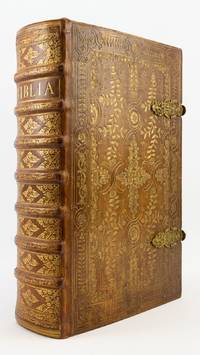
1752réf. ST19424Stockholm: Tryckt af Henrick Christoph Merckell 1724-28; Peter Jöranson Nyström 1752. 422 x 275 mm. 16 5/8 x 11". 30 p.l. 1 leaf section title 234 2 section title 235-604 2 section title 605-908 2 section title 909-1387 1 pp.; 4 p.l. 300 4 301-666 pp. STATELY CONTEMPORARY CALF INTRICATELY GILT IN THE FANFARE STYLE over bevelled wooden boards covers with strapwork frame containing lilies and floral garlands central panel with strapwork rows of floral crosses the spaces between with floral sprays emerging from urns very expertly rebacked preserving original backstrip raised bands spine compartments with flowers-and-pomegranate centerpieces floral cornerpieces gilt lettering two decorative brass clasps catch plates and original straps turn-ins with lattices and floral ornaments marbled endpapers edges gilt and delicately gauffered. Five section titles with engraved vignettes. With ink presentation inscription celebrating the baptism of Claës Georg Listromer on 20th November 1604 and expressing the hope the Book will bring him wisdom as he grows signed by Claës Lindman dated 17th September 1605. A 20th century Swedish inscription below tracing the book's descent through generations of the Listromer family into the 1920s. Darlow and Moule 8821 8826. Slight variations in color of the leather Ffff8 with lower corner torn away not affecting engraving occasional faint offsetting but AN EXTREMELY CLEAN FRESH COPY in a binding bright with gilt. This impressively bound Swedish Bible was a baptism gift that clearly would have outweighed its recipient as Swedish law at the time required an infant be baptized within the first eight days of life. Although hardly practical for personal devotion and study the majestic tome was a treasured heirloom passed down in the same family for 200 years. The beautiful fanfare style seen here emerged in France in the 16th century but remained very popular in Northern Europe into the 18th century particularly for large "lectern" Bibles like the present item. The text here is an extensively annotated edition of the 1618 Gustave II Adolf Bible prepared by a father and son both named Johannes Gezelius who served successively as Bishop of Åbo. The New Testament was first printed in that city in 1711-13 the Old Testament in Stockholm in 1724-28. In our copy the New Testament is a 1752 reprinting. Tryckt af Henrick Christoph Merckell, 1724-28; Peter Jöranson Nyström unknown