46 662 résultats
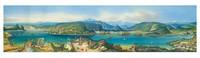
1850réf. 42496Italy 1850. Watercolour over faint etched line black gouache border. Period gilt and faux bois frames. A splendid panoramic view of Lake Maggiore. Catering to the foreigners flocking to the region on The Grand Tour this hand-painted print beautifully depicts the famed picturesque lake with rich bands of blue highlighting the water and sky with the surrounding hills and mountains dotted with luxurious villas. In this view of Lake Maggiore we see from a very high vantage point the Borromean Islands: Isola Bella Isola Madre and Isola dei Pescatori with their extraordinary gardens. unknown books
réf. 8616119th century Japan - Album of 42 original tinted albumen photographs of Japan Alaska and Sir G. Baden-Powell and Sir G. Dawson seal expedition in 1891 N.p. N.d. c. late 19th C 1891 Oblong 14 x 18.5cm album disbound accordion style. Paper mache over wood boards with an intricate embossed design and gold and red pigment. Stiff card pages are bordered in pale blue with mounted tinted album photographs 10.8 x 14cm. Most are captioned in pencil in English in the margins of the card mounts. The leaves are disbound/unhinged. 25pp 42 photos. 8 of the 50 sides are blank with no photo mounted. There is no evidence of any photos having been removed. The posed Japanese photos appear to be from photography studios in Japan that catered to tourists. Among these studio portraits are photos of sumo wrestlers women with umbrellas in a rickshaw washing and applying makeup and posing as dancers. There are also picturesque views of Nagasaki. A photo of the bronze horse statue at Suwa Shrine è«è¨ªç¥žç¤¾ Suwa Jinja in Nagasaki mislabeled a ‘temple’ in the album does not have an enclosure around it dating it to between 1870 when it was first dedicated and 1913 as a corral was built around it during the Meiji period. Scenes of villages from the Aleutian Islands of Alaska are pictured as well as locations in Russia. Included are photos of people on a rustic main street in Petropavlovsk Russia the SSS Danube in Avacha Russia a seal rookery and a group photo that includes Sir George Smyth Baden-Powell 1847–1898 and scientist and explorer Sir George Dawson 1849– 1901. On June 23 1891 an article appeared in the NY Times stating that the two men were made British Commissioners in the Bering Sea seal question and an October 22 1891 article from the same newspaper announced the arrival of Baden-Powell and Dawson in Ottawa Canada after returning from the expedition to observe seal hunters dating the photos from late June to October of 1891. This expedition was important in gaining evidence that was used in arbitration that voted in favor of England against the U.S. As the expedition was an official one undertaken largely in secret it is possible that the photos of the area were taken by a member of that expedition likely a Westerner and skilled amateur or professional photographer. A full report of that expedition undertaken on the chartered steamer Danube also in the photos was accessed 1.2.23. https://babel.hathitrust.org/cgi/ptid=hvd.hwyprv&view=1up&seq=11 The British Man-O’-War Porpoise which is included in the photographs is mentioned as accompanying the group. Photos overall are in good condition a few are slightly faded some with tissue guards interleaved. Chipping to edge of cover. An unusual combination of studio and candid photos with historic significance in stunning lacquer paper-mache covers. unknown books
1927réf. 2406Paris 1927. Staplebound. Color illustrated and embossed wraps. Very good. 39 pages. 22 x 14 cm. Elaborately illustrated French trade catalog. Covers lightly rubbed. paperback books
1870réf. 822261870. 19TH CENTURY. TUDOR WHARVES ICE: THE SHIPS ANAHUAC LUCY S. WILLS AND ANNA DECATUR. Photographer unknown. ca. 1870. Matted framed original photograph matted to 11 x 17 inches. Diagonal vista: The ships Anahuac Lucy S. Wills and Anna Decatur load ice at the Tudor Wharves Charlestown Massachusetts. The first two ships were East Boston-built and Boston-registered; the latter was built and registered in Portsmouth New Hampshire. Charlestown Bridge is in the foreground with one lone spectator observing the shipyard docks. Frederick Tudor known as "The Ice King" combined two trades without much apparent connection ice and sawdust and by using the sawdust for insulation was able to create a shipping industry in New England that reached the far East and South America. Some vertical bands of toning faintly apparent from original wood backing. 338-9 Bunting "Portrait of a Port: Boston 1852-1914. unknown books
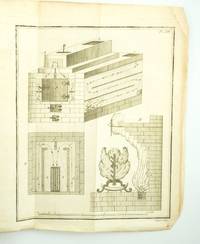
1792réf. ST20535-05Paris: L'imprimerie de Valade fils aîné 1792. 210 x 130 mm. 8 1/4 x 5 1/4". xviii 3 22- 152 pp. Translated by J. Goy. Publisher's blue paper wrapper flat spine with paper label hand-lettered in ink edges untrimmed three quires UNOPENED. With 14 folding engraved plates. First section with an attractive woodcut headpiece of a pastoral landscape; floral woodcut tailpieces throughout. VD18 11592109 first edition. Front joint cracked joints and spine with apparent chipping first quire thinking about detaching but the volume still intact and retaining much of its fragile antique appeal. The text clean and fresh with the plates being crisp and well preserved. In its original paper wrappers this is an exceptionally well-preserved copy of a scarce work on stoves heating and saving wood first printed in Quedlinburg in 1790. Our author Johann Heinrich Sachtleben writes in the introduction that he composed this book on efficient and economical heating in response to increasing wood prices throughout Europe. The 14 engraved plates done in imitation of those in the German edition are particularly appealing. The technical depictions of chimneys and cooking apparatuses are joined by illustrations of stylish heating stoves with artistic decorative elements. This is quite a rare book: OCLC finds no copies in American institutions. And we have been unable to trace any copies of this French edition at auction and only two copies of the German edition. Our copy is distinguished by the state of preservation of its original wrappers assembled by the publisher as a temporary binding using unmatching endleaves repurposed from other volumes never intended to have lasted as the book's binding for well over two centuries. L'imprimerie de Valade, fils aîné unknown books
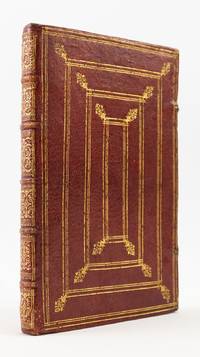
1651réf. ST19567-214Paris: Chez F. Mazot 1651. 172 x 110 mm. 6 3/4 x 4 1/4". 3 34 leaves 35-39 1 pp. 12 leaves. Fine old contemporary red morocco covers panelled with gilt fillets with flowering urn cornerpieces raised bands the spine densely gilt in compartments with scrolls and dots two clasps marbled endpapers all edges gilt. ENGRAVED THROUGHOUT WITH 38 FULL-PAGE ILLUSTRATIONS consisting of one portrait two allegorical religious scenes including title and 35 illustrations of the Holy Eucharist plus 44 PAGES OF ENGRAVED TEXT 37 of these with text flanked by full-length figures of saints accompanied by other religious symbols at head and foot of page six framed with vignettes of angels the Madonna or scenes from the life of David one page with text only. Contemporary ink inscription to the lower margin of the title page reading "In Archui. vitr." Endleaf with engraved armorial bookplate of Viscount Strathallan; front pastedown with the bookplate of John Evelyn. Duportal pp. 244-45; Brunet V 624; Graesse VI 4. Trivial rubbing to the extremities leather straps slightly worn but holding strong but A SUPERB COPY exceptionally clean fresh and bright internally and in its solid and unsophisticated and still very pleasing binding. This is a particularly attractive copy of a sumptuously illustrated prayer book in its especially appealing original 17th century binding. According to Duportal it is "One of three important publications whose engravings reveal the trend characteristic of religious illustrations in France between 1601 and 1660." The work opens with a dedication to Charles d'Aubespine Marquis de Châteauneuf 1580-1653 with a full-page portrait by Guillame de Gheyn b. 1610. Then the bulk of the book is made up of two groups of plates. Those in the first group appear primarily on the rectos and contain prayers in Latin and French flanked by pairs of saints; gaps in the prayers are filled by naturalistic flowers insects and birds. Many of these plates also include a scene or two in miniature depicting the life of the saints or a vignette of angels. Just two of these engravings are signed "J. Collin" but they all appear to be in the same hand and demonstrate an impressive level of finesse and delicacy with emotive graceful saints depicted with sure light lines. Duportal notes that our artist had a "talent charmant" and that well-executed dry-points of this type are quite rare in French books of the period. The second group of engravings appear on the versos and depict the performance of a part of the Mass beneath a cloud in which appears a relevant scene from the life of Christ. They are all unsigned and clearly by a different hand with more rustic features--possibly "copies of originals published abroad" according to Duportal. The book concludes with text framed by gamboling putti and scenes from the life of Christ and facing full-page bust portraits followed by the Penitential Psalms each with elaborate illustrated frames depicting scenes from the life of David. Copies of this work can be found with varying numbers of leaves and engravings but the present item seems to be an early edition as it contains the earlier state of the engravings on the versos before they were substantially reworked and it does not contain the "Privilege du Roy" with the date 1652 or 1653. Our copy comes from the books assembled by the famous diarist John Evelyn 1620-1706 a library that Quaritch's dictionary of English book collectors calls "a noble collection." De Ricci says that the finest books from the library bear Evelyn's monogram as ours does and this bookplate brings with it the expectation of remarkably fine contemporary condition. This copy also has the bookplate of Viscount Strathallan possibly William Drummond 1810-86 Conservative MP and the second to hold the family title following the reversal of the attainder put in place after his family's participation in the Jacobite uprising. Chez F. Mazot unknown books
1800réf. 409761800. Depicting couples from various regions with accoutrements as named in each lower margin unsigned. Image size: 10 1/2 x 8 3/4 inches. Sheet size: 13 3/8 x 10 3/8 inches The group consists: 1. Di Pesco Costanza Contado di Molise 2. Paese di Sessano Provincia Contado di Molise 3. Massagronica Provincia si Chiete Abruzzo Citra 4. Passe di Monte Aldiero Provincia d'Aquila. This group of watercolours showcases couples from various mountainous villages in the Abruzzo and Molise regions of Italy. Dressed in traditional garb each couple's attire highlights the distinct differences in the dress across this region to the east of Rome as well and the delicately ornate clothing of the time complete with bright colours intricate patterns and fascinating accessories. Each couple is beautifully captured in gauche executed with delicate brushwork and vivid colours that bring the characters to life capturing the essence of each couple's culture and lifestyle. The drawings offer a glimpse into Italy's rich and diverse heritage presenting a window into the customs and traditions of its people through their traditional clothing and accessories. unknown books
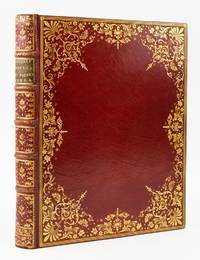
1772réf. ST18628bBirminghamiae: Typis Joannis Baskerville 1772. First Baskerville Edition. 310 x 260 mm. 11 7/8 x 9 3/4". 1 p.l. 200 221-372 pp. but complete. SUPERB CONTEMPORARY RED MOROCCO LAVISHLY GILT IN THE STYLE OF DEROME covers with wide dentelle frame composed of botanical elements and many small tools raised bands spines gilt in compartments with central floral sprig surrounded by acorns flowers stars and dots volute cornerpieces green morocco labels gilt turn-ins marbled endpapers all edges gilt. Front pastedowns with engraved bookplate of P. Dupont and with morocco heraldic book label. Gaskell 44. ◆A breath of rubbing to extremities title page a little browned final page a bit foxed other trivial imperfections but AN EXCEPTIONALLY FINE COPY internally clean smooth and bright and in a sparkling binding. This is the impressive quarto edition of a trio of great Roman love poets in a premier binding befitting the elegant printing. In a sheet dated 1760 which Baskerville issued appended to a specimen of his folio Bible the printer discusses his proposed "Baskerville Classics": "Many gentlemen" he says "have wished to see a sett of the Classicks . . . in the Manner Letter and Paper of the 'Virgil' already published" and he vows to print the same with the poetical classics first. The present items are from what turned out to be seven Baskerville quarto printings of the classics mostly done late in the printer's career but according to Reed bearing "the marks of unabated genius." These volumes says Reed would "suffice had Baskerville printed nothing else to distinguish him as the first typographer of his time." In the present works the stately typography the luxurious paper textured but feeling rather like vellum and the spacious design combine to give the reader a particularly gratifying feeling of strength and serenity. The extraordinarily smooth surface of our leaves provides a tactile experience not available from any other 18th century printer Bodoni included. The beautiful binding here is unsigned but is clearly the product of a first-rate workshop; while it is not uncommon to see a volume from the Baskerville quartos in a decorative contemporary binding the present one would have a place in the front row of any assemblage. Typis Joannis Baskerville unknown books
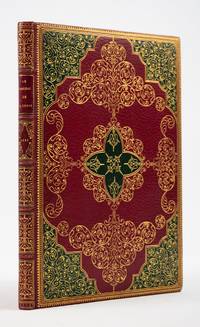
1651réf. ST20278Paris: Chez F. Mazot 1651. 172 x 118 mm. 6 3/4 x 4 3/4". 3 34 leaves 35-39 1 pp. 2 leaves. LOVELY CRIMSON CRUSHED MOROCCO GILT AND ONLAID BY CAPÉ stamp-signed on front turn-in covers with onlaid green morocco cornerpieces and central quatrefoil all filled and surrounded by delicate pointillé tooling in floral and paisley designs raised bands spine compartments tooled in pointillé gilt lettering richly gilt turn-ins marbled endpapers all edges gilt. In a felt-lined morocco-lipped marbled paper slipcase. ENGRAVED THROUGHOUT WITH 38 FULL-PAGE ILLUSTRATIONS consisting of one portrait two allegorical religious scenes including title and 35 illustrations of the Holy Eucharist 40 pages of engraved text 37 of these with text flanked by full-length figures of saints accompanied by other religious symbols at head and foot of page two framed with vignettes of angels or the Madonna one page with text only. Front pastedown with "A W F" book label of bookseller Adrian Fluhmann. Duportal "Étude sur les livres à figures" pp. 244-45; Brunet V 624; Graesse VI 4; Leaves perhaps very lightly washed and pressed but an extremely fresh clean copy IN A SPARKLING BINDING. Covered by a luxurious binding by Capé this is a particularly attractive copy of a sumptuously illustrated prayer book composed entirely of engraved plates. According to Duportal it is "One of three important publications whose engravings reveal the trend characteristic of religious illustrations in France between 1601 and 1660." The work opens with a dedication to Charles d'Aubespine Marquis de Châteauneuf 1580-1653 with a full-page portrait by Guillame de Gheyn b. 1610. The bulk of the book is made up of two groups of plates. Those in the first group appearing primarily on the rectos contain prayers in Latin and French flanked by pairs of saints; gaps in the prayers are filled by naturalistic flowers insects and birds. Many of these plates also include a scene or two in miniature depicting the life of one or both of the saints or a vignette of angels. While just two of these engravings are signed "J. Collin" they all appear to be in the same hand which demonstrates an impressive level of finesse and delicacy depicting graceful figures with sure light lines. Duportal notes that this artist had a "talent charmant" and that well-executed dry-points of this type are quite rare in French books of the period. The second group of engravings appear strictly on the versos and depict the performance of a part of the Mass beneath a cloud in which appears a relevant scene from the life of Christ. They are all unsigned and clearly by a different hand with more rustic features--possibly "copies of originals published abroad" according to Duportal. The book concludes with two leaves of text framed by gamboling putti and the Virgin. Copies of this work can be found with varying numbers of leaves and engravings apparently the result of multiple reprintings with added material produced between 1651-53 but the present item can be distinguished as an early if not the very first edition as it does not contain "Privilege du Roy" dated 1652 or 1653. Furthermore our copy also contains the earliest state of the plates without the "I N R I" initials on the cross found on the title page and with the earlier state of the verso engravings before they were substantially reworked. Our edition seems to be quite rare with OCLC finding just one other copy with the same sequence of contents at the Bibliothèque Sainte-Genevieve. The stunning binding by Capé looks just as fresh and lustrous as the day it left its workshop. One of the most distinguished binders in France in the middle years of the 19th century Capé d. 1867 was especially well known for the delicacy of his work--which can be appreciated to full effect in the present example. He was the binder to the Empress Eugénie and Béraldi calls him "the Bozérian of the second Empire." This is precisely the kind of book our former owner the discriminating connoisseur-bookseller Fluhmann would have owned. Chez F. Mazot unknown books
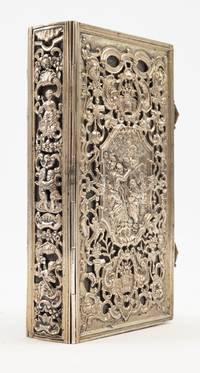
1885réf. ST20549cOxford: Printed at the University Press for Peacock Mansfield and Britton London ca. 1885. 146 x 80 mm. 5 3/4 x 3 1/8". 536 pp. IN A LOVELY 18TH CENTURY SILVER BINDING over contemporary brown morocco DONE IN THE FRENCH RÉGENCE STYLE combining piercing with repoussé ornamentation the covers with central cartouche depicting a scene from the life of Christ in repoussé that on the front cover showing the Baptism of Christ with two hallmarks at the upper left an "A" and a rooster that on the lower cover showing the Ascension this surrounded by a pierced frame of rocaille drawer handles vases of flowers swans a leafy fronds spine pierced with rocaille and flowers separating three allegorical putti ornaments representing Faith Hope and Charity two openwork rocaille clasps. Endpapers rather worn at fore edge isolated very faint foxing otherwise A FINE COPY the text clean and fresh and THE SILVER BINDING SPARKLING AND UNMARRED. This glittering binding is a lovely example of 18th century silverwork in nearly flawless condition. While we have been unable to identify the maker the binding is probably French. A silver binding on a 1686 copy of a Rotterdam "Speculum Poenitentiae" catalogued by Antiquariat Roo is identical to ours in size and design except for the content in the large central frames and is identified by them as French. They find a master's mark of "T. G" beneath the front scene not present on our binding. In any case the delicate symmetrical ornamentation featured on our binding is typical of French Régence decorative arts with scrolls studded with naturalistic embellishments that reward close inspection. Many charming details are hidden within the sea of volutes such as the swans stealing treats from overflowing baskets of fruit. The central scenes from the life of Christ come to life through meticulous execution as our silversmith has taken great care with the details: water trickles from John the Baptist's outstretched arm and voluminous curls of cloud frame Christ's Ascension. The later Book of Common Prayer the binding now contains is a testament to the binding's enduring appeal as a precious devotional object. Printed at the University Press for Peacock, Mansfield, and Britton, London unknown books
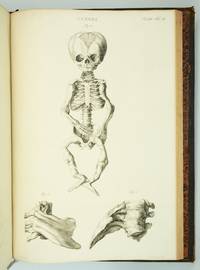
1793réf. ST20586Lugduni Batavorum Leyden: S. & J. Luchtmans 1793 1827 1835. FIRST EDITION A COMPLETE SET. 525 x 350 mm. 20 3/4 x 14". Four volumes. First two volumes in contemporary cat's paw calf volumes III and IV in contemporary flamed calf raised bands spines gilt in compartments with central fleuron one red and one black morocco label. WITH 206 ENGRAVED ANATOMICAL PLATES all with guards. Front pastedowns with bookplate of Harvard Medical School Library; library shelf markings in white at bottom of spines; bookseller's ticket of Schönhof & Mueller Foreign Books Boston. Bibliotheca Walleriana 8549; Choulant pp. 312-13; Larousse XIX vol. 14 p. 171. Lucas L. Boer Peter L. J. Boek Andries J. van Dam and Roelof-Jan Oostra "History and highlights of the teratological collection in the Museum Anatomicum of Leiden University The Netherlands " American Journal of Medical Genetics Part A Volume 176 no. 3 2018 pp. 618-37. Shallow chips across the tail of first two volumes covers variably abraded one noticeably so corners somewhat worn partially with boards showing through vague additional signs of wear but the bindings solid and retaining much of their original appeal; plates in first two volumes with faint overall browning either because of paper stock or because of contact with guards a handful of trivial tears but all in all an extremely pleasing set the plates in volume IV very clean and bright and the plates elsewhere and the wide-margined text clean and fresh throughout. This is an extremely scarce complete set of a very substantially proportioned anatomical work with more than 200 striking giant folio engravings that emphasize birth defects and that range from clinically cheerless to heartbreaking. A physician and professor of anatomy at Leyden Eduard Sandifort 1742-1814 was commissioned by the University and the city council to publish this account of the school's anatomical collections with a focus on pathological anatomy including especially congenital abnormalities. After the publication of the first two volumes in 1793 the third and fourth were issued following Sandifort's death by his son Gerard 1779-1848 who followed in his father's professorial footsteps in Leyden. The first second and fourth volume are illustrated with copperplate engravings which Larousse tell us make this book "one of the most beautiful works of this genre" though "beautiful" needs to be understood here to mean "convincing" or "compelling" rather than aesthetically appealing. The first volume concludes with nine full-size depictions of skulls; the illustrations in the second and fourth are of a more affecting nature consisting of malformed bodies and body parts damaged or destroyed by disease and birth defects. The engravings of the conjoined twins in these volumes are especially powerful--consisting of poignant even haunting images showing undeserving victims of pronounced congenital defects though some are softened with a touch of the fanciful in their presentation. The thoroughness and accuracy of the work is so great that it remains of scholarly value even today. A recent study by Dutch curators and anatomical scholars Lucas L. Boer Peter L. J. Boek Andries J. van Dam and Roelof-Jan Oostra used "Museum Anatomicum" as a guide to identify and re-diagnose the University's historic teratological collections noting that "many historically made diagnoses could not be improved upon after re-diagnosing the specimens with contemporary dysmorphological knowledge actually confirming that these old collectors were perhaps the first dysmorphologists and can be seen as true pioneers in the field of teratology." Although single volumes and incomplete sets of this work come on the market with some regularity we have been able to trace only five complete sets at auction since 1872. And ours especially fresh and wide-margined in pleasing contemporary calf is a particularly attractive specimen. S. & J. Luchtmans unknown books
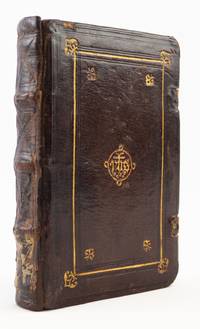
1538réf. ST19567-018Venetiis Venice: in officina heredum Luceantonii Junte hiers of Lucantonio Giunta 1538. 149 x 104 mm. 5 7/8 x 4". 8 143 of 144 leaves lacking leaf p6. Contemporary Venetian morocco rebacked preserving original blind-ruled spine and corners rounded off and renewed covers each with blind-ruled borders and a gilt- and blind-ruled panel with gilt fleurons in each inner and outer corner central gilt IHS monogram raised bands brass clasps renewed all edges gilt and gauffered lacking final endleaf. Printer's device on title numerous historiated woodcut initials first page of text with woodcut border two full-page woodcut illustrations. Printed in red and black. Essling 181; Sander 5970 under "autres éditions"; EDIT 16 CNCE 11880. Original spine somewhat crackled bottom compartment with slight surface loss perhaps from removal of a label covers with several but insignificant small dings very minor dampstain at extreme top edge of a few leaves other trivial imperfections but a clean fresh and bright copy in an attractive early binding. Offered in what is probably its original binding this is a very rare edition of a Psalter done by one of the leading Venetian printing families of the 15th and 16th centuries. A major figure in the Italian book trade Lucantonio Giunta 1457-1538 began his career as a bookseller in Venice in 1477 and became a printer there in 1489. Together with family members and carefully arranged partnerships Giunta expanded his printing empire into numerous cities in Europe including Lyon Lisbon Antwerp Frankfurt and Salamanca. The present book was printed just after the death of Lucantonio whose heirs would continue to run the family business which grew prosperous in part because of its specialty in producing liturgical works such as this. The contents here are routine but the well-preserved decorative period binding makes the volume definitely worth having. in officina heredum Luceantonii Junte [hiers of Lucantonio Giunta] unknown books
1774réf. ST12037Vicenza: per Gio. Battista Vendramini Mosca 1774. FIRST EDITION. 305 x 216 mm. 12 x 8 1/2". lxxvi pp. Original paste paper boards covered in red and green block-printed patterned paper. In a modern red cloth folding box. Frontispiece engraving of the arms of bride and groom engraved allegorical vignettes on title page and at end woodcut head- and tailpieces and foliated initials all done with considerable charm. Spine and head edge just slightly faded a couple of very small snags in backstrip one page with mild thumbing but A SUPERB COPY EXCEPTIONALLY CLEAN FRESH AND BRIGHT both the text and original printed paper wrappers in an almost unbelievable state of preservation. This is a remarkably well-preserved Italian "wedding book" a souvenir produced for friends and guests of a noble bride and groom. It contains a collection of romantic poems by 28 different authors along with engravings of the newlyweds' arms. This kind of book was popular in Italy particularly in the north during the second half of the 18th and early part of the 19th centuries. Such occasional works were produced by printers in the major cities like Venice Vicenza Padua Trento and Milan for assorted noble patrons. Copies of these fête books are to be found today in Italian and Swiss libraries but only two copies of any such volumes are held in North America one by the New York Public Library and one by the Getty. KVK locates four copies of our work one of them damaged in three Italian libraries. The groom here Count Lodovico Tiene or Thiene was a scion of one of Vicenza's most important families. His ancestor also named Lodovico built the Palazzo Thiene that was memorably remodelled by Vicenza's most famous son Andrea Palladio. Our volume was obviously a treasured keepsake that was carefully stored away from light and dust and it looks amazingly like it must have on the day of the happy nuptials. per Gio. Battista Vendramini Mosca books
1802réf. 2433S W Fores 1802. Loose_leaf. Hand colored etching. Very good. Williams Charles. A waggish sense of humor is presented here in this etching. A massive butcher presides in front of his stall pointing out the benefits of a gargantuan joint of beef. His clientele dressed in ostentatious costume look on as he points of the merits of his wares: "There is not such dignified Beef in the Market - believe me Right Honorable every Inch of it; Coronets marked in the fat and Genealogy in the lean - had it pon Honor - from my Lord cram Bullock - delicious! - you may smell the Oil Cake a mile - no vulgar ingredients - only half a Crown per pound - a mere trifle - I have indeed some low bred beef at Sixpence but I am sue Sir it would not suit your refined Taste." The gentleman answers: "Why look ye - Master Suet as I am not over ambitious if you please - I'll have a slice of the Citizen." His wife adds: "Husband dont be so Wulgar I say send home a Sir Loin of true Nobility." Light foxing small close tear to top edge. Past crease marks visible. S W Fores unknown books
1886réf. 1742York England 1886. Loose_leaf. Folded folio. Very good. 32 x 20 cm. Delightful acquisition for a connoisseur of English military history. This menu written by Halliwell a local master of ceremonies and freemason was made to accommodate and service the 3rd and 4th battalions' officers of the West Riding Regiment formerly known as the Duke of Wellington's Regiment. The officers were lodged in the De Grey Rooms neo-classically designed and constructed by architect George Townsend Andrews in the 1840's. The building was originally built to house the Yorkshire Hussar Regiment. The menu describes breakfast luncheon and dinner with served dishes that include tea coffee bacon and eggs kidneys cakes salad soups sweets ices and more. Menu also informs the officers of prices to pay per diem for services and the charges the guests and live-in servants must pay for board and food. The second page lists the sums for individual drinks. Light fold marks with some toning. unknown books
1888réf. 1363Boston: John A. Lowell & Co. 1888. Cards. Illustrated folding cards. Very good. 17 x 11 cm. Cover engraved by John A. Lowell & Co. portrays a Civil War Soldier rear cover portrays an ad for the Central Hotel No. 6 Canal Street Providence R.I. The interior records the Eighth Regiment Staff. Bill of Fare/Menu lists Breakfast Dinner And Supper menus. 2 cm. closed tear to spine otherwise clean and crisp. John A. Lowell & Co. unknown books
1830réf. 1277Providence RI: H.H. Brown 1830. Wraps. Cream wraps. Very good. 27 pages. 22 x 13.5 cm. Historical narration of the Second Baptist Church by Reverend John O. Choules in Newport at the Second Baptist Church beginning with the secession from Dr. Clark's church in Providence 1656 to 1829. In December 1829 the church Deacons voted to thank Reverend Choules and request a copy for press of the sermon preached on Thanksgiving day. Discernible fold at center covers stained interior foxed. Closed tear to head and tail of spine holding well with string binding intact. 4 to 5 corners folded 1 to 2 cm. not affecting text. H.H. Brown paperback books
1880réf. 1253Milwaukee WI c. 1880. Cards. Illustrated card. Good. 13.5 x 8 cm. Small illustrated black and white cardstock with lavish menu on rear. Built in 1867 by John Plankinton a prosperous meat packer one time partner with Philip Armour. Back of menu has some residue front is clean. unknown books
1929réf. 1404347Berlin: Aldus Druck 1929. Limited edition 800 copies. Hardcover. Octavo unpaged. In Good minus condition. Spine is cream with black print. Boards quarter bound with cream vellum to spine and grey paper; light wear to spine caps and corners bump to spine head warping. Text block consists of folded leaves with illustration and text on facing pages. Illustrated: nine woodblock prints. Pamphlet laid in: Mitteilungen der Soncino Gesellschaft Nr. 4 Februar 1929 15 pages. Text in German fraktur/gothic font and Hebrew. Signed in pencil by the artist on the colophon page. NOTE: Shelved in Locked Annex Area ND-HV Section. 1404347. FP New Rockville Stock. Aldus Druck hardcover books
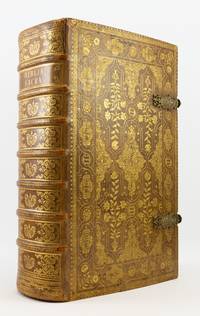
1768réf. ST19422Nuremberg: Johann Andrea Endterischen 1768. 460 x 295 mm. 18 1/4 x 11 1/2". 17 p.l. 11 48 2 2 3-8 3 9-190 2 191-740 pp.; 512 pp.; 2 2 3-190 2 191-480 18 pp. Three parts bound in one volume. STRIKING CONTEMPORARY SMOOTH CALF LAVISHLY GILT in the entrelac style covers with frame and compartments formed by gilt-ruled strapwork and filled with floral designs and lace-like ornaments of massed volutes and small tools raised bands spine compartments with central bouquet of pomegranate and flowers with massed floral tools on either side gilt lettering brass clasps featuring images of King David and St. Paul gilt-tooled turn-ins marbled endpapers all edges gilt and gauffered with pomegranates and flowers older repair to front joint alongside top compartment. Extra engraved title page woodcut headpieces and historiated initials 47 engraved plates comprised of: copperplate portraits of Luther and 11 Electors; 11 section titles each with 11 vignettes; nine full-page engraved depictions of Moses the Prophets and the Evangelists; seven full-page plates engraved with 12 vignettes six double-page maps and two double-page engravings. Front pastedown with ornate heart-shaped bookplate of Adam Melchior Dæumer dated 1784. ◆Two-inch crack to head of rear joint a bit of rubbing to joints and extremities a handful of quite minor dark spots to boards isolated trivial smudges or stains internally other insignificant imperfections but still a fine specimen--THE CONTENTS EXCEPTIONALLY CLEAN BRIGHT AND FRESH and the remarkable binding entirely solid and bright with gilt. This is an especially pleasing copy of the last and most extensive edition of the very popular and sumptuously illustrated Weimar Electors' Bible offered here in an impressive contemporary binding. Known as the "Kurfürstenbibel" because of its portraits of the Electoral Princes called "Kurfürsten" in German it was originally prepared for Ernst I Duke of Saxe-Gotha and Altenburg as a celebration of Martin Luther's Bible translation. Editions were issued by the Endters one of the prominent German printing families beginning in 1641. In addition to portraits of Luther and the Protestant princes of Germany the present edition contains the maps views and illustrated half-titles by Jacob van Sandrart and others first used in the edition of 1686. Our copy contains four maps and views not found in other copies of this edition showing the eastern Mediterranean and Palestine as well as both a map and a view of Jerusalem. The size of our volume puts a great strain on the binding which has nevertheless stood the test of time remarkably well. The overall decoration is exuberant the delicate gauffering lovely and the original straps remarkably well preserved. Johann Andrea Endterischen unknown books
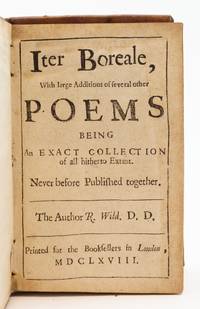
1668réf. ST19030London: Printed for the Booksellers in London 1668. First Complete Edition Fourth Edition overall. 145 x 90 mm. 5 3/4 x 3 1/2". 1 p.l. blank 3-122 pp. 3 leaves table and final blank. Contemporary sheep covers ruled in blind smooth spine early paper label with gilt titling. Front blank with the ink ownership inscription of John Drinkwater; inside lower board with the book label of Michael Curtis Phillips. Hayward "English Poetry" 121 this copy; Grolier Club "Wither to Prior" 976; Wing W2136; ESTC R7135. ◆Covers with light scuffing bottom leather thong of two broken but the text block quite secure at the top pastedowns lifted but the insubstantial binding still in remarkably good original condition; internally A VERY FINE COPY especially clean fresh and bright. From the library of Richard Jennings noted for the outstanding condition of his books this is an especially fresh and extraordinarily well-preserved copy of poems by a Puritan divine known for his surprisingly biting wit. Dryden dubbed Robert Wild 1609-79 "the Wither of the City" after hearing the Financial District's workers' enthusiastic reception of the title poem here which celebrates General Monck's successful campaign to restore Charles II to the throne: "I have seen them reading it in the midst of 'Change so vehemently that they lost their bargains by their candles' ends." Our collection contains several of Wild's most notable works including "The Recantation of a Penitent Proteus" satirizing Puritan clergy who had conformed to the Anglican Church; "The Loyal Nonconformist" professing his loyalty to the monarchy but maintaining his Puritan religious views; and "The Fair Quarrel" an attack on the 1665 Five Mile Act designed to drive nonconformist ministers out of their parishes. Wild was something of a paradox: he could preach a hellfire Puritan sermon but also write verse sufficiently scandalous to be mistakenly attributed to the notorious libertine John Wilmot Earl of Rochester. Our volume was loaned by Richard Jennings for the celebrated 1947 London Exhibition of First and Early Editions of English Poetry catalogued by John Hayward. It would not be reasonable to expect to find a finer unrestored contemporaneous copy of this imprint. Printed for the Booksellers in London unknown books
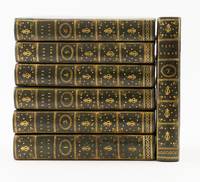
1775réf. ST17825Paris: Joseph-Gérard Barbou rue Mathurins 1775. 163 x 96 mm. 6 3/8 x 3 3/4". Seven volumes. Edited by J. N. Lallemand; preface by Jean Baptiste Louis Crévier. EXTREMELY ATTRACTIVE CONTEMPORARY GREEN ARMORIAL MOROCCO perhaps by Derome covers with triple gilt rule border central gilt coat of arms of the Blanche family featuring a seated fox with one paw raised above it a row of three five-pointed stars smooth spine divided into compartments containing a gilt lyre surrounded by stars and dots floral sprigs at corners volume number within a laurel wreath gilt lettering marbled endpapers all edges gilt. With printer's two-swans device on title pages volume I with frontispiece portrait engraved by L. J. Cathelin after J. C. Philips. With pencilled note on front flyleaf attributing the binding to Derome. Brunet III 1108 "Edition estimée"; Dibdin II 171. For the binding: Olivier Pl. 2279. ◆Spines slightly and uniformly sunned very light shelf wear to bindings occasional faint foxing in volume IV but A SUPERB SET almost entirely absent of any signs of use. This is a fine-paper copy in a binding both charming and handsome of what Dibdin deems "a truly beautiful and accurate edition" of Livy's Roman history. Brunet called it an "esteemed edition" and notes that fine paper copies like the present set sold for twice what regular copies cost. First printed by Sweynheym and Pannartz in 1469 the "Histories" of Titius Livius Patavani 59 B.C. - 17 A.D. follow the rise of Rome from the founding of the city through its triumphs in the Punic Wars and up through the reign of the author's contemporary emperor Augustus. His account is notable for its emphasis on the glorious triumphs and accounts of heroism of the Romans stemming in his eyes from their virtue; his history is intended not just to inform but also to elevate the reader. The present edition according to Dibdin builds on the fine editions edited by Crevier and Drakenborch incorporating their useful notes and additions. It was beautifully printed by Joseph-Gérard Barbou 1723-90 scion of a family that had begun printing in Lyon in 1529 moving to Paris in 1540. Joseph apparently specialized in Latin classics producing editions of Cicero Lucretius Pliny Caesar and Martial among others. The fine binding here does not have Derome's ticket but is well executed enough to make the attribution written in at front plausible. There were no fewer than 18 members of the Derome family not to mention workshop associates who made their livings as binders in Paris from the middle of the 17th century until the first quarter of the 19th. Our binding is tasteful--perfect for a scholarly edition of a classic--and conceivably the work of one of the Deromes or of an extremely competent associate. Olivier attributes our armorial stamp to the 18th century Blanche family of Burgundy and he finds it on a copy of Barbou's 1771 Sallust in the library of Madame la Comtesse de Cossé. The "country house" condition of the present set suggests an aristocratic owner more concerned with owning fine books than with reading them. [Joseph-Gérard] Barbou, rue Mathurins unknown books
1905réf. List01132Chihuahua 1905. Albumen photographs most measuring 4 x 6 and smaller. Photographs faded and with wear some stray marks and scuffs to versos good condition overall. Good. We find scant information about Circo Perez a traveling circus in Chihuahua at the turn of the century. The circus was directed by Praxedis Perez and appeared to be largely a family affair. The present collection includes three overtly circus-related cabinet cards: an outdoor scene of the circus tent with a crowd of spectators looking at the camera the verso bearing the note “Circus Perez Chihuahua 1898”; an advertisement for the troupe Compania Acrobatica de Variedades y Grandes Novedades with a portrait of the director Praxedis Perez; and a cabinet card portrait of a girl in costume. The other photographs appear to be a mix of gifts from grateful patrons and unidentified photographs likely family members. Two photographs relate to a Capitan Manuel Villordo both dated in Chihuahua in 1900 one showing the man on a horseback in military attire the other a gift from a Caciano Perez. Another photograph shows an older woman with two children beside her with the verso identifying her as Prudencia Perez. Overall an evocative if somewhat mysterious group worthy of further research for scholars of Mexican performance. unknown books
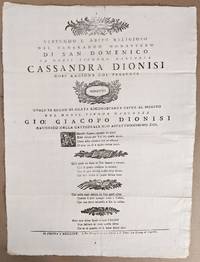
réf. 1235Rare Series of Twenty-Four Festival Broadsides Celebrating the Accomplishments and Appointments of Members of the Dionisi Family of Verona During the Middle Years of the Eighteenth Century. Including celebratory broadsides commemorating civil appointments ordinations taking of religious habits by the women of the family retirements and funerals for the Dionisi of Verona. The format of the twenty-four broadsides is folio four are printed on silk and one in gold ink. There is one duplicate in the collection. Each is illustrated with a large engraved cartouche at the top of the sheet and printer's ornaments in the body of the text. The quality of the paper is uniformly very good and the condition of the collection is excellent. Gabriello Dionisi or Dionigi as it sometimes appears 1718-1808 was the patriarch of the family and Captain of the Guard for the Lago di Garda. This was an important civil position responsible for protecting the cities along Lake Garda from potential conflicts coming from Austria in the north and the west from Milan and is celebrated in a number of broadsides in the collection. His brother Giovan Francesco a noted lawyer and judge in Verona in is feted in two examples in the collection. Gabrielo's daughters and nieces Cassandra Maria Teresa Origa and Maria Eleonaro are celebrated for entering the Convent of San Domenico and the Monastery of Maria the Virgin One of the broadsides is dedicated to Monsignor Dionisio Dionisi and in another the Marchese Ottaviano Dionisi is recognized for his tenure as Captain of the Guard for Lake Garda. Many of the poems are composed by Giovan Francesco Dionisi and others by Antiono Maroadi Stefano Trimeloni Gio. Battista Turazza Gio. Battista Conte Anton Maria Pedrotti and Alessandro Bonifazio. This is a unique collection which documents the lives of the men and women of the Dionisi Family during the second half of the eighteenth century. It provides an insight into manner in which noble families took responsibilities for their community and church and celebrated individuals for their contributions to the society in which they lived. Women are celebrated as mothers novitiates and leaders of convents and the men as soldiers lawyers poets and priests. As a collection this group of broadsides offers scholars significant access to a ruling family of Verona one with a distinguished history. . unknown books
réf. 3892Watercolour and gouache on vellum signed 'Gablle Fontaine'. An exceptionally large scale work by this talented but apparently unrecorded artist probably executed in the 1830s or early 1840s. The composition includes roses bi-colour pinks/carnations morning glory dahlias auriculas flowering quince or prunus hollyhock plums and peaches. In addition a clouded yellow and two red admiral butterflies are shown. unknown books