Sieburg FriedrichMareMagnum

402 résultats
br. In molti hanno provato a cambiare l'umanità applicando dei principi ritenuti perfetti, e "l'incorruttibile" Robespierre è uno degli esempi più celebri. In questa biografia scritta nel 1935 come un romanzo con uno stile quasi cinematografico, Friedrich Sieburg riflette le inquietudini della sua epoca, quella dei totalitarismi, a partire dalla barbarie del Terrore scaturita dall'applicazione delle dottrine illuministe. Ispirato da Rousseau, infatti, Robespierre portò in politica la logica totalitaria di un sistema universale di ispirazione religiosa, fatto di ombra e di luce: la sua "volontà generale" non era certo la volontà della maggioranza ma la volontà di coloro che sono virtuosi e in possesso della verità, i giacobini, setta eretta come nuova Chiesa nella Francia rivoluzionaria (Saint-Just, l'arcangelo della Rivoluzione, è qui dipinto come un protocomunista). E questo nonostante "l'incorruttibile" fosse un uomo piuttosto timido e cupo sin dall'infanzia, capace di umanità solo nelle tristi pareti dell'intimità domestica.
br. Chi era Robespierre? Un incorruttibile paladino del popolo o un sanguinario tiranno? Eroe per alcuni, contraltare negativo per altri, l'enigmatico Robespierre ha incarnato nella maniera più plastica i due volti della Rivoluzione: da campione dei diritti del popolo a fautore della ghigliottina, sotto cui egli stesso cadde. Ci sono due Robespierre: l'«incorruttibile» e il «tiranno», l'eroe e il mostro, per usare le parole dell'epoca. Le due immagini corrispondono alle due fasi della sua carriera rivoluzionaria: l'oppositore e l'uomo di governo. Il problema essenziale che gli storici, e in generale tutti coloro che riflettono sull'eredità della Rivoluzione, si trovano ad affrontare consiste nel dover raccordare tra loro questi due momenti e i due volti che hanno trasmesso alla posterità. Come si passa dall'uno all'altro? Il filo rosso che collega l'intrepido oratore della Costituente e il padrone della Convenzione va ricercato nel pensiero che li anima. Marcel Gauchet ripercorre la parabola politica di Robespierre, attraverso la lettura dell'impressionante mole dei suoi tesissimi scritti, e tenta di rispondere a questi interrogativi mostrando come la transizione dall'affermazione dei diritti del popolo alla fondazione di un sistema politico basato su di essi non sia una cesura ma appunto un passaggio, potremmo dire necessario, con tratti di rottura violenta. Fare i conti con questo apparente paradosso equivale ad accogliere l'idea che le memorie divise della Rivoluzione debbano convivere, e ad oltre due secoli di distanza, in un'Europa in cui le democrazie parlamentari sono sempre più in bilico, la lezione di Robespierre, che incarna la tensione tra i principi fondativi della democrazia e gli imperativi dettati dal suo stesso quadro politico, è più che mai utile a riflettere su una contraddizione che ci riguarda da vicino.
Stampa antica originale raffigurante il ritratto del politico, avvocato e rivoluzionario francese Maximilien de Robespierre, in allegato pagina descrittiva. Piccole gore, lieve ingiallimento e segno ad inchiostro in alto a sx. Inserita nell'opera "Serie di vite e ritratti de Famosi Personaggi degli ultimi Tempi" edita da Bettalli e Fanfani a Milano dal 1815 al 1818
réf. DADAX0270928383Wentworth Press 2018-07-29. hardcover. New. 6.14x0.81x9.21. Buy with confidence. Excellent Customer Service & Return policy. Wentworth Press hardcover
2010réf. DADAX1166195813Kessinger Publishing 2010-09-10. paperback. New. 6.00x0.84x9.00. Buy with confidence. Excellent Customer Service & Return policy. Kessinger Publishing paperback
1970réf. ZB573205Burt Franklin 1970. facsimile reprint of the Paris 1840 edition; 3 volumes hardcovers fine. - If you are reading this this item is actually physically in our stock and ready for shipment once ordered. We are not bookjackers. Buyer is responsible for any additional duties taxes or fees required by recipient's country. Burt Franklin hardcover
2009réf. DADAX110489629XKessinger Publishing 2009-08-10. paperback. New. 6.00x0.84x9.00. Buy with confidence. Excellent Customer Service & Return policy. Kessinger Publishing paperback
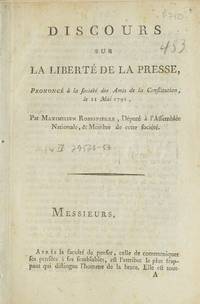
1791réf. 18587Paris: De L'Imprimerie Nationale 1791. 8vo. Disbound. Some spotting at front and back. 23 pages. 8vo. Robespierre on freedom of the writer and the press and on slander: "la liberté de la presse ne peut être distinguée de la liberté de la parole; l'une & l'autre est sacrée comme la nature; elle est nécessaire comme la société même. Par quelle fatalité les lois se sont-elles donc presque partout appliqués à la violer C'est que le lois étoient l'ouvrage des despotes & que la liberté de la presse est le plus redoutable fléau du despotisme". M & W IV 29526-53 De L'Imprimerie Nationale unknown
réf. 103119Paris Académie des Bibliophiles 1868. IX. 51 pages. 1 feuillet. 25x16 Cm. Couverture imprimée rempliée menus défauts. Manque de papier sur le dos. Papier bruni. Réimpression tirée à 113 exemplaires pour l'Académie des Bibliophiles. Exemplaire hors-série tiré sur papier Whatman pour être offert par l'éditeur Jouaust avec l'envoi autographe suivant: "Exemplaire unique de passe sur papier Whatman offert à M. Louis Lacour par son bien dévoué Jouasut". Bel exemplaire non rogné et non coupé dans son brochage d'origine. Paris, Académie des Bibliophiles, 1868. unknown
1794réf. 18581Nismes: De l'Imprimerie Nationale de J. Gaude Imprimeur du Departement du Gard 1794. Reprinted by the Departement du Gard for distribution. 8vo. Stitched. 16 pp. Reprinted by the Departement du Gard for distribution. 8vo. His defence and explanation of the laws and actions of the revolution "La revoltion est la guerre de la liberte contre ses ennemis: la constitution est le régime de la liberté victorieuse & paisible". M & W IV 29526-45 variant De l'Imprimerie Nationale de J. Gaude, Imprimeur du Departement du Gard unknown
1794réf. 18583Paris: de l'Imprimerie Nationale 1794. 8vo. Disbound. 6 pages. 8vo. In an effort to combat atheism Robespierre and others of the National Convention scheduled a Fête de l'Être Suprême on 8 June 1794 the culmination of which was to be the symbolic destruction of the statue of Atheism by fire and the emergence of Wisdom from the remains. Unfortunately the figure of Wisdom was so badly smeared in soot that the audience laughed. This was his speech to inspire the people and to assure them of the Supreme Being and of his support of their notable cause. M & W IV 29526-40 de l'Imprimerie Nationale unknown
1792réf. 18576Paris: De L'Imprimeris Nationale 1792. 8vo. Disbound. 15 pages. 8vo. Responding to the public need for bread and grains he challenges the judgements of the lawmakers and those choosing to tax and control grains as they do indigo and similar imports without consideration of the needs of the people for provisions. M & W IV 29526-32 De L'Imprimeris Nationale unknown
1790réf. 18573Paris: De l'Imprimerie de L. Potier de Lille 1790. 8vo. Disbound. 19 pages. 8vo. Following Robespierre's election in 1789 a strong campagne to discredit and denigrate Robespierre in the eyes of the populace that had elected him took place. It was quite effective and Robespierre was even warned not to return to his area for fear of physical attack. This campagne was credited a great deal to Brios de Beaumetz the elder in the Council of Artois and his son also Brios de Beaumetz a member of the Assembly with Robespierre. Robespierre decided that these attacks should not go unanswered and the present pamphlet is part of the response. He was strongly attacked for a comment saying that most of the people of Artois did not pay enough taxes. This was picked up by Beaumetz and widely circulated causing great discord and greater loss of popularity. What this related to was the decision of the Assembly in October 1789 to adopt conditions for being a candidate for election or an elector and basing it upon the amount of direct tax paid by the individual. Robespierre had pointed out that only the rich in Artois paid direct taxes and the most of the population there paid duty or indirect taxes and would therefore be excluded from the electoral process. This is explained in this pamphlet which includes a letter of good conduct by other Artois delegates to the Assembly Fleury Du Buisson Boucher Payen de Croix Brassart and Charles de Lameth. M & W IV 29526-18 De l'Imprimerie de L. Potier de Lille unknown
réf. 18575Paris: de l'Iprimerie de Pierre-Jacques Duplain. 8vo. Disbound. 32 pages. 8vo. Robespierre's very strong speech denouncing actions of the Convention and speaking of the role of slander in the Revolution and expounding on the need for the Revolution. A speech given to the Société des Amis de la Liberté et de l'Egalité formerly the Brissotins now the Jacobins the 29 October 1792 in Paris whose president was Danton vice president-LaFaye; deputies Le Peletier and Bentabole and Le Fort Moernne and Simonne as secretaries. M & W IV 29526-64 de l'Iprimerie de Pierre-Jacques Duplain unknown
1792réf. 18578Paris: De l'Imprimerie de Mayer et Compagnie 1792. 8vo. Disbound. 16 pages. 8vo. The Brissotins were continuing to battle against the power and conduct of Robespierre. He had been elected public prosecutor of the criminal tribunal of Paris and resigned prior to taking his seat. He had spoken in March of the peaceful intentions of the Emperor Francois II attributing Emperor Leopold's demise as an act of Providence drawing severe criticism from the atheists and specific criticism from the Girondin deputy Guadet. On the 20th of April Louis XVI had proposed a declaration of war against the King of Bohemia and Hungary and the vote was carried unanimously. Robespierre was against it. Guadet attacked him denouncing him with an accusation of tyranny and Robespierre responded with his explanation of his behavior how he had done everything that he had done for the country to guarantee freedoms and establish equality how when his goals were reached he would retire into private life but how could he abandon the nation that needed him in its time of crisis. He also as usual strikes out at Lafayette. M & W IV 29526-61 De l'Imprimerie de Mayer et Compagnie unknown
1794réf. 23050Paris: De L'Imprimerie Nationale 1794. First edition. 4 pages. 1 vols. 8vo. Disbound else a very good copy. First edition. 4 pages. 1 vols. 8vo. Recommending honors for bravery and dying for the nation on Fabre de l'Hérault. The Convention Nationale gave Fabre the honors of the Pantheon. M &W IV 29526-46 De L'Imprimerie Nationale unknown
1971réf. BN252123Hamburg : Merlin-Verla 1971. 1971. Ausgewählte Texte. Maximilien Robespierre. Hrsg. von Andreas J. Meyer. Dt. von Manfred Unruh u.a. Mit e. Einl. von Carlo Schmid Ausgewählte Texte. Maximilien Robespierre. Hrsg. von Andreas J. Meyer. Dt. von Manfred Unruh u.a. Mit e. Einl. von Carlo Schmid Robespierre Maximilien de und Andreas J. Meyer Hamburg : Merlin-Verla unknown
1979réf. BN252363Kronberg : Scriptor 1979. 1979. Miscellen Miszellen zur Geschichte des Tages. Johann Wilhelm von Archenholz Scriptor-Reprints : Aufklärung u. Revolution : Dt. Texte 1790 - 1810 Miscellen Miszellen zur Geschichte des Tages. Johann Wilhelm von Archenholz Scriptor-Reprints : Aufklärung u. Revolution : Dt. Texte 1790 - 1810 Archenholz Johann Wilhelm von Jean-Baptiste Louvet de Couvray und Maximilien de Robespierre Kronberg] : Scriptor unknown
réf. BN359295Hamburg Merlin 1971. Hardcover. Ausgewählte Texte. Dt. von M. Unruh. Mit einer Einl. von Carlo Schmid. 1. A. Ausgewählte Texte. Dt. von M. Unruh. Mit einer Einl. von Carlo Schmid. 1. A. Maximilien Robespierre Hamburg, Merlin 1971. hardcover
2006réf. BN554919Editions de l'Aube 2006. 2006. Softcover. Discours sur la religion la République l'esclavage Discours sur la religion la République l'esclavage Maximilien Robespierre Editions de l'Aube paperback
réf. 1245915940.Gpaperback. Good. Access codes and supplements are not guaranteed with used items. May be an ex-library book. paperback
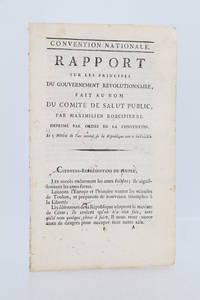
1793réf. 83855Paris: Convention Nationale 1793. Fine. Convention Nationale Paris 5 Nivôse An II 25 Décembre 1793 12 x 19.50 cm broché First edition of this famous speech by Robespierre justifying the principle of revolutionary government and laying the foundations for the establishment of the Terror. Small black ink stains sometimes faded and some foxing. In autumn 1793 the threats weighing on the Republic had intensified both at the borders and in the heart of the country: Hébert the extremist ""enragé"" calling for a popular uprising the royalist threat still present the Indulgents demanding an end to the policy of Terror. On 5 Nivôse Year II December 25 1793 Robespierre went to the Committee of Public Safety to present the principles of revolutionary government. He warns from the very first words of his speech: recent victories Vendée defeats of December 12 and 23 recapture of Toulon on December 19 thanks to the notable action of Captain Bonaparte must not lull patriots into complacency. Counter-revolution remains very active within the country the Committee of Public Safety must confound the intrigues of the enemies of liberty and make revolutionary principles triumph. In his words: ""Le gouvernement révolutionnaire doit aux bons citoyens toute la protection nationale ; il ne doit aux ennemis du peuple que la mort."" ""Revolutionary government owes good citizens all national protection; it owes the enemies of the people nothing but death."" To carry out its action successfully the latter must find its way between two extremes: the moderatism preached by the ""indulgents"" and the excess aspired to by the ""enragés."" For Robespierre the dictatorship of the Committees like the Terror is justified because they alone will make it possible to end civil and foreign war. As long as the country is in conflict citizens will not be able to fully enjoy the Constitution. Counter-revolution must be annihilated. To this end Robespierre demands reform of the Revolutionary Tribunal. Reform that would find its culmination in the law of 22 Prairial Year II June 10 1794: suppression of defense hearing of witnesses when material evidence is lacking acquittal or death being the only possible verdicts. Thus the machinery of Terror is set in motion replacing with arbitrariness the principles and laws enacted by the Declaration of the Rights of Man and by the Constitution. cf Delphine DUBOIS and Régis LAPASIN on the site Nouvel éclairage sur l'histoire - L'histoire par l'image. Very rare copy of this founding speech of the policy of Terror which would ultimately lead its principal instigator Maximilien Robespierre to the scaffold. Convention Nationale unknown
réf. ALDR0021Paris 1794. 12° XLVI Titelbl. 76 S. S. 3 -58.Marmorierter Pappband d. Zeit mit beschriftetem Rückenschildchen Schnitt rotgefärbt Einbandecken u. -kanten bestoßen Papierüberzug am Rücken schadhaft Seiten fleckig. Mit einigen alten Bleistiftanmerkungen und -anstreichungen. Vgl. Van de Velde: Catalogue des livres rares et precieux 43210742 - Druckschrift mit Berichten des vom Nationalkonvent während der Französischen Revolution eingerichteten Comite de salut public. Unter dem Einfluss Robespierres 1758-1794 entwickelte sich dieser Wohlfahrtsausschuss zur treibenden Kraft der jakobinischen Tyrannei. Paris 1794. unknown
réf. ria9783563073056_inpHardcover. New. New Book; Fast Shipping from UK; Not signed; Not First Edition; Réimpression inchangée de l'édition originale de 1868. La maison d'édition Antigonos est spécialisée dans la publication de réimpressions de livres historiques. Nous veillons à ce que ces ouvrages soient mis à la disposition du public d hardcover