503 risultati
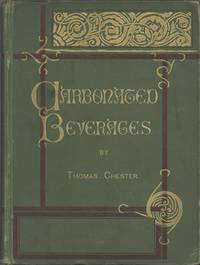
1882rif. 6662New York: P.H. Reilly Wood-Cut and Color Printer 25 Rose Street 1882. Quarto 27 x 20.5 cm. 108 4 166 2 pages. Profusely illustrated. Text in two columns. Table of contents at rear. FIRST EDITION. An early – perhaps the first – history of carbonated beverages. Issued together with a trade catalogue for the soda water supply firm of John Matthews of New York an important manufacturer of bottling equipment soda fountains and carbonation apparatus. The fountains get progressively larger and more elaborate and with wonderful names: “The Citadel” “The Horicon” “The Adriatic” “The Fire-Eater” “The Nepenthe” and “The Snow Queen”. There I also an outdoor soda fountain “The Street Spa”. Also included are the auxiliary equipment of the carbonated water industry like siphon boxes for home delivery of soda water. The historical work and the trade catalogue were issued in celebration of the firm’s 50th Anniversary. Some pencil scribbles to a few pages. Text block shaken; free front endpaper lacking. In publisher’s brown and gilt-decorated green cloth corners rubbed and extremities a bit worn. Better than good. With the ownership signature of “Leopold F. Schmidt Deer Lodge Montana” and a more recent “Olympia Brewing Company”. Very scarce. OCLC records two copies with this pagination Loma Linda Univ. & Hagley Museum and four copies with just 108 pages presumably just the history; Noling Beverage Literature page 104 for the 108 page version. P.H. Reilly, Wood-Cut and Color Printer, 25 Rose Street hardcover books
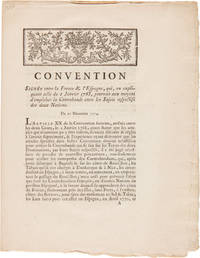
1775rif. 14145Versailles. 1775. Further Regulation of Colonial Trade An important treaty between France and Spain with significant ramifications for their colonial holdings in America. Herein Vergennes and the Conde d'Aranda further define commercial arrangements between the two countries in an attempt to control contraband. This had special impact for the Caribbean basin where the colonies of both powers were required to ship goods through European ports. Dissatisfaction over this prohibition was a key factor in the Louisiana Rebellion of 1768. This convention was agreed to at Versailles on Dec. 27 1774. Not in Wroth. 8pp. Quarto. Printed self-wrappers. Fine. DAVENPORT 155. unknown books
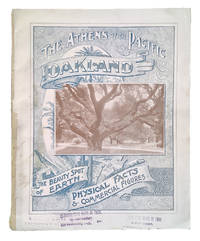
1896rif. 002571Oakland CA: Calderwood G. W. and Loofbourow G. T. 1897 Copyrighted 1896. First Edition. Very good. First edition; 11 3/4 x 9 1/4; pp. iii-v 3 9-99 1; pink wraps printed in blue with a sepia-tone photograph; illustrated with numerous maps and b & w photographs; two stamps of the Calfironia State Board of Trade to lower margin of front wrap; small antiques shop label to front wrap verso; a thin strip of clear tape to spine cover; a few spots to margins; overall bright and well-preserved; in about very good- condition. Intented to be "mailed free to prospective home seekers on application to Secretary of Merchants' Exchange or Board of Trade Oakland Cal." the book was pronounced by then former Mayor William R. Davis to be: ".the best and most accurate presentation of our resources and local attractive features and as an advertising medium yet published in the interest of Alameda County." It began with an aptly-titled chapter - "Deadly Parallel" - listing specific statistics and numbers from August 1896 of people dying of heat-stroke in cities around the country while in Oakland the temperature is balmy 65 degrees. It proceeds to describe Alameda County and the City of Oakland their climate resources modern ammenities notable businesses often with flowery and/or bombastic statements e.g. "One does not need to sniff the odor of the Chicago River or of its immense piggeries as a New Yorker contemptuously styled its huge pork-packing establishments to realize that he is in the Garden City." Several copies at institutions most e-publications; none other in the trade as of December 2019. Calderwood, G. W. and Loofbourow, G. T. paperback books
1802rif. 55719New York: Printed and Sold by G. F. Hopkins 1802. First American edition. Leather bound. Very good. 296pp. Octavo 22 cm In a later 3/4 leather binding with brown cloth over boards. New endsheets and flyleaves. The boards are a bit warped. Repair to title and dedication pages. With map present at the front. Wright-Howes M 133. "First crossing of the continent from ocean to ocean by a white man. The narrative portion was prepared for publication by William Combe from Makenzie's notes." - Wright-Howes p. 362. Printed and Sold by G. F. Hopkins unknown books
1873rif. 002874Washington DC: Published by Order of the Secretary of War 1873. First Edition. Good. Six maps for: Monday February 17 1873 - 11 P. M.; Tuesday February 18 1873 - 7:35 A. M.; Tuesday February 18 1873 - 4:35 P. M.; Wednesday February 19 1873 - 7:35 A. M.; Wednesday February 19 1873 - 4:35 P. M.; Wednesday February 19 1873 - 11 P. M.; 8 3/4 x 11 1/2; relief shown by hachures and gradient tints; small reference table in the lower half of the image; edges brittle with small chips and cuts; overall in good to very good condition. A scarce collection of maps their publication began in January of 1871 with no less than 3 maps being published every day. Samuel Morse's invention of the telegraph had made it possible to easily observe gather and transmit data from different points over the entire country. A small note at the head read: "All observations made at the same moment of actual not local time." Released by the US Army's Signal Service the maps were intented to be primarily used by farmers and merchants. They were published in at least three different sizes and formats the current being one of the smaller ones. These particular maps showed precipitation and wind velocity at various elevation points. Published by Order of the Secretary of War unknown books
1833rif. 34458v.p. including Antwerp London Havana Pensacola New York 1833. Folio. 12 3/4 x 8 inches. 21 leaves plus two additional manuscript leaves laid in. Contemporary half calf and marbled boards manuscript label on front board. Bookseller's label on front pastedown. Account book of Atlantic trading voyages. An interesting manuscript ship's log containing financial accounts for the brigs Nimrod and Jasper for an eight year period from 1826 to 1833 while they were under the command of a Captain John Hill. The two ships made numerous voyages between the United States Europe and the Caribbean. The present log book contains line accounts of expenditures for journeys from London and Marseilles to New York and Norfolk in 1827; from Antwerp to London in 1828; from Philadelphia to the West Indies in 1829; from Madeira to the Turks Islands in 1831; from the West Indies to Pensacola to Havana in 1832; from the Indies to New York in 1833; and other similar voyages. The log also contains two copies of an 1832 letter written in Havana by Hill to merchants there inquiring about the price of molasses and a list of port charges at several major way points. A fascinating artifact of trans-Atlantic trade in the 1820s and 1830s. unknown books
1920rif. 9871Montelimar: the company 1920. Oblong album 21 x 30.5 cm. 38 pages; with 52 original labels or wrappers pasted-in each with a handwritten annotation on the leaf not the label with the name of the product including weight and price. FIRST EDITION. A handsome salesman's sample album that showing the varied offerings of the firm of Nougats Arnaud Soubeyran. Products represented include fruit nougats chocolate pistachios . all with very beautiful labels including one illustrated by Alain Saint-Ogan. The labels are striking in their design many with electric colors and colorful ribbons. "The history of this great house located in Montelimar north of Avignon begins in 1837 with a marriage between Mr. Arnaud confectioner and a Miss Soubeyran. Together they launched nougat production on a scale exceeding that of any single pastry chef. Their goal was to position their high-end confectionery by employing the best regional raw materials" company website. The firm persists and includes a Nougat Museum in the town of Montelimar. Some light dusting to some of the leaves and the labels but mostly sound and clean. The colors are unfaded. In full green alligator-patterned cloth tied on cord. Gilt titled on the front board. Some light rubbing to edges otherwise near fine. Rare. OCLC locates no copies of any publication of Arnaud Soubeyran. the company hardcover books
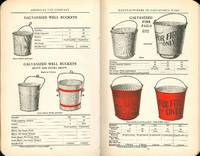
1908rif. 3211Rome N.Y. 1908. Ten trade catalogues. Items mostly uniform in size ~ 19 x 12.5 cm. though page count does vary from 14 to 155. Each catalogue contains an index. Each catalogue is illustrated and most include select full-color images. Including the Erie Can Company’s there are four general catalogues that cover a broad range of products; three catalogues are specific to syrup cans; and the remainder feature one specific type of product or another. ~ Incorporated in 1901 the American Can Company was a member of the “Tin Can Trust” that controlled a large percentage of the tin market. In 1913 the U.S. Government sued the company on the grounds of monopoly. The individual catalogues: 1. American Can Company. American Steel Lead Kegs. New York: American Can Company circa 1908. 24 pages. Steel kegs for lead manufacturers and lead users; features product descriptions for five unique kegs and over 25 testimonials from consumers across the country. Illustrated cover. Cream wrappers with black/red text bound with red ribbon and staple. Slight discoloration and creasing otherwise very good; 2. Tin Galvanized and Japanned Ware; Catalogue No. 16. No date. 147 pages plus index. Features Canco trademarked products also manufactured by American Can Company. In total over 275 unique products featured. Gray wrappers with embossed type. Rounded edges. Slight bumping to spine otherwise fine condition; 3. Tin Galvanized and Japanned Ware; Catalogue No. 17. No date. 155 pages plus index interleaved with graph paper. Very nearly same content as #16 but this edition is interleaved with graph paper presumably for consumers to mark their notes. Bound in black vinyl with gold print. Rounded edges. “E. Hoffman” printed on the cover. Edges of cover chipping but text is in fine condition; 4. Tin Galvanized and Japanned Ware; Catalogue No. 18. No date. 123 pages interleaved with graph paper. Same as #17 with variations in featured products. Bound in blue vinyl cover has white paint stain and printed name is scratched out. Otherwise very good; 5. Druggists’ Tinware; Catalogue No. 21. No date. 98 pages. Illustrated throughout with select full-color images. Has ninety-nine unique products for druggists: arnica salve boxes cosmoline cans insect powder guns tooth powder boxes herb cans and more. Gray wrappers with green and gray text company name embossed on front cover and monogram embossed on back. Some pencil marks and slight discoloration on wrappers text in fine condition; 6. American Can Company. Syrup Cans; Catalogue 43. No date.15 pages. Illustrated throughout. Indexed catalogue of cans for syrups. Features twelve unique cans in variety of sizes and shapes. Light gray wrapper with red and black print. Interior text has some water staining; 7. American Can Company. Syrup Cans; Catalogue 45. No date.14 pages. Almost identical to #43 in form condition and content. Illustrations vary just slightly and this catalogue does not feature the “‘Chelco’” Metal Swing Seal” thus features just eleven products; 8. Syrup Cans; Catalogue 47. No date. 14 pages. Same as #45; 9. Seamless and Pieced Boxes Hinged Slip and Sliding Covers; Catalogue No. 56. No date.37 pages. Thirty-eight seamless and pieced boxes in oblong square and miscellaneous shapes with slip hinge or sliding covers. Also highlights location of manufacturer: Brooklyn Richmond Philadelphia Boston Chicago St. Louis. Gray wrappers with green and black text pencil marks on back cover; water stains throughout; 10. Erie Can Company. Illustrated Catalogue Sheet Metal Specialties including Tea Coffee and Spice Cabinets Cans and Caddies and Sample Room Goods Etc. Chicago: Erie Can Company no date. 27 pages. Features thirty-three unique products from painters pots and brush safes to display cabinets and coffee caddies. In cream wrappers with some discoloration and slight edge chipping. Text slightly discolored by staple binding. As a collection overall condition is very good. unknown books
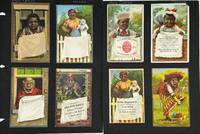
1896rif. 21325New York and elsewhere 1896. Folio. 14 1/2 x 12 inches. Approximately 350 larger ephemeral items and about 200 small scraps mounted on both pastedowns and recto and verso of 22 leaves. All leaves browned 3 leaves split vertically others with margins chipped some loosely inserted. Original rose-coloured glazed paper-covered boards lower cover blocked in blind and lettered 'Pat. March 76' in blind the upper cover blocked in gilt with three shaped raised panels with gilt borders enclosing chromolithographic images backstrip blocked in gilt corners rounded some fading to upper cover and backstrip inner hinges broken A spectacular album with an unusually rich assortment of advertising and trade cards including a selection chromolithographed designs of birds after Audubon. Internal evidence suggests that the album was probably assembled by a New York State resident living just south of Rochester - possibly from near Bath Cohocton or Canandaigua the patent date of the album gives a 'now earlier than' date whilst there are a number of dated items amongst the scraps the latest being 1896. Included are a large number of cards issued by local businesses as well as more national concerns like a fine series of six advertising cards for 'Wright's Indian Vegetable Pills' featuring toddlers playing baseball "Tum on ets' p'ay ball"; "See me tech it!"; "Aint dot out!"; "I'se bo'en home"; "I'se dot it!". There are also 33 'Arm & Hammer' bird cards after designs by John James Audubon 13 from the Arm & Hammer Brand / Church & Co. "Beautiful Birds of America" Collectors' Card 1st Series from 1894; the others probably from the second series. unknown books
rif. 285901984. 1887-1984 v. 1-369 lacking 23 books see below. 1887-1984 v. 1-369 lacking 23 books see below. Interstate Commerce Commission Decisions. Reports and Decisions of the Interstate Commerce Commission of the United States. Washington: Government Printing Office. 1887-1984. Volumes 1-369 lacking 23 books: 11 97 99 100 101 103 106 108 110 114 116 119 121 125 127 130 133 135 137 141 143 149 178. Publisher's original cloth hardcover. Ex-private law firm library with property stamps. Sixty-one 61 linear feet of shelf space. Special $1200. unknown books
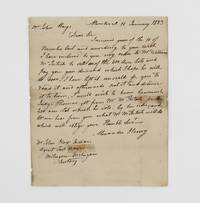
1823rif. 374695Montreal 1823. 1p. 1p. "I received yours of the 10 of November last and according to your wish I have inclosed to you my order to Mr. William MacIntosh to sell one of the 400 acre lots and pay you your demand which I hope he will do soon. I have left it unsealed for you to read it and afterwards seal it and deliver to him. I would wish to know how much Judge Thomas got from Mr. MacIntosh for the 400 acre lot which he sold by his order and let me hear from you what Mr. MacIntosh will do . unknown books
1884rif. 370801Boston: 33 to 51 Bowker Street and 49 & 51 Cardon Street printed by Wilson & Son University Press Cambridge 1884. 7 photogravure plates woodcut illustrations throughout text. With printed order slip tipped-in following text publisher's acknowledgment slip laid-in at front. 256pp. Roan cloth decoratively stamped in gilt and black on cover and spine; decorative blind stamping to rear board; minor edge wear mainly at head and tail of spine; illustrated throughout with black-and-white drawings and photographs. 7 photogravure plates woodcut illustrations throughout text. With printed order slip tipped-in following text publisher's acknowledgment slip laid-in at front. 256pp. A beautifully illustrated trade catalog detailing both the remarkable variety and elaborate designs of the Tufts company's commercial soda fountains. 33 to 51 Bowker Street, and 49 & 51 Cardon Street [printed by Wilson & Son, University Press, Cambridge] unknown books
rif. 6863398 of the cards are mounted to black album paper 12 are loose all are housed in a three-ring binder. Chips to the edges of several cards but very good overall. For the lot of 110 cards unknown books
1816rif. 40803London: Printed for J. M. Richardson Cornhill Opposite the Royal Exchange 1816. 3-28pp. Light scattered foxing. Bound in modern cloth withdrawal stamp on front pastedown; inoffensive faint blindstamp on blank corner of title leaf. Else Very Good. Our collation matches that of the bibliographers. The nameless author disclaims any "intention to advocate the revival or regret the abolition of the Slave Trade. . . It is a traffic so objectionable in almost every respect that being abolished for the most part I hope never to see it revived and that every endeavour will be made to realize those advantages which the zeal of the authors of the Abolition has induced them to expect." However "The passage of the registration bill would constitute an unwarranted interference of the central power in the planters' private affairs" Ragatz. The property right of the West Indian colonists in their slaves is non-negotiable. Slaves comprise "the most valuable property of our colonists." Parliament's interference with "the private rights and private property of our colonists. . . would absolutely and tyrannically deprive the individuals whose property it is proposed to regulate and affect of those constitutional means of redress which all British subjects are entitled to." The pamphlet prints resolutions of West Indian Planters objecting to any such intrusions on their rights. The anonymous author objects to the African Institution's "representations of the miseries and hardships of slaves and in circulating ignorantly and unguardedly no doubt the most unfounded calumnies on the subject. If these gentlemen were to compare the situation of the Irish peasantry with that of our colonial slaves they would find they were comparing the extreme of wretchedness with comparative comfort." Ragatz 442. LCP Supp. 1608. Sabin 56509. OCLC records 16 locations worldwide as of March 2025. Printed for J. M. Richardson, Cornhill, Opposite the Royal Exchange unknown books
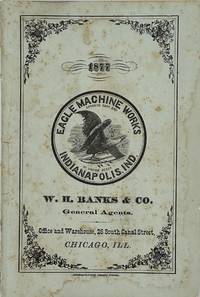
1877rif. 54690Indianapolis IN: Indianapolis Journal Co 1877. Trade catalogue. 8vo. 32 pp. 4-page inserted price list dated March 1877. Profusely illustrated with seven black and white wood-engraved plates four large black and white illustrations in text and five striking folding chromolithograph plates. Original printed green wrappers foxed. Very good. A scarce catalogue of heavy agricultural machinery with five brilliantly colored folding plates chromolithographed by Chandler Indianapolis depicting the "double canvass separator Hasselman separator oscillator thresher agricultural engine and the Eagle horse power." Romaine records nothing from this firm. OCLC locates several items from this firm but nothing before 1883. 1219. Indianapolis Journal Co unknown books
rif. 172080TRADE CATALOGUE. Katalog masných výrobku a konserv. Catalogue of meat products and conserves. 100 pp. Oblong 4to publisher's cloth. Prague : Ministerstvo potravinárského prumyslu 1953. A handsome and unusual Eastern European trade catalogue full of edible delights which were probably available more in the imagination than reality in a year when most people's savings were wiped out. OCLC lists Wellesly Stanford and the Tate. hardcover books
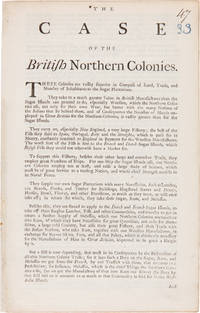
1731rif. 46721London. 1731. Limiting Sugar Trade with the French and Dutch A protest against a Bill to restrain the northern colonies from trading with the French and Dutch sugar islands. One of five editions published all rather scarce. Only four copies of this edition noted by ESTC - at the National Archives New-York Historical Society University of Michigan and the University of Minnesota. European Americana also notes Yale and JCB. Folded folio sheet. Vertical fold reinforced with tissue. Minor soiling. Very good. ESTC N15514. EUROPEAN AMERICANA 731/37. unknown books
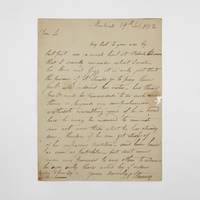
1802rif. 374694Montreal 1802. 1p. Slight loss of paper caused by removal of wax seal on right margin not affecting text. Old fold. Else fine. 1p. An excellent autograph letter signed from this prominent fur trader explorer and author of TRAVELS AND ADVENTURES IN CANADA AND THE INDIAN TERRITORIES published in 1809. Henry was sixty-three at the time this letter was written and mainly occupied with directing fur operations from Montreal. He evidently writes concerning his son's bad debts: "My last to you was by last post was so much hurt by Robert's behavior that I scarcely remember what I wrote. his Horse and Gigg it is only just that the produce of it should go to pay those Gentm who indorsed his notes - how these Gentm could be persuaded to do such a thing is beyond my comprehension without consulting you. if he is turned loose he may be induced to commit some act worse than what he has already done - therefore if he can get clear of his imposing creditors - send him here as soon as possible - but dont come under any promise to any other to whom he owes only those acted by yr orders. unknown books
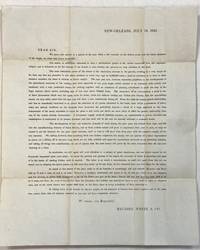
1843rif. 41470New Orleans 1843. Printed folio sheet folded to 4 pp each page 9-1/4" x 11-1/4." Printed on recto of first leaf only interior pages blank addressed in ink on last page to Captain J. Keyes Florence Alabama. Old folds address page worn. Blank hole where seal was broken no text affected. Text clean. Very Good. The head of the firm Maunsel White of New Orleans was an energetic Irish immigrant. He married the daughter of a wealthy Creole merchant allied with Andrew Jackson. Wikipedia says "White maintained a lifelong friendship with Jackson for whom he served as a cotton factor from 1826 until Jackson's death in 1845." White carefully delivers hopeful but cautious news to his clients. He celebrates "the marvellous increase in the growth" of cotton "resulting in a crop larger by far than any that has preceded it." However "the next crop will show a considerable falling off. From the onset the season opened unfavorably" because of rains and other weather problems. But "new and extensive channels of trade infused fresh vigor and life into the manufacturing districts of Great Britain." The Letter demonstrates the importance of the South's commercial connection with England. He reminds his customers of "a subject of great importance and one which cannot be too frequently impressed upon your mind; we mean the picking and ginning of the staple the necessity of which is sometimes lost sight of in the desire of sending Cotton early to market." This necessity of course would be met with slave labor. We do not locate this printed letter on OCLC as of November 2025 although OCLC records several items relating to Maunsel White: a letter from Andrew Jackson to White in 1842; the firm's business records at the University of North Carolina; and a similar letter on the cotton trade from 1841 at the Library of Congress OCLC 1284917506. unknown books
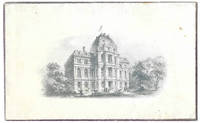
1865rif. 10246Boston: the hotel 1865. Menu printed on silk 30 x 10.5 cm. one leaf printed verso only. Illustrated with an engraving of vignettes of freight transport via ship and train. WITH: Printed envelope 8 x 13 cm. with an engraving. A handsome menu printed on silk for a banquet celebrating the Boards of Trade of the Western Cities given by the City of Boston at the Revere Hotel. Revere House was one of the city's leading hotels hosting guests that included Charles Dickens Jenny Lind and Walt Whitman. Daniel Webster addressed audience from the steps of the portico. The engraving on the envelope depicts the hotel from across Boston's Bowdoin Square. The hotel has had an additional structure added to the previously flat roof. The bill of fare for the Western Boards of Trade included Green Turtle Soup Baked Shad in a Wine Sauce Leg of Southshore Mutton in Caper Sauce Duffield's Ham Pate de Foie and much more. In remarkably fine condition with only the slightest fraying to the edges of the silk. The envelope with an engraving of the Boston's City Hall has some light soil but is near fine. the hotel hardcover books
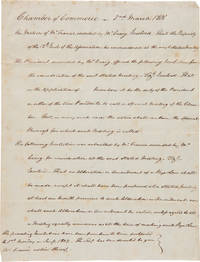
1801rif. 57454Philadelphia: Printed by Zachariah Poulson Junior February 9 1801. With a Contemporary Manuscript Document The official Articles of Association for the Philadelphia Chamber of Commerce adopted when it was founded on January 5 1801 along with a manuscript document regarding changes to those rules written shortly after. The titlepage of the ARTICLES OF ASSOCIATION exists in two states; this is the much rarer state which specifies the month and date in the imprint. The Chamber was established according to these articles "for the purpose of aiding the Trade of the City of Philadelphia by carrying into effect such Rules and Regulations as may from time to time be established with respect to our Commerce and the adjustment of Mercantile differences between each other." The Chamber of Commerce was founded exclusively for merchants with rule XV stating that "No person can become a Member of this Institution who is not a citizen of the United States and a trading merchant of the city of Philadelphia either as a ship owner importer or exporter or a marine insurance broker." This rule was reversed in 1834 when the Chamber of Commerce was absorbed into the Philadelphia Board of Trade and became open to all businessmen. The accompanying manuscript document dated March 2 1801 is addressed to Thomas Willing Francis and regards the proposed reconsideration of Rule XII which states that members may not refuse to submit their accounts to the Chamber in the case of a legal dispute as well as a handful of other motions. Thomas Willing Francis 1767-1815 was a Philadelphia native from a long line of Pennsylvania businessmen. After graduating from the University of Pennsylvania in 1814 he entered the family firm of Willing & Francis - the firm which had sent the first recorded American ship to China for the purpose of trading opium nearly a decade before. He was a founding member of the Chamber of Commerce achieved the rank of captain in the Second Philadelphia City Cavalry and served as a director of numerous other Philadelphia organizations. A significant document in the economic and civic history of Philadelphia with a rare manuscript addition from less than a month after publication and two months after the Chamber's founding. Contemporary marbled wrappers. Spine ends chipped corners a bit worn. Manuscript with some old folds and light creases. Very good. SHAW & SHOEMAKER 1148. SABIN 61974. unknown books
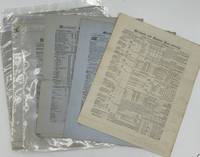
1904rif. 70360Mobile AL: Sanford & Wilson John Forsyth and others 1904. 4to. 1-4 pages each issue some issues lacking a blank integral leaf. 39 scattered issues from this period published under several variant titles by several different publishers; the largest run in the group consists of 26 issues September 1 1859 -- August 18 1860 of 31 issued during the period under the title Merchants' and Planters' Prices-Current published by John Forsyth. The balance of the group consists of five issues published 1848-1859 and ten issues published 1866-1904. Each issue includes all manner of information concerning trade from the port of Mobile during the past week especially cotton with names of ships coming and going destinations tables of goods comparisons with previous years a weekly review if the Mobile market business news notes etc. The long run from 1859 and 1860 offers an excellent view of the market on the eve of the Civil War. Several issues have letters written on the recto of an otherwise blank integral leaf. Overall a very good lot. For the 39 issues Sanford & Wilson, John Forsyth [and others] unknown books
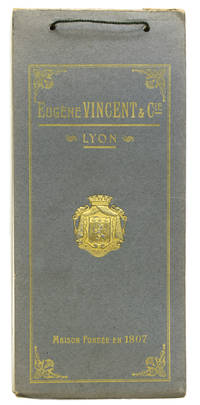
1907rif. 302671Lyon: Imprimerie Gougenheim Frères 1907. 30 numbered chromolithograph plates. Thin oblong 8vo 9-3/4 x 4-1/4 in. Printed gray wrappers stapled and with hole punches and string gold foil stamped arms on front cover. Light wear to covers. With the distribution stamp of Albert Martin 6 Rue des Tonneliers Marseille. 30 numbered chromolithograph plates. Thin oblong 8vo 9-3/4 x 4-1/4 in. A finely printed trade catalogue illustrating the liqueurs and brandies offered by the Lyon wine distributors Eugéne Vincent & Cie including Crème de Cacoa-chouva various brands of curaçao and triple sec anisette fruit brandies Peronneau absinthe and Grog Americain a bottled punch. Imprimerie Gougenheim Frères unknown books
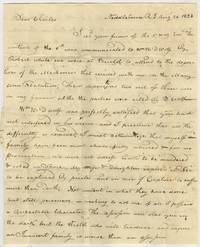
1823rif. BK0184Middletown Rhode Island 1823. Autograph letter signed three pages on a folded sheet with integral address panel to Charles E. Dudley in Albany and Newport postal markings. 7 ¾ x 9 ¾ inches. Old folds scattered staining and some marginal losses a few affecting text. Good to very good. A letter from Newport mariner John Wood concerning his acrimonious departure from the DeWolf family's Mary Ann plantation in Cuba and the ensuing legal dispute with James DeWolf and Charles Collins. Wood was almost certainly the same John Wood whose signature appears on an 1806 Newport agreement for an illegal voyage transporting enslaved Africans from Cape Coast to Havana now held by the Smithsonian's National Museum of African American History and Culture.1 By 1823 he was residing on the Mary Ann plantation one of several Cuban estates belonging to the DeWolfs among the most prominent families involved in the American slave trade. His relationship with DeWolf and Collins had evidently collapsed over his obligations on the estate resulting in what he describes as his forced departure from Cuba under apparently dangerous conditions with his family and a contentious effort to settle their accounts. Writing to his friend Charles E. Dudley then mayor of Albany and a New York state senator Wood reports that three mechanics who had resided with him on the plantation had recently given depositions in Bristol Rhode Island. Two of the three had testified in his favor though all had been called by DeWolf. Wood was particularly incensed by the circumstances surrounding his family's departure from Cuba writing: "I must acknowledge that myself & family have been most shamefully abused & for no provocation we were set adrift liable to be murdered & robbed on Shore My Wife & Daughter exposed at Sea to be captured By pirates and in case of Capture to suffer more than Death; Not content in what they have done but still persevere in wishing to rob me of all I possess a Respectable Character. The assassin will stab you in the dark but the Wretch who will traduce and injure an Innocent family is worse than an assassin." Wood goes on to describe receiving two writs from DeWolf and Collins and transcribes an August 8 letter from James DeWolf explaining his decision to pursue legal action despite their previous discussions of an amicable settlement: "Lest you should think me inconsistent in causing an action to be brought after the last conversation we had I take leave to explain my wishes to come to an amicable settlement by referring to men as we talked remains the same my object is to put the business in a legal and proper train for bringing it to a close . & to enable me to avail of the testimony of the people who were on the Estate with you." Wood expected the Rhode Island Supreme Court meeting at Bristol the following month to appoint referees to settle the accounts. The precise origin of the disagreement is not stated though the depositions of the mechanics and the references to outstanding accounts suggest a dispute over Wood's contractual obligations or activities on the plantation. Wood 1770-1826 was a Newport merchant and captain with longstanding connections to Atlantic commerce. He died at Cape Coast West Africa in 1826 three years after writing the present letter. James DeWolf 1764-1837 then serving in the United States Senate had amassed a substantial fortune through the slave trade and his Cuban plantation interests. Charles Collins his brother-in-law had served as collector of customs at Bristol from 1804 to 1820 an appointment closely connected to the family's slave-trading operations. The Mary Ann plantation is documented in the DeWolf Papers at the Rhode Island Historical Society which include inventories from 1818 and 1820 and contemporary plans of the plantation grounds. The present letter preserves Wood's account of his treatment by the DeWolf family together with his transcription of DeWolf's explanation for pursuing legal action. 1 "Agreement facilitating illegal trade of enslaved Africans" National Museum of African American History & Culture accessed October 12 2026 https://nmaahc.si.edu/object/nmaahc_2019.28.1. . unknown books
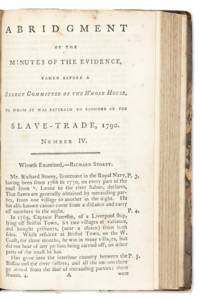
1789rif. 187101789. Committee of the Whole House of the British Parliament investigation into the Atlantic slave trade recorded in Abridgment of the Minutes of the Evidence Taken Before a Committee of the Whole House to Whom It Was Referred to Consider of the Slave Trade published 1789 to 1791 presenting one of the earliest parliamentary documentary compilations addressing the operation and human consequences of the transatlantic slave trade. The volumes preserve testimony gathered during parliamentary inquiries that examined the practices of British slave traders and the treatment of enslaved Africans transported across the Atlantic. These proceedings formed part of the political campaign in Britain that eventually culminated in the abolition of the British slave trade in 1807. The collected evidence includes statements from ship surgeons naval officers merchants and other witnesses whose accounts describe the conditions experienced by enslaved Africans during capture transport and plantation labor. Abridgment of the Minutes of the Evidence Taken Before a Committee of the Whole House To Whom It Was Referred to Consider of the Slave Trade. London: 1789-1791. First edition first printing. Four volumes bound in two books. The compilation reproduces testimony presented before Parliament concerning the organization and operation of the slave trade and includes firsthand statements describing the physical suffering and resistance of enslaved Africans during transport. Surgeon Alexander Falcon-Bridge who had firsthand experience aboard slave ships described acts of despair among captives: he "Has known several enslaved persons to refuse sustenance with a design to starve themselves. refusing to take medicines when sick because they wished to die. Many other slaves expressed the same." Another witness Royal Navy surgeon Thomas Trotter recorded the emotional trauma experienced by captives during embarkation noting that "Slaves on being brought on board showed signs of extreme distress and despair from a feeling of their situation and regret at being torn from friends and connections." The volumes therefore preserve testimony that exposed the violence and human suffering embedded within the Atlantic slave trading system. During the eighteenth century European and American traders transported millions of Africans across the Atlantic through a commercial system that relied on maritime networks linking West Africa the Caribbean and the Americas. Parliamentary investigations of the slave trade in the late eighteenth century were fueled in part by abolitionist activism and public campaigns demanding government inquiry into the practice. Publications of witness testimony such as this abridged parliamentary record circulated evidence used by reformers advocating the end of the trade. Four volumes bound in two books with folding table in the fourth volume. Octavo format. Contemporary marbled quarter calf bindings with modern bookplates on the front past down. Wear present with most spine titles lacking and foxing primarily affecting the title pages; text remains clear. Overall condition very good. unknown books