[SLAVERY]ABAA
1.532 Ergebnisse
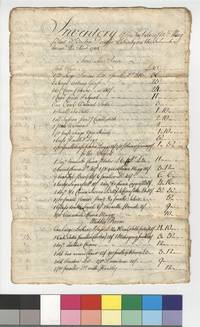
1738Best.-Nr. 60003Mary Grosse Phillips Blair 1681-1738. Manuscript Document Estate Inventory Boston Mass. November 3 1738. 8 pp. folio. Mary Blair was widow of Capt. John Phillips and Capt. William Blair merchant. This inventory depicts a lavishly furnished mansion vast real estate holdings and a rich array of items in the shop -- suggesting that Mary Blair continued the mercantile trade after her husband's death in 1736. Also of note are enslaved persons Cato and Monday. Thomas Hancock was one of the administrators of the estate which was valued at over £28232. Another copy of the inventory exists in state records Suffolk County probate case 7223. Fine condition. books
1864Best.-Nr. 1067529 leaves of blue lined paper written in ink on rectos only. 31.5x20 cm 12¼x8" set in custom-made half cloth folder .Minor aging old folds; near fine. Official court document from Bexar County Texas summarizing the case of "Jim Owen a free person of African descent thirty years of age a resident of said county and state" who "desires to choose an owner and mistress and has selected for his mistress Sephrony Kerr…" Owen states that "he was brought from the State of Illinois to his state in 1850 before he was of lawful age by one John H. Burrus… who has since said time assumed a kind of guardianship over your petitioner without lawful authority…" All seemed on track until John H. Burrus filed suit stating that he was the "owner of said petitioner Owen" and "proof was not made that said petitioner is a free man of African descent" and "the negro Jim Owen… is his slave that he was brought to this State by the respondent in January 1850 as is slave and has been so held and owned up to the present time…" A new trial was granted and Kerr and Owen's petition denied. An appeal was allowed contingent on paying to Burrus a surety bond of $1500. A fascinating glimpse into the legal morass surrounding slavery as the Civil War raged and the "peculiar institution" of slavery was soon to be ended by force of arms. books
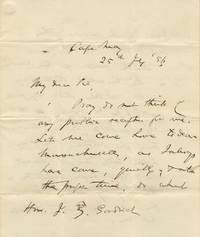
1856Best.-Nr. List3745Cape May New Jersey 1856. Folded sheet with letter on three of four pages measuring 8 ½ x 7 ¼ inches. Fine condition. In May 1856 Senator Charles Sumner of Massachusetts delivered his incendiary "Crime Against Kansas" speech condemning slavery's expansion into the territories and attacking the architects of the Kansas-Nebraska Act. Three days later Representative Preston Brooks of South Carolina entered the Senate chamber and brutally assaulted him with a cane inflicting injuries severe enough to remove Sumner from public life for years. The attack became one of the defining symbolic episodes of the sectional crisis before the Civil War. Northern newspapers followed his condition closely and his empty Senate seat itself became a political emblem. Written from Cape May only two months after the attack while Sumner remained under physician supervision and uncertain whether full recovery would come quickly-or at all-Sumner writes here to a political ally in Massachusetts describing his physical and mental state: "My dear Sir "Pray do not think of any public reception for me. Let me come home to dear Massachusetts as I always have come quietly & at the proper time do what I can for the cause. This is best. Another reason for this course is the uncertain state of my health. I am still very feeble with such recurring ups & downs that my complete restoration seems sometimes far distant. My physician tells me I cannot be strong before September & then only by entire absence from all excitement. Perhaps not then. "Think of these things; & let us all join to stir Massachusetts in the good work forgetting men & remembering only the cause. "Ever sincerely yours Charles Sumner "P.S. From here I go to the mountains; but my address will be with Rev. Wm. H. Furness Phila. to Hon. J. Z. Goodrich" The letter gives a personal insight into the fallout of one of the most dramatic and violent political events of the antebellum sectional crisis. Sumner would return to politics three years later and the event would galvanize both Southern sympathizers to Brooks who sent him canes as tokens of gratitude and the Northern anti-slavery cause which considered Sumner a martyr. We find two other examples of letters by Sumner discussing the aftermath of the attack in all historical auction records.
1856Best.-Nr. List3745Cape May New Jersey 1856. Folded sheet with letter on three of four pages measuring 8 ½ x 7 ¼ inches. Fine condition. In May 1856 Senator Charles Sumner of Massachusetts delivered his incendiary "Crime Against Kansas" speech condemning slavery's expansion into the territories and attacking the architects of the Kansas-Nebraska Act. Three days later Representative Preston Brooks of South Carolina entered the Senate chamber and brutally assaulted him with a cane inflicting injuries severe enough to remove Sumner from public life for years. The attack became one of the defining symbolic episodes of the sectional crisis before the Civil War. Northern newspapers followed his condition closely and his empty Senate seat itself became a political emblem. Written from Cape May only two months after the attack while Sumner remained under physician supervision and uncertain whether full recovery would come quickly-or at all-Sumner writes here to a political ally in Massachusetts describing his physical and mental state: "My dear Sir "Pray do not think of any public reception for me. Let me come home to dear Massachusetts as I always have come quietly & at the proper time do what I can for the cause. This is best. Another reason for this course is the uncertain state of my health. I am still very feeble with such recurring ups & downs that my complete restoration seems sometimes far distant. My physician tells me I cannot be strong before September & then only by entire absence from all excitement. Perhaps not then. "Think of these things; & let us all join to stir Massachusetts in the good work forgetting men & remembering only the cause. "Ever sincerely yours Charles Sumner "P.S. From here I go to the mountains; but my address will be with Rev. Wm. H. Furness Phila. to Hon. J. Z. Goodrich" The letter gives a personal insight into the fallout of one of the most dramatic and violent political events of the antebellum sectional crisis. Sumner would return to politics three years later and the event would galvanize both Southern sympathizers to Brooks who sent him canes as tokens of gratitude and the Northern anti-slavery cause which considered Sumner a martyr. We find two other examples of letters by Sumner discussing the aftermath of the attack in all historical auction records. books
1834Best.-Nr. 31598Philadelphia 1834. 3pp. Later annotation at head of first page. Scarce letter on the Liberian colonization movement by one of its founders. Writing to Hawes a member of Parliament and a committee member of the Society for the Extinction of the Slave Trade Cresson wishes for success in the British anti-slavery action off the coast of Sierra Leone writing "I hope that you may yet enjoy the satisfaction of crushing one of the worst & most unacceptable of the slave markets in existence that at Gallinas." After mentioning the travels of the colonial governor of Liberia he writes: ". I have been gratified to learn from several highly respectable sources that such a Colony as you propose located either at the mouth of the Cape Mount River or even a little more to the Northward say at Sugaree & provided with a good supply of trade goods to exchange with the natives would have a powerful tendency to break up the monopoly now enjoyed by the Spanish Slavers. My letters from Africa state that the demand is so great in Cuba from the ravages of Cholera among their ill-fed human cattle as to have rendered the shipments from the Gallinas during the past year almost unprecedented. It appears that the benevolent efforts of your Govt. are not likely to extirpate the evil until commercial & agricultural colonies shall be substituted for cruisers." The letter continues with news from their consul at Liberia before turning to American politics: ". political affairs engrossing the entire energies of the nation. The excitement is painfully great . Our military chieftan Jackson by his acts of unauthorized assumption has called forth a burst of indignation which cannot subside until we get rid of the offender." The letter concludes with an introduction for Gerard Ralston. Cresson a noted Philadelphia businessman and philanthropist was among the most ardent supports of colonization the movement to relocate former slaves and free African Americans to colonies in Liberia. In 1833 Cresson and the Philadelphia Young Men's Colonization Society a branch of the American Colonization Society founded Port Cresson in Liberia. However the colony was attacked in 1835 by Bassa tribesmen incited by Spanish slave traders and destroyed. unknown
1834Best.-Nr. 31598Philadelphia 1834. 3pp. Later annotation at head of first page. Scarce letter on the Liberian colonization movement by one of its founders. Writing to Hawes a member of Parliament and a committee member of the Society for the Extinction of the Slave Trade Cresson wishes for success in the British anti-slavery action off the coast of Sierra Leone writing "I hope that you may yet enjoy the satisfaction of crushing one of the worst & most unacceptable of the slave markets in existence that at Gallinas." After mentioning the travels of the colonial governor of Liberia he writes: ". I have been gratified to learn from several highly respectable sources that such a Colony as you propose located either at the mouth of the Cape Mount River or even a little more to the Northward say at Sugaree & provided with a good supply of trade goods to exchange with the natives would have a powerful tendency to break up the monopoly now enjoyed by the Spanish Slavers. My letters from Africa state that the demand is so great in Cuba from the ravages of Cholera among their ill-fed human cattle as to have rendered the shipments from the Gallinas during the past year almost unprecedented. It appears that the benevolent efforts of your Govt. are not likely to extirpate the evil until commercial & agricultural colonies shall be substituted for cruisers." The letter continues with news from their consul at Liberia before turning to American politics: ". political affairs engrossing the entire energies of the nation. The excitement is painfully great . Our military chieftan Jackson by his acts of unauthorized assumption has called forth a burst of indignation which cannot subside until we get rid of the offender." The letter concludes with an introduction for Gerard Ralston. Cresson a noted Philadelphia businessman and philanthropist was among the most ardent supports of colonization the movement to relocate former slaves and free African Americans to colonies in Liberia. In 1833 Cresson and the Philadelphia Young Men's Colonization Society a branch of the American Colonization Society founded Port Cresson in Liberia. However the colony was attacked in 1835 by Bassa tribesmen incited by Spanish slave traders and destroyed. unknown books
1789Best.-Nr. 40544Hempfield Westmoreland County Pennsylvania 1789. Folio leaves folded to oblong 7.5" x 9." Plain wraps with manuscript title detached but present. 44 pp including: 1-title 35 hand-paginated with entries 1-tally page and 1-assessors' certification 6 blank. Toned some splitting along spine folds light chipping at edges. Good. In March 1780 Pennsylvania enacted "An Act for the Gradual Abolition of Slavery" requiring "That all persons as well Negroes and Mulattoes as others who shall be born within this state from and after the passing of this act shall not be deemed and considered as servants for life or slaves; and that all servitude for life or slavery of children in consequence of the slavery of their mothers in the case of all children born within this state from and after the passing of this act as aforesaid shall be and hereby is utterly taken away extinguished and for ever abolished." Persons born in Slavery before the date of the Act would remain as slaves. This inventory of taxable property is a Who's Who of Hempfield Township in western Pennsylvania consisting of an alphabetical list of the heads of households for the township. Each entry includes the number of servants under columns headed "Negro & Mulatto Slaves" or "Negroes"; land by deed warrant or location; improvements; number of horses horned cattle mills stills houses/lots and outlots; and value of the property in pounds shillings and pence. Several entries have "Single Man" written across the first few columns. The total taxable property in this return is £12850.3.9. Five entries have a "1" under the "Negroes" column including: William Perry Esq.; James Guthry who notes F 30; Alexander McDowall; David D.P. Marchant; Christian Rhodabough who notes 1-30. Other entries have an "X" in the "Negroes" column. The assessor is listed on the last page as Robert Flemman; Robert McKee 1771-1850 and Robert Taylor are his assistants. "Hempfield's early settlers were Germans from southeastern Pennsylvania. The name Hempfield was taken from Hempfield Township in Lancaster County which was formed in 1729 as an English place name. Hempfield Township in Lancaster County derived their name from the production of hemp. In 1818 Lancaster County divided Hempfield Township into East and West Hempfield. The settlers from Lancaster County that came to this area gave the same name to our Township where some of the early settlers had resided. Agriculture was the base for the settlers in the early days. The Township was known for the stills and distilleries where farmers refined the substantial grain output." "Naming & Establishing Hempfield Township" accessed at official website of Hempfield Township 25 February 2025. Two notable individuals listed are Henry Aleshouse 1757-1837 and Michael Huffnagle 1753-1819. Aleshouse was Captain of the Continental Army from 1776-1780 and prisoner of war during his service; Major in the Pennsylvania Militia in 1783; member of the Pennsylvania State House of Representatives from 1802-1805 1812-15 1817-1818; and Pennsylvania State Senate from 1819-1826. Huffnagle was prothonotary for Westmoreland County Captain in the 8th Pennsylvania Regiment during the Revolutionary War one of the first lawyers admitted to the Westmoreland County bar Judge of the Court of Common Pleas Clerk of the Court of Quarter Sessions and Clerk of the Orphan's Court and Agent for Forfeited Estates. Of the slave owners Dr. David Marchant Marchand 1746-1809 was a Captain in the American Revolution local doctor and founder of the first hospital west of the Allegheny Mountains; William Perry Esq. 1745-1793 was a sheriff of Westmoreland County from about 1777-1789 Treasurer of Westmoreland County from 1783-1788 County Sheriff in 1779 and Captain of a company of rangers with the Westmoreland Militia. Some of the surnames listed are: Alesworth Aultman Berger Brisby Beer Barnheart Bell Campbell Condon Cough Crookshank Clingahsmith Davison Errit Fullerton Jenkins Kimble McCurdey Russell Robison Shotts Shull Taylor Turner Wagley Waterson Yokey and others. unknown
1789Best.-Nr. 40544Hempfield Westmoreland County Pennsylvania 1789. Folio leaves folded to oblong 7.5" x 9." Plain wraps with manuscript title detached but present. 44 pp including: 1-title 35 hand-paginated with entries 1-tally page and 1-assessors' certification 6 blank. Toned some splitting along spine folds light chipping at edges. Good. In March 1780 Pennsylvania enacted "An Act for the Gradual Abolition of Slavery" requiring "That all persons as well Negroes and Mulattoes as others who shall be born within this state from and after the passing of this act shall not be deemed and considered as servants for life or slaves; and that all servitude for life or slavery of children in consequence of the slavery of their mothers in the case of all children born within this state from and after the passing of this act as aforesaid shall be and hereby is utterly taken away extinguished and for ever abolished." Persons born in Slavery before the date of the Act would remain as slaves. This inventory of taxable property is a Who's Who of Hempfield Township in western Pennsylvania consisting of an alphabetical list of the heads of households for the township. Each entry includes the number of servants under columns headed "Negro & Mulatto Slaves" or "Negroes"; land by deed warrant or location; improvements; number of horses horned cattle mills stills houses/lots and outlots; and value of the property in pounds shillings and pence. Several entries have "Single Man" written across the first few columns. The total taxable property in this return is £12850.3.9. Five entries have a "1" under the "Negroes" column including: William Perry Esq.; James Guthry who notes F 30; Alexander McDowall; David D.P. Marchant; Christian Rhodabough who notes 1-30. Other entries have an "X" in the "Negroes" column. The assessor is listed on the last page as Robert Flemman; Robert McKee 1771-1850 and Robert Taylor are his assistants. "Hempfield's early settlers were Germans from southeastern Pennsylvania. The name Hempfield was taken from Hempfield Township in Lancaster County which was formed in 1729 as an English place name. Hempfield Township in Lancaster County derived their name from the production of hemp. In 1818 Lancaster County divided Hempfield Township into East and West Hempfield. The settlers from Lancaster County that came to this area gave the same name to our Township where some of the early settlers had resided. Agriculture was the base for the settlers in the early days. The Township was known for the stills and distilleries where farmers refined the substantial grain output." "Naming & Establishing Hempfield Township" accessed at official website of Hempfield Township 25 February 2025. Two notable individuals listed are Henry Aleshouse 1757-1837 and Michael Huffnagle 1753-1819. Aleshouse was Captain of the Continental Army from 1776-1780 and prisoner of war during his service; Major in the Pennsylvania Militia in 1783; member of the Pennsylvania State House of Representatives from 1802-1805 1812-15 1817-1818; and Pennsylvania State Senate from 1819-1826. Huffnagle was prothonotary for Westmoreland County Captain in the 8th Pennsylvania Regiment during the Revolutionary War one of the first lawyers admitted to the Westmoreland County bar Judge of the Court of Common Pleas Clerk of the Court of Quarter Sessions and Clerk of the Orphan's Court and Agent for Forfeited Estates. Of the slave owners Dr. David Marchant Marchand 1746-1809 was a Captain in the American Revolution local doctor and founder of the first hospital west of the Allegheny Mountains; William Perry Esq. 1745-1793 was a sheriff of Westmoreland County from about 1777-1789 Treasurer of Westmoreland County from 1783-1788 County Sheriff in 1779 and Captain of a company of rangers with the Westmoreland Militia. Some of the surnames listed are: Alesworth Aultman Berger Brisby Beer Barnheart Bell Campbell Condon Cough Crookshank Clingahsmith Davison Errit Fullerton Jenkins Kimble McCurdey Russell Robison Shotts Shull Taylor Turner Wagley Waterson Yokey and others. unknown books
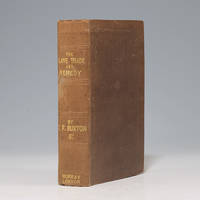
1840Best.-Nr. 1132391840. First Edition. SLAVERY BUXTON Thomas Fowell. The African Slave Trade and its Remedy. London: John Murray 1840. Octavooriginal brown clothuncut and partially unopened; pp.14 viii 3 6-273 274-276 i ii-vi 277 278-582. $2800.First expanded and revised edition of British abolitionist Buxton's powerful call for an end to the slave trade the first to include his extensive and influential Remedy two major works that followed the lead of Wilberforce in calling for treaties and commerce to end the slave trade and outlined a way to ""secure the regeneration of Africa through agricultural development"" with large folding map a handsome copy in original cloth.Quaker Thomas Buxton was in Parliament when in 1824 Wilberforce asked him to become his successor. ""In 1789 Wilberforce had begged Parliament to 'make reparation to AfricaÉ by establishing a trade upon true commercial principlesÉ Fifty years later Buxton redeveloped this appeal in The African Slave TradeÉ To support his vision Buxton formed the African Civilization Society July 1839."" In this first expanded edition of African Slave Trade 1839Ñthe first to include his RemedyÑBuxton argues for the ""agricultural colonization of West Africa and the development of a broad-based commerce that could undercut the economic dominance of the illicit slave trade"" Hopkins Peter Thonning 615. He documents the horrors of the Middle Passage to show that despite all efforts to end the slave trade ""twice as many human beings are now its victims as when Wilberforce and Clarkson entered upon their noble task."" And in Remedy he further develops his argument: showing how ""legitimate commerce would put down the Slave Trade by demonstrating the superior value of man as a laborer on the soil to man as an object of merchandise.""With African Slave Trade and its Remedy Buxton powerfully ""synthesized contemporary currents of thought developed the arguments about the relationship between abolition and African improvement more systematically than before and then catapulted them to national prominenceÉ His views prevailed. The belief that the only way to suppress the African slave trade was to promote 'legitimate commerce' and that this new trade would launch Africa on the road to moral and material progress became the conventional wisdom in mid-19th-century Britain."" Among those he convinced was David Livingstone who as ""an unknown medical student attended the 1840 meeting of the African Civilization Society where Buxton first announced his remedy for the slave trade. What Livingstone heard on that occasion helped inspire a lifetime of work and travel on the continent"" Mann Slavery and the Birth of an African City 88-90. First expanded and revised edition: first to include Buxton's Remedy which was issued separately in 1839. Precedes the first American edition. With folding map of ""Central Africa."" Paginated as issued without loss of text. With 14-page ""Prospectus of the Society for the Extinction of the Slave Trade and for the Civilization of Africa"" preceding title page. Sabin 9685. Goldsmith's 31743. Kress C5121 See Goldsmith's 31181; Kress C4818; Blockson 9121. Interior fresh with light foxing to folding map as often front inner paper hinge starting but very sound mild rubbing and toning to bright original cloth. A desirable near-fine copy. hardcover
1840Best.-Nr. 1132391840. First Edition. SLAVERY BUXTON Thomas Fowell. The African Slave Trade and its Remedy. London: John Murray 1840. Octavooriginal brown clothuncut and partially unopened; pp.14 viii 3 6-273 274-276 i ii-vi 277 278-582. $2800.First expanded and revised edition of British abolitionist Buxton's powerful call for an end to the slave trade the first to include his extensive and influential Remedy two major works that followed the lead of Wilberforce in calling for treaties and commerce to end the slave trade and outlined a way to ""secure the regeneration of Africa through agricultural development"" with large folding map a handsome copy in original cloth.Quaker Thomas Buxton was in Parliament when in 1824 Wilberforce asked him to become his successor. ""In 1789 Wilberforce had begged Parliament to 'make reparation to AfricaÉ by establishing a trade upon true commercial principlesÉ Fifty years later Buxton redeveloped this appeal in The African Slave TradeÉ To support his vision Buxton formed the African Civilization Society July 1839."" In this first expanded edition of African Slave Trade 1839Ñthe first to include his RemedyÑBuxton argues for the ""agricultural colonization of West Africa and the development of a broad-based commerce that could undercut the economic dominance of the illicit slave trade"" Hopkins Peter Thonning 615. He documents the horrors of the Middle Passage to show that despite all efforts to end the slave trade ""twice as many human beings are now its victims as when Wilberforce and Clarkson entered upon their noble task."" And in Remedy he further develops his argument: showing how ""legitimate commerce would put down the Slave Trade by demonstrating the superior value of man as a laborer on the soil to man as an object of merchandise.""With African Slave Trade and its Remedy Buxton powerfully ""synthesized contemporary currents of thought developed the arguments about the relationship between abolition and African improvement more systematically than before and then catapulted them to national prominenceÉ His views prevailed. The belief that the only way to suppress the African slave trade was to promote 'legitimate commerce' and that this new trade would launch Africa on the road to moral and material progress became the conventional wisdom in mid-19th-century Britain."" Among those he convinced was David Livingstone who as ""an unknown medical student attended the 1840 meeting of the African Civilization Society where Buxton first announced his remedy for the slave trade. What Livingstone heard on that occasion helped inspire a lifetime of work and travel on the continent"" Mann Slavery and the Birth of an African City 88-90. First expanded and revised edition: first to include Buxton's Remedy which was issued separately in 1839. Precedes the first American edition. With folding map of ""Central Africa."" Paginated as issued without loss of text. With 14-page ""Prospectus of the Society for the Extinction of the Slave Trade and for the Civilization of Africa"" preceding title page. Sabin 9685. Goldsmith's 31743. Kress C5121 See Goldsmith's 31181; Kress C4818; Blockson 9121. Interior fresh with light foxing to folding map as often front inner paper hinge starting but very sound mild rubbing and toning to bright original cloth. A desirable near-fine copy. hardcover books
Best.-Nr. 234106Saint-Thomas [Antilles], 18 janvier 1743 in-folio, 12 pp. couvertes d'une écriture lisible (environ 20/25 lignes par page), en feuilles, cousu.
Best.-Nr. 8192Saint-Denis (Ile Bourbon), 1810. 10 pp. manuscrites.
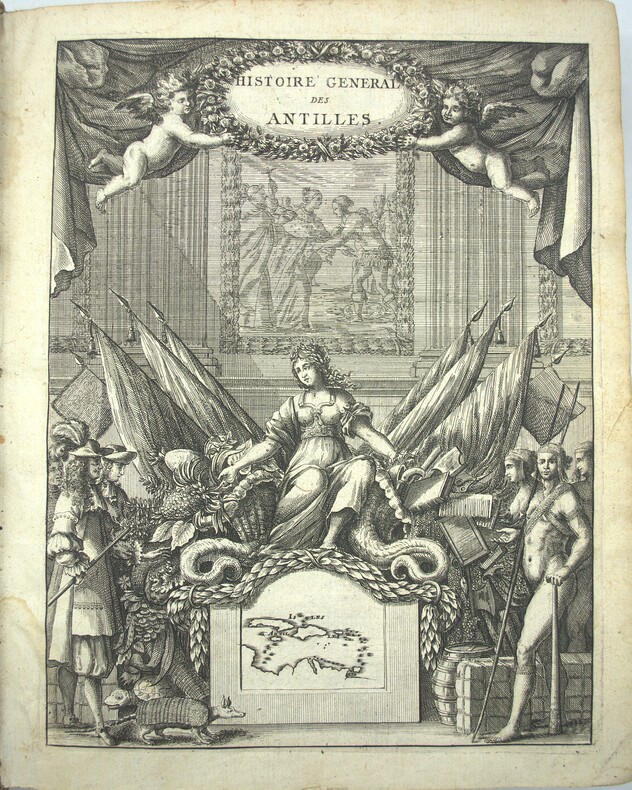
1667Best.-Nr. PHO-2095Paris, Thomas Jolly, 1667, 2 tomes en in-4, veau brun, dos à nerfs orné avec titre et tomaison, (Reliure de l'époque), manques aux coiffes, coins émoussés, début de fente L'illustration, gravée sur cuivre, comprend 2 titres-frontispices, 3 cartes au premier tome et 14 planches au second dont la planche figurant un couple nu, la gravure des armoiries de Harlay manque
Best.-Nr. 245233Paris, Pagnerre, 1843 2 volumes in-8, (6)-390 pp. et (4)-488 pp., 8 pp. de Catalogue Pagnerre, demi-veau cerise, dos à nerfs orné, roulettes dorées et fleurons à froid, couverture verte imprimée conservée (reliure moderne).
1833Best.-Nr. 31599England: Elliott Cresson 1833. Bi-folded folio. 3 pp. 12 1/3 x 7 1/2 inches. Important autograph letter from Elliott Cresson one of the foremost proponents of the American Colonization Society and its colony in Liberia to Member of Parliament Benjamin Hawes presenting a resolution to found the British African Colonization Society. Discusses the famed abolitionist William Lloyd Garrison's opposition to the colonization movement. The letter begins with the two-page text of a resolution to establish the British African Colonization Society under the patronage of the Duke of Sussex: "That Colonies composed of fair settlers of African race established on judicious principles on the Coast of Africa appear calculated beyond any other plan to put an effectual stop to the slave trade . . . Resolved that a Society be formed to be called the British African Colonization Society and that its objects be to cooperate with the American Colonization Society and with the several missionaries and other religious and charitable societies in Great Britain and the United States of America in such measures as may promote the total abolition of the slave trade and the establishment of Christianity and Civilization among the Natives of Africa chiefly by the employment of Free Persons of African birth or descent . . ." In the letter which follows Cresson writes of William Lloyd Garrison's opposition to the colonization movement: "I send the list of officers as far as accepted several others have not yet answered but I trust we shall present a bold front. I have just heard thru his Chaplain from the Duke. Garrison has written to poison his mind and probably will annoy our meeting. I trust that as the notice has been so short our friends will bring many with them . . . My letter to the Times in answer to Garrison they have not yet noticed so that it will be put in the Globe whose Editor has offered it a place in his columns." Cresson a noted Philadelphia businessman and philanthropist was among the most ardent supporters of colonization the movement to relocate formerly enslaved people and free black Americans to colonies in Liberia. In 1832 he traveled to England to promote international support for the movement. The following year Cresson and the Philadelphia Young Men's Colonization Society a branch of the American Colonization Society founded Port Cresson in Liberia. However the colony was attacked in 1835 by Bassa tribesmen incited by Spanish slave traders and destroyed. Although initially in favor of colonization William Lloyd Garrison changed his mind and decried the efforts of the American Colonization Society as a perpetuation of slavery. For Garrison's 28 June 1833 letter to the Duke of Sussex referenced above see The Letters of William Lloyd Garrison I:107. Elliott Cresson unknown
1833Best.-Nr. 31599England: Elliott Cresson 1833. Bi-folded folio. 3 pp. 12 1/3 x 7 1/2 inches. Important autograph letter from Elliott Cresson one of the foremost proponents of the American Colonization Society and its colony in Liberia to Member of Parliament Benjamin Hawes presenting a resolution to found the British African Colonization Society. Discusses the famed abolitionist William Lloyd Garrison's opposition to the colonization movement. The letter begins with the two-page text of a resolution to establish the British African Colonization Society under the patronage of the Duke of Sussex: "That Colonies composed of fair settlers of African race established on judicious principles on the Coast of Africa appear calculated beyond any other plan to put an effectual stop to the slave trade . . . Resolved that a Society be formed to be called the British African Colonization Society and that its objects be to cooperate with the American Colonization Society and with the several missionaries and other religious and charitable societies in Great Britain and the United States of America in such measures as may promote the total abolition of the slave trade and the establishment of Christianity and Civilization among the Natives of Africa chiefly by the employment of Free Persons of African birth or descent . . ." In the letter which follows Cresson writes of William Lloyd Garrison's opposition to the colonization movement: "I send the list of officers as far as accepted several others have not yet answered but I trust we shall present a bold front. I have just heard thru his Chaplain from the Duke. Garrison has written to poison his mind and probably will annoy our meeting. I trust that as the notice has been so short our friends will bring many with them . . . My letter to the Times in answer to Garrison they have not yet noticed so that it will be put in the Globe whose Editor has offered it a place in his columns." Cresson a noted Philadelphia businessman and philanthropist was among the most ardent supporters of colonization the movement to relocate formerly enslaved people and free black Americans to colonies in Liberia. In 1832 he traveled to England to promote international support for the movement. The following year Cresson and the Philadelphia Young Men's Colonization Society a branch of the American Colonization Society founded Port Cresson in Liberia. However the colony was attacked in 1835 by Bassa tribesmen incited by Spanish slave traders and destroyed. Although initially in favor of colonization William Lloyd Garrison changed his mind and decried the efforts of the American Colonization Society as a perpetuation of slavery. For Garrison's 28 June 1833 letter to the Duke of Sussex referenced above see The Letters of William Lloyd Garrison I:107. Elliott Cresson unknown books
1823Best.-Nr. 423251London: Printed by Ellerton and Henderson Gough Square 1823. Near Fine. Folio 21.5 x 33 cm / 8½" x 13”. pp. 1 2-3 4 blank. Light vertical and horizontal center folds three short tears at the horizontal fold near fine with a contemporary drawing of a few survey lines and diagrams very lightly sketched in ink and pencil on the final blank page. The Society states its case against slavery in the Colonies of Great Britain where "there are at this moment upwards of 800000 human beings in a state of degrading personal slavery." It provides a brief but detailed description of "the immoral inhuman and unjust" nature of the slave trade and of the absolute power of slave owners. Printed by Ellerton and Henderson, Gough Square unknown
1823Best.-Nr. 423251London: Printed by Ellerton and Henderson Gough Square 1823. Near Fine. Folio 21.5 x 33 cm / 8½" x 13”. pp. 1 2-3 4 blank. Light vertical and horizontal center folds three short tears at the horizontal fold near fine with a contemporary drawing of a few survey lines and diagrams very lightly sketched in ink and pencil on the final blank page. The Society states its case against slavery in the Colonies of Great Britain where "there are at this moment upwards of 800000 human beings in a state of degrading personal slavery." It provides a brief but detailed description of "the immoral inhuman and unjust" nature of the slave trade and of the absolute power of slave owners. Printed by Ellerton and Henderson, Gough Square unknown books
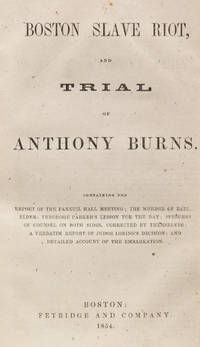
1854Best.-Nr. 1266841854. First Edition. SLAVERY BURNS Anthony. Boston Slave Riot and Trial of Anthony Burns. Boston: Fetridge 1854. Slim octavo modern half calf and marbled boards. $3000.First edition of a seminal pre-Civil War pamphlet on the 1854 arrest and Boston trial of fugitive slave Anthony Burns whose return to his Virginia slave owner at the order of the Boston court sparked public fury and ""set Boston on its ear in the spring of 1854"" inspiring Whitman to write his Boston Ballad and Thoreau to deliver his speech Slavery in Massachusetts to a July 4 1854 antislavery rally.The trial of fugitive slave Anthony Burns which ""set Boston on its ear in the spring of 1854É.was nothing less than a pocket revolution"" Von Frank Trials of Anthony Burns xii. The arrest and trial in Boston of Burns whose Virginia slave-owner Suttle followed him there was ""one of the most dramatic and famous incidents in the enforcement of the Fugitive Slave Act."" When Boston Commissioner Loring signed Burns' arrest warrant Richard Henry Dana Jr. and Charles Ellis immediately volunteered to defend Burns. On ""May 26 there was a mass meeting in Faneuil Hall to protest Burns' arrest. This meeting was followed by a poorly planned and disastrously executedÉ attempt to rescue BurnsÉ Despite conflicting testimony and imperfect evidence provided by Suttle Loring declared Burns was indeed Suttle's slave."" With that Burns was taken from the courtroom and through streets crowded with his supporters then placed aboard a ship ""for return to Virginia. The trial and removal of Burns from Boston created one of the great spectacles of the late antebellum period"" Finkelman 107-112.""The Burns case made slavery appear to Northerners as an immediate threatÉ Walt Whitman was impelled to write an ironic piece A Boston Ballad soon to be incorporated into his revolutionary volume Leaves of GrassÉ At an antislavery rally in Framingham Massachusetts on July 4É William Lloyd Garrison burned copies of the Fugitive Slave Law and the Constitution as the large crowd chanted 'Amen!' Thoreau delivered his speech Slavery in Massachusetts declaring that the American system had lost its integrity and purityÉ The antislavery sentiment bred by the case helped give birth to the Republican Party which in turn fostered Lincoln's Presidency the South's secession and the Civil War"" New York Times. Containing ""valuable primary source material about the trial and the events surrounding it"" including testimony legal documents"" as well as the full texts of the speeches of the counsel and the opinion of Commissioner Loring."" Bound without rear advertisements: ""some have advertisements at the back of the pamphlet while others do not"" no priority established Finkelman 113. Sabin 6505. Harvard Law Catalogue II:1030. Text fine. hardcover
1854Best.-Nr. 1266841854. First Edition. SLAVERY BURNS Anthony. Boston Slave Riot and Trial of Anthony Burns. Boston: Fetridge 1854. Slim octavo modern half calf and marbled boards. $3000.First edition of a seminal pre-Civil War pamphlet on the 1854 arrest and Boston trial of fugitive slave Anthony Burns whose return to his Virginia slave owner at the order of the Boston court sparked public fury and ""set Boston on its ear in the spring of 1854"" inspiring Whitman to write his Boston Ballad and Thoreau to deliver his speech Slavery in Massachusetts to a July 4 1854 antislavery rally.The trial of fugitive slave Anthony Burns which ""set Boston on its ear in the spring of 1854É.was nothing less than a pocket revolution"" Von Frank Trials of Anthony Burns xii. The arrest and trial in Boston of Burns whose Virginia slave-owner Suttle followed him there was ""one of the most dramatic and famous incidents in the enforcement of the Fugitive Slave Act."" When Boston Commissioner Loring signed Burns' arrest warrant Richard Henry Dana Jr. and Charles Ellis immediately volunteered to defend Burns. On ""May 26 there was a mass meeting in Faneuil Hall to protest Burns' arrest. This meeting was followed by a poorly planned and disastrously executedÉ attempt to rescue BurnsÉ Despite conflicting testimony and imperfect evidence provided by Suttle Loring declared Burns was indeed Suttle's slave."" With that Burns was taken from the courtroom and through streets crowded with his supporters then placed aboard a ship ""for return to Virginia. The trial and removal of Burns from Boston created one of the great spectacles of the late antebellum period"" Finkelman 107-112.""The Burns case made slavery appear to Northerners as an immediate threatÉ Walt Whitman was impelled to write an ironic piece A Boston Ballad soon to be incorporated into his revolutionary volume Leaves of GrassÉ At an antislavery rally in Framingham Massachusetts on July 4É William Lloyd Garrison burned copies of the Fugitive Slave Law and the Constitution as the large crowd chanted 'Amen!' Thoreau delivered his speech Slavery in Massachusetts declaring that the American system had lost its integrity and purityÉ The antislavery sentiment bred by the case helped give birth to the Republican Party which in turn fostered Lincoln's Presidency the South's secession and the Civil War"" New York Times. Containing ""valuable primary source material about the trial and the events surrounding it"" including testimony legal documents"" as well as the full texts of the speeches of the counsel and the opinion of Commissioner Loring."" Bound without rear advertisements: ""some have advertisements at the back of the pamphlet while others do not"" no priority established Finkelman 113. Sabin 6505. Harvard Law Catalogue II:1030. Text fine. hardcover books
1801Best.-Nr. 0032601801 Paris, Dentu, An IX - 1801. Deux volumes in-8 (197 X 130 mm) demi-veau fauve à petits coins, dos lisse orné de filets gras et perlés, larges fleurons dorés, pièces de titre et de tomaison veau vert lierre, la tomaison est frappée au centre d'un blason doré et orné (reliure de l'époque). Tome I : faux-titre, titre, 32 pages, XXVIII pages, 226 pages, 1 carte et 7 planches dépliantes ; Tome II : faux-titre, titre, 320 pages, 1 plan, 1 carte et 1 planche dépliante. Tache brune en marge de quelques feuillets du premier tome et en marge de deux gravures, sans gravité.
1833Best.-Nr. 84791Lexington KY: Abraham Skillman 1833. First Edition. First printing. 12mo 18.5cm; original brown cloth-covered boards; viii207pp. Respined to style with facsimile printed spine label; Bookplate of the Young Men's Christian Institute New Haven to front pastedown; bookseller's ticket Williams' Bookstore Under the Old South Meeting House Boston at base of front flyleaf; pencil signature faded and illegible to front endpaper. Complete sound and Good. One of a tiny number of pre-Civil War abolitionist texts to have been written by a Virginia author. Paxton 1784-1868 was a Presbyterian minister born in Rockbridge County Virginia and educated at Princeton Theological Seminary; it is likely his mentorship there under Charles Hodge helped develop Paxton's antislavery sentiments. In 1826 after publishing an essay asserting the institution of slavery to be incompatible with the teachings of the Bible Paxton was expelled from his pastorship of Cumberland Presbyterian Church near Farmville in south-central Virginia. The present text addressed to his former congregation recounts the events of his expulsion reprints the essay in question and adds a series of epistolary essays supporting his theological position in oppostion to slavery. The existence of any abolitionist sentiment during this period in Virginia's history is remarkable in itself. For a native-born minister to willfully preach the gospel of antislavery even the relatively conservative version of abolitionism professed by Paxton before a congregation whose sentiments on the subject would have been diametrically opposed - and which doubtless included a number of slaveholding families - must have amounted to apostasy in some congregants' eyes. By publishing the present work Paxton essentially doubled down on his unpopular beliefs making him in this cataloguer's eyes a rather remarkable figure. We find it surprising that so little biographical information exists regarding Paxton. His name barely appears in the scholarly literature on the period; perhaps because no mention of abolition is made in either the title nor the sub-title of his book the work is rarely discussed in articles on the antebellum southern antislavery movement. Though reasonably available institutionally Letters on Slavery is perenially scarce in commerce having appeared at auction only three times in the current century. This a quite decent copy in a discreetly restored binding. SABIN 59264. DUMOND Antislavery Bibliography p.89. LCP AFRO-AMERICANA 7501. Abraham Skillman unknown
1833Best.-Nr. 84791Lexington KY: Abraham Skillman 1833. First Edition. First printing. 12mo 18.5cm; original brown cloth-covered boards; viii207pp. Respined to style with facsimile printed spine label; Bookplate of the Young Men's Christian Institute New Haven to front pastedown; bookseller's ticket Williams' Bookstore Under the Old South Meeting House Boston at base of front flyleaf; pencil signature faded and illegible to front endpaper. Complete sound and Good. One of a tiny number of pre-Civil War abolitionist texts to have been written by a Virginia author. Paxton 1784-1868 was a Presbyterian minister born in Rockbridge County Virginia and educated at Princeton Theological Seminary; it is likely his mentorship there under Charles Hodge helped develop Paxton's antislavery sentiments. In 1826 after publishing an essay asserting the institution of slavery to be incompatible with the teachings of the Bible Paxton was expelled from his pastorship of Cumberland Presbyterian Church near Farmville in south-central Virginia. The present text addressed to his former congregation recounts the events of his expulsion reprints the essay in question and adds a series of epistolary essays supporting his theological position in oppostion to slavery. The existence of any abolitionist sentiment during this period in Virginia's history is remarkable in itself. For a native-born minister to willfully preach the gospel of antislavery even the relatively conservative version of abolitionism professed by Paxton before a congregation whose sentiments on the subject would have been diametrically opposed - and which doubtless included a number of slaveholding families - must have amounted to apostasy in some congregants' eyes. By publishing the present work Paxton essentially doubled down on his unpopular beliefs making him in this cataloguer's eyes a rather remarkable figure. We find it surprising that so little biographical information exists regarding Paxton. His name barely appears in the scholarly literature on the period; perhaps because no mention of abolition is made in either the title nor the sub-title of his book the work is rarely discussed in articles on the antebellum southern antislavery movement. Though reasonably available institutionally Letters on Slavery is perenially scarce in commerce having appeared at auction only three times in the current century. This a quite decent copy in a discreetly restored binding. SABIN 59264. DUMOND Antislavery Bibliography p.89. LCP AFRO-AMERICANA 7501. Abraham Skillman unknown books
1830Best.-Nr. PHO-17051830, à Paris, imprimerie royale, 3 volumes in-8°et 1 atlas ,1 portrait-frontispice ,5 planches et 1 carte et itinéraire dépliante (900x 650mm). 3 fnch-xii-475pp,426pp, 404pp..Très rare et complet- très bel exemplaire, relié plein buffle rouge, dos lisse avec auteur et titre, tomaison, atlas, titre au plat, couvertures conservées Dans l’Atlas : 5 planches et 1 grande carte repliée par Jomard
1857Best.-Nr. 23389.07Rare New York Senate Print of Proposed State Law to Combat the Dred Scott Decision "Every slave … who shall come or be brought or be involuntarily in this state shall be free." SLAVERY AND ABOLITION—NEW YORK STATE. New York Senate. "An Act To secure Freedom to all persons within this State" Edward M. Madden April 9 1857 Passed the Assembly on April 17; failed in the Senate. Printed with numbered lines for the use of the Senate. 1 p. 6.5 x 11.5 in. Excerpts "Neither descent near or remote from an African…nor color of skin shall disqualify any person for being or prevent any person from becoming a citizen of this state; nor deprive such person of the rights and privileges of a citizen thereof." "Every person who shall hold or attempt to hold in this state in slavery…under any pretence or for any time however short shall be deemed guilty of felony and on conviction thereof shall be confined in the state prison at hard labor for a term not less than two nor more than ten years." Historical Background In 1799 the New York legislature passed "An Act for the gradual abolition of slavery" that indentured and would eventually free slave children born after July 4 1799. In 1817 it passed a law freeing those slaves in 1827. But non-residents and part-time residents could still bring their slaves into the state temporarily. On March 14 1857 New York Assemblyman Samuel A. Foot introduced resolutions declaring that the U.S. Supreme Court through its decision in Dred Scott v. Sanford "has in effect declared slavery to be national" and calling for the creation of a joint committee of three senators and five assemblymen to "consider and report what measures if any the Legislature of this State ought to adopt to protect the constitutional rights of her citizens." The resolution passed by a vote of 49-24 and the Senate concurred on April 2. On April 9 Edward M. Madden introduced this bill in the Senate. Simultaneously Foot introduced this bill #24129 and three resolutions #23389.08 in the Assembly. Eight days later the Assembly with 81 Republicans 38 Democrats and 8 American Party members passed the bill 72 to 38. In the Senate with 17 Republicans 9 American Party members Know Nothings and 4 Democrats attempts to move the bill to the Committee of the Whole were evenly divided. Lacking the two-thirds majority required for this procedure the bill died. Very similar language appeared in an 1859 bill which also failed; New York passed no new Personal Liberty Law during the decade before the Civil War. The New York Senate had thirty-two members in 1857 so it is likely no more than fifty copies of this bill were printed for Senate consideration. We can find no evidence that any other copies have survived. Edward M. Madden 1818-1885 was born in Orange County New York and began work at a cotton factory at age nine. He worked as a merchant and then opened a saw factory in Middletown. He entered politics as a Democrat and was a delegate to the 1852 Democratic state convention. He joined the new Republican Party and served as a member of the New York Senate in 1856-1857 1872-1873 1875 and 1880-1881. He also served as a delegate to the 1864 and 1876 Republican National Conventions. books