1.828 Ergebnisse
1850Best.-Nr. 106404Folio manuscript legal sheets 11 pp. plus docketing on final back sheet. Traces of wax in some margins. Paper is browned and aged some minor creasing at folds margin hole on a couple of pages not affecting text; otherwise very good. This is a very complex legal case about the ownership of two slaves. These manuscript documents are signed by the three Constables deposed as witnesses. The testimony is taken at the law offices of Lysander G. Gordon. It seems that an individual who owed people money was forced to give the slaves to a sheriff and were then sold to William Knox in Southern Tennessee. However it appears that the slaves actually belonged to someone else. These documents try to sort though this mess.
1807Best.-Nr. 190225London: W. Flint 1807. First edition published soon after the abolition of the slave trade in the British Empire appealing for Britain to make the international end of the trade a core part of its aims in the ongoing Napoleonic Wars. Quarto 248 x 194 mm 4 pp. Recent white and grey boards printed paper label to front cover. Light stain at bottom fore corner and light spotting: a good copy. hardcover
1846Best.-Nr. 18128London; Chapman Brothers. 1846. The True 1st Edition. Hardback. Very good copy in the original blind-blocked fine-ribbed cloth. Minor nick to the spine crown with the usual dust-dulling to the bands and panel edges. Remains an uncommonly well-preserved example of a scarce and seminal title; 296 pages; Physical desc. : 296 p. ; 22 cm. Intended by the publisher as the first in a 'Library' of political and literary importance for discerning readers. Subject: Slaves - United States - Social conditions. The Clarke Family Narrative - Witness accounts - Jonathan Walker's Trial - etc. London; Chapman Brothers. hardcover
Best.-Nr. 101301 P., Veuve Tilliard et Fils, An VII, petit in-8° de 230 pp.-f.bl., relié demi-basane noire d'époque, dos lisse orné, titre or sur pièce peau rouge ; mouillure angulaire en tête jusqu'à la page 19, à peine perceptible jusquà la page 160 puis descendant vers le deuxième tiers des pages et finissant plus marquée de la p. 209 au feuillet de garde.
Best.-Nr. 13974453Paris: Chez Louis Anne Sevestre et Pierre François Giffaré, 1721 in-16, titre, [7]-169-lx ("Liste des Esclaves rachetez")-306 ("La tradition de l'Eglise pour le rachat des captifs")-(6), 2 gravures, l'une en double page ("Audience du Deï d'Alger donné à Mr. Dusault ...."). Reliure veau d'ép., usures, coiffes manquantes, coins de toile postérieurs, pièce de titre et n° de classement sur étiquettes de papier, qq rousseurs, déchirure transversale sans manque de papier page 103. Edition originale. (Barbier IV,1095).
Best.-Nr. 733216Imprimerie Royale Paris 1841 In-8 ( 230 X 155 mm ) de XVI-546 pages, demi-chagrin vert sapin, dos à nerfs orné de chaînettes dorées. EDITION ORIGINALE très rare. Usures minimes aux coupes, bel exemplaire, très pur imprimé sur beau papier vergé.
1842Best.-Nr. PHO-2339Paris, Dauvin et Fontaine Libraires, 1842, Au Comptoir Des Imprimeurs-Unis, 1844, 2 volumes in-8 (21,5x13,5cm), VIII-356 pp., 481 pp., demi chagrin époque, dos à nerfs avec auteur et titre, armoiries dorées en pied, ex-libris en page de garde (Bruneau, officier de vaisseau).
Best.-Nr. his2518Mchez lezs libraires associés., A La Haye 1776 - 7 volumes IN8. Reliure d'époque en demi-veau blond. Dos lisses avec pièces de titres et de tomaison en maroquin. Tranches mouchetées.(Trois coiffes usées). Bonne édition complète du portrait gravé de l'auteur et des sept cartes
1860Best.-Nr. 9565Charleston: Steam-Power Presses of Evans & Cogswell 1860. Disbound. Very Good binding. Octavo. 30 2 blank pp. First edition. Removed from binding. Vertical crease from old fold; a few instances of pencil bracketing; De Bow's name is penciled in on the title page by a later hand. Generally a well preserved copy. One of a series of pamphlet issued by Charleston's "1860 Association" a group of wealthy slave-holders who moved to promote immediate secession. In this tract De Bow a Charlestonian by birth who was living and publishing pro-Southern essays in his New Orleans Commercial Review of the South and Southwest offers and economic argument about the "benefits" of slavery on the Southern worker's wages and working condition. De Bow's essay is followed by extracts from an article on the rights of secession as well as lengthy extracts from a sermon by Rev. Henry J. Van Dyke "The Character and Influence of Abolitionism" in which this Northern pastor argues that abolitionism has no Biblical foundation and that its principles are misrepresented for men's gain. Uncommon in commerce. Parrish & Willingham 5330; Confederate Hundred 28; Work p. 399; Afro-Americana 5157; Turnbull III p. 298. Steam-Power Presses of Evans & Cogswell unknown
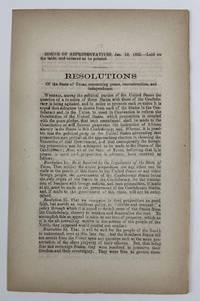
1865Best.-Nr. 4902Richmond Va.: January 19 1865. Very good. 3pp. printed on a single folded sheet. Minor toning and wear. A defiant screed issued by the Confederate House of Representative in January 1865 printing eight resolutions by the Texas Legislature passed in November 1864 to be presented to the President of the Confederate States should a "re-union" between the Confederacy and the Union occur at the end of the Civil War. Paramount among the Texas House's concerns is their insistence that an amendment be made to the U.S. Constitution that "will forever guarantee the institution of African slavery in the States in this Confederacy." The third resolution prints a familiar refrain in which the Texas House argues that their secession from the Union was not motivated "upon any questions such as the mere preservation of the slave property of their citizens" but rather in order to "preserve their freedom and their sovereignty" i.e. state's rights. Further in this same resolution the Texas legislature warns that they "are still unwavering in their resolution to preserve their freedom and their sovereignty without which all else is valueless." Other resolutions cover trade with foreign powers the South's unfavorable opinion of Abraham Lincoln "a Chief Magistrate with the purpose that he should destroy our liberties in disregard to the Constitution" the South's inability to accept reconciliation with the North and proposes that any end to the Civil War must begin with the U.S. government "making their proposition to the Government of the Confederate States which alone can entertain it." Resolution five contains fiery language cataloguing the "inhumanities of this war" which concludes with an unsurprising but nonetheless eye-opening accusation: "Lying to themselves and pretending to the rest of the world that they are fighting the battle of freedom for four millions of happy and contented negroes they are attempting the enslavement of eight millions of freedmen. With devilish mockery of philanthropy. they have deluded and dragged these negroes from their comfortable homes to use them as screens from our weapons in the day of battle and they have sent them by thousands to painful death by neglect exposure and starvation. January 19 unknown books
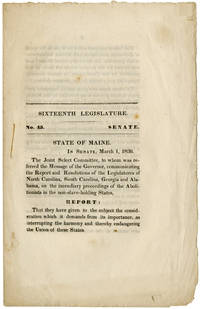
1836Best.-Nr. 52765N.p. likely Augusta. 1836. Mainers Propose to Not Meddle in the Slave States A rare Maine slip-bill document resolving that the citizens from Maine and other states should not interfere with the issue of slavery in slave-holding states. The legislature writes: "Any interference therefore of a State or the inhabitants of a State with the domestic concerns of another State is dangerous as having a direct tendency to create jealousies between the States and thereby weakening the attachment to the Union which is our only security against domestic dissensions and foreign aggressions." This is a somewhat surprising position for the state of Maine to have taken at the time. Maine came into the Union in 1820 as a free state to balance the admission of the slave-owning state of Missouri. Also Maine opposed the admission of the Republic of Texas in 1836 the same year the present document was printed on the basis of Texas' position on slavery. It is curious that they would take two seemingly opposite positions in the same year. Still the legislature printed the resolution and authorized copies to be sent to the four southern slave-owning states mentioned in the title. Folded sheets stitched. Minor foxing and toning. Very good. Untrimmed. unknown books
1842Best.-Nr. 106407Folded letter sheet four pages and remnant of wax seal. Creases at folds normal aging; otherwise very good or better. The letter is to Henry J. Carter Stockbridge Mass. from his brother. An unemployed 20 year-old Massachusetts teacher who had left home the year before in "exceeding hard times" Edward had gone to Baltimore – where some 50 teachers were out of work – and taken a job working for a wealthy man who had 4 acres of farm land worked by slaves. "…he has given me the office of overseer to look after the blacks in their work. O but you ought to see me walk over the lot with my cane in my hand to see how my work is going on. Then you ought to see the darky when he wants anything of me come up and take off his hat before he speaks…" Praising the "fine folks live in this beautiful part of the world" Carter proves that even a Massachusetts Yankee could quickly adapt to Southern culture and make peace with slavery. The letter is unsigned. books
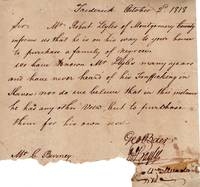
1818Best.-Nr. 12956Frederick MD: October 2 1818. 1p. docketed on verso. Roughly torn along bottom edge minor foxing and spotting. Good condition. An uncommon document in Maryland slave history in which George Baer the future mayor of Frederick and a few other men attest that another local citizen named Robert Lyles is not a slave trader. The document reads in part: "Lyles is on his way to your house to purchase a family of negroes. We have known Mr. Lyles many years and have never heard of his Trafficking in Slaves nor do we believe that in this instance he has any other view but to purchase them for his own use." Baer served as mayor of Frederick from 1820 to 1823; his correspondent "C. Burney" is perhaps Clotworthy Birney 1765-1845 a farmer and real estate trader living near Taney Town. An unusual Maryland slave document concerning a slave owner who just wants to buy slaves for his own use not traffic in them because that's somehow better. October 2 unknown books
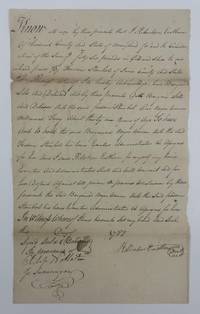
1788Best.-Nr. 4111Frederick County Md: March 7 1788. About very good. 1p. folio docketed on verso. Old folds short splits along a couple of fold lines minor toning. An impactful manuscript document from the early national period in Maryland formalizing the sale of a slave woman in Frederick County. The sale was made by Robertson Eastburn whose family emigrated from England to Maryland in the early 18th century. The document reads in part: "In consideration of the sum of forty six pounds in Gold and Silver to me in hand and paid by Frederic Strombol.I do hereby Acknowledge have Bargain'd Sold and Delivered and by these presents doth Bargain Sell and Deliver Unto the said Frederic Strombol One Negro Woman named Torry about thirty years of age To Have and to hold the said Bargained Negro woman unto the said Frederic Strombol." Slavery in Maryland lasted over 200 years from its beginnings in 1642 when the first Africans were brought as slaves to St. Mary's City to its end following the Civil War. In 1664 under the governorship of Charles Calvert 3rd Baron Baltimore the Assembly ruled that all enslaved people should be held in slavery for life and that children of enslaved mothers should also be held to the same standard of law. 19th-century American slave sale documents are growing increasingly scarce in the market. March 7 unknown books
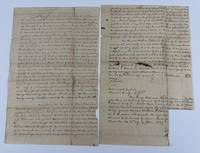
1839Best.-Nr. 3013Washington D.C. 1839. Fair. 3pp. Large folio. Separated into six pieces with a very small section of the final attestation lacking altogether. Still highly readable. A wounded but important document. A rare and historically-important document relating to slavery in the District of Columbia which was outlawed on April 16 1862 nearly nine months before the issuance of the Emancipation Proclamation. The present document is an indenture made between William G. Howison and Alexander Hunter Esquire both citizens of Washington D.C. associated with property conveyed to Hunter by the deceased Joseph Birch. In 1824 Birch conveyed to Hunter land "and also a negro man slave for life named Lewis - another named George - two horses - 4 cows - 3 calves." The document indicates that Lewis was subsequently sold for four hundred dollars and George was sold to Birch in his lifetime. Documents recording the movement of slaves within the District especially among two citizens of the city are rare in the market. unknown books
1865Best.-Nr. 4902Richmond Va.: January 19 1865. Very good. 3pp. printed on a single folded sheet. Minor toning and wear. A defiant screed issued by the Confederate House of Representative in January 1865 printing eight resolutions by the Texas Legislature passed in November 1864 to be presented to the President of the Confederate States should a "re-union" between the Confederacy and the Union occur at the end of the Civil War. Paramount among the Texas House's concerns is their insistence that an amendment be made to the U.S. Constitution that "will forever guarantee the institution of African slavery in the States in this Confederacy." The third resolution prints a familiar refrain in which the Texas House argues that their secession from the Union was not motivated "upon any questions such as the mere preservation of the slave property of their citizens" but rather in order to "preserve their freedom and their sovereignty" i.e. state's rights. Further in this same resolution the Texas legislature warns that they "are still unwavering in their resolution to preserve their freedom and their sovereignty without which all else is valueless." Other resolutions cover trade with foreign powers the South's unfavorable opinion of Abraham Lincoln "a Chief Magistrate with the purpose that he should destroy our liberties in disregard to the Constitution" the South's inability to accept reconciliation with the North and proposes that any end to the Civil War must begin with the U.S. government "making their proposition to the Government of the Confederate States which alone can entertain it." Resolution five contains fiery language cataloguing the "inhumanities of this war" which concludes with an unsurprising but nonetheless eye-opening accusation: "Lying to themselves and pretending to the rest of the world that they are fighting the battle of freedom for four millions of happy and contented negroes they are attempting the enslavement of eight millions of freedmen. With devilish mockery of philanthropy. they have deluded and dragged these negroes from their comfortable homes to use them as screens from our weapons in the day of battle and they have sent them by thousands to painful death by neglect exposure and starvation. January 19 unknown
1836Best.-Nr. 52765N.p. likely Augusta. 1836. Mainers Propose to Not Meddle in the Slave States A rare Maine slip-bill document resolving that the citizens from Maine and other states should not interfere with the issue of slavery in slave-holding states. The legislature writes: "Any interference therefore of a State or the inhabitants of a State with the domestic concerns of another State is dangerous as having a direct tendency to create jealousies between the States and thereby weakening the attachment to the Union which is our only security against domestic dissensions and foreign aggressions." This is a somewhat surprising position for the state of Maine to have taken at the time. Maine came into the Union in 1820 as a free state to balance the admission of the slave-owning state of Missouri. Also Maine opposed the admission of the Republic of Texas in 1836 the same year the present document was printed on the basis of Texas' position on slavery. It is curious that they would take two seemingly opposite positions in the same year. Still the legislature printed the resolution and authorized copies to be sent to the four southern slave-owning states mentioned in the title. Folded sheets stitched. Minor foxing and toning. Very good. Untrimmed. unknown
1842Best.-Nr. 106407Folded letter sheet four pages and remnant of wax seal. Creases at folds normal aging; otherwise very good or better. The letter is to Henry J. Carter Stockbridge Mass. from his brother. An unemployed 20 year-old Massachusetts teacher who had left home the year before in "exceeding hard times" Edward had gone to Baltimore – where some 50 teachers were out of work – and taken a job working for a wealthy man who had 4 acres of farm land worked by slaves. "…he has given me the office of overseer to look after the blacks in their work. O but you ought to see me walk over the lot with my cane in my hand to see how my work is going on. Then you ought to see the darky when he wants anything of me come up and take off his hat before he speaks…" Praising the "fine folks live in this beautiful part of the world" Carter proves that even a Massachusetts Yankee could quickly adapt to Southern culture and make peace with slavery. The letter is unsigned.
1839Best.-Nr. 3013Washington D.C. 1839. Fair. 3pp. Large folio. Separated into six pieces with a very small section of the final attestation lacking altogether. Still highly readable. A wounded but important document. A rare and historically-important document relating to slavery in the District of Columbia which was outlawed on April 16 1862 nearly nine months before the issuance of the Emancipation Proclamation. The present document is an indenture made between William G. Howison and Alexander Hunter Esquire both citizens of Washington D.C. associated with property conveyed to Hunter by the deceased Joseph Birch. In 1824 Birch conveyed to Hunter land "and also a negro man slave for life named Lewis - another named George - two horses - 4 cows - 3 calves." The document indicates that Lewis was subsequently sold for four hundred dollars and George was sold to Birch in his lifetime. Documents recording the movement of slaves within the District especially among two citizens of the city are rare in the market. unknown
1788Best.-Nr. 4111Frederick County Md: March 7 1788. About very good. 1p. folio docketed on verso. Old folds short splits along a couple of fold lines minor toning. An impactful manuscript document from the early national period in Maryland formalizing the sale of a slave woman in Frederick County. The sale was made by Robertson Eastburn whose family emigrated from England to Maryland in the early 18th century. The document reads in part: "In consideration of the sum of forty six pounds in Gold and Silver to me in hand and paid by Frederic Strombol.I do hereby Acknowledge have Bargain'd Sold and Delivered and by these presents doth Bargain Sell and Deliver Unto the said Frederic Strombol One Negro Woman named Torry about thirty years of age To Have and to hold the said Bargained Negro woman unto the said Frederic Strombol." Slavery in Maryland lasted over 200 years from its beginnings in 1642 when the first Africans were brought as slaves to St. Mary's City to its end following the Civil War. In 1664 under the governorship of Charles Calvert 3rd Baron Baltimore the Assembly ruled that all enslaved people should be held in slavery for life and that children of enslaved mothers should also be held to the same standard of law. 19th-century American slave sale documents are growing increasingly scarce in the market. March 7 unknown
1818Best.-Nr. 12956Frederick MD: October 2 1818. 1p. docketed on verso. Roughly torn along bottom edge minor foxing and spotting. Good condition. An uncommon document in Maryland slave history in which George Baer the future mayor of Frederick and a few other men attest that another local citizen named Robert Lyles is not a slave trader. The document reads in part: "Lyles is on his way to your house to purchase a family of negroes. We have known Mr. Lyles many years and have never heard of his Trafficking in Slaves nor do we believe that in this instance he has any other view but to purchase them for his own use." Baer served as mayor of Frederick from 1820 to 1823; his correspondent "C. Burney" is perhaps Clotworthy Birney 1765-1845 a farmer and real estate trader living near Taney Town. An unusual Maryland slave document concerning a slave owner who just wants to buy slaves for his own use not traffic in them because that's somehow better. October 2 unknown
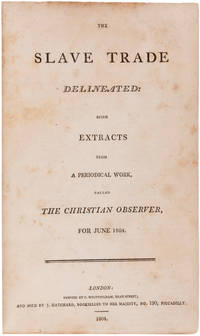
1805Best.-Nr. 21055261805. London: Whittingham for Hatchard. 1805. 8vo. Recent marbled wrappers; pp. 20 printed in two columns; one corner of title-page clipped light browning; a good copy of a great rarity.This combined offprint opens with a first-hand report by 'Leo Africanus' of a journey recently made on a slave ship from West Africa to the West Indies. On board the ship the Captian told the visitors and traveller 'that a slave ship was a very different thing from what it had been represented. We should find the slaves rejoicing in their happy state' p. 3. The truth however showed the sheer horror of this crime against humanity at high sea. This is followed on page ten by a discussion of a Hatchard-published pamphlet on the abolition of the slave trade. The present pamphlet is concluded by the refutation of the printed Letter to the Right Honorable W.Pitt containing some new Arguments against the Abolition of the Slave Trade in which the author Britannicus had argued 'if we give freedom to the negroes we shall ourselves indubitable become slaves of Bonaparte' p. 13. Post-truth over two hundred years ago. unknown
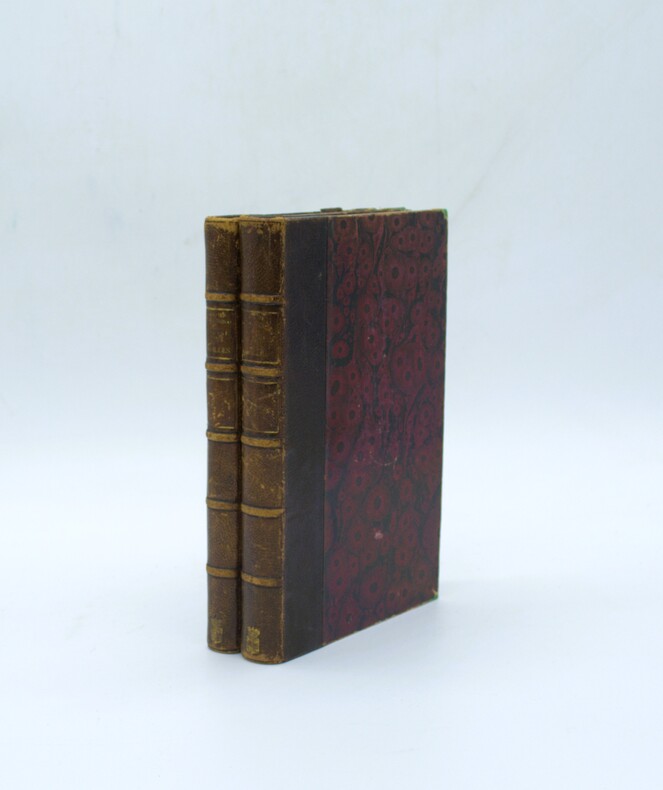
1841Best.-Nr. 25455PARIS 1841-45 -in-8 demi-basane 31 plaquettes du même Auteur, reliées en 2 volumes, reliure demi-basane (half binding sheepskin) bleu-marine in-octavo, dos long (spine without raised band)décoré "or" (gilt decoration), Auteur et Titre frappés "or" (gilt title) avec 4 filets fins "or" de part et d'autre, 4 filets fin "or" en place des nerfs et en tête et en pied, papier marbré vert, crème et marron aux plats (cover with marbled paper), toutes tranches lisses (all smooth edges), sans illustration (no illustration), Oeuvres Reliées comme suit : TOME I ...... 1- Précis de l'Affaire Douillard-Mahaudière adressé à la Chambre des Députés, 20 pages, 1841, Paris Imprimerie de Cosse et G.-Lagionie Editeur, 2- Mémoire du Conseil des Délégués des Colonies à M. le Baron DUPERRE Amiral de France, Ministre de la Marine et des Colonies, 28 pages, 1841, Paris Imprimerie de Cosse et G.-Lagionie Editeur, 3- Conseil des Délégués des Colonies. a Monsieur le Ministre de l'Agriculture et du Commerce, 21 pages, 1841, Paris Imprimerie d'Ad. Blondeau Editeur, 4- Avis de M. JOLLIVET, Délégué de la Martinique à Monsieur le Ministre de la Marine et des Colonies, sur le projet d'Ordonnance relatif à l'emprisonnement disciplinaire des Esclaves, 24 pages, 1841, Paris Imprimerie d'Ad. Blondeau Editeur, 5- ANALYSE DES OPINIONS ET VOTES DES CONSEILS GENERAUX DE L'AGRICULTURE, DES MANUFACTURES ET DU COMMERCE, SUR LA QUESTION DES SUCRES : Lettre de Mr A. JOLLIVET, Membre de la Chambre des Députés, Délégué de la Martinique à Messieurs les Présidents et Membres du Conseil Supérieur du Commerce, SUR LA QUESTION DES SUCRES, 18 pages, 1842 Paris Imprimerie d'Ad. Blondeau Editeur, 6- Des Missions en France de la Société Abolitionniste Anglaise et Etrangère, par M. JOLLIVET, Député d'Ille-et-Vilaine, Délégué de la Martinique, 15 pages, sans date (1841)Paris Imprimerie d'Ad. Blondeau Editeur, 7- Question des Sucres dans la Chambre des Communes d'Angleterre - Du Travail Libre et du Travail Forcé. Leur Influence sur la Production Coloniale, par M. JOLLIVET, Député d'Ille-et-Vilaine, Délégué de la Martinique, Bon à Tirer avec dernières corrections de fautes et parfois de phrases rajoutée de la main de l'Auteur avant impression définitive par l'Editeur, 27 pages, Mai 1841 Paris Imprimerie d'Ad. Blondeau Editeur, 8- De L'Expropriation Forcée dans les Colonies de la Martinique, de la Guadeloupe et de la guyane par M. JOLLIVET, membre de la Chambre des Députés, 70 pages, 1842 Paris Imprimerie d'Ad. Blondeau Editeur, 9- Du Projet de Loi tendant à Régler les Attributions Financières des Conseils Coloniaux par M. JOLLIVET, membre de la Chambre des Députés, 51 pages, 2 Avril 1842 Paris Imprimerie d'Ad. Blondeau Editeur, 10- De la Philantropie Anglaise par Mr JOLLIVET, membre de la Chambre des Députés (deuxième edition), 55 pages, 1842 Paris Imprimerie d'Ad. Blondeau Editeur, 11- Discours de Mr JOLLIVET, Député d'Ille-et-Vilaine, dans les Séances des 28 et 30 Mai 1842, 15 pages, 1842 Paris Imprimerie de Cosse et G.-Laguionie Editeur, 12 - LETTRE ET REPONSE AU JOURNAL DES DEBATS, par M. JOLLIVET, Membre de la Chambre des Députés, Délégué de la Martinique, 14 pages, 1842 Paris Imprimerie de E.-B. DELANCHY Editeur, 13 - LETTRES de M. A. JOLLIVET, Membre de la Chambre des Députés et Délégué de la Martinique, 31 pages, 1842 Paris Imprimerie de E.-B. DELANCHY Editeur, 14- Analyse des Délibérations et Avis des CONSEILS COLONIAUX des Gouverneurs et des Administrateurs des Colonies sur les PROJETS D'EMANCIPATION(ABOLITION DE L'ESCLAVAGE), de la Commission présidée par M. Le Duc de Broglie, Par M. JOLLIVET, Membre de la Chambre des Députés, 69 pages, 1843 Paris Imprimerie Bruneau Editeur, 15 - L'EMANCIPATION ANGLAISE (ABOLITION DE L'ESCLAVAGE) Jugée par ses Résultats - Analyse des Documents Officiels Imprimés par ordre de M. le Ministre de la Marine et des Colonies, par M. JOLLIVET, Membre de la Chambre des Députés, Délégué de la Martinique, 104 pages, 1842 Paris Imprimerie de Moquet et Hauquelin Editeur, 16 - Enquête Parlementaire sur les COLONIES ANGLAISES publiée en Septembre 1842 - ANALYSE DE L'ENQUÊTE par M. JOLLIVET, Membre de la Chambre des Députés, 48 pages, 1843 Paris Imprimerie de Bruneau Editeur, 17- QUESTION DES SUCRES par M. JOLLIVET, Membre de la Chambre des Députés, 86 pages, 1843 Paris Imprimerie de Bruneau Editeur, 18 - PARALLELE entre les COLONIES FRANCAISES ET LES COLONIES ANGLAISES, Appendice au Rapport du Duc de Broglie par M. JOLLIVET, Membre de la Chambre des Députés, Délégué de la Martinique, 40 pages, 1843 PARIS Imprimerie de Bruneau Editeur, TOME II ..... 1 - Lettre de M. JOLLIVET, Membre de la Chambre des Députés, Délégué de la Martinique, au Rédacteur du Journal des Débats, 13 pages, 1844 Paris Imprimerie de Bruneau Editeur, 2 - Note Présentée au Conseil des Ministres Par M. JOLLIVET, Membre de la Chambre des Députés, Délégué de la Martinique, sur UN PROJET DE LOI RELATIF A LA CONSTITUTION POLITIQUE DES COLONIES, 23 pages, sans date (1844)Paris Imprimerie de Bruneau Editeur, 3 - A LOS HABITANTES DE LA ISLA DE CUBA (texte en espagnol ...par A. JOLLIVET, diputado de la camara de francia, y delegado de la Martinica), 23 pages, 1844 Paris imprimerie d'Ed. Proux et Cie Editeur, 4 - HISTORIQUE DE LA TRAITE ET DU DROIT DE VISITE. Par M. JOLLIVET, Membre de la Chambre des Députés, 35 pages, 1844 Paris Imprimerie de Bruneau Editeur, 5 - PETITIONS DE QUELQUES OUVRIERS ET OUVRIERES DE PARIS POUR L'ABOLITION IMMEDIATE DE L'ESCLAVAGE - VERITABLE SITUATION DES NOIRS DANS LES COLONIES FRANCAISES Par M. JOLLIVET, Membre de la Chambre des Députés, 20 pages, 1844 Paris Imprimerie de Bruneau Editeur, 6 - Observations Présentées par M. JOLLIVET, Délégué de la Martinique, devant la Commission de la Chambre des Pairs sur LE PROJET DE LOI (SUR L'ESCLAVAGE DES NOIRS), Tendant à Modifier les Articles 2 et 3 de la loi du 24 Avril 1833 - Séance du 11 Juin- 81 pages, 1844 Paris Imprimerie de Bruneau Editeur, 7 - QUESTION DES SUCRES EN ANGLETERRE. - DU TRAVAIL LIBRE ET DU TRAVAIL ESCLAVE, par M. JOLLIVET, Membre de la Chambre des Députés, 23 pages, 1845 Paris Imprimerie de Bruneau Editeur, 8 - DOCUMENTS AMERICAINS, ANNEXION DU TEXAS, EMANCIPATION DES NOIRS(ABOLITION DE L'ESCLAVAGE), POLITIQUE DE L'ANGLETERRE, par M. JOLLIVET, Membre de la Chambre des Députés, 40 pages, 1845 Paris Imprimerie de Bruneau Editeur, 9- ANNEXION DU TEXAS - NOUVEAUX DOCUMENTS AMERICAINS Publiés par M. JOLLIVET, Membre de la Chambre des Députés, 55 pages, 1845 Paris Imprimerie de Bruneau Editeur, 10 - DOCUMENTS AMERICAINS, 3ème Série. LES ETATS UNIS D'AMERIQUE ET L'ANGLETERRE. ANNEXION DU TEXAS. L'OREGON, par M. JOLLIVET, Membre de la Chambre des Députés, 74 pages, Avril 1845 Paris Imprimerie de Bruneau Editeur, 11 - LES COLONIES FRANCAISES DEVANT LA CHAMBRE DES PAIRS. Analyse de la Discussion Générale du Projet de Loi sur le Régime Colonial, par M. JOLLIVET, Membre de la Chambre des Députés, 112 pages, 1845 Paris imprimerie de Guiraudet et Jouaust Editeur, 12 - Chambre des Députés - Session de 1844-1845 - DISCOURS prononcé par M. JOLLIVET, Député d'Ille-et-Vilaine dans la discussion générale du projet de loi relatif aux COLONIES, Séance du 29 Mai 1845, 31 pages, extrait du Moniteur Universel du 30 Mai 1845, 1845 Paris Imprimerie Panckoucke Editeur, 13 - DISCOURS prononcés par M. JOLLIVET, Député d'Ille-et-Vilaine, dans la discussion des articles du projet de loi relatif au REGIME DES COLONIES, Séances des 2, 3 et 4 Juin 1845, extraits du Moniteur Universel des 3, 4 et 5 Juin 1845, 36 pages, 1845 Paris Imprimerie Panckoucke Editeur,
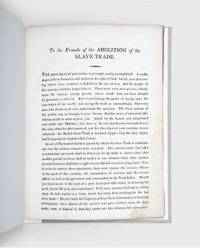
Best.-Nr. 210609[Paris], Imprimerie du Patriote François, s.d. (1791) in-4, 3 pp., broché sous couverture d'attente de papier marbré.
Best.-Nr. 239790Paris, L. Pelletier, an XII - 1804 in-8, [2] ff. n. ch., VIII pp., pp. 5-194, demi-basane fauve à coins, dos lisse, tranches mouchetées de rouge (reliure à l'imitation).