[Slavery]: [Rhode Island]Biblio.com
1.828 Ergebnisse
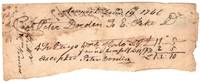
1766Best.-Nr. 13353Newport RI: December 19 1766. Manuscript document 2.25 x 6 inches. Unevenly trimmed moderate toning and staining. About very good. Rare surviving evidence of a slaveowner hiring out a slave for manual labor in colonial Rhode Island. Here Captain Peter Darden bills E. Teke for "4 Days work of Cato" for eleven shillings five pence. The verso indicates the bill was paid on January 6 1767; the payment may have involved another slave as Teke seems to note that payment was made by an "agt" agent named Cicero. A rare surviving document pertaining to slavery in pre-revolutionary Rhode Island. December 19 unknown
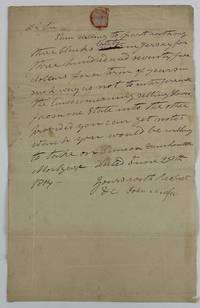
1814Best.-Nr. 13354N.p.: June 28 1814. 1p. addressed on verso. Old mailing folds remnants of wax seal minor staining and toning. Very good. An interesting letter involving the sale of slaves in early-19th-century New Jersey. The letter comes from a slaveowner named John Neagie writing to Garrabrandt Van Houten Esquire in Patterson New Jersey in 1814. The text of the letter reads in full: "Dear Sir I am willing to part with my three blacks lately in Jersey for three hundred and seventy five dollars for a term of years in such way as not to interfere with the laws concerning selling slaves from one state into the other provided you can get notes which you would be willing to take on. Same on Van Houten's mortgage. Dated June 20th 1814. Yours with respect John Neagie." Neagie's concerns about "selling slaves from one state into the other" seems to indicate that he is based somewhere outside New Jersey where his slaves have been "lately." In fact he has crossed out the word "now" and replaced it with "lately. June 28 unknown
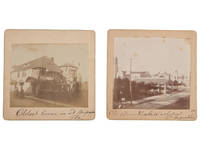
1897Best.-Nr. 185871897. Albumen photographs of slavery-related sites circa 1890s document physical locations tied to the sale and habitation of enslaved people in the United States and the persistence of those sites in post-Emancipation visual culture. The images include a pavilion in St. Augustine Florida identified in contemporary sources as a site where enslaved Africans were bought and sold a photographic negative depicting outbuildings identified as Mississippi slave quarters and a mounted view of the González Alvarez House a colonial structure associated with early settlement in St. Augustine. Together the photographs provide material evidence of how spaces connected to slavery were recorded labeled and circulated in the late nineteenth century linking architectural survival to the historical memory of enslavement in both the Southeast and the Gulf South. Collection of three albumen photographs. United States circa 1890s. One mounted photograph approximately 3 3/16 x 3 inches bears the ink inscription "Old Slave Market Cathedral St. Augustine Fla." and depicts the waterfront pavilion constructed in the early nineteenth century originally used as a commercial market and identified in local records as a site of slave trading. One photographic negative approximately 3 1/2 x 3 3/4 inches shows three small structures identified as Mississippi slave quarters. One mounted photograph approximately 3 1/8 x 2 5/8 inches is inscribed "Oldest house in St. Augustine Fla. Built in the early 1700s" depicting the González Alvarez House. Mounts and inscriptions indicate a documentary intent linking the images to historically significant sites. By the late nineteenth century sites associated with slavery were being reframed within local historical narratives often presented as landmarks while still retaining traces of their earlier function within systems of forced labor and sale. The identification of the St. Augustine pavilion as a slave market in inscription and record aligns the image with documented urban sites of sale in Spanish and later American Florida while the Mississippi quarters image extends the archive into the plantation landscape of the postbellum South. The grouping provides a concise visual record of how structures tied to enslavement were preserved interpreted and circulated in photographic form decades after abolition. Minor adhesive residue to one mount small tear to negative and light toning and staining to mounts; overall good condition. unknown
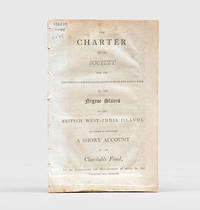
1794Best.-Nr. 126550London no printer 1794 or later. First edition variously dated by ESTC and WorldCat between 1794 the date given at the end of the preliminary "Short Account of the origin and present state of the charitable fund" and 1823. The short account dated March 1794 is followed by a tipped in leaf reporting on the first meeting of the society which took place on Thursday April 3 1794 electing the Lord Bishop of London as president. The Charter of the Society 18 pages in length is dated at Westminster "this thirtieth Day of October in the thirty-fourth Year of our Reign" which again falls in 1794. Octavo 190 x 123 mm pp. ix 18. Sometime in a pamphlet vol. now disbound. Spine shows evidence of earlier binding sometime folded vertically; title lightly dust soiled page ix trimmed down and tipped onto p. viii; a good copy. Sabin 85881. unknown
1817Best.-Nr. SLAVERY005957W. Alexander York. 1817. First U.K. edition with additions to the Philadelphia printing. 12mo. 156 pages including 4 pages of adverts. Frontispiece. Original boards with paper backstrip and title label. Anthony Benezet 1713-1784 was a leading abolitionist.Early nameplates Thomas Marsh and Robert Langdon on front pastedown. Some foxing to prelims. Cup ring to front cover. Backstrip defective label rubbed. Very good. Scarce in original state. W. Alexander, York. hardcover
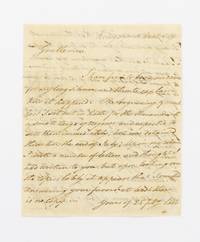
Best.-Nr. 130002Very Good. Quarto 4 pages a bifolium comprising 3 pages of text with the last page used for address purposes. Creased where folded for posting; slight loss to the leading edge of the second leaf where torn open removing one word of text; overall in excellent condition. The letter dated 10 December 1791 and carried privately by ship from Kingston is addressed to 'Messrs Newton Gordon & Murdoch Merchants Madeira'. A number of lesser matters are touched upon but the letter deals primarily with the importation of wine: 'I cannot at present ascertain what quantity of wine I shall be able to dispose of next year as I have 20 pipes on hand and sales are slow from the great quantity at market; however you will please ship me twenty pipes of York market wine Barbadoes Gauge & 12 Iron hoops at first convenient opportunity'. As often with letters of any age the first paragraph contains an apology for the tardy response: 'I have first to beg your excuse for my silence and then to explain how it happen'd. The beginning of March last I set out in haste for the Havana with a small cargo of negroes and expected to sell them immediately but was detain'd there till the end of July'. unknown
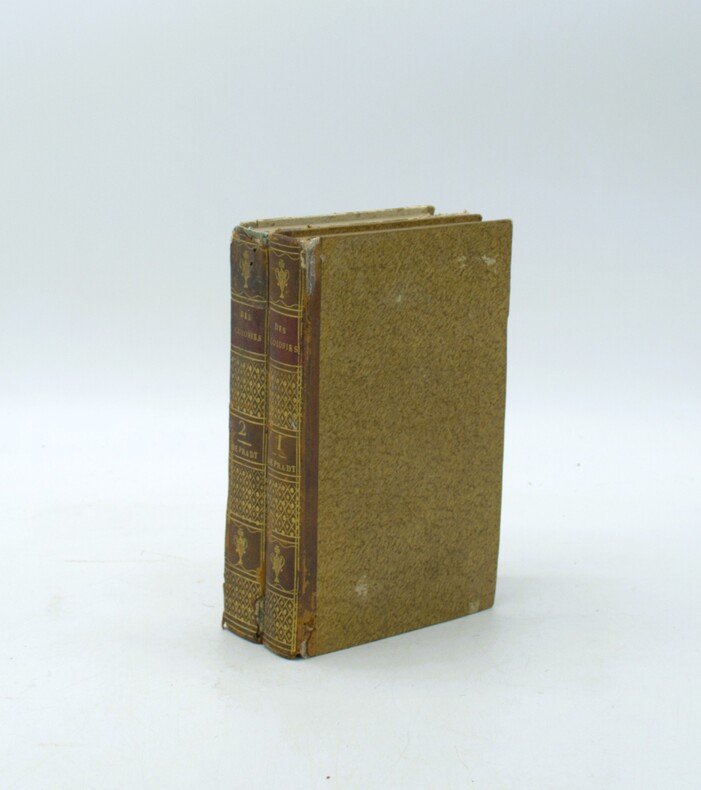
1817Best.-Nr. PHO-2154Paris, Bechet,1817. 3 parties en 2 vol in 8°, (23x 13cm), demi veau époque, dos lisse orné, pièce de titre rouge, xxxii, 507 pp errata, 394 pp.-1f. (errata)- 2ff.-160pp.-1f (errata), demi veau époque, dos lisse orné avec tomaison et pièce de titre, frottements et épidermures, manque de papier au tome 2 et au dos, intérieur frais.
Best.-Nr. 28345Confidant of Missouri pioneer Jonathan Bryan 1759-1846 of the noted St. Charles family whose relatives included their neighbor Daniel Boone. DS 1p 7½" X 12" St. Charles County MO 1847 February 2. Near fine. Acknowledgment that Tuter who signs himself as "Administrator of the Estate of Johnathan Bryan" has had a writ of replevin made out and issued to the St. Charles sheriff Edward C. Cunningham 1809-65 for delivery to an unnamed offender. The writ seeks to recover the following property apparently wrongfully taken from Jonathan Bryan's estate: "one negro man a Slave named Heney one Two horse waggon and one pair of Briches Two Black horses one Lorrel horse with bold face one walnut Cupboard one clock one Bureau one bedstead and bedding one walnut Table one Trunk one Bible." In other words everything but the kitchen sink. Signed at the conclusion by Tater in his definitely untutored hand. Tales of slaves are found in the Bryan family lore such as: "Mrs. Jonathan Bryan a kinswoman of Daniel Boone was working in her yard with a slave woman when a boy slave screamed. She saw an Indian warrior heading for them with a tomahawk in one hand and a gun in the other. The women ran for the house. Just as they were slamming the door they caught the warrior's head and right arm between the door and facing. The slave woman grabbed the hatchet from his hand and killed him with a sharp blow. The women had barely recovered from their fright when the boy shouted again." Could the slave boy in this old family legend by none less than the "Slave named Heney" whose return is demanded in this replevin suit Quite unusual slavery item with an intriguing history. unknown books
Best.-Nr. 28345Confidant of Missouri pioneer Jonathan Bryan 1759-1846 of the noted St. Charles family whose relatives included their neighbor Daniel Boone. DS 1p 7½" X 12" St. Charles County MO 1847 February 2. Near fine. Acknowledgment that Tuter who signs himself as "Administrator of the Estate of Johnathan Bryan" has had a writ of replevin made out and issued to the St. Charles sheriff Edward C. Cunningham 1809-65 for delivery to an unnamed offender. The writ seeks to recover the following property apparently wrongfully taken from Jonathan Bryan's estate: "one negro man a Slave named Heney one Two horse waggon and one pair of Briches Two Black horses one Lorrel horse with bold face one walnut Cupboard one clock one Bureau one bedstead and bedding one walnut Table one Trunk one Bible." In other words everything but the kitchen sink. Signed at the conclusion by Tater in his definitely untutored hand. Tales of slaves are found in the Bryan family lore such as: "Mrs. Jonathan Bryan a kinswoman of Daniel Boone was working in her yard with a slave woman when a boy slave screamed. She saw an Indian warrior heading for them with a tomahawk in one hand and a gun in the other. The women ran for the house. Just as they were slamming the door they caught the warrior's head and right arm between the door and facing. The slave woman grabbed the hatchet from his hand and killed him with a sharp blow. The women had barely recovered from their fright when the boy shouted again." Could the slave boy in this old family legend by none less than the "Slave named Heney" whose return is demanded in this replevin suit Quite unusual slavery item with an intriguing history. unknown
Best.-Nr. DADAX0531116921New unknown
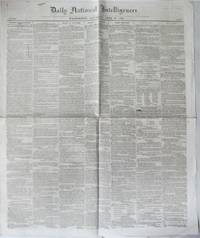
1859Best.-Nr. 017039Washington DC: Gales and Seaton 1859. Tabloid. Good. Side folding large tabloid newspaper. A single issue of this long running newspaper published in Washington DC first published in 1800 and publishing until 1870 with an eventual bias toward conservative Whig policies. Besides the usual ads and political news this issue contains two "Was Committed" notices last page bottom right one pertaining to Mary Norris George Park and Sally King the other pertaining to Lewis West. All four were African-Americans with Mary Norris George Park and Lewis West being enslaved people from enslaver Robert E. Lee. According to the US National Park Service website devoted to Robert E. Lee's Arlington House Memorial Mary Norris George Parks and another man Wesley Norris believed they were free based on a provision in the will of George Washington Custis. Based on this knowledge the three emancipated themselves traveling to Pennsylvania. They were all captured in Maryland. According to contemporary newspaper accounts New York Tribune in June 1859 Lee had the re-captured African-Americans whipped. Wesley Norris himself wrote an article in the Anti-Slavery Standard in 1866 which provides his account of the whipping. Early historians and biographers dismissed both accounts considering them to be accounts used for anti-slavery propaganda. Lee himself was silent on the subject with many of his contemporaries and historians taking his silence as a denial. However modern research suggests the accounts of Wesley Norris and others were true dispelling the myth of Lee as benevolent enslaver perpetuated by earlier historians. The first notice states that Norris Park and West were committed to jail on May 26th and that "George and Mary say they belong to Col. Robert Lee of Fairfax County Virginia." The complexion and height of all three are given as well as descriptions of the clothing they wore. Sally King asserted that she was free living in Washington with a Mrs. D. Bread. According to the piece they all initially left Washington on May 22nd 1859. The second notice contains the same information as the first although it appears Lewis West was jailed on May 27th but also asserted he "belongs to Col. Robert Lee." Both notices request that the "owner or owners" come forward and pay all charges due. Also present is a notice of "young servants for sale" indicating the availability of several girls from ages 11 to 15 as well as young men from 21 to 25 years old. All were apparently located in Georgetown. The newspaper is in GOOD condition. Paper split chipped and deteriorating along the spine with very slight loss of letters to some of the "was committed" ads. Horizontal and vertical fold creases present. Moderate toning along the spine edge. Small hole worn through at the intersection of the fold creases. Some wrinkling and creasing to the paper. Several small tears along the extremities. Gales and Seaton unknown
1791Best.-Nr. 31477[Paris] Imprimerie de Momoro, premier imprimeur de la Liberté nationale s.d. [1791] in-8 en feuilles
1839Best.-Nr. 36511Paris Didier 1839 in-8 broché sous couverture imprimée, non coupé, dos défraîchi
1802Two volumes in one, complete. FIRST AND ONLY EDITION OF THIS CLASSIC STUDY OF EUROPEAN AND COLONIAL ECONOMICS, including slavery. 2 leaves; 223 pp; 2 leaves; 267 pp. Printed on fine laid paper. 8vo. Original wraps with paper spine label. Entirely uncut. FINE AND BRIGHT, WITH NO DEFECTS. A pristine copy of an important book, exactly as it came out of the printer's office.
1860Best.-Nr. 62260Atlanta: Printed at the Daily Locomotive Job Office 1860. 47 pp. 1 vols. 8vo. Original blue printed wrappers. Wrapper a bit chipped else Fine. 47 pp. 1 vols. 8vo. Printed at the Daily Locomotive Job Office unknown books
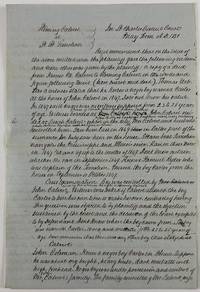
1851Best.-Nr. 13321St. Charles LA 1851. 31pp. docketed on last page. Original folds minor wear. Very good plus. An intriguing legal document from antebellum Louisiana involving the status of Carter "a dark mulatto from 23 to 26 years of age" whose ownership and/or freedom is being contested. The deposition opens with testimony regarding the last time Carter was seen by the plaintiff's family the Calverts as well as another man named John Coleman both in 1849. The testimony also discusses Carter's ability to hire himself out for work and further testimony from Joseph M. Heddy a "negro trader" who valued Carter at $750 to $800. At this point the plaintiffs rested the case. Further testimony from the defense lays out a detailed argument that Carter was actually the son of a slave named Lucinda who was owned by a man named Isham Harrison who took Lucinda to Illinois 1812. In a one-page addendum the defense asks the Court to instruct the jury that by taking Lucinda to Illinois where Lucinda gave birth to Carter that "the mother by such residence became free and any children born of the mother after the time said Isham took up his residence in Illinois are free.and the defendant is entitled to the verdict." The strategy did not work. The plaintiff won the case and was awarded $800 for Carter. unknown books
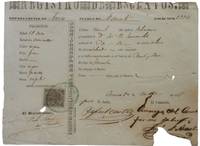
1871Best.-Nr. 237101871. Slavery Black Labor Puerto Rico This official Puerto Rican slave registry document issued in Manatí in 1871 under Spanish colonial administration represents the bureaucratic infrastructure of slavery in the Caribbean at the precise moment preceding abolition. Titled within the printed form as part of the "Registro de Esclavos - Isla de Puerto Rico" the document records the forced legal identity of an identified enslaved man. Single sheet slave registry document "Empadronamiento General de esclavos" from Manatí Puerto Rico dated 20 de Mayo de 1871. Measuring 6.25" x 8.5". This document was registered by "Don Manuel María Monserrate" for the enslaved person "Feliciano." Document bears official signatures from the local authorities. The enslaved person is listed by their age stature "color" hair color beard eyes nose and mouth. The person is listed as 18 years old and the "color" of this individual is listed as "negro". The physical list of classifications functioned as mechanisms of surveillance control and verification within the colonial slave system. Inclusion of official signatures from both the "dueño" and "comisario" along with a stamped fiscal seal en verso. Produced just under two years prior to the 1873 abolition of slavery in Puerto Rico the document reflects the transitional legal environment in which enslaved individuals were increasingly catalogued in anticipation of emancipation policies that would in practice impose systems of forced apprenticeship and indemnification to former enslavers. Tape was previously applied to the bottom right of the document; some minor wormholes and occasional spotting. Overall good condition. The document stands as evidence of how emancipation in Spanish territories was mediated through administrative control prolonging coercive labor conditions even as slavery was formally dismantled. unknown books
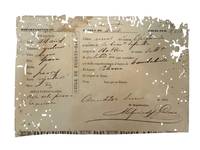
1873Best.-Nr. 238001873. Puerto Rican slave registration document from January 1873 recording the legal identity ownership agricultural occupation parentage and physical classification of Epifanio a forty four year old enslaved Black man in Arecibo less than three months before slavery was abolished in Puerto Rico. Issued after Spain's 1870 Moret Law had initiated a limited process of emancipation but before the abolition law of March 22 1873 the cédula placed Epifanio within a registration system designed to record enslaved people by name family relations occupation owner residence civil status and identifying physical characteristics. The January 20 date makes the document especially closely situated to abolition recording Epifanio as legally enslaved only weeks before the Spanish National Assembly dismantled the legal institution under which the certificate had been issued. Registro de Esclavos Isla de Puerto Rico. Arecibo Puerto Rico January 20 1873. Single printed and manuscript cédula folio no. 7215. The document identifies "Epifanio" as an enslaved man "propiedad de la Sucn. Tafarella" forty four years old a native of Puerto Rico single and "de oficio labrador." He is recorded as "no está coartado" and as registered in the barrio of Cambalache with his mother identified as "Petrona." The printed "Filiacion" column subjects his body to a standardized identifying description: regular stature "Color negro" sparse hair sparse beard brown eyes and a regular nose. Under "Señas particulares" the manuscript records "Cojo de la pierna izquierda" identifying him as lame in the left leg and incorporating a physical disability into the identifying data maintained by the slave registry. The lower portion differs from the earlier 1871 forms in carrying a prominent signature beneath "El Registrador" while extensive insect damage has removed portions of the printed heading and margins. The verso bears manuscript offsetting and additional evidence of administrative handling. Epifanio's cédula was produced at the endpoint of Puerto Rico's rapidly changing legal regime. The Moret Law of 1870 had granted freedom to specified categories of enslaved people including those aged sixty and older those belonging to the state and children born after September 17 1868 while leaving a forty four year old man such as Epifanio legally enslaved. His notation as "no está coartado" further records that he had not entered coartación the mechanism through which an enslaved person could make payments toward self purchase. His recorded occupation as "labrador" placed him within Puerto Rico's agricultural labor economy while "Cojo de la pierna izquierda" shows how the registry extended beyond racial and occupational classification to bodily characteristics capable of distinguishing one enslaved person from another. On March 22 1873 only about two months after this cédula was dated the Spanish National Assembly abolished slavery in Puerto Rico compensating former enslavers while requiring the emancipated population to enter labor contracts for an additional three years. Extensive insect damage with numerous wormholes and substantial losses along the upper and side margins affecting portions of the printed heading and several fields; moderate toning and staining with principal manuscript entries and the registrar's signature remaining legible. Overall fair condition. An individually named record of the administrative system that converted Epifanio's race body physical disability agricultural labor parentage residence and legal ownership into the identifying data of slavery during the final months before abolition in Puerto Rico. unknown books
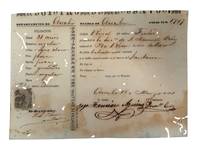
1871Best.-Nr. 237981871. Puerto Rican slave registration document from 1871 recording the legal identity ownership agricultural occupation and physical classification of a named thirty one year old enslaved man in Arecibo during the final years of slavery under Spanish colonial rule. Issued after Spain's 1870 Moret Law had initiated a limited process of emancipation but nearly two years before abolition in Puerto Rico the cédula placed Fruto within a registration system designed to record enslaved people by name occupation owner residence civil status and identifying physical characteristics. His classification as "negro claro" his occupation as "labrador" and his ownership by the succession of D. Manuel Ortiz place racial designation agricultural labor and property status together within the administrative machinery of colonial slavery. Registro de Esclavos Isla de Puerto Rico. Arecibo Puerto Rico March 15 1871. Single printed and manuscript cédula folio no. 1747. The document identifies this enslaved man "propiedad de la Sucn. de D. Manuel Ortiz" thirty one years old a native of Puerto Rico single and "de oficio labrador." He is recorded as "no está coartado" and as residing in the barrio of Santana. The fields for parents spouse and children are left blank. The printed "Filiacion" column subjects his body to a standardized identifying description: regular stature "Color negro claro" sparse hair sparse beard large eyes a regular nose and a further description of the mouth partially obscured by worming. A one peseta fiscal stamp at lower left is cancelled by an official marking. The lower portion carries the signatures or attestations of the "Registrador" "El dueño" and "El Comisario" with the owner's portion apparently signed on behalf of the succession by Francisco Aguirre. The verso bears ink offsetting and staining associated with subsequent administrative handling. This man's cédula was produced within a rapidly changing legal regime. The Moret Law of 1870 granted freedom to specified categories of enslaved people including those aged sixty and older those belonging to the state and children born after September 17 1868 while leaving many others including a thirty one year old agricultural laborer such as this individual legally enslaved. His notation as "no está coartado" further records that he had not entered coartación the mechanism through which an enslaved person could purchase freedom incrementally. The document's ownership by the "Sucn. de D. Manuel Ortiz" also records the treatment of an enslaved person as property within an estate with his legal ownership continuing through the succession rather than ending with the death of the named enslaver. On March 22 1873 the Spanish National Assembly abolished slavery in Puerto Rico compensating former enslavers while requiring the emancipated population to enter labor contracts for an additional three years. Moderate toning and staining scattered wormholes with small losses affecting several manuscript entries minor edge losses and a larger loss at the lower right edge; principal manuscript information and signatures remain legible. Overall good condition. An individually named record of the administrative system that converted this individuals race body agricultural labor residence civil status and legal ownership into the identifying data of slavery less than two years before abolition in Puerto Rico. unknown books
1871Best.-Nr. 237971871. Puerto Rican slave registration document from 1871 recording the legal identity ownership agricultural occupation and physical classification of Eleuterio a twenty six year old enslaved man in Arecibo during the final years of slavery under Spanish colonial rule. Issued after Spain's 1870 Moret Law had initiated a limited process of emancipation but nearly two years before abolition in Puerto Rico the cédula placed Eleuterio within a registration system designed to record enslaved people by name family relations occupation owner residence and identifying physical characteristics. His classification as "mulato" his occupation as "labrador" and his ownership by the succession of D. Manuel Ortiz place racial designation agricultural labor and property status together within the administrative machinery of colonial slavery. Registro de Esclavos Isla de Puerto Rico. Arecibo Puerto Rico May 15 1871. Single printed and manuscript cédula folio no. 1740. The document identifies "Eleuterio" as an enslaved man "propiedad de la Sucn. de D. Manuel Ortiz" twenty six years old a native of Puerto Rico single and "de oficio labrador." He is recorded as "no está coartado" and as residing in the barrio of Santana with his mother identified as "Valentina." The printed "Filiacion" column subjects his body to a standardized identifying description: tall stature "Color mulato" sparse hair sparse beard black eyes a regular nose and a further description of the mouth partially affected by loss. The lower portion carries the signatures or attestations of the "Registrador" "El dueño" and "El Comisario" with the owner's portion apparently signed on behalf of the succession by Francisco Aguirre. A one peseta fiscal stamp appears at lower left beneath the physical description. The verso bears manuscript docketing and staining associated with subsequent administrative handling. Eleuterio's cédula was produced within a rapidly changing legal regime. The Moret Law of 1870 granted freedom to specified categories of enslaved people including those aged sixty and older those belonging to the state and children born after September 17 1868 while leaving many others including a twenty five six old agricultural laborer such as Eleuterio legally enslaved. His notation as "no está coartado" further records that he had not entered the system of coartación through which an enslaved person could make payments toward self purchase. On March 22 1873 the Spanish National Assembly abolished slavery in Puerto Rico compensating former enslavers while requiring the emancipated population to enter labor contracts for an additional three years. Moderate toning and staining scattered wormholes with small losses affecting several manuscript entries loss along the upper edge affecting part of the printed heading and additional minor edge losses; principal manuscript information and signatures remain legible. Overall good condition. An individually named record of the administrative system that converted Eleuterio's race body family relationship agricultural labor residence and legal ownership into the identifying data of slavery less than two years before abolition in Puerto Rico. unknown books
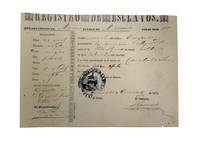
1872Best.-Nr. 237961872. Puerto Rican slave registration document from January 1872 recording the legal status ownership labor residence parentage and physical identification of Eugenio a twenty year old enslaved Black man in Arecibo during the final fourteen months of slavery on the island. The cédula was issued within the registration system expanded following the Moret Law of 1870 which freed specified categories of enslaved people while leaving young adults such as Eugenio in bondage and led to the preparation of Puerto Rico's central slave register. Surviving 1872 schedules record the same categories present here including name origin residence parents marital status occupation age physical description and enslaver. Registro de Esclavos Isla de Puerto Rico. Arecibo Puerto Rico January 20 1872. Single printed and manuscript slave registration cédula folio no. 119. The document identifies "Eugenio" as twenty years old "Color negro" single and employed "de oficio labrador" placing agricultural labor directly within his official identification. He is recorded as a native of Puerto Rico and registered in the barrio of Cambalache. His ownership entry appears to read "propiedad de la sucesión ." indicating ownership by an estate or succession although the following name is difficult to establish confidently from the manuscript hand. The "Filiacion" column records his stature as "regular" black hair sparse beard brown eyes a regular nose and additional identifying information; under "Señas particulares" a manuscript notation appears to record a defect involving the right foot though the exact wording is partially unclear. The document carries the signatures or attestations of the "Registrador" and "El Comisario" together with a fiscal stamp heavily cancelled by an official circular handstamp. The verso bears additional official stamps and manuscript markings associated with the document's administrative use. Eugenio was registered at a moment when Spanish policy had begun dismantling slavery selectively while continuing to document and regulate those excluded from immediate freedom. The Moret Law granted freedom to people over sixty enslaved people belonging to the state and children born after September 17 1868; at twenty Eugenio fell outside its principal age based provisions. Puerto Rico's surviving 1872 Registro Central de Esclavos is preserved in eight rolls of National Archives microfilm and comparable original Arecibo cédulas survive institutionally including a January 1872 folio at the University of Florida that likewise records an enslaved man's age physical description ownership and official signatures. On March 22 1873 slavery was abolished in Puerto Rico terminating the legal status under which Eugenio had been entered on this form. Light toning and spotting several small wormholes and minor edge losses; stamps printed text and principal manuscript entries remain legible. Overall good condition. An individually named record of how Spanish colonial authorities reduced Eugenio's legal status agricultural occupation ancestry residence and bodily characteristics to standardized identifying data during Puerto Rico's final full year of slavery. unknown books
1860Best.-Nr. 62260Atlanta: Printed at the Daily Locomotive Job Office 1860. 47 pp. 1 vols. 8vo. Original blue printed wrappers. Wrapper a bit chipped else Fine. 47 pp. 1 vols. 8vo. Printed at the Daily Locomotive Job Office unknown
1851Best.-Nr. 13321St. Charles LA 1851. 31pp. docketed on last page. Original folds minor wear. Very good plus. An intriguing legal document from antebellum Louisiana involving the status of Carter "a dark mulatto from 23 to 26 years of age" whose ownership and/or freedom is being contested. The deposition opens with testimony regarding the last time Carter was seen by the plaintiff's family the Calverts as well as another man named John Coleman both in 1849. The testimony also discusses Carter's ability to hire himself out for work and further testimony from Joseph M. Heddy a "negro trader" who valued Carter at $750 to $800. At this point the plaintiffs rested the case. Further testimony from the defense lays out a detailed argument that Carter was actually the son of a slave named Lucinda who was owned by a man named Isham Harrison who took Lucinda to Illinois 1812. In a one-page addendum the defense asks the Court to instruct the jury that by taking Lucinda to Illinois where Lucinda gave birth to Carter that "the mother by such residence became free and any children born of the mother after the time said Isham took up his residence in Illinois are free.and the defendant is entitled to the verdict." The strategy did not work. The plaintiff won the case and was awarded $800 for Carter. unknown
1871Best.-Nr. 237101871. Slavery Black Labor Puerto Rico This official Puerto Rican slave registry document issued in Manatí in 1871 under Spanish colonial administration represents the bureaucratic infrastructure of slavery in the Caribbean at the precise moment preceding abolition. Titled within the printed form as part of the "Registro de Esclavos - Isla de Puerto Rico" the document records the forced legal identity of an identified enslaved man. Single sheet slave registry document "Empadronamiento General de esclavos" from Manatí Puerto Rico dated 20 de Mayo de 1871. Measuring 6.25" x 8.5". This document was registered by "Don Manuel María Monserrate" for the enslaved person "Feliciano." Document bears official signatures from the local authorities. The enslaved person is listed by their age stature "color" hair color beard eyes nose and mouth. The person is listed as 18 years old and the "color" of this individual is listed as "negro". The physical list of classifications functioned as mechanisms of surveillance control and verification within the colonial slave system. Inclusion of official signatures from both the "dueño" and "comisario" along with a stamped fiscal seal en verso. Produced just under two years prior to the 1873 abolition of slavery in Puerto Rico the document reflects the transitional legal environment in which enslaved individuals were increasingly catalogued in anticipation of emancipation policies that would in practice impose systems of forced apprenticeship and indemnification to former enslavers. Tape was previously applied to the bottom right of the document; some minor wormholes and occasional spotting. Overall good condition. The document stands as evidence of how emancipation in Spanish territories was mediated through administrative control prolonging coercive labor conditions even as slavery was formally dismantled. unknown
1873Best.-Nr. 238001873. Puerto Rican slave registration document from January 1873 recording the legal identity ownership agricultural occupation parentage and physical classification of Epifanio a forty four year old enslaved Black man in Arecibo less than three months before slavery was abolished in Puerto Rico. Issued after Spain's 1870 Moret Law had initiated a limited process of emancipation but before the abolition law of March 22 1873 the cédula placed Epifanio within a registration system designed to record enslaved people by name family relations occupation owner residence civil status and identifying physical characteristics. The January 20 date makes the document especially closely situated to abolition recording Epifanio as legally enslaved only weeks before the Spanish National Assembly dismantled the legal institution under which the certificate had been issued. Registro de Esclavos Isla de Puerto Rico. Arecibo Puerto Rico January 20 1873. Single printed and manuscript cédula folio no. 7215. The document identifies "Epifanio" as an enslaved man "propiedad de la Sucn. Tafarella" forty four years old a native of Puerto Rico single and "de oficio labrador." He is recorded as "no está coartado" and as registered in the barrio of Cambalache with his mother identified as "Petrona." The printed "Filiacion" column subjects his body to a standardized identifying description: regular stature "Color negro" sparse hair sparse beard brown eyes and a regular nose. Under "Señas particulares" the manuscript records "Cojo de la pierna izquierda" identifying him as lame in the left leg and incorporating a physical disability into the identifying data maintained by the slave registry. The lower portion differs from the earlier 1871 forms in carrying a prominent signature beneath "El Registrador" while extensive insect damage has removed portions of the printed heading and margins. The verso bears manuscript offsetting and additional evidence of administrative handling. Epifanio's cédula was produced at the endpoint of Puerto Rico's rapidly changing legal regime. The Moret Law of 1870 had granted freedom to specified categories of enslaved people including those aged sixty and older those belonging to the state and children born after September 17 1868 while leaving a forty four year old man such as Epifanio legally enslaved. His notation as "no está coartado" further records that he had not entered coartación the mechanism through which an enslaved person could make payments toward self purchase. His recorded occupation as "labrador" placed him within Puerto Rico's agricultural labor economy while "Cojo de la pierna izquierda" shows how the registry extended beyond racial and occupational classification to bodily characteristics capable of distinguishing one enslaved person from another. On March 22 1873 only about two months after this cédula was dated the Spanish National Assembly abolished slavery in Puerto Rico compensating former enslavers while requiring the emancipated population to enter labor contracts for an additional three years. Extensive insect damage with numerous wormholes and substantial losses along the upper and side margins affecting portions of the printed heading and several fields; moderate toning and staining with principal manuscript entries and the registrar's signature remaining legible. Overall fair condition. An individually named record of the administrative system that converted Epifanio's race body physical disability agricultural labor parentage residence and legal ownership into the identifying data of slavery during the final months before abolition in Puerto Rico. unknown