GEORGE IIIBiblio.com
77 résultats
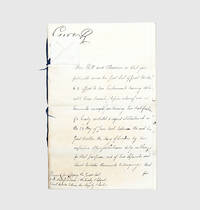
1807réf. 18934215 July 1807. Diplomatic deals in the Napoleonic Wars A royal warrant signed by George III at the head ordering the application of the Great Seal to the Convention of Subsidy between Great Britain and Sweden signed at Stralsund on 23 June 1807. The document is countersigned on the second page by the Foreign Secretary George Canning later prime minister. The warrant orders the Great Seal be affixed to two instruments "containing our Ratifications of a Treaty concluded & signed at Stralsund on the 23d Day of June last between us and our good brother the King of Sweden by our respective plenipotentiaries". Annexed to the document are manuscript copies of the instruments. Sweden joined Britain in the war against Napoleon in 1805 in the Treaty of Bäckaskog. In early 1807 France launched an offensive against Swedish Pomerania and by June Swedish forces were weakening. Canning saw Pomerania as the only viable base for continental military operations against Napoleon and agreed in the treaty of 23 June to provide British subsidies to Swedish troops. The Swedes nevertheless capitulated in August. Britain reinforced Sweden in 1808 as France's allies entered the war against her but in 1809 King Gustav IV was deposed and in 1810 Sweden aligned with France and declared war on Britain. Folio 309 x 197 mm. 10 leaves: 2-page warrant followed by 16-page treaty blank page and final page with docket title all in manuscript; blind-impressed paper seal mounted over George III signature sewn with blue thread paper watermarked 1805. Minor fraying to ribbon else in fine condition. unknown
2010réf. 1-1439160813Star Trek 2010. Paperback. New. original edition. 400 pages. 6.75x4.25x1.25 inches. Star Trek paperback
2010réf. DADAX1439148414Pocket Books/Star Trek 2010-12-14. Original. paperback. New. 5.31x1.20x8.25. Buy with confidence. Excellent Customer Service & Return policy. Pocket Books/Star Trek paperback
1981réf. DADAX0313230390Bloomsbury Academic 1981-07-24. hardcover. New. 5.50x0.81x8.50. Buy with confidence. Excellent Customer Service & Return policy. Bloomsbury Academic hardcover
2007réf. DADAX074349170XPocket Books/Star Trek 2007-02-01. First Edition. mass_market. New. 4.19x0.90x6.75. Buy with confidence. Excellent Customer Service & Return policy. Pocket Books/Star Trek unknown
1771réf. ZB517827London: Charles Eyre & William Strahan 1771. tall quarto 46 pp. general title leaf pp. 1271-1314 complete in itself but part of a series two pieces of clear tape on extraction mark at left margin else very good. - If you are reading this this item is actually physically in our stock and ready for shipment once ordered. We are not bookjackers. Buyer is responsible for any additional duties taxes or fees required by recipient's country. London: Charles Eyre & William Strahan unknown
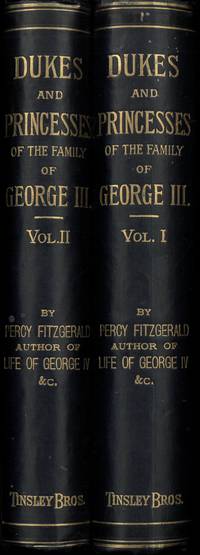
1882réf. 64247London 1882. 8vo. Originalbind med gulldekor på rygg. xiv 384 s ; x 341 s. . Tinsley Brothers Engelsk. Ex libris. unknown
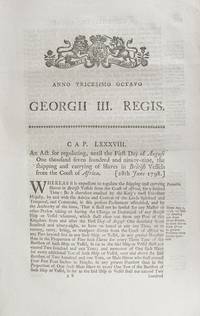
1799réf. 92483London: Printed by George Eyre and Andrew Strahan 1799-1824. Rare collection of three British Acts related to the regulation and abolition of the British slave trade including: An Act for better regulating the Manner of carrying Slaves in British Vessels from the Coast of Africa 12th July 1799; An Act for regulating.the shipping and carrying of Slaves in British Vessels from the Coast of Africa 28th June 1798; and An Act to Amend and consolidate the Laws relating to the Abolition of the Slave Trade 24th June 1824. Quarto decorative royal emblematic headpieces schedules of muster roles and seizures. Accompanied by a Copy of an Act Passed in 1817 by the Legislature of Antigua For Restricting the Exportation of Slaves to that Island Henry Goulburn 1821 and Copies or Extracts of Correspondence relating to an Expedition to be sent to the River Niger Vernon Smith 1840; both ordered by the House of Commons. In near fine condition. An exceptional piece of history. The anti-slavery movement to abolish the slave trade became popular among the British public following barrister Lord Mansfield's judgement in the Somersett's Case which held that slavery was unsupported by the common law in England and Wales. In 1807 Parliament passed the Slave Trade Act of 1807 which outlawed the slave trade but not slavery itself. Over two decades later in 1833 the Slavery Abolition Act was passed which made the purchase or ownership of slaves illegal within the British Empire and provided monetary compensation for previous slave owners. Printed by George Eyre and Andrew Strahan unknown
2010réf. DADAX1439160813Pocket Books/Star Trek 2010-12-28. mass_market. New. 4.19x1.00x6.75. Buy with confidence. Excellent Customer Service & Return policy. Pocket Books/Star Trek unknown
réf. 19779St James 30 July 1796. 2 pages 9 x 7 inches plus integral address leaf gilt edges in fine fresh and attractive condition bearing two seals in red wax with ends of red silk ties SIGNED BY A RELUCTANT GEORGE III ON BEHALF OF HIS FORMER MINISTER TO THE UNITED STATES. The bearer of this letter George Hammond had returned to England after serving as the first British Minister to the United States of America in 1795. He was then promoted by George Grenville the Foreign Secretary to act as his senior Under-Secretary with George Canning serving as the second. Meanwhile faced with Napoleon's victories in Italy and the Rhineland Pitt's First Coalition was facing collapse. Grenville keen on an alliance with Prussia proposed that her support could be ensured by giving her a free hand in annexing either of the Belgic provinces or extensive domains in Germany; a plan that was turned down by George III with the cutting observation that 'Italian politics are too complicated for my understanding'. Nevertheless as Ward puts it the British Cabinet was in its desperation 'prepared to act on the degrading principle of gaining the help of a powerful State by conniving at its annexation of a week neighbour' Cambridge History of British Foreign Policy ii p. 267. Hammond as per our letter was therefore despatched to Berlin with George III's reluctant agreement. But he had no luck. For when he got to Berlin he discovered that the King was away and nothing could be done in his absence. So he let the matter drop. unknown
réf. 19217Queens House 14 January 1781 52 minutes past 5 P.M.. 2 lines on 1 page 9 x 7 inches in very good condition with an integral blank leaf. King George III reigned 1760-1820. Sir Stanier Porter diplomat and courtier. Frederick North 1732-92 known as Lord North was Prime Minister from 1770-1782 and was largely responsible for the measures which led to the loss of America. unknown
1779réf. 34022London: Printed for the Editor; and sold by J. Bew 1779. First edition. Pp. iii-57. Lacking half-title. 1 vols. 8vo. Red morocco-backed green cloth spine lettered in gilt. Rubbed some light spotting. Bookplate of John Carter Brown ex-library with stamp on title else very good. First edition. Pp. iii-57. Lacking half-title. 1 vols. 8vo. A satire. Often attributed to Richard Tickell as it imitates the tone of Tickell's "Anticipation" published the year before. Purports to contains speeches made in the Houses responding to the King's speech on the war in America and his need for more monies to pay for it. Adams "American Controversy" 79-3a; Sabin 1685 Printed for the Editor; and sold by J. Bew unknown
2017réf. BN72437Cross Cult Entertainment 2017. 2017. Star Trek - Deep Space Nine: Sakramente des Feuers Sakramente des Feuers Cross Cult Entertainment unknown
réf. BN495130Cross Cult. Softcover. Star Trek - The Fall 1: Erkenntnisse aus Ruinen Star Trek - The Fall 1: Erkenntnisse aus Ruinen George III David R. Cross Cult paperback
réf. 43717George the Third's Hair Cut 22nd July 1819." 5½" x 3" no place 22nd July King George died of pneumonia at Windsor Castle on 29th January 1820 aged 81 six days after the death of his fourth son Prince Edward Duke of Kent and Strathearn. His favourite son Prince Frederick Duke of York and Albany was with him. He lay in state for two days and his funeral and interment took place on 16th February in St George's Chapel Windsor Castle Provenance: From a small collection of locks of Royal Hair. unknown
réf. 43718George the Third's Hair Cut 22nd July 1819." 5½" x 3½" no place 22nd July King George died of pneumonia at Windsor Castle on 29th January 1820 aged 81 six days after the death of his fourth son Prince Edward Duke of Kent and Strathearn. His favourite son Prince Frederick Duke of York and Albany was with him. He lay in state for two days and his funeral and interment took place on 16th February in St George's Chapel Windsor Castle Provenance: From a small collection of locks of Royal Hair. unknown
réf. 43632printed with the details filled in by hand appointing Colonel James Pringle "to be Major General in our Army in the East Indies only." countersigned by Robert Banks Jenkinson 2nd Earl LIVERPOOL Baron Hawkesbury 1770-1828 Prime Minister 1 side oblong folio on vellum with papered seal and revenue stamp St James's 25th October hardcover
réf. 43488saying that "Edward Warburton and William Boulton were at a Quarter Session of the Peace holden at Aylesbury. tried and convicted of Grand Larceny and were sentenced to be transported seven years for the same. We in consideration of some favorable circumstances humbly represented unto Us in their behalf are graciously pleased to extend Our Grace and Mercy unto them and grant them our Pardon for their said Crime on Condition of their enlisting and entering to serve Us as Soldiers in Our Army abroad until duly discharged therefrom." 2 sides folio with papered seal Court at St James 21st January unknown
réf. 560232 hand-coloured woodcuts copied from the illustrations in The Universal Magazine for October and November 1761 the first taken as the Archbishop of Canterbury places the Crown on the King's head is lettered with explanations of the crowded scene including at h 'The Dukes of Normandie and Acquitain and other great officers' the second similarly explained shows the King's Champion flanked by the Earl Marshal and Lord High Constable riding up the centre between the long tables watched by the diners and the others present in the galleries printed within a 'Greek Key' border both referring to 22nd September 1761 laid down on two separate album leaves 10" x 7¾" with other items on the versos the two prints no date circa edges worn and border trimmed in places without loss to text or image The original articles of 1761 explain the role at the Dinner of the King's Champion who challenged any one to assert that George III was not their lawful sovereign and the 'Dukes of Normandy and Aquitaine' at the Coronation. The French King had anciently a council of twelve great Peers 6 lay and 6 ecclesiastic. Long after the council ceased to function the ecclesiastics attended at Reims but the lay peerages had became vested in the crown. So the King appointed people to represent his lay peerages. Henry II liked this idea which was last used in 1761 given that in 1801 Great Britain renounced all claims to France and the use of the lilies on her coat of arms. On the versos are 1 a pleasing engraving of Bouverie Hall Chart next Sutton Valence Kent and 2 a number of cuttings including temperance verses and the monument to Captain Charles Colby of the 98th Dragoons killed by a tiger at 'Rawal Pinde' 27th March 1852. unknown
réf. 19768with Royal Arms below including Hanover vellum approx. 5" x 5" date in pencil on verso 24th March hardcover
réf. 17632with double voucher before Sir John Eardley WILMOT 1709-1792 Chief Justice of the Common Pleas 1766-1771 of 2 dwellings 1 granary 3 gardens and 100 acres in the parish of Titchfield Hants owned by tenant in tail John Paffard fine engraved portrait 8" x 7¼" of George III elaborately engraved border on three sides of the document the vignettes include Neptune ruling the waves and Hercules slaying the Hydra vellum 27¼" x 35¾" Westminster 14th June lacks seal a little creased in some folds On the verso the property is named as 'Paffard's Lee'. Before the trial John Paffard will have conveyed it to his friend John Webb the defendant for a nominal sum. Another friend Henry Cutler sues Webb for possession alleging dispossession by a fictitious Hugh Hunt. Called to warrant Webb's title Paffard in turn calls the court crier Thomas Francis Martin to say untruthfully that Martin had sold the lands to Paffard as a freehold. The process ends with judgment against Webb and Martin and with Cutler in freehold possession. John Paffard has rid himself of all entails and encumbrances on the property and will soon get it back from Cutler. Wilmot a fellow pupil with Dr. Johnson at Lichfield took part in the cases arising from John Wilkes' libels. hardcover
réf. 51577printed with manuscript details appointing Richard Ward to be "Captain of Dragoons in Our Army" countersigned by "Dunk HALIFAX" George Montague-Dunk 1716-1771 2nd Earl of Halifax uncle of Lord North as a Secretary of State and by the Hon. Robert WALPOLE d. 1810 Clerk of the Privy Council Ambassador to Portugal for the War office vellum 1 side oblong folio with papered seal and revenue stamp Court at St James's 17th November Dunk Halifax 'the Father of the Colonies' was 1st Lord of Trade 1748-1761 promoting Nova Scotia whose capital is named after him 1749 as are counties in Virginia and North Carolina. In 1741 he married the heiress of Sir Thomas Dunk. In 1763 he signed the famous 'Dunk Warrant' to search and apprehend the authors printers and publishers of Wilkes 'North Briton' No. 45. After the officers arrested 18 people and seized a vast quantity of papers the warrant was pronounced by the judges to be 'unreasonable search and seizure' and Halifax was mulcted in damages. It has been called 'the most important warrant in Anglo-American law' and the doctine overturning it is closely related to the Fourth Amendment. Robert Walpole's father was Horatio 1st Baron Walpole of Wolterton brother of the Prime Minister. hardcover
réf. 53782appointing James Hay of Seggieden 1771-1838 as Captain Lieutenant in the Perthshire Regiment of Fencible Cavalry commanded by Colonel Charles Moray in the Troop of which Hay is already Captain and further he is to rank as "Captain in the Army during the Establishment of the said Regiment in the Army only" engraved with manuscript additions papered seal of Royal Arms 1 side vellum 5" x 15" no date circa lower portion has been cut away in a rather irregular line three other small portions cut out affecting two words easily supplied James Hay had begun as a Cornet in his local Yeomanry in 1794. In 1804 following the great invasion scare he had been appointed Captain though not so to rank in the Army unless called to active service. Militia regiments were being called upon to volunteer up to half their strength for service in the line and Hay now ranks as a full Captain in the Army. By 1809 he was Lieutenant-Colonel Commandant of the E. Perth Regiment of Militia. Seggieden is 4 miles SE of Perth. hardcover
2003réf. 3E8-00084Pocket Books 2003-08-26. Mass Market Paperback. New. 4x1x6. Ship within 24hrs. 100% Satisfaction is Our #1 Goal! Pocket Books paperback
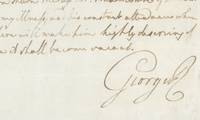
1701réf. 3775117/01/1801. A rare ALS of the King just weeks before yet another episode of his illness King George demonized in the New World for mental incapacity struggled throughout his life. He had experienced a poorly documented illness in 1765 but the episode beginning in 1788 was dramatically more serious. Earlier that year he suffered physical problems including jaundice or gall-duct trouble. After spending time recuperating at Cheltenham his behavior became increasingly abnormal. By October and November after returning to Windsor he was unmistakably suffering from a major psychiatric episode. Contemporary observers described a striking cluster of symptoms: extreme agitation extraordinarily rapid and incessant speech sleeplessness racing thoughts emotional volatility inappropriate familiarity delusions and at times violent or uncontrollable behavior. Treatments were typical of eighteenth-century medicine and could be brutal. The King was subjected to bloodletting blistering purgatives and emetics; some medicines contained substances such as antimony that could themselves produce serious side effects. In the interim he was unable to properly rule. This was a major English constitutional crisis with domestic issues playing out while a potential regency was being mapped out. What would they do with a living but ""mad"" King Parliament spent the winter of 1788–89 wrestling with the extraordinary question of how to create a regency when the monarch was alive but incapable of giving royal assent to the legislation establishing it. And then George recovered. By February 1789 his physicians were increasingly confident. On February 26 the medical bulletin announced the ""entire cessation of His Majesty's illness."" It was this illness that gave credence to the name ""mad King George."" Among the men at his bedside in 1788-9 was apothecary Robert Battiscombe. He had been treating members of the royal household since about 1780 and personally attended George during the King's famous 1788–89 episode of mental illness including cupping him applying and dressing blisters bleeding him and sitting regular watches over him. His surviving memorandum book records those encounters. In early 1801 the King's longtime apothecary John Devaynes died. For a time he wanted another apothecary Everard Augustus Brande to fill the role. He was a first-generation Englishman. But ultimately he wanted to reward Battiscombe. The Marquess of Salisbury is James Cecil 1st Marquess of Salisbury. He was a senior courtier and politician under George III and served as Lord Chamberlain of the Household from 1783 to 1804. Autograph letter signed January 17 1801 Queen's House to Salisbury. ""I am sensible of the Marquess of Salisbury's Attention in having immediately acquainted Me of the death of Mr Desvaines one of my Apothecaries. I as well as every one of my Predecessors have employed constantly Mr. Brande's Shop. I desire therefore that Mr. Brande Junior who is an Englishman may be appointed to succeed Mr. Desvaines. The other Apothecary is now an Old Man his employment less lucrative. The attention shewn me by Mr. Battiscombe of Windsor during my illness and his constant attendance when I am there will make him highly deserving of it when it shall it become vacant."" George suffered a serious recurrence of his mental illness in February 1801 less than a month after this letter was written. Beginning around February 12–13 the King became increasingly agitated talkative sleepless and eventually delirious at one point reportedly praying that God would either let him die or spare his reason. The attack coincided with an intense political crisis over Catholic emancipation: George believed granting political rights to Catholics would violate his Coronation Oath and the dispute contributed to William Pitt's resignation; George himself later blamed Pitt for having caused his illness. By February 22 the King was considered incapable of properly exercising his royal functions and members of the Willis family who had treated him during his famous 1788–89 breakdown were again summoned. Unlike that earlier crisis however the 1801 episode was comparatively brief and George had substantially recovered by early March. Battiscombe would in 1805 become apothecary of Windsor to the royal household. He stayed in that role for decades — he's the apothecary of Windsor recorded as handling the king's post-mortem preparations in 1820. <img class=""alignnone wp-image-25018 size-post-window"" src=""https://cdn.raabcollection.com/wp-content/uploads/20231204144051/Folder-site-11-1600x1327.jpg"" alt=""historical memorabilia dealer"" width=""1600"" height=""1327"" /> unknown