123 résultats
réf. 43632printed with the details filled in by hand appointing Colonel James Pringle "to be Major General in our Army in the East Indies only." countersigned by Robert Banks Jenkinson 2nd Earl LIVERPOOL Baron Hawkesbury 1770-1828 Prime Minister 1 side oblong folio on vellum with papered seal and revenue stamp St James's 25th October hardcover
réf. 43717George the Third's Hair Cut 22nd July 1819." 5½" x 3" no place 22nd July King George died of pneumonia at Windsor Castle on 29th January 1820 aged 81 six days after the death of his fourth son Prince Edward Duke of Kent and Strathearn. His favourite son Prince Frederick Duke of York and Albany was with him. He lay in state for two days and his funeral and interment took place on 16th February in St George's Chapel Windsor Castle Provenance: From a small collection of locks of Royal Hair. unknown
réf. 43718George the Third's Hair Cut 22nd July 1819." 5½" x 3½" no place 22nd July King George died of pneumonia at Windsor Castle on 29th January 1820 aged 81 six days after the death of his fourth son Prince Edward Duke of Kent and Strathearn. His favourite son Prince Frederick Duke of York and Albany was with him. He lay in state for two days and his funeral and interment took place on 16th February in St George's Chapel Windsor Castle Provenance: From a small collection of locks of Royal Hair. unknown
réf. 43488saying that "Edward Warburton and William Boulton were at a Quarter Session of the Peace holden at Aylesbury. tried and convicted of Grand Larceny and were sentenced to be transported seven years for the same. We in consideration of some favorable circumstances humbly represented unto Us in their behalf are graciously pleased to extend Our Grace and Mercy unto them and grant them our Pardon for their said Crime on Condition of their enlisting and entering to serve Us as Soldiers in Our Army abroad until duly discharged therefrom." 2 sides folio with papered seal Court at St James 21st January unknown
réf. 42581printed with the details filled in by hand appointing Charles Mingay Gent to be "Ensign to that Company whereof. Esq is Captain in our Twenty Second or the Cheshire Regiment of Foot commanded by our Trusty and Wellbeloved Major General David Dundas." countersigned by the Duke of PORTLAND 1 side oblong folio on vellum with papered seal and revenue stamp Court at St James's 2nd December Along with many other conservative Whigs such as Edmund Burke Portland was deeply uncomfortable with the French Revolution; he broke with Fox over that issue and joined Pitt's government as Secretary of State for the Home Department in 1794. In that role he oversaw the administration of patronage and financial inducements which were often secret to secure the passage of the Act of Union 1800 hardcover
réf. 42584appointing "Our Trusty and Wellbeloved Major Thoam Inglis on half pay of our One Hundred and Twenty Sixth Regiment of Foot. to be Lieutenant Colonel." countersigned by Pelham at the foot 1 side oblong folio on vellum with papered seal and revenue stamp Court at St James's 29th April Pelham was Home Secretary from July 1801 to August 1803 under Addington who made him Chancellor of the Duchy of Lancaster in 1803. Pelham went out of office in 1804 and in the next year succeeded to the earldom. hardcover
réf. 42582printed with the details filled in by hand appointing James Hay Gent to be "Adjutant in Our Perthshire Regiment of Fencible Cavalry commanded by Our Trusty and Wellbeloved Colonel Charles Moray." the top four inches of 1 side oblong folio on vellum with papered seal no place no date circa hardcover
réf. 42237printed with manuscript details giving "Our Royal Licence authorizjng them to pay two Bills of Exchange for the respective sums of £290 & £473.19.10 the former drawn on themselves the other on Messrs Boyd Benfield & Co drawn at Leghorn." the printed side states that "by these Presents and by the Powers vested in us by the Act passed in the Thirty-fourth Year of Our Reign intitled 'An Act for preventing Money or Effects in the Hands of His Majesty's Subjects belonging to or disposable by Persons resident in France being applied to the Use of the Persons exercising the Powers of Government in France and for preserving the Property thereof'." countersigned by Portland 1 side folio with papered seal Court at St James's 1st April Thomas RAIKES the Elder 1741-1813 was a British merchant particularly trading from London with Russia a banker and newspaper proprietor. Notably he was Governor of the Bank of England during the 1797 currency crisis when the Bank was prohibited by the British Government from paying out in gold. Walter BOYD 1754-1837 was a financier. In March 1793 the firm of Boyd Benfield & Co. was established in London. Boyd as the principal partner contributed £60000 to the common stock. The Bank Restriction Act of 1797 was an Act of Parliament which removed the requirement for the Bank of England to convert banknotes into gold. The period lasted until 1821 when convertibility was restored. The period between these two dates is known as the Restriction period. unknown
réf. 40960saying that "on receiving the two Boxes yesterday morning I perceived that the one was not intended for my perusal and sent it to the Messenger which gave rise to the mistake of his going to London previous to my dispatching the other Box which I therefore sent by a safe hand at a later hour." 1 side 4to. Windsor 8th February It is unusual to find holograph letters from the monarch. unknown
réf. 560232 hand-coloured woodcuts copied from the illustrations in The Universal Magazine for October and November 1761 the first taken as the Archbishop of Canterbury places the Crown on the King's head is lettered with explanations of the crowded scene including at h 'The Dukes of Normandie and Acquitain and other great officers' the second similarly explained shows the King's Champion flanked by the Earl Marshal and Lord High Constable riding up the centre between the long tables watched by the diners and the others present in the galleries printed within a 'Greek Key' border both referring to 22nd September 1761 laid down on two separate album leaves 10" x 7¾" with other items on the versos the two prints no date circa edges worn and border trimmed in places without loss to text or image The original articles of 1761 explain the role at the Dinner of the King's Champion who challenged any one to assert that George III was not their lawful sovereign and the 'Dukes of Normandy and Aquitaine' at the Coronation. The French King had anciently a council of twelve great Peers 6 lay and 6 ecclesiastic. Long after the council ceased to function the ecclesiastics attended at Reims but the lay peerages had became vested in the crown. So the King appointed people to represent his lay peerages. Henry II liked this idea which was last used in 1761 given that in 1801 Great Britain renounced all claims to France and the use of the lilies on her coat of arms. On the versos are 1 a pleasing engraving of Bouverie Hall Chart next Sutton Valence Kent and 2 a number of cuttings including temperance verses and the monument to Captain Charles Colby of the 98th Dragoons killed by a tiger at 'Rawal Pinde' 27th March 1852. unknown
réf. 19768with Royal Arms below including Hanover vellum approx. 5" x 5" date in pencil on verso 24th March hardcover
réf. 17632with double voucher before Sir John Eardley WILMOT 1709-1792 Chief Justice of the Common Pleas 1766-1771 of 2 dwellings 1 granary 3 gardens and 100 acres in the parish of Titchfield Hants owned by tenant in tail John Paffard fine engraved portrait 8" x 7¼" of George III elaborately engraved border on three sides of the document the vignettes include Neptune ruling the waves and Hercules slaying the Hydra vellum 27¼" x 35¾" Westminster 14th June lacks seal a little creased in some folds On the verso the property is named as 'Paffard's Lee'. Before the trial John Paffard will have conveyed it to his friend John Webb the defendant for a nominal sum. Another friend Henry Cutler sues Webb for possession alleging dispossession by a fictitious Hugh Hunt. Called to warrant Webb's title Paffard in turn calls the court crier Thomas Francis Martin to say untruthfully that Martin had sold the lands to Paffard as a freehold. The process ends with judgment against Webb and Martin and with Cutler in freehold possession. John Paffard has rid himself of all entails and encumbrances on the property and will soon get it back from Cutler. Wilmot a fellow pupil with Dr. Johnson at Lichfield took part in the cases arising from John Wilkes' libels. hardcover
réf. 51577printed with manuscript details appointing Richard Ward to be "Captain of Dragoons in Our Army" countersigned by "Dunk HALIFAX" George Montague-Dunk 1716-1771 2nd Earl of Halifax uncle of Lord North as a Secretary of State and by the Hon. Robert WALPOLE d. 1810 Clerk of the Privy Council Ambassador to Portugal for the War office vellum 1 side oblong folio with papered seal and revenue stamp Court at St James's 17th November Dunk Halifax 'the Father of the Colonies' was 1st Lord of Trade 1748-1761 promoting Nova Scotia whose capital is named after him 1749 as are counties in Virginia and North Carolina. In 1741 he married the heiress of Sir Thomas Dunk. In 1763 he signed the famous 'Dunk Warrant' to search and apprehend the authors printers and publishers of Wilkes 'North Briton' No. 45. After the officers arrested 18 people and seized a vast quantity of papers the warrant was pronounced by the judges to be 'unreasonable search and seizure' and Halifax was mulcted in damages. It has been called 'the most important warrant in Anglo-American law' and the doctine overturning it is closely related to the Fourth Amendment. Robert Walpole's father was Horatio 1st Baron Walpole of Wolterton brother of the Prime Minister. hardcover
réf. 53782appointing James Hay of Seggieden 1771-1838 as Captain Lieutenant in the Perthshire Regiment of Fencible Cavalry commanded by Colonel Charles Moray in the Troop of which Hay is already Captain and further he is to rank as "Captain in the Army during the Establishment of the said Regiment in the Army only" engraved with manuscript additions papered seal of Royal Arms 1 side vellum 5" x 15" no date circa lower portion has been cut away in a rather irregular line three other small portions cut out affecting two words easily supplied James Hay had begun as a Cornet in his local Yeomanry in 1794. In 1804 following the great invasion scare he had been appointed Captain though not so to rank in the Army unless called to active service. Militia regiments were being called upon to volunteer up to half their strength for service in the line and Hay now ranks as a full Captain in the Army. By 1809 he was Lieutenant-Colonel Commandant of the E. Perth Regiment of Militia. Seggieden is 4 miles SE of Perth. hardcover
2003réf. 3E8-00084Pocket Books 2003-08-26. Mass Market Paperback. New. 4x1x6. Ship within 24hrs. 100% Satisfaction is Our #1 Goal! Pocket Books paperback
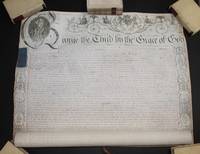
réf. 20855Manuscript on vellum three membranes with an initial portrait of the King and the Great Seal attached. The document overall 31 x 24 inches the Great Seal 6 inches in diam. All contained in the original shaped leather over wood case; the case now rather worn and lacking much of the original leather covering. The Great Seal is a rather poor lumpy impression and now lacking the original tin case skippet. The document inscribed to the reverse "The within Patent has been duly recorded in the College of Arms London pursuant to the tenor of His Majesty's Warrant under his Royal Signet and Sign Manual .Examined therewith the thirteenth day of December 1803" and signed George Harrison Clarenceux & Register. Watson has an interesting history. At the age of 14 and in the employ of his uncle on one of his merchant ships whilst swimming in Havana harbour was attacked by a shark and lost his right leg This incident prompted Watson in 1778 to commission John Singleton Copley to paint this dramatic scene known as "Watson and the Shark" for which see our illustration which when exhibited at the Royal Academy caused a sensation. It now hangs in the National Gallery of Art Washington D.C.Watson was a member of the original committee of the Corporation of Lloyd's of London; he was elected as an Alderman of the City of London and served as M.P. for the City of London. Lord Mayor of London in 1796 and a deputy Director of the Bank of England.Copley painted a portrait of Watson in c.1796. This now hangs in Indianapolis Museum of Art. He was also the subject of a caricature by Robert Dighton in 1803. His coat of arms had his severed leg on it and the shark as the crest. hardcover
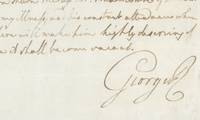
1701réf. 3775117/01/1801. A rare ALS of the King just weeks before yet another episode of his illness King George demonized in the New World for mental incapacity struggled throughout his life. He had experienced a poorly documented illness in 1765 but the episode beginning in 1788 was dramatically more serious. Earlier that year he suffered physical problems including jaundice or gall-duct trouble. After spending time recuperating at Cheltenham his behavior became increasingly abnormal. By October and November after returning to Windsor he was unmistakably suffering from a major psychiatric episode. Contemporary observers described a striking cluster of symptoms: extreme agitation extraordinarily rapid and incessant speech sleeplessness racing thoughts emotional volatility inappropriate familiarity delusions and at times violent or uncontrollable behavior. Treatments were typical of eighteenth-century medicine and could be brutal. The King was subjected to bloodletting blistering purgatives and emetics; some medicines contained substances such as antimony that could themselves produce serious side effects. In the interim he was unable to properly rule. This was a major English constitutional crisis with domestic issues playing out while a potential regency was being mapped out. What would they do with a living but ""mad"" King Parliament spent the winter of 1788–89 wrestling with the extraordinary question of how to create a regency when the monarch was alive but incapable of giving royal assent to the legislation establishing it. And then George recovered. By February 1789 his physicians were increasingly confident. On February 26 the medical bulletin announced the ""entire cessation of His Majesty's illness."" It was this illness that gave credence to the name ""mad King George."" Among the men at his bedside in 1788-9 was apothecary Robert Battiscombe. He had been treating members of the royal household since about 1780 and personally attended George during the King's famous 1788–89 episode of mental illness including cupping him applying and dressing blisters bleeding him and sitting regular watches over him. His surviving memorandum book records those encounters. In early 1801 the King's longtime apothecary John Devaynes died. For a time he wanted another apothecary Everard Augustus Brande to fill the role. He was a first-generation Englishman. But ultimately he wanted to reward Battiscombe. The Marquess of Salisbury is James Cecil 1st Marquess of Salisbury. He was a senior courtier and politician under George III and served as Lord Chamberlain of the Household from 1783 to 1804. Autograph letter signed January 17 1801 Queen's House to Salisbury. ""I am sensible of the Marquess of Salisbury's Attention in having immediately acquainted Me of the death of Mr Desvaines one of my Apothecaries. I as well as every one of my Predecessors have employed constantly Mr. Brande's Shop. I desire therefore that Mr. Brande Junior who is an Englishman may be appointed to succeed Mr. Desvaines. The other Apothecary is now an Old Man his employment less lucrative. The attention shewn me by Mr. Battiscombe of Windsor during my illness and his constant attendance when I am there will make him highly deserving of it when it shall it become vacant."" George suffered a serious recurrence of his mental illness in February 1801 less than a month after this letter was written. Beginning around February 12–13 the King became increasingly agitated talkative sleepless and eventually delirious at one point reportedly praying that God would either let him die or spare his reason. The attack coincided with an intense political crisis over Catholic emancipation: George believed granting political rights to Catholics would violate his Coronation Oath and the dispute contributed to William Pitt's resignation; George himself later blamed Pitt for having caused his illness. By February 22 the King was considered incapable of properly exercising his royal functions and members of the Willis family who had treated him during his famous 1788–89 breakdown were again summoned. Unlike that earlier crisis however the 1801 episode was comparatively brief and George had substantially recovered by early March. Battiscombe would in 1805 become apothecary of Windsor to the royal household. He stayed in that role for decades — he's the apothecary of Windsor recorded as handling the king's post-mortem preparations in 1820. <img class=""alignnone wp-image-25018 size-post-window"" src=""https://cdn.raabcollection.com/wp-content/uploads/20231204144051/Folder-site-11-1600x1327.jpg"" alt=""historical memorabilia dealer"" width=""1600"" height=""1327"" /> unknown
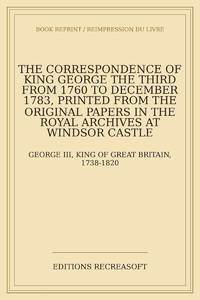
2026réf. LRB48019532Paris: Editions Recreasoft 2026 Language: English. Approximately 562 pages. English: Print-on-demand reprint. Original edition : 1927. Text in English. This six-volume collection presents the correspondence of King George III of Great Britain covering the period from 1760 to December 1783. The letters printed from the original papers in the royal archives at Windsor Castle offer a detailed insight into the political and personal life of one of Britain's most significant monarchs during a critical period of the American Revolution and the early years of his reign. Book images are non-contractual. Editions Recreasoft. Softcover. New. Editions Recreasoft paperback
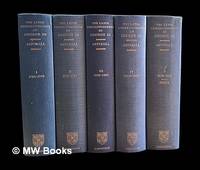
réf. 464329London : Cambridge U.P. First Edition. Hardcover. Very good cloth copy. Spine bands and panel edges somewhat bumped and rubbed as with age. Remains well-preserved overall. Physical description; 5 volumes ; 25 cm. Contents; v. 1. December 1783 to January 1793 -- v. 2. February 1793 to December 1797 -- v. 3. January 1798 to December 1801 -- v. 4. January 1802 to December 1807 -- v. 5. January 1808 to December 1810. Subjects; George III King of Great Britain. 1738-1820. Correspondence. Great Britain. History. George III 1760-1820. Sources. Great Britain. Kings and rulers. Correspondence. London : Cambridge U.P hardcover
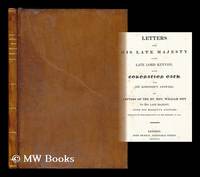
1827réf. 181920London : John Murray 1827. First Edition. Hardback. Very good copy in the original full aniline calf. Professionally and period sympathetically re-backed with the title blocked direct in gilt; very impressively finished. Remains particularly well-preserved overall; tight bright clean and strong.; 8vo 8"" - 9"" tall; 45 pages; Physical desc.: viii 2 45 1p.: 1 plate. ; 4o. Notes: Ed. by H. Phillpotts pref. With a half-title preceded by a facsimile. Other names: Phillpotts Henry 1778-1869. Kenyon Lloyd Kenyon Baron. Pitt William 1759-1806. Genre: Letters - 19th century. London : John Murray hardcover
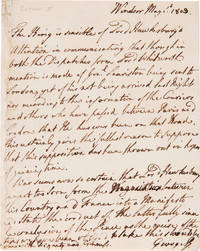
1803réf. 56968Windsor. May 12 1803. King George III Admits War with Napoleon "seems now so certain" A royal letter of profound import written entirely in the hand of King George III and signed "George R." Here the British King writes hastily to Lord Hawkesbury his Secretary of State outlining the lack of recent communications from his emissaries in Paris who were conducting peacetime negotiations with Napoleon after the failure of the Treaty of Amiens the year before. King George III mentions receiving dispatches from Lord Whitworth who was serving as the King's ambassador to France at the time; interestingly it was Whitworth to whom Napoleon threatened war if Great Britain did not evacuate Malta just a few months earlier in February 1803. Whitworth himself evacuated France the day after the present letter was written in full knowledge that peace negotiations were over. The King also relates the failure of French General Jacques Lauriston to arrive in London presumably for last-minute peace talks to prevent conflict. The King states that Lauriston's activities were likely intended to buy time for French negotiators. King George III then writes portentously beginning the second and final paragraph: "War seems now so certain that Lord Hawkesbury cannot too soon form the negotiations between this country and France into a Manifesto and state the conduct of the latter fully since the conclusion of the Peace as the cause of the steps we have been obliged to take." In other words the King is ordering his Secretary of State Lord Hawkesbury to state Great Britain's case for war with France. This is very likely the first admission by the King himself of the reality of impending war with France. Six days after the present letter was written Great Britain declared war on France sparking the long series of armed conflicts known as the Napoleonic Wars which would culminate a dozen years later at the Battle of Waterloo. Important letters signed by King George III are rarely offered in the market. Rarer still are letters composed entirely in his hand and signed by him as in the present example. Cheffin's Auctions in England sold a follow-up to the present letter also to Lord Hawkesbury and dated two days later on May 14 for £11430 in January 2019. That letter was bought for £55 in 1966. By comparison the present earlier letter was bought by H. Richard Dietrich for $92 at Parke Bernet's Fitzgerald sale on November 6 1963. It has remained part of the Dietrich American Foundation collection since then. A momentous political and diplomatic communication from the King of England to his Secretary of State resigned to the fact that war with Napoleon is at hand. 1p. on an 8¾ x 6¾-inch sheet. Left margin reinforced with thicker paper old folds. Mostly minor losses along left margin just touching first letters of several words. Very good. unknown
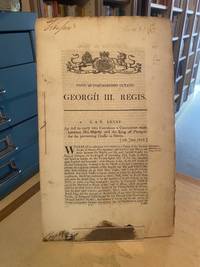
1818réf. 65380Eyre & Strahan London 1818. First Edition. Softcover. Good Condition. Size: Folio - over 12 - 15" tall. 729-744pp. String-bound. Previous owner's signature in ink. Slightly chipped at margins. Creasing to page corners. Covers marked. Original Act of Parliament. Quantity Available: 1. Shipped Weight: Under 250 grams. Category: Law & Criminal Studies; Britain/UK; 19th century; History. Pictures of this item not already displayed here available upon request. Inventory No: 65380. . Eyre & Strahan paperback
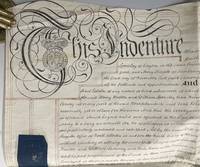
réf. 750Light rubbing and soiling. Very good. JJA-750. George III County of York Indenture of Conveyance in the amount of £150 from Dorothy Temple to Henry Haldor and William Spencelay both of York and dated May 21 1776. Measures approx. 11 x 31.5 inches. Manuscript on vellum sealed and stamped. Docketed to verso. . unknown
réf. 360435Contentum Ltd. Loose sheet. New. High-quality art print based on an original work from the Met. Created in the 18th century 1793–1800. Professionally printed on premium fine-art paper Photo Rag Bright White premium quality in size A2. The artwork is printed with a white border museum-style presentation. Contentum Ltd. unknown
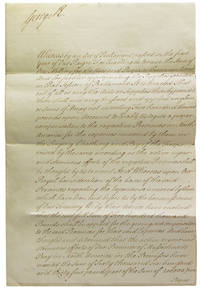
1761réf. 319882Great Britain 1761. 2pp. plus integral blank. Docketed on verso "King's Warrant / Province of Massachusetts / Bay £60634 in part / of £200000 Granted for / the North American / Provinces." Signed by George III at the head of the first page countersigned on the second page by William Wildman Barrington James Oswald and Gilbert Elliot. Folio 14 1/4 x 9 1/2 inches. Usual folds. 2pp. plus integral blank. Docketed on verso "King's Warrant / Province of Massachusetts / Bay £60634 in part / of £200000 Granted for / the North American / Provinces." Signed by George III at the head of the first page countersigned on the second page by William Wildman Barrington James Oswald and Gilbert Elliot. Folio 14 1/4 x 9 1/2 inches. Towards the end of the French and Indian War William Pitt started a specie grant program to reward colonies for raising troops thus putting the colonies in competition with each other for a share of an annual 200000 pounds. With specie scarce in the colonies the colonial assemblies were thus incentivized to raise troops to fight against the French. The present document authorizes Henry Fox to make payment to Massachusetts via their colonial agent William Bollan for their share of the annual grant. Although successful the policy was abandoned in favor of direct taxation after 1762 leading to the Sugar Act and most notably the Stamp Act. This undated document -- the space for the date being left blank suggesting it to possibly be a draft -- is countersigned by William Wildman Barrington Chancellor of the Exchequer 21 March 1761 to 8 May 1762; Sir Gilbert Elliot third Baron Minto Lord of the Treasury 1761-62 and James Oswald Commissioner of the Treasury 1759-63. The date would therefore appear to be 1761 or early in 1762. George III documents relating to North America from the early years of his reign are particularly scarce. unknown