135 results
1970ref. 239451970. 1970s drag gala and showgirl photo archive depicting costumed performers gender transformation erotic display and nightlife during a decade when gay liberation and the broader sexual revolution challenged established boundaries governing sexuality dress and gender presentation. Several photographs carry December 1973 processing dates placing part of the archive only four years after Stonewall and three years after the first Christopher Street Liberation Day marches brought a new gay liberation politics into American public life. The photographs concentrate on the social life within through parties galas clubs and other gathering spaces in which men and women could adopt extravagant personae expose or transform their bodies and participate in forms of gender presentation that remained subject to discrimination and in some jurisdictions police scrutiny outside such settings. Drag organizations themselves were contesting those restrictions during these years; the Queens Liberation Front campaigned against cross dressing laws and began publishing Drag in 1971 as a forum for drag and gender nonconforming communities. Photo archive of 23 chromogenic color photographs ranging from approximately 3.5 x 4 to 4 x 6 inches circa 1970s with several prints dated December 1973. The photographs show showgirls and drag performers in feathered headdresses rhinestone and pearl covered costumes gowns masks lingerie boas wigs theatrical makeup and revealing stage clothes. A blonde showgirl repeatedly poses in an elaborate white jeweled costume with a towering feathered headdress and fan both alone and beside a woman in a floral dress. Other photographs show performers in enormous white wigs and feathered costumes a figure enveloped in a tiered ruffled gown masked men in minimal costumes and participants mingling in crowded interiors. Several scenes are particularly physical: a nearly nude masked man dances in briefs and boots beneath a feathered headdress; another performer wears a bikini style costume with white fur; dancers in abbreviated stage costumes pose and move beneath colored lights. Six square prints record individual performers onstage in feathered and ruffled costumes preserving the performance itself rather than only posed portraits before or after it. Men and women appear as performers companions and spectators and the photographs repeatedly move between staged glamour and informal social interaction. One outdoor image depicts costumed participants near a banner extending the material beyond the interiors represented elsewhere in the group. The archive belongs to the decade in which post Stonewall liberation politics and older drag traditions increasingly overlapped with a broader culture of sexual experimentation. The first Pride march in 1970 emerged directly from resistance to police harassment and anti homosexual laws while drag queens and gender nonconforming participants occupied a contested position even within gay liberation. Contemporary drag culture was simultaneously developing its own institutions and media. Drag magazine recorded performers clubs legal struggles and community life beginning in 1971 while Female Mimics in 1974 reported on performance venues and offered readers information about makeup clothing and drag presentation. The private and semi private interiors represented here show another dimension of that history: spaces in which elaborate femininity male erotic display masquerade nudity and transformations of conventional gender presentation could function as entertainment and as social practice among participants and spectators. Light surface and handling wear occasional scratches and minor fading or color shift; several prints show period processing marks. Overall in very good condition. A concentrated visual record of drag pageantry showgirl spectacle sexual display and the social spaces in which men and women experimented with gender and self presentation during the sexual liberation era. unknown
1666ref. 20195Lyon, Charles Mathevet, 1666 ; soit trois parties reliées en un volume in-12, veau marbré, dos à nerfs décoré et doré, pièce de titre havane, roulette sur les coupes, tranches rouges (reliure ancienne) ; [16], 454 pp., [1] f. bl., [1] f., [12], 215, [1 bl.] pp. ; Frontispice qui porte en titre “Le médecin libéral à son Malade, tourmenté des vives appréhensions de la Mort”.
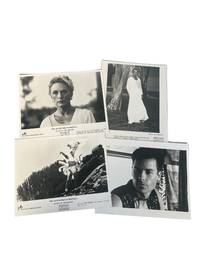
1994ref. 201941994. Elliott Stephan director. The Adventures of Priscilla Queen of the Desert 1994 documents drag performance transgender identity and queer mobility within late twentieth-century cinema situating its narrative in the Australian Outback as three performers travel together and encounter varied social environments. The film follows characters portrayed by Guy Pearce Hugo Weaving and Terence Stamp with Stamp's role as Bernadette presenting a transgender woman within a narrative that foregrounds resilience performance and community. Released during a period of expanding international visibility for LGBTQ stories the film received critical recognition for its costume design and visual presentation winning the Academy Award for Best Costume Design at the 67th Academy Awards and later developed into a stage musical that extended its cultural reach. Its portrayal of drag and transgender experience contributed to broader shifts in representation within global cinema during the 1990s. The Adventures of Priscilla Queen of the Desert. PolyGram Filmed Entertainment: Australia 1994. Archive of four original silver gelatin press photographs each measuring approximately 8 x 10 inches. Images include Terence Stamp as Bernadette in formal attire and Guy Pearce both in and out of drag including a performance costume featuring elaborate feathered design. Photographs retain the compositional clarity typical of studio-issued promotional stills intended for press and publicity use. Produced at a time when LGBTQ narratives were gaining increased prominence in international film these photographs align with the circulation of queer cinema across national boundaries and the role of visual promotion in shaping audience reception. The emphasis on costume character and performance reflects the film's engagement with identity as both lived experience and theatrical expression. As a group the images contribute to the documentation of late twentieth-century LGBTQ representation in film and the visual culture surrounding its promotion. Images crisp with no visible edge wear; overall very good condition. unknown
1920ref. 201891920. LGBTQ Cross-Dressing Collection of eight photographs 1920s-1990s traces the evolution of female impersonation and cross-dressing entertainment across the twentieth century spanning early vaudeville-era performers through television and film portrayals of gender variance. The archive captures both underground stage culture and mainstream representation illuminating shifting public attitudes toward cross-dressing in American performance history. Early real photo postcards advertising Francis Blair as "Dancer De Luxe" demonstrate commercial promotion of female impersonation in the 1920s while later silver gelatin photographs depict drag performers in 1960s stage attire and publicity stills from film and television exploring gender disguise as narrative device. One image references Jamie Farr's portrayal of a cross-dressing soldier in 1979 television described in accompanying press text as "the first time a man played a man who would dress as a woman" underscoring changing media engagement with gender nonconformity. Collection of eight photographs. Sizes range from 3.5 x 5.25 inches to 8 x 10 inches. Includes two real photo postcards from the early 1920s advertising Francis Blair; four silver gelatin photographs from the 1960s showing drag performers in contemporary women's fashion; publicity still of Reg Varney in The Best Pair of Legs in the Business 1973; and images of Danielle Carter in tiger print stage costume. Several photographs retain original press articles or captions en verso. The archive chart a movement from theatrical female impersonation in live revue culture to mediated representation in film and television. They illustrate how cross-dressing functioned alternately as spectacle satire subcultural identity and emerging topic of public conversation. Photographs crisp with minimal edge wear; versos clean where visible. Overall very good condition. A cross-generational visual archive of twentieth-century gender-nonconforming performance. unknown
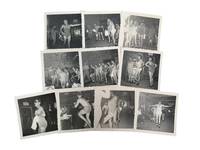
1950ref. 236641950. American cross dressing performance photo archive depicting cisgender men modeling women's bathing suits skirts jewelry and accessories before a mixed audience circa 1950s when gender nonconformity remained vulnerable to public condemnation employment discrimination police surveillance and prosecution under local masquerade and public decency laws. The photographs record gender play within a communal entertainment setting where exaggerated poses costume changes and spectators' laughter temporarily displaced the rigid standards governing masculine appearance in postwar public life. Neither the performers' identities nor their sexual orientations are established but the event preserves a social space in which femininity could be assumed displayed and applauded by men and women. Photo archive of 10 silver gelatin photographs each 3.5" x 3.5" United States circa 1950s. The photographs show several men taking turns before an audience inside a wood paneled bar diner lodge or social hall. Performers model floral and striped bathing suits short skirts necklaces earrings head coverings sunglasses handbags and other accessories sometimes standing with hands on hips or adopting runway poses associated with fashion modeling and beauty contests. One man walks past seated spectators carrying a handbag; another poses beside a jukebox; others appear in groups as participants watch wait or compare costumes. A tattooed performer sits at a counter while applying or adjusting makeup preserving an informal backstage moment within the evening. Women and men sit close to the improvised runway and an illuminated "Exit" sign recurs behind the performers. Cross dressing revues occupied an unstable position in midcentury American culture. Professional female impersonation appeared in traveling productions and nightclub programs including the nationally touring Jewel Box Revue during the 1950s while comparable conduct outside theatrical settings could expose individuals to arrest harassment or forced disclosure. The federal Lavender Scare begun in 1950 treated homosexuality and perceived sexual nonconformity as threats to employment and national security reinforcing the pressure to conceal identities and relationships. This event appears less formal than a commercial revue locating gender performance within an ordinary social gathering where friends and patrons participated as performers witnesses and judges. Light surface wear curling occasional creasing and small edge losses with a larger tear affecting the borders of two photographs; images retain generally strong contrast. Overall in good condition. A compact visual record of men testing the boundaries of acceptable dress and gendered behavior through fashion parody embodied performance and collective amusement in 1950s America. unknown
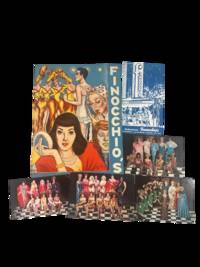
1940ref. 226681940. LGBTQ Drag Archive of Finocchio's nightclub materials 1940s-1950s one of the earliest and most influential drag venues in the United States. Founded in 1936 at 506 Broadway in San Francisco Finocchio's emerged from Depression-era nightlife to become a nationally recognized stage for female impersonation at a time when queer expression was routinely policed and publicly stigmatized. Operating decades before the gay liberation movement the club cultivated a space where gender illusion theatrical glamour and camp spectacle were presented for mixed audiences from San Francisco's gay community to tourists and Hollywood figures. Six items. San Francisco 1940s-1950s. The archive is anchored by a large-format performance booklet featuring illustrated cover artwork by performer and artist Li-Kar and interior photographic portraits of principal female impersonators in elaborate costume. Substantially larger than standard venue handouts the booklet is a visually ambitious souvenir highlighting star performers through graphic design and photography. Also included are a smaller illustrated promotional drink menu and four souvenir postcards depicting the revue cast in sequined gowns chorus-line formations and staged tableaux. Measurements range approximately from 4 x 6 inches to 8 x 11 inches. During the 1940s and 1950s as policing of queer bars intensified in many American cities Finocchio's maintained a visible and commercially successful presence marketing itself with the slogan "The most interesting women are not women at all." Its stage featured performers who helped bring female impersonation into mainstream entertainment in the U.S. Minor edge wear and light handling creases; printed surfaces remain bright with strong image clarity. Overall very good condition. unknown
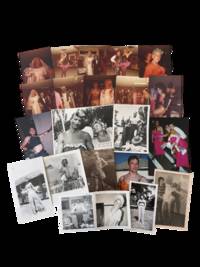
1960ref. 234611960. Gender nonconforming and drag performance photo archive documenting queer social gatherings costume performance pageantry and private queer community life from the 1960s through the 1990s. The photographs preserve a period when drag culture existed simultaneously in nightlife informal house parties outdoor gatherings and small community events often outside mainstream visibility. Long before drag became widely commercialized through television and corporate entertainment circuits queer performers and gender nonconforming individuals built their own social spaces through costume parody theatricality and communal celebration. Photo archive of 22 color and silver gelatin photographs ranging from small vernacular snapshots to larger prints United States circa 1960s-1990s. Several images center on a recurring bridal drag performer wearing lace wedding dresses veils floral bouquets wigs and exaggerated makeup while posing beside guests in tuxedos theatrical costumes and evening attire. Other photographs depict individuals in burlesque-inspired outfits feather boas crop tops wigs and handmade dresses posed indoors and outdoors at parties picnics and performance-like gatherings. One outdoor scene shows two figures in matching feminine costumes smiling arm in arm while additional images record staged poses beside vehicles improvised dance or performance gestures and casual snapshots emphasizing glamour and gender transformation. The archive repeatedly shifts between formal costume display and relaxed social interaction grounding drag not only as stage entertainment but as an everyday form of queer expression and community-making. The photographs align with broader developments in post-Stonewall queer culture when drag performance expanded from underground bars and private parties into increasingly visible forms of social and artistic expression. During much of this period openly gender nonconforming presentation still carried substantial social and legal risk especially outside major urban nightlife districts. This archive preserves the social fabric surrounding drag culture through intimate portrayals of friendships amateur performance gender experimentation and private community environments that sustained queer life across several decades. Light handling wear scattered creasing and occasional fading consistent with vernacular snapshot use. Overall in good condition. unknown
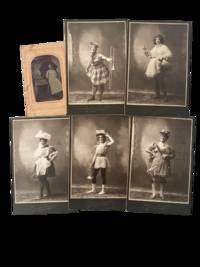
1880ref. 230281880. Cross-dressing Archive of six 19th century photographs of cross-dressing performers Springfield Illinois capturing early American drag performance during a period when public cross-dressing outside performance contexts could provoke not only social but legal backlash. These cross dressing portrait photographs created in Springfield Illinois during the late nineteenth century document early visual culture of gender nonconforming performance in the United States decades before modern LGBTQ identities were publicly articulated. The photographs show male individuals posed in women's clothing and adopting stylized feminine presentation part of a broader nineteenth century culture in which gender impersonation circulated in entertainment spaces private gatherings and visual novelty photography while remaining socially and legally sensitive in everyday life. Public cross dressing outside stage contexts could provoke moral condemnation and in many cities legal sanction under emerging anti cross dressing ordinances that appeared in the late nineteenth century. Portraits such as these therefore preserve rare visual evidence of early drag presentation and gender play at a moment when photographic studios documented identities and performances that existed at the margins of accepted social norms such portraits illuminate early emerging cross-dressing long before twentieth century drag entertainment or even the articulation of modern LGBTQ identities. Six original photographs produced in Springfield Illinois ca. 1880s to 1890s consisting of five cabinet cards and one tintype depicting cross dressing individuals posed in elaborate women's attire. The cabinet cards bear the imprint of Kessberger and Georg Studio of Springfield. Subjects appear against painted studio backdrops typical of commercial portrait photography of the period. Costumes include knee length dresses with lace trim aprons bows bonnets stockings and heeled shoes with attention given to wigs coiffure and accessories. Several figures hold musical instruments including trombone cornet and clarinet suggesting coordinated presentation or group identity among the sitters. Gestures emphasize stylized femininity including a figure lifting a skirt in exaggerated pose and another standing with hand placed at the hip. Also includes one smaller tintype photograph shows a similarly costumed man with a tick mustache in women's nightgown and holding a parasol. Cabinet card mounts show moderate edge wear and minor corner bumping with light surface scratches typical of late nineteenth century albumen studio photography. Images remain clear with strong contrast and well preserved costume detail. Overall Very good condition. Together the photographs form a cohesive visual archive documenting late nineteenth century cross dressing and early drag presentation in the American Midwest preserving rare photographic evidence of gender non conforming identity and performance practices that circulated in American culture long before twentieth century LGBTQ communities began to organize publicly. unknown
1887ref. 47165New Haven, Conn., J.D. & E.S. Dana, 1887. 8vo. Contemporary half calf. Gilt lettering to spine. A small stamp to top of title-page. In: ""The American Journal of Science. Editors James D. and Edward S. Dana"", Third series Vol. XXXIV (July to December, 1887). VIII,500 pp., textillustr. and 10 plates. (Entire volume offered). The joint paper: pp. 333-345 and textillustr. (Apparatus). A few faint brownspots to titlepage, otherwise clean and fine.
1887ref. 47165New Haven Conn. J.D. & E.S. Dana 1887. 8vo. Contemporary half calf. Gilt lettering to spine. A small stamp to top of title-page. In: "The American Journal of Science. Editors James D. and Edward S. Dana" Third series Vol. XXXIV July to December 1887. VIII500 pp. textillustr. and 10 plates. Entire volume offered. The joint paper: pp. 333-345 and textillustr. Apparatus. A few faint brownspots to titlepage otherwise clean and fine. First appearance of this classic paper which announced one of the most celebrated experiments in the history of physics and eventually led Einstein to his Relativity Theory.The experiment was expected to show the rate of the earth's movement through the ether; they looked in vain for a difference between the speed of light in the direction of the earth's motion around the sun and the direction perpendicular to it. The failure of this experiment was a serious blow to classical scientific theories because it cast doubts on the existance of the universal ether which had been a basic principleof for example the Newtonian theories of the universe. Vide PMM: 378 401 408.The paper appeared first in the "American Journal of Science" in November as offered here and was published a month later in "Philosophical Magazine" in a slightly modified form."Michelson trained at the U.S. Naval Academy and Morley minister turned chemist began a series of experiments to determine the relation of ether drift and the velocity of light effects of extremely minute values. They used a slightly silvered glass set angular to a ray of sunlight so that a part ofthe ray was transmitted a part reflected out and again returned thereby providing two paths one perpendicular to the other. If drift existed the superimposed rays would produce interference. None was observed showing that the earth's motion did not affect the light's speed. The negative result held revolutionary implications which led directly thru Lorentz and Einstein to the acceptance of new standards of reference of time and space from geometry and cosmometry."DibnerIn 1919 Einstein met Michelson in California. At a dinner given in honor of them both Einstein said in a speech "You Michelson uncovered an insidious defect in the ether theory of light as it existed and stimulated the ideas of H.A. Lorentz and Fitzgerald out of which the Special Theory of Relativity developed. Without your work this theory would today be scarcely more than an interesting speculation." In an interview in 1842 Einstein said: "It is no doubt that Michelson's experiment was of considerably influence upon my work insofar as it strengthened my conviction concerning the validity of the Principle of relativity.On the other side I was pretty much convinced of the validity of the principle before I did know this experiment and its result. In any case Michelson's experiment removed practically any doubt about the validity of the principle in optics and showed that a profound change of the basic concepts of physics was inevitable."Michelson was awarded the 1907 Nobel Prize "for his optical precision instrument the inteferometer and the spectroscopic and metrological investigations he has carried on."Dibner: Heralds of Science: 161 lising the later version from "Philosophical Magazine" - Norman 1505.- Magee "A Source Book in Physics" pp. 369 ff. the later paper.The volume contains another paper by Michelson and Morley "On a method of Making the Wave-lenght of Sodium Light the actual and practical Standard of Lenght" pp. 427-430. unknown