3536 risultati
1865rif. 711631865. Presented by the Author Then the Governor of Massachusetts To a Prominent Judge and Legal Scholar Trial. Bullock Alexander H. 1816-1882. Green Edward W. d.1866 Defendant. Address of His Excellency Alexander H. Bullock to the Honorable Council on the Occasion of Presenting the Case of Edward W. Green A Convict Under the Sentence of Death for the Crime of Murder in the First Degree. February 27 1866. Boston: Wright & Potter State Printers 1865 i.e. 1866. 29 pp. Octavo 9-1/4" x 5-3/4". Stab-stitched pamphlet in printed wrappers recent repair to lower corner of rear wrapper. Light soiling and a few minor spots light wear to spine ends faint vertical crease through center presentation inscription "J.C. Perkins/ from Gov. Bullock" to head of front wrapper light toning to interior a few spots to title page. $750. Only edition. According to McDade Green the postmaster of Malden Massachusetts was the first person to rob an American bank at gunpoint. He was "a 'secretly drinking man' and had been short on his post office accounts. On December 15 1863 finding the bank manned solely by the seventeen-year-old son of the president he went back for his gun. Entering the bank he shot the youth twice through the head and carried off $5000. in bills. The crime was very quickly traced to him; his confession disclosed where he had hidden the money and he was condemned to die" McDade annotation to 381. Bullock was the governor of Massachusetts. His Address discusses his reasons for signing Green's death warrant. The recipient of this copy was likely Jonathan C. Perkins 1809-1877 a judge and prolific legal scholar. Perkins and Bullock served together in the Massachusetts legislature and on the board of Amherst College. OCLC locates 5 copies in North American law libraries Harvard Library of Congress Ohio State University Worcester Trial Court Library Yale. McDade The Annals of Murder 382. unknown books
1864rif. 712931864. Boston: James Redpath 1864. Boston: James Redpath 1864. The Definitive First Edition of an Exceptionally Rare Anti-Capital Punishment Pamphlet Regarding the First Recorded Bank Robbery in American History Trial. Green Edward W. d.1866 Defendant. A Citizen of Malden. Shall We Suffocate Ed. Green. Boston: James Redpath 1864. 61 3 pp. Octavo 9-1/4" x 5-1/2"; 23.5 x 14 cm. Stab-stitched pamphlet in printed wrappers. Light soiling staining and edgewear to wrappers and corners of text block spine abraded wrappers partially detached but secure. Moderate toning to interior faint dampstaining to a few leaves early owner inscription "Chas W. Raisbeck/ Malden/ Mass" to head of front wrapper. $1250. Only edition. Edward W. Green the seemingly respectable postmaster of Malden Massachusetts earned a dark place in American history as the nation's first bank robber. Secretly struggling with alcoholism and a shortfall in his post office accounts Green targeted the Malden Bank on December 15 1863. Finding the institution manned solely by Frank Converse the 17-year-old son of the bank's president Green retrieved a gun shot the youth twice in the head and escaped with $5000. The crime was swiftly solved; Green confessed led authorities to the stolen funds and was sentenced to hang. Published during the height of the public furor surrounding Green's trial this highly charged polemic fiercely condemns the bloodlust of the public. The anonymous author writing as "A Citizen of Malden" argues that those demanding Green's execution are betraying the core teachings of Christ. The pamphlet was issued by James Redpath 1833-1891 the prominent journalist radical abolitionist and progressive publisher known for championing social reform and human rights causes. This title is of exceptional rarity. While Thomas M. McDade's definitive bibliography The Annals of Murder records two other contemporary accounts of the Green case items 381 and 382 this specific pamphlet is unrecorded by McDade. Charles William Raisbeck 1829-1872 the former owner of this copy was a bookkeeper and genealogist who split his time between Boston and Malden. Only edition. Green the postmaster of Malden Massachusetts is. unknown books
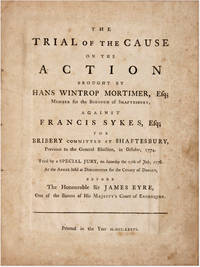
1776rif. 712211776. London: S.n. 1776. London: S.n. 1776. An Account of a Notorious Case of Election Bribery Bound with a Related Unrecorded Broadside Trial. Sykes Francis 1730-1804 Defendant. Mortimer Hans Wintrop Plaintiff. The Trial of the Cause on the Action Brought by Hans Wintrop Mortimer Esq; Member for the Borough of Shaftesbury Against Francis Sykes Esq; For Bribery Committed at Shaftesbury Previous to the General Election In October 1774. Tried by a Special Jury On Saturday the 27th of July 1776. At the Assize Held at Dorchester for the County of Dorset Before The Honourable Sir James Eyre One of the Barons of His Majesty's Court of Exchequer. London: S.n. 1776. 19 1 pp. Main text in parallel columns. Quarto 9-3/4" x 7-1/2"; 24.8 x 19 cm. Bound with Text Two later tipped-in leaves of notes. Affixed to one of these leaves are a contemporary account of the trial and a section of a letter in Mortimer's hand. And Tipped-in contemporary 14" x 21" 35.5 x 53.3 cm mezzotint by an unknown artist The Shaftsbury Election or the Humours of Punch 1775. Additional annotations about the mezzotint to front endleaves one followed by two ownership inscriptions one of Henry White. Affixed to one of these is a small clipping about the Mortimer family. And Broadside. Mortimer Hans Winthrop. To the Worthy Electors of the Borough of Shaftsbury. Shafton: s.l. 11 June 1790. Trimmed to 9" x 6" 22.8 x 15.2 cm and affixed to verso of title page. Nineteenth-century calf rebacked in period style gilt rules to boards gilt fillets and retained nineteenth-century lettering piece to spine hinges mended marbled endleaves. Moderate rubbing to boards and toning to text occasional early underlining and brief notes in pencil. $3500. THIS DESCRIPTION IS TRUNCATED DUE TO CHARACTER LIMITS. PLEASE CONTACT US FOR A COMPLETE VERSION. The Shaftesbury Election of 1774 stands as one of the most infamous instances of parliamentary corruption in 18th-century England. Ministerial candidates Sir Francis Sykes and Sir Thomas Rumbold bribed electors with thousands of pounds routing money through a masked figure known as "Punch" to avoid direct liability. Voters were given cash in exchange for signing promissory notes payable to an imaginary figure named "Glenbucket". The defeated candidate Hans Winthrop Mortimer. unknown books
1807rif. 708151807. I Am Inclined to Give Credit to Her Assertions": An Irish Magistrate's Defense of an 1807 Rape Victim Manuscript. Trial. Ireland. Account of a Rape. County Carlow Ireland June 25 1807. 11" x 7" 27.9 x 17.8 cm leaf docketed on verso. Single leaf manuscript on paper measuring 11" x 7" 27.9 x 17.8 cm. Unbound as issued with contemporary legal docketing and extensive manuscript annotations by the presiding magistrate to the lower margin of the recto and across sections of the verso. Light horizontal folds from period mailing/filing mild uniform browning and light wear along the edges otherwise remarkably fresh and completely legible throughout. $1500. A powerful and hauntingly detailed original sworn manuscript record detailing an account of sexual violence in rural County Carlow paired with a rare candid commentary by the presiding local magistrate regarding the legal competence and credibility of the female victim. Taken before Gilbert Fitzgerald a prominent local Magistrate of the Peace this manuscript records the direct testimony of Margaret Janson regarding an assault by Myles Barin. The body of the information vividly captures the victim's contemporaneous narrative: "Myles Barin opened his small cloths informant asked him what he was going to do to her he answered he would ride her then extending her legs and endeavouring to force something into her body and struggled with her near an hour." In 19th-century Irish and British common law victims of sexual crime faced formidable legal obstacles often compounding the trauma of the assault itself. Female testimony was frequently met with deep skepticism stringent requirements for physical corroboration and strict adherence to oaths that marginalized uneducated or illiterate witnesses. What elevates this document from a routine legal record to a remarkable artifact of historical criminal justice is Magistrate Fitzgerald's handwritten commentary appended directly to the foot of the document: "I did not swear Informant to this Information as she appeared to be entirely ignorant of the nature of an Oath but the facts are strongly corroborated by other evidence and I am inclined to give credit to her assertions." Fitzgerald's willingness to bypass strict procedural religious swearing while explicitly validating Janson's truthfulness. unknown books
1914rif. 659851914. New York 1912-1914. Image in 30-1/2" x 24" frame. New York 1912-1914. Image in 30-1/2" x 24" frame. "His Famous Wig Composed Entirely of Split Hairs and Adorned with the Ceremonial Crimson Tape" Robinson Boardman 1876-1952. Becker-Rosenthal Murder Trial. Mr. Justice Precedent. New York 1914. 21" x 15-1/2" 53.3 x 39.4 cm gouache image on 26" x 19-1/2" 66 x 49.5 cm sheet image signed twice and inscribed by Robinson caption in pencil below image most likely in another hand laid down on illustration board. Image in 30-1/2" x 24" 77.5 x 60.9 cm wooden frame glazed. Light soiling a few minor stains and four crop-marks to margins outside of image which could be covered with a matte image fine. Several minor scuffs and nicks to frame. An exceptional unique piece of original artwork capturing a defining moment in American legal and criminal history. $3500. This striking original gouache was created to illustrate "Leaden Footed Justice in New York State" a feature article published in the Special Feature section of the New York Tribune on Sunday March 1 1914. The penciled caption reads:"Mr. Justice Precedent wearing his famous wig composed entirely of split hairs and adorned with the ceremonial crimson tape." The caricature was a scathing commentary on the notoriously protracted bureaucratically tangled legal proceedings of the Becker-Rosenthal Murder case which centered on NYPD Police Lieutenant Charles Becker who ran a massive protection racket targeting illegal Manhattan casinos. When gambling house owner Herman Rosenthal threatened to expose Becker's corruption to District Attorney Charles S. Whitman Becker hired a gang of underworld executioners including "Gyp the Blood" and "Lefty Louie" to gun Rosenthal down outside the Hotel Metropole. The investigation and subsequent trials completely dominated New York front pages. Becker's first trial began on October 7 1912 resulting in a conviction that was subsequently overturned on appeal by the New York Court of Appeals due to judicial bias. His highly anticipated second trial began on May 6 1914 just over two months after this cartoon appeared. Becker was convicted a second time and after his appeals were exhausted in 1915 went to the electric chair at Sing Sing-marking the first time in U.S. history a police officer was executed for murder. The case profoundly shook the public psyche and entered the cultural lexicon most. unknown books
1682rif. 144001682. De Vries Simon. Persian royal court scene 1682 depicts kingship judgment and punishment in a European publication describing Persia and other regions of Asia Africa and the Americas. Issued during the Safavid period the scene places a Persian ruler above assembled courtiers and judges while a kneeling governor is restrained before him presenting Dutch readers with a visual account of royal authority and judicial punishment in seventeenth-century Persia. De Vries compiled his extensive geographical work from earlier travel and eyewitness accounts rather than presenting it as the record of his own travels. De Vries Simon. Curieuse aenmerckingen der bysonderste Oost en West-Indische verwonderens-waerdige dingen; nevens die van China Africa en andere gewesten des werelds. Utrecht: Johannes Ribbius 1682. Original etching on laid watermarked paper. Image 6" x 7.5"; overall sheet 8.25" x 6.5". A Persian king occupies an elevated carpeted throne above an assembly of courtiers and judges. Below him a governor kneels while another figure restrains him establishing punishment as the central action of the composition. Most of the assembled figures wear turbans and long garments; several others have markedly different European-style headwear. Through an architectural opening additional guards appear within the palace setting. Small numbers incorporated into the composition correspond to explanatory text printed in early Dutch above the image linking individual figures and actions to De Vries's written account. Published at Utrecht by Johannes Ribbius De Vries's Curieuse aenmerckingen appeared in four parts in 1682 and compiled European accounts of geography customs religion government and court practices across numerous regions. Bibliographic records confirm both the four-part publication and its substantial series of engraved plates. The present scene documents how Persian royal government and judicial authority were explained pictorially to a late seventeenth-century Dutch readership with the numbered key allowing the image to be interpreted alongside the accompanying text. Uncut as published; overall excellent condition. The watermark surviving margins numbered explanatory system and detailed court scene preserve material and textual evidence of the engraving's original use as an illustration within De Vries's 1682 geographical compilation. unknown books
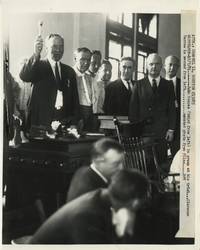
1925rif. List38112New York City: United Press International 1925. Photograph measuring 8 x 9 ¾ inches. With caption recto; manuscript caption and UPI and "Not For Publication" stamps verso. Excellent. A photograph of John Scopes Clarence Darrow and others during Tennessee's famous "Monkey Trial" in which Scopes was charged with violating the Butler Act which outlawed teaching human evolution in public schools. The case arose when the ACLU put out an advertisement for a teacher willing to violate the Act; community leaders from Dayton Tennessee saw an opportunity both to test the law and to draw attention to their community. New teacher John Scopes agreed to claim to have taught evolution likely falsely as he had not yet taught biology at all. He was represented by Clarence Darrow who was set against the prosecution's William Jennings Bryan-two of the most prominent legal minds of their day. Scopes was found guilty-though the verdict was overturned on a technicality-and the Butler Act stayed Tennessee law until 1967. United Press International unknown books
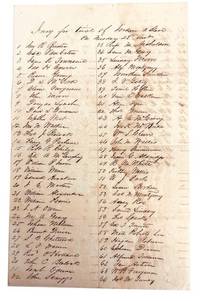
rif. 95800Very Good. Single leaf folded to form four pages with list of 83 names on first two pages. Three later horizontal folds probably for filing. Has some pencil markings beside most names -- either a red "x" or an black line. Ink note at top of one of the narrow folded section on last page:Jury of 80 Men for trial of Jorden on Tuesday 28th Inst. Waterstain -- name still quite readable -- a bit wavy but covers about the right third of both leaves as folded. No information as to date or location. Looks like it probably dates sometime in first two-thirds of 19th century. Someone might be able to narrow it down -- most juror names seem common but Plesant W. Ponder probably is not. Later pencil note in unknown hand on last page: possibly Lawrence County Alabama. unknown books
1978rif. 318021Tennesse: Rhea County Historical Society 1978. Reprint. hardcover. very good. Illustrated sparsely in black and white. 339 65 18 pages. 8vo gilt-stamped red cloth. corners bumped. Dayton Tennesse: Rhea County Historical Society 1978. A very good copy. A word-for-word report of the famous court test of the Tennessee Anti-Evolution Act at Dayton July 10 to 21 1925 including speeches and arguments of attorneys testimony of noted scientists and Bryan's last speech. Rhea County Historical Society unknown books
1968rif. 250798Los Angeles 1968. unbound. Autographed first day Olympic Trial Covers signed in full by several athletes who went on to participate in the 1968 Summer Games in Mexico City. Each Trial Cover contains a black shadow figure engaging in the participant's sport as well as the athlete's signature. Signatures include George Foreman boxing Deborah Meyer swimming Spencer Heywood basketball Al Oerter discus and Sue Gossick diving. Twenty-one covers total each measuring 3.5 x 6.5 inches. Los Angeles California. Postmarked August 28 1968. Fine condition. unknown books
1945rif. 47189Krakow: Spóldzielnia Wydawnicza "Czytelnik" Czytelnik Publishing Cooperative 1945. First edition. Softcover. g to von-. Octavo 8 1/4 x 6". 93pp. 13 leaves of double sided photographic plates interleaved and unpaginated. Illustrated tan red and black wrappers with black lettering on the front cover. Photographic b/w frontispiece. Spóldzielnia Wydawnicza "Czytelnik." Possibly an earlier publication on lower quality paper compare to a slightly smaller publication by the "Library of the Union of Polish Patriots in the USSR" Biblioteczka Zwiazku Patriotów Polskich w ZSRR with the same text in different layout. That publication issued on higher quality paper and with twenty-eight photogravures three more than in this publication with twelve photographs appearing in both publications though in lesser quality here. Court Proceedings of the Polish-Soviet Special Criminal Court established in Lublin in August 1944 in order to investigate the crimes committed by the Germans in the Majdanek extermination camp. Despite the importance of this document it must be mentioned that the Commission made erroneous assumptions regarding the duration of the camp and the number of people killed at Majdanek. The Publishing cooperative "Czytelnik" was established behind Soviet front lines in 1944. It became the first post-World War II. publisher in Poland. The total numbers of the victims is still controversial: In this report 1.5 million victims of different nationalities were counted however according to the latest researches there were 79000 victims 59000 of whom were Jews See: Kranz T.: "Bookkeeping of Death and Prisoner Mortality at Majdanek." pp. 81-110. In: Silberklang D. Ed.: Yad Vashem Studies. Vol. 35:1. Jerusalem 2007. Illustrated with 25 pages of b/w photographic reproductions including a frontispiece on 13 double-sided interleaved plates altogether thirty-two photographs depicting members of the Commission Nazi guards now prisoners who used to run the camp and survivors alike testifying before the Commission. Also includes views of the actual concentration camp piles of suitcases Zyklon B poison gas pellets gas chambers ovens and survivors amid corpses. Wrappers with some chipping rubbing creasing and/or closed tears to extremities. Small stain on the back cover and side edge of book block. Verso of frontispiece with a vertical crease. Some pages throughout with some light age toning or small water spots. Overall text and images clear and vibrant. Wrappers in good interior in very good- condition overall. One of two editions of this work published in Moscow and Krakow in 1945. It is not certain which was released first. Each has different wrappers size pagination and publishers. Spóldzielnia Wydawnicza "Czytelnik" (Czytelnik Publishing Cooperative) unknown books
1950rif. 66299Garden City: Doubleday & Company Inc 1950. First edition. Hardcover. Very Good/Very Good Minus. 309pp. Octavo 22 cm Beige cloth over boards. The spine ends are bumped and the covers are cocked. In a price-clipped dust jacket with several small losses from the edges. Hayward Patterson's account of being falsely accused of raping two white women aboard a train near Scottsboro Alabama in 1931. The trials sparked an international uproar and the defendents were forced to endure the harsh conditions of the Alabama prison system for years. The trials and the Supreme Court verdicts which followed helped fuel the rise of the Civil Rights Movement. Doubleday & Company, Inc hardcover books
1824rif. BB056Murder Trial Account of the Murder of the late Mr William Weare . the coroner's inquest the trials of the prisoners and the execution. By George Henry Jones. London 1824. With 3 landscapes 2 folding plates finely lithographed by C J Hullmandel. 8vo iv344pp; half-leather marbled boards spine label "Thurtell's Trial" lightly scuffed very solid and clean throughout. First edition. William Weare was a solicitor of Lyon's Inn and a gambler. His killer was John Thurtell 1794–1824 a sports promoter amateur boxer a former Royal Marine officer and a son of the Mayor of Norwich. Thurtell owed Weare a gambling debt of £300 an immense sum at the time equivalent to £24500 in 20151. Thurtell believed Weare had cheated him of the money. Whatever the truth when Weare demanded payment Thurtell murdered him rather than pay up. He invited Weare to join him and his friends – Joseph Hunt a tavern landlord and William Probert a former convict and alcohol merchant – for a weekend of gambling at Probert's cottage at the site of Oaks Close off Gills Hill Lane subsequently popularly known as Murder Lane23 Radlett. On 24 October 1823 they journeyed from London in Thurtell's horse-drawn gig but Weare was killed in a dark lane just short of their destination. The gruesome and callous events created such public sensation that it attracted numerous ballads and theatre shows at the time along with comment by the essayist Babington Macaulay and the crime used variously in the work of Sir Walter Scott William Hazllitt and Robert Louis Stevenson. After the trial one of the accused was hanged and another Joseph Hunt was transported to Botany Bay Australia. Charles Joseph Hullmandel 1789–1850 studied art and printmaking and is considered amongst the most important figures in the development of British lithography. He developed a method for reproducing gradations in tones and for creating the effect of soft color washes which enabled the reproduction of Romantic landscape paintings of the type made popular by J. M. W. Turner. Hullmandel's essay The Art of Drawing on Stone 1824 was an important handbook of lithography issued the same year as this account of the trial. books
rif. 2368London: H. Owen 1757. . 8vo in half-sheets lacking the final blank; now bound in modern blue paper wrappers with typed label. Text somewhat soiled particularly at edges; first 4 leaves with small horizontal closed tear not affecting text; title with small loss in the bottom gutter. ESTC N25456. A record of the notorious trial of Captain James Gambier later Vice Admiral for adultery with Sir Charles Knowles's wife Maria Magdalena Therese de Bouget 1733-1796. Interestingly the wife's maiden name is given as Plusbee on p. 13 whereas it actually Bouget London: H. Owen, 1757. unknown books
1995Legatura editoriale in cartoncino rigido ruvido, protetto da sovraccoperta con bandelle, leggermente annerita. Buonissimo lo stato conservativo, pagine perfettamente tenute, fortemente ossidate da tonalità seppia, bruniti i tagli. Numero pagine 204. USATO
2001Volume appartenente alla collana Memorie documenti biografie. Brossura editoriale con risvolti leggermente stanca agli angoli, lievemente macchiata ai piatti. Dorso leggermente stanco alle estremità. Mancanza all'occhiello. Pagine ben salde alla cerniera, con ampio margine, lievemente brunite. Numero pagine 157. USATO
1967Volume numero 42 appartenente alla collana I record Mondadori. Copertina leggermente stanca agli angoli e alle estremità del dorso. Pagine ben salde alla cerniera, brunite, così come i tagli. Presente piega all'occhiello. Controguardie leggermente brunite. Presente piccolo strappo al margine di pagina 161. Numero pagina 244. USATO
1960Coperta lievemente segnata da fattore tempo, tagli e pagine con imbrunitura, libro completamente fruibile, n. 5 della collana "Serie di Psicologia", con prefazione di Dario Varin e con premessa dell'autore, traduzione di Laura Schwarz, ristampa della seconda edizione, numero pagine 321; da segnalare: alcune pagine con appunti e sottolineature a matita (talvolta anche a penna) USATO
1962Stato discreto, sovraccoperta originale illustrata in carta, illustrazione di Signo, diversi segni d'uso, lievi bruniture, gora, coperta illustrata in cartoncino patinato semimorbido, bordo appena sfregato, tagli e margini delle pagine leggermente ambrati, pagine in buono stato. Illustrazioni in nero. Impaginazione: Franco Magnani. XXIX volume della collana Biblioteca Socialista, diretta da Lelio Basso. Numero Pagine 290 USATO
1999Volume a cura del Centro studi di Politica Internazionale. Introduzione di Andrea Manzella. La presente pubblicazione ha ricevuto il sostegno della Commissione europea nel quadro del progetto comunitario di informazione e comunicazione "Costruire insieme l'Europa" del Ministero della Pubblica Istruzione e del Comune di Roma. Copertina in buone condizioni leggermente stanca alle estremità del dorso. Pagine ben salde alla cerniera, con ampio margine. Numero pagine 181. USATO
1963Prima edizione del volume. Copertina leggermente stanca agli angoli e ai margini; usurata al dorso, sia alle estremità che sulla lunghezza; dorso brunito, probabilmente per l'esposizione al sole. Presente del nastro adesivo al piatto posteriore nell'angolo in basso. Presenti note a penna alle controguardie. Pagine ben salde alla cerniera, con ampio margine, lievemente brunite, così come i tagli. Numero pagine 228. USATO
2013ril. Londra, 1857. Davanti al neonato Tribunale per i divorzi civili compaiono i legali di Henry Robinson, facoltoso e gretto ingegnere di Edimburgo, che sostiene di essere stato tradito dalla moglie Isabella con un altro uomo, il dottor Edward Lane. La vicenda è una storia vera. L'unica prova che viene consegnata al giudice è un diario in cui compaiono gli struggimenti di Isabella per un medico molto più giovane di lei, stimato precursore dell'idroterapia, il cui stabilimento termale veniva frequentato fra gli altri da Charles Darwin. Cosi, anche se la lettura di alcuni brani non chiarisce cosa sia successo veramente, solo un miracolo potrebbe far desistere un tribunale presieduto da tre giudici anziani e conservatori dal condannare la donna. Una donna che per di più dimostra di avere, secondo gli studi frenologici del tempo, l'organo della Amatività eccessivamente sviluppato e quello della Venerazione di dimensioni assai ridotte. Una donna che descrive nel suo diario comportamenti considerati così licenziosi da far allontanare il pubblico femminile dall'aula del tribunale quando vengono letti stralci del suo diario. Il verdetto sembra scontato, ma ecco il colpo di scena: i legali del dottor Lane escogitano una linea difensiva. Isabella è affetta da un "disturbo uterino", un'agitazione patologica che allude alla sua accentuata sensualità (ninfomania, erotomania) e il diario in questione non è che una "prova di romanzo"...
2007br. Anni fa, quando fu pubblicato per la prima volta con un altro titolo, questo libro era diverso da adesso. Gianrico Carofiglio, allora esclusivamente un magistrato ben lontano dai romanzi che ne hanno fatto uno degli autori più amati dal pubblico, l'aveva concepito come un manuale sulla tecnica dell'interrogatorio, su come demolire o rafforzare una testimonianza nel dibattimento penale. Ma siccome il testo era tutto costruito su casi concreti, su verbali di veri interrogatori, ebbe una cerchia di lettori più vasta di quella degli specialisti. Evidentemente molti, nell'arte controllata di insinuare il dubbio fra i fatti, avevano avvertito l'umorismo, ossia il lavoro del contrario. In breve, lo spirito della letteratura, in una raccolta di racconti veristici venati di giallo: pezzi di vita, storie tragiche e comiche di esseri umani presi in avventure e peripezie, di prede e predatori, furbi e poveracci sul palcoscenico del processo che diventa teatro di vita. Da tutto questo lo stimolo a ripubblicarlo oggi liberato dalle parti più tecniche, per tornare ciò che era veramente: una raccolta di racconti giudiziari.
1994br.