3510 risultati
1863rif. 830711863. Trial. Bailey John Crawshay Primary Defendant. Somerset Henry Charles FitzRoy 8th Duke of Beaufort 1824-1899 Plaintiff. In the Common Pleas. His Grace the Duke of Beaufort Against John Crawshay Bailey and Others. For Trespass on Cwmdu Hill In the Parish of St. Michael Cwmdu Breconshire. Report of the Trial Before Mr. Justice Mellor and a Special Jury At Brecon On the 21st 23d And 24th of March 1863. Watkins Hooper Baylis And Baker 11 Sackville Street London Solicitors for His Grace. London: Printed by Strangeways & Walden 1863. iv 284 2 pp. Octavo 9-1/2" x 6-1/4"; 24.5 x 15.5 cm. Later green pebbled cloth printed paper label to spine endpapers renewed. Light rubbing and minor shelfwear moderate toning to interior negligible light foxing and soiling to a few leaves presentation inscription "C. Lloyd Esq./ With Mr. Baker's Compliments/ 30 March 1868" to front endleaf. $300. Somerset the 8th Duke of Beaufort was a British peer military officer and Conservative politician. This case centered on trespassing by members of the public on some of his vast property holdings totalling some 51000 acres in all in Wales. The defendants nearby farmers alleged that the portions of the land in question were part of their estates but the court found for the Duke. This copy was presented by Charles Baker one of the Duke's attorneys in the case. This is a scarce title. OCLC locates 3 copies in North American law libraries Columbia Harvard Jenkins Law Library. unknown books
1863rif. 831271863. Don't Trespass on My Land! Trial. Bailey John Crawshay Primary Defendant. Somerset Henry Charles FitzRoy 8th Duke of Beaufort 1824-1899 Plaintiff. In the Common Pleas. His Grace the Duke of Beaufort Against John Crawshay Bailey and Others. For Trespass on Cwmdu Hill In the Parish of St. Michael Cwmdu Breconshire. Report of the Trial Before Mr. Justice Mellor and a Special Jury At Brecon On the 21st 23d And 24th of March 1863. Watkins Hooper Baylis And Baker 11 Sackville Street London Solicitors for His Grace. London: Printed by Strangeways & Walden 1863. iv 284 2 pp. Octavo 9-1/2" x 6-1/4"; 24.5 x 15.5 cm. Textured cloth with later cloth rebacking printed paper label to spine endpapers renewed. Light rubbing and minor shelfwear faint dampstaining to boards minor bubbling of cloth in places moderate toning to interior mostly negligible light foxing and soiling to a few leaves inscription "To be kept with His Grace's Breconshire Muniments/ C. Baker/ 29 Apl. 1863" to head of title page. $300. Somerset the 8th Duke of Beaufort was a British peer military officer and Conservative politician. This case centered on trespassing by members of the public on some of his vast property holdings about 51000 acres in Wales. The defendants nearby farmers alleged that the portions of the land in question were part of their estates but the court found for the Duke. This copy was apparently retained and filed by Charles Baker one of the Duke's attorneys in the case who was also an antiquarian and the duke's "steward of seignories of Gower and Kilvey." This is a scarce title. OCLC locates 3 copies in North American law libraries Columbia Harvard Jenkins Law Library. Powys-Land Club Collections Historical and Archaeological Relating to Montgomeryshire 5:407. unknown books
1818rif. PHO-2615Paris, Eymery, 1818, in-8, 407pp., demi basane époque, dos lisse. Frottements, rousseurs, planches déchirées aux plis. Illustré de 4 planches dépliantes réunissant plusieurs sujets : vue de l’Aveyron à l’endroit où fut retrouvé le cadavre de Fualdès, intérieur de la maison Bancal à Rodez, portraits des 14 personnages de l’affaire, Dubernard, avocat de Jausion et Veynac, et maison Jausion, place de la Cité. La représentation de la maison Fualdès, rue Balestrière, manque. L’exemplaire possède en revanche une saisissante planche de la sentence prononcée contre les accusés, que nous n’avons pas retrouvée dans les collations consultées.
1817rif. 760Paris, Alexis Eymery, 1817. 1 volume in-8 de XI+246 pages, demi percaline chocolat. Plat un peu insolés.
1817rif. 11343A Paris, Alexis Eymery / Delaunay, 1817. In-8 deXV-260 pages, sous couverture d'attente (frottée, avec petits manques de papier au dos). Petite étiquette de bibliothèque en face de la page de titre.
1865Mm 115x180 Volume cartonato, legatura in mezza pelle nera con quattro nervature, titoli e fregi in oro al dorso, 272 pagine. Firma d'appartenenza, peraltro buona copia. Testo in lingua francese - french text. SPEDIZIONE IN 24 ORE DALLA CONFERMA DELL'ORDINE.
1966rif. 9909Paris Albin Michel 1966 Un volume in-8 broché, couverture bleue à rabats, 338 pages et tables. Couverture tâchée et défraîchie.
1966rif. 10951Paris, Albin Michel, 1966 ; in-16 ; demi-basane noisette à coins, dos à nerfs décoré et doré, titre doré, couverture illustrée et dos conservés (reliure de l'époque) ; 338, (6) pp., 4 planches hors-texte représentant 13 documents.
1868rif. 901741868 Ernest Thorin, 1868, 367 p., demi-reliure, reliure frottée, un tampon sur la page de titre, sinon intérieur propre.
1864rif. GIT01257Paris Michel Lévy 1864. In-8 broché 515pp. Petit manque sur le dos, rousseurs par endroits.
rif. 47367Paris, Robert Laffont, 1967. 14 x 20, 430 pp., broché, très bon état.
rif. 7060in 12 pleine toile noire d’éditeur,fers en long et titre dorés, au dos, petites plaques dorées sur les plats. Frontispice sur acier de Karl Girardet.Titre,284 pages, tranches mouchetées,gravures hors-texte.Mame & Cie 1859 (un prénom manuscrit sur la page de garde-au dos du frontispice ,en haut de la page 1
1947rif. GITj976Paris La Jeune Parque 1947. In-8 broché 219pp 2 feuillets non chiffrés dont table des matières. Exemplaire en bon état et complet (5034)
rif. 18226Paris, Dentu, 1820 ; TOME 2 seul,volume in-8°, demi-velin glacée , dos lisse tomaison dorée, plats de papier 2ff.,328pp.E
rif. 239663Paris, aux bureaux du journal La France, 1841 in-8, 48 pp., dérelié.
in-8 broche de 316 pages.— Edition originale. Bel exemplaire (manque les gardes et la couv.). [BU-11]
rif. 232567Paris, Perlet, 1792 8 tomes en 4 vol. in-8, demi-basane brune, dos lisse orné (reliure vers 1820). Frottements sur les plats.
rif. 10234ou journal des Assemblées Nationales, depuis 1789 jusqu’en 1815. La narration des évènemens, les débats des assemblées, les discussions des principales sociétés populaires, et particulièrement des la société des Jacobins, les procès verbaux de la Commune de Paris, les séances du tribunal révolutionnaire, le compte rendu des principaux procès politiques, le détail des budgets annuels, le tableau du mouvement moral, extrait des journaux de chaque époque, etc. précédé d’une introduction sur l’histoire de France jusqu’à la convocation des Etats généraux. 40 tomes en 40 volume in 8 reliure demi-cuir noire d’époque, titre, tomaison, roulette, palmette, filets dorés. Fers filets à froid. Tome1 : faux-titre, titre, 486 pages, 2 pages explication du plan de la salle d’assemblée des notables à la séance présentée par le Roi, 1 plan. Une page d’explication du plan de la salle d’assemblée des notables présidée par Monsieur. Un plan. Tome 2 : faux-titre, titre, IV-475 pages. Tome 3 : faux-titre, VIII, titre, 480 pages. Tome 3 : faux-titre, titre, VIII, 480 pages. Tome 4 : faux-titre, VIII, titre, 478 pages. 3 pages de table. Tome 5 : faux-titre, titre VIII 480 pages. Tome 6 : faux-titre, titre, VIII, 479 pages. Tome 7 : faux-titre, titre VIII, 473 pages. 3 pages de catalogue. Tome 8 : faux-titre, titre, XV, 463 pages. Tome 9 : faux-titre, titre XII, 475 pages. Tome 10 faux-titre, titre, XII, 478 pages. Tome 11 : faux-titre, titre, X, 494 pages ; 1 page d’errata. Tome 12 : faux-titre, titre, XIII, 493 pages. Tome 13 : faux-titre, titre, XI, 455 pages. Tome 14 faux-titre, titre, XII ; 457 pages. Avec une liste des membres de la Société des amis de la Constitution séante à Paris A la maison des Jacobins dite des Jacobins Saint-Honoré. Tome15 : Faux-titre, titre, XV, 469 pages. Tome 16 : faux-titre, titre, XV, 470 pages. Tome 17 faux-titre, titre, XVI 479 pages. Tome 18 faux-titre, titre, XVI 480 pages. Tome 19 : faux-titre, titre ; XV, 469 pages. Tome 20 faux-titre, titre, XV, 469 pages. Tome 21 : faux-titre, titre ; XVI, 443 pages. Tome 22 : faux-titre, titre, XI, 479 pages. Tome 23 : faux-titre, titre, XV, 480 pages. Tome 24 : faux-titre, titre, XI, 479 pages. Tome 25 : faux-titre, titre, XV, 474 pages. Tome 26 faux-titre, titre, XV, 479 pages. Tome 27 : faux-titre, titre, XVI, 463 pages. Tome 28 : faux-titre, titre, XV, 508 pages. Tome 29 : faux-titre, titre, XVI, 480 pages. Tome 30 : faux-titre, titre, XV, 472 pages. Tome 31 : Faux-titre, titre, XV, 503 pages ; Tome 32 : faux-titre, titre, XV, 487 pages. Tome 33 : faux-titre, titre, XI, 461 pages. Tome 34 : Faux-titre, titre, 489 pages, 1 page d’errata. Tome 35 : faux-titre, titre, 508 pages. Tome 36 faux-titre, titre, 524 pages. Tome 37 : faux-titre, titre, 508 pages .Tome 38 : faux-titre, titre, 508 pages. Tome 39 : faux-titre, titre, 532 pages. Tome 40 : faux-titre, titre, V, 422 pages Une page d’avis. Paris PAULIN libraire 1834-1838. Edition originale. Fort rare complet, en reliure uniforme. Petites rousseurs, plus principalement concentrées en début et fin de volume. Sinon très bon état
1885rif. GITj568Paris Aux Bureaux du Progrès Médical, Delahaye et Lecrosnier 1885. 2 volumes fort in-8 brochés LVIII 1 feuillet non chiffré errata et VI 605pp. Sans le 2e plat de la couverture du Tome I; pâles rousseurs sur les couverture, intérieur frais, complet, non coupé. Réimpression soignée de l'édition de 1579, tirée à 500 exemplaires, celui-ci 1 des 350 sur papier parchemin, non justifié.
2005xxi, 346 pages. Index. Footnotes. "Deborah Lipstadt's personal, riveting chronicle of the legal battle with [David] Irving, in which she went from a relatively quiet existence as a professor at an American university to being a defendant in a sensational libel case." Former library copy with usual markings. Above-average wear. Spine leaning. Binding intact. Dust jacket preserved in glossy new archival-grade Brodart. A worthy reading copy. Book
2005rif. 14287Le Grand livre du mois 2005 334 pages in8. 2005. Broché. 334 pages. Cet ouvrage de Philippe Masson professeur d'histoire et de stratégie analyse le rôle militaire d'Adolf Hitler pendant la Seconde Guerre mondiale. Il examine ses talents de stratège et les controverses autour de ses décisions en s'appuyant sur des témoignages de l'époque comme ceux du procès de Nuremberg
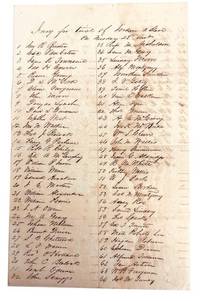
rif. 95800Very Good. Single leaf folded to form four pages with list of 83 names on first two pages. Three later horizontal folds probably for filing. Has some pencil markings beside most names -- either a red "x" or an black line. Ink note at top of one of the narrow folded section on last page:Jury of 80 Men for trial of Jorden on Tuesday 28th Inst. Waterstain -- name still quite readable -- a bit wavy but covers about the right third of both leaves as folded. No information as to date or location. Looks like it probably dates sometime in first two-thirds of 19th century. Someone might be able to narrow it down -- most juror names seem common but Plesant W. Ponder probably is not. Later pencil note in unknown hand on last page: possibly Lawrence County Alabama. unknown
rif. 95800Very Good. Single leaf folded to form four pages with list of 83 names on first two pages. Three later horizontal folds probably for filing. Has some pencil markings beside most names -- either a red "x" or an black line. Ink note at top of one of the narrow folded section on last page:Jury of 80 Men for trial of Jorden on Tuesday 28th Inst. Waterstain -- name still quite readable -- a bit wavy but covers about the right third of both leaves as folded. No information as to date or location. Looks like it probably dates sometime in first two-thirds of 19th century. Someone might be able to narrow it down -- most juror names seem common but Plesant W. Ponder probably is not. Later pencil note in unknown hand on last page: possibly Lawrence County Alabama. unknown books
1817rif. 619331817. Appeals of murder were abolished after this case. Appeals of murder were abolished after this case. "Diabolically Ravished Murdered And Thrown Into a Pit" Trial. Thornton Abraham c.1793-1860 Defendant. Horrible Rape and Murder!! The Affecting Case of Mary Ashford A Beautiful Young Virgin Who was Diabolically Ravished Murdered And Thrown Into a Pit As She Was Returning From a Dance; Including the Trial of Abraham Thornton For the Wilful Murder of the Said Mary Ashford; With the Whole of the Evidence Charge to the Jury &c. Tried at Warwick Assizes Before Mr. Justice Holroyd On the 8th of August 1817. Taken in Short Hand. To Which is Added Copious Elucidations of this Extraordinary Case; And a Correct Plan of the Spot Where the Rape and Murder were Committed &c. &c. London: Published by John Fairburn 1817. ii 60 columns 34 pp 64 1 pp. Several newspaper clippings concerning this case pasted to final leaf rear wrapper and verso of title page. Woodcut folding map of crime scene. Octavo 8-3/4" x 5-1/2". Stab-stitched pamphlet in printed wrappers untrimmed edges. Some soiling and edgewear spine and fold-lines of table reinforced fore-edge mended some toning to text. Early owner inscriptions to front wrapper "Bright" and "St John Crookes" and verso of map "St John Crookes/ Sunderland/ 1856". $950. "Third Edition." Abraham Thornton a bricklayer was accused of the rape and murder of Mary Ashford when she was found dead the morning after a dance where the two had been seen together. Thornton admitted that the two had been consensually intimate but denied the charges of rape and murder. Eyewitness accounts backed up his story and in the absence of other evidence he was acquitted of both charges. Public outcry around his acquittal led to Mary's brother William invoking an "appeal of murder." This uncommon legal practice allowed a retrial of a defendant acquitted for murder but crucially gave the defendant the right to trial by battle. Thornton invoked that right and was released after William Ashford declined the challenge. The case resulted in the abolition of appeals by murder and thus the end of trial by battle. Despite his protestations of innocence the public was thoroughly convinced of his guilt. Unable to lead a normal life Thornton moved to the United States and settled in Baltimore Maryland. One of the former owners of our copy may have been John Bright 1811-1889 a r. unknown
1817rif. 619331817. Appeals of murder were abolished after this case. Appeals of murder were abolished after this case. "Diabolically Ravished Murdered And Thrown Into a Pit" Trial. Thornton Abraham c.1793-1860 Defendant. Horrible Rape and Murder!! The Affecting Case of Mary Ashford A Beautiful Young Virgin Who was Diabolically Ravished Murdered And Thrown Into a Pit As She Was Returning From a Dance; Including the Trial of Abraham Thornton For the Wilful Murder of the Said Mary Ashford; With the Whole of the Evidence Charge to the Jury &c. Tried at Warwick Assizes Before Mr. Justice Holroyd On the 8th of August 1817. Taken in Short Hand. To Which is Added Copious Elucidations of this Extraordinary Case; And a Correct Plan of the Spot Where the Rape and Murder were Committed &c. &c. London: Published by John Fairburn 1817. ii 60 columns 34 pp 64 1 pp. Several newspaper clippings concerning this case pasted to final leaf rear wrapper and verso of title page. Woodcut folding map of crime scene. Octavo 8-3/4" x 5-1/2". Stab-stitched pamphlet in printed wrappers untrimmed edges. Some soiling and edgewear spine and fold-lines of table reinforced fore-edge mended some toning to text. Early owner inscriptions to front wrapper "Bright" and "St John Crookes" and verso of map "St John Crookes/ Sunderland/ 1856". $950. "Third Edition." Abraham Thornton a bricklayer was accused of the rape and murder of Mary Ashford when she was found dead the morning after a dance where the two had been seen together. Thornton admitted that the two had been consensually intimate but denied the charges of rape and murder. Eyewitness accounts backed up his story and in the absence of other evidence he was acquitted of both charges. Public outcry around his acquittal led to Mary's brother William invoking an "appeal of murder." This uncommon legal practice allowed a retrial of a defendant acquitted for murder but crucially gave the defendant the right to trial by battle. Thornton invoked that right and was released after William Ashford declined the challenge. The case resulted in the abolition of appeals by murder and thus the end of trial by battle. Despite his protestations of innocence the public was thoroughly convinced of his guilt. Unable to lead a normal life Thornton moved to the United States and settled in Baltimore Maryland. One of the former owners of our copy may have been John Bright 1811-1889 a r. unknown books