2.782 resultados
ref. 24020923like new. unknown
ref. 24020923-nnew. unknown
ref. 851579like new. unknown
2006ref. mon0000408381Rowman & Littlefield Publishers 2006-12-13. Hardcover. Very Good. 0.5000 in x 9.1000 in x 6.0000 in. Rowman & Littlefield Publishers hardcover
2012ref. DADAX1782662693www.Militarybookshop.Co.UK 2012-12-01. hardcover. New. 8.50x0.56x11.00. Buy with confidence. Excellent Customer Service & Return policy. www.Militarybookshop.Co.UK hardcover
2001ref. DADAX0807408077Brand: Urj Press 2001-11-01. hardcover. New. 10.40x7.00x0.43. Buy with confidence. Excellent Customer Service & Return policy. Brand: Urj Press hardcover
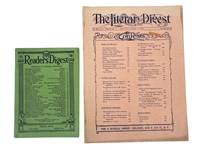
1904ref. 237201904. Two American digest periodicals documenting changes in national public discourse from the Progressive Era through the Great Depression. The earlier issue contains prominent contemporary coverage of the Statesboro Georgia lynching of 1904 reproducing reactions from newspapers across the country and condemning the burning and killing of two Black men by a white mob after the courts had already imposed sentences. The Literary Digest. New York: Funk & Wagnalls Company August 27 1904. Vol. XXIX No. 9 Whole No. 749. Together with The Reader's Digest. Pleasantville New York: The Reader's Digest Association May 1932. Eleventh Year Vol. 21 No. 121. Two illustrated periodicals. The Literary Digest complete in original printed wrappers; the Reader's Digest in original green printed wrappers. The Literary Digest treats the Statesboro lynching as a national disgrace assembling condemnations of the white mob that seized two Black prisoners from lawful custody and burned them alive after their convictions. Its opposition to mob violence is forceful for a mainstream national periodical but the journalism is not racially radical: it condemns lynching chiefly as a collapse of law civilization and public order while reproducing racialized language paternalistic assumptions and comparisons with "Darkest Africa" that reveal the limits of white Progressive reform discourse. The article documents how anti-lynching sentiment could coexist with the racial hierarchies embedded in early twentieth-century American journalism. Other contents also address the Russo-Japanese War Theodore Roosevelt's "Big Stick" politics immigration early automobile culture religion scientific racism and political caricature preserving the mixture of reform journalism racial ideology international reporting and editorial debate that shaped mass-circulation American periodicals at the beginning of the twentieth century. The May 1932 issue captures an American reading public attempting to understand economic collapse mass unemployment and the instability of modern life during the darkest years of the Great Depression. Its condensed articles move from Arthur Pound's courtroom account of bankrupt workers shopkeepers and failed speculators to proposals for canceling international war debts arguments over housing and advertising and criticism of the press's exploitation of the Lindbergh kidnapping. Reports on Japan's campaign in Manchuria cancer research industrial materials telecommunications and labor-saving inventions place domestic economic crisis beside the geopolitical and technological transformations reshaping the interwar world. The two issues document national and international crises into accessible commentary for a broad readership moving from the racial violence imperial politics and reform debates of 1904 to the economic collapse mass media consumer culture and geopolitical instability of 1932. Both remain stapled without annotations or other markings. Completely legible and in overall very good condition with only minor discoloration and scattered creasing or handling use. unknown
1972ref. 232591972. Prison and IncarcerationSocial activism Prison reform organizing conference broadside. Attica and San Quentin prison organizing stand at the center of this January 1972 Berkeley conference broadside which opens with a Brecht quote "Slave who is it that shall free you.all of us or none" and declares that "no one in America today is more a slave than the inmates in American prisons." The text ties prison struggle to "class and racial oppression" names the murders at Attica and San Quentin and frames the prison system as a site of beatings drugs "behavior modification" and brain surgery schemes. The conference was held just a few months after the 1971 Attica uprising during which prisoners revolted against inhumane treatment and racial discrimination in a violent struggle that left 39 dead. The conference roster grounds the prison rights moment Bay Area Black liberation featuring figures including Afeni Shakur Fay Stender and former Soledad Prison chief psychiatrist Frank Rundle. "Slave Who Is It Shall Free You . . . All of Us or None." The Struggle Inside. Prison Action Conference. Berkeley 1972. Single-sheet broadside 8.5 x 11 inches for a prison action conference scheduled for January 28-30 in Pauley Ballroom UC Berkeley printed on both sides. Recto features two halftone prison photographs and a dense typed manifesto arguing that prisoner demands had moved "from traditional demands for food and shelter to demands for civil and religious rights and finally to a general challenge to the prison system and the society which fosters it." It announces the conference as "a forum for self education and exploration of potential action to assist the prison movement" with key speakers Afeni Shakur a defendant in the Panther 21 trial Fay Stender a Berkeley attorney with years of prison movement experience and Frank Rundle former chief psychiatrist at Soledad Prison. Verso gives the full three-day program: Friday evening remarks by Stender and Shakur; Saturday sessions on "Medical Repression in Prisons" "Adult Authority and Indeterminate Sentencing" "Economics of Prisons" "Juvenile Reformatories and Detention" and "Prisoners Demands"; and Sunday sessions on "Women in Prison" "Defense of Political Prisoners" "Military Prisons" "Prison-Community Communications" "Prisoners Organizations" "County Jails and Pre-trial Detention" plus a closing "Panel Discussion on Racism." The broadside illustrates the actions and intentions of the Berkeley prison movement at a time when prison rebellion legal defense anti-racist analysis and ex-prisoner testimony were being brought before public audiences in the aftermath of the Attica Uprising. Afeni Shakur's appearance links the handbill to the political world of the Black Panther movement while the inclusion of sessions on women in prison political prisoners juvenile detention county jails and medical repression demonstrate the intersectional goals of the movement and the broadening of post-Attica activism from outrage over one massacre to a larger indictment of prison administration and criminal punishment. Some light staining; otherwise very good condition. A Bay Area prison movement piece that preserves both the rhetoric and the working program of organizing against U.S. imprisonment in the immediate aftermath of the 1971 Attica Uprising. unknown
2012ref. SONG1782662693www.Militarybookshop.Co.UK 2012-12-01. hardcover. Used: Good. 8.50x0.56x11.00. Buy with confidence. Excellent Customer Service & Return policy. www.Militarybookshop.Co.UK hardcover
1995ref. DADAX0883850982Brand: Mathematical Assn of Amer 1995-01-01. paperback. New. 9.00x0.75x11.00. Buy with confidence. Excellent Customer Service & Return policy. Brand: Mathematical Assn of Amer paperback
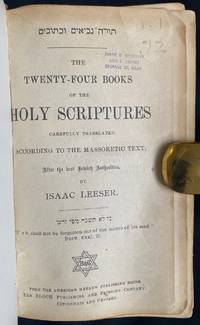
1880ref. 43529Cincinnati & Chicago: From the American Hebrew Publishing House the Bloch Publishing and Printing Company 1880. 1880s Preface is dated 1856. Original Full Leather binding with black & gilt spine label 12mo 2 leaves iii-xii 1243 pages. 17 cm. Title in Hebrew at head of title. Copyright page lists 1853 the copyright date for the first edition of Leeser's original translation of the Twenty Four Books of the Holy Scriptures published in 1854. The present Preface is dated Philadelphia 1856. The 1880s date is based on Singerman 3204 which notes the presence of the "undated 'Advertisement to the London Edition.' Repeated.in undated Bloch editions 1243 p. with acopyright date of 1853." Preceding the 1856 Preface is the undated 4-page "Advertisement to the London Edition" which notes that "This corrected version supplies an admitted want to our times. The so-called Authorized or Anglican version of the Scriptures.betrays great need for revision.Jews who of their own accord introduce the Anglican version into their households and who provide none other for the schools commit a flagrant breach of sacred trust in the abandonment of those for whose safe guidance they are immediately responsible to a helpless ignorance of truth-an ignorance all the more fatal because false interpreataions are obtruded in season and out of season with an unscrupulous object-to procure apostasy i.e. conversion from Judaism.Hence this version accomplished by a learned and conscientious Hebraist i.e. Leeser has found acceptance from all denominations. In the 10-page 1856 Preface Leeser explains in detail the need for his new translation giving many examples from earlier Christian translations of what we would today call "Christian bias." Leeser here acknowledges recent partial Jewish translations noting "Hitherto-at least before the completion of the first edition of this work two years ago-no other translation in the English had been completed by Jews although several had been commenced; for instance Dr. Raphall's and Mr. A. De Sola's and Mr Lindenthal's book of Genesis with Hebrew text and ample notes and Dr. Benische's version with Hebrew text to the end of the Second Book of Kings." OCLC 233529725 locates 4 copies worldwide U Illinois Andrews U Community of Christ MO UPenn of an "1853" edition published in "Cincinnati ; Chicago : from the American Hebrew Pub. House the Bloch Pub. and Print. Co." with 1243 pages and 17 cm high ours is 16 cm. However the OCLC listing notes neither the "Advertisement to the London Edition" nor Leeser's Preface of 1856 both of whose pagination does not affect that of the main text. Such was the enmity between Leeser and leaders of the Reform movement that it would seem surprising that Leeser would authorize a Bloch publication of his bible during his lifetime given that Bloch was owned by Isaac M. Wise' brother-in-law Edward Bloch. Only a year after the date of the preface in our copy Leeser famously printed an "anonymous attack on Wise signed 'Lawyers' in the pages of his Occident shortly after the appearance of Minhag Amerika in 1857. Leesers' anti-Reform rejoinder singled out Bloch & Co. for allegedly keeping its store open on the Jewish Sabbath and closing it on Sunday the Christian Sabbath." Singerman. In our Bloch copy the copyright is still held by Isaac Leeser; It was not until 1888 20 years after Leeser's death in 1868 that "his Bloch's firm obtained the copyright of this popular and frequently reprinted landmark text." Neither Singerman nor Goldman list any edition published by Bloch before 1884. Singerman Nr 1418 and Goldman Nr 13 both list a similar edition 1856 published in Philadelphia by C. Sherman & Son also with the 1856 Preface and identical pagination and physically smaller than the 1853 ed.with a new preface by Leeser." Goldman specifically writes that the "Advertisement to the London Edition" does not appear until an 1865 edition is "published in London in 5625 1865 by Trubner & Co. printed by John Childs and Son. Explaining the need for a new translation in the prefatory 'advertisement' the publisher criticized the standard King James Version authorized by the English Church for being flawed with 'abundant cases of false rendering' and 'propagandist tendencies.' They thus chose to issue Leeser's translation despite the existence of English translations by Christians because "this version accomplished by a learned and conscientious Hebraist has found acceptance from all denominations." This may be a previously unrecorded stereotype reissue of Trubner's London edition by Bloch issued with the 1853 Copyright date the 1856 Preface and the undated Advertisement though its mid-19th Century binding with black leather spine label would not be much later than 1880. Some pencil underlining to Advertisement and Preface with small owner's stamps and pulling as well. Gutter margin at title page is thin and crowds the title page text see photo. Spine reinforced with leather at edges boards show wear especially at corners but a solid Good Condition copy. A rare Leeser variant. B AMR-38-23. Cincinnati & Chicago: From the American Hebrew Publishing House, the Bloch Publishing and Printing Company unknown
1895ref. 30984Cincinnati Bloch 1895. No Date 1895. 1st edition. Later Paper Wrappers 8vo 102 pages. 23 cm. Singerman 3914. With chapters by the leading lights of the Reform Movement of the day. Undated but described as a recent publication in the 14 November 1895 issue of the American Israelite. Contents include: "Introduction to Biblical History" K. Kohler; "Religio-Moral Instruction in the Sabbath-School" D. Philipson; "On Instruction in the Post-Biblical History" B. Felsenthal; "How to Teach Biblical History in the Primary Grades" by E. N. Calisch; & "How to Organize a Sabbath School" H. Berkowitz. OCLC: 45754442. OCLC lists 6 copies worldwide Yale UIllinois Towson HUC Harvard Princeton. Probably lacks original wrappers. Otherwise Very Good Condition. BER-1AMR-38-24-DLX-'eb. Cincinnati, Bloch unknown
ref. 1535216557.Gpaperback. Good. Access codes and supplements are not guaranteed with used items. May be an ex-library book. paperback
1998ref. abc956Howard League for Penal Reform 1998 A BRAND NEW BOOK UNUSED. Full refund if not satisfied. 24 hour despatch. If not pictured in this listing a scan of the actual book is available on request. Soft cover. New. Howard League for Penal Reform paperback
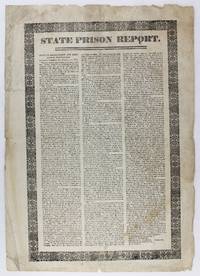
1834ref. 3806Providence 1834. Good plus. Broadside 15 x 10.5 inches printed in three columns within an ornamental border. Old folds short splits along some folds a few small chips moderate dust-soiling and foxing. Untrimmed. A rare broadside disseminating a report from a five-man committee of the General Assembly of Rhode Island recommending penal code reform and the establishment of a state prison in the Ocean State in 1834. The beginning of the report expounds upon the inconsistency of the various legal punishments meted out in county jails. The committee then evaluates different methods of imprisonment in New York Pennsylvania Connecticut and other states concluding as follows: "On the whole the committee are in favor and recommend to the General Assembly the erection of a State penitentiary on the principle of solitary confinement at labor with instruction in labor in morals and religion." The committee hoped this prison reform would "relieve the State from the future support of convicts and may produce a moral reformation in those who may be subjected to its operation." We could locate just one copy of this broadside in OCLC at Brown. unknown
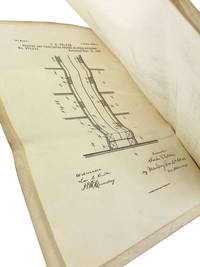
1887ref. 21386Washington: H. Peters 1887. Very Good. Washington: H. Peters 1887. Folio 30.5cm.; ribbon-bound engraved self-wrappers wax-sealed and accomplished in manuscript; 8ll. of photo-engraved plans printed on versos only followed by 3pp. text printed in double columns on rectos only. Previous mail folds extremities a bit chipped and toned ribbons slightly frayed else Very Good internally clean and sound. Signed by Acting Secretary of State D.L. Hawkins and Commissioner of Patents Burton J. Hall. Detailed patent application submitted by the Superintendent of the Chicago Bridewell Prison on September 13 1887. Charles E. Felton ca. 1832-1909 was the prison's longest serving overseer having held the position from its opening in 1872 until his retirement in 1890. Formerly a printer in Buffalo New York Felton entered the field of prison administration through the usual political platforms though he assumed his position in Chicago not through the usual channels but based on his previous experience serving as director of the Erie PA correctional facility. A Democrat and avid duck hunter with a rather unfocussed eye on the mayoralty of Chicago Felton was especially interested in enforcing labor in his prisons as a means of reducing costs and galvanizing individual reformation a position he clung to even past his retirement. The present patent submitted with steel manufacturer Herbert B. Streeter 1833-1919 offered substantial air circulation improvements for prisons "or other structures where the tiers of cells or dormitories have an open hall or corridor without separation by floors or otherwise." Previously the Chicago House of Corrections had just one small ventilating flue leaving the air "absolutely foul and poisonous." The plans depicted here show two foul air flues and one steam-coil heating device per cell as well as additional open air gratings for increased circulation. Though it is unclear whether the patent was ever approved Felton in an address delivered before the Prison Congress four years later complained that the increase in crime rates could be blamed in part on "the comfortable quarters" offered prospective convicted criminals. Also to blame "the present views of the public and acts of legislatures as to systems of prison labor and its ease to the prisoner.the quality of food; their the prisoners' easy access to visitation and the readiness with which a sympathetic public accepts as true the complaints of the prisoners" "Inter Ocean" newspaper October 14 1891. This patent submitted to improve the comfortable prison cells Felton so bemoaned an important document for students and historians of prison reform architecture and engineering. H. Peters unknown
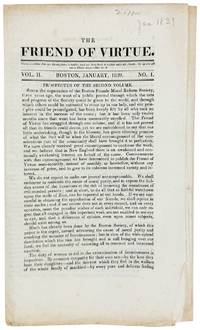
1839ref. 33043Boston: New England Female Moral Reform Society 1839. Very Good. Boston: New England Female Moral Reform Society 1839. First Edition. Octavo; self-wrappers unopened. 16pp. Toning and creasing to edges with a few minor nicks; about Very Good. The New England Female Moral Reform Society's stated goal was the "prevention of licentiousness" prostitution the moral double standard regarding both and protecting young women from the "unprincipled destroyer who seduce and ruin the unsuspecting." Indeed this issue devotes a section to "Street Beggars" who are imposters attempting to lead astray the young and unsuspecting. The paper continues in telling the story of two young women who were led to "a house of ill fame" by one such imposter and were saved from a member of the society and thus saved "from this sink of iniquity. from her 'whose house is the way to hell going down to the chambers of death.'" Also of note here is the ongoing "Letters to Sarah E. Grimke" portion of this publication which runs several pages in this issue gently arguing several points regarding the role of women in society. The letter concludes with a post script that the author has just received Grimke's pamphlet "Equality of the Sexes" acknowledges her sincere obligations and urges everyone who reads this publication to also read Grimke's. Scarce in retail. New England Female Moral Reform Society unknown
1886ref. 47659London: Longmans Green & Co. and Liverpool: The Financial Reform Association 1886. 8vo; contemporary half calf over marbled boards with red morocco spine label; front and rear boards detached inexpert repairs made made with buckram but contents are clean and sound; good. Longmans, Green & Co. and Liverpool: The Financial Reform Association unknown
ref. 45195919-nnew. unknown
ref. 46555223-nnew. unknown
ref. 851579-nnew. unknown
ref. 0970983506.Gpaperback. Good. Access codes and supplements are not guaranteed with used items. May be an ex-library book. paperback
2004ref. 61978Washington DC: U. S. Government Printing Office 2004. Presumed first edition/first printing. Wraps. Very good. No dust jacket as issued. iii 588 p. Illustrations. Serial No. 108-206. This hearing examins the latest medical science regarding cervical cancer and ongoing Federal efforts to treat the disease and prevent infection from the virus that causes it. U. S. Government Printing Office paperback
2004ref. 61678Washington DC: U. S> Government Printing Office 2004. Presumed first edition/first printing. Hardcover. Good. No dust jacket as issued. iii 508 p. Illustrations. Serial No. 108-276. This hearing was held at Kailua-Kona Hawaii. This hearing is a continuation of the subcommittee's work on the problem of methamphetamine abuse--a problem that was ravaging the State of Hawaii and other parts of the United States. Meth in Hawaii came from superlabs in California and Mexico and from small local laboratories. The hearing sought to address "Firstly what to we need to do to reduce the supply of meth " and "Second how shouldwe deal with the environmental issues created in the wake of a meth lab seizure " U. S> Government Printing Office hardcover