2 104 résultats
2004New English Paperback. In publisher's special box. Folio. 4to. (24 x 34 cm). In Turkish. 2 volumes set: (919 p.), richly color and b/w ills. A comprehensive monograph and guide study on Pera / Beyoglu of Istanbul / Constantinople with collected articles by collective authors. Geçmisten günümüze Beyoglu. 2 volumes set in special hardbox.
1845Very Good French A fine original chromo-lithograph print from "Souvenirs de Constantinople" by Brindesi, printed in 1845. Framed, but will be sent no frame. 52x49 cm / 39x 44 cm print area. Stains on right bottom margins of the paper. The Ottoman navy, stationed in front of the Tophane Artillery barracks, is preparing to sail under the leadership of Kapudan Pasha's ship "Amiraute". Jean Brindesi was born in 1826 and worked primarily as a watercolour artist. During the Abdulmecid period (1831-1861), he worked on scenes involving soldiers in Istanbul. Two albums of lithographs after his drawings were produced by Lemercier in Paris: Elbicei Atika - Musee des Anciens Costumes Turcs de Constantinople, 1855, and Souvenirs de Constantinople, 1860; these two works are collections of picturesque views of the city of Constantinople. The originals are kept at the Istanbul Topkapi Palace Museum and at the University of Istanbul. (Source: Levantine Heritage).
1876Very Good German Original color map on cloth. Chipped on folded places. Otherwise a clean copy. Oblong atlas folio. (46 x 52 cm). Scale: 1/300.000. Toponyms in German. Shows Gallipoli [and the Hellespont, Edremid Gulf, Imbros, Tenedos, Lesbos (Midilli), Aivali (Ayvalik) and North Aegean shores of Anatolia]. A sheet of the collection of 'The general map of Central Europe'. appeared in the years between 1873-1876 with the work of Joseph Ritter von Scheda, (1815-1888) who was a general, geographer and cartographer.
2009New English Original bdg. HC. Oblong 4to. (22 x 30 cm). In English and Romanian. 115, [140] p., fully color ills. Byzantine manuscripts in Bucharest's collections.= Manuscrise bizantine în colectii bucurestene. Project coordinator: Ileana Stanculescu. From the first article: "From the photographs taken over time, we chose those which best capture a special artistic quality with their strictly documentary value. This selection of manuscripts ends before the dawn of the 16th century, given the common view that after the fall of Constantinople (1453) we can no longer speak of a truly Byzantine culture, but only of a Byzantine style, albeit one which continued to shine. The selection of images was also intended to emphasize not only the aesthetics of the illuminated folios, but also those details that are significant for the codices as a whole, things which would dryly translate today as typeface font type, page layout and binding. Far from the sight of all interested parties, the Byzantine manuscripts in the Bucharest repositories are still full of mysteries waiting to be discovered and explained by researchers. We present these images here to provide a platform for a wider discussion of the significance of the Byzantine legacy for Romanian pre-modern culture. For the identification and description of the items chosen we used several catalogues, either manuscript or in print, which we then compared with the corresponding labels used by the repositories. The bibliography at the end of the volume indicates the various catalogues used for each collection. We found a wealth of details pertaining to the manuscript collections of the Romanian Patriarchy in the album published by the archimandrite Policarp. This is an excellent occasion to thank the specialists involved in the inventory of the collection for the additional information they supplied. We extend our warmest gratitude to them.Here and there we updated and corrected the information found in the aforementioned sources in the light of recent research: the dating of ms. sl. II 280, from the Library of the Holy Synod of the Romanian Orthodox Church at the Antim Monastery. We thank Mrs Tatiana Popova (University of St. Petersburg in Severodvinsk), for the observation that we are dealing with a direct copy, made at the end of the 14th century, of the Russian metropolitan Kyprian's reworking (dated 1385) of the Ladder of John Climax. Ms. sl. II 280 belongs to a group of manuscripts kept at Antim Monastery, but originates from a collection in Slava Rusa, a settlement in Dobrogea and a known...".
2003Fine Turkish Paperback. Roy. 8vo. (24 x 17 cm). In Turkish. Set: 1-48. Most issues include two issues. Publishing still goes on. B/w and color ills. Yeni film. No.: 1-48. Nisan-Mayis 2003 / 2017. Owner: Necati Sönmez. Edited by Aysun Sayin. A heavy set.
2000New New English Original bdg. Dust wrapper. 4to. (29 x 24 cm9. In English. 2 volumes set: (678 p.), richly ills., photos. A history of Robert College: The American College for Girls and Bogaziçi University (Bosphorus University). This two volume slipcased set is the story of two American Schools in Istanbul – Robert College and American College for Girls- both of them founded in the third quarter of the nineteenth century. The story takes the two schools through the last half-century of the Ottoman Empire and the first half-century of the Turkish Republic. The last part of the book tells the story of the founding of Bogazici University on the campus of the old Robert College in Bebek-Rumeli Hisarý , and the establishment of the new co-educational Robert College on the campus of the old American College for Girls in Arnavutköy. The principal characters in the story are the men and women who worked at the two colleges as teachers and administrators, and the students who studied there, many of them going on to distinguished careers, including two prime ministers of Turkey and two of Bulgaria. Bogazici University and the new Robert College, both founded in 1971, continued a tradition that has now linked east and west for over a century, perpetuating bonds of culture and friendship that have endured through wars and the fall and rise of nations. Hundreds of photographs in each volume visually trace the history of these two venerable institutions. A very heavy and oversize set.
1981réf. BN110682Dumbarton Oaks Center for Byzantine Studie 1981. 1981. Hardcover. Nicholas I. Patriarch of Constantinople : Miscellaneous Writings Nicholas I. Patriarch of Constantinople : Miscellaneous Writings Dumbarton Oaks Center for Byzantine Studie hardcover
réf. 5525ouvrage traduit de l’italien avec l’autorisation de l’auteur par Mme COLOMB.Petit in 4 pleine toile rouge d’éditeur titre et caissons dorés,titre doré sur le premier plat encadré d’un filet et d’une frise décorative.Faux-titre,portrait de l’auteur d’après RONJAT,titre en noir et rouge 452 pages,tranches dorées, 183 illustrations dans et hors-texte d’après les dessins pris sur nature par C. BISEO.Hachette & Cie 1883,rousseurs éparses plus ou moins fortes à certaines pages, ainsi qu'en début et fin de volume habituelles
2011New New English Original bdg. Dust wrapper. 4to. (34 x 24 cm). In English. 368 p., color and b/w ills. A garden for the Sultan: Gardens and flowers in the Ottoman culture. Contents: Ottoman and other gardens. The features of Ottoman gardens. Ottoman gardens and Europe. Flowers among the Ottomans. The concepts of paradise and garden among the Ottomans. Ottoman palace gardens. Imperial gardens in Istanbul other than palace agdrens. References to Istanbul gardens and flowers in contemporary memoirs. Treatises on gardening and flowers. "True lover who has exprienced this blossoming of eternal rose in himself understands that the gardens of this world are only a lovelyn pretext for the Beloved to veil and unveil Himself at the same time. The hidden treasure of his beauty needs the garden to become visible to those who are still bound to sensible and tangible beauty. The eye of love sees behind the roses and trees, in the shade of the slender cypress and in the modest genuflection of the little violet, in the limpid water of basins and in the gushing fountains faint remembrances of the garden of Paradise with its Tuba tree, kauthar and salsabil; a Paradise which is, in turn, only a sensual symbol of God's everlasting beauty". OTTOMANIA Ottoman court Palace Istanbul Constantinople Flower Garden Turkish and Islamic art.
1998réf. 186332Berlin: De Gruyter 1998. Hardcover. VG Covers have very minor wear. Greek Text. Volumes I & II. Green cloth boards with light green lettering. Includes bibliographical references. De Gruyter hardcover books
réf. 9033Leipzig, 1905. In 12 percaline rouge de l’éditeur, XXIV-275 pp.
réf. 19372Londres et Parois, Fisher, Son & Cie, s.d. 3 séries en 1 vol. in-4, XLII-60 pp. 30 (sur 32) pl. + 58 pp. 31 (sur 32) pl. + 54 pp. 32 pl., demi-basane havane (dos manquant, reliure défraîchie, rousseurs et taches, 3 planches manquantes).
réf. 9807Paris, chez Mondhare, fin XVIIIéme. 31 x 45 cm contrecollé sur carton fort et entouré d'un filet doré.
1894réf. 025738Paris 1894 Alphonse Picard et Fils Full-Leather
1919Front cover illustration of a raving Bolshevik. Secrets of the London Air Raids - Where Zepps and Gothas dropped their bombs - article. Allied flags at Constantinople and Cattaro - two photos. New World Knights Guard River of Old Romance - 5 photos of American troops in Germany. Two photos of British soldiers in Germany. Four photos related to the escape of 29 British officers from the POW camp at Holzminden. Bolshevism in its True Colours - article by Sir Sidney Low. Photogravure centerfold includes images of the British in Cologne. Shall we Hang the Kaiser - article by Lovat Fraser. Equine and Canine Transport Bound for the Rhine. Ships of the Allies Anchor Off Sebastopol Again - 4 photos. Two photos of a British 'mystery' aeroplane' dropping a torpedo. And more. Average wear. Unmarked. Staples disintegrated. A sound copy. Book
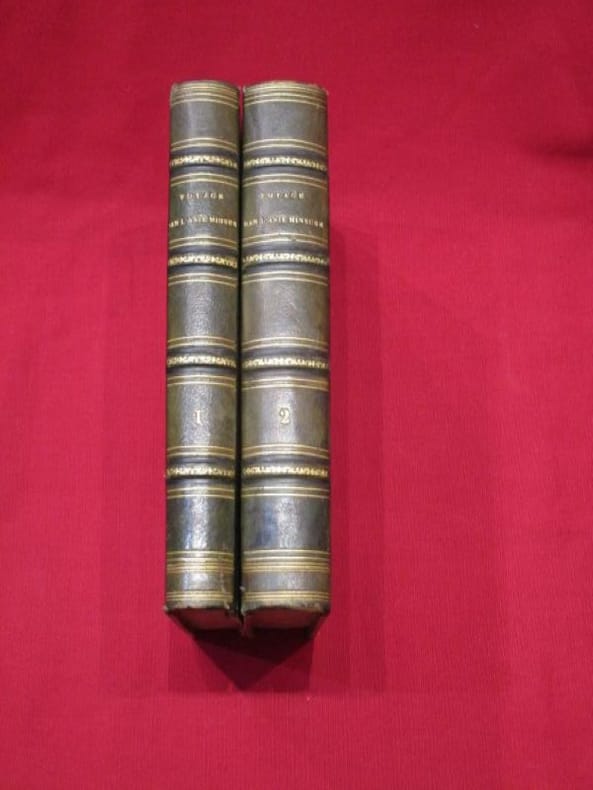
1840réf. PHO-1534Paris, Ducollet, 1840-1841. 2 vol. in-8, XII-456pp.-612pp., brochage éditeur, non coupé, non rogné, petit manque de papier à la couverture du tome 1 et dernière de couv. tome 2.
réf. 118922Paris, Ducollet, 1840, 2 volumes in-8 de XII, 456 pages - 612 pages. Demi-reliure verte, dos à nerfs portant titres et tomaisons dorés, tranches mouchetées, gardes de papier marbré. Dos insolés, quelques épidermures sur le cuir, ex libris papier sur les contreplats, taches d'oxydation par endroits, sinon bon état général.
réf. 522087 pages IN 8 , reliure plein veau lisse , dos lisse , tres decoré piece de titre Constantinople 1777 , bon etat , photos sur demande
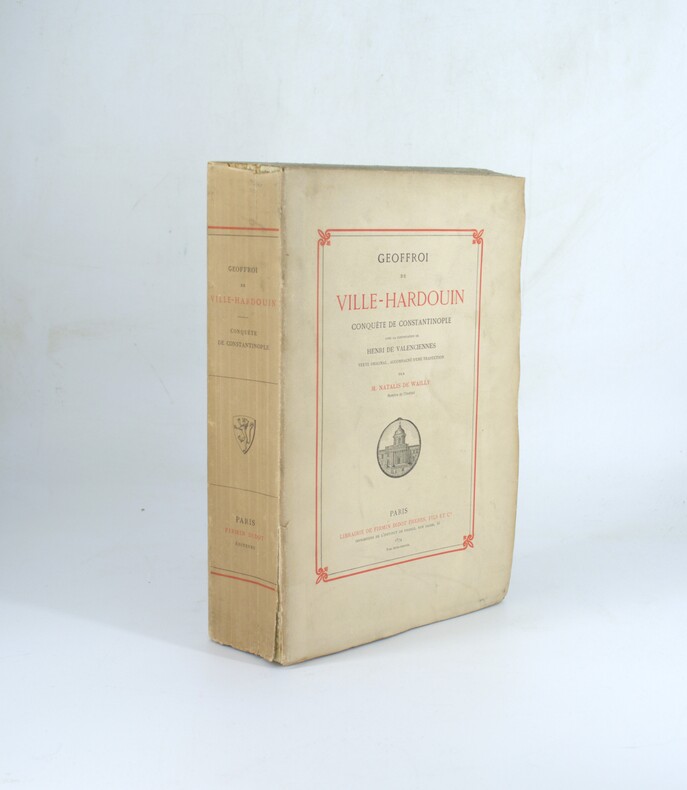
1874réf. PHO-2270Paris, Firmin Didot, 1874. In-4° de xxiv, 616 pp. Frontispice en couleur et 1 carte dépliante. Brochage éditeur. Tirage de luxe à 220 exemplaires sur papier à la forme, celui-ci n° 122. Petite déchirure au dernier plat, petite fente et léger
réf. 16709Paris, Librairie de Firmin-Didot et Cie, 1882. In-4 ; demi-chagrin rouge, dos à 4 nerfs, plat avec l'écusson du Lycée Henri IV ; faux-titre, fronstipice couleurs et page de titre imprimée en noir et rouge - XXIV pp (préface, notice sur la présente édition, note explicative de la carte, observations sur les culs-de-lampe et autres ornements), 616 pp.
Paris, Librairie de Firmin-Didot et Cie, 1882. In-4 ; demi-chagrin rouge, dos à 4 nerfs, plat avec l'écusson du Lycée Henri IV ; faux-titre, fronstipice couleurs et page de titre imprimée en noir et rouge - XXIV pp (préface, notice sur la présente édition, note explicative de la carte, observations sur les culs-de-lampe et autres ornements), 616 pp. Texte original avec la traduction en regard. Edition ornée de lettres intiales et de bordures empruntées aux manuscrits du XIIe et du XIIIe siècle et accompagné d'une carte géographique dépliante en noir et blanc sur fond vert, dressée par Auguste Longnon et gravée par Erhard (en fin d'ouvrage). Planches hors-texte, culs-de-lampe. Bel exemplaire (sans rousseurs).
2001New English Paperback. Pbo. Roy. 8vo. (24 x 17 cm). In French. La Turquie d'Asie. 7 volumes set. Vol. I: L'Anatolie Orientale: Trebizonde, Erzeroum, Bitlis, Van, Diarbekir. Vol. II: Les Provinces Arabes: Alep, Mossoul, Bagdad, Bassorah. Vol. III: Provinces des Iles de l'Archipel et de la Crete. Vol. IV: Vilayet de Constantinople et Mutessariflik d'Ismidt. Vol. V: Le Vilayet de Smyrne et le Mutessariflik de Bigha. Vol. VI: L'Anatolie Centrale: Angora, Koniah, Adana, Mamouret-ul-Aziz, Sivas. Vol. VII: L'Anatolie Occidentale: Broussa et Castamouni. 7 volumes set: (428 p.; 464 p.; 187 p.; 158 p.; 341 p.; 424 p.; 390 p.).
1651réf. 1221324London: Roger Daniels 1651. ESTC R12717. Folio; 393 pp.; recased in modern tan leather with gilt title; moderately worn 18th century leather boards preserved; endpapers freshened; contents very good; spine: tan leather with gilt titles. Consignment. 1221324. Rockville Non-Retail Listings. Roger Daniels unknown books
1901Very Good French Original autograph letter signed (ALS) by P.pon "[We hereby declare that Ms. L. Cassinelli occupied our house located in Pera Rue, Hodja Ali No 19. On December 1, 1887, and left him on September 30, 1899. That during all time, he did not pay me the tax... P. pon de la succession de feu le Comte A. de Camondo. [i.e. On behalf of the succession of Count A[braham Salomon] Camondo, (1781-1873)]. Probably it's signed by his advocate of Moise de Camondo. Recipient is not defined. Letter indicates one of Camondo family's houses in Pera, Constantinople. 26,5x21 cm. Completely in French. 14 lines. On a paper watermarked "William Brown & Co., London". William Brown and Co. were located in London in this 'St. Mary Axe, and 40 to 41, Old Broad Street, London, E.C.' address according to Grace's guide to British industrial industry; they worked on 'Lithographic and Letterpress Printers'. 1887 Registered as a Limited Company. Count Moïse de Camondo, (1860-1935), was an Ottoman Empire-born French banker and art collector. He was a member of the prominent Camondo family. As a child, Camondo moved with his family from their home in Constantinople, Ottoman Empire, to Paris around 1869, where he grew up and continued the career of his father, Nissim de Camondo (1830-1889), as a banker. He was born into a Sephardic Jewish family that owned one of the largest banks in the Ottoman Empire, established in France since 1869. Starting in 1911, he completely rebuilt the family's Parisian mansion on the Parc Monceau in order to house his collection of 18th-century French furniture and artwork. Working closely with the architect René Sergent, he created a palatial home conforming to certain 18th-century traditions, even planning the room dimensions to match exactly the objects in his collection. The entryway is inspired by the Petit Trianon of Versailles. The home includes a kosher kitchen with separate sections for meat and dairy. The dining room includes a beautifully-carved green marble fountain in the shape of a shell, with a dolphin spigot for the ritual washing of hands before eating a meal. Some highlights of his collection include a French silver service that had been ordered by Russian Empress Catherine the Great, a set of Buffon porcelain (with exact reproductions of ornithological drawings) from the Sèvres manufacturer, and perhaps the only existing complete set of Gobelin royal tapestry sketches. He married Irène Cahen d'Anvers, daughter of Louis Cahen d'Anvers, in 1891. They separated in August 1897 after her affair with de Camondo's stable master, Count Charles Sampieri, whom she would later marry and divorce. The children, Nissim and Beatrice, remained with de Camondo. The mansion was completed in 1914, but his son did not reside there very long, as he rejoined the French Army to fight in The Great War. It had been de Camondo's great hope that his son, whom he adored, would take over the family empire. Following Nissim's death in 1917, de Camondo closed all banking activities. He largely withdrew from society and devoted himself primarily to his collection and to hosting dinners for a club of gourmets at regular intervals. Camondo died in 1935, and the museum opened the following year. He donated the home to Paris's Decorative Arts society as a museum (Musée Nissim de Camondo) in honor of the loss of his son Nissim in World War I. In addition to the collection, the meticulously-restored service areas, elevator, and woodwork of the mansion are noteworthy. During the German occupation of France during World War II, his daughter Béatrice, his son-of-law Léon Reinach, and their children (Fanny and Bertrand) were deported from France and died in the Auschwitz concentration camp. As a result, the de Camondo family died out.
1875Very Good German Original color map on cloth of Constantinople, the Bosphorus, the Golden Horn, Princess' Islands, Pera, Galata, Scutari and environment. Map on cloth. 50x60 cm. Toponyms are in German entirely. Folded. Scale: 1:100000. A detailed toponyms list titled "Verzeichnis der mit Ziffern bezeichneten öffentlichen Gebaude" under the sections A: Pera und Galata, B: Stambul, C: Skutari; and "Erlauterung der Abkürzungen". Some toponyms are transcripted Turkish into western characters like Karadenis - Bahr-i Siach, Burgas Adassi, Kisil Adalar, Jeni Djami, etc. A rare Istanbul map printed in 19th century.