60 résultats
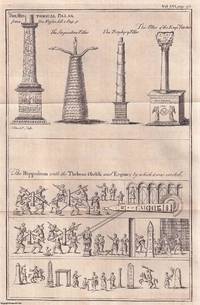
1748réf. 372012Printed for T. Osborne in Gray's Inn; A. Miller in the Strand; and J. Osborn in Paternoster Row London 1748. Unframed Print. Very Good Condition. This 1748 engraving depicts several monumental structures located in the Hippodrome of Constantinople modern-day Istanbul a grand arena used for chariot racing and public ceremonies. Among the notable features illustrated are The Serpent Column originally erected at Delphi to commemorate the Greek victory over the Persians at Plataea 479 BCE later moved to Constantinople by Emperor Constantine. The Porphyry Pillar A column made of red porphyry believed to have been erected by Constantine the Great. The Pillar of Emperor Marcian a 5th-century monument honouring Emperor Marcian known for its Corinthian-style capital. The Theban Obelisk also known as the Obelisk of Theodosius originally from Egypt brought to Constantinople by Emperor Theodosius I. The engraving was printed in London by T. Osborne A. Miller and J. Osborn.1 folding plate. Size: 17 x 26 cms. Category: Universal History; Unframed Prints : Old; Printed before 1800; PRINTS : Antiquarian Interest; Special Interest. This item may require more postage than the rates shown for delivery outside the UK. If extra postage is required we will contact you before processing your order and you will be given the details and option to decline the extra cost. Printed for T. Osborne, in Gray's Inn; A. Miller, in the Strand; and J. Osborn, in Paternoster Row unknown
réf. 1391635922.Ghardcover. Good. Access codes and supplements are not guaranteed with used items. May be an ex-library book. hardcover
réf. 1391196112.Gpaperback. Good. Access codes and supplements are not guaranteed with used items. May be an ex-library book. paperback
réf. 0366551515.Ghardcover. Good. Access codes and supplements are not guaranteed with used items. May be an ex-library book. hardcover
1910réf. 053669Istanbul: ADS. AH 1326 1910. No Binding. Very Good. Original manuscript autograph document sealed by Bosnevî Darülhadis Basmüderrisi i.e. Bosnevî Darülhadis School in Sehzâde Istanbul. Oblong: 12x145 cm. In Ottoman script. 1 p. 4 lines. "Huve. Bâdi-i sehâdetnâme oldur ki; Müderrisi bulundugum Sehzâde civarinda Darülhadis Bosnevî Medresesi'nde mukayyid talebe ilm-i sarf. Mehmed bin Mehmed Efendi'nin. 1326 1910 AD.". ADS., [AH 1326] unknown
réf. 0332229742.Ghardcover. Good. Access codes and supplements are not guaranteed with used items. May be an ex-library book. hardcover
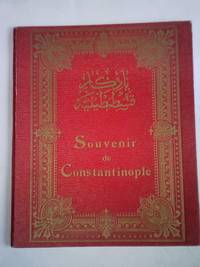
réf. 6j7419Ludwigsohn Constantinopel um 1900. 24 Totochromolithpgraphien auf 12 Tafeln als Leporello Pappband mit Goldprägung . unknown
1985réf. Q-0881410381St Vladimirs Seminary Pr 1985-04-01. Paperback. New. In shrink wrap. Looks like an interesting title! St Vladimirs Seminary Pr paperback
réf. 026454Constantinople: Imp. Tsitouris Freres 1928 0. Soft cover. Very Good. 8vo - over 7¾ - 9¾" tall. Paperback. Pbo. Cr. 8vo. 19 x 13 cm. In French. 8 1 p. Stamp on cover minor tear at bottom corner of front cover. Clean inside and covers. Otherwise a good copy. Rare pharmaceutical brochure booklet printed in Istanbul Constantinople. La lutte contre la Syphilis: Le noveau traitement de la Syphilis dans toutes ses manifestations. Le plus Efficace et le plus Inoffensif par le Bizmol Hydroxyde de Bismuth en suspension huileuse. Grand Laboratoire Pharmaceutique 'L'Orient' Istanbul Sirkedji Demirkapou No.10. Imp. Tsitouris Freres, [1928] 0 paperback
réf. a32070NY 1840. Dodd. Hardcover. Sm.8vo. 323pp. frontis portrait of Mrs. Dwight who died during a plague epidemic in Constantinople original black cloth. Some names in pencil on front blank. VG a few small chips on spine some foxing on pages. Bright gilt labelling on spine. Original book not a reprint. . hardcover
réf. 0881410381New. paperback. New. Satisfaction Guaranteed or your money back. paperback
1910réf. 053167Istanbul: Mihran Iranian. c. 1910 1910. No Binding. Very Good. 8vo - over 7¾ - 9¾" tall. Original sepia-toned photograph printed in a period photograph paper. 19x25 cm. Descriptive text in French. Chipped and tear on margins. Iranian was born in 1890 in Constantinople Istanbul. It is known that he established his studio in 1891 in Pera district of Constantinople - the center of Armenian cultural and political life. In 1895 he enters into partnership with another photographer by the name of Gugasyan. By 1900s the business seems to have wound down as the images marked with his studio signature don't exhibit any over elements of the new century. Of all the major Armenian studios from Istanbul Iranian's photographs are the rarest and less than 300 are known to have survived. Iranian's primary subject was the city of Constantinople its picturesque landscape architectural heritage and the many types of artisans and workers that populated its streets. Using the latest photography techniques which allowed for very rapid exposures Iranian captured the bustle of the city streets with remarkable clarity. Teeming with life and movement these images have a remarkable immediacy and documentary veracity quite unlike similar views produced by other photographers of the period. The typical approach for many of Iranian's contemporaries such as Sebah & Joalier or Guillame Berggren was to achieve as clear a picture as possible with perfectly balanced compositions and highly visible details - the hallmark of a 'good' commercial photographer. In contrast Iranian's street views are full of photographic 'ruptures' - blurred figures in movement surprised glances of people caught unawares - which give his works the viscerality of snapshots. But above all Iranian was a master at capturing the mood of a place. Catching the Ottoman capital on the brink of rapid transformation the photographer aimed to record many of its ancient streets and quarters disappear or change the appearance. Thus like the Parisian street photography of Atget Iranian's images are 'nostalgic for the present' that is irrevocably slipping into the past. In his studio the clientele had the choice of a large range of costumes and props through which the modern urbanite could slip into the role of some long-gone ethnic or street type and become a part of history. It is this sense of melancholy that gives Iranian's photographs their subtle emotional power. This is also perhaps the reason why he was ultimately not as successful as a commercial photographer. Modernity had captured the imagination of the people and the wistful romanticism of Iranian's markedly less spectacular images was fast going out of fashion. The small legacy he has left behind is nevertheless of significance in the history of Near-Easter photography. He was one of the rare Ottoman photographers with an individual and subjective approach which deserves a proper evaluation. Mihran Iranian., [c. 1910] unknown
réf. 19-7848Ixelles-Brussels: Tramways & Electricite de Constantinople 1929. . Folio. Single page. Very good. Includes seven rubber stamps on front. Signed by two administrators. En Francais. Ixelles-Brussels: Tramways & Electricite de Constantinople, [1929]. unknown
réf. 103727Facsimile reprint of the Leiden edition 1864. Two volumes. Edited by S. A. Naber. Hard cover 24 cm 458986 pp. ISBN: 978-960-400-377-8 set. . . ================================================ IMPORTANT: The shipping cost in not included in the price. You will have to approve it at confirmation of the order. hardcover
1965réf. 13811Adolf M. Hakkert. Very Good with no dust jacket. Hardcover. Spine a little sunned and discolored. Corners a little rounded. Light bump to top of spine. Light shelfwear.; Reprint of the edition Leiden 1864-1865. 459 456 pp; 2 Volumes in 1 COMPLETE; 1-2; 455 pages . 1965. Adolf M. Hakkert hardcover
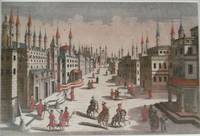
réf. #[35345]Augsburg Georg Balthasar Probst ca. 1770. Contemporary handcoloured perspective view vue d'optique or Guckkastenbild depicting a street scene with the prison in Constantinople. Ca 26 x 39 cm. Optical view inside Istanbul showing the state prison the seven towers to Constantinople. A fine street view with on both sides buildings with slender towers and several local peope and horsemen. - Fine. unknown
1897réf. 237507Constantinople 1897. 10 x 7-3/4 inches. Mounted. Slightly faded. 10 x 7-3/4 inches. Photo/Wh/2/up unknown
1981réf. BN110682Dumbarton Oaks Center for Byzantine Studie 1981. 1981. Hardcover. Nicholas I. Patriarch of Constantinople : Miscellaneous Writings Nicholas I. Patriarch of Constantinople : Miscellaneous Writings Dumbarton Oaks Center for Byzantine Studie hardcover
1982réf. 15850Walter De Gruyter & Co. . Very Good with no dust jacket. Hardcover. Scholars' bookplate to inner cover. Slight spine slant. Very minor shelfwear.; Volume 1 Only.; 1; 461 pages . 1982. 3110085305 . Walter De Gruyter & Co. hardcover
réf. 260791828. On one side of 31 x 21 cm. A frail survival worn aged and with closed tears with the backing damaged and stained. Text clear and entire in Greek key border. Blind stamp of Cardinal Zurla at bottom left. Signed by 'J. Patr. Constantinop. Vicesgs.' and by the scribe who completed the printed document in manuscript. Somewhat crudely printed with Zurla's arms at the head. Headed: 'D. PLACIDUS ORDINIS S. BENEDICTI / CONGREGATIONIS CAMALDULENSIS / TITULI S. CRUCIS IN JERUSALEM S. R. E. PRESBYTER / CARDINALIS ZURLA / SSmi Domini Nostri PAPAE VICARIUS GENERALIS.’ The manuscript part of the document concerning 'sacred particles from the neck of Saint Theresa the Virgin reads: 'sacras particulas ex ossibus S. Teresiae Virg; quas ex authenticis locis extractas reverenter collo cavimus in thea ex aurichalco argento obducto ovalis figurae unico crystallo munita’. See scan. 1828. unknown
réf. 041231770 Neuchatel Au dépends de la Société Typographique. 17 x 10 cm - 204187 pgs - plein veau marbré avec titre estampé en or sur de dos dos lisse avec fleuron dans la caissons estampée en or - coiffe usée autrement bel exemplaire l'intérieur est très bien petite fente en bas du mors suppérieur en bas 1770 Neuchatel Au dépends de la Société Typographique unknown
1823réf. 30930C. H. F. Hartmann. Good with no dust jacket. Hardcover. Books rebound in brown marbled boards. Gilt bands and lettering to spines. Ex-library copy with usual stamps. Spines has some edgewear with colour flecking off in places. Corners edgeworn. Some foxing. Ink initials to inner covers.; V1: XII 316 pp. ; V2: 317-750; 2 Volumes in 1 COMPLETE; 1-2; 750 pages . 1823. C. H. F. Hartmann hardcover
1651réf. 21700London: Robert Daniel 1651. First edition. leather_bound. Contemporary Cambridge style full brown calf lacking spine label. Very good. 393 pages plus 5 leaves: Index Rerum & Verborum & Index Scripturarum. 32 x 21 cm. Translated and edited by Richard Montague. Parallel text in Latin and Greek. He is recognized in the Eastern Orthodox Church as St. Photios the Great viewed as the most important intellectual of his time - "the leading light of the ninth-century renaissance" and a central figure in both the conversion of the Slavs to Christianity. Considered by some scholars as only one of many Byzantine scholars of Armenian descent. Text generally clean and fresh. Armorial bookplate hinges cracked but firm woodcut device on title leaf Ddd browned minor marginal worming not affecting text errata. Lacks first blank free endpaper. BRUNET Vol. IV p.623. WING P2136. Robert Daniel unknown
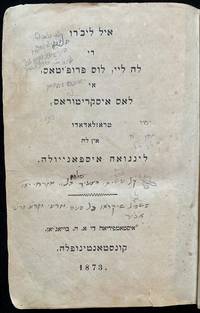
1873réf. 43536Konstantinoplah Constantinople: A. H. Boyagian Boyag'yan 1873. 8vo Original boards 2 volumes bound together 560 630 pages. 22 cm. 23 cm. In Ladino Only. Title translates as "The Book of the Law the Prophets and the Writings Translated into Ladino/Spanish." Ya'ari Reshimat Sifre Ladino no. 3. The publisher also issued a more common parallel Hebrew and Ladino bible the same year; this edition however is the scarcer Ladino only edition. "The translation of the Pentateuch in Hebrew vocalized square characters Constantinople 1547 was the first larger work which the Sephardic Jews of Turkey published in the language 'which the old Jews use. ' Twenty years later the entire Bible was published in several parts the third of which included the Later Prophets. This translation which agreed almost entirely with the one that appeared at Ferrara in Latin letters in 1553 was followed by another in four parts Constantinople 1739-45 in Ladino 'entero bien Ladinado'; seventy years later Israel b. Hayyim of Belgrade issued a translation Vienna 1813-16; the Constantinople edition was reprinted at Smyrna in 1838 et seq and again at Constantinople in 1873 all of these being in Rashi characters." EJ The Ladino Bible was later used by modern scholars and writers such as Holocaust survivor and poet Moshe Ha-Elion as a linguistic reference point to study authentic traditional Salonican and Turkish Ladino vocabulary. "All in all between 1493 and 1940 approximately 260 books and thirty periodicals were printed in Ladino in Istanbul most of them printed after 1730 out of a total of 758 publications in Hebrew type. As we have noted early Ladino publications focused on religion: Biblical commentary and texts religious law ethics and prayer books. These topics continued in the nineteenth century but the majority of publications in the later period were belles lettres history and biography sciences and communal and state laws and regulations. Of special social and cultural importance since the second half of the nineteenth century were Ladino periodicals which also served as publishers of books in Ladino. Having initially aimed to "Judaize" the Jews the objective of Ladino publishing in the later period was to modernize and entertain them while at the same time attempting to spread Judaic knowledge." Rachel Simon The Contribution of Hebrew Printing Houses and Printers in Istanbul to Ladino Culture and Scholarship SUBJECTS: Ladino literature. OCLC:79281753 & 976898012. OCLC locates only 4 sets of this rare Ladino-only edition only 2 in North America Harvard & UToronto. Well bound with some edgewear. Some markings and an inscription on the title page. Good Condition. Rare and important PSB-1-29-CC-'. Konstantinoplah [Constantinople]: A. H. Boyagian [Boyag'yan] unknown
1913réf. 055948Rodosto & Constantinopoli: Manuscript & Typescript 3-9 October 1913. 1913. No Binding. Very Good. 8vo - over 7¾ - 9¾" tall. A one-page typed letter with autograph marginal notes and a two-page manuscript report in black ink. Both are written on bifolia papers with "Renage's Mill" watermark One is "Banknote Paper" the other is "Extra Strong". "Agenzia Consolare d'Italia Rodosto" & "Consolato Generale d'Italia in Constantinopoli" letterheads. 27x21 cm. The letter is in Italian report is in French. 1 p.; 2 p. Signed. Except for the horizontal centre-fold in very clean condition. A letter written by the Italian Consul General in Constantinople to the Italian chargé d'affaires accompanied by a historically significant report from the Consular Agent in Rodosto provides valuable first-hand information about the outbreak of epidemic diseases such as cholera and typhus among humans and anthrax and bubonic plague among animals in the Ottoman Empire in 1913. It also sheds light on the authorities' failure to address these public health crises while offering significant insights into the Muslim immigrants arriving in convoys to the region during the ongoing Balkan Wars. This is an invaluable firsthand account of the Sixth Cholera Pandemic in the Ottoman Empire "a time when the Empire's foundations were shaken by the Balkan War military defeats territorial losses the plight of refugees and immigrants and the dreadful calamity of the cholera epidemic between 1911 and 1913 during which no reliable official records exist regarding the exact number of cholera cases and deaths". Unat. The manuscript report opens by stating the number of direct death cases as rendered in the translation: "I believe it is my duty to inform you that on the 27th a case of cholera followed by death was reported in the town. The day before yesterday there were four other cases two of them fatal; yesterday four new ones two of which were fatal; today another case. So out of ten cases there have been five deaths." The letter goes on: "The other municipality requested a credit of 1000 piastres from Constantinople to take the measures required by the circumstances. Unfortunately no reply has been given and our local officials do not know to which authority they should turn." "Cholera is present in Kirklareli Quarante Églises Baba-Eski Babaeski à Vise Vize à Bounar-Hissar Pinarhisar à Luli Bourgaz Lüleburgaz à Ouzun Keupiru Uzunköprü and aound Krichan Kirikhan. In Tchorlou Çorlu typhus is wreaking havoc and smallpox is present here. Our entire region is devastated by an epizootic outbreak: smallpox and foot-and-mouth disease among the sheep anthrax and bubonic plague among the oxen and buffaloes. Money and serum have been requested from the Ministry of Agriculture but there has been no response. The chief veterinarian I spoke with assured me that it would be impossible to do anything until he has serum to treat the livestock and that if the epidemic disease continues to spread like this the livestock will be completely wiped out in our region." The Royal Consular Agent states that during and after the war between the Turks and Bulgarians also known as the Battle of Kirkkilise which was part of the Balkan Wars Muslim immigrants who continually flocked to Kirklareli and the surrounding areas brought cholera and other epidemic diseases to the region. "Regularly there are convoys of migrants who had left their villages in the surrounding areas of Adrianople Quarante Églises Lüleburgaz etc. before the Turco-Bulgarian War arriving from Anatolia by steamships. They are the ones who brought us cholera and the epidemic disease." He ended his manuscript report by stating there is no way to convince the authorities to have them disembark elsewhere outside the city or to prevent the arrival of these immigrants who are being directed utilizing forced requisitions to areas where cholera is spreading. This report was presented to the Italian chargé d'affaires with this letter additionally as below: "Healt Manuscript & Typescript, 3-9 October 1913. unknown