82 résultats
1612réf. 9681Geneva: Oliva Pauli Stephani 1612. Folio in 6s pp. xxxii cols. 1624 104 ff. xii. Title page printed in red and black large woodcut olive-tree title device Schreiber 34 woodcut head- and tailpieces and initials Greek and Latin text in double column some spotting and browning at intervals largely due to paper qualityl later sheep circa 1700 minor wear abrasions to covers and wear to headcaps. A couple of ink library stamps St Patricks Collge Maynooth. Ownership inscription of Antoine Pericaud probably the Lyons-based antiquary author and translator 1782-1867. Engraved armorial bookplate to verso of title. Second edition overall and the first bilingual edition of the Myriobiblon combining David Hosechels recension of the original Greek text 1601 with Andreas Schotts 1606 Latin translation. A powerful and capable statesman and churchman Photios a 9th century Patriarch of Constantinople was also at the centre of intellectual life in the Byzantine capital. His Bibliotheca or Myrobiblon supposedly written just before Photios undertook a dangerous diplomatic mission and dedicated to his brother Tarasius as a consolation in case he should fail to return is an account of some 280 books read and reviewed many of them classical works which have since been lost and for which this is the most important surviving record. Reynolds and Wilson credit him with inventing the book review Scribes and Scholars third ed. p. 62. Renouard Annales de l'imprimerie des Estienne 197 no.21 also noting copies dated 1611; further copies traced dated 1613; Schreiber The Estiennes 275. Book ] Oliva Pauli Stephani, unknown
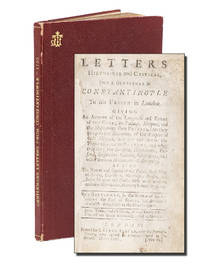
1735réf. 10011London: Printed for George Spavan 1735. First Edition. Hardcover. Very good. Octavo. 4.625 x 7.125 inches. 2 blanks 86 2 blanks pp. A British account of 18th-century Constantinople by an anonymous author "a gentleman" from the retinue of George Hay the 8th Earl of Kinnoul British ambassador to Constantinople 1729-1737. Title page professionally reinforced at an early date. Very good. Rebound in red textured cloth titled in gilt on spine with gilt monogram to upper cover all edges gilt. Classical archaeologist Henry Schroder Robinson's copy with his ex libris label affixed to front pastedown; inscribed to Robinson on front free endpaper "To Henry / the Bibliophile / as a token of appreciation / from / The Gennadius Library / June 30 1969". Text bright and unmarked binding square and tight. Very scarce with three copies appearing in libraries worldwide OCLC and no auction records. The Gennadius Library is located within the American School of Classical Studies at Athens. Printed for George Spavan hardcover
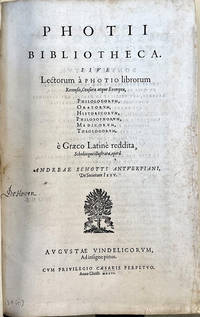
réf. 43456Augsburg: Christoph Mang. Photius I Saint Patriarch of Constantinople ca. 810 - 893. Bibliotheca; sive lectorum a Photio librorum recensio censura atque excerpta. Latin translation with notes by Andreas Schott S.J. 28 555 37 pages including final blank. Augsburg: Christoph Mang 1606. 312 x 201 mm. Vellum ca. 1606 spine ends restored inner hinges cracking vellum over covers wrinkled. Infrequent light marginal dampstaining but very good. Booklabel of Frederic Huidekoper on rear pastedown. First Edition in Latin of the chief work by this 9th-century Byzantine scholar and Eastern Orthodox church leader consisting of a critical account of 280 works read by him many of which are now lost. The Greek original text was first published in 1600. "To Photios we are indebted for almost all we possess of Ctesias Memnon of Heraclea Conon the lost books of Diodorus Siculus and the lost writings of Arrian. Theology and ecclesiastical history are also very fully represented but poetry and ancient philosophy are almost entirely ignored. It seems that he did not think it necessary to deal with those authors with whom every well-educated man would naturally be familiar. The literary criticisms generally distinguished by keen and independent judgment and the excerpts vary considerably in length. The numerous biographical notes are probably taken from the work of Hesychius of Miletus" Wikipedia article on Photius. Hoffmann III 91; Sarton I 594. . Christoph Mang unknown
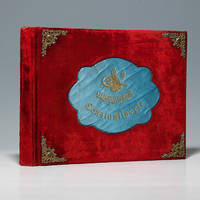
1890réf. 1031341890. PHOTOCHROM ZURICH. Constantinople. Zrich: Photochrom Zrich circa 1890. Oblong folio 16 by 12 inches 30 photochrom images each measuring approximately 9 by 6-1/2 inches and mounted on heavy cardstock; original red velvet blue silk gilt-lettered title centerpiece on front cover brass cornerpieces. $4500.Rare photographic album of Constantinople circa 1890 by the renowned studio of Photochrom Zrich with 30 beautiful mounted vintage photochrom color prints offering exceptional views of majestic mosques palaces and plazas as well as the people of this great city in magnificent velvet binding with brass furniture.This splendid souvenir album of Constantinople contains exquisite color photographic prints of images taken at the turn of the 20th century produced by the revolutionary photochrom process. Photochrom also called the Ac process is ""a very successful form of color photolithography developed in the late 19th century by the Swiss firm of Orell Fssli and used mainly for topographical views; photochroms have almost the appearance of color photographs but through a glass will show a delicate ink pattern which was achieved by a combination of photographic and manual work on grained i.e. lithographic stones being a forerunner therefore of modern screenless offset lithography"" Gascoigne 206. In this process black and white photographic negatives were directly transferred onto lithographic printing plates to produce color prints. These photographs are a high point in late 19th-century photography when albums such as these captivated a world newly spellbound ""by photography's capacity to 'take them there' and bring them directly in contact with the long ago and far away"" Parr & Badger I:18. Each image captioned with a four-digit number followed by ""P.Z."" for Photochrom Zrich and then the title of the scene in French. A few instances of marginal spotting to mounts; photochrom prints clean and fine with vivid colors. Binding splendid. An about-fine copy of this lovely album. unknown
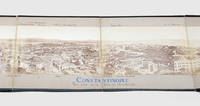
1875réf. 170484Constantinople c. 1875. A superb photographic panorama A panoramic 360-degree view of the city. Towards the Golden Horn the Topkapi Palace and the city's great mosques can be seen including Hagia Sophia the Blue Mosque the Yeni Mosque and the Süleymaniye. Panoramas of this period usually favour the Galata Tower as a vantage point. The view is unsigned though likely from the studios of Pascal Sébah and Policarpe Joaillier or the Swede Guillaume Berggren. Both are renowned for their handsome panoramas of the city. In 1857 Sébah opened one of the first photographic studios in Constantinople. The business was taken over by his son Jean in 1883 who styled himself J. Pascal Sébah and went on to become a talented photographer in his own right. In 1888 he partnered with Policarpe Joaillier their firm becoming the official photographers of the Sultan. "From the 1870s Sébah and Joaillier were major suppliers of evocative imagery to the increasing number of people who undertook the Victorian Grand Tour" Hannavy p. 1261. Berggren moved to Constantinople in 1866 and opened his studio on Grand Rue de Pera in the early 1870s. His oeuvre included studio work a remarkable series of documentary portraits of working people and the eternalising of the construction of the Anatolian Railway. Oblong quarto concertina 290 x 255 mm. Comprising 8 mounted albumen prints each 165 x 248 mm together approximately 165 x 1984 mm mounts captioned in manuscript red and blue ink. Contemporary dark brown pebbled paper over bevelled boards later blue paper on verso of mounts. Minor loss to corners and edges of boards a few surface scratches; prints yellowed and faded in margins some a little creased at folds: a very good example. John Hannavy ed. Encyclopaedia of Nineteenth-Century Photography Vol. I 2005; Engin Özendes From Sebah & Joaillier to Foto Sabah: Orientalism in Photography 2004. hardcover
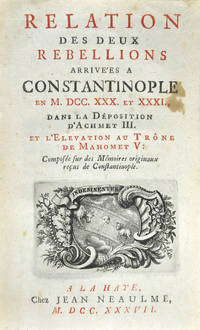
réf. 86461The Hague Jean Neaulme 1737. . First edition first issue; Small 8vo 15.5 x 10.5; iv 164 viiiadspp. title printed in red and black with engraved device small stain to title light waterstain to inner upper margin bound in later green morocco backed marbled boards spine gilt lettered very good. This account describes the two rebellions which broke out during the unsettled period following the victories of Nadir Kuli Khan of Persia against Turkey during September 1730 and which brought to and end the 'Tulip Period'. On the 20th of that month a minor riot developed into a full scale insurrection and Sultan Ahmet III was forced to abdicate in favour of his nephew Mahmoud I. The janissaries were led by one of their own an Albanian by the name of Patrona Halil and for two months the empire was in the hands of the insurgents. They were eventually overthrown by the Grand Vizier the Mufti and Aga of the Janissaries with the help of the Khan of the Crimea and Patrona and 7000 of his supporters were put to death. The first issue has the title printed in red and black as here. Atabey 1026; Blackmer 1407. The Hague, Jean Neaulme, 1737. hardcover
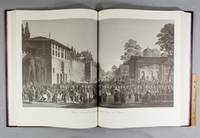
réf. CJW1322Bern: Ertug & Kocabiyuk 2002. No. 46 OF 50 SPECIALLY BOUND COPIES of a total edition of 350. 670 x 508 mm. 26 3/8 x 20". 3 p.l. 10 pp. 63 leaves. Publisher's scarlet morocco by Buchbinderei Burkhardt AG covers with gilt-rolled border cornerpieces tooled in gilt upper cover with gilt calligraphic Arabic centerpiece lower cover with gilt central heraldic device marbled endleaves all edges gilt. With a portrait frontispiece of Emperor Selim III 48 DOUBLE-PAGE PLATES AND THREE DOUBLE-PAGE MAPS. ◆A virtually as-new copy. This is one of the deluxe copies of a modern facsimile of Melling's massive and magnificently illustrated work devoted to 18th century Constantinople a book that provided the earliest interior views and plans of the harems and palaces of Sultan Selim III when it was published in 1819. The illustrations remain the best and certainly most attractive record we have of the city during this era in its history. Our edition was produced from a copy of the elephant folio first printing in the collection of the facsimile's publisher Ahmet Ertug with images faithfully reproduced in their original mammoth size 650 x 970 mm. After his arrival in Constantinople in 1795 architect and painter Antoine Ignace Melling 1763-1831 was appointed imperial architect by Selim III. In the course of his duties he designed and landscaped a seaside palace for Selim's sister Princess Hatice and produced these striking panoramic views of the city and its environs. After completing the palace and a number of other building projects for Selim he returned to Paris and in 1804 issued a prospectus for this work. He established an engraving studio in 1809 to reproduce these drawings and began publishing the completed prints as a series of fascicles that were sent to subscribers. The last one appeared in 1819. The outstanding success of an exhibition of the paintings on which the "Voyage Pittoresque" was based earned Melling the rank of painter to the Empress Josephine. When "Voyage Pittoresque" was originally published booksellers in England sold copies for £84 a huge sum for a book at the time. The original edition in pleasing condition now fetches between $75000 and $100000. Our handsomely bound actual size facsimile offers an attractively priced alternative. Ertug & Kocabiyuk unknown